Chapter 18 
Electrochemistry 
Dr. S. M. Condren
Redox Reactions 
Oxidation 
• loss of electrons 
Reduction 
• gain of electrons 
oxidizing agent 
• substance that cause oxidation by being reduced 
reducing agent 
• substance that cause oxidation by being reduced 
Dr. S. M. Condren
Electrochemistry 
In the broadest sense, electrochemistry is 
the study of chemical reactions that produce 
electrical effects and of the chemical 
phenomena that are caused by the action of 
currents or voltages. 
Dr. S. M. Condren
Dr. S. M. Condren
Voltaic Cells 
• harnessed chemical reaction which 
produces an electric current 
Dr. S. M. Condren
Voltaic Cells 
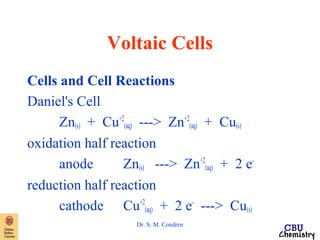
Cells and Cell Reactions 
Daniel's Cell 
Dr. S. M. Condren 
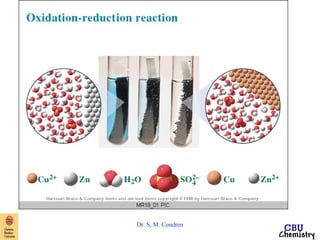
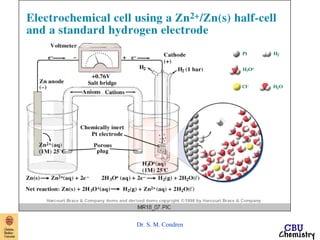
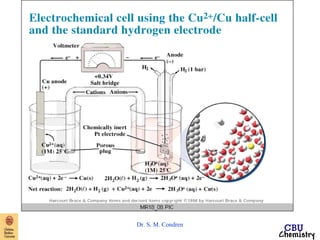
Zn(s) + Cu+2 
(aq) ---> Zn+2 
(aq) + Cu(s) 
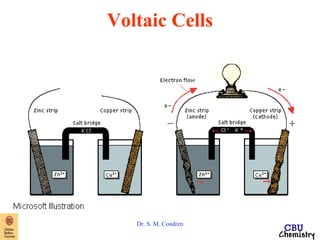
oxidation half reaction 
anode Zn(s) ---> Zn+2 
(aq) + 2 e-reduction 
half reaction 
cathode Cu+2 
(aq) + 2 e- ---> Cu(s)
Voltaic Cells 
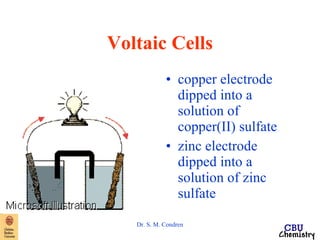
• copper electrode 
dipped into a 
solution of 
copper(II) sulfate 
• zinc electrode 
dipped into a 
solution of zinc 
sulfate 
Dr. S. M. Condren
Voltaic Cells 
Dr. S. M. Condren
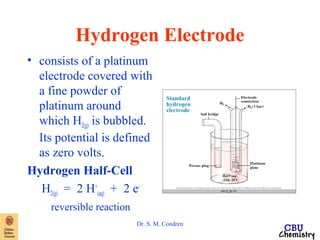
Hydrogen Electrode 
• consists of a platinum 
electrode covered with 
a fine powder of 
platinum around 
which H2(g) is bubbled. 
Its potential is defined 
as zero volts. 
Hydrogen Half-Cell 
H2(g) = 2 H+ 
(aq) + 2 e-reversible 
Dr. S. M. Condren 
reaction
Dr. S. M. Condren
Dr. S. M. Condren
Standard Reduction Potentials 
• the potential under standard conditions 
(25oC with all ions at 1 M concentrations 
and all gases at 1 atm pressure) of a half-reaction 
in which reduction is occurring 
Dr. S. M. Condren
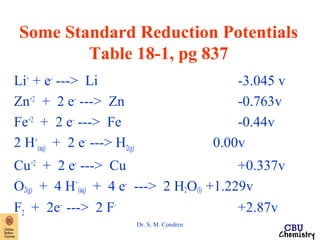
Some Standard Reduction Potentials 
Table 18-1, pg 837 
Li+ + e- ---> Li -3.045 v 
Zn+2 + 2 e- ---> Zn -0.763v 
Fe+2 + 2 e- ---> Fe -0.44v 
2 H+ 
(aq) + 2 e- ---> H2(g) 0.00v 
Cu+2 + 2 e- ---> Cu +0.337v 
O2(g) + 4 H+ 
(aq) + 4 e- ---> 2 H2O(l) +1.229v 
F2 + 2e- ---> 2 F- +2.87v 
Dr. S. M. Condren
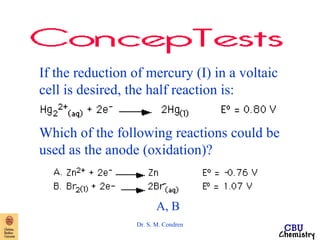
If the reduction of mercury (I) in a voltaic 
cell is desired, the half reaction is: 
Which of the following reactions could be 
used as the anode (oxidation)? 
A, B 
Dr. S. M. Condren
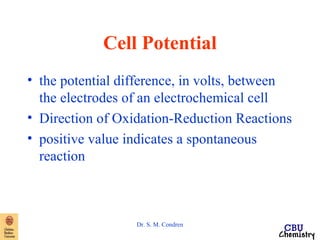
Cell Potential 
• the potential difference, in volts, between 
the electrodes of an electrochemical cell 
• Direction of Oxidation-Reduction Reactions 
• positive value indicates a spontaneous 
reaction 
Dr. S. M. Condren
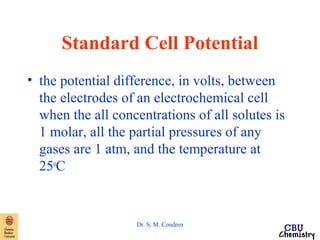
Standard Cell Potential 
• the potential difference, in volts, between 
the electrodes of an electrochemical cell 
when the all concentrations of all solutes is 
1 molar, all the partial pressures of any 
gases are 1 atm, and the temperature at 
25oC 
Dr. S. M. Condren
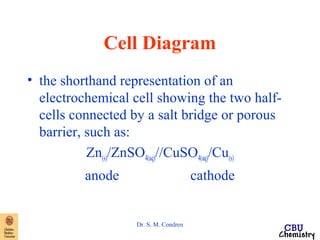
Cell Diagram 
• the shorthand representation of an 
electrochemical cell showing the two half-cells 
connected by a salt bridge or porous 
Dr. S. M. Condren 
barrier, such as: 
Zn(s)/ZnSO4(aq)//CuSO4(aq)/Cu(s) 
anode cathode
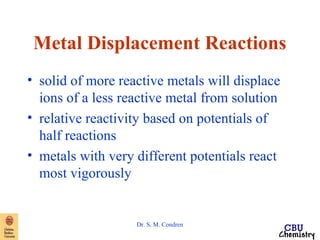
Metal Displacement Reactions 
• solid of more reactive metals will displace 
ions of a less reactive metal from solution 
• relative reactivity based on potentials of 
half reactions 
• metals with very different potentials react 
most vigorously 
Dr. S. M. Condren
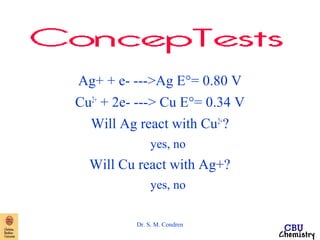
Ag+ + e- --->Ag E°= 0.80 V 
Cu2+ + 2e- ---> Cu E°= 0.34 V 
Will Ag react with Cu2+? 
yes, no 
Will Cu react with Ag+? 
yes, no 
Dr. S. M. Condren
Internet Report 
• Due end of day, 5:00 pm, Dec. 1, 2001 
Dr. S. M. Condren
Gibbs Free Energy 
and Cell Potential 
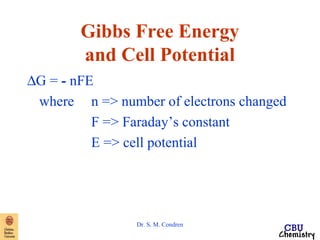
DG = - nFE 
where n => number of electrons changed 
F => Faraday’s constant 
E => cell potential 
Dr. S. M. Condren
Applications of 
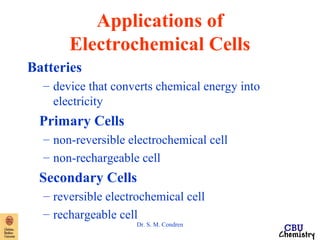
Electrochemical Cells 
Batteries 
– device that converts chemical energy into 
electricity 
Primary Cells 
– non-reversible electrochemical cell 
– non-rechargeable cell 
Secondary Cells 
– reversible electrochemical cell 
– rechargeable cell 
Dr. S. M. Condren
Applications of 
Electrochemical Cells 
Dr. S. M. Condren 
Batteries 
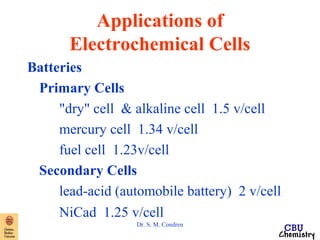
Primary Cells 
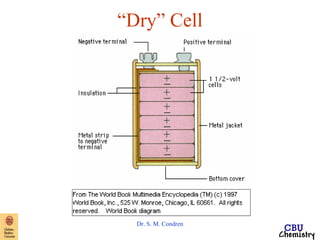
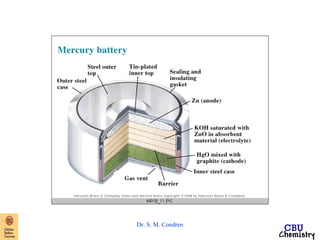
"dry" cell & alkaline cell 1.5 v/cell 
mercury cell 1.34 v/cell 
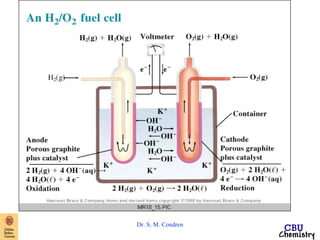
fuel cell 1.23v/cell 
Secondary Cells 
lead-acid (automobile battery) 2 v/cell 
NiCad 1.25 v/cell
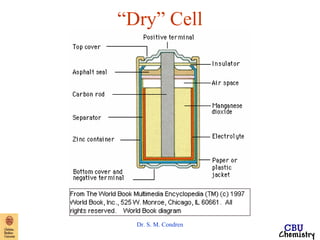
“Dry” Cell 
Dr. S. M. Condren
“Dry” Cell 
Dr. S. M. Condren
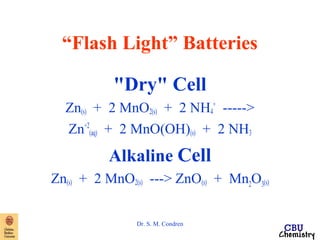
“Flash Light” Batteries 
"Dry" Cell 
Zn(s) + 2 MnO2(s) + 2 NH4 
Dr. S. M. Condren 
+ -----> 
Zn+2 
(aq) + 2 MnO(OH)(s) + 2 NH3 
Alkaline Cell 
Zn(s) + 2 MnO2(s) ---> ZnO(s) + Mn2O3(s)
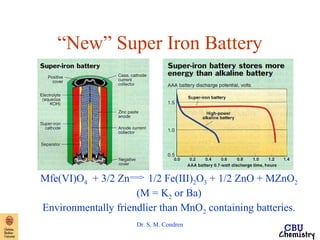
“New” Super Iron Battery 
Mfe(VI)O4 + 3/2 Zn 1/2 Fe(III)2O3 + 1/2 ZnO + MZnO2 
(M = K2 or Ba) 
Environmentally friendlier than MnO2 containing batteries. 
Dr. S. M. Condren
Dr. S. M. Condren
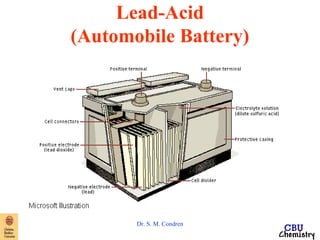
Lead-Acid 
(Automobile Battery) 
Dr. S. M. Condren
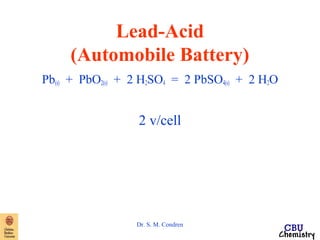
Lead-Acid 
(Automobile Battery) 
Pb(s) + PbO2(s) + 2 H2SO4 = 2 PbSO4(s) + 2 H2O 
2 v/cell 
Dr. S. M. Condren
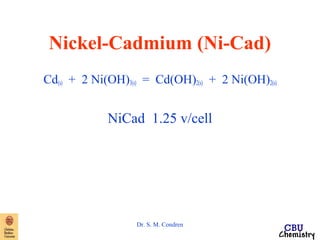
Nickel-Cadmium (Ni-Cad) 
Cd(s) + 2 Ni(OH)3(s) = Cd(OH)2(s) + 2 Ni(OH)2(s) 
NiCad 1.25 v/cell 
Dr. S. M. Condren
Dr. S. M. Condren
Automobile Oxygen Sensor 
ZrO2 / CaO 
Dr. S. M. Condren 
Air, 
constant [O 2 ] 
porous Pt electrodes 
migrating 
O 2 - ions 
exhaust gas, 
unknown [O2 ] 
measured potential difference
Automobile Oxygen Sensor 
• see Oxygen Sensor Movie from Solid-State 
Resources CD-ROM 
Dr. S. M. Condren
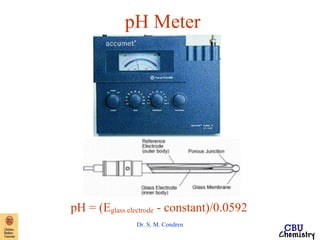
pH Meter 
pH = (Eglass electrode - constant)/0.0592 
Dr. S. M. Condren
Effect of Concentration on Cell 
Voltage: The Nernst Equation 
Ecell = Eo 
cell - (RT/nF)ln Q 
Ecell = Eo 
cell - (0.0592/n)log Q 
where Q => reaction quotient 
Q = [products]/[reactants] 
Dr. S. M. Condren
EXAMPLE: What is the cell potential for the 
Daniel's cell when the [Zn+2] = 10 [Cu+2] ? 
Q = ([Zn+2]/[Cu+2] = (10 [Cu+2])/[Cu+2] = 10 
Eo = (0.34 V)Cu couple + (-(-0.76 V)Zn couple 
n = 2, 2 electron change Ecell = Eo 
cell - (0.0257/n)ln Q 
thus Ecell = (1.10 - (0.0257/2)ln 10) V 
Ecell = (1.10 - (0.0257/2)2.303) V 
Ecell = (1.10 - 0.0296) V = 1.07 V 
Dr. S. M. Condren
Nernst Equation 
nF ln Q = – 2.3 RT 
F log[H+]base side 
[H+]acid side 
H 2 in 
1 atm 
e– e– 
Dr. S. M. Condren 
+0.83 V 
salt bridge 
H 2 in 
1 atm 
voltmeter 
Pt 
electrode 
Pt 
NaOH electrode 
1 M 
anode (–) 
HCl 
1 M 
cathode (+) 
F log [h+]n-type side 
[h+]p-type side 
n p + 
+ 
+ 
+ 
– 
– 
– 
– 
[H+]acid side ® [H+]base side 
E = Eo – RT 
[h+]p-type side ® [h+]n-type side 
E (in volts) = – 2.3 RT
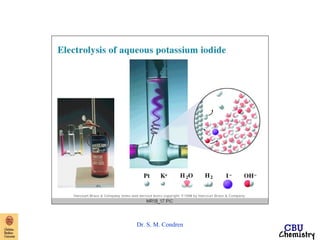
Electrolysis 
• non-spontaneous reaction is caused by 
the passage of an electric current 
through a solution 
Dr. S. M. Condren
Dr. S. M. Condren
Electrolysis 
Electrolysis of Sodium chloride 
(chlor-alkali process) 
molten reactants => liquid sodium and 
chlorine gas 
aqueous reactants => caustic soda (sodium 
hydroxide) and chlorine gas 
Dr. S. M. Condren
Electrolysis 
Preparation of Aluminum (Hall process) 
Dr. S. M. Condren
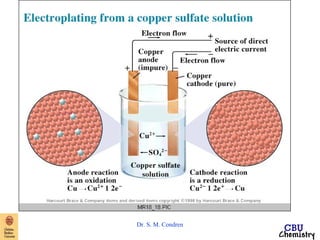
Electrolytic Refining of Copper 
Cu(s) + Cu+2 
(aq) --> Cu+2 
(aq) + Cu(s) 
impure pure 
anode cathode 
impurities: anode mud; Ag, Au, Pb 
Dr. S. M. Condren
Dr. S. M. Condren
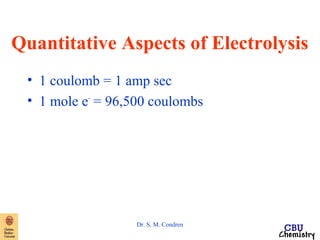
Quantitative Aspects of Electrolysis 
• 1 coulomb = 1 amp sec 
• 1 mole e- = 96,500 coulombs 
Dr. S. M. Condren
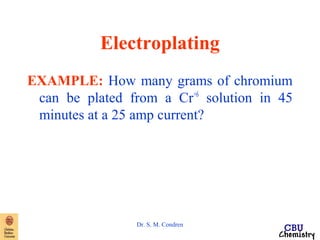
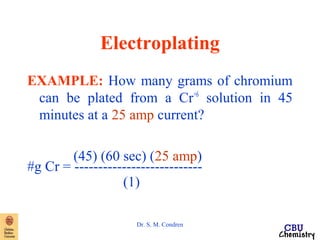
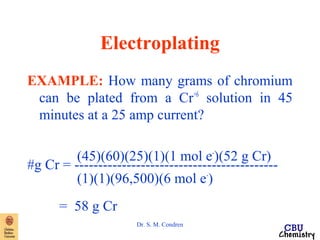
Electroplating 
EXAMPLE: How many grams of chromium 
can be plated from a Cr+6 solution in 45 
minutes at a 25 amp current? 
Dr. S. M. Condren
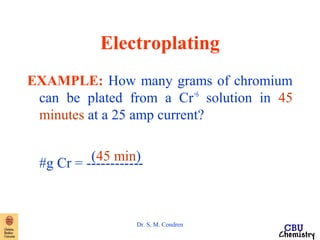
Electroplating 
EXAMPLE: How many grams of chromium 
can be plated from a Cr+6 solution in 45 
minutes at a 25 amp current? 
#g C r = - -(-4-5-- m---in--)- 
Dr. S. M. Condren
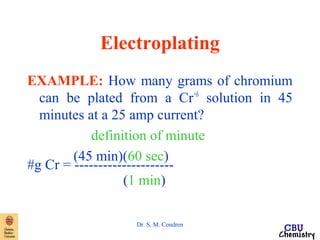
Electroplating 
EXAMPLE: How many grams of chromium 
can be plated from a Cr+6 solution in 45 
minutes at a 25 amp current? 
definition of minute 
#g Cr = (-4--5- -m--i-n--)-(-6-0-- -s-e-c-)-- 
(1 min) 
Dr. S. M. Condren
Electroplating 
EXAMPLE: How many grams of chromium 
can be plated from a Cr+6 solution in 45 
minutes at a 25 amp current? 
(45) (60 sec) (25 amp) 
#g Cr = --------------------------- 
(1) 
Dr. S. M. Condren
Electroplating 
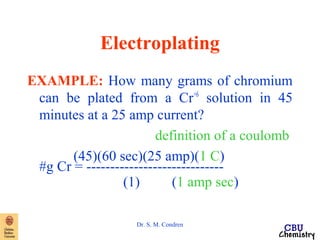
EXAMPLE: How many grams of chromium 
can be plated from a Cr+6 solution in 45 
minutes at a 25 amp current? 
definition of a coulomb 
(45)(60 sec)(25 amp)(1 C) 
#g Cr = ----------------------------- 
(1) (1 amp sec) 
Dr. S. M. Condren
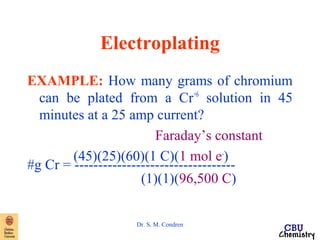
Electroplating 
EXAMPLE: How many grams of chromium 
can be plated from a Cr+6 solution in 45 
minutes at a 25 amp current? 
Faraday’s constant 
(45)(25)(60)(1 C)(1 mol e- #g Cr = --------------------------------)-- 
(1)(1)(96,500 C) 
Dr. S. M. Condren
Electroplating 
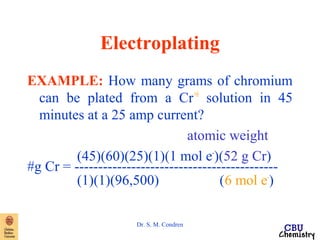
EXAMPLE: How many grams of chromium 
can be plated from a Cr+6 solution in 45 
minutes at a 25 amp current? 
Dr. S. M. Condren 
atomic weight 
(45)(60)(25)(1)(1 mol e-)(52 g Cr) 
#g Cr = ------------------------------------------- 
(1)(1)(96,500) (6 mol e-)
Electroplating 
EXAMPLE: How many grams of chromium 
can be plated from a Cr+6 solution in 45 
minutes at a 25 amp current? 
(45)(60)(25)(1)(1 mol e- #g Cr = ------------------------------)-(-5--2- -g- -C--r-)-- 
(1)(1)(96,500)(6 mol e-) 
= 58 g Cr 
Dr. S. M. Condren
Dr. S. M. Condren
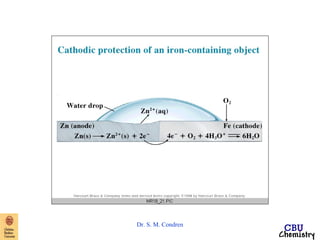
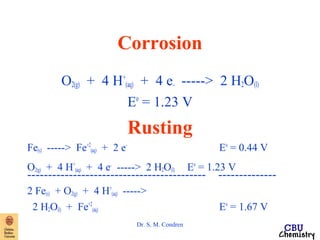
Corrosion 
O2(g) + 4 H+ 
(aq) + 4 e- -----> 2 H2O(l) 
Eo = 1.23 V 
Rusting 
Fe(s) -----> Fe+2 
(aq) + 2 e- Eo = 0.44 V 
O2(g) + 4 H+ 
(aq) + 4 e- -----> 2 H2O(l) Eo = 1.23 V ------------------------------------------- -------------- 
2 Fe(s) + O2(g) + 4 H+ 
(aq) -----> 
2 H2O(l) + Fe+2 
(aq) Eo = 1.67 V 
Dr. S. M. Condren
Preventing Corrosion 
Dr. S. M. Condren 
painting 
galvanizing 
sacrificial anode

Electrochemistry

  • 1.
    Chapter 18 Electrochemistry Dr. S. M. Condren
  • 2.
    Redox Reactions Oxidation • loss of electrons Reduction • gain of electrons oxidizing agent • substance that cause oxidation by being reduced reducing agent • substance that cause oxidation by being reduced Dr. S. M. Condren
  • 3.
    Electrochemistry In thebroadest sense, electrochemistry is the study of chemical reactions that produce electrical effects and of the chemical phenomena that are caused by the action of currents or voltages. Dr. S. M. Condren
  • 4.
    Dr. S. M.Condren
  • 5.
    Voltaic Cells •harnessed chemical reaction which produces an electric current Dr. S. M. Condren
  • 6.
    Voltaic Cells Cellsand Cell Reactions Daniel's Cell Dr. S. M. Condren Zn(s) + Cu+2 (aq) ---> Zn+2 (aq) + Cu(s) oxidation half reaction anode Zn(s) ---> Zn+2 (aq) + 2 e-reduction half reaction cathode Cu+2 (aq) + 2 e- ---> Cu(s)
  • 7.
    Voltaic Cells •copper electrode dipped into a solution of copper(II) sulfate • zinc electrode dipped into a solution of zinc sulfate Dr. S. M. Condren
  • 8.
    Voltaic Cells Dr.S. M. Condren
  • 9.
    Hydrogen Electrode •consists of a platinum electrode covered with a fine powder of platinum around which H2(g) is bubbled. Its potential is defined as zero volts. Hydrogen Half-Cell H2(g) = 2 H+ (aq) + 2 e-reversible Dr. S. M. Condren reaction
  • 10.
    Dr. S. M.Condren
  • 11.
    Dr. S. M.Condren
  • 12.
    Standard Reduction Potentials • the potential under standard conditions (25oC with all ions at 1 M concentrations and all gases at 1 atm pressure) of a half-reaction in which reduction is occurring Dr. S. M. Condren
  • 13.
    Some Standard ReductionPotentials Table 18-1, pg 837 Li+ + e- ---> Li -3.045 v Zn+2 + 2 e- ---> Zn -0.763v Fe+2 + 2 e- ---> Fe -0.44v 2 H+ (aq) + 2 e- ---> H2(g) 0.00v Cu+2 + 2 e- ---> Cu +0.337v O2(g) + 4 H+ (aq) + 4 e- ---> 2 H2O(l) +1.229v F2 + 2e- ---> 2 F- +2.87v Dr. S. M. Condren
  • 14.
    If the reductionof mercury (I) in a voltaic cell is desired, the half reaction is: Which of the following reactions could be used as the anode (oxidation)? A, B Dr. S. M. Condren
  • 15.
    Cell Potential •the potential difference, in volts, between the electrodes of an electrochemical cell • Direction of Oxidation-Reduction Reactions • positive value indicates a spontaneous reaction Dr. S. M. Condren
  • 16.
    Standard Cell Potential • the potential difference, in volts, between the electrodes of an electrochemical cell when the all concentrations of all solutes is 1 molar, all the partial pressures of any gases are 1 atm, and the temperature at 25oC Dr. S. M. Condren
  • 17.
    Cell Diagram •the shorthand representation of an electrochemical cell showing the two half-cells connected by a salt bridge or porous Dr. S. M. Condren barrier, such as: Zn(s)/ZnSO4(aq)//CuSO4(aq)/Cu(s) anode cathode
  • 18.
    Metal Displacement Reactions • solid of more reactive metals will displace ions of a less reactive metal from solution • relative reactivity based on potentials of half reactions • metals with very different potentials react most vigorously Dr. S. M. Condren
  • 19.
    Ag+ + e---->Ag E°= 0.80 V Cu2+ + 2e- ---> Cu E°= 0.34 V Will Ag react with Cu2+? yes, no Will Cu react with Ag+? yes, no Dr. S. M. Condren
  • 20.
    Internet Report •Due end of day, 5:00 pm, Dec. 1, 2001 Dr. S. M. Condren
  • 21.
    Gibbs Free Energy and Cell Potential DG = - nFE where n => number of electrons changed F => Faraday’s constant E => cell potential Dr. S. M. Condren
  • 22.
    Applications of ElectrochemicalCells Batteries – device that converts chemical energy into electricity Primary Cells – non-reversible electrochemical cell – non-rechargeable cell Secondary Cells – reversible electrochemical cell – rechargeable cell Dr. S. M. Condren
  • 23.
    Applications of ElectrochemicalCells Dr. S. M. Condren Batteries Primary Cells "dry" cell & alkaline cell 1.5 v/cell mercury cell 1.34 v/cell fuel cell 1.23v/cell Secondary Cells lead-acid (automobile battery) 2 v/cell NiCad 1.25 v/cell
  • 24.
    “Dry” Cell Dr.S. M. Condren
  • 25.
    “Dry” Cell Dr.S. M. Condren
  • 26.
    “Flash Light” Batteries "Dry" Cell Zn(s) + 2 MnO2(s) + 2 NH4 Dr. S. M. Condren + -----> Zn+2 (aq) + 2 MnO(OH)(s) + 2 NH3 Alkaline Cell Zn(s) + 2 MnO2(s) ---> ZnO(s) + Mn2O3(s)
  • 27.
    “New” Super IronBattery Mfe(VI)O4 + 3/2 Zn 1/2 Fe(III)2O3 + 1/2 ZnO + MZnO2 (M = K2 or Ba) Environmentally friendlier than MnO2 containing batteries. Dr. S. M. Condren
  • 28.
    Dr. S. M.Condren
  • 29.
  • 30.
    Lead-Acid (Automobile Battery) Pb(s) + PbO2(s) + 2 H2SO4 = 2 PbSO4(s) + 2 H2O 2 v/cell Dr. S. M. Condren
  • 31.
    Nickel-Cadmium (Ni-Cad) Cd(s)+ 2 Ni(OH)3(s) = Cd(OH)2(s) + 2 Ni(OH)2(s) NiCad 1.25 v/cell Dr. S. M. Condren
  • 32.
    Dr. S. M.Condren
  • 33.
    Automobile Oxygen Sensor ZrO2 / CaO Dr. S. M. Condren Air, constant [O 2 ] porous Pt electrodes migrating O 2 - ions exhaust gas, unknown [O2 ] measured potential difference
  • 34.
    Automobile Oxygen Sensor • see Oxygen Sensor Movie from Solid-State Resources CD-ROM Dr. S. M. Condren
  • 35.
    pH Meter pH= (Eglass electrode - constant)/0.0592 Dr. S. M. Condren
  • 36.
    Effect of Concentrationon Cell Voltage: The Nernst Equation Ecell = Eo cell - (RT/nF)ln Q Ecell = Eo cell - (0.0592/n)log Q where Q => reaction quotient Q = [products]/[reactants] Dr. S. M. Condren
  • 37.
    EXAMPLE: What isthe cell potential for the Daniel's cell when the [Zn+2] = 10 [Cu+2] ? Q = ([Zn+2]/[Cu+2] = (10 [Cu+2])/[Cu+2] = 10 Eo = (0.34 V)Cu couple + (-(-0.76 V)Zn couple n = 2, 2 electron change Ecell = Eo cell - (0.0257/n)ln Q thus Ecell = (1.10 - (0.0257/2)ln 10) V Ecell = (1.10 - (0.0257/2)2.303) V Ecell = (1.10 - 0.0296) V = 1.07 V Dr. S. M. Condren
  • 38.
    Nernst Equation nFln Q = – 2.3 RT F log[H+]base side [H+]acid side H 2 in 1 atm e– e– Dr. S. M. Condren +0.83 V salt bridge H 2 in 1 atm voltmeter Pt electrode Pt NaOH electrode 1 M anode (–) HCl 1 M cathode (+) F log [h+]n-type side [h+]p-type side n p + + + + – – – – [H+]acid side ® [H+]base side E = Eo – RT [h+]p-type side ® [h+]n-type side E (in volts) = – 2.3 RT
  • 39.
    Electrolysis • non-spontaneousreaction is caused by the passage of an electric current through a solution Dr. S. M. Condren
  • 40.
    Dr. S. M.Condren
  • 41.
    Electrolysis Electrolysis ofSodium chloride (chlor-alkali process) molten reactants => liquid sodium and chlorine gas aqueous reactants => caustic soda (sodium hydroxide) and chlorine gas Dr. S. M. Condren
  • 42.
    Electrolysis Preparation ofAluminum (Hall process) Dr. S. M. Condren
  • 43.
    Electrolytic Refining ofCopper Cu(s) + Cu+2 (aq) --> Cu+2 (aq) + Cu(s) impure pure anode cathode impurities: anode mud; Ag, Au, Pb Dr. S. M. Condren
  • 44.
    Dr. S. M.Condren
  • 45.
    Quantitative Aspects ofElectrolysis • 1 coulomb = 1 amp sec • 1 mole e- = 96,500 coulombs Dr. S. M. Condren
  • 46.
    Electroplating EXAMPLE: Howmany grams of chromium can be plated from a Cr+6 solution in 45 minutes at a 25 amp current? Dr. S. M. Condren
  • 47.
    Electroplating EXAMPLE: Howmany grams of chromium can be plated from a Cr+6 solution in 45 minutes at a 25 amp current? #g C r = - -(-4-5-- m---in--)- Dr. S. M. Condren
  • 48.
    Electroplating EXAMPLE: Howmany grams of chromium can be plated from a Cr+6 solution in 45 minutes at a 25 amp current? definition of minute #g Cr = (-4--5- -m--i-n--)-(-6-0-- -s-e-c-)-- (1 min) Dr. S. M. Condren
  • 49.
    Electroplating EXAMPLE: Howmany grams of chromium can be plated from a Cr+6 solution in 45 minutes at a 25 amp current? (45) (60 sec) (25 amp) #g Cr = --------------------------- (1) Dr. S. M. Condren
  • 50.
    Electroplating EXAMPLE: Howmany grams of chromium can be plated from a Cr+6 solution in 45 minutes at a 25 amp current? definition of a coulomb (45)(60 sec)(25 amp)(1 C) #g Cr = ----------------------------- (1) (1 amp sec) Dr. S. M. Condren
  • 51.
    Electroplating EXAMPLE: Howmany grams of chromium can be plated from a Cr+6 solution in 45 minutes at a 25 amp current? Faraday’s constant (45)(25)(60)(1 C)(1 mol e- #g Cr = --------------------------------)-- (1)(1)(96,500 C) Dr. S. M. Condren
  • 52.
    Electroplating EXAMPLE: Howmany grams of chromium can be plated from a Cr+6 solution in 45 minutes at a 25 amp current? Dr. S. M. Condren atomic weight (45)(60)(25)(1)(1 mol e-)(52 g Cr) #g Cr = ------------------------------------------- (1)(1)(96,500) (6 mol e-)
  • 53.
    Electroplating EXAMPLE: Howmany grams of chromium can be plated from a Cr+6 solution in 45 minutes at a 25 amp current? (45)(60)(25)(1)(1 mol e- #g Cr = ------------------------------)-(-5--2- -g- -C--r-)-- (1)(1)(96,500)(6 mol e-) = 58 g Cr Dr. S. M. Condren
  • 54.
    Dr. S. M.Condren
  • 55.
    Corrosion O2(g) +4 H+ (aq) + 4 e- -----> 2 H2O(l) Eo = 1.23 V Rusting Fe(s) -----> Fe+2 (aq) + 2 e- Eo = 0.44 V O2(g) + 4 H+ (aq) + 4 e- -----> 2 H2O(l) Eo = 1.23 V ------------------------------------------- -------------- 2 Fe(s) + O2(g) + 4 H+ (aq) -----> 2 H2O(l) + Fe+2 (aq) Eo = 1.67 V Dr. S. M. Condren
  • 56.
    Preventing Corrosion Dr.S. M. Condren painting galvanizing sacrificial anode

Editor's Notes

  • #39 In an electrochemical concentration cell, the cell potential depends on the concentrations of ions (in this case, H+ ion) in the two half-cells. In semiconductors the voltage obtainable with a p-n junction depends on the relative concentration of electrons or holes on the two sides of the junction.