
Drive activity
• Please submit your drive activities.
Sec. 4.1: Antiderivatives
Uses of integration
1.
2.
3.
4.
5.

“Undoes” differentiation.
Finds the area under a curve.
Finds the volume of a solid.
Finds the center of mass.
Finds s(t) given a(t) or v(t).
*** and many more….
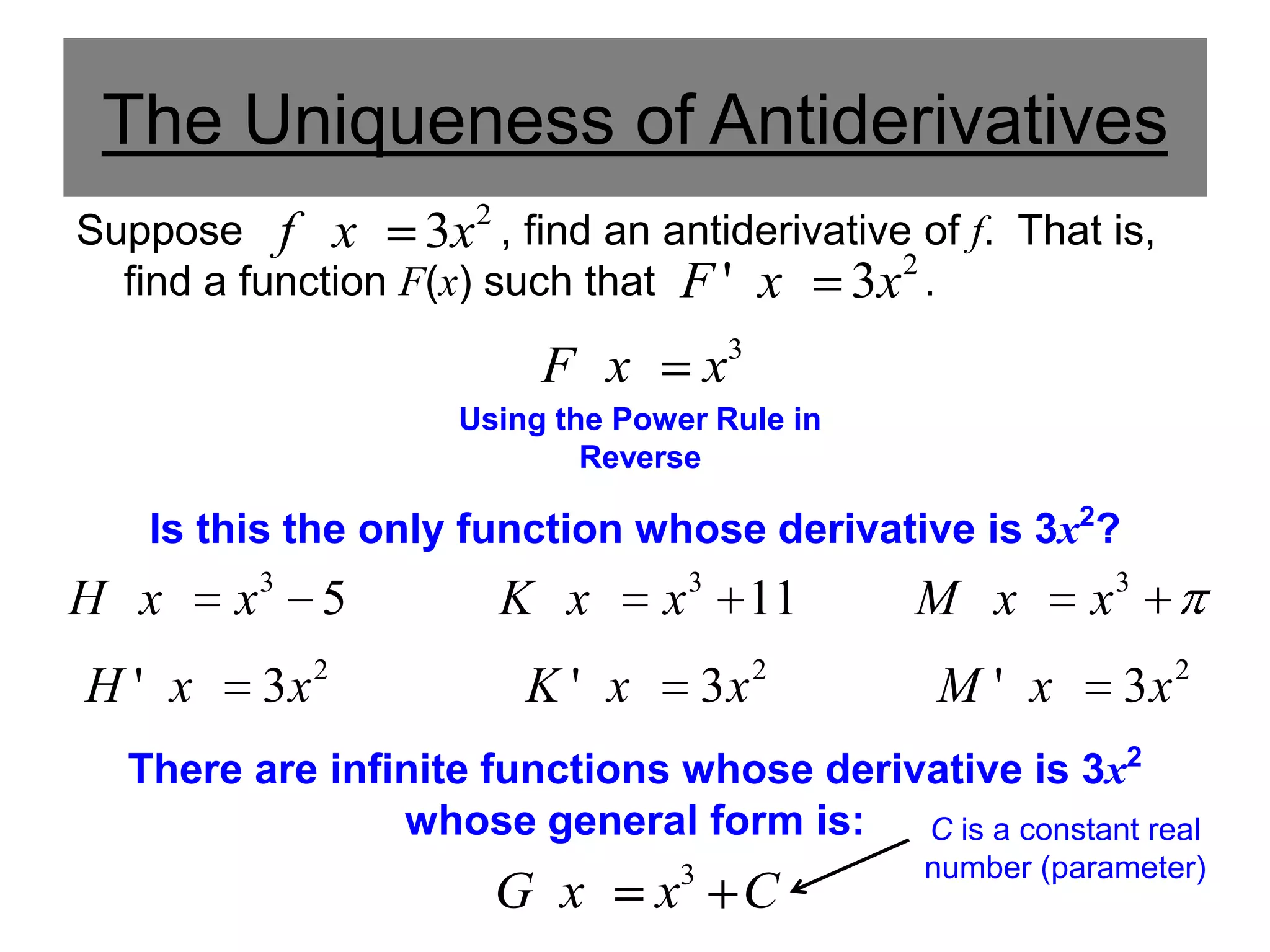
The Uniqueness of Antiderivatives
2
Suppose f x
3x , find an antiderivative of f. That is,
2
find a function F(x) such that F ' x
3x .

F x

x

3

Using the Power Rule in
Reverse

Is this the only function whose derivative is 3x2?

H x
H' x

x

3

5

3x 2

K x

x

3

11

3x 2

K' x

M x
M' x

x

3

3x 2

There are infinite functions whose derivative is 3x2
whose general form is:
C is a constant real

G x

3

x

C

number (parameter)
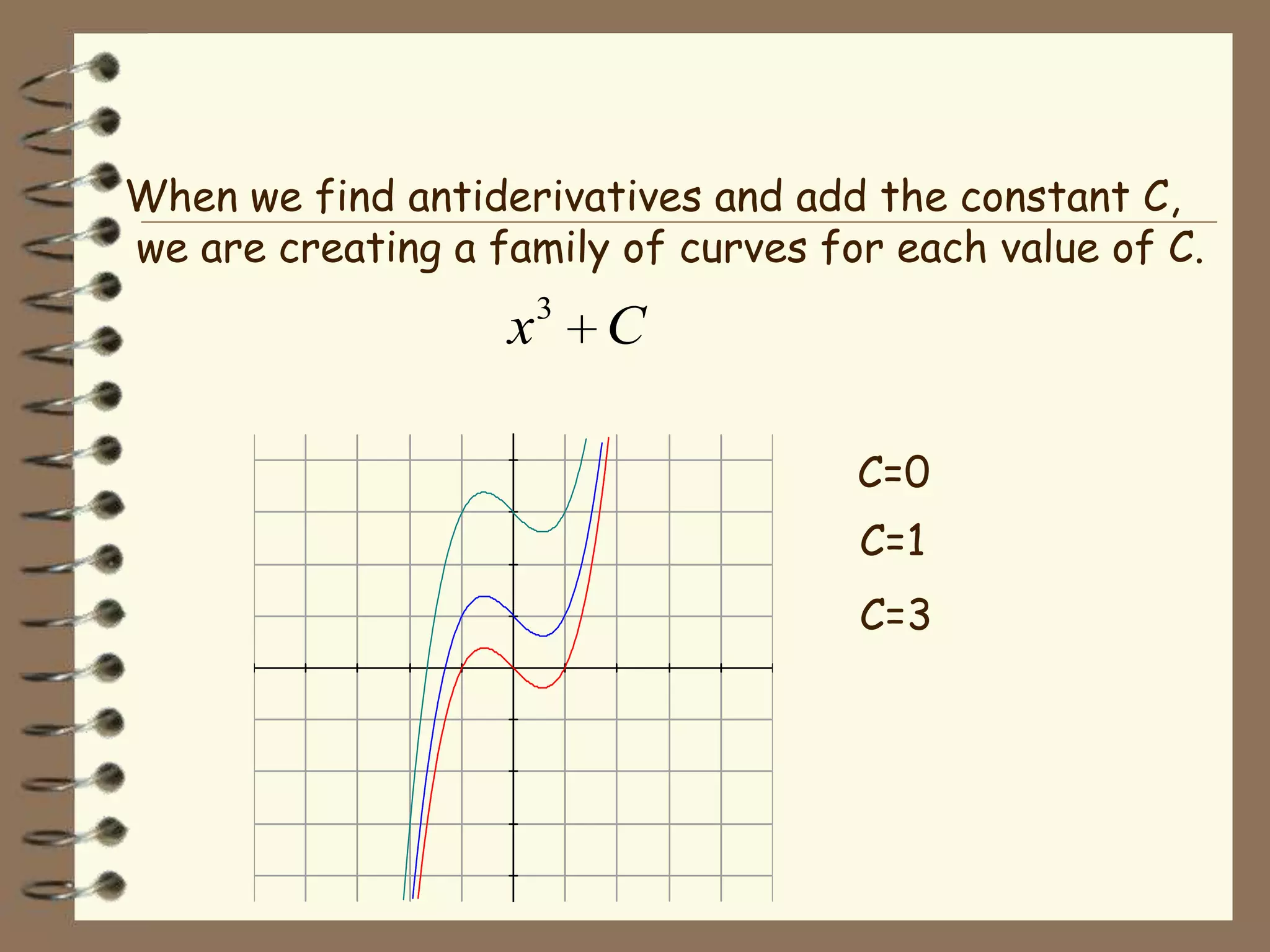
When we find antiderivatives and add the constant C,
we are creating a family of curves for each value of C.

x3 C
C=0
C=1

C=3
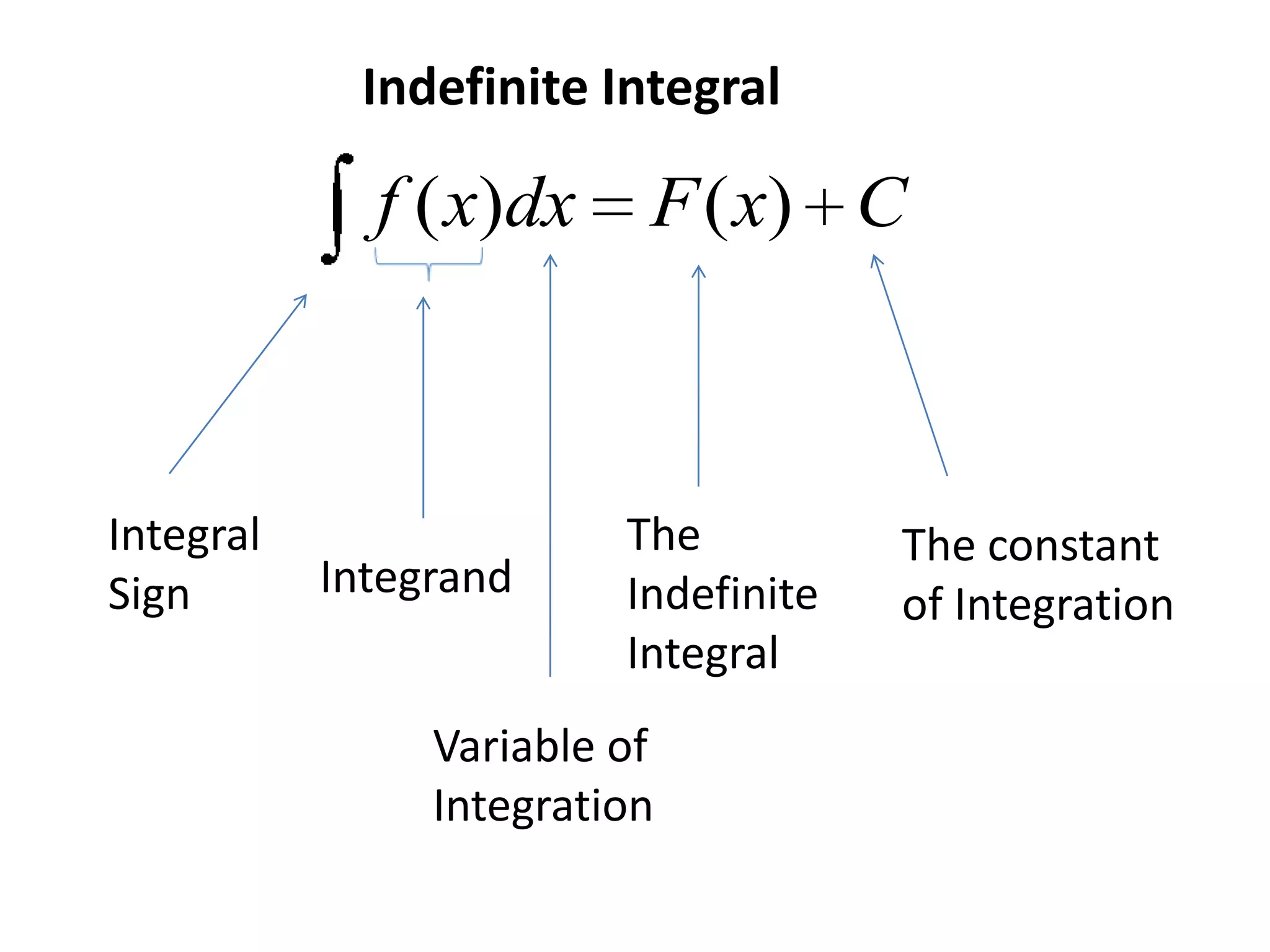
Indefinite Integral

f ( x)dx

Integral
Sign

Integrand

F ( x) C

The
Indefinite
Integral

Variable of
Integration

The constant
of Integration
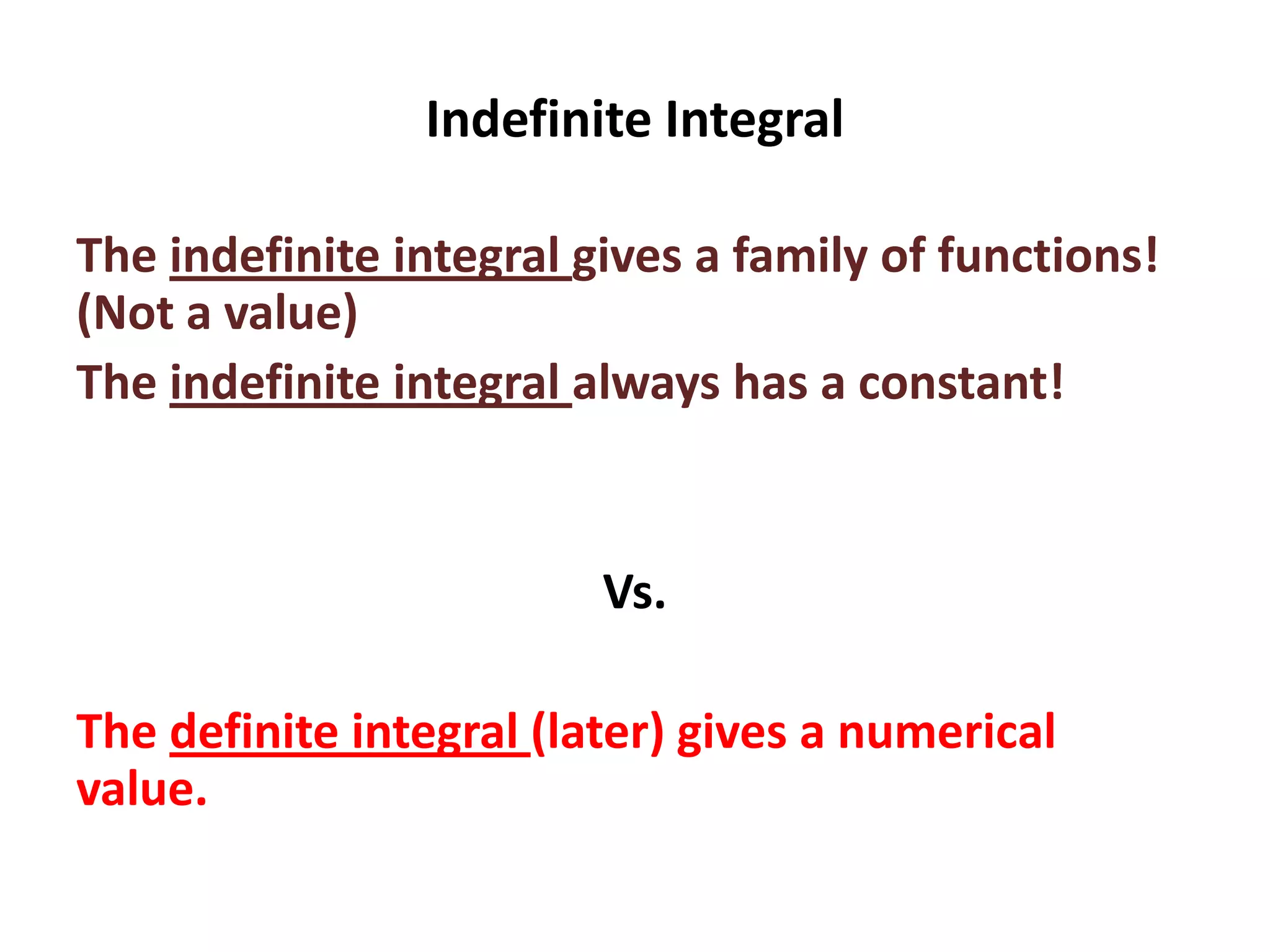
Indefinite Integral
The indefinite integral gives a family of functions!
(Not a value)
The indefinite integral always has a constant!

Vs.
The definite integral (later) gives a numerical
value.
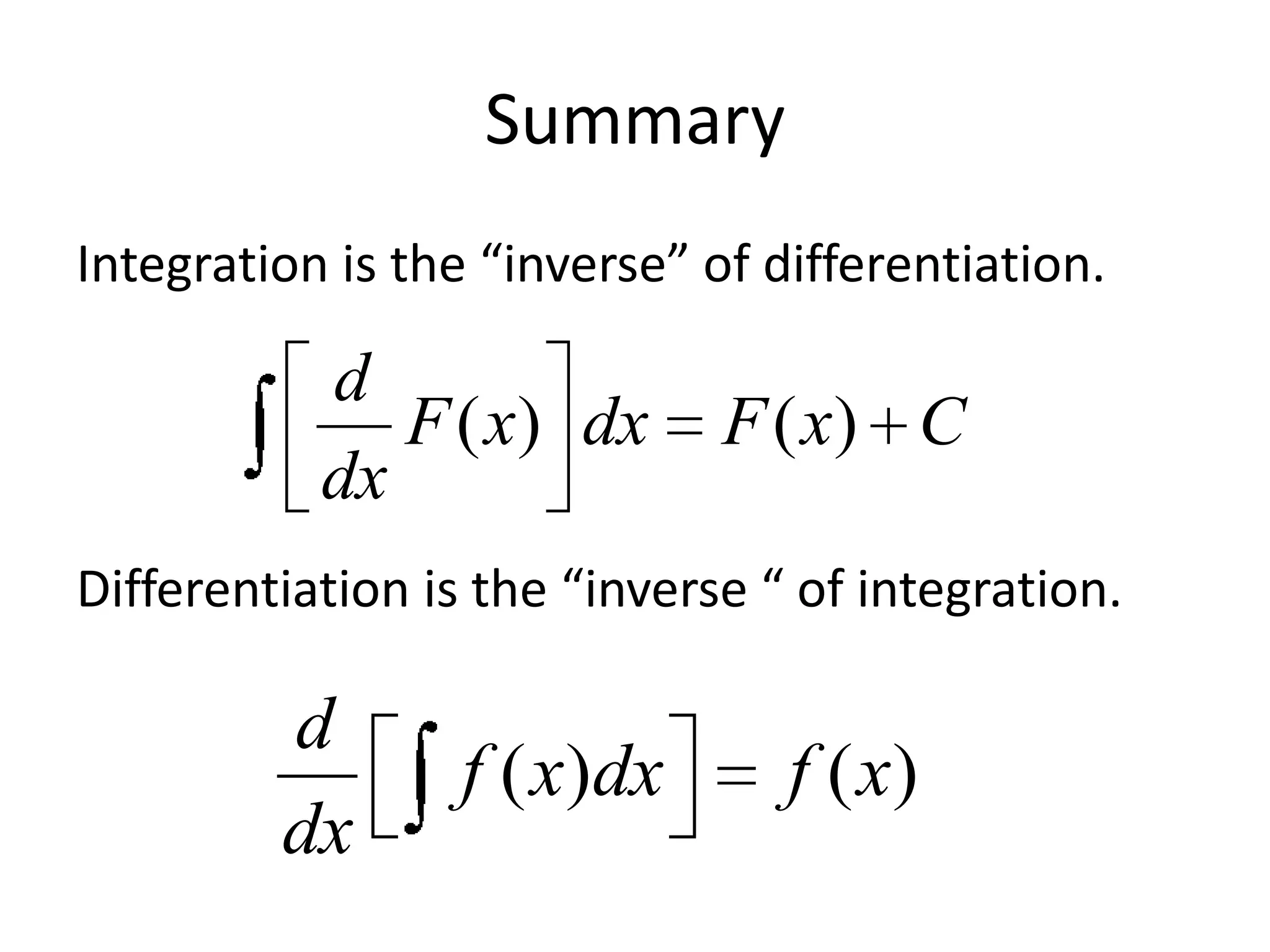
Summary
Integration is the “inverse” of differentiation.

d
F ( x) dx
dx

F ( x) C

Differentiation is the “inverse “ of integration.

d
dx

f ( x)dx

f ( x)
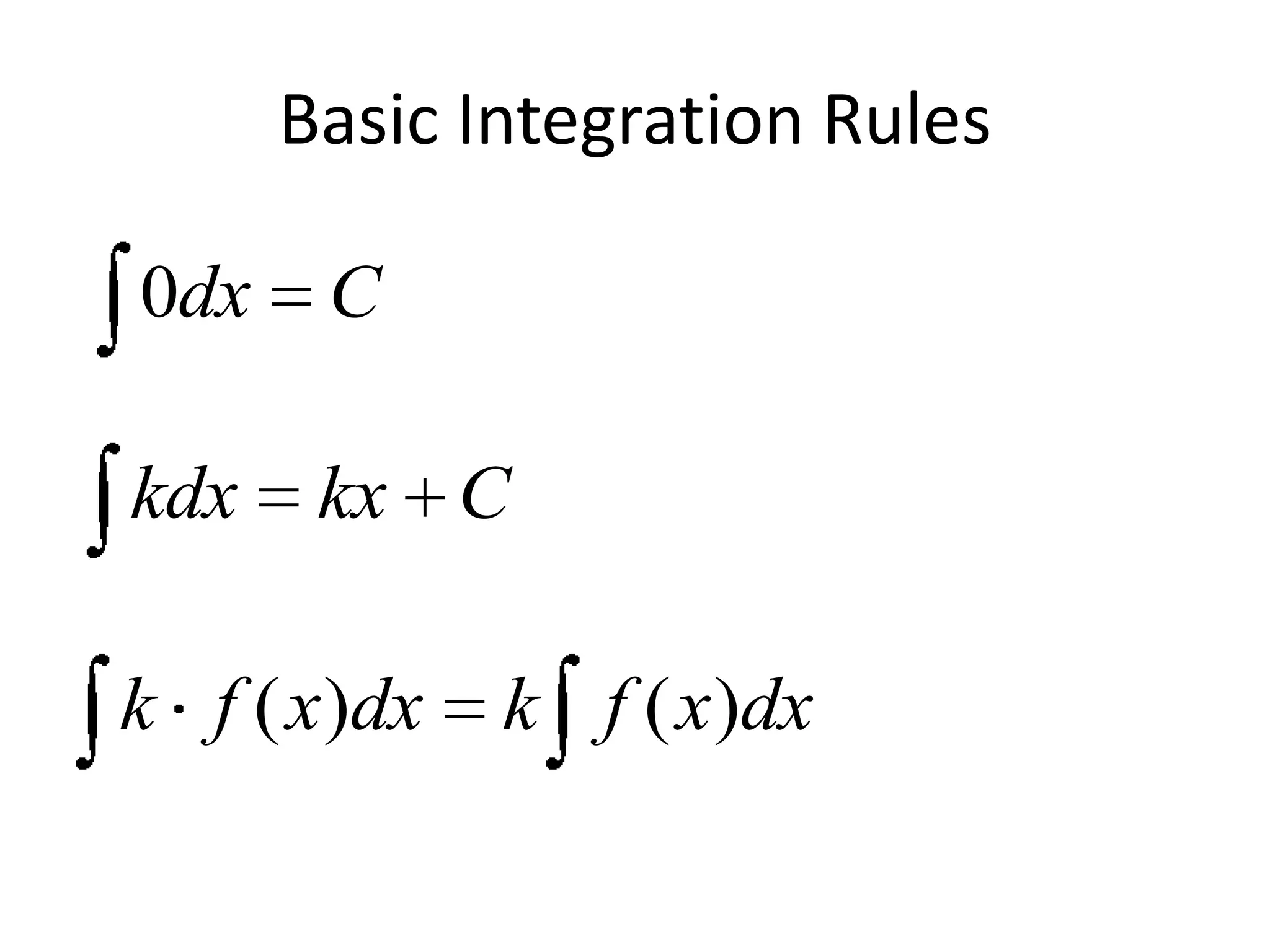
Basic Integration Rules
0dx

C

kdx

kx C

k f ( x )dx

k f ( x )dx
Basic Integration Rules
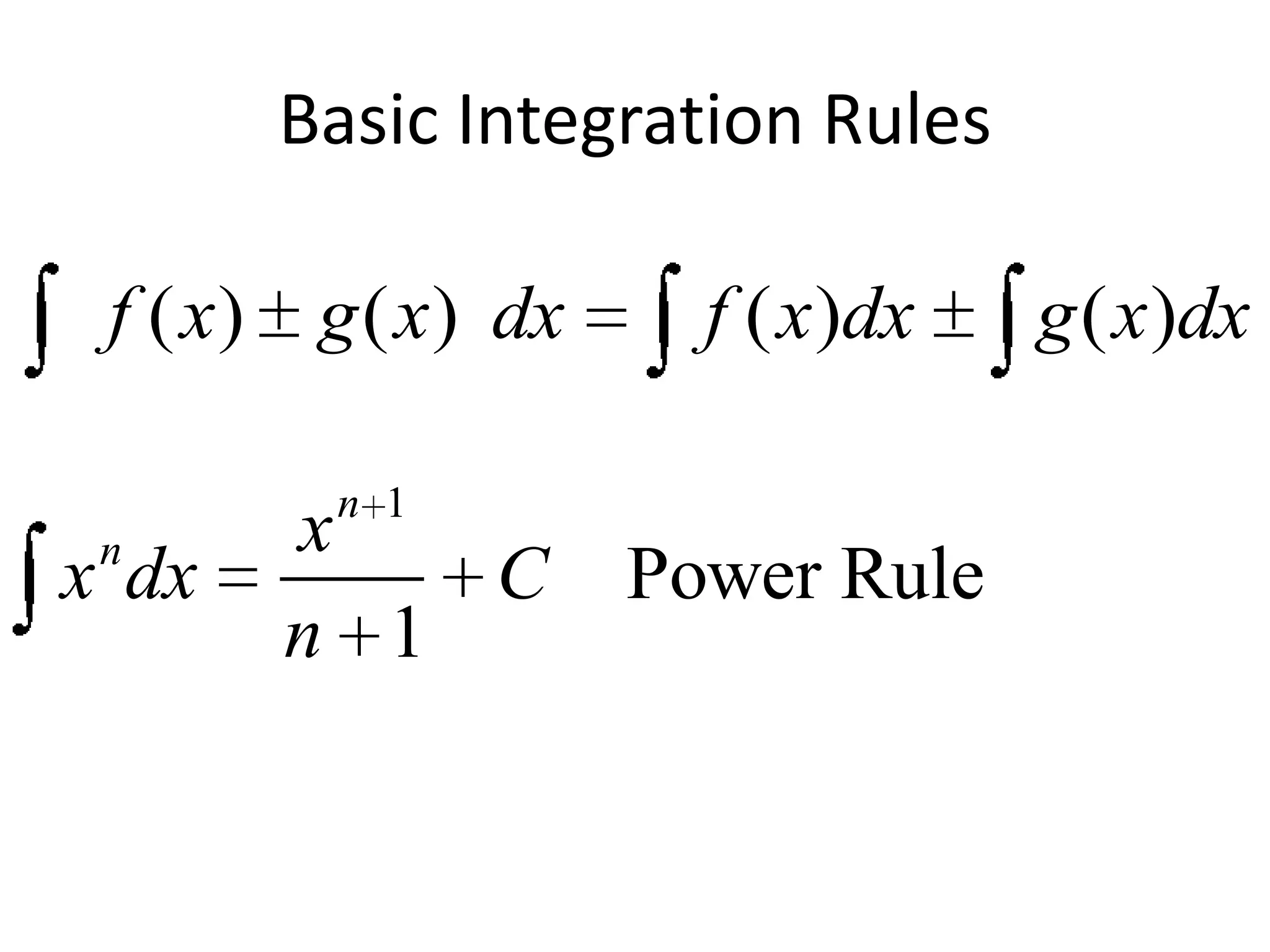
f ( x ) g ( x ) dx

f ( x )dx

n 1

n

x dx

x
C
n 1

Power Rule

g ( x )dx
Basic Integration Rules
cos xdx
sin xdx
2

sec xdx

sin x C
cos x C
tan x C
Basic Integration Rules
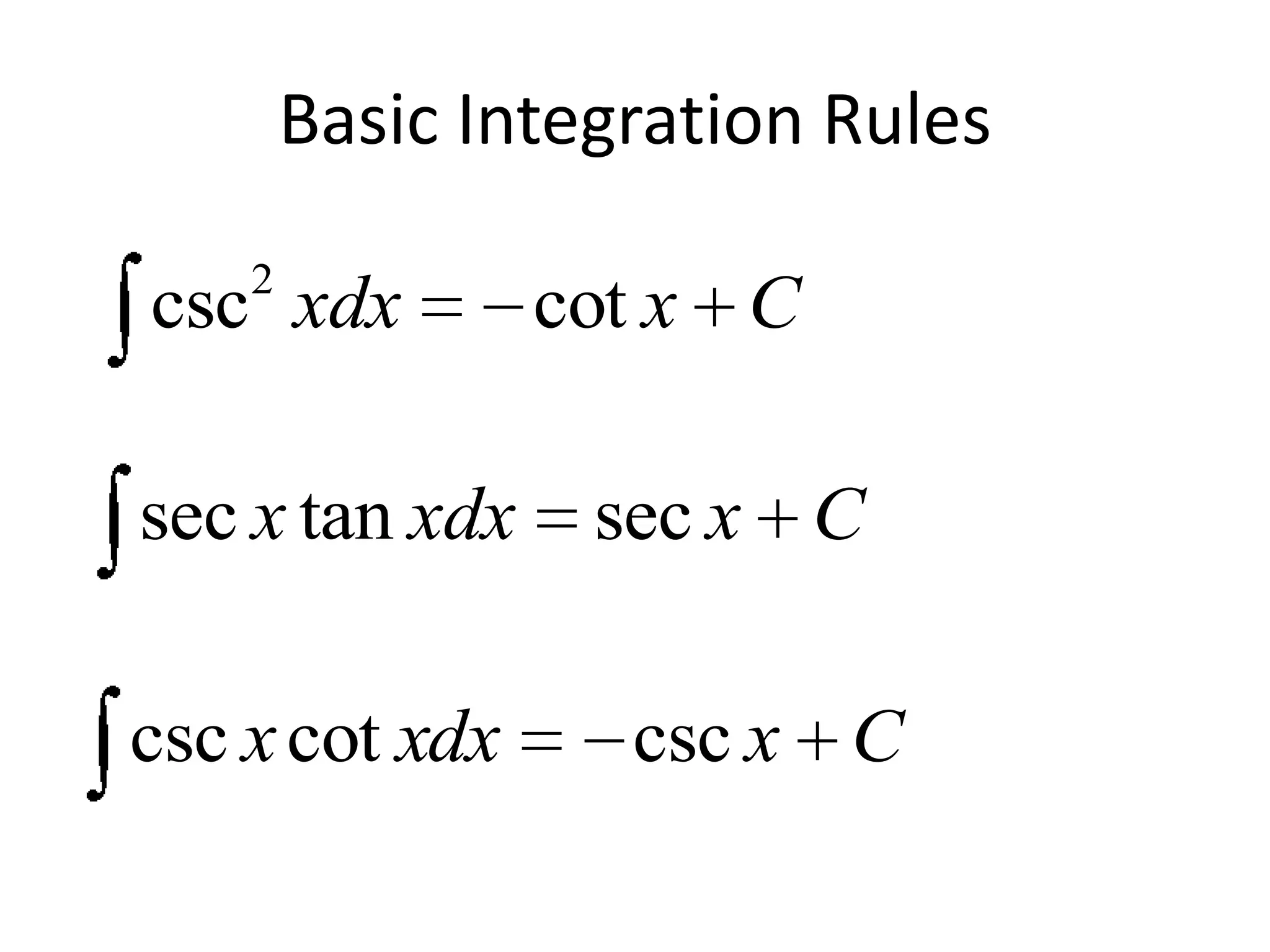
2

csc xdx
sec x tan xdx
csc x cot xdx

cot x C
sec x C
csc x C
Examples
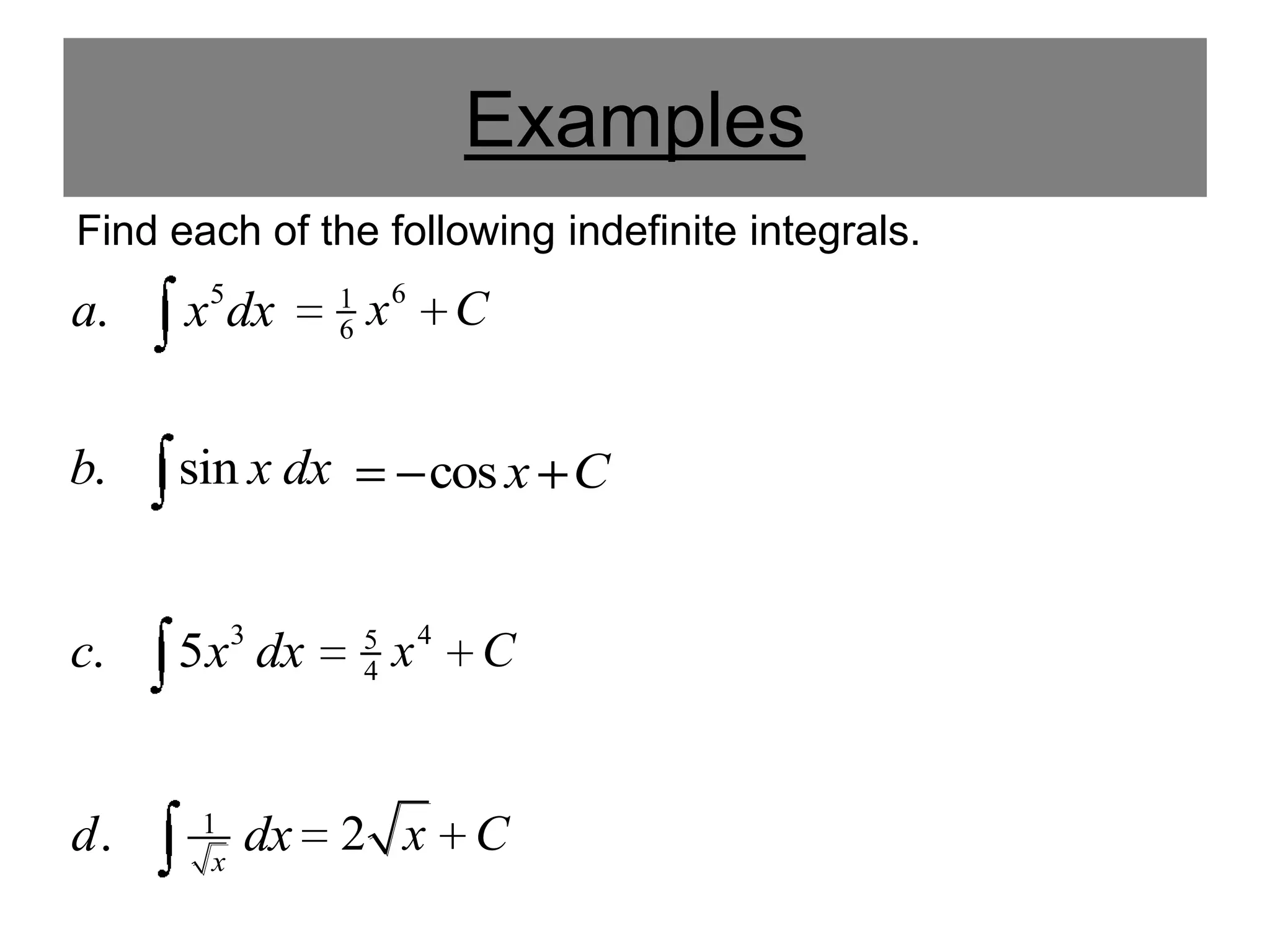
Find each of the following indefinite integrals.
5

a.

x dx

b.

5 x3 dx

x

sin x dx

c.

1
6

d.

1
x

6

C

cos x C

5
4

x4

C

dx 2 x C
Application problem
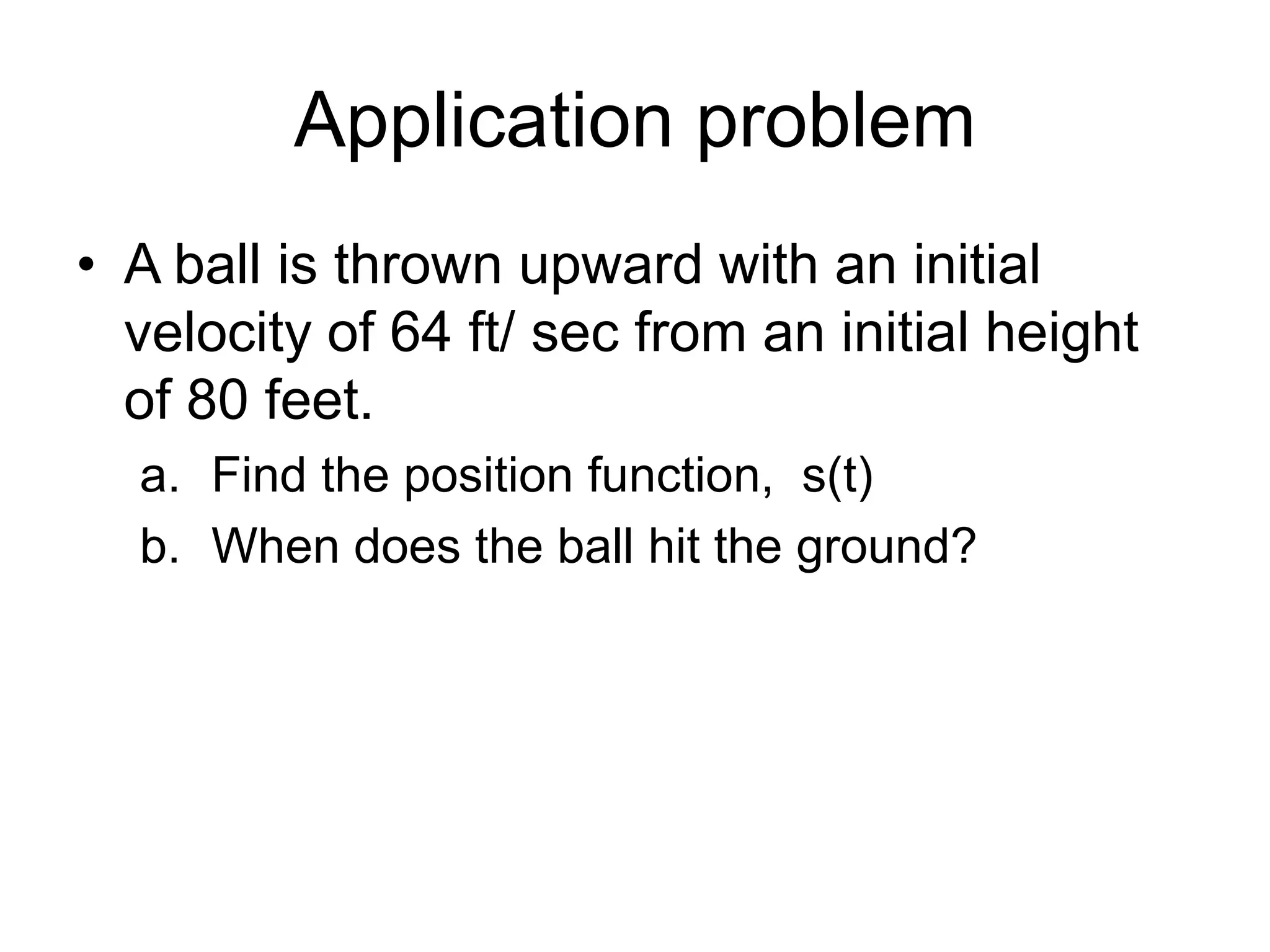
• A ball is thrown upward with an initial
velocity of 64 ft/ sec from an initial height
of 80 feet.
a. Find the position function, s(t)
b. When does the ball hit the ground?
Example
A particle moves along a coordinate axis in such a way that
3
its acceleration is modeled by a t
2t for time t > 0.
If the particle is at s = 5 when t = 1 and has velocity v = - 2
at this time, where is it when t = 4?
Integrate the acceleration to find velocity:

v t

2t

3

dt

2 t

3

1
3 1

2

dt

t

3 1

t

2

t

C

2

C

Use the Initial Condition to find C for velocity:

2

1

2

C

C

v t

1

1

Integrate the Velocity to find position:

s t

t

5

1

2

1

Answer the
Question:

1 dt

t 2 dt

1
2 1

1 dt

t

2 1

1t C t

Use the Initial Condition to find C for position:

1 C
s 4

C

4

1

4 5

5
1.25

s t

t

1

1

t C

t 5

Antiderivatives and indefinite integration2009

  • 1.
    Drive activity • Pleasesubmit your drive activities.
  • 2.
  • 3.
    Uses of integration 1. 2. 3. 4. 5. “Undoes”differentiation. Finds the area under a curve. Finds the volume of a solid. Finds the center of mass. Finds s(t) given a(t) or v(t). *** and many more….
  • 4.
    The Uniqueness ofAntiderivatives 2 Suppose f x 3x , find an antiderivative of f. That is, 2 find a function F(x) such that F ' x 3x . F x x 3 Using the Power Rule in Reverse Is this the only function whose derivative is 3x2? H x H' x x 3 5 3x 2 K x x 3 11 3x 2 K' x M x M' x x 3 3x 2 There are infinite functions whose derivative is 3x2 whose general form is: C is a constant real G x 3 x C number (parameter)
  • 5.
    When we findantiderivatives and add the constant C, we are creating a family of curves for each value of C. x3 C C=0 C=1 C=3
  • 6.
    Indefinite Integral f (x)dx Integral Sign Integrand F ( x) C The Indefinite Integral Variable of Integration The constant of Integration
  • 7.
    Indefinite Integral The indefiniteintegral gives a family of functions! (Not a value) The indefinite integral always has a constant! Vs. The definite integral (later) gives a numerical value.
  • 8.
    Summary Integration is the“inverse” of differentiation. d F ( x) dx dx F ( x) C Differentiation is the “inverse “ of integration. d dx f ( x)dx f ( x)
  • 9.
    Basic Integration Rules 0dx C kdx kxC k f ( x )dx k f ( x )dx
  • 10.
    Basic Integration Rules f( x ) g ( x ) dx f ( x )dx n 1 n x dx x C n 1 Power Rule g ( x )dx
  • 11.
    Basic Integration Rules cosxdx sin xdx 2 sec xdx sin x C cos x C tan x C
  • 12.
    Basic Integration Rules 2 cscxdx sec x tan xdx csc x cot xdx cot x C sec x C csc x C
  • 13.
    Examples Find each ofthe following indefinite integrals. 5 a. x dx b. 5 x3 dx x sin x dx c. 1 6 d. 1 x 6 C cos x C 5 4 x4 C dx 2 x C
  • 14.
    Application problem • Aball is thrown upward with an initial velocity of 64 ft/ sec from an initial height of 80 feet. a. Find the position function, s(t) b. When does the ball hit the ground?
  • 15.
    Example A particle movesalong a coordinate axis in such a way that 3 its acceleration is modeled by a t 2t for time t > 0. If the particle is at s = 5 when t = 1 and has velocity v = - 2 at this time, where is it when t = 4? Integrate the acceleration to find velocity: v t 2t 3 dt 2 t 3 1 3 1 2 dt t 3 1 t 2 t C 2 C Use the Initial Condition to find C for velocity: 2 1 2 C C v t 1 1 Integrate the Velocity to find position: s t t 5 1 2 1 Answer the Question: 1 dt t 2 dt 1 2 1 1 dt t 2 1 1t C t Use the Initial Condition to find C for position: 1 C s 4 C 4 1 4 5 5 1.25 s t t 1 1 t C t 5