EXPERIMENTAL METHODEXPERIMENTAL METHOD
Mukut HazarikaMukut Hazarika
ProfessorProfessor
Department of EducationDepartment of Education
Dibrugarh UniversityDibrugarh University
DefinitionsDefinitions
““Experimentation is the name given to theExperimentation is the name given to the
type of educational research in which thetype of educational research in which the
investigator controls the educative factorsinvestigator controls the educative factors
to which a child or a group of children isto which a child or a group of children is
subjected during the period of inquiry andsubjected during the period of inquiry and
observed the resulting achievement.”observed the resulting achievement.”
W.S. Monroe and M.D. EnglehartW.S. Monroe and M.D. Englehart
““ Experimental Research is theExperimental Research is the
description and analysis of what willdescription and analysis of what will
be or what will occur, under carefullybe or what will occur, under carefully
controlled conditions.”controlled conditions.”
J.W. BestJ.W. Best
Nature of Experimental MethodNature of Experimental Method
 Experimentation provides a method ofExperimentation provides a method of
hypothesis testing. After defining the problem, ahypothesis testing. After defining the problem, a
tentative answer or hypothesis is formulated.tentative answer or hypothesis is formulated.
 Experimenters manipulates certain stimuli,Experimenters manipulates certain stimuli,
treatments or environmental conditions andtreatments or environmental conditions and
observe how the condition or behaviour of theobserve how the condition or behaviour of the
subject is affected or changed.subject is affected or changed.
 An experiment involves the comparison of theAn experiment involves the comparison of the
effects of a particular treatment with that of aeffects of a particular treatment with that of a
different treatment or no treatment.different treatment or no treatment.
TERMS USEDTERMS USED
VariablesVariables : Variables are the conditions: Variables are the conditions
or characteristics that the experimenteror characteristics that the experimenter
manipulates, controls or observes.manipulates, controls or observes.
ManipulationManipulation : It refers to introduction,: It refers to introduction,
removal or change of a variable.removal or change of a variable.
IndependentIndependent VariableVariable : The conditions: The conditions
or characteristics that the experimenteror characteristics that the experimenter
manipulates or controls to ascertain theirmanipulates or controls to ascertain their
relationship to observed phenomena.relationship to observed phenomena.
TERMS USEDTERMS USED
 DependentDependent VariablesVariables : They are the: They are the
conditions or characteristics that appear,conditions or characteristics that appear,
disappear or change as the experimenterdisappear or change as the experimenter
introduces, removes or changes theintroduces, removes or changes the
independent variable.independent variable.
 ConfoundingConfounding VariablesVariables : The conditions or: The conditions or
characteristics in a study that might influence thecharacteristics in a study that might influence the
dependent variable and whose effects may bedependent variable and whose effects may be
confused with the effects of independentconfused with the effects of independent
variables.variables.
CHARACTERISTICS OFCHARACTERISTICS OF
EXPERIMENTAL RESEARCHEXPERIMENTAL RESEARCH
ControlControl
ManipulationManipulation
ObservationObservation
ReplicationReplication
CONTROLCONTROL
Control refers to the extent to which differentControl refers to the extent to which different
factors in an experiment are accountedfactors in an experiment are accounted
for. Variables that are not of direct interestfor. Variables that are not of direct interest
to the researcher are removed or theirto the researcher are removed or their
influence is minimized. The purpose ofinfluence is minimized. The purpose of
control in an experiment is to arrange acontrol in an experiment is to arrange a
situation in which the effect of variablessituation in which the effect of variables
under consideration may be accuratelyunder consideration may be accurately
measured.measured.
Purpose of ControlPurpose of Control
Achieving IsolationAchieving Isolation
Achieving Changes in MagnitudeAchieving Changes in Magnitude
Achieving Quantitative EvaluationAchieving Quantitative Evaluation
Methods of Controlling ConfoundingMethods of Controlling Confounding
VariablesVariables
Methods of Controlling Inter-SubjectMethods of Controlling Inter-Subject
DifferencesDifferences
Methods of Controlling SituationalMethods of Controlling Situational
VariablesVariables
Methods of Controlling Inter-SubjectMethods of Controlling Inter-Subject
DifferencesDifferences
 Random Assignment of Subjects to GroupsRandom Assignment of Subjects to Groups
 Random Assignment on the basis ofRandom Assignment on the basis of
Homogeneous SelectionHomogeneous Selection
 Technique of Analysis of Co-VarianceTechnique of Analysis of Co-Variance
 Method of using Subjects as their own ControlsMethod of using Subjects as their own Controls
 Matching Subjects with Random AssignmentMatching Subjects with Random Assignment
 Procedure of Subject to subject MatchingProcedure of Subject to subject Matching
 Matching for Mean and Standard DeviationMatching for Mean and Standard Deviation
 Ranking of Subjects in the Matching VariableRanking of Subjects in the Matching Variable
Random Assignment of Subjects toRandom Assignment of Subjects to
GroupsGroups
Selecting the two samples from theSelecting the two samples from the
population using simple random sampling.population using simple random sampling.
Random Assignment on the basis ofRandom Assignment on the basis of
Homogenous SelectionHomogenous Selection
In certain case, the groups are madeIn certain case, the groups are made
homogenous in the confounding variableshomogenous in the confounding variables
and two groups are selected randomly.and two groups are selected randomly.
For example, in an experiment the sex is aFor example, in an experiment the sex is a
confounding variable. In such case bothconfounding variable. In such case both
the groups are made equivalent bythe groups are made equivalent by
selecting only boys or girls.selecting only boys or girls.
Techniques of Analysis ofTechniques of Analysis of
CovarianceCovariance
The technique of analysis of co-variance isThe technique of analysis of co-variance is
used to control the variation within theused to control the variation within the
groups. This technique analyses thegroups. This technique analyses the
differences between the two groups,differences between the two groups,
subjected to two different experimentalsubjected to two different experimental
treatments, on the dependent variabletreatments, on the dependent variable
after taking into account any initialafter taking into account any initial
difference between the groups on pretestdifference between the groups on pretest
measures or any other relevantmeasures or any other relevant
independent variables.independent variables.
Method of using Subjects as theirMethod of using Subjects as their
own Controlown Control
Here the method of control is to assign theHere the method of control is to assign the
same subjects to two experimentalsame subjects to two experimental
treatments and then to obtaintreatments and then to obtain
measurements of the subjects first undermeasurements of the subjects first under
one treatment and then under the other. Inone treatment and then under the other. In
other words, here the same group is usedother words, here the same group is used
as both experimental and control group.as both experimental and control group.
Matching Subjects with RandomMatching Subjects with Random
AssignmentsAssignments
Procedure of Subject-to-subjectProcedure of Subject-to-subject
MatchingMatching or Matching by Pairor Matching by Pair : In this: In this
method the researcher wants to locate twomethod the researcher wants to locate two
members ( or pairs of subjects) from themembers ( or pairs of subjects) from the
available subjects who obtain equalavailable subjects who obtain equal
scores in the measurement of confoundingscores in the measurement of confounding
variable. Then from each pair, put one invariable. Then from each pair, put one in
one group and other in the other groupone group and other in the other group
using lottery method.using lottery method.
 Matching for MeanMatching for Mean : The two groups are: The two groups are
selected in such a way such that the mean andselected in such a way such that the mean and
standard deviation of both the groups are equalstandard deviation of both the groups are equal
on the matching variable.on the matching variable.
 Matching Ranking of Subjects on theMatching Ranking of Subjects on the
Variable:Variable: In this method the scores on theIn this method the scores on the
confounding variable are arranged in ascendingconfounding variable are arranged in ascending
or descending order. Then it is paired from theor descending order. Then it is paired from the
above as 1 and 2; 3 and 4; and so on. From theabove as 1 and 2; 3 and 4; and so on. From the
first pair, the 1first pair, the 1stst
is placed in 1is placed in 1stst
group (say group-group (say group-
A) and the 2A) and the 2ndnd
is placed in 2is placed in 2ndnd
group (say group-B)group (say group-B)
and so on.and so on.
Methods of Controlling SituationalMethods of Controlling Situational
VariablesVariables
Method of Holding Situational VariableMethod of Holding Situational Variable
ConstantConstant
Method of RandomizationMethod of Randomization
Method of Manipulating SituationalMethod of Manipulating Situational
VariablesVariables
ManipulationManipulation
 It refers to a deliberate operation of the conditions by theIt refers to a deliberate operation of the conditions by the
researcher. It involves intentional introduction, removalresearcher. It involves intentional introduction, removal
or change of the condition (variable).or change of the condition (variable).
 An experiment involves the comparison of the effects ofAn experiment involves the comparison of the effects of
a particular treatment with that of a different treatment ora particular treatment with that of a different treatment or
of no treatment.of no treatment.
 Usually, two groups are made – Experimental andUsually, two groups are made – Experimental and
Control Group. These groups are equated as nearly asControl Group. These groups are equated as nearly as
possible. The experimental group is exposed to thepossible. The experimental group is exposed to the
influence of the factor under consideration; the controlinfluence of the factor under consideration; the control
group is not.group is not.
 The treatment variable is the independent variable.The treatment variable is the independent variable.
ObservationObservation
In experimental research, the researcherIn experimental research, the researcher
studies the effect of the manipulation ofstudies the effect of the manipulation of
the independent variable on thethe independent variable on the
dependent variable. The researcherdependent variable. The researcher
records the change, appearance andrecords the change, appearance and
disappearance of the dependent variabledisappearance of the dependent variable
with the change, introduction or removal ofwith the change, introduction or removal of
the independent variable.the independent variable.
ReplicationReplication
Replication is a matter of conducting aReplication is a matter of conducting a
number of sub-experiments within thenumber of sub-experiments within the
framework of an overall experimentalframework of an overall experimental
designdesign
Steps in Experimental ResearchSteps in Experimental Research
 Surveying the Literature Relating to the ProblemSurveying the Literature Relating to the Problem
 Selecting and Defining the ProblemSelecting and Defining the Problem
 Stating of HypothesisStating of Hypothesis
 Constructing the Experimental planConstructing the Experimental plan
 Identifying all non-experimental variables and controllingIdentifying all non-experimental variables and controlling
themthem
 Selecting a research designSelecting a research design
 Manipulating the treatment variableManipulating the treatment variable
 Selecting/constructing instruments to measure the outcomesSelecting/constructing instruments to measure the outcomes
 Outlining procedures for collecting dataOutlining procedures for collecting data
 Testing the null hypothesis.Testing the null hypothesis.
EXPERIMENTAL DESIGNEXPERIMENTAL DESIGN
““Experimental Design is the blueprint ofExperimental Design is the blueprint of
the procedures that enable the researcherthe procedures that enable the researcher
to test hypotheses by reaching validto test hypotheses by reaching valid
conclusions about relationships betweenconclusions about relationships between
independent and dependent variables.independent and dependent variables.
Selection of a particular design is basedSelection of a particular design is based
upon the purposes of the experiment, theupon the purposes of the experiment, the
type of variables to be manipulated, andtype of variables to be manipulated, and
the conditions or limiting factors underthe conditions or limiting factors under
which it is constructed.”which it is constructed.” Best & KahnBest & Kahn
Experimental Design Tells UsExperimental Design Tells Us
How subjects are to be assigned to theHow subjects are to be assigned to the
Experimental and the Control GroupExperimental and the Control Group
The way variables are to be manipulatedThe way variables are to be manipulated
The way confounding variables are to beThe way confounding variables are to be
controlledcontrolled
How observations are to be madeHow observations are to be made
The type of statistical analysis to beThe type of statistical analysis to be
employed in interpreting data.employed in interpreting data.
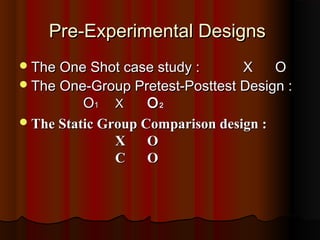
Pre-Experimental DesignsPre-Experimental Designs
The One Shot case study :The One Shot case study : XX OO
The One-Group Pretest-Posttest Design :The One-Group Pretest-Posttest Design :
OO11 XX OO22
The Static Group Comparison design :The Static Group Comparison design :
XX OO
CC OO
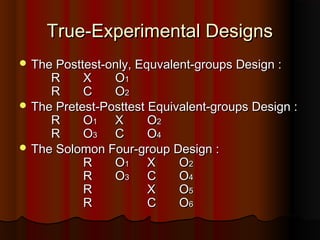
True-Experimental DesignsTrue-Experimental Designs
 The Posttest-only, Equvalent-groups Design :The Posttest-only, Equvalent-groups Design :
RR XX OO11
RR CC OO22
 The Pretest-Posttest Equivalent-groups Design :The Pretest-Posttest Equivalent-groups Design :
RR OO11 XX OO22
RR OO33 CC OO44
 The Solomon Four-group Design :The Solomon Four-group Design :
RR OO11 XX OO22
RR OO33 CC OO44
RR XX OO55
RR CC OO66
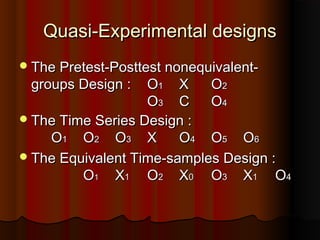
Quasi-Experimental designsQuasi-Experimental designs
The Pretest-Posttest nonequivalent-The Pretest-Posttest nonequivalent-
groups Design :groups Design : OO11 XX OO22
OO33 CC OO44
The Time Series Design :The Time Series Design :
OO11 OO22 OO33 XX OO44 OO55 OO66
The Equivalent Time-samples Design :The Equivalent Time-samples Design :
OO11 XX11 OO22 XX00 OO33 XX11 OO44
HISTORICAL METHODHISTORICAL METHOD
Dr. Manashee GogoiDr. Manashee Gogoi
Department of EducationDepartment of Education
Dibrugarh UniversityDibrugarh University
DefinitionsDefinitions
Historical research describesHistorical research describes what waswhat was..
The process involves investigating,The process involves investigating,
recording, analyzing and interpreting therecording, analyzing and interpreting the
events of the past for the purpose ofevents of the past for the purpose of
discovering generalisations that arediscovering generalisations that are
helpful in understanding the past and thehelpful in understanding the past and the
present, and to a limited extent, inpresent, and to a limited extent, in
anticipating the future. (Best and Kahn,anticipating the future. (Best and Kahn,
1989)1989)
Historical research refers to the applicationHistorical research refers to the application
of scientific method to the description andof scientific method to the description and
analysis of past events. (Singh, 1997)analysis of past events. (Singh, 1997)
Nature of Historical ResearchNature of Historical Research
 Historical research attempts to establish facts soHistorical research attempts to establish facts so
as to arrive at conclusions concerning pastas to arrive at conclusions concerning past
events.events.
 It includes interpretation of past events and theirIt includes interpretation of past events and their
relevance to present circumstances and whatrelevance to present circumstances and what
might happen in the future.might happen in the future.
 It provides an accurate account of the past so asIt provides an accurate account of the past so as
to gain a clearer perspective of the present.to gain a clearer perspective of the present.
Historical research includes theHistorical research includes the
delimitation of a problem, formulatingdelimitation of a problem, formulating
hypotheses or tentative generalisations,hypotheses or tentative generalisations,
gathering and analyzing data, and arrivinggathering and analyzing data, and arriving
at conclusions or generalisations basedat conclusions or generalisations based
upon deductive-inductive reasoning.upon deductive-inductive reasoning.
It lacks control over both treatment andIt lacks control over both treatment and
measurement of data.measurement of data.
It has little control over sampling and hasIt has little control over sampling and has
no opportunity for replication.no opportunity for replication.
Types of Historical ResearchTypes of Historical Research
Bibliographical ResearchBibliographical Research
Legal ResearchLegal Research
Studying the History of IdeasStudying the History of Ideas
Studying the History of Institutions andStudying the History of Institutions and
OrganisationsOrganisations
Bibliographical ResearchBibliographical Research
Bibliographical research aims atBibliographical research aims at
determining and presenting truthfully thedetermining and presenting truthfully the
important facts about the life, character,important facts about the life, character,
and achievements of important educators.and achievements of important educators.
Example: Studies on the contributions ofExample: Studies on the contributions of
Gandhiji, Tagore and other educationistsGandhiji, Tagore and other educationists
and their influence on current educationaland their influence on current educational
practice and thought.practice and thought.
Legal ResearchLegal Research
 Legal research aims at studying the legal basisLegal research aims at studying the legal basis
of educational institutions run by differentof educational institutions run by different
religions and castes, relation between centralreligions and castes, relation between central
and state governments with regard to education,and state governments with regard to education,
legal status of teachers and students,legal status of teachers and students,
administration of private aided schools, schooladministration of private aided schools, school
finance, participation of students in thefinance, participation of students in the
administration of universities, etc. Legaladministration of universities, etc. Legal
research needs special training in the field ofresearch needs special training in the field of
law.law.
Studying the History of IdeasStudying the History of Ideas
It involves the tracing of majorIt involves the tracing of major
philosophical or scientific thoughts fromphilosophical or scientific thoughts from
their origins through their different stagestheir origins through their different stages
of development.of development.
It also aims at tracing of changes inIt also aims at tracing of changes in
popular thoughts and attitudes over apopular thoughts and attitudes over a
given period of time.given period of time.
Studying the History of InstitutionsStudying the History of Institutions
and organisationsand organisations
It includes the study of some prominentIt includes the study of some prominent
schools, universities and other educationalschools, universities and other educational
institutions.institutions.
Steps involved in Historical ResearchSteps involved in Historical Research
 Selection of the problemSelection of the problem
 Formulation of hypothesesFormulation of hypotheses
 Collection of data:Collection of data:
a) Primary Sourcesa) Primary Sources
b) Secondary Sourcesb) Secondary Sources
 Criticism of data:Criticism of data:
a) External Criticisma) External Criticism
b) Internal Criticismb) Internal Criticism
 Interpretation dataInterpretation data
 Reporting of findingsReporting of findings
Primary SourcesPrimary Sources
Primary sources are eyewitness accountsPrimary sources are eyewitness accounts
of events reported by an actual observer orof events reported by an actual observer or
participant in an event. The originalparticipant in an event. The original
documents come under the category ofdocuments come under the category of
primary sources. They are available inprimary sources. They are available in
written, pictorial and mechanical formswritten, pictorial and mechanical forms
such as personal records, official records,such as personal records, official records,
oral testimony of traditions and events,oral testimony of traditions and events,
pictorial records, remains or relics, etc.pictorial records, remains or relics, etc.
Secondary SourcesSecondary Sources
Secondary sources are the accounts of anSecondary sources are the accounts of an
event provided by a person who did notevent provided by a person who did not
directly observe the event, object, ordirectly observe the event, object, or
condition.condition.
Secondary sources are discussions onSecondary sources are discussions on
past written by persons who have hadpast written by persons who have had
either directly or indirectly access toeither directly or indirectly access to
primary sources.primary sources.
Criticism of DataCriticism of Data
The process of establishing theThe process of establishing the
authenticity of the sources and ofauthenticity of the sources and of
establishing the validity of its contents isestablishing the validity of its contents is
known as criticism of data.known as criticism of data.
External CriticismExternal Criticism
External criticism is one which establishesExternal criticism is one which establishes
the authenticity or genuineness of thethe authenticity or genuineness of the
historical data.historical data.
It helps to determine whether it is what itIt helps to determine whether it is what it
appears or claims to be and whether itappears or claims to be and whether it
reads to be original.reads to be original.
The purpose of external criticism is theThe purpose of external criticism is the
‘establishment of historical truth’.‘establishment of historical truth’.
(Mouly,1963).(Mouly,1963).
Testing authenticity involves suchTesting authenticity involves such
techniques as authentication oftechniques as authentication of
signatures, handwriting, script; chemicalsignatures, handwriting, script; chemical
analysis of paint, carbon dating ofanalysis of paint, carbon dating of
artifacts, ink, paper, cloth, stone, metals,artifacts, ink, paper, cloth, stone, metals,
wood, etc.wood, etc.
It tries to establish whether or not theseIt tries to establish whether or not these
elements are consistent with known factselements are consistent with known facts
about the person, knowledge availableabout the person, knowledge available
and the technology of the period fromand the technology of the period from
which remains have been obtained.which remains have been obtained.
Internal CriticismInternal Criticism
 The process of establishing the validity of the content isThe process of establishing the validity of the content is
termed as internal criticism.termed as internal criticism.
 Internal criticism is one in which the historian tries toInternal criticism is one in which the historian tries to
evaluate accuracy or worth of the data.evaluate accuracy or worth of the data.
 It is concerned with the validity, credibility, or worth of theIt is concerned with the validity, credibility, or worth of the
content of the document.content of the document.
 It tries to establish whether the writers of the data wereIt tries to establish whether the writers of the data were
honest, unbiased and actually acquainted with facts orhonest, unbiased and actually acquainted with facts or
whether they were themselves biased or too antagonisticwhether they were themselves biased or too antagonistic
or too sympathetic to a true picture, whether they were inor too sympathetic to a true picture, whether they were in
agreement with other competent authority of that period,agreement with other competent authority of that period,
whether they wrote about the events freely or werewhether they wrote about the events freely or were
under pressure.under pressure.
Interpretation of DataInterpretation of Data
 For interpretation of data in historical research,For interpretation of data in historical research,
ingenuity and imagination is necessary on theingenuity and imagination is necessary on the
part of the researcher.part of the researcher.
 Interpretation of data includes determining theInterpretation of data includes determining the
trends which the data may suggest and drawingtrends which the data may suggest and drawing
inferences from the data.inferences from the data.
 It makes use of analogy in the interpretation ofIt makes use of analogy in the interpretation of
historical data.historical data.
 It makes use of similarities and differences inIt makes use of similarities and differences in
comparing one historical event with another.comparing one historical event with another.
Writing of Research ReportWriting of Research Report
 The report of historical research includes aThe report of historical research includes a
statement of the problem, a review of thestatement of the problem, a review of the
literature, the statement of the objectives andliterature, the statement of the objectives and
hypotheses, survey and sources of data, andhypotheses, survey and sources of data, and
methods of collection, organisation, classificationmethods of collection, organisation, classification
and ordering of data; the criticism; analysis andand ordering of data; the criticism; analysis and
interpretation of data, the conclusions reachedinterpretation of data, the conclusions reached
and a bibliography.and a bibliography.
 The style of writing research report should beThe style of writing research report should be
objective and systematic; and free fromobjective and systematic; and free from
distortion.distortion.
The historical research report must beThe historical research report must be
presented in the logical, chronological andpresented in the logical, chronological and
topical order.topical order.
It must be precise, continuous, clear andIt must be precise, continuous, clear and
complete.complete.
SynopsisSynopsis
IntroductionIntroduction
Review of related literatureReview of related literature
Significance of the studySignificance of the study
Title of the studyTitle of the study
ObjectivesObjectives
HypothesesHypotheses
Definitions of the terms usedDefinitions of the terms used
Methods and proceduresMethods and procedures
i) Methodi) Method
ii) Populationii) Population
iii) Sampleiii) Sample
iv) Tools to be usediv) Tools to be used
v) Collection of datav) Collection of data
vi) Analysis of datavi) Analysis of data
Delimitations of the studyDelimitations of the study
ChapterisationChapterisation
Descriptive MethodDescriptive Method
Descriptive method provides a method ofDescriptive method provides a method of
investigation to study, describe andinvestigation to study, describe and
interpret what exists at present.interpret what exists at present.
Nature of Descriptive ResearchNature of Descriptive Research
Descriptive research studies are designedDescriptive research studies are designed
to obtain pertinent and precise informationto obtain pertinent and precise information
concerning the current status ofconcerning the current status of
phenomena.phenomena.
It is concerned with drawing valid generalIt is concerned with drawing valid general
conclusions from the facts discovered.conclusions from the facts discovered.
It involves measurement, classification,It involves measurement, classification,
analysis, comparison, and interpretation ofanalysis, comparison, and interpretation of
data.data.
 It investigates phenomena in their natural setting.It investigates phenomena in their natural setting.
 Descriptive research provides mainly three typesDescriptive research provides mainly three types
of information:of information:
i) of what exists with respect to variables ori) of what exists with respect to variables or
conditions in a situation.conditions in a situation.
ii) of what we want by identifying standards orii) of what we want by identifying standards or
norms with which to compare the presentnorms with which to compare the present
conditions or what experts consider to beconditions or what experts consider to be
desirable.desirable.
iii) of how to achieve goals by exploring possibleiii) of how to achieve goals by exploring possible
ways and means on the basis of the experienceways and means on the basis of the experience
of others or opinion of experts.of others or opinion of experts.
Types of Descriptive ResearchTypes of Descriptive Research
Survey StudiesSurvey Studies
Interrelationship StudiesInterrelationship Studies
Developmental StudiesDevelopmental Studies
Survey StudiesSurvey Studies
 Survey studies are conducted to collect detailedSurvey studies are conducted to collect detailed
descriptions of existing phenomena with thedescriptions of existing phenomena with the
intent of employing data to justify currentintent of employing data to justify current
conditions and practices or to make moreconditions and practices or to make more
intelligent plans for improving them. ( Koul,intelligent plans for improving them. ( Koul,
1988)1988)
 The objectives of survey studies are:The objectives of survey studies are:
i) to analyze, interpret, and report the status ofi) to analyze, interpret, and report the status of
an institution, group, or area in order to guidean institution, group, or area in order to guide
practice in the immediate future.practice in the immediate future.
ii) to determine the adequacy of status byii) to determine the adequacy of status by
comparing it with established standards.comparing it with established standards.
Case StudyCase Study
 The case study is an intensive and in depthThe case study is an intensive and in depth
investigation of a social unit. The unit may be aninvestigation of a social unit. The unit may be an
individual, a family, a school, an institution, aindividual, a family, a school, an institution, a
group of delinquents, etc.group of delinquents, etc.
 The element of typical ness, rather thanThe element of typical ness, rather than
uniqueness, is the focus of attention.uniqueness, is the focus of attention.
 A ‘case’ is not only about a person but alsoA ‘case’ is not only about a person but also
about that ‘kind of person’. A case is an exampleabout that ‘kind of person’. A case is an example
of, perhaps even a prototype for, a category ofof, perhaps even a prototype for, a category of
individuals. (Bromley,1986)individuals. (Bromley,1986)
It is a longitudinal approach, showingIt is a longitudinal approach, showing
development over a period of time.development over a period of time.
The case study is a way of organizingThe case study is a way of organizing
social data for the purpose of viewingsocial data for the purpose of viewing
social reality.social reality.
The purpose of case study is toThe purpose of case study is to
understand the life cycle or an importantunderstand the life cycle or an important
part of the life cycle of the unit.part of the life cycle of the unit.
Steps followed in the Case StudySteps followed in the Case Study
Method:Method:
Determining the present status ofDetermining the present status of
the unit chosen:the unit chosen:
Formulation of hypothesesFormulation of hypotheses : To: To
determine the most probable antecedentsdetermine the most probable antecedents
of the case and to formulate a fruitfulof the case and to formulate a fruitful
hypothesis or set of hypotheses throughhypothesis or set of hypotheses through
the knowledge of similar cases.the knowledge of similar cases.
Verification of the HypothesesVerification of the Hypotheses ::
Validation of the diagnosisValidation of the diagnosis : After: After
verification of the hypotheses, the nextverification of the hypotheses, the next
step is directed towards further validationstep is directed towards further validation
of the diagnosis. In this step, someof the diagnosis. In this step, some
remadial measures are suggested in theremadial measures are suggested in the
light of the causes found.light of the causes found.
Follow upFollow up: The case study is re-: The case study is re-
examined to ascertain whether anyexamined to ascertain whether any
changes have been produced by thechanges have been produced by the
treatment introduced. If the changes istreatment introduced. If the changes is
positive and significant, the diagnosis ispositive and significant, the diagnosis is
taken to be correct.taken to be correct.
Ethnographic ResearchEthnographic Research
A)A) Ethnos: A Greek word for people, race of culturalEthnos: A Greek word for people, race of cultural
group.group.
B)B) Ethnography: Descriptive account of people of race orEthnography: Descriptive account of people of race or
cultural group of descriptive anthropology.cultural group of descriptive anthropology.
C)C) Ethnographic Research: This type of research isEthnographic Research: This type of research is
concerned with studying a social group and giving itsconcerned with studying a social group and giving its
cultural description.cultural description.
D)D) The Ethnographic research method is characterizedThe Ethnographic research method is characterized
by:by:
i) Strong emphasis on EXPLORATION rather than toi) Strong emphasis on EXPLORATION rather than to
test hypothesis.test hypothesis.
ii) Need to be OPEN to elements that cannot be codedii) Need to be OPEN to elements that cannot be coded
before. Data is UNSTRUCTURED.before. Data is UNSTRUCTURED.
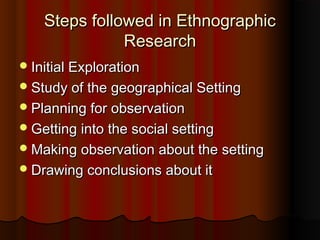
Steps followed in EthnographicSteps followed in Ethnographic
ResearchResearch
Initial ExplorationInitial Exploration
Study of the geographical SettingStudy of the geographical Setting
Planning for observationPlanning for observation
Getting into the social settingGetting into the social setting
Making observation about the settingMaking observation about the setting
Drawing conclusions about itDrawing conclusions about it
Content AnalysisContent Analysis
 Content analysis is a research technique for theContent analysis is a research technique for the
objective, systematic and quantitativeobjective, systematic and quantitative
description of the manifest content ofdescription of the manifest content of
communication. (Berelson, 1952)communication. (Berelson, 1952)
 Content analysis is a method of social researchContent analysis is a method of social research
that aims at the analysis of content-qualitativethat aims at the analysis of content-qualitative
and/or quantitative-of documents, books,and/or quantitative-of documents, books,
newspapers, magazines and other forms ofnewspapers, magazines and other forms of
written materials. (Ahuja, 2003)written materials. (Ahuja, 2003)
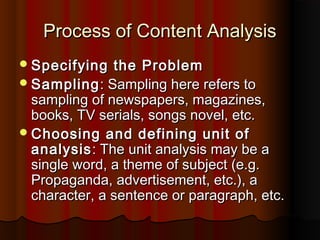
Process of Content AnalysisProcess of Content Analysis
Specifying the ProblemSpecifying the Problem
SamplingSampling: Sampling here refers to: Sampling here refers to
sampling of newspapers, magazines,sampling of newspapers, magazines,
books, TV serials, songs novel, etc.books, TV serials, songs novel, etc.
Choosing and defining unit ofChoosing and defining unit of
analysisanalysis: The unit analysis may be a: The unit analysis may be a
single word, a theme of subject (e.g.single word, a theme of subject (e.g.
Propaganda, advertisement, etc.), aPropaganda, advertisement, etc.), a
character, a sentence or paragraph, etc.character, a sentence or paragraph, etc.
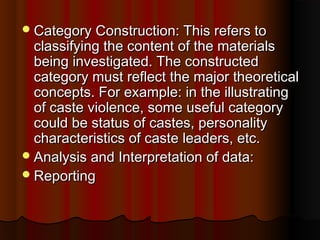
Category Construction: This refers toCategory Construction: This refers to
classifying the content of the materialsclassifying the content of the materials
being investigated. The constructedbeing investigated. The constructed
category must reflect the major theoreticalcategory must reflect the major theoretical
concepts. For example: in the illustratingconcepts. For example: in the illustrating
of caste violence, some useful categoryof caste violence, some useful category
could be status of castes, personalitycould be status of castes, personality
characteristics of caste leaders, etc.characteristics of caste leaders, etc.
Analysis and Interpretation of data:Analysis and Interpretation of data:
ReportingReporting
Causal-comparative Studies or ExCausal-comparative Studies or Ex
post facto Researchpost facto Research
 Ex post facto research is systematic empiricalEx post facto research is systematic empirical
inquiry in which the scientist does not haveinquiry in which the scientist does not have
direct control of independent variables becausedirect control of independent variables because
their manifestations have already occurred ortheir manifestations have already occurred or
they are inherently not manipulable. Inferencesthey are inherently not manipulable. Inferences
about relations among variables are made,about relations among variables are made,
without direct intervention, from concomitantwithout direct intervention, from concomitant
variation of independent and dependentvariation of independent and dependent
variables. (Kerlinger,1983)variables. (Kerlinger,1983)
Correlation and PredictionCorrelation and Prediction
StudiesStudies
This type of research is concerned withThis type of research is concerned with
determining the extent of relationshipdetermining the extent of relationship
existing between variables. They are usedexisting between variables. They are used
to obtain description of existingto obtain description of existing
phenomenon and enable a researcher tophenomenon and enable a researcher to
ascertain the extent to which variations inascertain the extent to which variations in
one variable are associated with variationsone variable are associated with variations
in another. The magnitude of thein another. The magnitude of the
relationship is determined through the userelationship is determined through the use
of coefficient of correlation.of coefficient of correlation.
Developmental StudiesDevelopmental Studies
Developmental studies are used forDevelopmental studies are used for
investigating the characteristics of childreninvestigating the characteristics of children
and the ways in which theseand the ways in which these
characteristics change with growth andcharacteristics change with growth and
development. Such studies are concerneddevelopment. Such studies are concerned
not only with the present status andnot only with the present status and
interrelationships of phenomena but withinterrelationships of phenomena but with
changes that take place as a function ofchanges that take place as a function of
time.time.
Phenomenological ResearchPhenomenological Research
 It was first propounded by Edmund Husserl.It was first propounded by Edmund Husserl.
 The aim of phenomenology is to study humanThe aim of phenomenology is to study human
phenomena without considering questions ofphenomena without considering questions of
their causes, their objective reality, or even theirtheir causes, their objective reality, or even their
appearances.appearances.
 The aim is to study how human phenomena areThe aim is to study how human phenomena are
experienced in consciousness, in cognitive andexperienced in consciousness, in cognitive and
perceptual acts, as well as how they may beperceptual acts, as well as how they may be
valued or appreciated aesthetically.valued or appreciated aesthetically.
 Phenomenology seeks to understand howPhenomenology seeks to understand how
persons construct meaning and key concept ispersons construct meaning and key concept is
inter-subjectivity.inter-subjectivity.
 In phenomenology, personal experience is theIn phenomenology, personal experience is the
starting point. The source of personal experiencestarting point. The source of personal experience
is a description or account of the livedis a description or account of the lived
experience.experience.
 It consists of six research activities:It consists of six research activities:
i) Turning to a phenomenon which seriouslyi) Turning to a phenomenon which seriously
interests us and commits us to the world.interests us and commits us to the world.
ii) Investigating experience as we live rather thanii) Investigating experience as we live rather than
as we conceptualize it.as we conceptualize it.
iii) Reflecting on the essential themesiii) Reflecting on the essential themes
which characterize the phenomenon.which characterize the phenomenon.
iv) Describing the phenomenon throughiv) Describing the phenomenon through
the art of writing and rewriting.the art of writing and rewriting.
v) Manipulating a strong and orientedv) Manipulating a strong and oriented
pedagogical relation to the phenomenon.pedagogical relation to the phenomenon.
vi) Balancing the research context byvi) Balancing the research context by
considering parts and whole.considering parts and whole.
 To produce lived-experience descriptions, vanTo produce lived-experience descriptions, van
Manen suggests:Manen suggests:
i) You need to describe the experience as youi) You need to describe the experience as you
live (d) through it avoiding as much as possiblelive (d) through it avoiding as much as possible
causal explanations, generalisations, or abstractcausal explanations, generalisations, or abstract
interpretations.interpretations.

ii) Describe experience from inside as it were;ii) Describe experience from inside as it were;
almost like a state of mind: the feeling, thealmost like a state of mind: the feeling, the
mood, the emotions, etc.mood, the emotions, etc.
iii) Focus on a particular example or incident ofiii) Focus on a particular example or incident of
the object of the experience: describe specificthe object of the experience: describe specific
events, an adventure, a happening, a particularevents, an adventure, a happening, a particular
experience.experience.
Try to focus on an example of theTry to focus on an example of the
experience which stands out for itsexperience which stands out for its
vividness, or as it was the first time.vividness, or as it was the first time.
Attend to how the body feels, how thingsAttend to how the body feels, how things
smell, how they sound, etc.smell, how they sound, etc.
Avoid trying to beautify your account withAvoid trying to beautify your account with
fancy phrases or flowery terminology.fancy phrases or flowery terminology.

Experimental method

  • 1.
    EXPERIMENTAL METHODEXPERIMENTAL METHOD MukutHazarikaMukut Hazarika ProfessorProfessor Department of EducationDepartment of Education Dibrugarh UniversityDibrugarh University
  • 2.
    DefinitionsDefinitions ““Experimentation is thename given to theExperimentation is the name given to the type of educational research in which thetype of educational research in which the investigator controls the educative factorsinvestigator controls the educative factors to which a child or a group of children isto which a child or a group of children is subjected during the period of inquiry andsubjected during the period of inquiry and observed the resulting achievement.”observed the resulting achievement.” W.S. Monroe and M.D. EnglehartW.S. Monroe and M.D. Englehart
  • 3.
    ““ Experimental Researchis theExperimental Research is the description and analysis of what willdescription and analysis of what will be or what will occur, under carefullybe or what will occur, under carefully controlled conditions.”controlled conditions.” J.W. BestJ.W. Best
  • 4.
    Nature of ExperimentalMethodNature of Experimental Method  Experimentation provides a method ofExperimentation provides a method of hypothesis testing. After defining the problem, ahypothesis testing. After defining the problem, a tentative answer or hypothesis is formulated.tentative answer or hypothesis is formulated.  Experimenters manipulates certain stimuli,Experimenters manipulates certain stimuli, treatments or environmental conditions andtreatments or environmental conditions and observe how the condition or behaviour of theobserve how the condition or behaviour of the subject is affected or changed.subject is affected or changed.  An experiment involves the comparison of theAn experiment involves the comparison of the effects of a particular treatment with that of aeffects of a particular treatment with that of a different treatment or no treatment.different treatment or no treatment.
  • 5.
    TERMS USEDTERMS USED VariablesVariables: Variables are the conditions: Variables are the conditions or characteristics that the experimenteror characteristics that the experimenter manipulates, controls or observes.manipulates, controls or observes. ManipulationManipulation : It refers to introduction,: It refers to introduction, removal or change of a variable.removal or change of a variable. IndependentIndependent VariableVariable : The conditions: The conditions or characteristics that the experimenteror characteristics that the experimenter manipulates or controls to ascertain theirmanipulates or controls to ascertain their relationship to observed phenomena.relationship to observed phenomena.
  • 6.
    TERMS USEDTERMS USED DependentDependent VariablesVariables : They are the: They are the conditions or characteristics that appear,conditions or characteristics that appear, disappear or change as the experimenterdisappear or change as the experimenter introduces, removes or changes theintroduces, removes or changes the independent variable.independent variable.  ConfoundingConfounding VariablesVariables : The conditions or: The conditions or characteristics in a study that might influence thecharacteristics in a study that might influence the dependent variable and whose effects may bedependent variable and whose effects may be confused with the effects of independentconfused with the effects of independent variables.variables.
  • 7.
    CHARACTERISTICS OFCHARACTERISTICS OF EXPERIMENTALRESEARCHEXPERIMENTAL RESEARCH ControlControl ManipulationManipulation ObservationObservation ReplicationReplication
  • 8.
    CONTROLCONTROL Control refers tothe extent to which differentControl refers to the extent to which different factors in an experiment are accountedfactors in an experiment are accounted for. Variables that are not of direct interestfor. Variables that are not of direct interest to the researcher are removed or theirto the researcher are removed or their influence is minimized. The purpose ofinfluence is minimized. The purpose of control in an experiment is to arrange acontrol in an experiment is to arrange a situation in which the effect of variablessituation in which the effect of variables under consideration may be accuratelyunder consideration may be accurately measured.measured.
  • 9.
    Purpose of ControlPurposeof Control Achieving IsolationAchieving Isolation Achieving Changes in MagnitudeAchieving Changes in Magnitude Achieving Quantitative EvaluationAchieving Quantitative Evaluation
  • 10.
    Methods of ControllingConfoundingMethods of Controlling Confounding VariablesVariables Methods of Controlling Inter-SubjectMethods of Controlling Inter-Subject DifferencesDifferences Methods of Controlling SituationalMethods of Controlling Situational VariablesVariables
  • 11.
    Methods of ControllingInter-SubjectMethods of Controlling Inter-Subject DifferencesDifferences  Random Assignment of Subjects to GroupsRandom Assignment of Subjects to Groups  Random Assignment on the basis ofRandom Assignment on the basis of Homogeneous SelectionHomogeneous Selection  Technique of Analysis of Co-VarianceTechnique of Analysis of Co-Variance  Method of using Subjects as their own ControlsMethod of using Subjects as their own Controls  Matching Subjects with Random AssignmentMatching Subjects with Random Assignment  Procedure of Subject to subject MatchingProcedure of Subject to subject Matching  Matching for Mean and Standard DeviationMatching for Mean and Standard Deviation  Ranking of Subjects in the Matching VariableRanking of Subjects in the Matching Variable
  • 12.
    Random Assignment ofSubjects toRandom Assignment of Subjects to GroupsGroups Selecting the two samples from theSelecting the two samples from the population using simple random sampling.population using simple random sampling.
  • 13.
    Random Assignment onthe basis ofRandom Assignment on the basis of Homogenous SelectionHomogenous Selection In certain case, the groups are madeIn certain case, the groups are made homogenous in the confounding variableshomogenous in the confounding variables and two groups are selected randomly.and two groups are selected randomly. For example, in an experiment the sex is aFor example, in an experiment the sex is a confounding variable. In such case bothconfounding variable. In such case both the groups are made equivalent bythe groups are made equivalent by selecting only boys or girls.selecting only boys or girls.
  • 14.
    Techniques of AnalysisofTechniques of Analysis of CovarianceCovariance The technique of analysis of co-variance isThe technique of analysis of co-variance is used to control the variation within theused to control the variation within the groups. This technique analyses thegroups. This technique analyses the differences between the two groups,differences between the two groups, subjected to two different experimentalsubjected to two different experimental treatments, on the dependent variabletreatments, on the dependent variable after taking into account any initialafter taking into account any initial difference between the groups on pretestdifference between the groups on pretest measures or any other relevantmeasures or any other relevant independent variables.independent variables.
  • 15.
    Method of usingSubjects as theirMethod of using Subjects as their own Controlown Control Here the method of control is to assign theHere the method of control is to assign the same subjects to two experimentalsame subjects to two experimental treatments and then to obtaintreatments and then to obtain measurements of the subjects first undermeasurements of the subjects first under one treatment and then under the other. Inone treatment and then under the other. In other words, here the same group is usedother words, here the same group is used as both experimental and control group.as both experimental and control group.
  • 16.
    Matching Subjects withRandomMatching Subjects with Random AssignmentsAssignments Procedure of Subject-to-subjectProcedure of Subject-to-subject MatchingMatching or Matching by Pairor Matching by Pair : In this: In this method the researcher wants to locate twomethod the researcher wants to locate two members ( or pairs of subjects) from themembers ( or pairs of subjects) from the available subjects who obtain equalavailable subjects who obtain equal scores in the measurement of confoundingscores in the measurement of confounding variable. Then from each pair, put one invariable. Then from each pair, put one in one group and other in the other groupone group and other in the other group using lottery method.using lottery method.
  • 17.
     Matching forMeanMatching for Mean : The two groups are: The two groups are selected in such a way such that the mean andselected in such a way such that the mean and standard deviation of both the groups are equalstandard deviation of both the groups are equal on the matching variable.on the matching variable.  Matching Ranking of Subjects on theMatching Ranking of Subjects on the Variable:Variable: In this method the scores on theIn this method the scores on the confounding variable are arranged in ascendingconfounding variable are arranged in ascending or descending order. Then it is paired from theor descending order. Then it is paired from the above as 1 and 2; 3 and 4; and so on. From theabove as 1 and 2; 3 and 4; and so on. From the first pair, the 1first pair, the 1stst is placed in 1is placed in 1stst group (say group-group (say group- A) and the 2A) and the 2ndnd is placed in 2is placed in 2ndnd group (say group-B)group (say group-B) and so on.and so on.
  • 18.
    Methods of ControllingSituationalMethods of Controlling Situational VariablesVariables Method of Holding Situational VariableMethod of Holding Situational Variable ConstantConstant Method of RandomizationMethod of Randomization Method of Manipulating SituationalMethod of Manipulating Situational VariablesVariables
  • 19.
    ManipulationManipulation  It refersto a deliberate operation of the conditions by theIt refers to a deliberate operation of the conditions by the researcher. It involves intentional introduction, removalresearcher. It involves intentional introduction, removal or change of the condition (variable).or change of the condition (variable).  An experiment involves the comparison of the effects ofAn experiment involves the comparison of the effects of a particular treatment with that of a different treatment ora particular treatment with that of a different treatment or of no treatment.of no treatment.  Usually, two groups are made – Experimental andUsually, two groups are made – Experimental and Control Group. These groups are equated as nearly asControl Group. These groups are equated as nearly as possible. The experimental group is exposed to thepossible. The experimental group is exposed to the influence of the factor under consideration; the controlinfluence of the factor under consideration; the control group is not.group is not.  The treatment variable is the independent variable.The treatment variable is the independent variable.
  • 20.
    ObservationObservation In experimental research,the researcherIn experimental research, the researcher studies the effect of the manipulation ofstudies the effect of the manipulation of the independent variable on thethe independent variable on the dependent variable. The researcherdependent variable. The researcher records the change, appearance andrecords the change, appearance and disappearance of the dependent variabledisappearance of the dependent variable with the change, introduction or removal ofwith the change, introduction or removal of the independent variable.the independent variable.
  • 21.
    ReplicationReplication Replication is amatter of conducting aReplication is a matter of conducting a number of sub-experiments within thenumber of sub-experiments within the framework of an overall experimentalframework of an overall experimental designdesign
  • 22.
    Steps in ExperimentalResearchSteps in Experimental Research  Surveying the Literature Relating to the ProblemSurveying the Literature Relating to the Problem  Selecting and Defining the ProblemSelecting and Defining the Problem  Stating of HypothesisStating of Hypothesis  Constructing the Experimental planConstructing the Experimental plan  Identifying all non-experimental variables and controllingIdentifying all non-experimental variables and controlling themthem  Selecting a research designSelecting a research design  Manipulating the treatment variableManipulating the treatment variable  Selecting/constructing instruments to measure the outcomesSelecting/constructing instruments to measure the outcomes  Outlining procedures for collecting dataOutlining procedures for collecting data  Testing the null hypothesis.Testing the null hypothesis.
  • 23.
    EXPERIMENTAL DESIGNEXPERIMENTAL DESIGN ““ExperimentalDesign is the blueprint ofExperimental Design is the blueprint of the procedures that enable the researcherthe procedures that enable the researcher to test hypotheses by reaching validto test hypotheses by reaching valid conclusions about relationships betweenconclusions about relationships between independent and dependent variables.independent and dependent variables. Selection of a particular design is basedSelection of a particular design is based upon the purposes of the experiment, theupon the purposes of the experiment, the type of variables to be manipulated, andtype of variables to be manipulated, and the conditions or limiting factors underthe conditions or limiting factors under which it is constructed.”which it is constructed.” Best & KahnBest & Kahn
  • 24.
    Experimental Design TellsUsExperimental Design Tells Us How subjects are to be assigned to theHow subjects are to be assigned to the Experimental and the Control GroupExperimental and the Control Group The way variables are to be manipulatedThe way variables are to be manipulated The way confounding variables are to beThe way confounding variables are to be controlledcontrolled How observations are to be madeHow observations are to be made The type of statistical analysis to beThe type of statistical analysis to be employed in interpreting data.employed in interpreting data.
  • 25.
    Pre-Experimental DesignsPre-Experimental Designs TheOne Shot case study :The One Shot case study : XX OO The One-Group Pretest-Posttest Design :The One-Group Pretest-Posttest Design : OO11 XX OO22 The Static Group Comparison design :The Static Group Comparison design : XX OO CC OO
  • 26.
    True-Experimental DesignsTrue-Experimental Designs The Posttest-only, Equvalent-groups Design :The Posttest-only, Equvalent-groups Design : RR XX OO11 RR CC OO22  The Pretest-Posttest Equivalent-groups Design :The Pretest-Posttest Equivalent-groups Design : RR OO11 XX OO22 RR OO33 CC OO44  The Solomon Four-group Design :The Solomon Four-group Design : RR OO11 XX OO22 RR OO33 CC OO44 RR XX OO55 RR CC OO66
  • 27.
    Quasi-Experimental designsQuasi-Experimental designs ThePretest-Posttest nonequivalent-The Pretest-Posttest nonequivalent- groups Design :groups Design : OO11 XX OO22 OO33 CC OO44 The Time Series Design :The Time Series Design : OO11 OO22 OO33 XX OO44 OO55 OO66 The Equivalent Time-samples Design :The Equivalent Time-samples Design : OO11 XX11 OO22 XX00 OO33 XX11 OO44
  • 28.
    HISTORICAL METHODHISTORICAL METHOD Dr.Manashee GogoiDr. Manashee Gogoi Department of EducationDepartment of Education Dibrugarh UniversityDibrugarh University
  • 29.
    DefinitionsDefinitions Historical research describesHistoricalresearch describes what waswhat was.. The process involves investigating,The process involves investigating, recording, analyzing and interpreting therecording, analyzing and interpreting the events of the past for the purpose ofevents of the past for the purpose of discovering generalisations that arediscovering generalisations that are helpful in understanding the past and thehelpful in understanding the past and the present, and to a limited extent, inpresent, and to a limited extent, in anticipating the future. (Best and Kahn,anticipating the future. (Best and Kahn, 1989)1989)
  • 30.
    Historical research refersto the applicationHistorical research refers to the application of scientific method to the description andof scientific method to the description and analysis of past events. (Singh, 1997)analysis of past events. (Singh, 1997)
  • 31.
    Nature of HistoricalResearchNature of Historical Research  Historical research attempts to establish facts soHistorical research attempts to establish facts so as to arrive at conclusions concerning pastas to arrive at conclusions concerning past events.events.  It includes interpretation of past events and theirIt includes interpretation of past events and their relevance to present circumstances and whatrelevance to present circumstances and what might happen in the future.might happen in the future.  It provides an accurate account of the past so asIt provides an accurate account of the past so as to gain a clearer perspective of the present.to gain a clearer perspective of the present.
  • 32.
    Historical research includestheHistorical research includes the delimitation of a problem, formulatingdelimitation of a problem, formulating hypotheses or tentative generalisations,hypotheses or tentative generalisations, gathering and analyzing data, and arrivinggathering and analyzing data, and arriving at conclusions or generalisations basedat conclusions or generalisations based upon deductive-inductive reasoning.upon deductive-inductive reasoning. It lacks control over both treatment andIt lacks control over both treatment and measurement of data.measurement of data. It has little control over sampling and hasIt has little control over sampling and has no opportunity for replication.no opportunity for replication.
  • 33.
    Types of HistoricalResearchTypes of Historical Research Bibliographical ResearchBibliographical Research Legal ResearchLegal Research Studying the History of IdeasStudying the History of Ideas Studying the History of Institutions andStudying the History of Institutions and OrganisationsOrganisations
  • 34.
    Bibliographical ResearchBibliographical Research Bibliographicalresearch aims atBibliographical research aims at determining and presenting truthfully thedetermining and presenting truthfully the important facts about the life, character,important facts about the life, character, and achievements of important educators.and achievements of important educators. Example: Studies on the contributions ofExample: Studies on the contributions of Gandhiji, Tagore and other educationistsGandhiji, Tagore and other educationists and their influence on current educationaland their influence on current educational practice and thought.practice and thought.
  • 35.
    Legal ResearchLegal Research Legal research aims at studying the legal basisLegal research aims at studying the legal basis of educational institutions run by differentof educational institutions run by different religions and castes, relation between centralreligions and castes, relation between central and state governments with regard to education,and state governments with regard to education, legal status of teachers and students,legal status of teachers and students, administration of private aided schools, schooladministration of private aided schools, school finance, participation of students in thefinance, participation of students in the administration of universities, etc. Legaladministration of universities, etc. Legal research needs special training in the field ofresearch needs special training in the field of law.law.
  • 36.
    Studying the Historyof IdeasStudying the History of Ideas It involves the tracing of majorIt involves the tracing of major philosophical or scientific thoughts fromphilosophical or scientific thoughts from their origins through their different stagestheir origins through their different stages of development.of development. It also aims at tracing of changes inIt also aims at tracing of changes in popular thoughts and attitudes over apopular thoughts and attitudes over a given period of time.given period of time.
  • 37.
    Studying the Historyof InstitutionsStudying the History of Institutions and organisationsand organisations It includes the study of some prominentIt includes the study of some prominent schools, universities and other educationalschools, universities and other educational institutions.institutions.

  • 38.
    Steps involved inHistorical ResearchSteps involved in Historical Research  Selection of the problemSelection of the problem  Formulation of hypothesesFormulation of hypotheses  Collection of data:Collection of data: a) Primary Sourcesa) Primary Sources b) Secondary Sourcesb) Secondary Sources  Criticism of data:Criticism of data: a) External Criticisma) External Criticism b) Internal Criticismb) Internal Criticism  Interpretation dataInterpretation data  Reporting of findingsReporting of findings
  • 39.
    Primary SourcesPrimary Sources Primarysources are eyewitness accountsPrimary sources are eyewitness accounts of events reported by an actual observer orof events reported by an actual observer or participant in an event. The originalparticipant in an event. The original documents come under the category ofdocuments come under the category of primary sources. They are available inprimary sources. They are available in written, pictorial and mechanical formswritten, pictorial and mechanical forms such as personal records, official records,such as personal records, official records, oral testimony of traditions and events,oral testimony of traditions and events, pictorial records, remains or relics, etc.pictorial records, remains or relics, etc.
  • 40.
    Secondary SourcesSecondary Sources Secondarysources are the accounts of anSecondary sources are the accounts of an event provided by a person who did notevent provided by a person who did not directly observe the event, object, ordirectly observe the event, object, or condition.condition. Secondary sources are discussions onSecondary sources are discussions on past written by persons who have hadpast written by persons who have had either directly or indirectly access toeither directly or indirectly access to primary sources.primary sources.
  • 41.
    Criticism of DataCriticismof Data The process of establishing theThe process of establishing the authenticity of the sources and ofauthenticity of the sources and of establishing the validity of its contents isestablishing the validity of its contents is known as criticism of data.known as criticism of data.
  • 42.
    External CriticismExternal Criticism Externalcriticism is one which establishesExternal criticism is one which establishes the authenticity or genuineness of thethe authenticity or genuineness of the historical data.historical data. It helps to determine whether it is what itIt helps to determine whether it is what it appears or claims to be and whether itappears or claims to be and whether it reads to be original.reads to be original. The purpose of external criticism is theThe purpose of external criticism is the ‘establishment of historical truth’.‘establishment of historical truth’. (Mouly,1963).(Mouly,1963).
  • 43.
    Testing authenticity involvessuchTesting authenticity involves such techniques as authentication oftechniques as authentication of signatures, handwriting, script; chemicalsignatures, handwriting, script; chemical analysis of paint, carbon dating ofanalysis of paint, carbon dating of artifacts, ink, paper, cloth, stone, metals,artifacts, ink, paper, cloth, stone, metals, wood, etc.wood, etc. It tries to establish whether or not theseIt tries to establish whether or not these elements are consistent with known factselements are consistent with known facts about the person, knowledge availableabout the person, knowledge available and the technology of the period fromand the technology of the period from which remains have been obtained.which remains have been obtained.
  • 44.
    Internal CriticismInternal Criticism The process of establishing the validity of the content isThe process of establishing the validity of the content is termed as internal criticism.termed as internal criticism.  Internal criticism is one in which the historian tries toInternal criticism is one in which the historian tries to evaluate accuracy or worth of the data.evaluate accuracy or worth of the data.  It is concerned with the validity, credibility, or worth of theIt is concerned with the validity, credibility, or worth of the content of the document.content of the document.  It tries to establish whether the writers of the data wereIt tries to establish whether the writers of the data were honest, unbiased and actually acquainted with facts orhonest, unbiased and actually acquainted with facts or whether they were themselves biased or too antagonisticwhether they were themselves biased or too antagonistic or too sympathetic to a true picture, whether they were inor too sympathetic to a true picture, whether they were in agreement with other competent authority of that period,agreement with other competent authority of that period, whether they wrote about the events freely or werewhether they wrote about the events freely or were under pressure.under pressure.
  • 45.
    Interpretation of DataInterpretationof Data  For interpretation of data in historical research,For interpretation of data in historical research, ingenuity and imagination is necessary on theingenuity and imagination is necessary on the part of the researcher.part of the researcher.  Interpretation of data includes determining theInterpretation of data includes determining the trends which the data may suggest and drawingtrends which the data may suggest and drawing inferences from the data.inferences from the data.  It makes use of analogy in the interpretation ofIt makes use of analogy in the interpretation of historical data.historical data.  It makes use of similarities and differences inIt makes use of similarities and differences in comparing one historical event with another.comparing one historical event with another.
  • 46.
    Writing of ResearchReportWriting of Research Report  The report of historical research includes aThe report of historical research includes a statement of the problem, a review of thestatement of the problem, a review of the literature, the statement of the objectives andliterature, the statement of the objectives and hypotheses, survey and sources of data, andhypotheses, survey and sources of data, and methods of collection, organisation, classificationmethods of collection, organisation, classification and ordering of data; the criticism; analysis andand ordering of data; the criticism; analysis and interpretation of data, the conclusions reachedinterpretation of data, the conclusions reached and a bibliography.and a bibliography.  The style of writing research report should beThe style of writing research report should be objective and systematic; and free fromobjective and systematic; and free from distortion.distortion.
  • 47.
    The historical researchreport must beThe historical research report must be presented in the logical, chronological andpresented in the logical, chronological and topical order.topical order. It must be precise, continuous, clear andIt must be precise, continuous, clear and complete.complete.
  • 48.
    SynopsisSynopsis IntroductionIntroduction Review of relatedliteratureReview of related literature Significance of the studySignificance of the study Title of the studyTitle of the study ObjectivesObjectives HypothesesHypotheses Definitions of the terms usedDefinitions of the terms used
  • 49.
    Methods and proceduresMethodsand procedures i) Methodi) Method ii) Populationii) Population iii) Sampleiii) Sample iv) Tools to be usediv) Tools to be used v) Collection of datav) Collection of data vi) Analysis of datavi) Analysis of data Delimitations of the studyDelimitations of the study ChapterisationChapterisation
  • 50.
    Descriptive MethodDescriptive Method Descriptivemethod provides a method ofDescriptive method provides a method of investigation to study, describe andinvestigation to study, describe and interpret what exists at present.interpret what exists at present.
  • 51.
    Nature of DescriptiveResearchNature of Descriptive Research Descriptive research studies are designedDescriptive research studies are designed to obtain pertinent and precise informationto obtain pertinent and precise information concerning the current status ofconcerning the current status of phenomena.phenomena. It is concerned with drawing valid generalIt is concerned with drawing valid general conclusions from the facts discovered.conclusions from the facts discovered. It involves measurement, classification,It involves measurement, classification, analysis, comparison, and interpretation ofanalysis, comparison, and interpretation of data.data.
  • 52.
     It investigatesphenomena in their natural setting.It investigates phenomena in their natural setting.  Descriptive research provides mainly three typesDescriptive research provides mainly three types of information:of information: i) of what exists with respect to variables ori) of what exists with respect to variables or conditions in a situation.conditions in a situation. ii) of what we want by identifying standards orii) of what we want by identifying standards or norms with which to compare the presentnorms with which to compare the present conditions or what experts consider to beconditions or what experts consider to be desirable.desirable. iii) of how to achieve goals by exploring possibleiii) of how to achieve goals by exploring possible ways and means on the basis of the experienceways and means on the basis of the experience of others or opinion of experts.of others or opinion of experts.
  • 53.
    Types of DescriptiveResearchTypes of Descriptive Research Survey StudiesSurvey Studies Interrelationship StudiesInterrelationship Studies Developmental StudiesDevelopmental Studies
  • 54.
    Survey StudiesSurvey Studies Survey studies are conducted to collect detailedSurvey studies are conducted to collect detailed descriptions of existing phenomena with thedescriptions of existing phenomena with the intent of employing data to justify currentintent of employing data to justify current conditions and practices or to make moreconditions and practices or to make more intelligent plans for improving them. ( Koul,intelligent plans for improving them. ( Koul, 1988)1988)  The objectives of survey studies are:The objectives of survey studies are: i) to analyze, interpret, and report the status ofi) to analyze, interpret, and report the status of an institution, group, or area in order to guidean institution, group, or area in order to guide practice in the immediate future.practice in the immediate future. ii) to determine the adequacy of status byii) to determine the adequacy of status by comparing it with established standards.comparing it with established standards.
  • 55.
    Case StudyCase Study The case study is an intensive and in depthThe case study is an intensive and in depth investigation of a social unit. The unit may be aninvestigation of a social unit. The unit may be an individual, a family, a school, an institution, aindividual, a family, a school, an institution, a group of delinquents, etc.group of delinquents, etc.  The element of typical ness, rather thanThe element of typical ness, rather than uniqueness, is the focus of attention.uniqueness, is the focus of attention.  A ‘case’ is not only about a person but alsoA ‘case’ is not only about a person but also about that ‘kind of person’. A case is an exampleabout that ‘kind of person’. A case is an example of, perhaps even a prototype for, a category ofof, perhaps even a prototype for, a category of individuals. (Bromley,1986)individuals. (Bromley,1986)
  • 56.
    It is alongitudinal approach, showingIt is a longitudinal approach, showing development over a period of time.development over a period of time. The case study is a way of organizingThe case study is a way of organizing social data for the purpose of viewingsocial data for the purpose of viewing social reality.social reality. The purpose of case study is toThe purpose of case study is to understand the life cycle or an importantunderstand the life cycle or an important part of the life cycle of the unit.part of the life cycle of the unit.
  • 57.
    Steps followed inthe Case StudySteps followed in the Case Study Method:Method: Determining the present status ofDetermining the present status of the unit chosen:the unit chosen: Formulation of hypothesesFormulation of hypotheses : To: To determine the most probable antecedentsdetermine the most probable antecedents of the case and to formulate a fruitfulof the case and to formulate a fruitful hypothesis or set of hypotheses throughhypothesis or set of hypotheses through the knowledge of similar cases.the knowledge of similar cases. Verification of the HypothesesVerification of the Hypotheses ::
  • 58.
    Validation of thediagnosisValidation of the diagnosis : After: After verification of the hypotheses, the nextverification of the hypotheses, the next step is directed towards further validationstep is directed towards further validation of the diagnosis. In this step, someof the diagnosis. In this step, some remadial measures are suggested in theremadial measures are suggested in the light of the causes found.light of the causes found. Follow upFollow up: The case study is re-: The case study is re- examined to ascertain whether anyexamined to ascertain whether any changes have been produced by thechanges have been produced by the treatment introduced. If the changes istreatment introduced. If the changes is positive and significant, the diagnosis ispositive and significant, the diagnosis is taken to be correct.taken to be correct.
  • 59.
    Ethnographic ResearchEthnographic Research A)A)Ethnos: A Greek word for people, race of culturalEthnos: A Greek word for people, race of cultural group.group. B)B) Ethnography: Descriptive account of people of race orEthnography: Descriptive account of people of race or cultural group of descriptive anthropology.cultural group of descriptive anthropology. C)C) Ethnographic Research: This type of research isEthnographic Research: This type of research is concerned with studying a social group and giving itsconcerned with studying a social group and giving its cultural description.cultural description. D)D) The Ethnographic research method is characterizedThe Ethnographic research method is characterized by:by: i) Strong emphasis on EXPLORATION rather than toi) Strong emphasis on EXPLORATION rather than to test hypothesis.test hypothesis. ii) Need to be OPEN to elements that cannot be codedii) Need to be OPEN to elements that cannot be coded before. Data is UNSTRUCTURED.before. Data is UNSTRUCTURED.
  • 60.
    Steps followed inEthnographicSteps followed in Ethnographic ResearchResearch Initial ExplorationInitial Exploration Study of the geographical SettingStudy of the geographical Setting Planning for observationPlanning for observation Getting into the social settingGetting into the social setting Making observation about the settingMaking observation about the setting Drawing conclusions about itDrawing conclusions about it
  • 61.
    Content AnalysisContent Analysis Content analysis is a research technique for theContent analysis is a research technique for the objective, systematic and quantitativeobjective, systematic and quantitative description of the manifest content ofdescription of the manifest content of communication. (Berelson, 1952)communication. (Berelson, 1952)  Content analysis is a method of social researchContent analysis is a method of social research that aims at the analysis of content-qualitativethat aims at the analysis of content-qualitative and/or quantitative-of documents, books,and/or quantitative-of documents, books, newspapers, magazines and other forms ofnewspapers, magazines and other forms of written materials. (Ahuja, 2003)written materials. (Ahuja, 2003)
  • 62.
    Process of ContentAnalysisProcess of Content Analysis Specifying the ProblemSpecifying the Problem SamplingSampling: Sampling here refers to: Sampling here refers to sampling of newspapers, magazines,sampling of newspapers, magazines, books, TV serials, songs novel, etc.books, TV serials, songs novel, etc. Choosing and defining unit ofChoosing and defining unit of analysisanalysis: The unit analysis may be a: The unit analysis may be a single word, a theme of subject (e.g.single word, a theme of subject (e.g. Propaganda, advertisement, etc.), aPropaganda, advertisement, etc.), a character, a sentence or paragraph, etc.character, a sentence or paragraph, etc.
  • 63.
    Category Construction: Thisrefers toCategory Construction: This refers to classifying the content of the materialsclassifying the content of the materials being investigated. The constructedbeing investigated. The constructed category must reflect the major theoreticalcategory must reflect the major theoretical concepts. For example: in the illustratingconcepts. For example: in the illustrating of caste violence, some useful categoryof caste violence, some useful category could be status of castes, personalitycould be status of castes, personality characteristics of caste leaders, etc.characteristics of caste leaders, etc. Analysis and Interpretation of data:Analysis and Interpretation of data: ReportingReporting
  • 64.
    Causal-comparative Studies orExCausal-comparative Studies or Ex post facto Researchpost facto Research  Ex post facto research is systematic empiricalEx post facto research is systematic empirical inquiry in which the scientist does not haveinquiry in which the scientist does not have direct control of independent variables becausedirect control of independent variables because their manifestations have already occurred ortheir manifestations have already occurred or they are inherently not manipulable. Inferencesthey are inherently not manipulable. Inferences about relations among variables are made,about relations among variables are made, without direct intervention, from concomitantwithout direct intervention, from concomitant variation of independent and dependentvariation of independent and dependent variables. (Kerlinger,1983)variables. (Kerlinger,1983)
  • 65.
    Correlation and PredictionCorrelationand Prediction StudiesStudies This type of research is concerned withThis type of research is concerned with determining the extent of relationshipdetermining the extent of relationship existing between variables. They are usedexisting between variables. They are used to obtain description of existingto obtain description of existing phenomenon and enable a researcher tophenomenon and enable a researcher to ascertain the extent to which variations inascertain the extent to which variations in one variable are associated with variationsone variable are associated with variations in another. The magnitude of thein another. The magnitude of the relationship is determined through the userelationship is determined through the use of coefficient of correlation.of coefficient of correlation.
  • 66.
    Developmental StudiesDevelopmental Studies Developmentalstudies are used forDevelopmental studies are used for investigating the characteristics of childreninvestigating the characteristics of children and the ways in which theseand the ways in which these characteristics change with growth andcharacteristics change with growth and development. Such studies are concerneddevelopment. Such studies are concerned not only with the present status andnot only with the present status and interrelationships of phenomena but withinterrelationships of phenomena but with changes that take place as a function ofchanges that take place as a function of time.time.
  • 67.
    Phenomenological ResearchPhenomenological Research It was first propounded by Edmund Husserl.It was first propounded by Edmund Husserl.  The aim of phenomenology is to study humanThe aim of phenomenology is to study human phenomena without considering questions ofphenomena without considering questions of their causes, their objective reality, or even theirtheir causes, their objective reality, or even their appearances.appearances.  The aim is to study how human phenomena areThe aim is to study how human phenomena are experienced in consciousness, in cognitive andexperienced in consciousness, in cognitive and perceptual acts, as well as how they may beperceptual acts, as well as how they may be valued or appreciated aesthetically.valued or appreciated aesthetically.
  • 68.
     Phenomenology seeksto understand howPhenomenology seeks to understand how persons construct meaning and key concept ispersons construct meaning and key concept is inter-subjectivity.inter-subjectivity.  In phenomenology, personal experience is theIn phenomenology, personal experience is the starting point. The source of personal experiencestarting point. The source of personal experience is a description or account of the livedis a description or account of the lived experience.experience.  It consists of six research activities:It consists of six research activities: i) Turning to a phenomenon which seriouslyi) Turning to a phenomenon which seriously interests us and commits us to the world.interests us and commits us to the world. ii) Investigating experience as we live rather thanii) Investigating experience as we live rather than as we conceptualize it.as we conceptualize it.
  • 69.
    iii) Reflecting onthe essential themesiii) Reflecting on the essential themes which characterize the phenomenon.which characterize the phenomenon. iv) Describing the phenomenon throughiv) Describing the phenomenon through the art of writing and rewriting.the art of writing and rewriting. v) Manipulating a strong and orientedv) Manipulating a strong and oriented pedagogical relation to the phenomenon.pedagogical relation to the phenomenon. vi) Balancing the research context byvi) Balancing the research context by considering parts and whole.considering parts and whole.
  • 70.
     To producelived-experience descriptions, vanTo produce lived-experience descriptions, van Manen suggests:Manen suggests: i) You need to describe the experience as youi) You need to describe the experience as you live (d) through it avoiding as much as possiblelive (d) through it avoiding as much as possible causal explanations, generalisations, or abstractcausal explanations, generalisations, or abstract interpretations.interpretations. ii) Describe experience from inside as it were;ii) Describe experience from inside as it were; almost like a state of mind: the feeling, thealmost like a state of mind: the feeling, the mood, the emotions, etc.mood, the emotions, etc. iii) Focus on a particular example or incident ofiii) Focus on a particular example or incident of the object of the experience: describe specificthe object of the experience: describe specific events, an adventure, a happening, a particularevents, an adventure, a happening, a particular experience.experience.
  • 71.
    Try to focuson an example of theTry to focus on an example of the experience which stands out for itsexperience which stands out for its vividness, or as it was the first time.vividness, or as it was the first time. Attend to how the body feels, how thingsAttend to how the body feels, how things smell, how they sound, etc.smell, how they sound, etc. Avoid trying to beautify your account withAvoid trying to beautify your account with fancy phrases or flowery terminology.fancy phrases or flowery terminology.