SHEILA A. PERALTA
Experimental Method: An In-Depth Look
JAMES L. PAGLINAWAN, PhD
Professor
Educ 241 (Research Methods in Education)
 Experimental Research Designs
 Experimental Research
 Experimental Method of Research
 Experimental Studies
 Experimenter
 Roles of the Experimenters
A. BACKGROUND
B. BASIC TERMINOLOGIES
 Experimental Research (ER)
 Experimental Design (ED)
 Independent Variable (IV)
 IV Examples
 Dependent Variable (DV)
 DV Examples
B. BASIC TERMINOLOGIES
 Control Variables (CtV)
 Random Variables (RD)
 Confounding Variables (CfV)
 Manipulation
 Control
C. EXPERIMENTAL PROCESS
 Steps when Conducting Experimental
Studies
Experimental Research Designs
 are often considered as the most “rigorous”
of all designs (Trochim, 2006), and
 probably the “strongest” design with
respect to internal validity (Davis, 2007).
Experimental Research
 is based on the assumption that the world
works according to causal laws. The goal of
experimental research is to establish these
cause-and effect laws by isolating causal
variables (Davis, 2007).
Experimental Method of Research
 is the most valid approach to test the
hypothesis concerning cause-effect
relationships.
Source: Prado, et.al (2011)
Experimental Studies
 when well conducted and appropriately
used can produce the best result
concerning hypothesized causal relations.
Source: Prado, et.al (2011)
Experimenter
 is a research worker who conducts
experiments and a person who enjoys testing
innovative ideas (Mnemonic Dictionary,
2013).
 is a person who performs a scientific
procedure, especially in a laboratory, to
determine something and who tries out new
ideas, methods, or activities (Oxford
University Press, 2017) .
Roles of the Experimenters:
1. They are in constant activity from the very
beginning of the experiment.
2. They form or select the groups, decide what
is going to happen to each group, and try to
control all other relevant factors.
Source: Prado, et.al (2011)
3. They manipulate at least one independent
variable, control other relevant variables, and
observe the effect on one or more
dependent variables.
4. Their goal is to establish cause effect
relationships between variables.
Source: Prado, et.al (2011)
Roles of the Experimenters:
5. They are guided by at least a hypothesis
that states an expected causal relationship
between two variables.
Source: Prado, et.al (2011)
Roles of the Experimenters:
Experimental Research (ER)
 An attempt by the researcher to maintain
control over all factors that may affect the
result of an experiment. In doing this, the
researcher attempts to determine or predict
what may occur (Key, 1997).
 The major feature that distinguishes
experimental research from other types of
research is that the researcher manipulates
the independent variable (Siegle, 2017).
Experimental Design (ED)
 It is a blueprint of the procedure that
enables the researcher to test his hypothesis
by reaching valid conclusions about
relationships between independent and
dependent variables. It refers to the
conceptual framework within which the
experiment is conducted.
Source: Prado, et.al (2011)
 It guides the experimental study by
specifying:
1. what independent variables are to be
manipulated;
2. what dependent variable are to be
measured;
Source: Prado, et.al (2011)
Experimental Design (ED)
 It guides the experimental study by
specifying:
3. what levels of experimental treatment
are to be used;
4. how to select test units and assign
them to different groups;
Source: Prado, et.al (2011)
Experimental Design (ED)
 It guides the experimental study by
specifying:
5. how to control for selection bias and
6. how to minimize the influence of
extraneous variables on the result of
the experiment.
Source: Prado, et.al (2011)
Experimental Design (ED)
 the basic idea of experimental design
involves formulating a question and
hypothesis, testing the question, and
analyzing data (Biddix, 2017).
Experimental Design (ED)
Independent Variable (IV)
 It is also referred to as the experimental
variable, the cause, or the treatment, is that
activity or characteristics believed to make a
difference. It has levels, conditions, or
treatments.
Source: Prado, et.al (2011)
Independent Variable (IV)
Note:
Experimenters may manipulate conditions, or
measure and assign subjects to conditions;
supposed to be the cause.
Source: Prado, et.al (2011)
Examples:
 teaching method;
 type of teaching material;
 a reward;
 a period of exposure to a particular
condition;
 an attribute such as sex or level of
intelligence.
Source: Prado, et.al (2011)
Independent Variable (IV)
 may be classified as treatment variables and
attribute variables.
Independent Variable (IV)
Source: Prado, et.al (2011)
Treatment variables are those that the
experimenter manipulates and to which
subjects are assigned.
Attribute variables are those characteristics
that cannot be altered by the experimenter,
such as age, sex, race and intelligence level. The
experimenter can decide to include or remove
them as variables in the study.
Independent Variable (IV)
Source: Prado, et.al (2011)
Dependent Variable (DV)
 It is also referred to as the criterion variable,
effect or posttest, is the outcome of the
study, the change or difference in groups
that occurs as a result of manipulation of the
independent variable measured by the
experimenter.
Source: Prado, et.al (2011)
Examples:
 test score
 mental ability of the participants
 the number of errors
 the mental health
Dependent Variable (DV)
Source: Prado, et.al (2011)
Control Variables (CtV)
 These are the held constant by the
experimenter to eliminate them as potential
causes.
Example:
Only research participants who have been
problems with anxiety or depression
(Psychiatry)
Source: Prado, et.al (2011)
Random Variables (RV)
 These are allowed to vary freely to eliminate
them as potential causes. Many other
characteristics of the research participants,
as long as they really do vary freely, might
include age, personality type or career goals.
Source: Prado, et.al (2011)
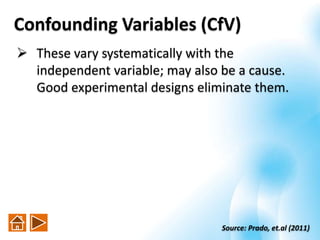
Confounding Variables (CfV)
 These vary systematically with the
independent variable; may also be a cause.
Good experimental designs eliminate them.
Source: Prado, et.al (2011)
Confounding Variables (CfV)
 Raagas (2006) considered these as
extraneous variables.
Source: Prado, et.al (2011)
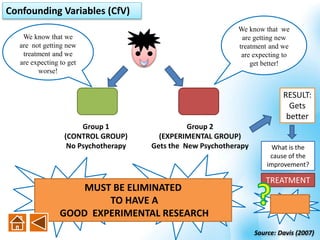
Confounding Variables (CfV)
Group 1
(CONTROL GROUP)
No Psychotherapy
Group 2
(EXPERIMENTAL GROUP)
Gets the New Psychotherapy
PARTICIPANTS’
EXPECTATIONS
We know that we
are getting new
treatment and we
are expecting to
get better!
We know that we
are not getting new
treatment and we
are expecting to get
worse!
RESULT:
Gets
better
Is a
CONFOUNDING
VARIABLE
Source: Davis (2007)
What is the
cause of the
improvement?
TREATMENT
CONFOUNDING
VARIABLE
MUST BE ELIMINATED
TO HAVE A
GOOD EXPERIMENTAL RESEARCH
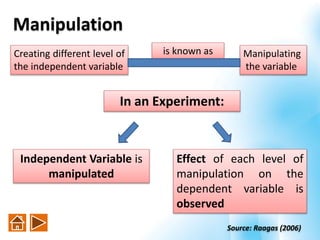
Manipulation
Creating different level of
the independent variable
Manipulating
the variable
In an Experiment:
Source: Raagas (2006)
Independent Variable is
manipulated
Effect of each level of
manipulation on the
dependent variable is
observed
is known as
Source: Prado, et.al (2011)
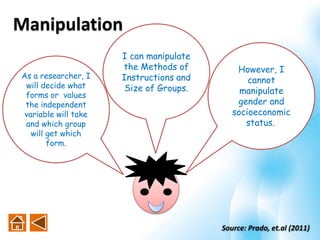
As a researcher, I
will decide what
forms or values
the independent
variable will take
and which group
will get which
form.
I can manipulate
the Methods of
Instructions and
Size of Groups.
However, I
cannot
manipulate
gender and
socioeconomic
status.
Manipulation
Control
 It refers to efforts on the part of the
researcher to remove the influence of any
variable (other than the independent variable)
that might affect performance on the
dependent variable (Gay, 1996)
Source: Prado, et.al (2011)
Source: Gay(1996)
Control
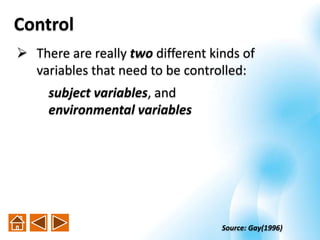
 There are really two different kinds of
variables that need to be controlled:
subject variables, and
environmental variables
subject variables
 such as reading readiness, variable on which
subjects in the different groups might differ.
Control
Source: Gay(1996)
environmental variables
 such as learning materials, variable which
might cause unwanted differences between
groups.
Control
Source: Gay(1996)
 Methods of experimental control include:
(a) physical control;
(b) selective control; and
(c) statistical control
Control
Source: Prado, et.al (2011)
(a) physical control
- which controls non experimental variables
that affect the dependent variable.
Control
Source: Prado, et.al (2011)
(b) selective control
- which manipulates indirectly by selecting in
and out variables that cannot be controlled.
Control
Source: Prado, et.al (2011)
(c) statistical control
- where variables conducive to physical or
selective manipulation may be controlled by
statistical technique, e.g. covariance.
Control
Source: Prado, et.al (2011)
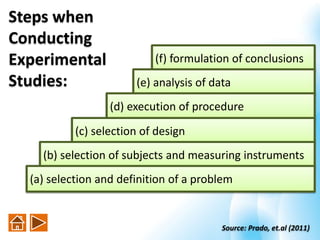
(f) formulation of conclusions
Steps when
Conducting
Experimental
Studies: (e) analysis of data
(d) execution of procedure
(c) selection of design
(b) selection of subjects and measuring instruments
(a) selection and definition of a problem
Source: Prado, et.al (2011)
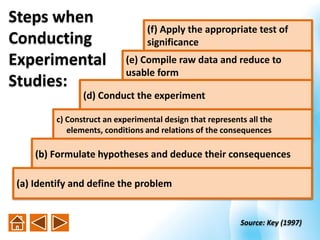
(f) Apply the appropriate test of
significance
Source: Key (1997)
Steps when
Conducting
Experimental
Studies:
(e) Compile raw data and reduce to
usable form
(d) Conduct the experiment
c) Construct an experimental design that represents all the
elements, conditions and relations of the consequences
(b) Formulate hypotheses and deduce their consequences
(a) Identify and define the problem
REFERENCES
Main Reference
Prado, N. I., et.al. 2011. Research Methods. Philippines: Central Mindanao University-IMDC. 12:205-209.
Used by the Authors of the Main Reference:
Davis, J. 2007. Experimental Research Methods. Metropolitan State College of Denver.
Gay, L.R. 1992. (4th Ed.) Educational Research-Competencies for Analysis and Application. Maxwell Macmillan, Canada Inc.
Key, J.P. 1997. Research Design in Occupational Education. Oklahoma State University. Retrieved from
http://www.okstate.edu/ag/aged.html.
Raagas, E. L. 2006. Experimental Designs. Lecture Notes shared during the PAGE Zonal Area Conference, VIP Hotel Cagayan de Oro
City.
Trochim, W. 2006. Research Methods Knowledge Base. Retrieved from http://socialresearchmethods.net/ kb/ deserper.htm.
Used by the Reporter
Biddix, J.P . 2017. Research Rundowns. University of Missouri - St. Louis: Higher Education and Research Methodology in
the Department of Curriculum, Leadership, and Technology. Retrieved from https://researchrundowns.com/intro/experimental-
design/
Mnemonic Dictionary. 2013. Experimenter. Retrieved from http://www.mnemonicdictionary.com/word/ experimenter.
Oxford University Press. 2017. Experimenter. Retrieved from https://en.oxforddictionaries.com/definition/ experimenter.
Siegle, D.2017. Experimental Research. Neag School of Education – University of Connecticut. Retrieved from
http://researchbasics.education.uconn.edu/ experimental-_research/
Thank you
and
God bless.

Peralta sheila-a

  • 1.
    SHEILA A. PERALTA ExperimentalMethod: An In-Depth Look JAMES L. PAGLINAWAN, PhD Professor Educ 241 (Research Methods in Education)
  • 2.
     Experimental ResearchDesigns  Experimental Research  Experimental Method of Research  Experimental Studies  Experimenter  Roles of the Experimenters A. BACKGROUND
  • 3.
    B. BASIC TERMINOLOGIES Experimental Research (ER)  Experimental Design (ED)  Independent Variable (IV)  IV Examples  Dependent Variable (DV)  DV Examples
  • 4.
    B. BASIC TERMINOLOGIES Control Variables (CtV)  Random Variables (RD)  Confounding Variables (CfV)  Manipulation  Control
  • 5.
    C. EXPERIMENTAL PROCESS Steps when Conducting Experimental Studies
  • 6.
    Experimental Research Designs are often considered as the most “rigorous” of all designs (Trochim, 2006), and  probably the “strongest” design with respect to internal validity (Davis, 2007).
  • 7.
    Experimental Research  isbased on the assumption that the world works according to causal laws. The goal of experimental research is to establish these cause-and effect laws by isolating causal variables (Davis, 2007).
  • 8.
    Experimental Method ofResearch  is the most valid approach to test the hypothesis concerning cause-effect relationships. Source: Prado, et.al (2011)
  • 9.
    Experimental Studies  whenwell conducted and appropriately used can produce the best result concerning hypothesized causal relations. Source: Prado, et.al (2011)
  • 10.
    Experimenter  is aresearch worker who conducts experiments and a person who enjoys testing innovative ideas (Mnemonic Dictionary, 2013).  is a person who performs a scientific procedure, especially in a laboratory, to determine something and who tries out new ideas, methods, or activities (Oxford University Press, 2017) .
  • 11.
    Roles of theExperimenters: 1. They are in constant activity from the very beginning of the experiment. 2. They form or select the groups, decide what is going to happen to each group, and try to control all other relevant factors. Source: Prado, et.al (2011)
  • 12.
    3. They manipulateat least one independent variable, control other relevant variables, and observe the effect on one or more dependent variables. 4. Their goal is to establish cause effect relationships between variables. Source: Prado, et.al (2011) Roles of the Experimenters:
  • 13.
    5. They areguided by at least a hypothesis that states an expected causal relationship between two variables. Source: Prado, et.al (2011) Roles of the Experimenters:
  • 15.
    Experimental Research (ER) An attempt by the researcher to maintain control over all factors that may affect the result of an experiment. In doing this, the researcher attempts to determine or predict what may occur (Key, 1997).  The major feature that distinguishes experimental research from other types of research is that the researcher manipulates the independent variable (Siegle, 2017).
  • 16.
    Experimental Design (ED) It is a blueprint of the procedure that enables the researcher to test his hypothesis by reaching valid conclusions about relationships between independent and dependent variables. It refers to the conceptual framework within which the experiment is conducted. Source: Prado, et.al (2011)
  • 17.
     It guidesthe experimental study by specifying: 1. what independent variables are to be manipulated; 2. what dependent variable are to be measured; Source: Prado, et.al (2011) Experimental Design (ED)
  • 18.
     It guidesthe experimental study by specifying: 3. what levels of experimental treatment are to be used; 4. how to select test units and assign them to different groups; Source: Prado, et.al (2011) Experimental Design (ED)
  • 19.
     It guidesthe experimental study by specifying: 5. how to control for selection bias and 6. how to minimize the influence of extraneous variables on the result of the experiment. Source: Prado, et.al (2011) Experimental Design (ED)
  • 20.
     the basicidea of experimental design involves formulating a question and hypothesis, testing the question, and analyzing data (Biddix, 2017). Experimental Design (ED)
  • 21.
    Independent Variable (IV) It is also referred to as the experimental variable, the cause, or the treatment, is that activity or characteristics believed to make a difference. It has levels, conditions, or treatments. Source: Prado, et.al (2011)
  • 22.
    Independent Variable (IV) Note: Experimentersmay manipulate conditions, or measure and assign subjects to conditions; supposed to be the cause. Source: Prado, et.al (2011)
  • 23.
    Examples:  teaching method; type of teaching material;  a reward;  a period of exposure to a particular condition;  an attribute such as sex or level of intelligence. Source: Prado, et.al (2011) Independent Variable (IV)
  • 24.
     may beclassified as treatment variables and attribute variables. Independent Variable (IV) Source: Prado, et.al (2011)
  • 25.
    Treatment variables arethose that the experimenter manipulates and to which subjects are assigned. Attribute variables are those characteristics that cannot be altered by the experimenter, such as age, sex, race and intelligence level. The experimenter can decide to include or remove them as variables in the study. Independent Variable (IV) Source: Prado, et.al (2011)
  • 26.
    Dependent Variable (DV) It is also referred to as the criterion variable, effect or posttest, is the outcome of the study, the change or difference in groups that occurs as a result of manipulation of the independent variable measured by the experimenter. Source: Prado, et.al (2011)
  • 27.
    Examples:  test score mental ability of the participants  the number of errors  the mental health Dependent Variable (DV) Source: Prado, et.al (2011)
  • 28.
    Control Variables (CtV) These are the held constant by the experimenter to eliminate them as potential causes. Example: Only research participants who have been problems with anxiety or depression (Psychiatry) Source: Prado, et.al (2011)
  • 29.
    Random Variables (RV) These are allowed to vary freely to eliminate them as potential causes. Many other characteristics of the research participants, as long as they really do vary freely, might include age, personality type or career goals. Source: Prado, et.al (2011)
  • 30.
    Confounding Variables (CfV) These vary systematically with the independent variable; may also be a cause. Good experimental designs eliminate them. Source: Prado, et.al (2011)
  • 31.
    Confounding Variables (CfV) Raagas (2006) considered these as extraneous variables. Source: Prado, et.al (2011)
  • 32.
    Confounding Variables (CfV) Group1 (CONTROL GROUP) No Psychotherapy Group 2 (EXPERIMENTAL GROUP) Gets the New Psychotherapy PARTICIPANTS’ EXPECTATIONS We know that we are getting new treatment and we are expecting to get better! We know that we are not getting new treatment and we are expecting to get worse! RESULT: Gets better Is a CONFOUNDING VARIABLE Source: Davis (2007) What is the cause of the improvement? TREATMENT CONFOUNDING VARIABLE MUST BE ELIMINATED TO HAVE A GOOD EXPERIMENTAL RESEARCH
  • 33.
    Manipulation Creating different levelof the independent variable Manipulating the variable In an Experiment: Source: Raagas (2006) Independent Variable is manipulated Effect of each level of manipulation on the dependent variable is observed is known as
  • 34.
    Source: Prado, et.al(2011) As a researcher, I will decide what forms or values the independent variable will take and which group will get which form. I can manipulate the Methods of Instructions and Size of Groups. However, I cannot manipulate gender and socioeconomic status. Manipulation
  • 35.
    Control  It refersto efforts on the part of the researcher to remove the influence of any variable (other than the independent variable) that might affect performance on the dependent variable (Gay, 1996) Source: Prado, et.al (2011)
  • 36.
    Source: Gay(1996) Control  Thereare really two different kinds of variables that need to be controlled: subject variables, and environmental variables
  • 37.
    subject variables  suchas reading readiness, variable on which subjects in the different groups might differ. Control Source: Gay(1996)
  • 38.
    environmental variables  suchas learning materials, variable which might cause unwanted differences between groups. Control Source: Gay(1996)
  • 39.
     Methods ofexperimental control include: (a) physical control; (b) selective control; and (c) statistical control Control Source: Prado, et.al (2011)
  • 40.
    (a) physical control -which controls non experimental variables that affect the dependent variable. Control Source: Prado, et.al (2011)
  • 41.
    (b) selective control -which manipulates indirectly by selecting in and out variables that cannot be controlled. Control Source: Prado, et.al (2011)
  • 42.
    (c) statistical control -where variables conducive to physical or selective manipulation may be controlled by statistical technique, e.g. covariance. Control Source: Prado, et.al (2011)
  • 44.
    (f) formulation ofconclusions Steps when Conducting Experimental Studies: (e) analysis of data (d) execution of procedure (c) selection of design (b) selection of subjects and measuring instruments (a) selection and definition of a problem Source: Prado, et.al (2011)
  • 45.
    (f) Apply theappropriate test of significance Source: Key (1997) Steps when Conducting Experimental Studies: (e) Compile raw data and reduce to usable form (d) Conduct the experiment c) Construct an experimental design that represents all the elements, conditions and relations of the consequences (b) Formulate hypotheses and deduce their consequences (a) Identify and define the problem
  • 46.
    REFERENCES Main Reference Prado, N.I., et.al. 2011. Research Methods. Philippines: Central Mindanao University-IMDC. 12:205-209. Used by the Authors of the Main Reference: Davis, J. 2007. Experimental Research Methods. Metropolitan State College of Denver. Gay, L.R. 1992. (4th Ed.) Educational Research-Competencies for Analysis and Application. Maxwell Macmillan, Canada Inc. Key, J.P. 1997. Research Design in Occupational Education. Oklahoma State University. Retrieved from http://www.okstate.edu/ag/aged.html. Raagas, E. L. 2006. Experimental Designs. Lecture Notes shared during the PAGE Zonal Area Conference, VIP Hotel Cagayan de Oro City. Trochim, W. 2006. Research Methods Knowledge Base. Retrieved from http://socialresearchmethods.net/ kb/ deserper.htm. Used by the Reporter Biddix, J.P . 2017. Research Rundowns. University of Missouri - St. Louis: Higher Education and Research Methodology in the Department of Curriculum, Leadership, and Technology. Retrieved from https://researchrundowns.com/intro/experimental- design/ Mnemonic Dictionary. 2013. Experimenter. Retrieved from http://www.mnemonicdictionary.com/word/ experimenter. Oxford University Press. 2017. Experimenter. Retrieved from https://en.oxforddictionaries.com/definition/ experimenter. Siegle, D.2017. Experimental Research. Neag School of Education – University of Connecticut. Retrieved from http://researchbasics.education.uconn.edu/ experimental-_research/
  • 48.