Presentation
topic:
Experimental
Method
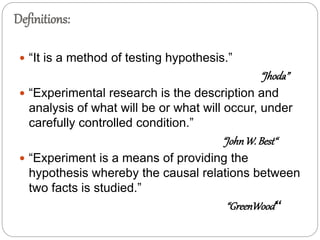
Definitions:
 “It is a method of testing hypothesis.”
“Jhoda”
 “Experimental research is the description and
analysis of what will be or what will occur, under
carefully controlled condition.”
“JohnW. Best“
 “Experiment is a means of providing the
hypothesis whereby the causal relations between
two facts is studied.”
“GreenWood“
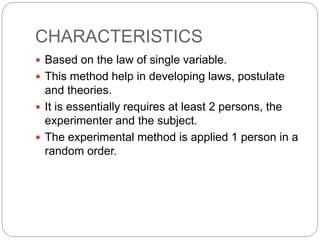
CHARACTERISTICS
 Based on the law of single variable.
 This method help in developing laws, postulate
and theories.
 It is essentially requires at least 2 persons, the
experimenter and the subject.
 The experimental method is applied 1 person in a
random order.
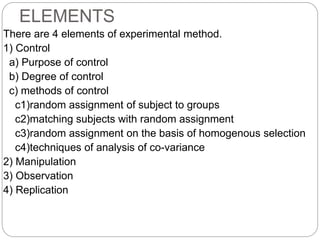
ELEMENTS
There are 4 elements of experimental method.
1) Control
a) Purpose of control
b) Degree of control
c) methods of control
c1)random assignment of subject to groups
c2)matching subjects with random assignment
c3)random assignment on the basis of homogenous selection
c4)techniques of analysis of co-variance
2) Manipulation
3) Observation
4) Replication
CONTROL
The extent to which different factors are accounted for
 (a) Purposes of Control:
 (i) Intervening variables are isolated so that they may
effect the dependent variable.
 (ii) Not only intervening variables are to be isolated
from independent variables but it is also to be
ascertained how much it contributed.
 (iii) The magnitude is not only ascertained terms of
larger or small but also in quantitative terms.
 (b) Degree of Control:
 It has to be remembered that in social researches
high degree of control is not possible as in laboratory
situation.
 (c) Methods of Control:
 The researcher directs efforts towards controlling the
variables which are related to the independent.
 (i) Random assignment of subjects to groups:
 It means that subjects are assigned in such a way that
every member has an equal opportunity of being chosen.
 (ii) Matching subjects with random assignment:
 The subjects are assigned to groups to match
individual’s subjects on as many extraneous variable as
the researcher can identify.
 (iii) Random assignment on the basis of
homogeneous selection:
 It is done to make groups comparable on an extraneous
variable so as to select groups those are as
homogenous as possible on the variable.
 (iv)Techniques of analysis of Co-variance:
 (2) Manipulation:
 In the experimental method manipulation is done to set the
stage for the occurrence of the factor whose performance is
to be studied under conditions in which all other factors are
controlled. Variables which can be manipulated may be
personality characteristics, attitudes, teaching methods, type
of motivation etc.
 (3) Observation:
 Another element of the experimental method is that the
effect of the manipulation of independent variable on the
dependent variable is studied or observed. The technique of
observation is applied if measurement is not possible.
 (4) Replication:
 In spite of attempts of controlling extraneous variables, some
extraneous variable and some discrepancies remain and
influence the 93 results. Thus replication is a matter of
conducting a number of sub-experiments within the frame
Validity:
 Two types of validity are involved;
 (i) Internal Validity:
 It is the minimum without which an experiment is
useless. The crucial point is whether the
independent variable created the effect on the
dependent variable. It means that some
uncontrolled extraneous factors do not affect the
dependent variable.
 (ii) External Validity:
 The crucial point is what is the applicability of the
findings beyond the limits of particular
experiment.
Types of Experimental
Designs:
 The following are the factors upon which the
designs depends.
 (i) What is the nature of the experiment?
 (ii) What is the main purpose of the experiment?
 (iii) What types of the variables are to be
manipulated?
 (iv) What is the nature of data?
 (v) What is the competence level of the
experimenter?
 (a) Pre-experimental designs:
 In this type of design there is no control over extraneous
or situation variables.
 (b)True-experimental designs:
 In these designs, the researcher attempts to control the
effects of history, maturation, testing, measuring
instruments etc.
 (C) Factorial Design:
 This design enables the experimenter to evaluate or
manipulate two or more experimenter to evaluate or
manipulate two or more variables simultaneously in
order to study the effects of number of independent
factors singly as well as the effects due to interactions
with one another.
Steps of Experimental Research
Methods
 (i) Identifying, defining and delimiting the problem:
 The problem that can be verified or refuted by the
experimental data should be selected first.
 (ii) Reviewing the literature:
 After selecting the problem, the related literature and
experiments should be reviewed and the method of
approach or experimental design to be pursued should
be planned or outlined.
 (iii) Formulating the hypothesis and deducing their
consequences:
 The problem has to be converted into a hypothesis that
can be verified or refuted by experimental method.
 (iv) Drawing up the experimental design:
 This section should place primary emphasis on the question
of control, randomization, replication, place of the experiment,
duration of the experiment, selecting or constructing and
validating instruments to measure the outcomes of the
experiment and conducting pilot for trial run tests to perfect
instrument.
 (v) Defining the population:
 It is necessary to define the population precisely so that there
can be no question about population to which the conclusions
are to apply.
 (vi) Administration of test / Carrying out the study:
 This will involve controlling variable or non-experimental
factors, applying the experimental factors and keeping the
careful record of steps in the procedure.
 (vii) Measuring the outcomes / Collection of Data:
 Careful consideration must be given to the selection of the
criterion on the basis of which the results are measured.
 (viii) Analyzing and interpreting the outcomes;
 The result pertaining to the factors under study should be
clearly noted. The analysis of data demands expert use
of statistical procedures.
 (ix) Drawing the conclusions:
 The conclusions of the study must be restricted to the
population actually covered; care must be taken not to
over generalize the results.
 (x) Reporting the results:
 The study must be reported in sufficient details.
Thank You…

Experimental method In Research Methodology

  • 1.
  • 2.
    Definitions:  “It isa method of testing hypothesis.” “Jhoda”  “Experimental research is the description and analysis of what will be or what will occur, under carefully controlled condition.” “JohnW. Best“  “Experiment is a means of providing the hypothesis whereby the causal relations between two facts is studied.” “GreenWood“
  • 3.
    CHARACTERISTICS  Based onthe law of single variable.  This method help in developing laws, postulate and theories.  It is essentially requires at least 2 persons, the experimenter and the subject.  The experimental method is applied 1 person in a random order.
  • 4.
    ELEMENTS There are 4elements of experimental method. 1) Control a) Purpose of control b) Degree of control c) methods of control c1)random assignment of subject to groups c2)matching subjects with random assignment c3)random assignment on the basis of homogenous selection c4)techniques of analysis of co-variance 2) Manipulation 3) Observation 4) Replication
  • 5.
    CONTROL The extent towhich different factors are accounted for  (a) Purposes of Control:  (i) Intervening variables are isolated so that they may effect the dependent variable.  (ii) Not only intervening variables are to be isolated from independent variables but it is also to be ascertained how much it contributed.  (iii) The magnitude is not only ascertained terms of larger or small but also in quantitative terms.  (b) Degree of Control:  It has to be remembered that in social researches high degree of control is not possible as in laboratory situation.
  • 6.
     (c) Methodsof Control:  The researcher directs efforts towards controlling the variables which are related to the independent.  (i) Random assignment of subjects to groups:  It means that subjects are assigned in such a way that every member has an equal opportunity of being chosen.  (ii) Matching subjects with random assignment:  The subjects are assigned to groups to match individual’s subjects on as many extraneous variable as the researcher can identify.  (iii) Random assignment on the basis of homogeneous selection:  It is done to make groups comparable on an extraneous variable so as to select groups those are as homogenous as possible on the variable.  (iv)Techniques of analysis of Co-variance:
  • 7.
     (2) Manipulation: In the experimental method manipulation is done to set the stage for the occurrence of the factor whose performance is to be studied under conditions in which all other factors are controlled. Variables which can be manipulated may be personality characteristics, attitudes, teaching methods, type of motivation etc.  (3) Observation:  Another element of the experimental method is that the effect of the manipulation of independent variable on the dependent variable is studied or observed. The technique of observation is applied if measurement is not possible.  (4) Replication:  In spite of attempts of controlling extraneous variables, some extraneous variable and some discrepancies remain and influence the 93 results. Thus replication is a matter of conducting a number of sub-experiments within the frame
  • 8.
    Validity:  Two typesof validity are involved;  (i) Internal Validity:  It is the minimum without which an experiment is useless. The crucial point is whether the independent variable created the effect on the dependent variable. It means that some uncontrolled extraneous factors do not affect the dependent variable.  (ii) External Validity:  The crucial point is what is the applicability of the findings beyond the limits of particular experiment.
  • 9.
    Types of Experimental Designs: The following are the factors upon which the designs depends.  (i) What is the nature of the experiment?  (ii) What is the main purpose of the experiment?  (iii) What types of the variables are to be manipulated?  (iv) What is the nature of data?  (v) What is the competence level of the experimenter?
  • 10.
     (a) Pre-experimentaldesigns:  In this type of design there is no control over extraneous or situation variables.  (b)True-experimental designs:  In these designs, the researcher attempts to control the effects of history, maturation, testing, measuring instruments etc.  (C) Factorial Design:  This design enables the experimenter to evaluate or manipulate two or more experimenter to evaluate or manipulate two or more variables simultaneously in order to study the effects of number of independent factors singly as well as the effects due to interactions with one another.
  • 11.
    Steps of ExperimentalResearch Methods  (i) Identifying, defining and delimiting the problem:  The problem that can be verified or refuted by the experimental data should be selected first.  (ii) Reviewing the literature:  After selecting the problem, the related literature and experiments should be reviewed and the method of approach or experimental design to be pursued should be planned or outlined.  (iii) Formulating the hypothesis and deducing their consequences:  The problem has to be converted into a hypothesis that can be verified or refuted by experimental method.
  • 12.
     (iv) Drawingup the experimental design:  This section should place primary emphasis on the question of control, randomization, replication, place of the experiment, duration of the experiment, selecting or constructing and validating instruments to measure the outcomes of the experiment and conducting pilot for trial run tests to perfect instrument.  (v) Defining the population:  It is necessary to define the population precisely so that there can be no question about population to which the conclusions are to apply.  (vi) Administration of test / Carrying out the study:  This will involve controlling variable or non-experimental factors, applying the experimental factors and keeping the careful record of steps in the procedure.  (vii) Measuring the outcomes / Collection of Data:  Careful consideration must be given to the selection of the criterion on the basis of which the results are measured.
  • 13.
     (viii) Analyzingand interpreting the outcomes;  The result pertaining to the factors under study should be clearly noted. The analysis of data demands expert use of statistical procedures.  (ix) Drawing the conclusions:  The conclusions of the study must be restricted to the population actually covered; care must be taken not to over generalize the results.  (x) Reporting the results:  The study must be reported in sufficient details.
  • 14.