+
Experimental
Research
Chapter 13 (page 265)
PREPARED BY
• IZZA ATHIRA BINTI AB JALIL
• NURUL SYAFIQAH MD AMIN
• NUR’IZZAH BINTI MOHAMMED FAUDZAN
• NORASYIKIN MT RASHID
+
WHAT is Experimental Research?
 The most conclusive of scientific methods
BECAUSE
The researcher actually establishes different
treatments and then studies their EFFECTS, results
from this type of research are likely to lead to the
most clear-cut interpretations.
+Two ways in which Experimental Research
differs from other educational research
Researcher manipulate the independent variable
1. Decide the nature of the treatment
- to whom it is to be applied
- to what extent
2. Enables researchers to go
- beyond description and prediction
- beyond the identification of relationship, to at
least a partial determination of what causes
them.
+
CHARACTERISTIC of
Experimental Research
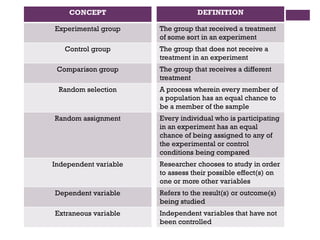
CONCEPT
Experimental group
Control group
Comparison group
Random selection
Random assignment
Independent variable
Dependent variable
Extraneous variable
DEFINITION
The group that received a treatment
of some sort in an experiment
The group that does not receive a
treatment in an experiment
The group that receives a different
treatment
A process wherein every member of
a population has an equal chance to
be a member of the sample
Every individual who is participating
in an experiment has an equal
chance of being assigned to any of
the experimental or control
conditions being compared
Researcher chooses to study in order
to assess their possible effect(s) on
one or more other variables
Refers to the result(s) or outcome(s)
being studied
Independent variables that have not
been controlled
+
PURPOSE of Experimental
Research
 To establish cause and effect relationship among
variables
 The only type of research that directly attempts to
influence a particular variables
 Correlational studies may demonstrate a strong
relationship between socio-economic level and
academic achievement, for instance
+
BASIC STEPS in conducting an
experiment
Formal experiment consist of two conditions :
 At least two conditions or methods are compared to
assess the effect(s) of particular conditions
 The independent variable is directly manipulated
by the researcher.
+Various Threats to Internal Validity
Associated with Different Experimental
Design
 Holding certain variables constant
 Building the variable into the design
 Matching
 Using subjects as their own controls
+
MANIPULATION of Independent
Variable
 The researcher actively manipulates the
independent variables
MEANS
The researcher deliberately and directly determines
what forms the independent variable will take and
then which group will get which form.
+
THREE WAYS in
such the
manipulation can
occur
1. One form of variable versus
another
 E.g. : Comparing the inquiry
method with the lecture method of
instruction in teaching chemistry
2. Presence versus absence of a
particular form
 E.g. : Comparing the use of power
point slides versus no power point
slide in teaching statistic
3. Varying degrees of the same form
 E.g. : Comparing the effects of
different specified amounts of
teacher enthusiasm on student
attitudes towards mathematics
+
Group Design in Experimental
Research
 Good designs control many of the various threats to
internal validity (chapter 9) while poor designs control
only a few.
 The quality of an experiment depends on how well the
various threats to internal validity are controlled.
 The essential ingredient of a true experimental design
is that subjects are randomly assigned to treatment
groups.
 Random assignment is a powerful technique for
controlling the subject characteristics threat to internal
validity
+
Example of Poor Experimental
Design
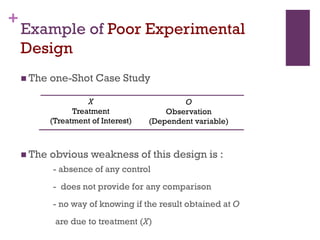
 The one-Shot Case Study
 The obvious weakness of this design is :
X
Treatment
(Treatment of Interest)
O
Observation
(Dependent variable)
- absence of any control
- does not provide for any comparison
- no way of knowing if the result obtained at O
are due to treatment (X)
+
Example of Poor Experimental
Design
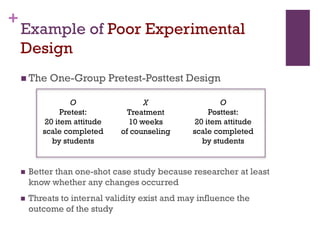
 The One-Group Pretest-Posttest Design
X
Treatment
10 weeks
of counseling
O
Pretest:
20 item attitude
scale completed
by students
O
Posttest:
20 item attitude
scale completed
by students
 Better than one-shot case study because researcher at least
know whether any changes occurred
 Threats to internal validity exist and may influence the
outcome of the study
+
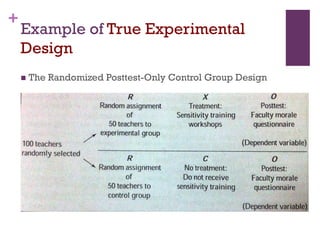
Example of True Experimental
Design
 The Randomized Posttest-Only Control Group Design
+
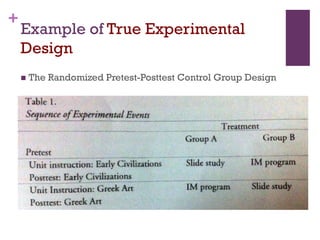
Example of True Experimental
Design
 The Randomized Pretest-Posttest Control Group Design
+
QUESTIONS :
1. Why experimental research is different than any
other educational research?
2. What is the purpose of experimental research?
3. Describe the basic steps involved in conducting
an experimental research?
4. What is one of experimental research
characteristic?
5. Explain how to identify poor experimental
design?

Experimental Research Presentation

  • 1.
    + Experimental Research Chapter 13 (page265) PREPARED BY • IZZA ATHIRA BINTI AB JALIL • NURUL SYAFIQAH MD AMIN • NUR’IZZAH BINTI MOHAMMED FAUDZAN • NORASYIKIN MT RASHID
  • 2.
    + WHAT is ExperimentalResearch?  The most conclusive of scientific methods BECAUSE The researcher actually establishes different treatments and then studies their EFFECTS, results from this type of research are likely to lead to the most clear-cut interpretations.
  • 3.
    +Two ways inwhich Experimental Research differs from other educational research Researcher manipulate the independent variable 1. Decide the nature of the treatment - to whom it is to be applied - to what extent 2. Enables researchers to go - beyond description and prediction - beyond the identification of relationship, to at least a partial determination of what causes them.
  • 4.
  • 5.
    CONCEPT Experimental group Control group Comparisongroup Random selection Random assignment Independent variable Dependent variable Extraneous variable DEFINITION The group that received a treatment of some sort in an experiment The group that does not receive a treatment in an experiment The group that receives a different treatment A process wherein every member of a population has an equal chance to be a member of the sample Every individual who is participating in an experiment has an equal chance of being assigned to any of the experimental or control conditions being compared Researcher chooses to study in order to assess their possible effect(s) on one or more other variables Refers to the result(s) or outcome(s) being studied Independent variables that have not been controlled
  • 6.
    + PURPOSE of Experimental Research To establish cause and effect relationship among variables  The only type of research that directly attempts to influence a particular variables  Correlational studies may demonstrate a strong relationship between socio-economic level and academic achievement, for instance
  • 7.
    + BASIC STEPS inconducting an experiment Formal experiment consist of two conditions :  At least two conditions or methods are compared to assess the effect(s) of particular conditions  The independent variable is directly manipulated by the researcher.
  • 8.
    +Various Threats toInternal Validity Associated with Different Experimental Design  Holding certain variables constant  Building the variable into the design  Matching  Using subjects as their own controls
  • 9.
    + MANIPULATION of Independent Variable The researcher actively manipulates the independent variables MEANS The researcher deliberately and directly determines what forms the independent variable will take and then which group will get which form.
  • 10.
    + THREE WAYS in suchthe manipulation can occur 1. One form of variable versus another  E.g. : Comparing the inquiry method with the lecture method of instruction in teaching chemistry 2. Presence versus absence of a particular form  E.g. : Comparing the use of power point slides versus no power point slide in teaching statistic 3. Varying degrees of the same form  E.g. : Comparing the effects of different specified amounts of teacher enthusiasm on student attitudes towards mathematics
  • 11.
    + Group Design inExperimental Research  Good designs control many of the various threats to internal validity (chapter 9) while poor designs control only a few.  The quality of an experiment depends on how well the various threats to internal validity are controlled.  The essential ingredient of a true experimental design is that subjects are randomly assigned to treatment groups.  Random assignment is a powerful technique for controlling the subject characteristics threat to internal validity
  • 12.
    + Example of PoorExperimental Design  The one-Shot Case Study  The obvious weakness of this design is : X Treatment (Treatment of Interest) O Observation (Dependent variable) - absence of any control - does not provide for any comparison - no way of knowing if the result obtained at O are due to treatment (X)
  • 13.
    + Example of PoorExperimental Design  The One-Group Pretest-Posttest Design X Treatment 10 weeks of counseling O Pretest: 20 item attitude scale completed by students O Posttest: 20 item attitude scale completed by students  Better than one-shot case study because researcher at least know whether any changes occurred  Threats to internal validity exist and may influence the outcome of the study
  • 14.
    + Example of TrueExperimental Design  The Randomized Posttest-Only Control Group Design
  • 15.
    + Example of TrueExperimental Design  The Randomized Pretest-Posttest Control Group Design
  • 16.
    + QUESTIONS : 1. Whyexperimental research is different than any other educational research? 2. What is the purpose of experimental research? 3. Describe the basic steps involved in conducting an experimental research? 4. What is one of experimental research characteristic? 5. Explain how to identify poor experimental design?