Introduction to Psychology
PSY-101
By:
Muhammad Bilal Younas
0323-6168636
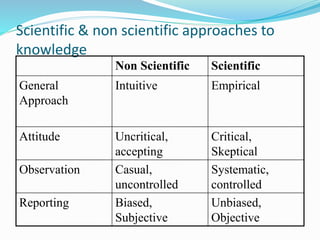
Scientific & non scientific approaches to
knowledge
Non Scientific Scientific
General
Approach
Intuitive Empirical
Attitude Uncritical,
accepting
Critical,
Skeptical
Observation Casual,
uncontrolled
Systematic,
controlled
Reporting Biased,
Subjective
Unbiased,
Objective
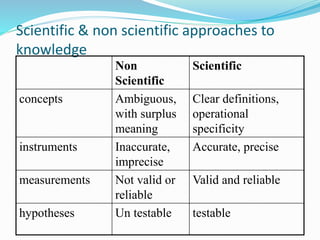
Scientific & non scientific approaches to
knowledge
Non
Scientific
Scientific
concepts Ambiguous,
with surplus
meaning
Clear definitions,
operational
specificity
instruments Inaccurate,
imprecise
Accurate, precise
measurements Not valid or
reliable
Valid and reliable
hypotheses Un testable testable
Methods of Psychology
 To understand the influence of society on individual
and individual’s influence on society, we have to
understand the research methods
 Research methods are important source to understand
the nature of emotions, cognitions and human
behavior by empirical evidences
Methods of Psychology
 e.g. causes of poverty, unemployment, how it effects
the quality of people’s lives and how the individual
behavior, emotions and feelings can be motivated to
overcome the related problems
Methods of Psychology
 Understanding of research methods also help to avoid
the some tempting logical traps e.g. lack of financial
sources is the only cause of illiteracy in Pakistan
Research Methods
 Some Important Research Methods:
1. Observation
2. Experimental Method
3. Correlation Method
4.Survey Method
5. Case Study Method
6.Interview
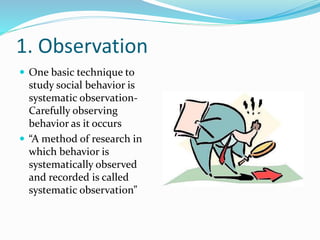
1. Observation
 One basic technique to
study social behavior is
systematic observation-
Carefully observing
behavior as it occurs
 “A method of research in
which behavior is
systematically observed
and recorded is called
systematic observation”
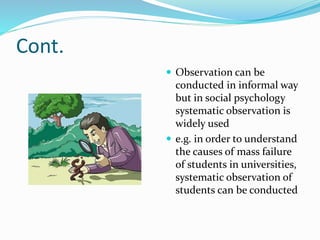
Cont.
 Observation can be
conducted in informal way
but in social psychology
systematic observation is
widely used
 e.g. in order to understand
the causes of mass failure
of students in universities,
systematic observation of
students can be conducted
Naturalistic Observation:- Observing
behavior in natural setting is called naturalistic
observation e.g. observing students attitudes
towards studies in the universities
 Observation can be Direct( in which
observer/researcher directly observer the
phenomena or targeted behavior) or Indirect
(in which information can be gathered by indirect
resources e.g. by recording the behavior etc
 Participant Observation:- A method of observation in
which observer/researcher participate in the natural
environment and observe the phenomena while living in
the same natural environment-through this method
researcher can control the effects of awareness to be
observed
 Non-Participant Observation:- In this method,
researcher observe the phenomena as being an
outsider of that natural environment
Cont.
 Merits:-
i. Direct sources
ii. Based on natural environment
iii. Simple Method
 Demerits:-
i. Observer Effect
ii. Observer Bias
2. Correlational Method
 The term correlation refers to a tendency for one event
to change as the other changes
 A method of research in which a scientist
systematically observes two or more variables to
determine whether changes in one are accompanied by
the changes in other.
Cont.
 e.g. Free education will increase the rate of illiteracy
 Social psychologists refers to such changeable aspects
of the natural world as variables because they can take
different values
 The existence of correlation is very useful from
scientific point of view because when a correlation
exist, it is possible to predict one variable from
information about one or more other variables
Cont.
 The ability to make such prediction is one of the
important goal of all branches of science
 Such type of prediction are very supportive for social
psychology as some of the future dangerous
behaviors/attitudes which can be predicted by
correlated variables will be controlled or managed
before time.
Cont.
 The stronger the correlation between the variables in
phenomena, the more accurate the prediction
 Correlation can range from zero to -1 or + 1 , the greater
the departure from zero, the stronger the correlation
Types of Correlation
 Positive Correlation:-The increase in one variable
causes the increase in other variable called positive
correlation
Perfect Positive Correlation:- When the correlation
falls at +1, it called perfect positive correlation
 Negative Correlation:- The increase in one variable
causes the decrease in other variable called negative
correlation
Cont.
Perfect Negative Correlation:- When the
correlation falls at -1, it called perfect negative
correlation
In this approach, social psychologists attempt to
determine whether and to what extent different
variables are related to each other
This method involves making careful observations
of each variable and then performing appropriate
statistical tests to determine whether and to what
degree the variables correlated
Cont.
 Merits:-
i. Predict future behavior
ii. Find the cause and effect relationship
 Demerits:-
i. Can misguide about the relationship between two
variables
ii. Excessive rely on predicted behavior
3. Experimental Method
 Correlation method is very useful in making accurate
prediction but it is less useful in attaining the goal of
“why” question
 The “why” question leads to the phenomena of
explanation which is very necessary in the field of
social psychology
 To answer the why, social psychologists use another
research method that is called Experimental Method
Cont.
 In a formal experiment , the relationship between two
or more variables is investigated by deliberately
producing a change in one variable in a situation and
observing the effects of that change on other aspects of
the situation.
 “A method of research in which one or more factors are
systematically changed to determine whether such
variations affect one or more other factors”
Cont.
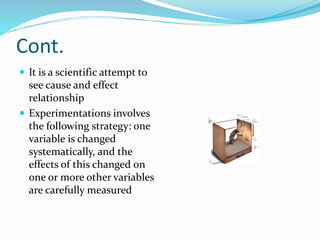
 It is a scientific attempt to
see cause and effect
relationship
 Experimentations involves
the following strategy: one
variable is changed
systematically, and the
effects of this changed on
one or more other variables
are carefully measured
Cont.
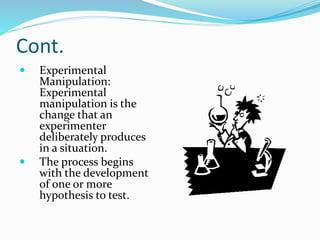
 Experimental
Manipulation:
Experimental
manipulation is the
change that an
experimenter
deliberately produces
in a situation.
 The process begins
with the development
of one or more
hypothesis to test.
Cont.
 Experimental research requires the responses of at
least two groups be compared with each other.
 Experimental Group
A group receiving a treatment (the manipulation
implemented by the experimenter) in an
experiment.
 Control Group
A group that receives no treatment in an
experiment.
 The variable involved in a particular experiment
may be classified as independent and dependent.
Cont.
 Variable: any thing which can changes its value
called variable
 Independent Variables: The variable that is
manipulated by an experimenter which is often
linked to causes.
 Dependant Variables: The variable that is
measured and is expected to change as a result of
changes caused by the experimenter’s
manipulation, which is often linked to effects.
Cont.
Control:
 Another important characteristic of the experimenter
method is control. it means that only independent
variable be allowed to change. Factor other than I.V
,which might affect the dependent variable, must be
held constant.
 In an experiment we must control conditions , which
would give misleading results.
Cont.
Random Assignment to condition:
 To make the experiment a valid test of the
hypothesis , the researcher need to add a final step
to the design properly assigning participants to
receive a particular treatment.
 The solution is random assignment to conditions.
 A procedure in which participants are assigned to
different experimental groups or “ conditions” on
the basis of chance and chance alone is called
random assignment to condition.
Cont.
 Extraneous Variables: There are some variables
which can also effect the results of the experiment
but experimenter does not want them to effect the
dependent variables e.g. in the above mentioned
example lack of coeducation institution in some
particular region can not create a change in the
people attitude even after taking effects from
media or due to lack of financial sources people
can not go for studies in coeducation, these two
factors can work as extraneous variables unless
they are controlled by the experimenter in both
groups
Cont.
 Merits:-
The experimental method has the following
advantages:
 Very useful to infer the cause and effect relationship
 With the help of this method psychologists gain
better understanding of behavior by exerting control
over stimuli.
Cont.
 Demerits:-
i. Expensive Method
ii. A serious limitation: we can not easily manipulate
mobs or large groups of people that might lead to
mental illness
iii. Artificial Environment
iv. Humans react differently when they know they are
participating in an experiment
Cont.
iv. Need highly expert and skilled experimenter
v. Experimenter Bias
vi. May involve ethical concerns
vii. Might not be able to apply to outside the laboratory
settings.
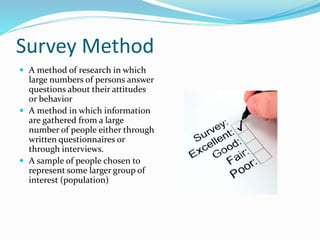
Survey Method
 A method of research in which
large numbers of persons answer
questions about their attitudes
or behavior
 A method in which information
are gathered from a large
number of people either through
written questionnaires or
through interviews.
 A sample of people chosen to
represent some larger group of
interest (population)
Cont.
 In survey Method
information from
people can be taken by
following methods:
Written questionnaire
Recording
Telephonic survey
Face to Face/Direct
Interview
Cont.
 Questionnaire: A list of statements either in form
of question or simple statement which are the direct
source of taking information about some particular
phenomena
 Types of Questionnaire:
i. Open-Ended Questionnaire
ii. Fixed-Ended Questionnaire
Cont.
 Merits:
i. Information from a large group of people in short
period
ii. Can be less expensive in some cases
 Demerits:
i. Non-serious attitudes of people
ii. Can be expensive in some cases
The Case Study Method
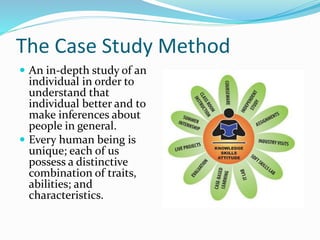
 An in-depth study of an
individual in order to
understand that
individual better and to
make inferences about
people in general.
 Every human being is
unique; each of us
possess a distinctive
combination of traits,
abilities; and
characteristics.
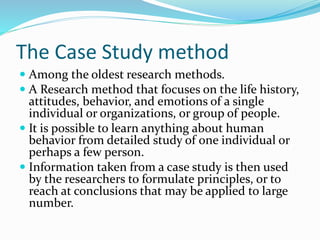
The Case Study method
 Among the oldest research methods.
 A Research method that focuses on the life history,
attitudes, behavior, and emotions of a single
individual or organizations, or group of people.
 It is possible to learn anything about human
behavior from detailed study of one individual or
perhaps a few person.
 Information taken from a case study is then used
by the researchers to formulate principles, or to
reach at conclusions that may be applied to large
number.
Cont.
 When the behavior involved is very unusual, the case
study method can be quite revealing.
 Researcher asks people what they have done in past
,rather than observing the behaviors of interest.
Cont.
Advantages:
 In depth, detailed knowledge
 Individuals can give such fruitful knowledge, which leads
to general truths.
Disadvantages:
 Unrepresentative information, common source of mistaken
judgment.
 If persons are unique, we cant generalize the results.
 There is repeated contact with the individual, being
studied, so researcher's bias may be there( lose scientific
objectivity)
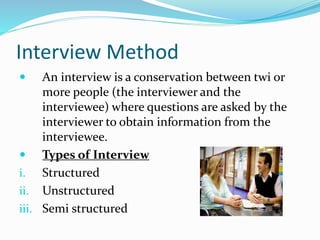
Interview Method
 An interview is a conservation between twi or
more people (the interviewer and the
interviewee) where questions are asked by the
interviewer to obtain information from the
interviewee.
 Types of Interview
i. Structured
ii. Unstructured
iii. Semi structured
Interviews
 Structured Interview
Has a formalized , limited set of questions which
are asked during interview.
 Semi Structured Interview
Flexible ,allowing new questions to be brought up
during the interview as a result of what the
interviewee says.
 Unstructured Interview
Questions can be changed or adapted to meet
the respondents intelligence , understanding or
beliefs.
Questions
 Open ended Questions
is designed to encourage a full, meaningful answer
using the subjects own knowledge and feelings. e.g Tell
me about your self?
 Close ended Questions
Encourages a short or single word answer. e.g
Do you get on well with your teacher?
Yes No
Cont.
Advantages:
 A great deal of information can be obtained in a
relatively short period of time.
Disadvantages:
 Subjects are sometimes not willing to express
themselves. they may be suspicious or
uncooperative.
 Interpretations could not be reliable when there is
a factor of subjectivity and personal
liking,disliking.

Psy 101 lec5

  • 1.
  • 2.
    Scientific & nonscientific approaches to knowledge Non Scientific Scientific General Approach Intuitive Empirical Attitude Uncritical, accepting Critical, Skeptical Observation Casual, uncontrolled Systematic, controlled Reporting Biased, Subjective Unbiased, Objective
  • 3.
    Scientific & nonscientific approaches to knowledge Non Scientific Scientific concepts Ambiguous, with surplus meaning Clear definitions, operational specificity instruments Inaccurate, imprecise Accurate, precise measurements Not valid or reliable Valid and reliable hypotheses Un testable testable
  • 4.
    Methods of Psychology To understand the influence of society on individual and individual’s influence on society, we have to understand the research methods  Research methods are important source to understand the nature of emotions, cognitions and human behavior by empirical evidences
  • 5.
    Methods of Psychology e.g. causes of poverty, unemployment, how it effects the quality of people’s lives and how the individual behavior, emotions and feelings can be motivated to overcome the related problems
  • 6.
    Methods of Psychology Understanding of research methods also help to avoid the some tempting logical traps e.g. lack of financial sources is the only cause of illiteracy in Pakistan
  • 7.
    Research Methods  SomeImportant Research Methods: 1. Observation 2. Experimental Method 3. Correlation Method 4.Survey Method 5. Case Study Method 6.Interview
  • 8.
    1. Observation  Onebasic technique to study social behavior is systematic observation- Carefully observing behavior as it occurs  “A method of research in which behavior is systematically observed and recorded is called systematic observation”
  • 9.
    Cont.  Observation canbe conducted in informal way but in social psychology systematic observation is widely used  e.g. in order to understand the causes of mass failure of students in universities, systematic observation of students can be conducted
  • 10.
    Naturalistic Observation:- Observing behaviorin natural setting is called naturalistic observation e.g. observing students attitudes towards studies in the universities  Observation can be Direct( in which observer/researcher directly observer the phenomena or targeted behavior) or Indirect (in which information can be gathered by indirect resources e.g. by recording the behavior etc
  • 11.
     Participant Observation:-A method of observation in which observer/researcher participate in the natural environment and observe the phenomena while living in the same natural environment-through this method researcher can control the effects of awareness to be observed  Non-Participant Observation:- In this method, researcher observe the phenomena as being an outsider of that natural environment
  • 12.
    Cont.  Merits:- i. Directsources ii. Based on natural environment iii. Simple Method  Demerits:- i. Observer Effect ii. Observer Bias
  • 13.
    2. Correlational Method The term correlation refers to a tendency for one event to change as the other changes  A method of research in which a scientist systematically observes two or more variables to determine whether changes in one are accompanied by the changes in other.
  • 14.
    Cont.  e.g. Freeeducation will increase the rate of illiteracy  Social psychologists refers to such changeable aspects of the natural world as variables because they can take different values
  • 15.
     The existenceof correlation is very useful from scientific point of view because when a correlation exist, it is possible to predict one variable from information about one or more other variables
  • 16.
    Cont.  The abilityto make such prediction is one of the important goal of all branches of science  Such type of prediction are very supportive for social psychology as some of the future dangerous behaviors/attitudes which can be predicted by correlated variables will be controlled or managed before time.
  • 17.
    Cont.  The strongerthe correlation between the variables in phenomena, the more accurate the prediction  Correlation can range from zero to -1 or + 1 , the greater the departure from zero, the stronger the correlation
  • 18.
    Types of Correlation Positive Correlation:-The increase in one variable causes the increase in other variable called positive correlation Perfect Positive Correlation:- When the correlation falls at +1, it called perfect positive correlation  Negative Correlation:- The increase in one variable causes the decrease in other variable called negative correlation
  • 19.
    Cont. Perfect Negative Correlation:-When the correlation falls at -1, it called perfect negative correlation In this approach, social psychologists attempt to determine whether and to what extent different variables are related to each other This method involves making careful observations of each variable and then performing appropriate statistical tests to determine whether and to what degree the variables correlated
  • 20.
    Cont.  Merits:- i. Predictfuture behavior ii. Find the cause and effect relationship  Demerits:- i. Can misguide about the relationship between two variables ii. Excessive rely on predicted behavior
  • 21.
    3. Experimental Method Correlation method is very useful in making accurate prediction but it is less useful in attaining the goal of “why” question  The “why” question leads to the phenomena of explanation which is very necessary in the field of social psychology  To answer the why, social psychologists use another research method that is called Experimental Method
  • 22.
    Cont.  In aformal experiment , the relationship between two or more variables is investigated by deliberately producing a change in one variable in a situation and observing the effects of that change on other aspects of the situation.  “A method of research in which one or more factors are systematically changed to determine whether such variations affect one or more other factors”
  • 23.
    Cont.  It isa scientific attempt to see cause and effect relationship  Experimentations involves the following strategy: one variable is changed systematically, and the effects of this changed on one or more other variables are carefully measured
  • 24.
    Cont.  Experimental Manipulation: Experimental manipulation isthe change that an experimenter deliberately produces in a situation.  The process begins with the development of one or more hypothesis to test.
  • 25.
    Cont.  Experimental researchrequires the responses of at least two groups be compared with each other.  Experimental Group A group receiving a treatment (the manipulation implemented by the experimenter) in an experiment.  Control Group A group that receives no treatment in an experiment.  The variable involved in a particular experiment may be classified as independent and dependent.
  • 26.
    Cont.  Variable: anything which can changes its value called variable  Independent Variables: The variable that is manipulated by an experimenter which is often linked to causes.  Dependant Variables: The variable that is measured and is expected to change as a result of changes caused by the experimenter’s manipulation, which is often linked to effects.
  • 27.
    Cont. Control:  Another importantcharacteristic of the experimenter method is control. it means that only independent variable be allowed to change. Factor other than I.V ,which might affect the dependent variable, must be held constant.  In an experiment we must control conditions , which would give misleading results.
  • 28.
    Cont. Random Assignment tocondition:  To make the experiment a valid test of the hypothesis , the researcher need to add a final step to the design properly assigning participants to receive a particular treatment.  The solution is random assignment to conditions.  A procedure in which participants are assigned to different experimental groups or “ conditions” on the basis of chance and chance alone is called random assignment to condition.
  • 29.
    Cont.  Extraneous Variables:There are some variables which can also effect the results of the experiment but experimenter does not want them to effect the dependent variables e.g. in the above mentioned example lack of coeducation institution in some particular region can not create a change in the people attitude even after taking effects from media or due to lack of financial sources people can not go for studies in coeducation, these two factors can work as extraneous variables unless they are controlled by the experimenter in both groups
  • 30.
    Cont.  Merits:- The experimentalmethod has the following advantages:  Very useful to infer the cause and effect relationship  With the help of this method psychologists gain better understanding of behavior by exerting control over stimuli.
  • 31.
    Cont.  Demerits:- i. ExpensiveMethod ii. A serious limitation: we can not easily manipulate mobs or large groups of people that might lead to mental illness iii. Artificial Environment iv. Humans react differently when they know they are participating in an experiment
  • 32.
    Cont. iv. Need highlyexpert and skilled experimenter v. Experimenter Bias vi. May involve ethical concerns vii. Might not be able to apply to outside the laboratory settings.
  • 33.
    Survey Method  Amethod of research in which large numbers of persons answer questions about their attitudes or behavior  A method in which information are gathered from a large number of people either through written questionnaires or through interviews.  A sample of people chosen to represent some larger group of interest (population)
  • 34.
    Cont.  In surveyMethod information from people can be taken by following methods: Written questionnaire Recording Telephonic survey Face to Face/Direct Interview
  • 35.
    Cont.  Questionnaire: Alist of statements either in form of question or simple statement which are the direct source of taking information about some particular phenomena  Types of Questionnaire: i. Open-Ended Questionnaire ii. Fixed-Ended Questionnaire
  • 36.
    Cont.  Merits: i. Informationfrom a large group of people in short period ii. Can be less expensive in some cases  Demerits: i. Non-serious attitudes of people ii. Can be expensive in some cases
  • 37.
    The Case StudyMethod  An in-depth study of an individual in order to understand that individual better and to make inferences about people in general.  Every human being is unique; each of us possess a distinctive combination of traits, abilities; and characteristics.
  • 38.
    The Case Studymethod  Among the oldest research methods.  A Research method that focuses on the life history, attitudes, behavior, and emotions of a single individual or organizations, or group of people.  It is possible to learn anything about human behavior from detailed study of one individual or perhaps a few person.  Information taken from a case study is then used by the researchers to formulate principles, or to reach at conclusions that may be applied to large number.
  • 39.
    Cont.  When thebehavior involved is very unusual, the case study method can be quite revealing.  Researcher asks people what they have done in past ,rather than observing the behaviors of interest.
  • 40.
    Cont. Advantages:  In depth,detailed knowledge  Individuals can give such fruitful knowledge, which leads to general truths. Disadvantages:  Unrepresentative information, common source of mistaken judgment.  If persons are unique, we cant generalize the results.  There is repeated contact with the individual, being studied, so researcher's bias may be there( lose scientific objectivity)
  • 41.
    Interview Method  Aninterview is a conservation between twi or more people (the interviewer and the interviewee) where questions are asked by the interviewer to obtain information from the interviewee.  Types of Interview i. Structured ii. Unstructured iii. Semi structured
  • 42.
    Interviews  Structured Interview Hasa formalized , limited set of questions which are asked during interview.  Semi Structured Interview Flexible ,allowing new questions to be brought up during the interview as a result of what the interviewee says.  Unstructured Interview Questions can be changed or adapted to meet the respondents intelligence , understanding or beliefs.
  • 43.
    Questions  Open endedQuestions is designed to encourage a full, meaningful answer using the subjects own knowledge and feelings. e.g Tell me about your self?  Close ended Questions Encourages a short or single word answer. e.g Do you get on well with your teacher? Yes No
  • 44.
    Cont. Advantages:  A greatdeal of information can be obtained in a relatively short period of time. Disadvantages:  Subjects are sometimes not willing to express themselves. they may be suspicious or uncooperative.  Interpretations could not be reliable when there is a factor of subjectivity and personal liking,disliking.