SEMINAR
PRESENTATION
CHIRAYU K.C. BAJAJ COLLEGE OF EDUCATION
POST GRADUATE DEPARTMENT OF EDUCATION, NAGPUR
SESSION 2017-19
PRESENTED BY:
HARSHITA ANKIT AGRAWAL
M.Ed (1st Semester)
The term variable is used as a synonym for construct or property
being studied.
It is a symbol of an event, act, or characteristic, trait or attribute that
can be measured and to which we assign categorical values.
"A concept that is observable, measurable, and has a dimension that
can vary".
For example, temperature is a variable that is observable,
measurable, and varies from high to low.
 A variable is defined as anything that varies or changes in value.
Because variable represents a quality that can exhibit differences in
value, usually magnitude or strength, it may be said that a variable
generally is anything that may assume different numerical or
categorical values.
Examples of variables….
Gender, motivation, marital status, religion, person’s attitude towards
women empowerment, family income, intelligence etc…
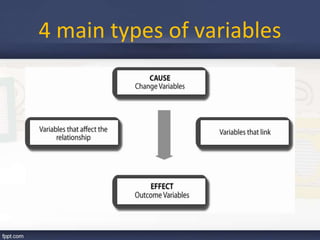
4 main types of variables
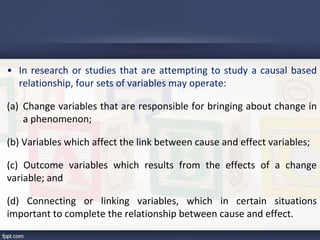
• In research or studies that are attempting to study a causal based
relationship, four sets of variables may operate:
(a) Change variables that are responsible for bringing about change in
a phenomenon;
(b) Variables which affect the link between cause and effect variables;
(c) Outcome variables which results from the effects of a change
variable; and
(d) Connecting or linking variables, which in certain situations
important to complete the relationship between cause and effect.
• They are also referred as outcome or effect or
responding or criterion variables.
• The variable that is the effect or the result or
outcome of another variable is the
dependent variable.
• The dependent is the factor that may change as a
result of changes made in the independent
variable.
• Variable that is influenced by the independent
variable.
EXAMPLES
Research Question 1: “The relationship between
mosquitoes and mosquito bites.”
- Dependent variable: the number of mosquito bites
per hour.
Research Question 2: “A study of the effect of
teacher praise on the reading achievement of
second-graders.”
-Dependent variable: the reading achievement of
second graders.
• They are also referred as manipulated or experimental or
treatment variables.
• The independent is a factor that’s intentionally varied by
the experimenter.
• The values of the independent variable are under
experimenter control.
• “Variable that is believed to cause or influence the
dependent variable".
Research Question 1: “The relationship between
mosquitoes and mosquito bites.”
- Independent variable: the number of mosquitoes
per acre of ground .
Research Question 2: “A study of the effect of
teacher praise on the reading achievement of
second-graders.”
-Independent variable: the amount and kind of
praise…no praise, oral praise, written praise or both.
EXAMPLES
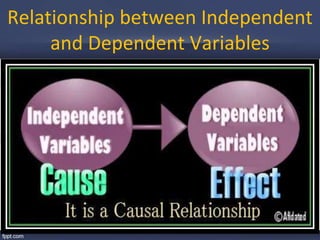
Relationship between Independent
and Dependent Variables
• A moderator variable is a secondary independent
variable that the researcher selects because he or
she thinks it may have a strong contingent effect
on the relationship between the primary
independent variable and the dependent variable.
• A variable that influences, or moderates, or
modifies the relation between two other variables
and thus produces an interaction effect.
EXAMPLES
Research Question 1: “Does anxiety affect test
performance and, if so, does it depend on test-
taking experience?”
– Independent variable: anxiety level
– Moderator variable: test-taking experience
– Dependent variable: test performance
Research Question 2: “Effects of library facilities
available on achievement of students.”
- Independent variable: library facilities
– Moderator variable: interest and inclination
towards reading
– Dependent variable: academic achievement
• A variable that explains a relation or provides a causal link
between other variables.
• Also called by some authors “mediating variable” or
“intermediary variable.”
• It cannot be measured.
• It is affected by the independent variable and it affects the
dependent variable.
Research Question 1: “Marital status causes the
degree of social integration which affects the
suicide rate.”
- Independent variable: marital status
– Intervening variable: the degree of social
integration
– Dependent variable: suicide rate
EXAMPLES
Research Question 2: “Higher education typically
leads to higher income.”
- Independent variable: higher education
– Intervening variable: better occupation
– Dependent variable: higher income
 The inter-veining variable is causally affected
by education and itself affects income.
• An extraneous variable that an investigator does
not wish to examine in a study.
• Thus the investigator controls this variable.
• It is also called a covariate.
• The factor that is kept constant all throughout the
experiment.
• There can be many controlled variables in an
experiment.
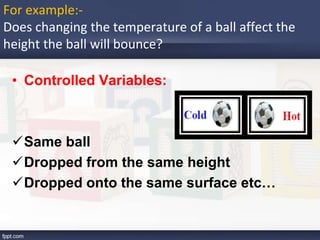
• Controlled Variables:
Same ball
Dropped from the same height
Dropped onto the same surface etc…
For example:-
Does changing the temperature of a ball affect the
height the ball will bounce?
Example 1:-
“The Relationship between Exposure to Mass Media and Smoking
Habits among Young Adults”
What was the independent variable?
What was the dependent variable?
 Smoking habits
 Exposure to mass media
A person’s smoking habit is assumed to change or vary depending
on his/her mere exposure to print or broadcast media related.
Example 2:-
Students of different ages were given the same jigsaw puzzle to put
together. They were timed to see how long it took to finish the puzzle.
What was the independent variable?
 Ages of the students
Different ages were tested by the scientist
What was the dependent variable?
 The time it to put the puzzle together
The time was observed and measured by the scientist.
What was the controlled variable?
 Same puzzle
All of the participants were tested with the same puzzle.
It would not have been a fair test if some had an easy 30 piece puzzle
and some had a harder 500 piece puzzle.
Example 3:-
The temperature of water was measured at different
depths of a pond.
• What was the Independent variable?
depth of the water
• What was the Dependent variable?
Temperature
• What was the Controlled variable?
Thermometer and pond
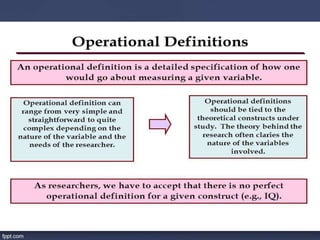
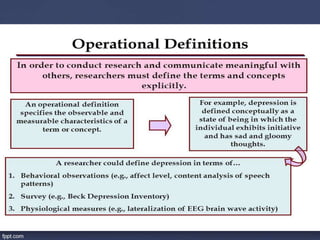
• An operational definition is how we (the researcher) decide to
measure our the variables in our study.
• Operational definition is a definition for a variable stated in terms of
specific testing criteria or operations, specifying what must be
counted, measured, or gathered through our senses.
- (Cooper & Schindler, pp.714)
• "The definition or description of a study variable that specifies how
it will be observed and measured in the study."
The operational definition gives a specific meaning to the variable. It
clarifies how a variable or a term is used and measured in terms of
events/units of measurement that are observable by the senses .
-(Fisher, et al., 1994)
• A manipulated variable is the independent variable in an
experiment. It’s called “manipulated” because it’s the one you can
change.
• It is an independent variable that is manipulated to achieve a
particular effect or tested to determine if it is the cause of the effect.
• In an experiment you should only have one manipulated variable at
a time.
• The values of the independent variable are under experimenter
control.
EXAMPLE
1. To find out if your weight depends on the amount of calories you
consume, you could lower your caloric intake.
 Here, calories is the manipulated variable for a period of time and
see how your weight changes in response.
2. You want to find out what the effect is of changing lesson lengths is
on student exam performance.
 Here, the manipulated variable would be the lesson times, as that’s
what you’re going to change to seethe effect on exam
performance.
• Controlled variables refer to variables or contributing factors that
are fixed or eliminated in order to clearly identify the relationship
between an independent variable and a dependent variable.
• Controlling variables is important because slight variations in the
experimental set-up could strongly affect the outcome being
measure.
• The factors or conditions that are kept the same (unchanged) in an
experiment.
• There can be many controlled variables in an experiment.
They are also called as covariate.
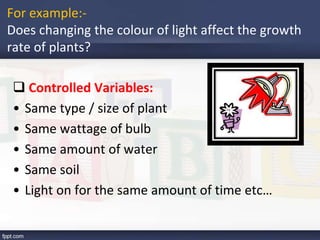
For example:-
Does changing the colour of light affect the growth
rate of plants?
 Controlled Variables:
• Same type / size of plant
• Same wattage of bulb
• Same amount of water
• Same soil
• Light on for the same amount of time etc…
variables in educational research

variables in educational research

  • 1.
    SEMINAR PRESENTATION CHIRAYU K.C. BAJAJCOLLEGE OF EDUCATION POST GRADUATE DEPARTMENT OF EDUCATION, NAGPUR SESSION 2017-19
  • 2.
    PRESENTED BY: HARSHITA ANKITAGRAWAL M.Ed (1st Semester)
  • 4.
    The term variableis used as a synonym for construct or property being studied. It is a symbol of an event, act, or characteristic, trait or attribute that can be measured and to which we assign categorical values. "A concept that is observable, measurable, and has a dimension that can vary". For example, temperature is a variable that is observable, measurable, and varies from high to low.  A variable is defined as anything that varies or changes in value. Because variable represents a quality that can exhibit differences in value, usually magnitude or strength, it may be said that a variable generally is anything that may assume different numerical or categorical values. Examples of variables…. Gender, motivation, marital status, religion, person’s attitude towards women empowerment, family income, intelligence etc…
  • 6.
    4 main typesof variables
  • 7.
    • In researchor studies that are attempting to study a causal based relationship, four sets of variables may operate: (a) Change variables that are responsible for bringing about change in a phenomenon; (b) Variables which affect the link between cause and effect variables; (c) Outcome variables which results from the effects of a change variable; and (d) Connecting or linking variables, which in certain situations important to complete the relationship between cause and effect.
  • 8.
    • They arealso referred as outcome or effect or responding or criterion variables. • The variable that is the effect or the result or outcome of another variable is the dependent variable. • The dependent is the factor that may change as a result of changes made in the independent variable. • Variable that is influenced by the independent variable.
  • 9.
    EXAMPLES Research Question 1:“The relationship between mosquitoes and mosquito bites.” - Dependent variable: the number of mosquito bites per hour. Research Question 2: “A study of the effect of teacher praise on the reading achievement of second-graders.” -Dependent variable: the reading achievement of second graders.
  • 10.
    • They arealso referred as manipulated or experimental or treatment variables. • The independent is a factor that’s intentionally varied by the experimenter. • The values of the independent variable are under experimenter control. • “Variable that is believed to cause or influence the dependent variable".
  • 11.
    Research Question 1:“The relationship between mosquitoes and mosquito bites.” - Independent variable: the number of mosquitoes per acre of ground . Research Question 2: “A study of the effect of teacher praise on the reading achievement of second-graders.” -Independent variable: the amount and kind of praise…no praise, oral praise, written praise or both. EXAMPLES
  • 12.
  • 13.
    • A moderatorvariable is a secondary independent variable that the researcher selects because he or she thinks it may have a strong contingent effect on the relationship between the primary independent variable and the dependent variable. • A variable that influences, or moderates, or modifies the relation between two other variables and thus produces an interaction effect.
  • 14.
    EXAMPLES Research Question 1:“Does anxiety affect test performance and, if so, does it depend on test- taking experience?” – Independent variable: anxiety level – Moderator variable: test-taking experience – Dependent variable: test performance
  • 15.
    Research Question 2:“Effects of library facilities available on achievement of students.” - Independent variable: library facilities – Moderator variable: interest and inclination towards reading – Dependent variable: academic achievement
  • 16.
    • A variablethat explains a relation or provides a causal link between other variables. • Also called by some authors “mediating variable” or “intermediary variable.” • It cannot be measured. • It is affected by the independent variable and it affects the dependent variable.
  • 17.
    Research Question 1:“Marital status causes the degree of social integration which affects the suicide rate.” - Independent variable: marital status – Intervening variable: the degree of social integration – Dependent variable: suicide rate EXAMPLES
  • 18.
    Research Question 2:“Higher education typically leads to higher income.” - Independent variable: higher education – Intervening variable: better occupation – Dependent variable: higher income  The inter-veining variable is causally affected by education and itself affects income.
  • 19.
    • An extraneousvariable that an investigator does not wish to examine in a study. • Thus the investigator controls this variable. • It is also called a covariate. • The factor that is kept constant all throughout the experiment. • There can be many controlled variables in an experiment.
  • 20.
    • Controlled Variables: Sameball Dropped from the same height Dropped onto the same surface etc… For example:- Does changing the temperature of a ball affect the height the ball will bounce?
  • 22.
    Example 1:- “The Relationshipbetween Exposure to Mass Media and Smoking Habits among Young Adults” What was the independent variable? What was the dependent variable?  Smoking habits  Exposure to mass media A person’s smoking habit is assumed to change or vary depending on his/her mere exposure to print or broadcast media related.
  • 23.
    Example 2:- Students ofdifferent ages were given the same jigsaw puzzle to put together. They were timed to see how long it took to finish the puzzle. What was the independent variable?  Ages of the students Different ages were tested by the scientist What was the dependent variable?  The time it to put the puzzle together The time was observed and measured by the scientist. What was the controlled variable?  Same puzzle All of the participants were tested with the same puzzle. It would not have been a fair test if some had an easy 30 piece puzzle and some had a harder 500 piece puzzle.
  • 24.
    Example 3:- The temperatureof water was measured at different depths of a pond. • What was the Independent variable? depth of the water • What was the Dependent variable? Temperature • What was the Controlled variable? Thermometer and pond
  • 26.
    • An operationaldefinition is how we (the researcher) decide to measure our the variables in our study. • Operational definition is a definition for a variable stated in terms of specific testing criteria or operations, specifying what must be counted, measured, or gathered through our senses. - (Cooper & Schindler, pp.714) • "The definition or description of a study variable that specifies how it will be observed and measured in the study." The operational definition gives a specific meaning to the variable. It clarifies how a variable or a term is used and measured in terms of events/units of measurement that are observable by the senses . -(Fisher, et al., 1994)
  • 30.
    • A manipulatedvariable is the independent variable in an experiment. It’s called “manipulated” because it’s the one you can change. • It is an independent variable that is manipulated to achieve a particular effect or tested to determine if it is the cause of the effect. • In an experiment you should only have one manipulated variable at a time. • The values of the independent variable are under experimenter control.
  • 31.
    EXAMPLE 1. To findout if your weight depends on the amount of calories you consume, you could lower your caloric intake.  Here, calories is the manipulated variable for a period of time and see how your weight changes in response. 2. You want to find out what the effect is of changing lesson lengths is on student exam performance.  Here, the manipulated variable would be the lesson times, as that’s what you’re going to change to seethe effect on exam performance.
  • 33.
    • Controlled variablesrefer to variables or contributing factors that are fixed or eliminated in order to clearly identify the relationship between an independent variable and a dependent variable. • Controlling variables is important because slight variations in the experimental set-up could strongly affect the outcome being measure. • The factors or conditions that are kept the same (unchanged) in an experiment. • There can be many controlled variables in an experiment. They are also called as covariate.
  • 34.
    For example:- Does changingthe colour of light affect the growth rate of plants?  Controlled Variables: • Same type / size of plant • Same wattage of bulb • Same amount of water • Same soil • Light on for the same amount of time etc…