.Concept of Guidance
By
Dr. Satish Raj
Assistant Professor
Scholl of Education
Lovely Professional University Jalandhar, Punjab, India
Email:- satishnurpur@gmail.com
+91 7589110552
.
.
.
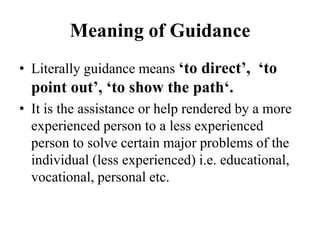
Meaning of Guidance
• Literally guidance means ‘to direct’, ‘to
point out’, ‘to show the path‘.
• It is the assistance or help rendered by a more
experienced person to a less experienced
person to solve certain major problems of the
individual (less experienced) i.e. educational,
vocational, personal etc.
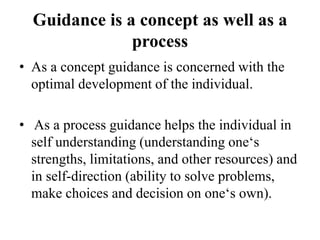
Guidance is a concept as well as a
process
• As a concept guidance is concerned with the
optimal development of the individual.
• As a process guidance helps the individual in
self understanding (understanding one‗s
strengths, limitations, and other resources) and
in self-direction (ability to solve problems,
make choices and decision on one‗s own).
Definition of Guidance
• Ruth Strang, ―Guidance is a process of helping
every individual, through his own efforts, to
discover and develop his potentialities for his
personal happiness and social usefulness.‖
• Knapps, ―Learning about the individual student,
helping him to understand himself, effecting
changes in him and in his environment which will
help him to grow and develop as much as possible
– these are the elements of guidance.‖
NEED AND IMPORTANCE OF
GUIDANCE
• Self understanding and self direction: Guidance helps
in understanding one‗s strength, limitations and other
resources.
• Guidance helps individual to develop ability to solve
problems and take decisions.
• Optimum development of individual
• Solving different problem of the individual
• Academic growth and development
• Vocational choices and vocational adjustments,
vocational maturity
NEED AND IMPORTANCE OF GUIDANCE
• Social adjustment
• Personal adjustment
• Better family life
• Good citizenship
• For conservation and proper utilization of human resources
• For national development
• Help to make a satisfactory transition from home to the school.
• To diagnose the difficulties in the learning of basic skills.
• To help to avoid potential dropouts to study in schools.
• To help them understand the purpose and meaning of life.
• To plan for further education.
Nature of Guidance
• 1. Guidance stands for the process of education as a whole
• 2. The guidance is meant for all the children
• 3. Guidance is attainment of self-direction by an individual
• 4. Guidance as a continuous process
• 5. Guidance is both a science and an art
• 6. Guidance is a process of learning, helping and effective for
an individual
• 7. Guidance is a team work
• 8. Guidance as the promotion of the growth of the individual
in self direction
• 9. Guidance is functional by nature
• 10. Guidance is a process of assisting an individual to find his
place
Nature of Guidance
• 11. Guidance establishes an effective relationship
• 12. Guidance is regarded as a professional process
• 13. Guidance is individual and grouped in nature
• 14. Guidance as a systematic phase of the educative process
• 15. Guidance is a process of assisting to adjust
• 16. The guidance is meant for the development of self
• 17. Guidance as helping and adjusting
• 18. Guidance as adjustment and vocational
• 19. Adjustment to environment
• 20. Guidance regards the worth of each and every child
Principles of Guidance
• Principle of universality
• Principle of continuity
• Principle of Individualism
• Principle of flexibility in methods and procedures
• Principle of complexity of problems
• Principle of self pacing
Scope of Guidance service
• Educational Guidance
• Vocational Guidance
• Personal Guidance
• Social Guidance
• Advocational Guidance
• Health Guidance
Guidance at Elementary School level
• To adjust the new environment.
• To adjust the special character of some children.
• To identify learning difficulties and the special needs of children
• To reduce the learning disabilities.
• To preserve their emotional, educational, social needs.
• To prevent emotional, educational, social backwardness.
Guidance at Secondary School level
• Increase self-knowledge and how to relate effectively to
others.
• Broaden the knowledge about the changing environment.
• Helps them reach their fullest academic potential.
• Provides opportunities for career exploration, planning and
decision making.
• Provides an opportunity for networking with services and thus
establishes an effective support system.
• To help child in selecting subjects
• To help child to maintain good health
• To encourage children
• To participate in co-curricular activities
• To develop & maintain records of children
Guidance at University level
• Sorting out their educational problems
• To develop personality and behaviour
• To provide a complete picture about the reality of life
• To help them in achieving the goals of life
• To acquaint them with the scope of higher studies
• To enable them to plan and organise seminars etc.
• To help them in finding job opportunities.
Need of Organizing Guidance Programme
• (i) It helps the teachers to take note of potentialities of each
student in different degree in different direction.
• (ii) It helps the students and their parents to make right and
appropriate career plans for future.
• (iii) It helps to understand the physical, social, emotional and
intellectual characteristics and the need of pupils.
• (iv) It promotes efficiency in providing essential reliable and
scientific data on pupils.
• (v) It provides knowledge to children in making satisfactory
adjustment in the school and the community.
• (vi) A well organized guidance programme saves time, money
and effort.
Need of Organizing Guidance Programme
• (vii) It helps students to find a suitable occupation or vocation.
• (viii) It helps teachers to understand the individual differences
of children in various spheres.
• (ix) It can properly utilize skill, training, knowledge,
potentialities and interest of staff members of the school.
• (x) It co-ordinates the work of all persons engaged in the
guidance programme.
• (xi) It utilizes community resources properly for ensuring
smooth organization of guidance programme.
• (xii) It helps the students in achieving self-development, self-
direction and self-realization.
• (xiii) It considers the activities and functions of the personnel
engaged in school guidance services.
• (xiv) It helps in developing good human relationships.
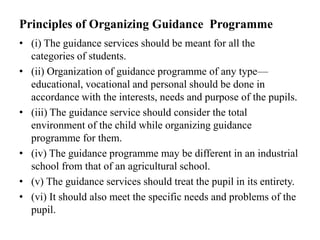
Principles of Organizing Guidance Programme
• (i) The guidance services should be meant for all the
categories of students.
• (ii) Organization of guidance programme of any type—
educational, vocational and personal should be done in
accordance with the interests, needs and purpose of the pupils.
• (iii) The guidance service should consider the total
environment of the child while organizing guidance
programme for them.
• (iv) The guidance programme may be different in an industrial
school from that of an agricultural school.
• (v) The guidance services should treat the pupil in its entirety.
• (vi) It should also meet the specific needs and problems of the
pupil.
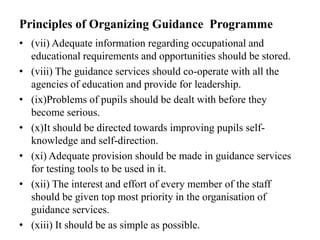
Principles of Organizing Guidance Programme
• (vii) Adequate information regarding occupational and
educational requirements and opportunities should be stored.
• (viii) The guidance services should co-operate with all the
agencies of education and provide for leadership.
• (ix)Problems of pupils should be dealt with before they
become serious.
• (x)It should be directed towards improving pupils self-
knowledge and self-direction.
• (xi) Adequate provision should be made in guidance services
for testing tools to be used in it.
• (xii) The interest and effort of every member of the staff
should be given top most priority in the organisation of
guidance services.
• (xiii) It should be as simple as possible.

Concept of guidance

  • 1.
    .Concept of Guidance By Dr.Satish Raj Assistant Professor Scholl of Education Lovely Professional University Jalandhar, Punjab, India Email:- satishnurpur@gmail.com +91 7589110552
  • 2.
  • 3.
  • 4.
  • 5.
    Meaning of Guidance •Literally guidance means ‘to direct’, ‘to point out’, ‘to show the path‘. • It is the assistance or help rendered by a more experienced person to a less experienced person to solve certain major problems of the individual (less experienced) i.e. educational, vocational, personal etc.
  • 6.
    Guidance is aconcept as well as a process • As a concept guidance is concerned with the optimal development of the individual. • As a process guidance helps the individual in self understanding (understanding one‗s strengths, limitations, and other resources) and in self-direction (ability to solve problems, make choices and decision on one‗s own).
  • 7.
    Definition of Guidance •Ruth Strang, ―Guidance is a process of helping every individual, through his own efforts, to discover and develop his potentialities for his personal happiness and social usefulness.‖ • Knapps, ―Learning about the individual student, helping him to understand himself, effecting changes in him and in his environment which will help him to grow and develop as much as possible – these are the elements of guidance.‖
  • 8.
    NEED AND IMPORTANCEOF GUIDANCE • Self understanding and self direction: Guidance helps in understanding one‗s strength, limitations and other resources. • Guidance helps individual to develop ability to solve problems and take decisions. • Optimum development of individual • Solving different problem of the individual • Academic growth and development • Vocational choices and vocational adjustments, vocational maturity
  • 9.
    NEED AND IMPORTANCEOF GUIDANCE • Social adjustment • Personal adjustment • Better family life • Good citizenship • For conservation and proper utilization of human resources • For national development • Help to make a satisfactory transition from home to the school. • To diagnose the difficulties in the learning of basic skills. • To help to avoid potential dropouts to study in schools. • To help them understand the purpose and meaning of life. • To plan for further education.
  • 10.
    Nature of Guidance •1. Guidance stands for the process of education as a whole • 2. The guidance is meant for all the children • 3. Guidance is attainment of self-direction by an individual • 4. Guidance as a continuous process • 5. Guidance is both a science and an art • 6. Guidance is a process of learning, helping and effective for an individual • 7. Guidance is a team work • 8. Guidance as the promotion of the growth of the individual in self direction • 9. Guidance is functional by nature • 10. Guidance is a process of assisting an individual to find his place
  • 11.
    Nature of Guidance •11. Guidance establishes an effective relationship • 12. Guidance is regarded as a professional process • 13. Guidance is individual and grouped in nature • 14. Guidance as a systematic phase of the educative process • 15. Guidance is a process of assisting to adjust • 16. The guidance is meant for the development of self • 17. Guidance as helping and adjusting • 18. Guidance as adjustment and vocational • 19. Adjustment to environment • 20. Guidance regards the worth of each and every child
  • 12.
    Principles of Guidance •Principle of universality • Principle of continuity • Principle of Individualism • Principle of flexibility in methods and procedures • Principle of complexity of problems • Principle of self pacing
  • 13.
    Scope of Guidanceservice • Educational Guidance • Vocational Guidance • Personal Guidance • Social Guidance • Advocational Guidance • Health Guidance
  • 14.
    Guidance at ElementarySchool level • To adjust the new environment. • To adjust the special character of some children. • To identify learning difficulties and the special needs of children • To reduce the learning disabilities. • To preserve their emotional, educational, social needs. • To prevent emotional, educational, social backwardness.
  • 15.
    Guidance at SecondarySchool level • Increase self-knowledge and how to relate effectively to others. • Broaden the knowledge about the changing environment. • Helps them reach their fullest academic potential. • Provides opportunities for career exploration, planning and decision making. • Provides an opportunity for networking with services and thus establishes an effective support system. • To help child in selecting subjects • To help child to maintain good health • To encourage children • To participate in co-curricular activities • To develop & maintain records of children
  • 16.
    Guidance at Universitylevel • Sorting out their educational problems • To develop personality and behaviour • To provide a complete picture about the reality of life • To help them in achieving the goals of life • To acquaint them with the scope of higher studies • To enable them to plan and organise seminars etc. • To help them in finding job opportunities.
  • 17.
    Need of OrganizingGuidance Programme • (i) It helps the teachers to take note of potentialities of each student in different degree in different direction. • (ii) It helps the students and their parents to make right and appropriate career plans for future. • (iii) It helps to understand the physical, social, emotional and intellectual characteristics and the need of pupils. • (iv) It promotes efficiency in providing essential reliable and scientific data on pupils. • (v) It provides knowledge to children in making satisfactory adjustment in the school and the community. • (vi) A well organized guidance programme saves time, money and effort.
  • 18.
    Need of OrganizingGuidance Programme • (vii) It helps students to find a suitable occupation or vocation. • (viii) It helps teachers to understand the individual differences of children in various spheres. • (ix) It can properly utilize skill, training, knowledge, potentialities and interest of staff members of the school. • (x) It co-ordinates the work of all persons engaged in the guidance programme. • (xi) It utilizes community resources properly for ensuring smooth organization of guidance programme. • (xii) It helps the students in achieving self-development, self- direction and self-realization. • (xiii) It considers the activities and functions of the personnel engaged in school guidance services. • (xiv) It helps in developing good human relationships.
  • 19.
    Principles of OrganizingGuidance Programme • (i) The guidance services should be meant for all the categories of students. • (ii) Organization of guidance programme of any type— educational, vocational and personal should be done in accordance with the interests, needs and purpose of the pupils. • (iii) The guidance service should consider the total environment of the child while organizing guidance programme for them. • (iv) The guidance programme may be different in an industrial school from that of an agricultural school. • (v) The guidance services should treat the pupil in its entirety. • (vi) It should also meet the specific needs and problems of the pupil.
  • 20.
    Principles of OrganizingGuidance Programme • (vii) Adequate information regarding occupational and educational requirements and opportunities should be stored. • (viii) The guidance services should co-operate with all the agencies of education and provide for leadership. • (ix)Problems of pupils should be dealt with before they become serious. • (x)It should be directed towards improving pupils self- knowledge and self-direction. • (xi) Adequate provision should be made in guidance services for testing tools to be used in it. • (xii) The interest and effort of every member of the staff should be given top most priority in the organisation of guidance services. • (xiii) It should be as simple as possible.