An Introduction to Research Methods in Psychology James Neill  (2010) Centre for Applied Psychology University of Canberra
Outline Introduction
What is research?
Quick Fun Survey
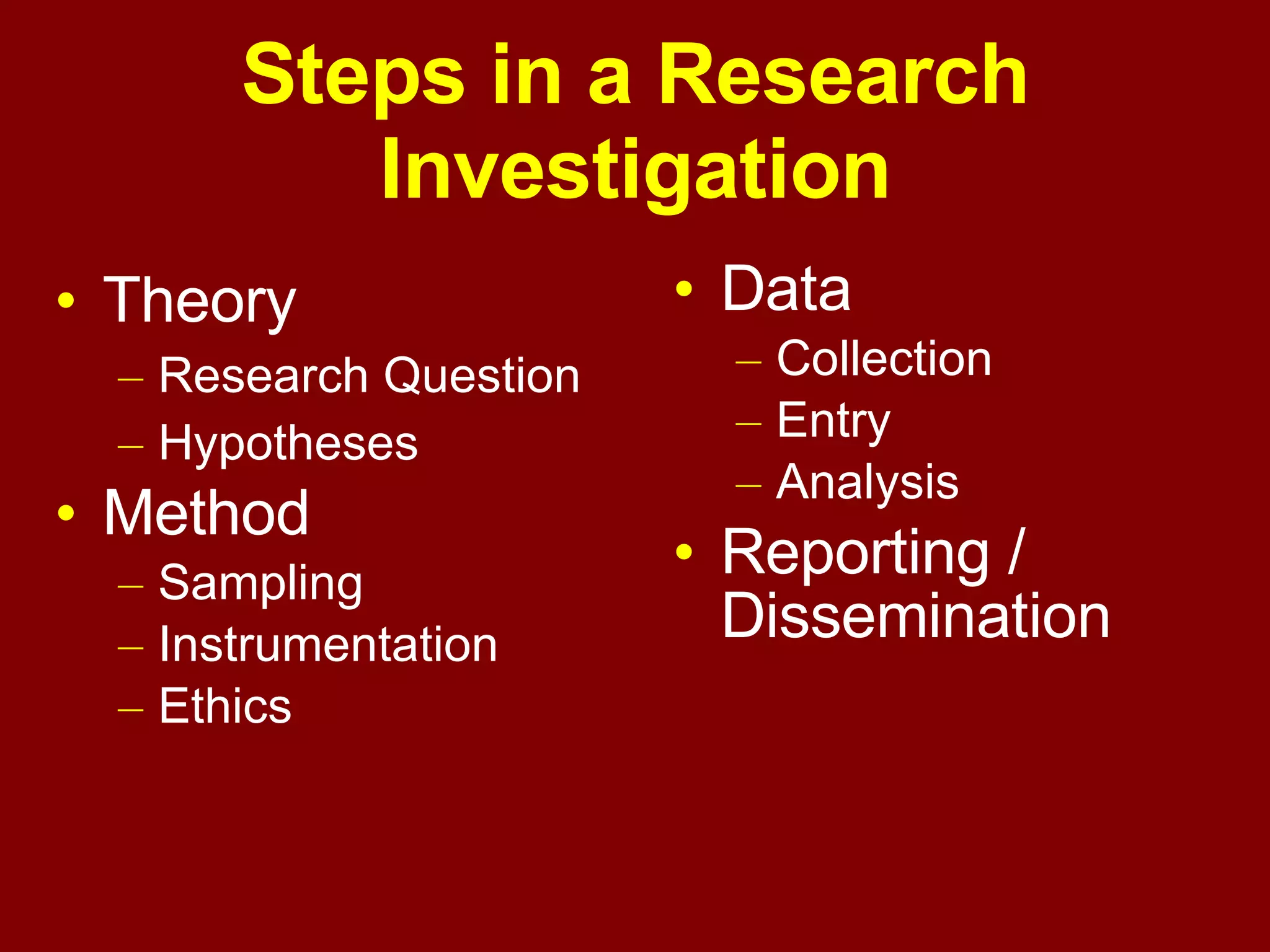
Research process
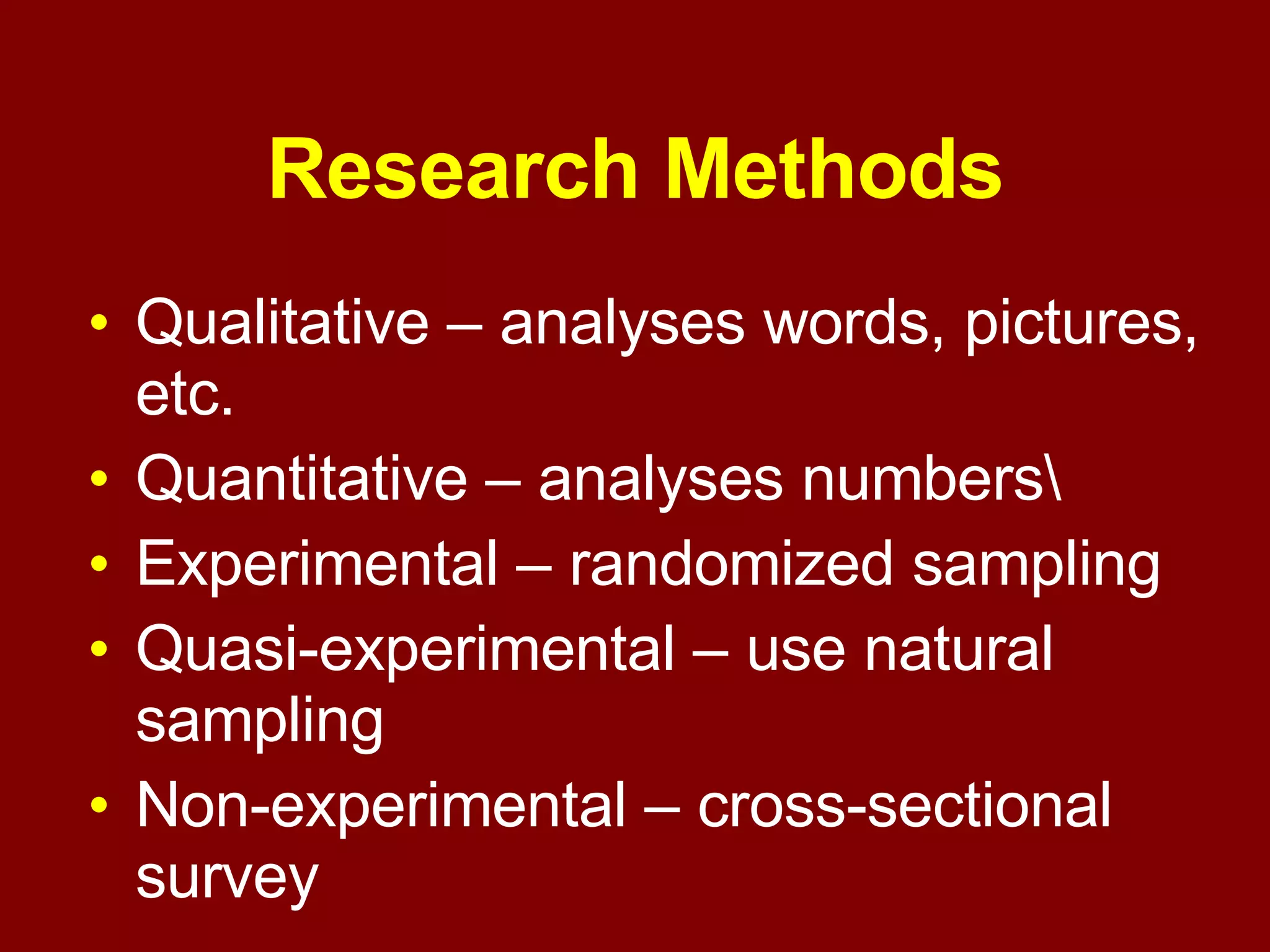
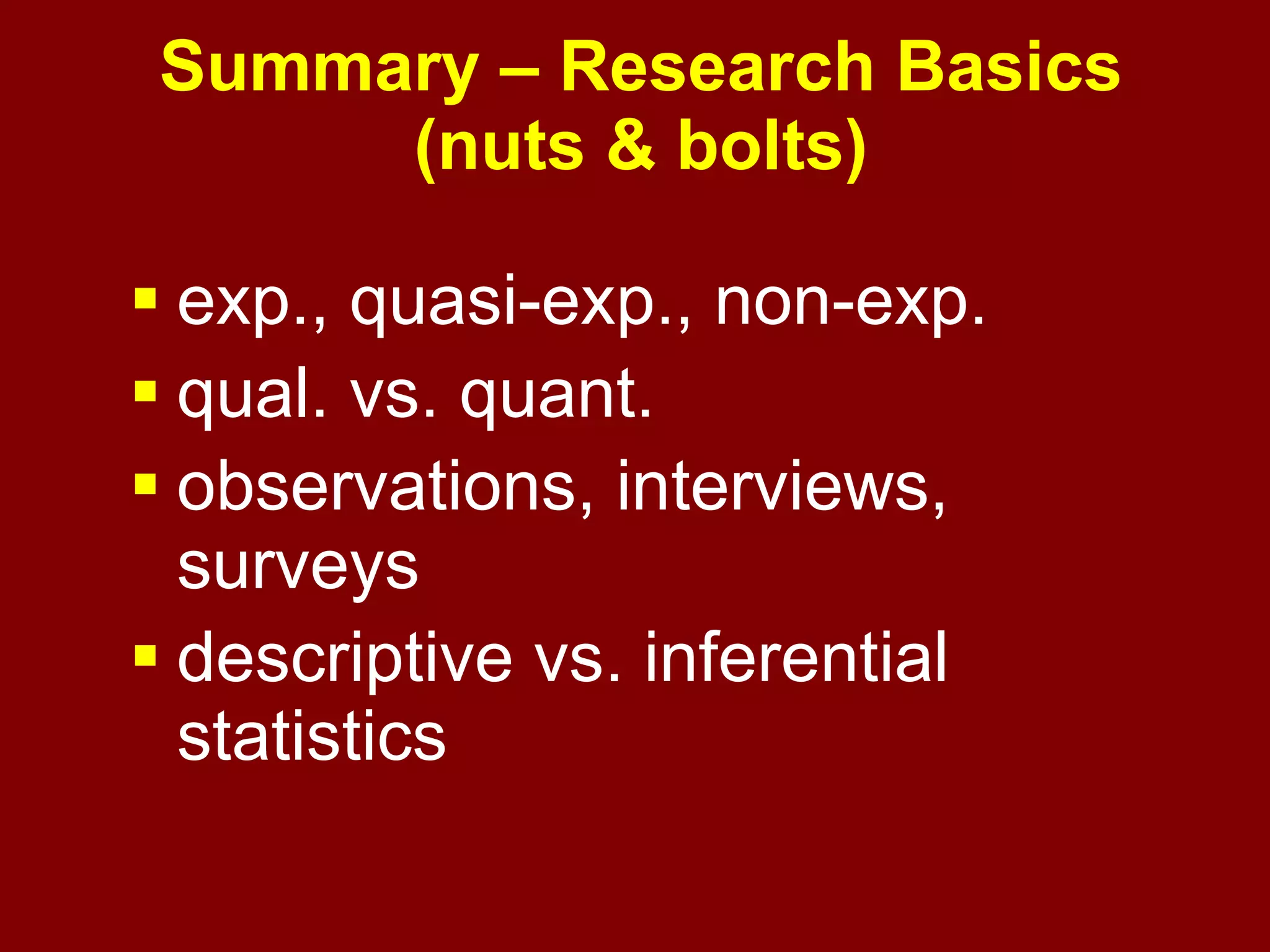
Research methods
Bias in research
Ethical issues
Reading Research methods in psychology  (Gerrig et al. 2008, Ch. 2)
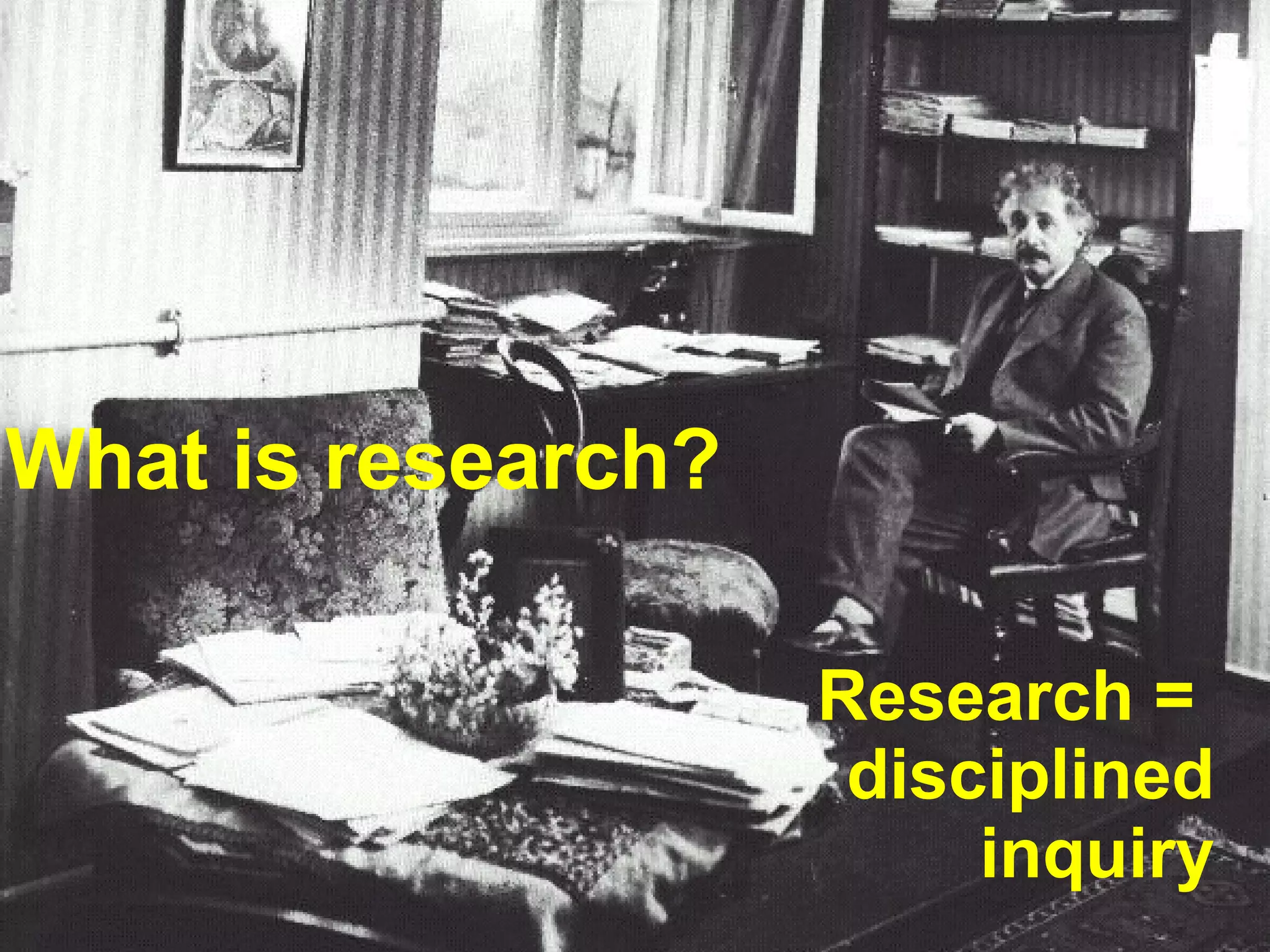
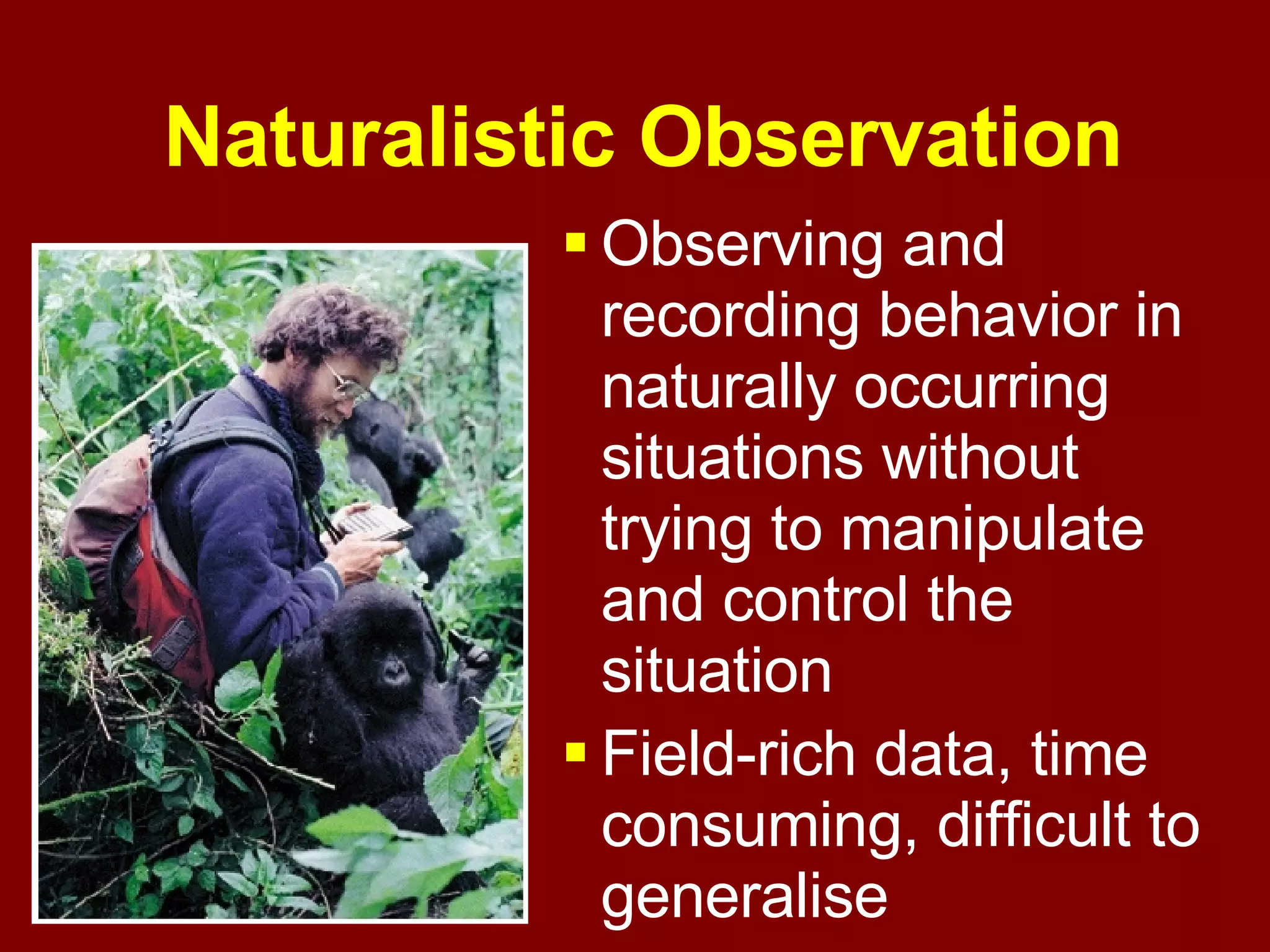
disciplined inquiry What is research?
What is research?
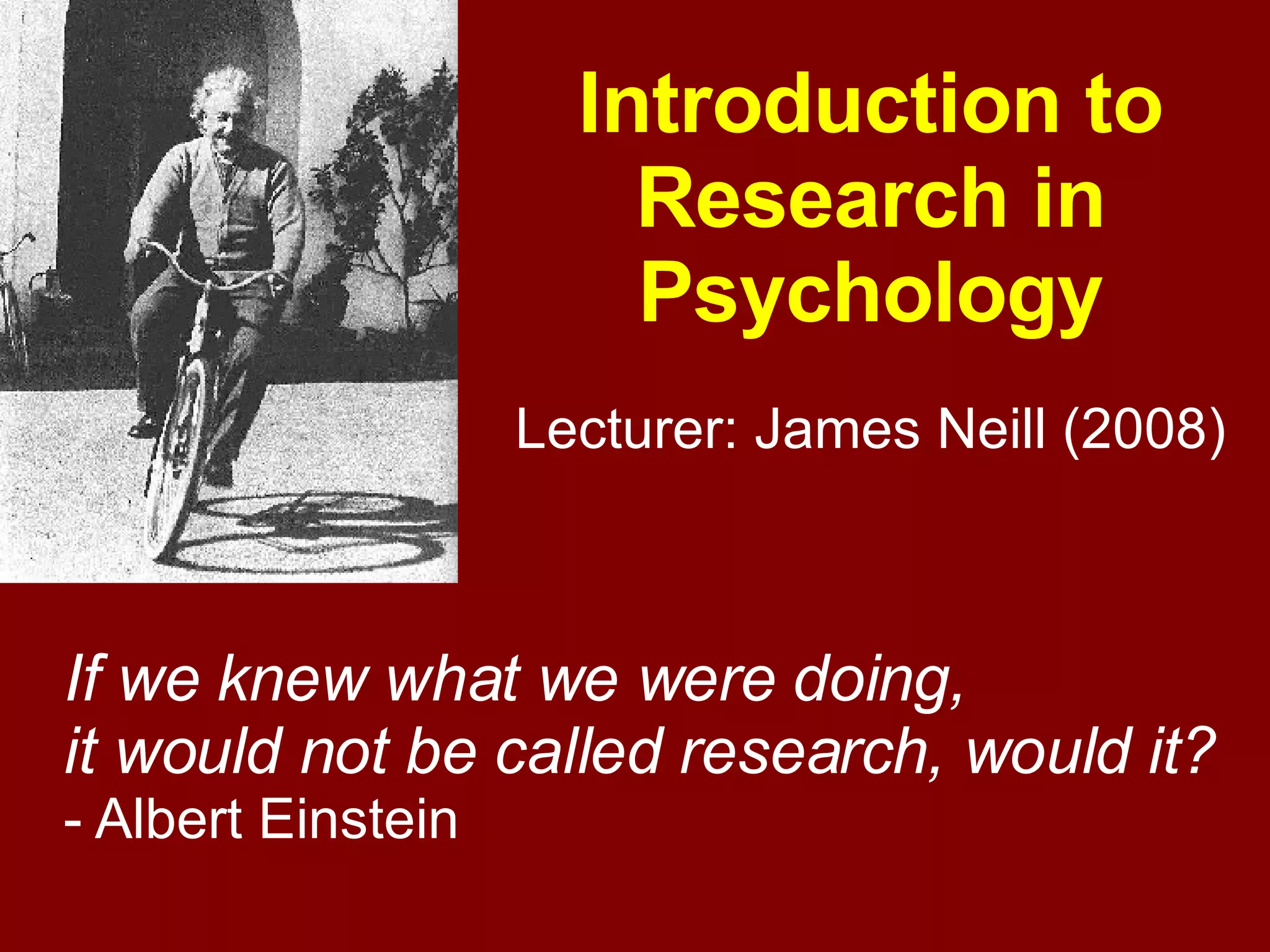
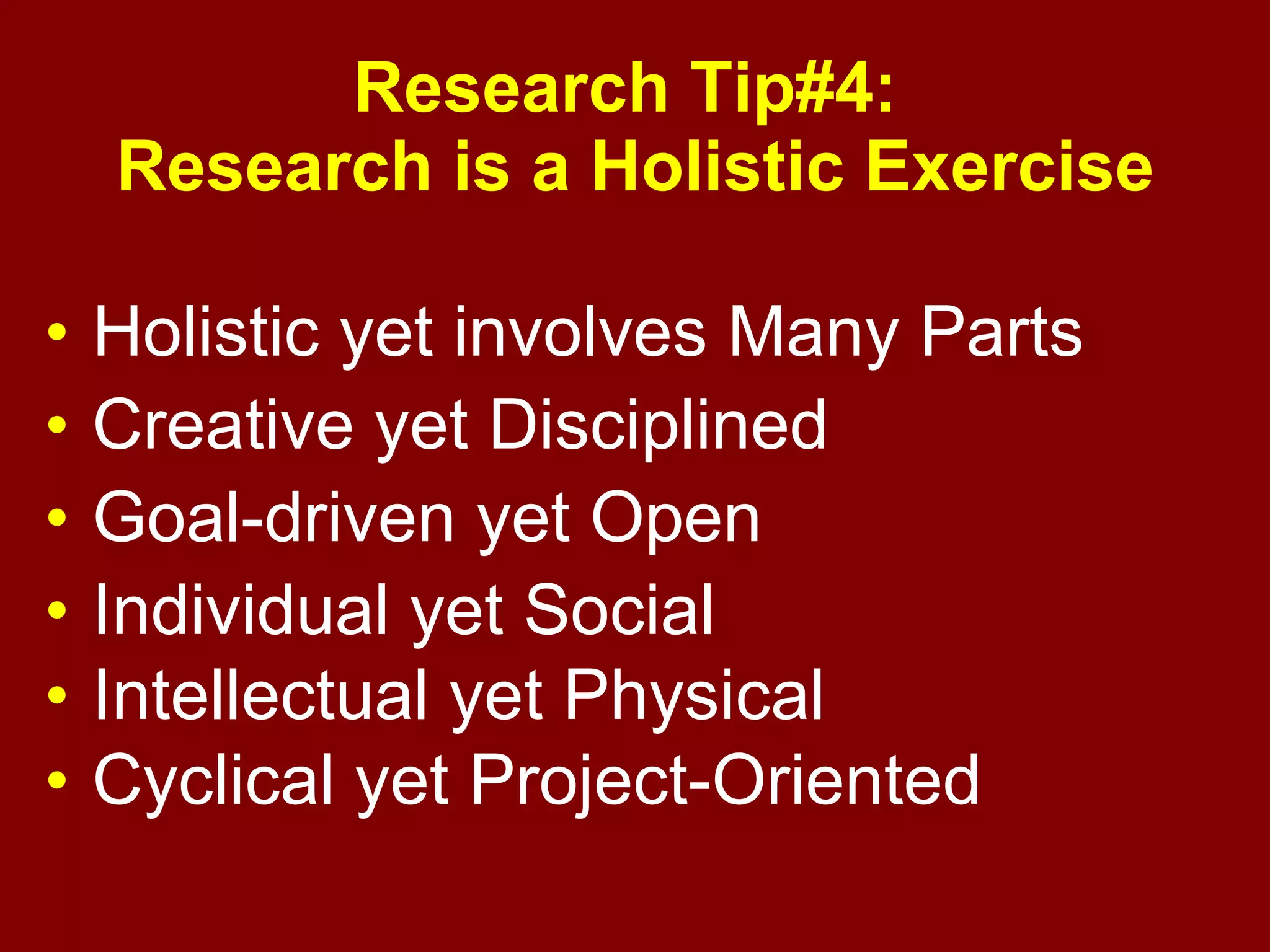
What is research? Research is  formalised curiosity .  It is poking and prying with a purpose. - Zora Neale Hurston
Research is a  a systematic attempt to understand the world .
Psychological research  is a systematic attempt to understand  human experiences of themselves and the world . What is  psychological research?
Systematic development & testing of theory  about human behaviour and mental events
Disciplined enquiry  into human  thinking, feeling, and behaviour . What is  psychological research?
Research is a language Learn key terms / concepts
UG study, especially 1st year, is about acquiring the language skills to access and make sense of recorded research knowledge
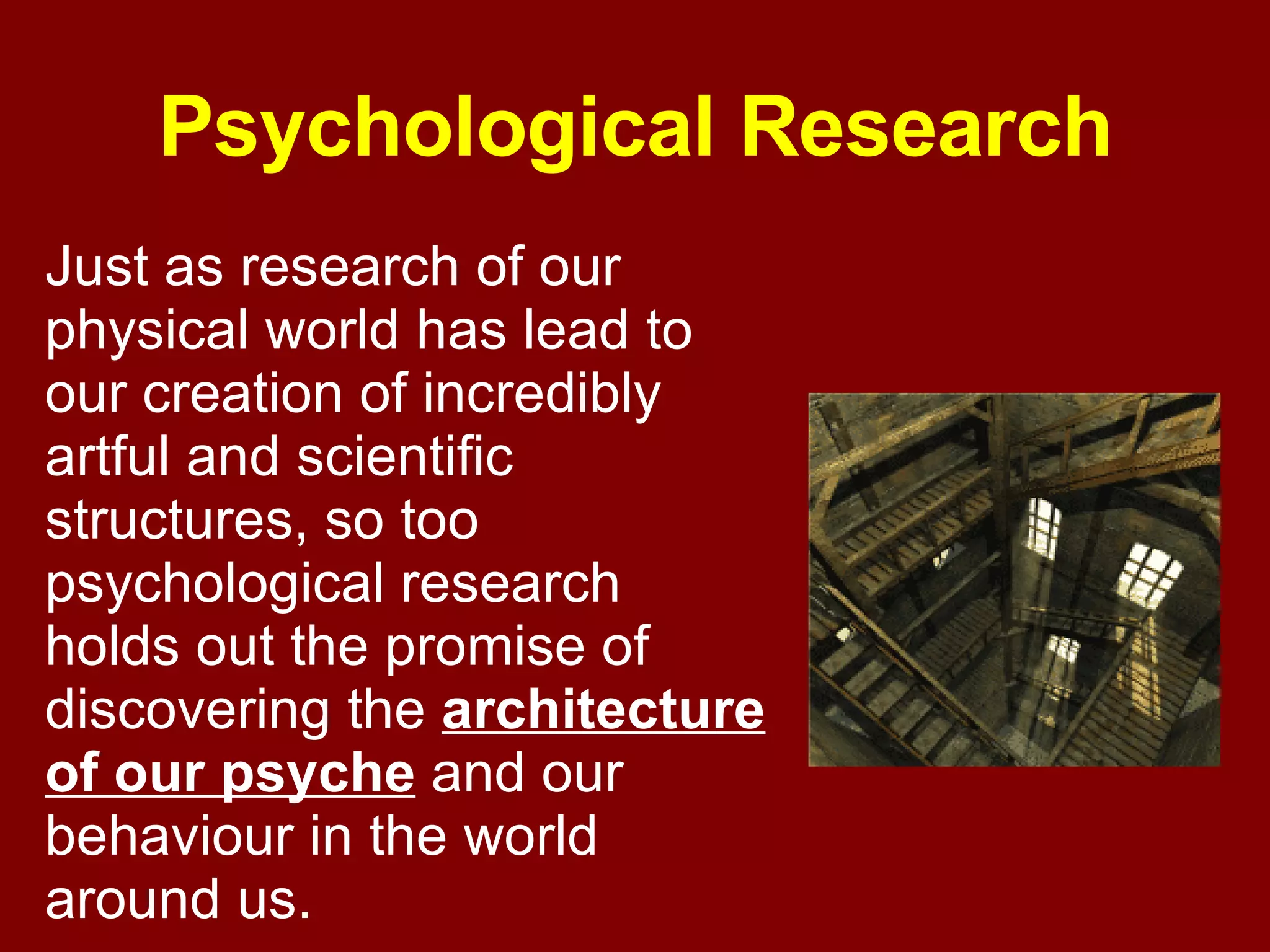
Psychological research ...holds out the promise of discovering the  architecture of our psyche  and understanding our behaviour in the world around us.
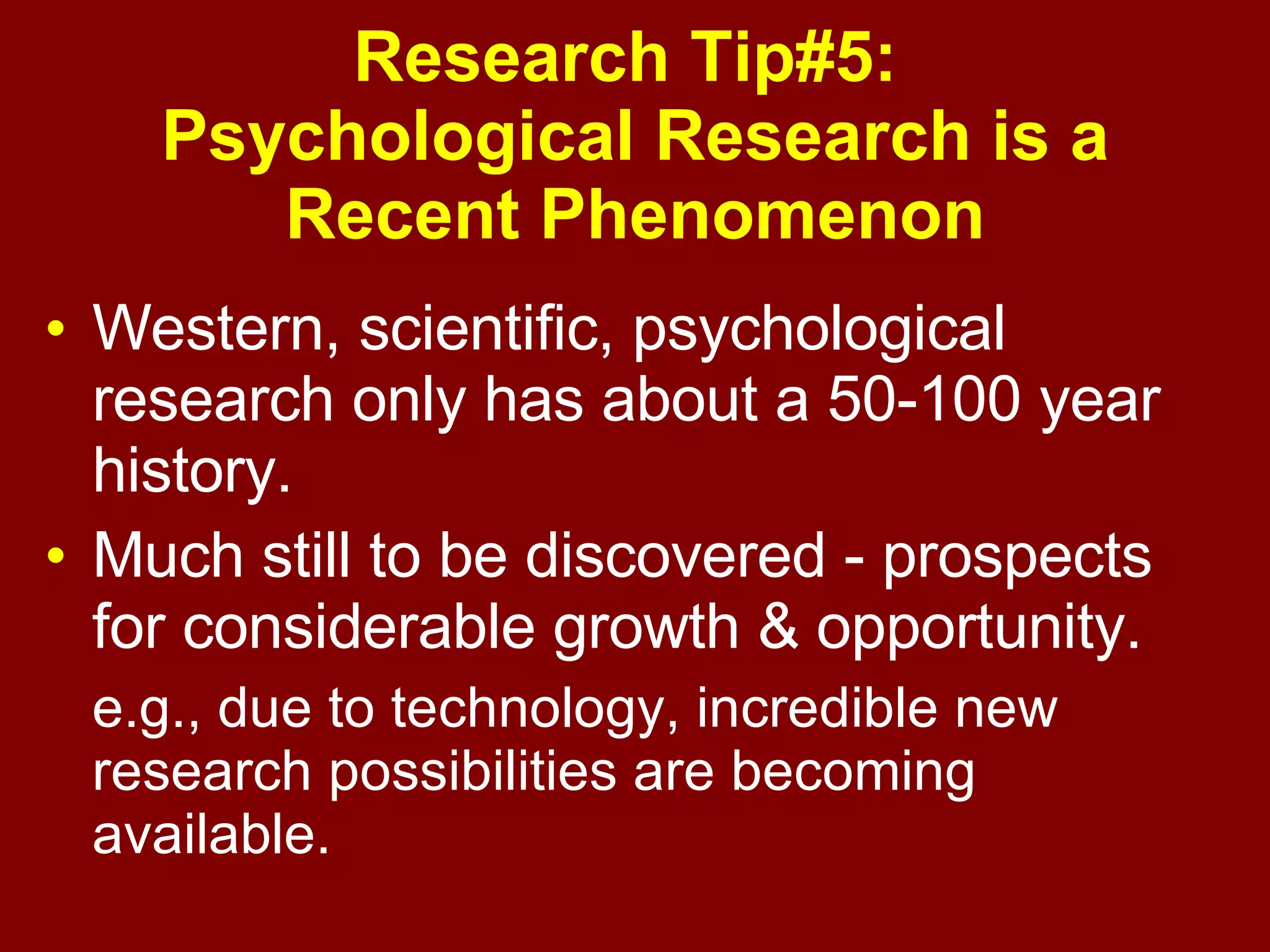
Psychological research is a recent phenomenon Western, scientific, psychological research only has about a 60-100 year history.
Much still to be discovered - prospects for considerable growth & opportunity. e.g., due to technology, new research techniques and directions are becoming available.
Observations, beliefs, information, and general knowledge lead to a new idea or a different way of thinking about some phenomenon
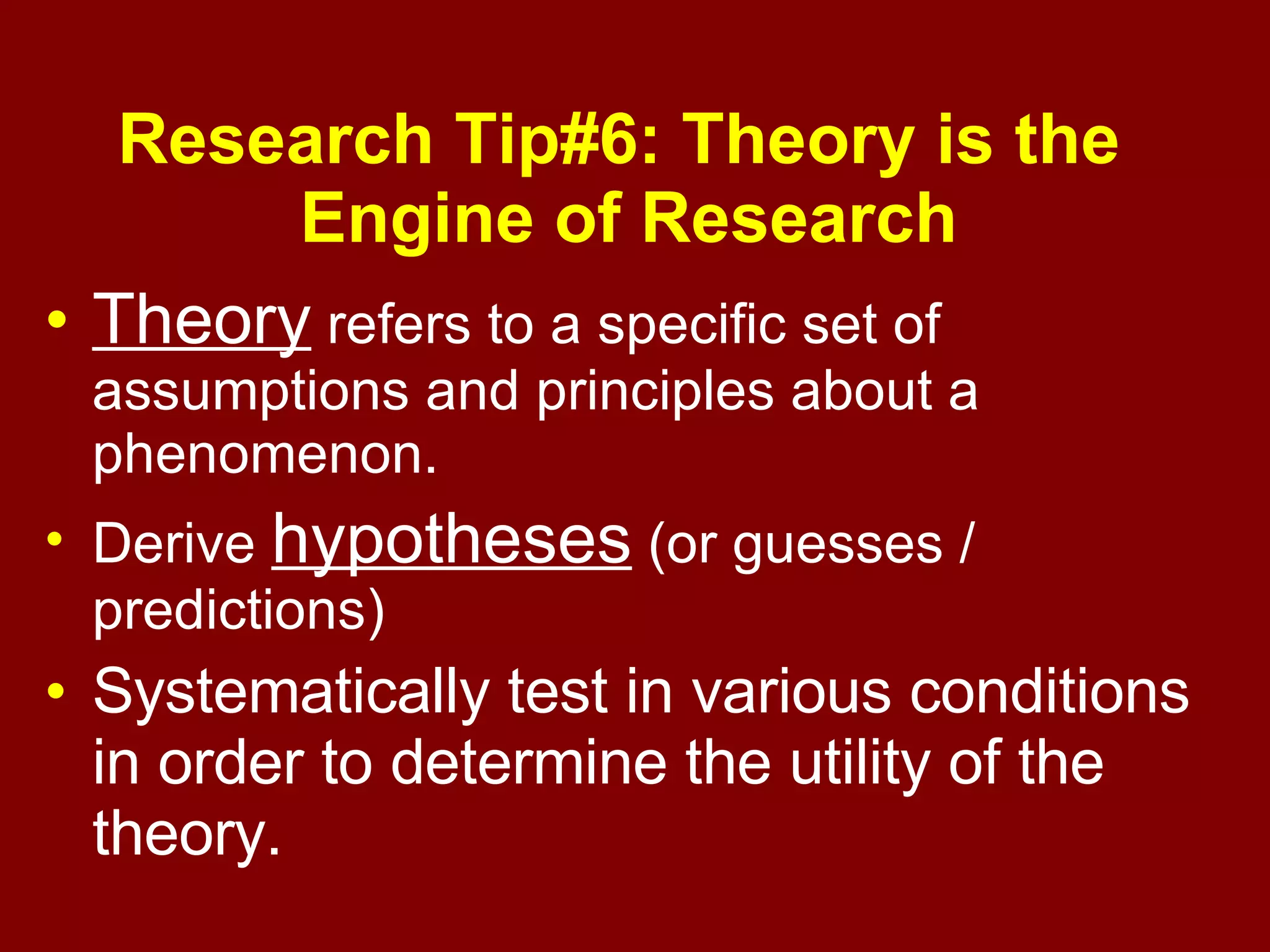
Theory: An organised set of concepts that explains a phenomenon or set of phenomena.
Use theory to formulate research questions. Process of research
Develop a hypothesis or hypotheses A tentative and testable explanation(s) of the relationship between two (or more) events or variables Use the scientific method to design the study Process of research
Initial observation or question
Form a hypothesis
Design the study
Analyse the data and draw conclusions
Report the findings
Consider open questions
Act on open questions The research process Gerrig et al. (2008)
Quick Fun Survey What is your favourite colour?
What is your favourite number?
What sex is the number 4?
What sex is the number 8?
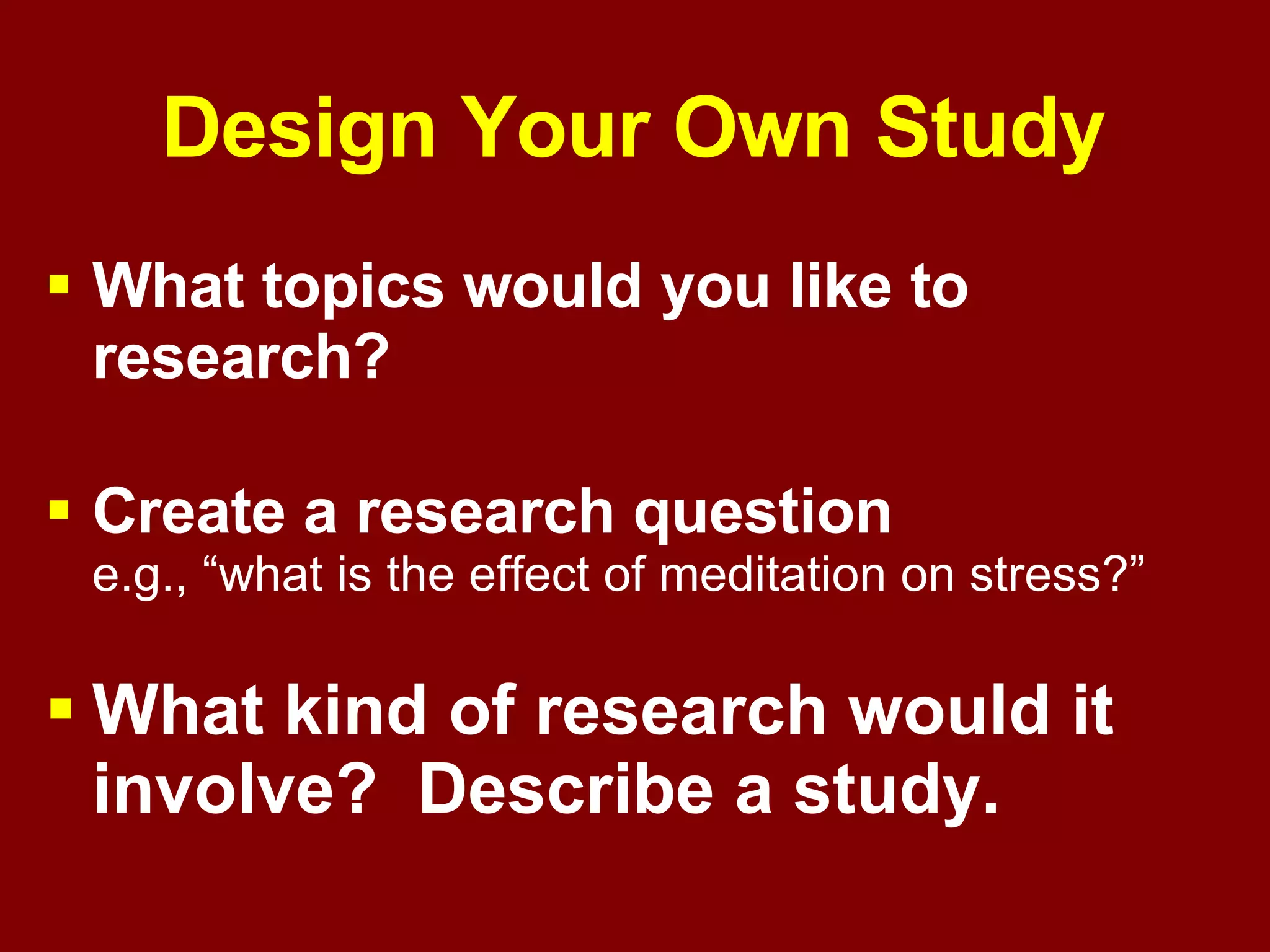
Design Your Own Psychological Study
Research questions Expressing topics of interest as  research questions  is a key first step, e.g., Is it bad to smack your children?
What is the effect of meditation on stress?
Do “smart drugs” really make people “smarter”?
My first study What changes in stress, anxiety, crisis and flow occur for novice abseilers?
Design your own study List  topics  you would like to research.
Create  research questions  & choose one.
What  variables  are to be measured?
What  research method  would you use?
What  population  and  sampling method  would you use?
Student research  opportunities Research participation
Research seminars
Research news e.g., via Journal alerts
Google Alerts Research journals Hard copies
Electronic copies
Scientific method
Research is a way of thinking Researchers need to acknowledge & understand the limits of intuition & common sense
Philosophy of science
The scientific attitude
The scientific method
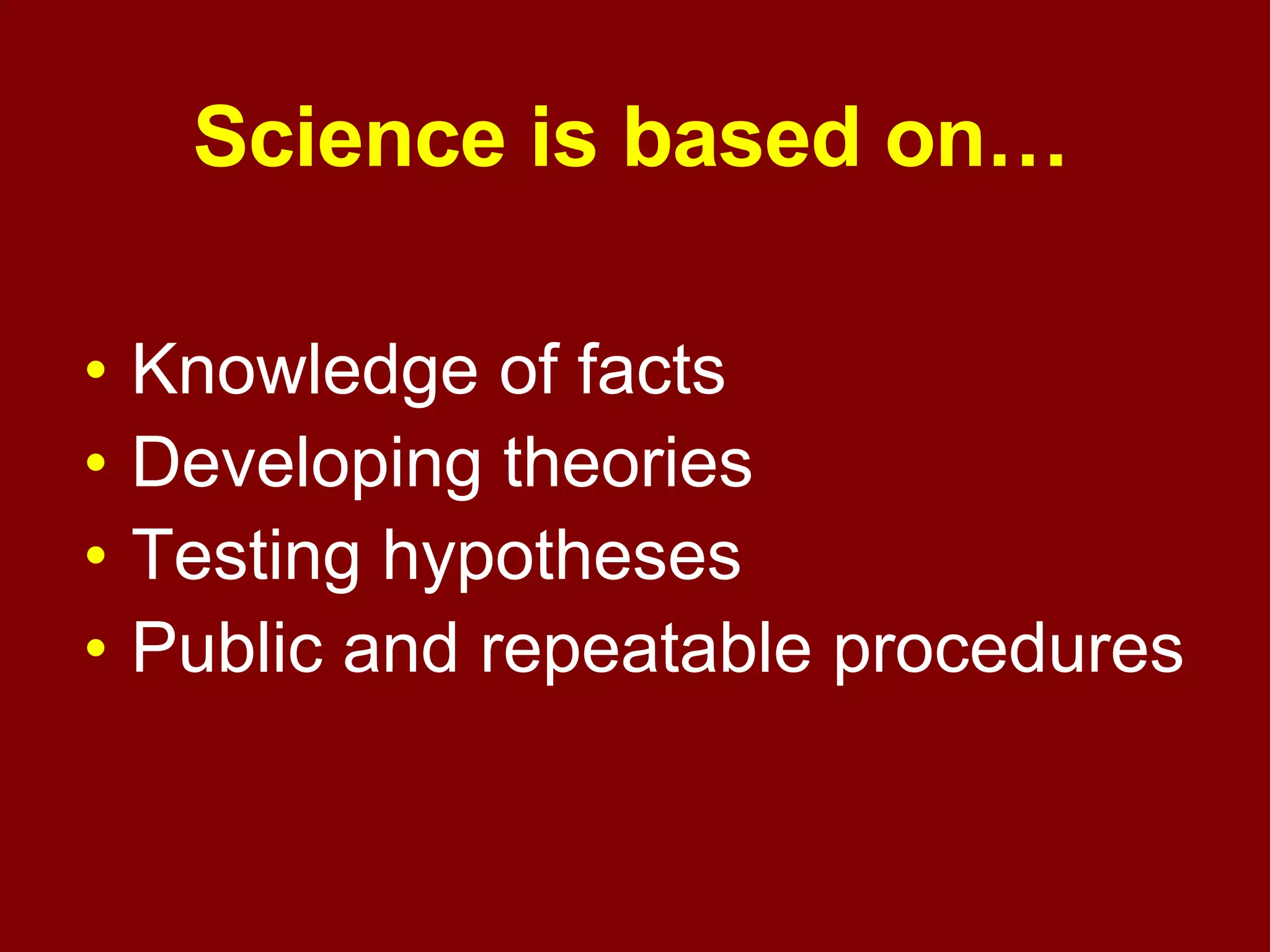
Science is based on… Knowledge of facts
Developing theories
Testing hypotheses
Public and repeatable procedures
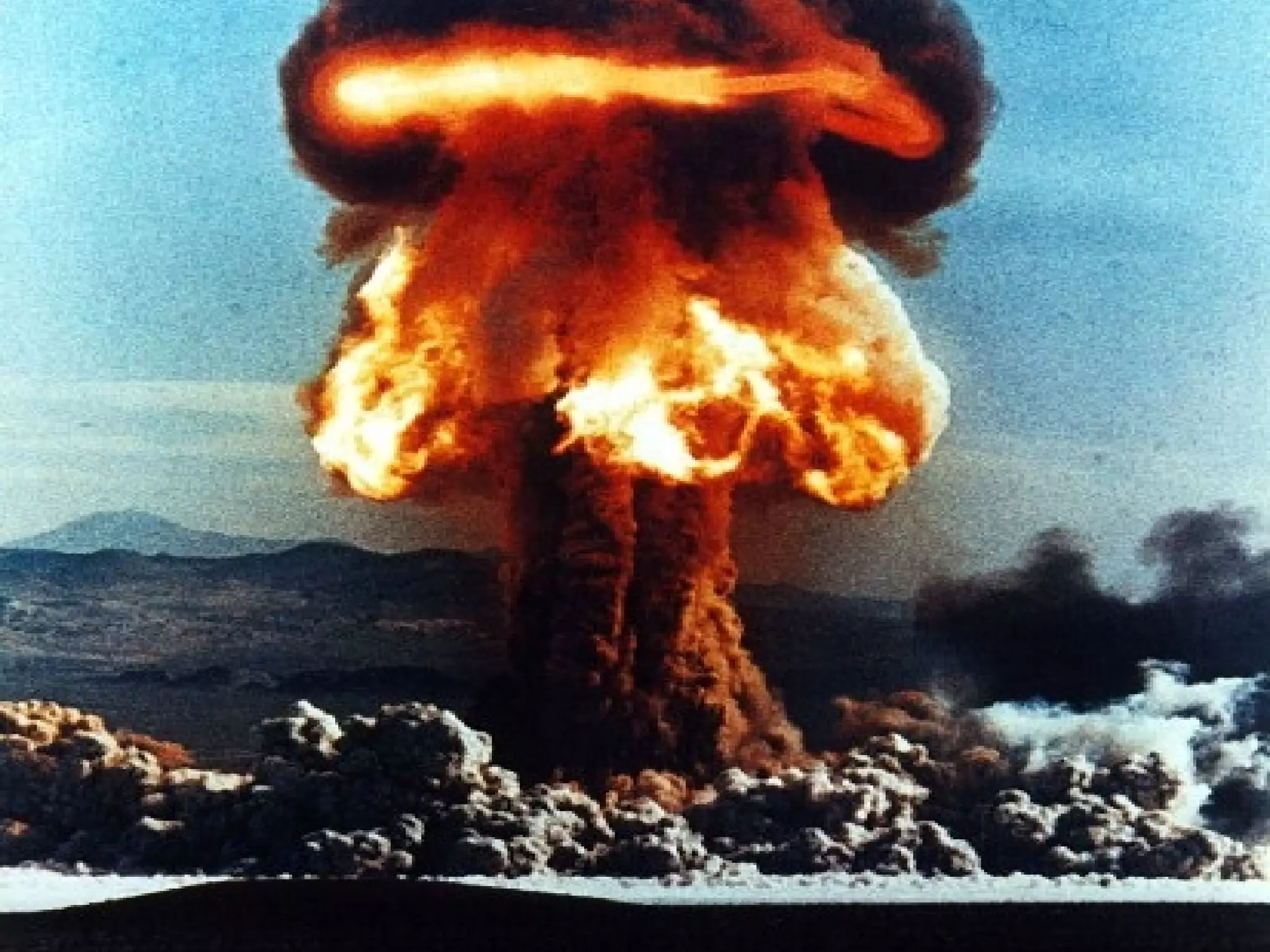
If you are a scientist you believe that it is good to find out how the world works, that it is good to find out what the realities are, that it is good to turn over to mankind at large the greatest possible power to control the world... It is not possible to be a scientist unless you believe that the knowledge of the world, and the power which this gives, is a thing which is of intrinsic value to humanity, and that you are using it to help in the spread of knowledge, and are willing to take the consequences. - J. Robert Oppenheimer (1904-1967)
 
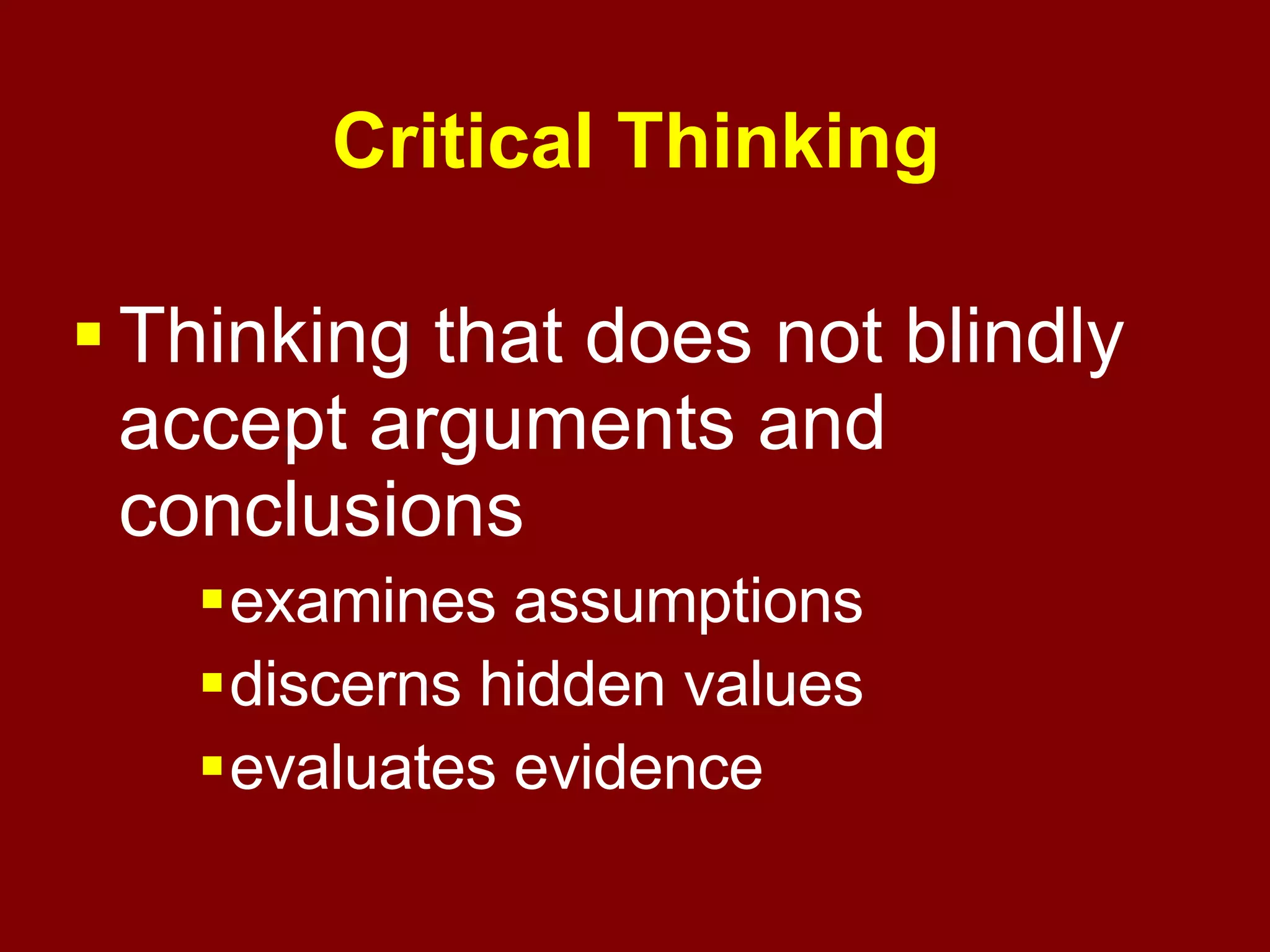
Critical thinking Critical thinking does not blindly accept arguments and conclusions: Examines assumptions
Discerns hidden values
Evaluates evidence
It is a good morning exercise for a research scientist to discard a pet hypothesis every day before breakfast - It keeps him [sic] young. - Konrad Lorenz
Set of procedures used for gathering and interpreting objective information in a way  that  minimises error and yields dependable generalisations .
Its goal is to draw conclusions with  maximum  objectivity . Conclusions are objective when they are  not influenced by emotions or personal biases . Scientific method
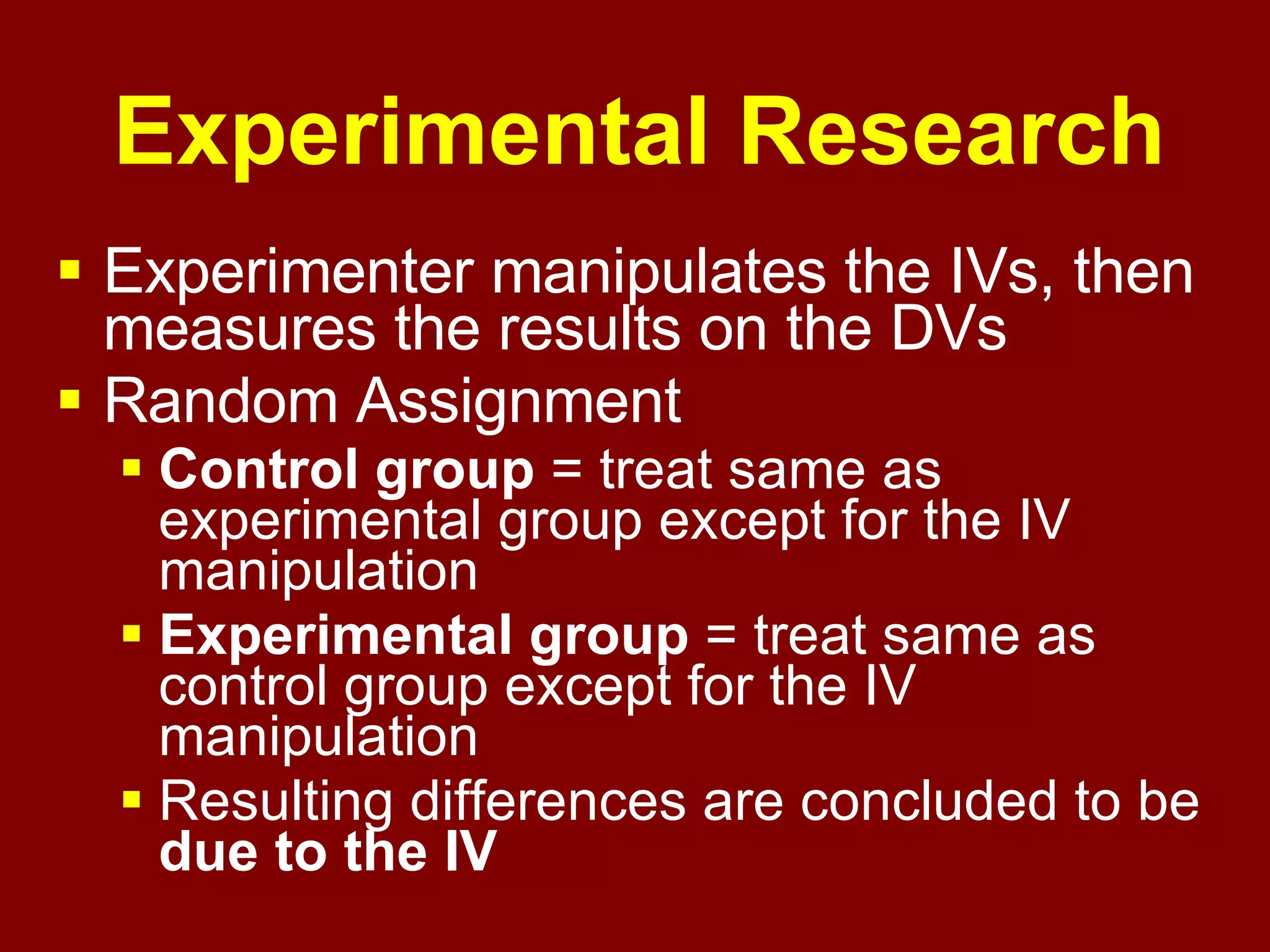
The doctrine that  all events   - physical, behavioural, and mental -  are “determined”  by  specific causal factors that are potentially knowable . Concept of determinism
Theory-testing is the  main function of research Observations  lead to theory
Theory  = a specific set of assumptions and principles about a phenomenon.
Derive testable  hypotheses   (or guesses / predictions)
Systematically  test hypotheses  in various conditions in order to  determine the utility of the theory .
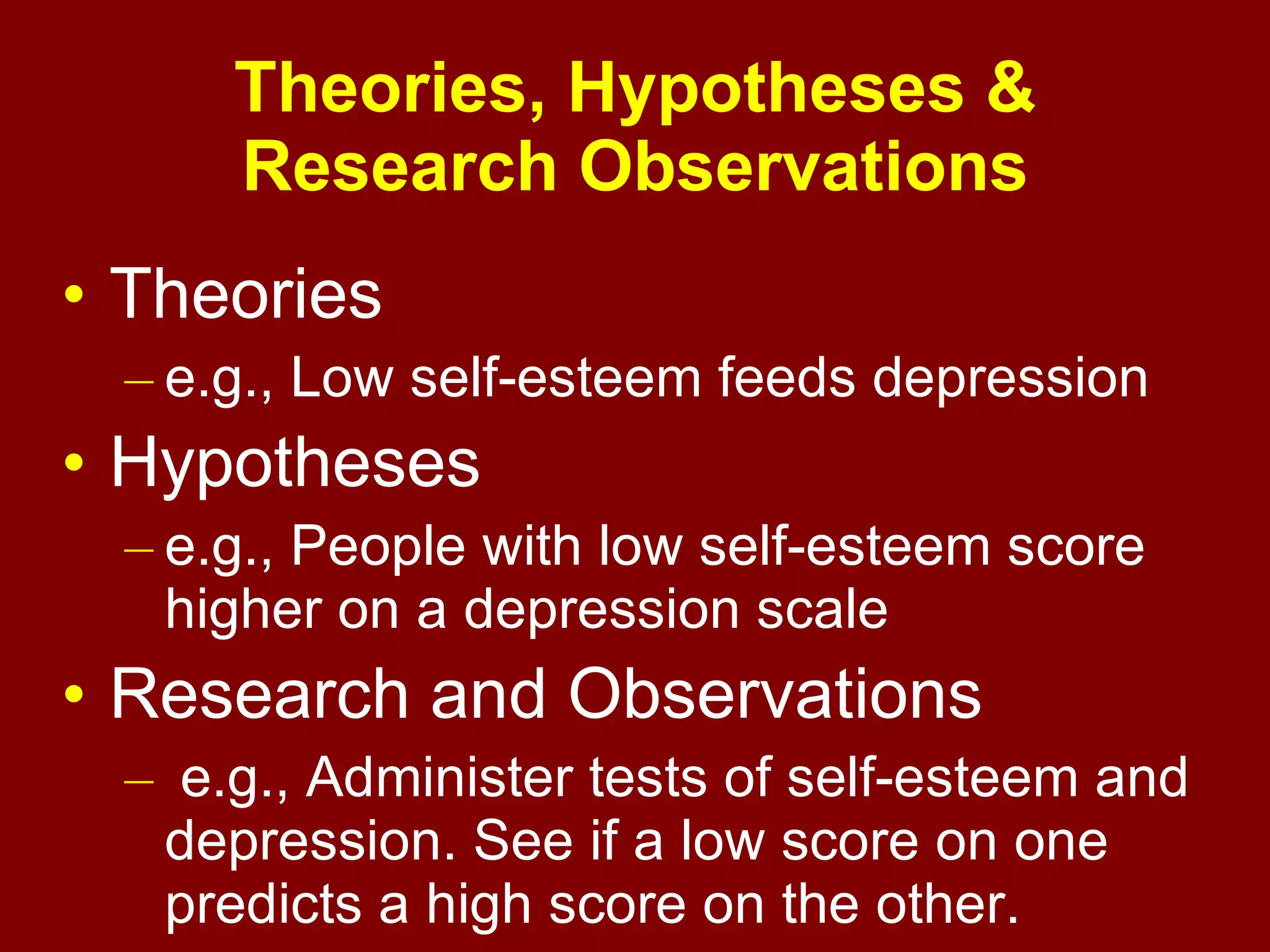
Theories, hypotheses & research observations Theories Low self-esteem feeds depression Hypothesis People with low self-esteem score higher on a depression scale Test with observations Administer tests of self-esteem and depression. See if a low score on one predicts a high score on the other.
Operationalisation Refers to how a fuzzy psychological construct is actually measured e.g., the concept of intelligence has been  operationalised  through a variety of Intelligence Quotient (IQ) tests
Variables are factors which can be controlled and/or measured in research
Two types: Independent Variable (IV) (or “predictors”)
Dependent Variable (DV) (or “outcomes”) Research variables
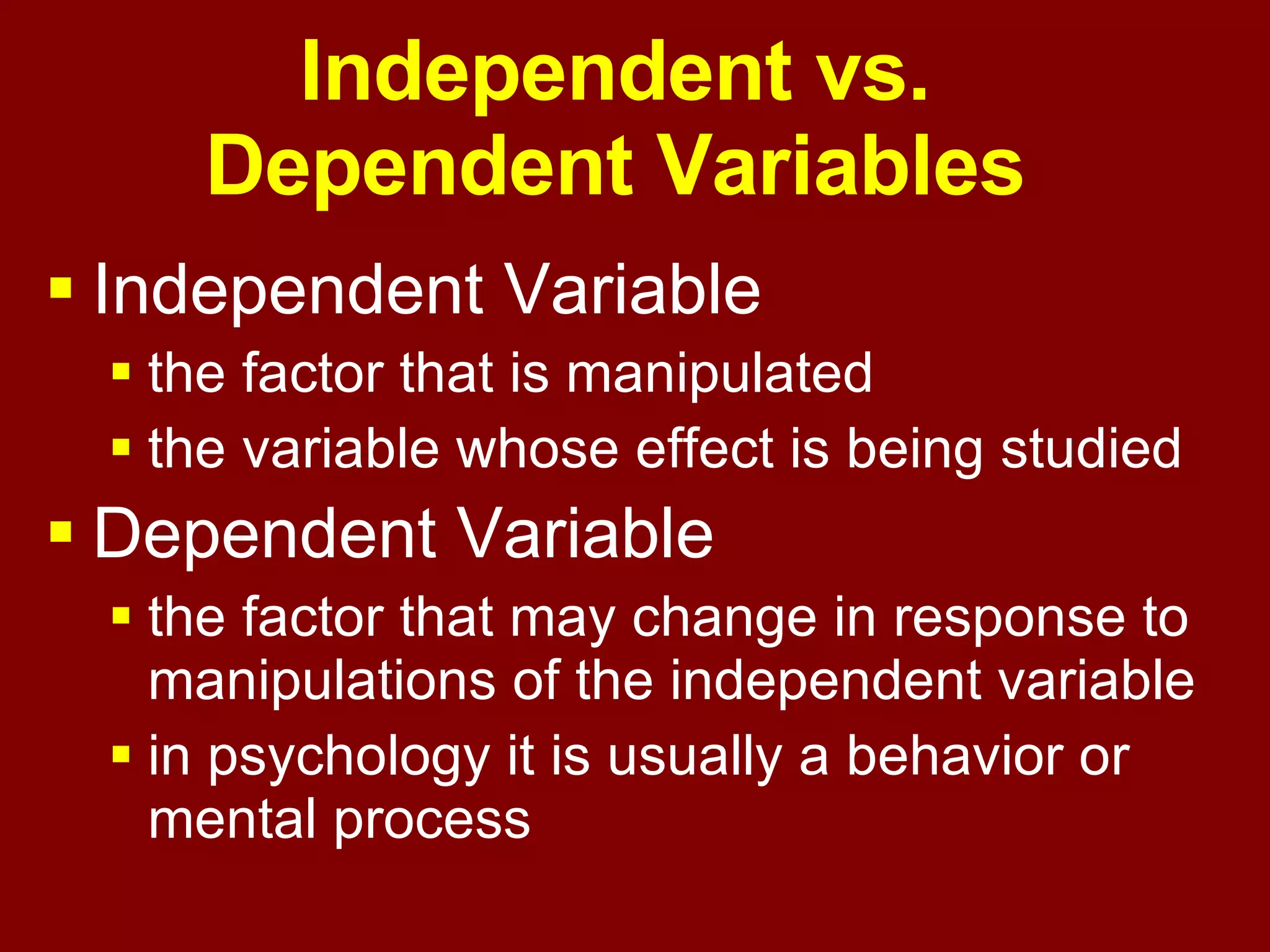
Independent vs. dependent variables Independent Variable(s) Dependent Variable(s)
Independent vs. dependent variables Independent Variable   the factor that is controlled and manipulated by the researcher
the variable whose effect is being studied Dependent Variable   the factor that may change in response to manipulations of the independent variable
in psychology it is usually a behaviour or mental process
Independent vs. dependent variables: Example IV:  Graffiti  or  no graffiti  on or near a letterbox DV:  Whether or not a passerby takes an envelope with money clearly showing from a letterbox Results: Graffiti condition: 27% took the $

Research Methods in Psychology

Editor's Notes

  • #2 Introduces the role and nature of research and research methods in psychological science. Image source: http://commons.wikimedia.org/wiki/File:Brain_mechanism.svg Image author: Alexander Krainov, http://commons.wikimedia.org/wiki/User:Alex_Krainov License: Creative Commons Share-Alike 3.0, http://creativecommons.org/licenses/by-sa/3.0/deed.en
  • #4 Image source: http://www.flickr.com/photos/gadl/395079578/ Image author: http://www.flickr.com/photos/gadl/ License: Creative Commons Attribution 2.0
  • #5 Image source: Unknown. Examination of this image suggests an orderly discipline, yet space and environment for creativity and passion.
  • #6 Image source: http://www.flickr.com/photos/nics_events/2349632625/in/set-72157610727439784/ By nic's events - http://www.flickr.com/photos/nics_events/ License: Creative Commons Attribution 2.0
  • #11 Just as research of our physical world and its properties and laws has lead to our creation of incredibly artful and scientific structures, so too psychological research holds out the promise of discovering the architecture of our psyche and our behaviour with the world around us. Image source: Unknown.
  • #12 Blue is usually the most popular 7 is usually the most popular 4 is usually male 8 is usually female This suggests that we may be more predictable than we like to think and indicates that there may be many patterns which can help to explain our thinking, feeling, and behaviouur.
  • #15 The process of psychological research, generating theories and testing hypotheses.
  • #16 Blue is usually the most popular 7 is usually the most popular 4 is usually male 8 is usually female This suggests that we may be more predictable than we like to think and indicates that there may be many patterns which can help to explain our thinking, feeling, and behaviouur.
  • #19 Image sources: Photo: http://www.flickr.com/photos/mvvermeulen/106707882/ By mauritsv - http://www.flickr.com/photos/mvvermeulen/ License: Creative Commons Attribution 2.0 James Neill (questionnaire). Explain story of my first research study – curiousity + methodology.
  • #21 Image source: http://www.flickr.com/photos/emdot/96674873/ By emdot - http://www.flickr.com/photos/emdot/ License: Creative Commons Attribution 2.0
  • #23 Blue is usually the most popular 7 is usually the most popular 4 is usually male 8 is usually female This suggests that we may be more predictable than we like to think and indicates that there may be many patterns which can help to explain our thinking, feeling, and behaviouur.
  • #25 Image soruce: A-bomb unknown
  • #26 Image soruce: A-bomb unknown
  • #28 Image source: http://www.flickr.com/photos/wwworks/1291468732/ By woodleywonderworks' http://www.flickr.com/people/wwworks/
  • #31 Facts are what need to be explained objective - viewable by others based on direct observation reasonable observers agree are true
  • #33 Image source: http://www.flickr.com/photos/pagedooley/3290475538/ License: Creative Commons Attribution 2.0 by kevindooley - http://www.flickr.com/photos/pagedooley/
  • #37 People surrounded by grafitti are more likely to steal Broken window effect See: http://www.rug.nl/gmw/nieuws/archief/archief2008/persberichten/153_08?lang=en
  • #41 qualitative approaches which utilise ethnography, grounded theory, content analysis of language, observation, etc. quantitative approaches which use tools (such as surveys) to collect empirical data
  • #42 Strengths: Conclusions about cause & effect can be drawn - Weaknesses – artificial and ethical/practical constraints
  • #46 Image source: https://secure.wikimedia.org/wikipedia/commons/wiki/File:Diphenhydramine_pills.jpg Image license: Creative Commons Attribution-Share Alike 2.0 Generic, http://creativecommons.org/licenses/by-sa/2.0/deed.en Image author: dysamoria, http://www.flickr.com/photos/dysamoria
  • #52 qualitative approaches which utilise ethnography, grounded theory, content analysis of language, observation, etc. quantitative approaches which use tools (such as surveys) to collect empirical data
  • #59 Image source: Myers.
  • #64 Image source: http://www.flickr.com/photos/gadl/395079578/ By gadl - http://www.flickr.com/photos/gadl/ License: Creative Commons Attribution 2.0
  • #65 Image source: http://commons.wikimedia.org/wiki/File:Correlation_vs_causation.png Image author:Rcragun http://commons.wikimedia.org/w/index.php?title=User:Rcragun&action=edit&redlink=1 Image license: Creative Commons Attribution 3.0 Unported, http://creativecommons.org/licenses/by/3.0/deed.en
  • #67 Image source: Myers.
  • #68 Image source: http://commons.wikimedia.org/wiki/File:Phineas_gage_-_1868_skull_diagram.jpg License: Public domain
  • #69 Image source: http://commons.wikimedia.org/wiki/File:Note.svg Image license: Public domain
  • #70 Image source: Unknown.
  • #72 If you want to know what the proportion of blue to red marbles is, the most efficient way is to take a sample and count the ratio. Image source: Mysers.
  • #75 http://research.unlv.edu/OPRS/history-ethics.htm