•Three-Group Design
                 •Parallel-Group Design
•Counterbalanced or Latin Square Design
 In this design, there are three groups of
  independent variables.
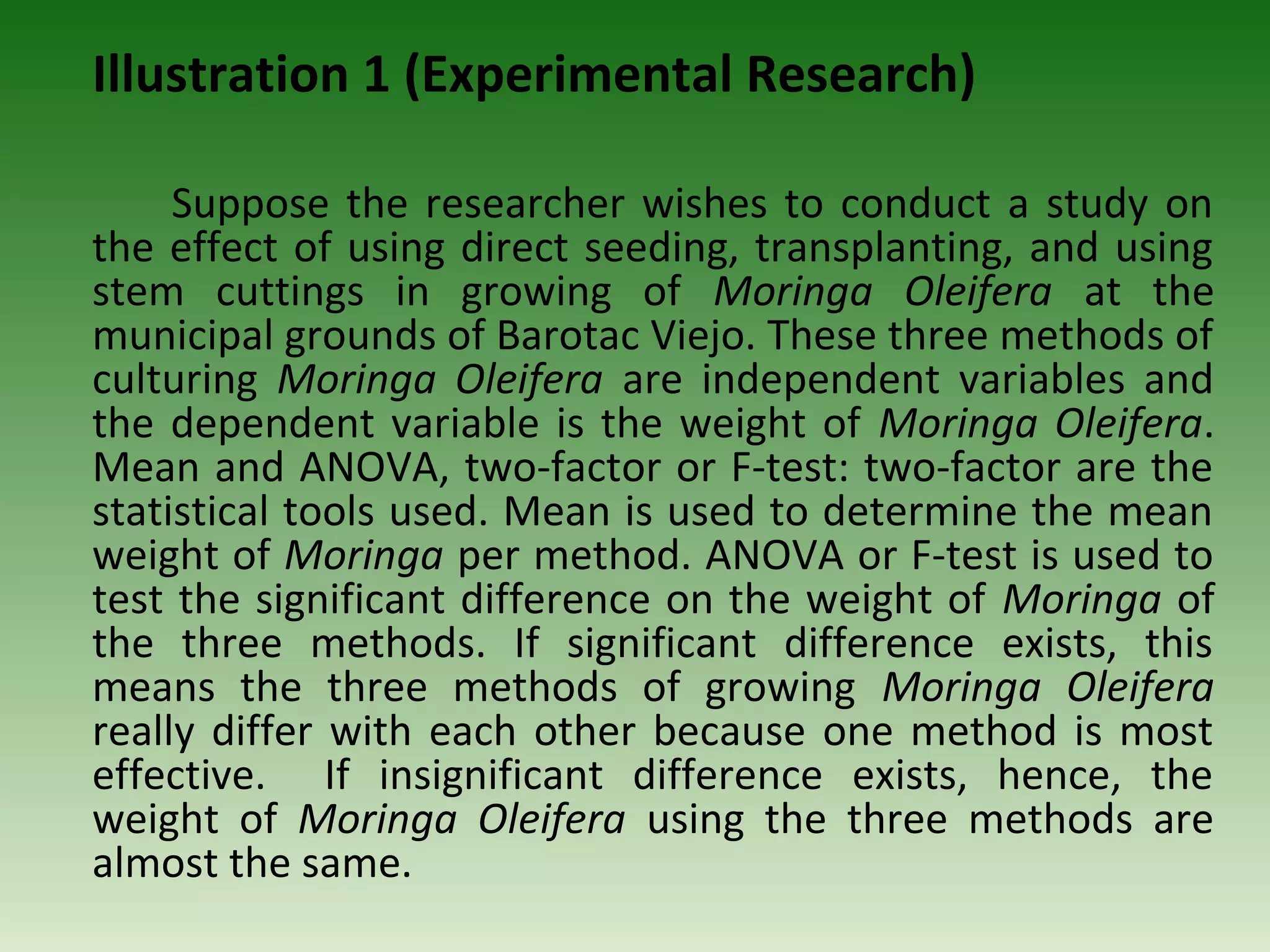
Illustration 1 (Experimental Research)

     Suppose the researcher wishes to conduct a study on
the effect of using direct seeding, transplanting, and using
stem cuttings in growing of Moringa Oleifera at the
municipal grounds of Barotac Viejo. These three methods of
culturing Moringa Oleifera are independent variables and
the dependent variable is the weight of Moringa Oleifera.
Mean and ANOVA, two-factor or F-test: two-factor are the
statistical tools used. Mean is used to determine the mean
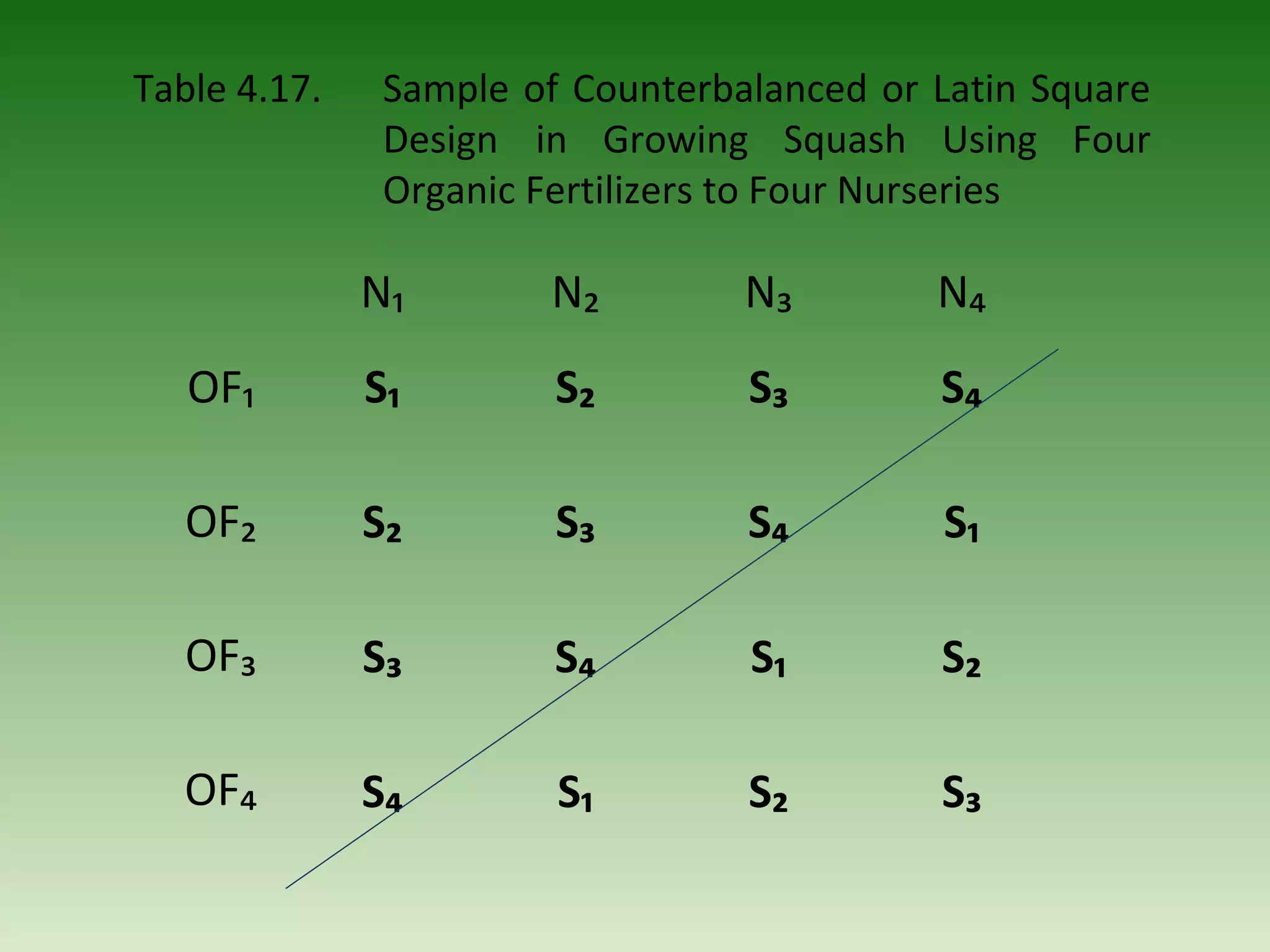
weight of Moringa per method. ANOVA or F-test is used to
test the significant difference on the weight of Moringa of
the three methods. If significant difference exists, this
means the three methods of growing Moringa Oleifera
really differ with each other because one method is most
effective. If insignificant difference exists, hence, the
weight of Moringa Oleifera using the three methods are
almost the same.
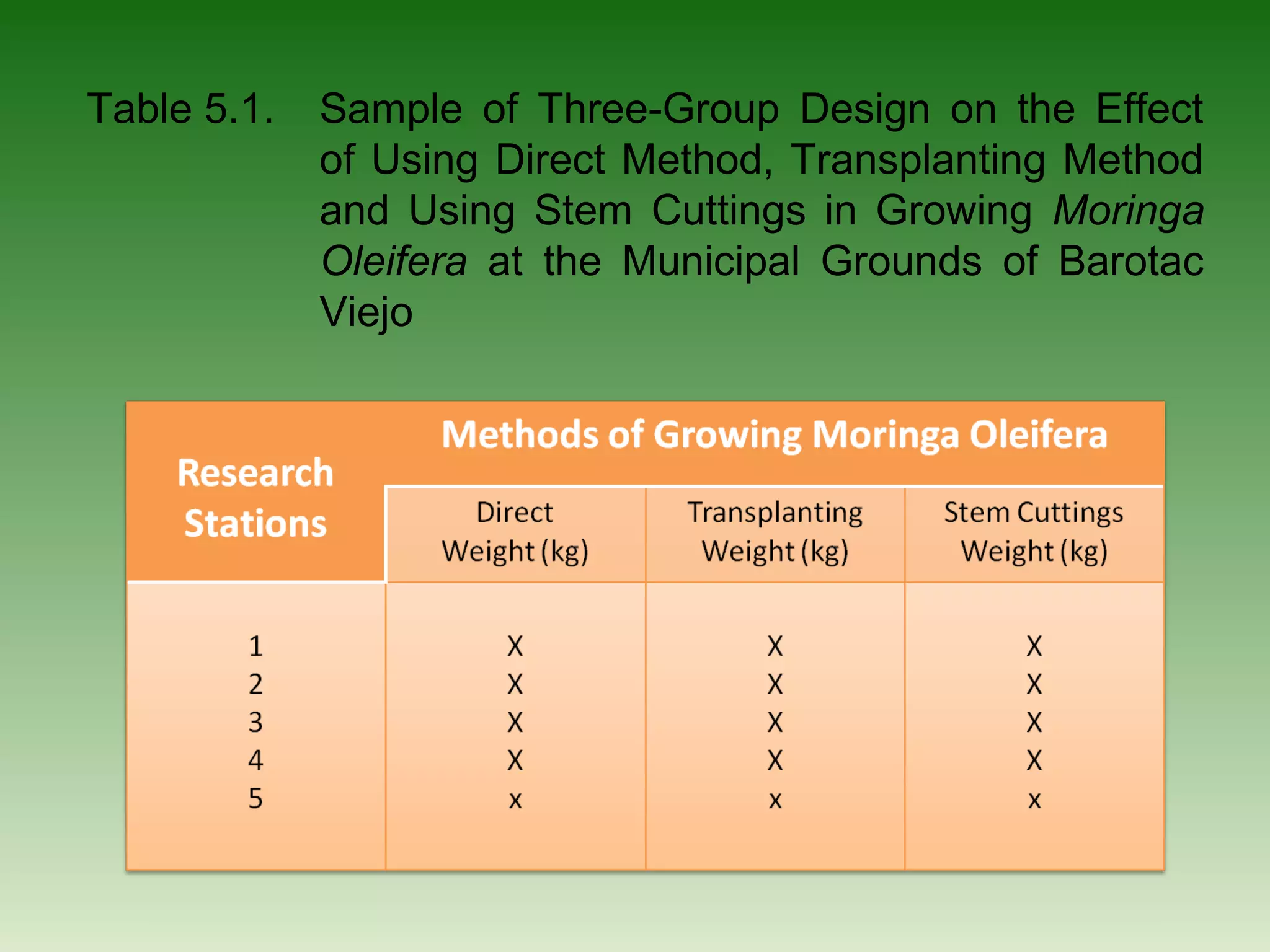
Table 5.1.   Sample of Three-Group Design on the Effect
             of Using Direct Method, Transplanting Method
             and Using Stem Cuttings in Growing Moringa
             Oleifera at the Municipal Grounds of Barotac
             Viejo
Illustration 2 (Descriptive Research)
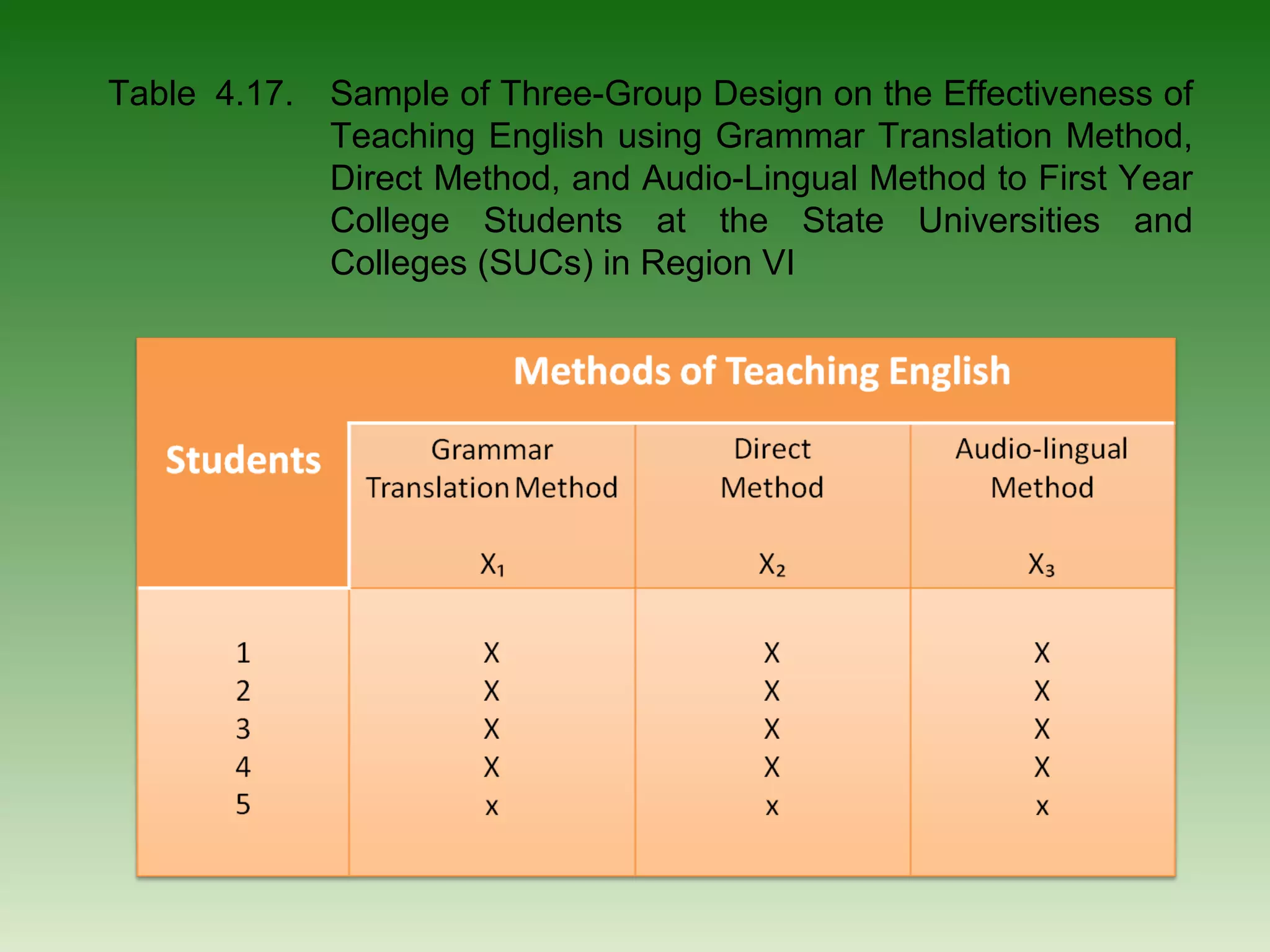
Suppose the researcher wishes to conduct a study on the effectiveness of
  teaching English using grammar translation method, direct method, and
  audio-lingual method to first year college students at the State
  Universities and Colleges (SUCs) in Region VI (Western Visayas). The
  three methods of teaching English are independent variables and the
  scores of students per method are dependent variables. The students
  are exposed to the three methods of teaching English with one teacher.
   Mean and ANOVA: two-factor of F-test: two-factor are the statistical
  tools used. Mean is used to determine the mean score of the students
  per method. ANOVA: two-factor is used to determine the significant
  difference of the scores using the three methods of teaching English. If
  significant difference exists, this means the methods of teaching English
  really differ with each other because one method is most effective. If
  insignificant difference exists, thus, the methods of teaching English are
  almost the same.
Table 4.17.   Sample of Three-Group Design on the Effectiveness of
              Teaching English using Grammar Translation Method,
              Direct Method, and Audio-Lingual Method to First Year
              College Students at the State Universities and
              Colleges (SUCs) in Region VI
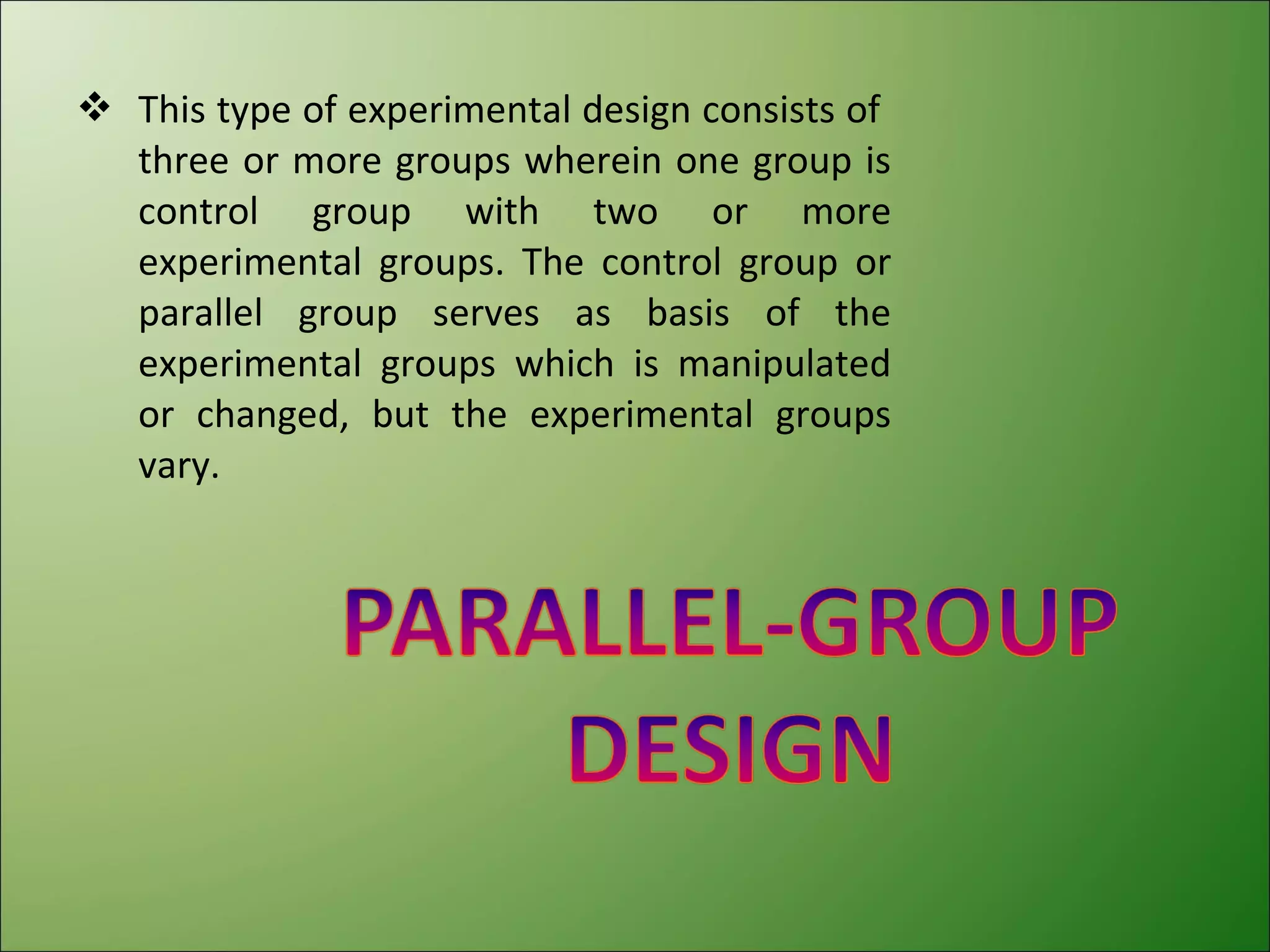
 This type of experimental design consists of
  three or more groups wherein one group is
  control group with two or more
  experimental groups. The control group or
  parallel group serves as basis of the
  experimental groups which is manipulated
  or changed, but the experimental groups
  vary.
Illustration 1 (Experimental Research)

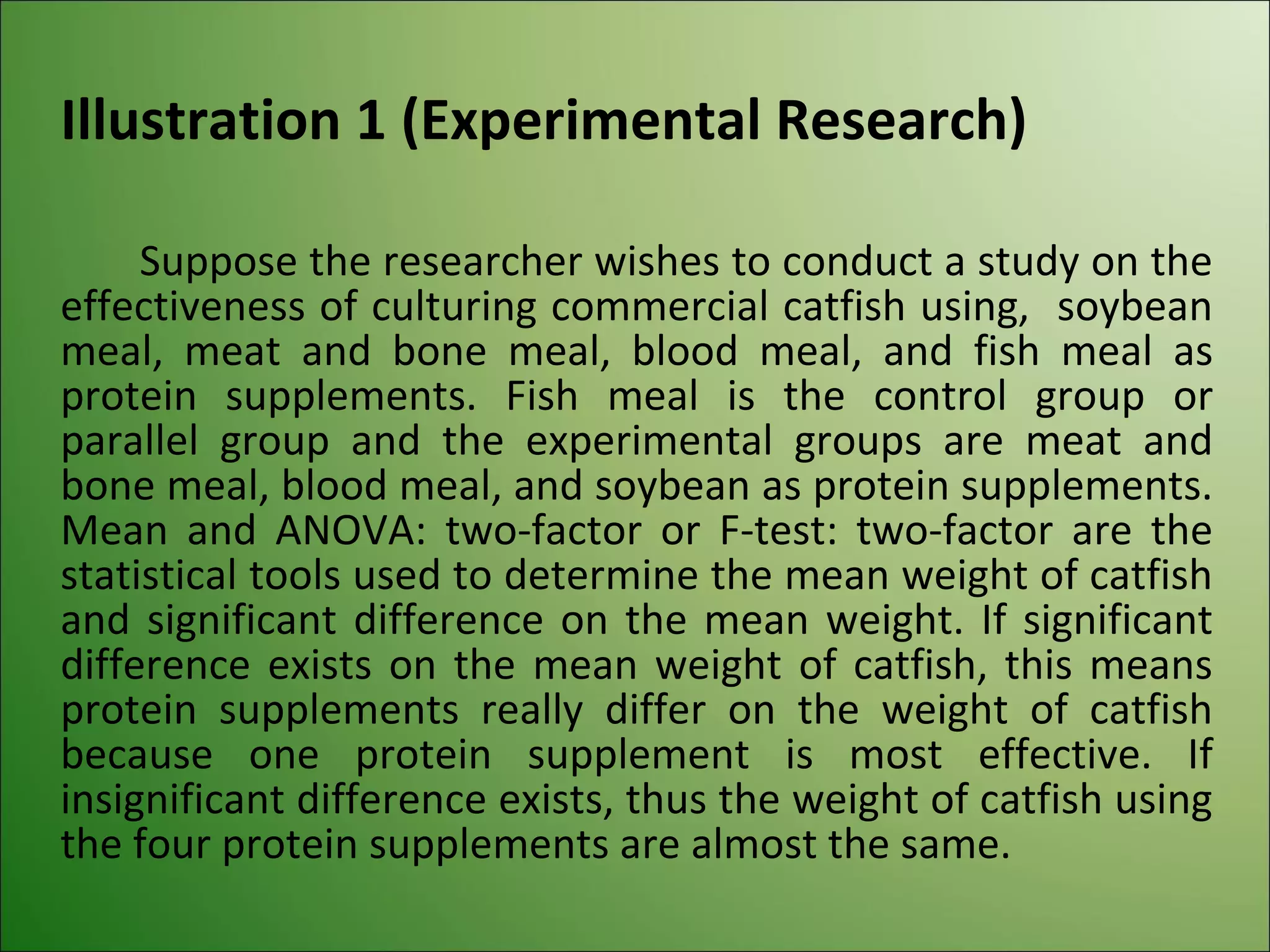
     Suppose the researcher wishes to conduct a study on the
effectiveness of culturing commercial catfish using, soybean
meal, meat and bone meal, blood meal, and fish meal as
protein supplements. Fish meal is the control group or
parallel group and the experimental groups are meat and
bone meal, blood meal, and soybean as protein supplements.
Mean and ANOVA: two-factor or F-test: two-factor are the
statistical tools used to determine the mean weight of catfish
and significant difference on the mean weight. If significant
difference exists on the mean weight of catfish, this means
protein supplements really differ on the weight of catfish
because one protein supplement is most effective. If
insignificant difference exists, thus the weight of catfish using
the four protein supplements are almost the same.
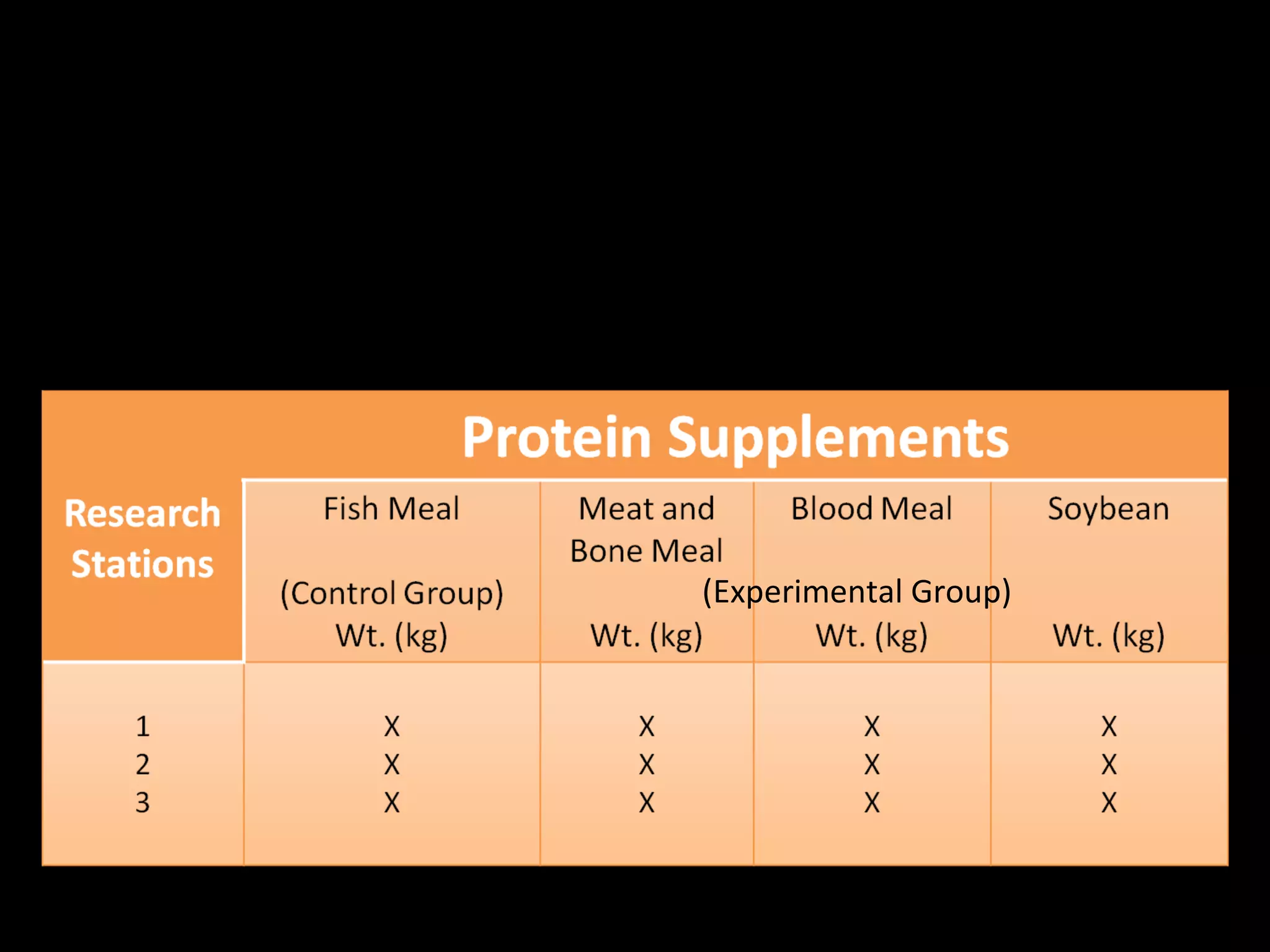
Table 5.2.   Sample Parallel-Group Design on the
             Effectiveness of Culturing Commercial
             Catfish Using Soybean Meal, Meat and
             Bone Meal, Blood Meal and Fish Meal as
             Protein Supplements


                              (Experimental Group)
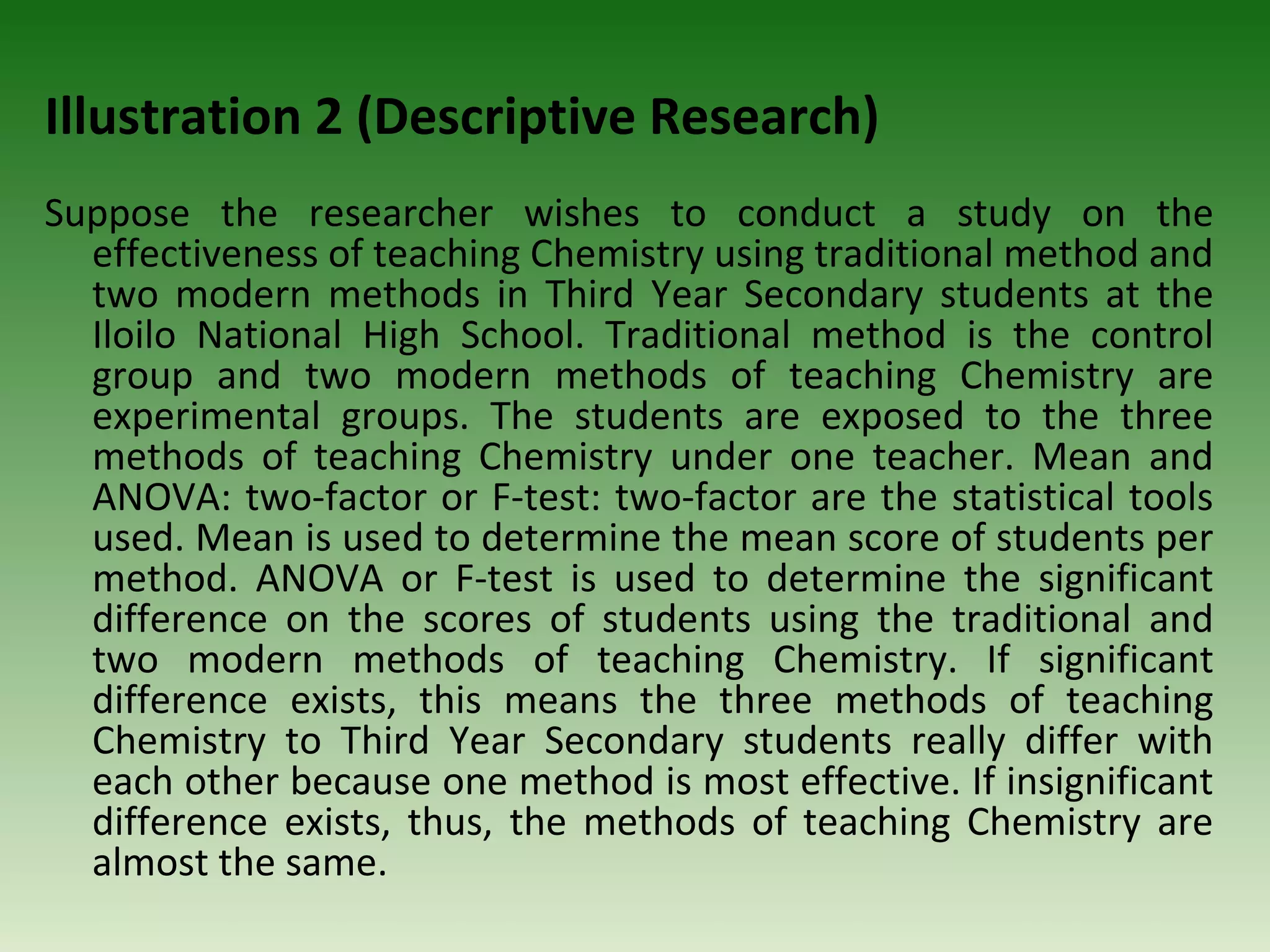
Illustration 2 (Descriptive Research)
Suppose the researcher wishes to conduct a study on the
  effectiveness of teaching Chemistry using traditional method and
  two modern methods in Third Year Secondary students at the
  Iloilo National High School. Traditional method is the control
  group and two modern methods of teaching Chemistry are
  experimental groups. The students are exposed to the three
  methods of teaching Chemistry under one teacher. Mean and
  ANOVA: two-factor or F-test: two-factor are the statistical tools
  used. Mean is used to determine the mean score of students per
  method. ANOVA or F-test is used to determine the significant
  difference on the scores of students using the traditional and
  two modern methods of teaching Chemistry. If significant
  difference exists, this means the three methods of teaching
  Chemistry to Third Year Secondary students really differ with
  each other because one method is most effective. If insignificant
  difference exists, thus, the methods of teaching Chemistry are
  almost the same.
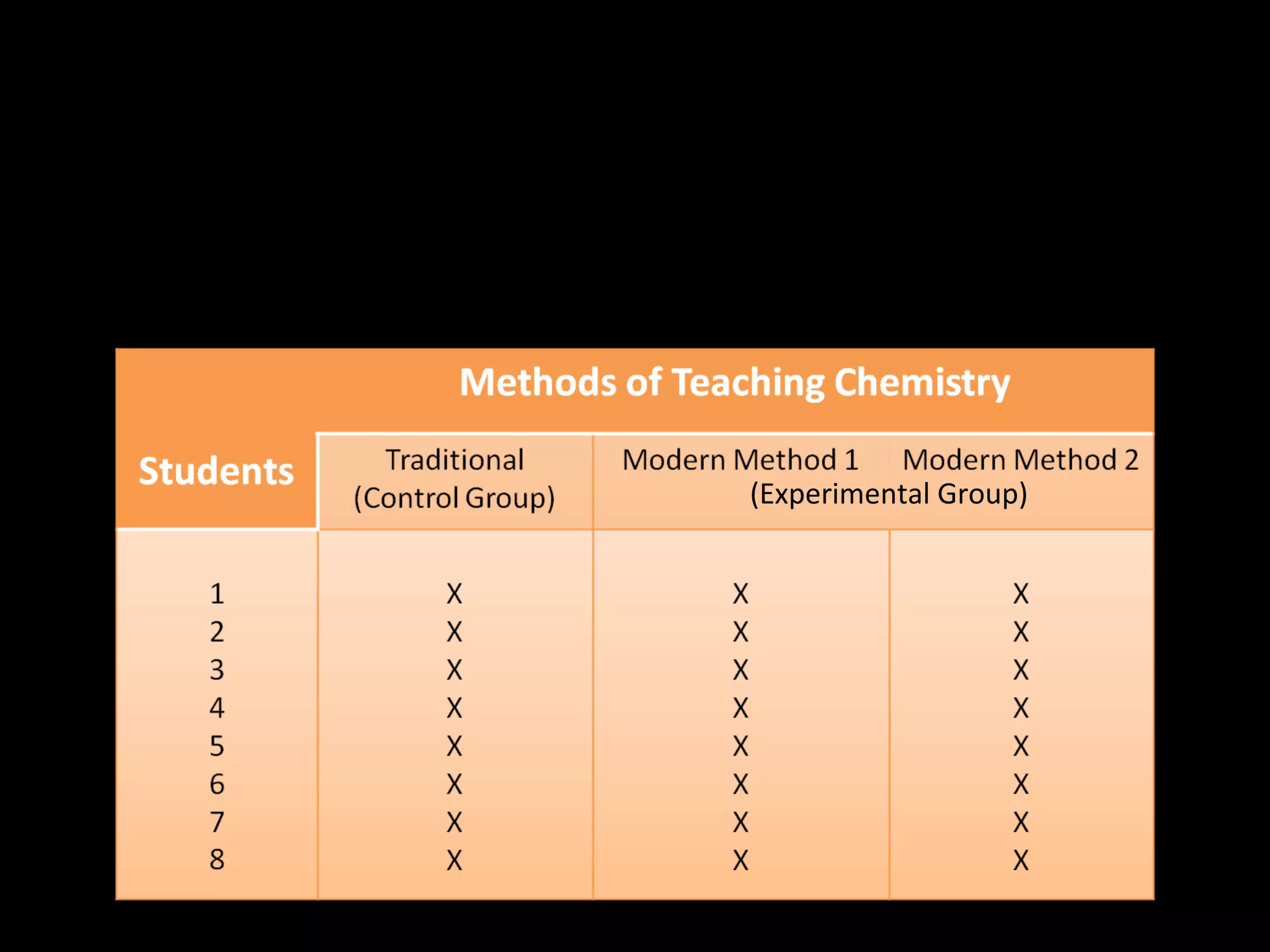
Table 4.20.   Sample Parallel-Group Design on the
              Effectiveness of Teaching Chemistry Using
              Traditional and Two Methods to Third Year
              Secondary Students at the Iloilo National
              High School


                                  (Experimental Group)
This design is also called “rotation design”. It
involves an exchange of two or more treatments
taken by the subjects during the experiment. The
arrangement employed in the design is Latin
square in which each variable is a form of square
occurring once in each row or column. This is
called quasi-experimental design.
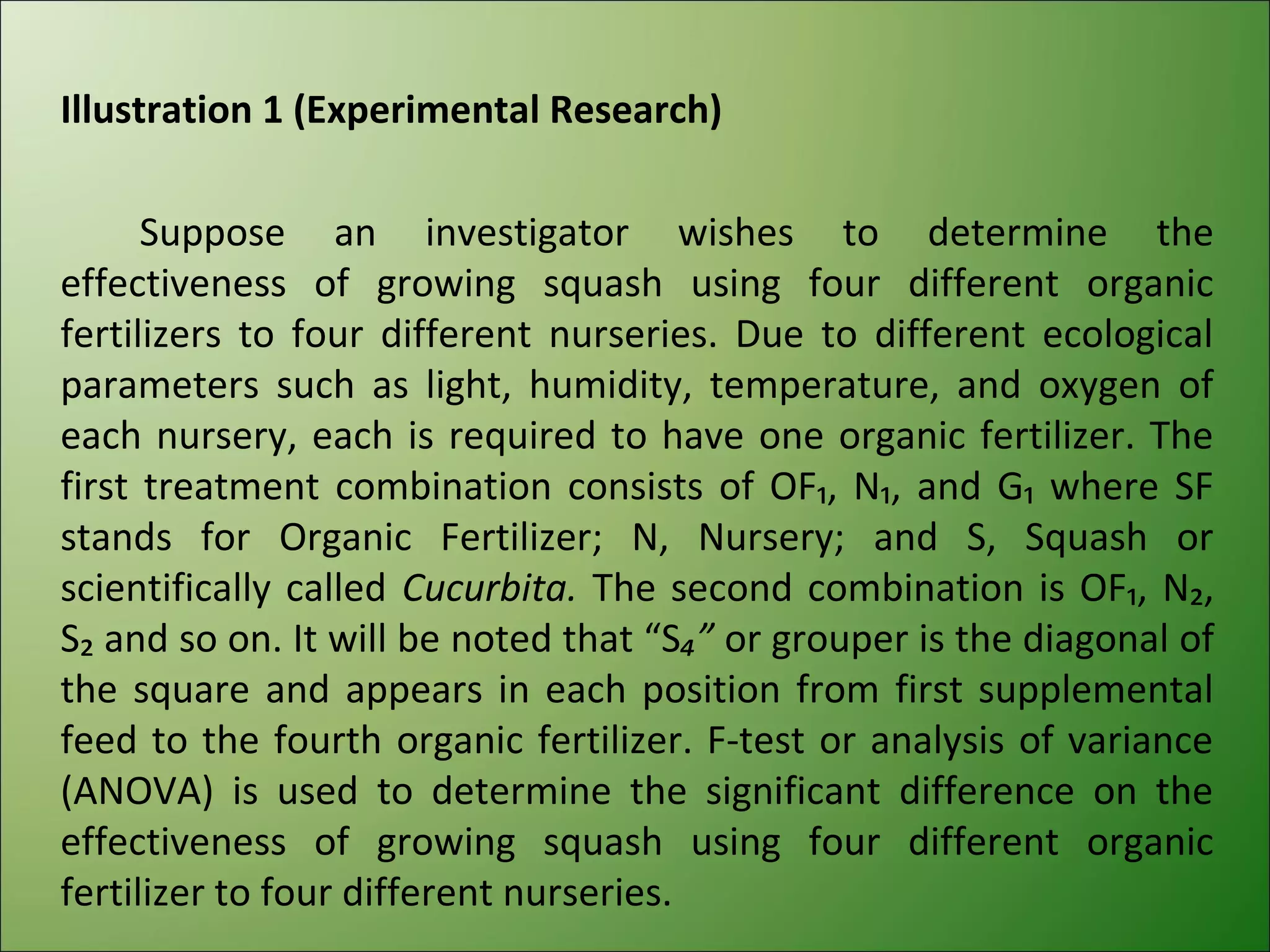
Illustration 1 (Experimental Research)

      Suppose an investigator wishes to determine the
effectiveness of growing squash using four different organic
fertilizers to four different nurseries. Due to different ecological
parameters such as light, humidity, temperature, and oxygen of
each nursery, each is required to have one organic fertilizer. The
first treatment combination consists of OF₁, N₁, and G₁ where SF
stands for Organic Fertilizer; N, Nursery; and S, Squash or
scientifically called Cucurbita. The second combination is OF₁, N₂,
S₂ and so on. It will be noted that “S₄” or grouper is the diagonal of
the square and appears in each position from first supplemental
feed to the fourth organic fertilizer. F-test or analysis of variance
(ANOVA) is used to determine the significant difference on the
effectiveness of growing squash using four different organic
fertilizer to four different nurseries.
Table 4.17.    Sample of Counterbalanced or Latin Square
               Design in Growing Squash Using Four
               Organic Fertilizers to Four Nurseries

              N₁        N₂        N₃        N₄
   OF₁        S₁        S₂        S₃        S₄

   OF₂        S₂        S₃        S₄        S₁

   OF₃        S₃        S₄        S₁        S₂

  OF₄         S₄        S₁        S₂        S₃
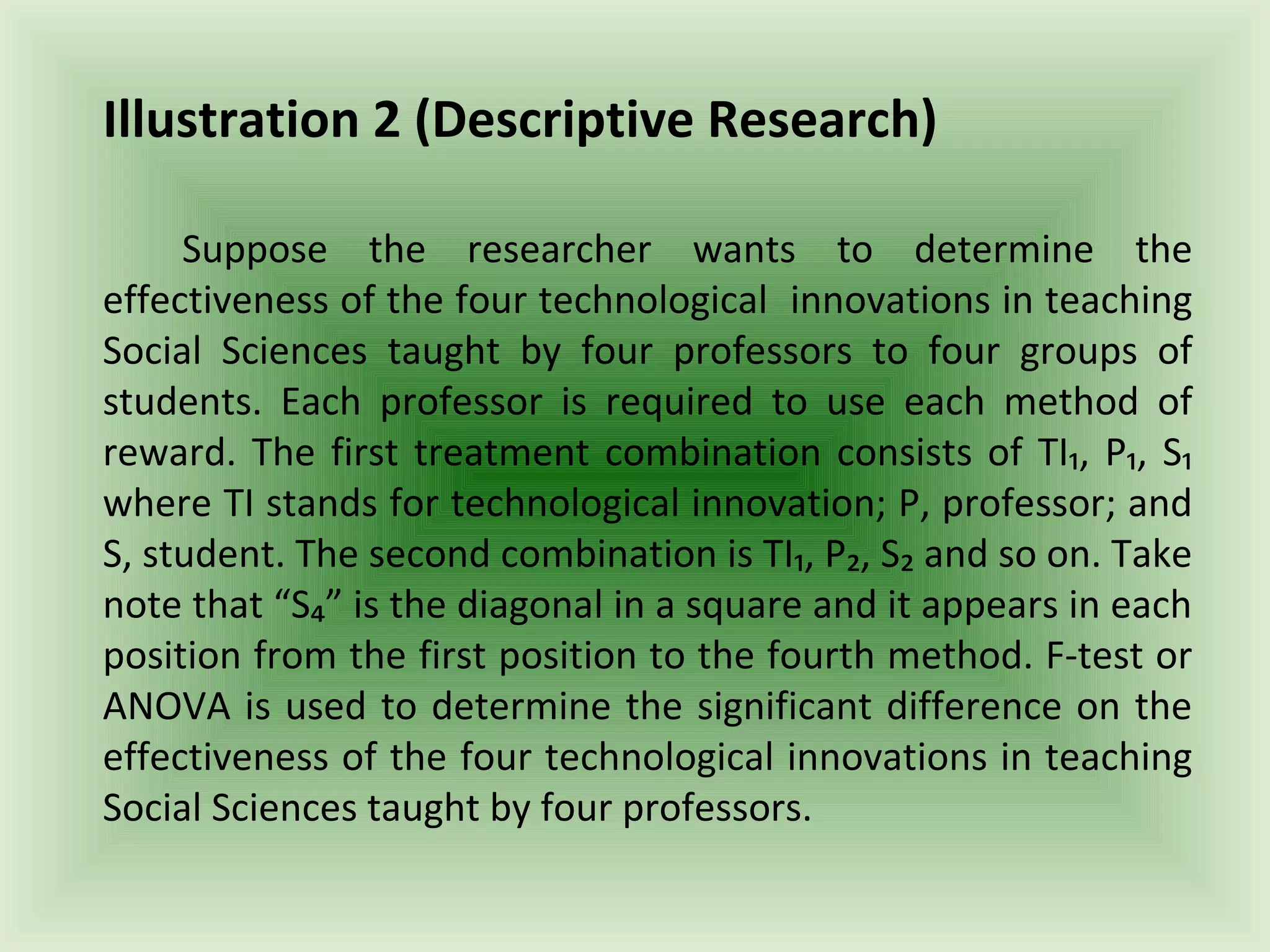
Illustration 2 (Descriptive Research)

     Suppose the researcher wants to determine the
effectiveness of the four technological innovations in teaching
Social Sciences taught by four professors to four groups of
students. Each professor is required to use each method of
reward. The first treatment combination consists of TI₁, P₁, S₁
where TI stands for technological innovation; P, professor; and
S, student. The second combination is TI₁, P₂, S₂ and so on. Take
note that “S₄” is the diagonal in a square and it appears in each
position from the first position to the fourth method. F-test or
ANOVA is used to determine the significant difference on the
effectiveness of the four technological innovations in teaching
Social Sciences taught by four professors.
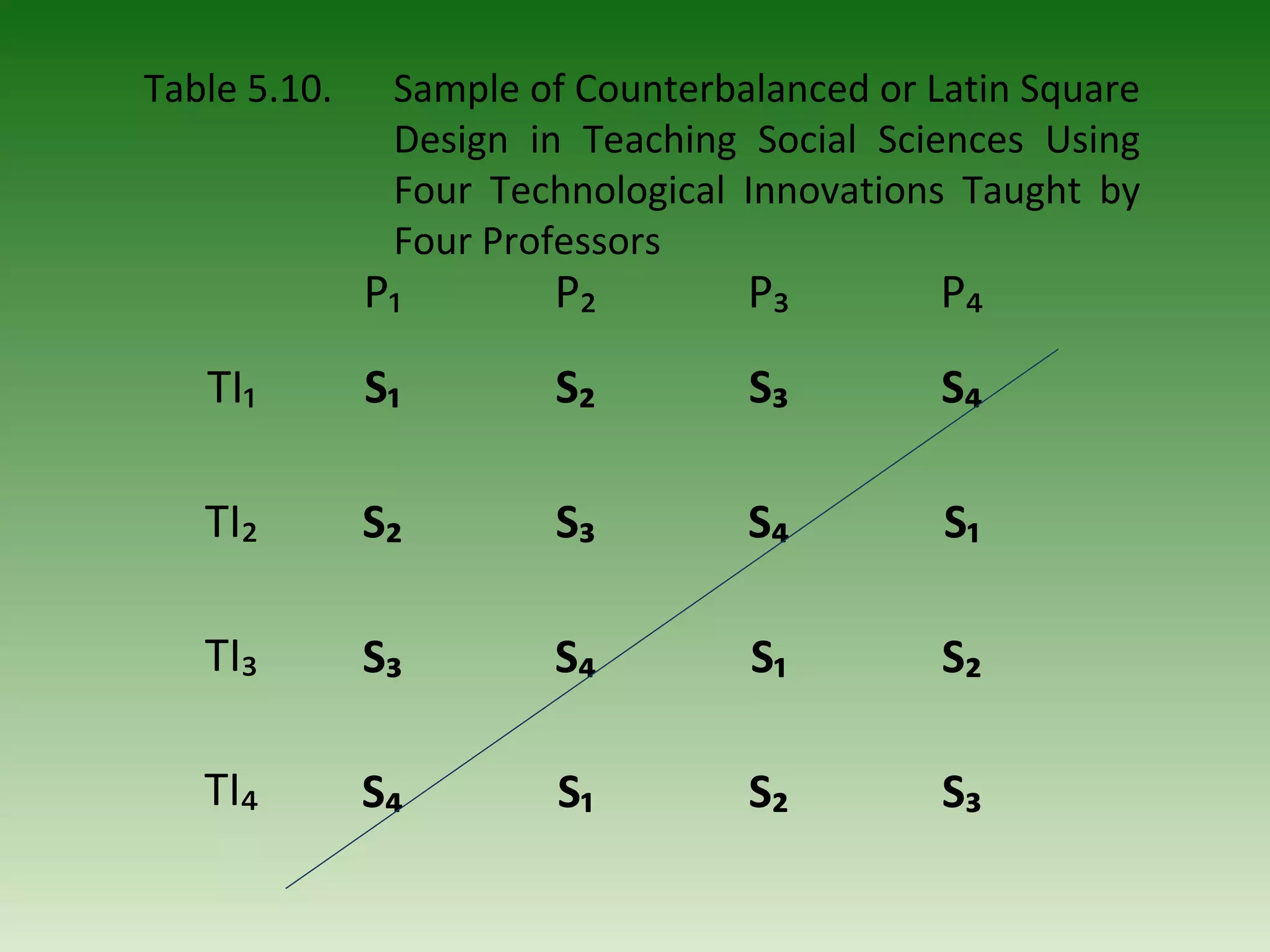
Table 5.10.    Sample of Counterbalanced or Latin Square
               Design in Teaching Social Sciences Using
               Four Technological Innovations Taught by
               Four Professors
              P₁       P₂         P₃         P₄
   TI₁        S₁       S₂         S₃         S₄

   TI₂        S₂       S₃         S₄         S₁

   TI₃        S₃       S₄         S₁         S₂

   TI₄        S₄        S₁        S₂         S₃
Types of experimental design

Types of experimental design

  • 1.
    •Three-Group Design •Parallel-Group Design •Counterbalanced or Latin Square Design
  • 2.
     In thisdesign, there are three groups of independent variables.
  • 3.
    Illustration 1 (ExperimentalResearch) Suppose the researcher wishes to conduct a study on the effect of using direct seeding, transplanting, and using stem cuttings in growing of Moringa Oleifera at the municipal grounds of Barotac Viejo. These three methods of culturing Moringa Oleifera are independent variables and the dependent variable is the weight of Moringa Oleifera. Mean and ANOVA, two-factor or F-test: two-factor are the statistical tools used. Mean is used to determine the mean weight of Moringa per method. ANOVA or F-test is used to test the significant difference on the weight of Moringa of the three methods. If significant difference exists, this means the three methods of growing Moringa Oleifera really differ with each other because one method is most effective. If insignificant difference exists, hence, the weight of Moringa Oleifera using the three methods are almost the same.
  • 4.
    Table 5.1. Sample of Three-Group Design on the Effect of Using Direct Method, Transplanting Method and Using Stem Cuttings in Growing Moringa Oleifera at the Municipal Grounds of Barotac Viejo
  • 5.
    Illustration 2 (DescriptiveResearch) Suppose the researcher wishes to conduct a study on the effectiveness of teaching English using grammar translation method, direct method, and audio-lingual method to first year college students at the State Universities and Colleges (SUCs) in Region VI (Western Visayas). The three methods of teaching English are independent variables and the scores of students per method are dependent variables. The students are exposed to the three methods of teaching English with one teacher. Mean and ANOVA: two-factor of F-test: two-factor are the statistical tools used. Mean is used to determine the mean score of the students per method. ANOVA: two-factor is used to determine the significant difference of the scores using the three methods of teaching English. If significant difference exists, this means the methods of teaching English really differ with each other because one method is most effective. If insignificant difference exists, thus, the methods of teaching English are almost the same.
  • 6.
    Table 4.17. Sample of Three-Group Design on the Effectiveness of Teaching English using Grammar Translation Method, Direct Method, and Audio-Lingual Method to First Year College Students at the State Universities and Colleges (SUCs) in Region VI
  • 7.
     This typeof experimental design consists of three or more groups wherein one group is control group with two or more experimental groups. The control group or parallel group serves as basis of the experimental groups which is manipulated or changed, but the experimental groups vary.
  • 8.
    Illustration 1 (ExperimentalResearch) Suppose the researcher wishes to conduct a study on the effectiveness of culturing commercial catfish using, soybean meal, meat and bone meal, blood meal, and fish meal as protein supplements. Fish meal is the control group or parallel group and the experimental groups are meat and bone meal, blood meal, and soybean as protein supplements. Mean and ANOVA: two-factor or F-test: two-factor are the statistical tools used to determine the mean weight of catfish and significant difference on the mean weight. If significant difference exists on the mean weight of catfish, this means protein supplements really differ on the weight of catfish because one protein supplement is most effective. If insignificant difference exists, thus the weight of catfish using the four protein supplements are almost the same.
  • 9.
    Table 5.2. Sample Parallel-Group Design on the Effectiveness of Culturing Commercial Catfish Using Soybean Meal, Meat and Bone Meal, Blood Meal and Fish Meal as Protein Supplements (Experimental Group)
  • 10.
    Illustration 2 (DescriptiveResearch) Suppose the researcher wishes to conduct a study on the effectiveness of teaching Chemistry using traditional method and two modern methods in Third Year Secondary students at the Iloilo National High School. Traditional method is the control group and two modern methods of teaching Chemistry are experimental groups. The students are exposed to the three methods of teaching Chemistry under one teacher. Mean and ANOVA: two-factor or F-test: two-factor are the statistical tools used. Mean is used to determine the mean score of students per method. ANOVA or F-test is used to determine the significant difference on the scores of students using the traditional and two modern methods of teaching Chemistry. If significant difference exists, this means the three methods of teaching Chemistry to Third Year Secondary students really differ with each other because one method is most effective. If insignificant difference exists, thus, the methods of teaching Chemistry are almost the same.
  • 11.
    Table 4.20. Sample Parallel-Group Design on the Effectiveness of Teaching Chemistry Using Traditional and Two Methods to Third Year Secondary Students at the Iloilo National High School (Experimental Group)
  • 12.
    This design isalso called “rotation design”. It involves an exchange of two or more treatments taken by the subjects during the experiment. The arrangement employed in the design is Latin square in which each variable is a form of square occurring once in each row or column. This is called quasi-experimental design.
  • 13.
    Illustration 1 (ExperimentalResearch) Suppose an investigator wishes to determine the effectiveness of growing squash using four different organic fertilizers to four different nurseries. Due to different ecological parameters such as light, humidity, temperature, and oxygen of each nursery, each is required to have one organic fertilizer. The first treatment combination consists of OF₁, N₁, and G₁ where SF stands for Organic Fertilizer; N, Nursery; and S, Squash or scientifically called Cucurbita. The second combination is OF₁, N₂, S₂ and so on. It will be noted that “S₄” or grouper is the diagonal of the square and appears in each position from first supplemental feed to the fourth organic fertilizer. F-test or analysis of variance (ANOVA) is used to determine the significant difference on the effectiveness of growing squash using four different organic fertilizer to four different nurseries.
  • 14.
    Table 4.17. Sample of Counterbalanced or Latin Square Design in Growing Squash Using Four Organic Fertilizers to Four Nurseries N₁ N₂ N₃ N₄ OF₁ S₁ S₂ S₃ S₄ OF₂ S₂ S₃ S₄ S₁ OF₃ S₃ S₄ S₁ S₂ OF₄ S₄ S₁ S₂ S₃
  • 15.
    Illustration 2 (DescriptiveResearch) Suppose the researcher wants to determine the effectiveness of the four technological innovations in teaching Social Sciences taught by four professors to four groups of students. Each professor is required to use each method of reward. The first treatment combination consists of TI₁, P₁, S₁ where TI stands for technological innovation; P, professor; and S, student. The second combination is TI₁, P₂, S₂ and so on. Take note that “S₄” is the diagonal in a square and it appears in each position from the first position to the fourth method. F-test or ANOVA is used to determine the significant difference on the effectiveness of the four technological innovations in teaching Social Sciences taught by four professors.
  • 16.
    Table 5.10. Sample of Counterbalanced or Latin Square Design in Teaching Social Sciences Using Four Technological Innovations Taught by Four Professors P₁ P₂ P₃ P₄ TI₁ S₁ S₂ S₃ S₄ TI₂ S₂ S₃ S₄ S₁ TI₃ S₃ S₄ S₁ S₂ TI₄ S₄ S₁ S₂ S₃

Editor's Notes

  • #9 Meat and bone meal is the rendered product from beef or pork tissues and should not contain blood, hair, hoof, horn, hide trimmings, manure, stomach and rumen contents, except in amounts as may be unavoidable during processing. Soybean meal is prepared by grinding the flakes after solvent extraction has been used to remove the oil from dehulled soybeans. Blood meal is prepared from clean, fresh animal blood, excluding hair, stomach belching, and urine except in trace quantities that are unavoidable.
  • #14 Organic fertilizers: manure, peat, wood chips, straw