BIOTECHNOLOGY
Risk Assessment &
Management
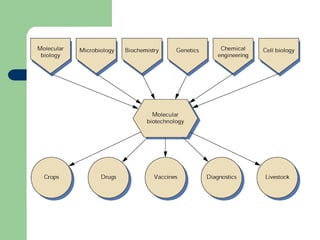
BIOTECHNOLOGY
 Science based technology and includes
recombinant DNA techniques, biochemistry,
molecular and cellular biology, microbiology,
and genetics
Impact of biotechnology
 Potential impact of transgenic crops on the
environment – most hotly debated
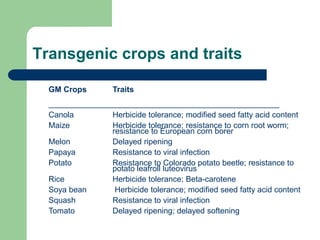
Transgenic crops and traits
GM Crops Traits
____________________________________________________
Canola Herbicide tolerance; modified seed fatty acid content
Maize Herbicide tolerance; resistance to corn root worm;
resistance to European corn borer
Melon Delayed ripening
Papaya Resistance to viral infection
Potato Resistance to Colorado potato beetle; resistance to
potato leafroll luteovirus
Rice Herbicide tolerance; Beta-carotene
Soya bean Herbicide tolerance; modified seed fatty acid content
Squash Resistance to viral infection
Tomato Delayed ripening; delayed softening
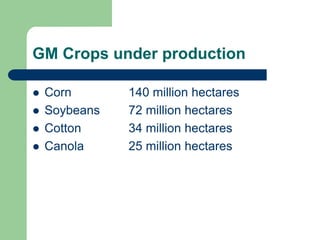
GM Crops under production
 Corn 140 million hectares
 Soybeans 72 million hectares
 Cotton 34 million hectares
 Canola 25 million hectares
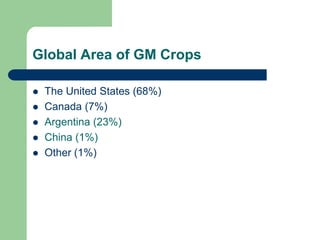
Global Area of GM Crops
 The United States (68%)
 Canada (7%)
 Argentina (23%)
 China (1%)
 Other (1%)
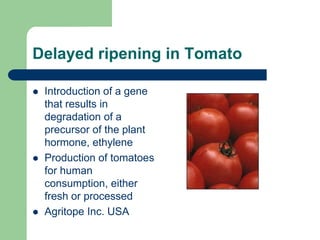
Delayed ripening in Tomato
 Introduction of a gene
that results in
degradation of a
precursor of the plant
hormone, ethylene
 Production of tomatoes
for human
consumption, either
fresh or processed
 Agritope Inc. USA
Genetic Trait
 S-adenosylmethionine hydrolase (SAMase)
encoding gene
 E. coli bacteriophage T3
Modification
 Transformed tomato plants that exhibit
significantly reduced levels of SAM, the
substrate in ethylene biosynthesis
 Ethylene plays an important role in fruit
ripening of climacteric fruits
 Lack of a sufficient pool of SAM results in a
tomato fruit with significantly reduced
ethylene biosynthetic capabilities and a
modified ripening phenotype
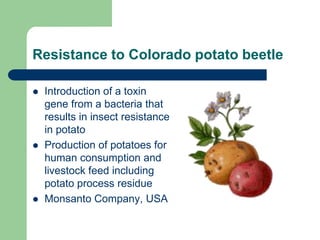
Resistance to Colorado potato beetle
 Introduction of a toxin
gene from a bacteria that
results in insect resistance
in potato
 Production of potatoes for
human consumption and
livestock feed including
potato process residue
 Monsanto Company, USA
Trait
 Colorado potato beetle resistant potatoes
produced by inserting the cry3A gene from
Bacillus thuringiensis (subsp. tenebrionis)
 encodes an insecticidal crystalline Cry3A
delta-endotoxin protein
Modification
 Transformed potato plants expresses the
insecticidal crystalline Cry3A delta-endotoxin
protein
 Cry3A protein binds selectively to specific
sites localized on the brush border mid-gut
epithelium of susceptible insect species
 Causes loss of ions
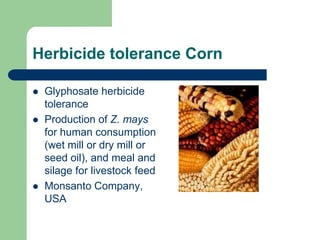
Herbicide tolerance Corn
 Glyphosate herbicide
tolerance
 Production of Z. mays
for human consumption
(wet mill or dry mill or
seed oil), and meal and
silage for livestock feed
 Monsanto Company,
USA
Trait
 Glyphosate tolerant version of the enzyme 5-
enolpyruvylshikimate-3-phosphate synthase
(EPSPS) encoding gene
 Isolated from Agrobacterium tumefaciens
strain CP4 (CP4 EPSPS)
Modifcation
 Biolistic transformation of embryogenic
maize cells with genes encoding the CP4
EPSPS enzyme
 The modified enzyme (CP4 EPSPS) has a
reduced binding affinity for glyphosate and
allows the plant to function normally in the
presence of the herbicide
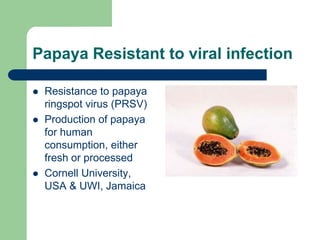
Papaya Resistant to viral infection
 Resistance to papaya
ringspot virus (PRSV)
 Production of papaya
for human
consumption, either
fresh or processed
 Cornell University,
USA & UWI, Jamaica
Trait
 Papaya ringspot virus (PRSV) resistant
papaya produced by inserting the coat
protein (CP) encoding sequences from this
plant potyvirus
Modification
 Microparticle bombardment of plant cells or
tissue
 Transgenic papayas exhibit “pathogen-
derived resistance” to infection and
subsequent disease caused by PRSV
through a process that is related to viral
cross-protection
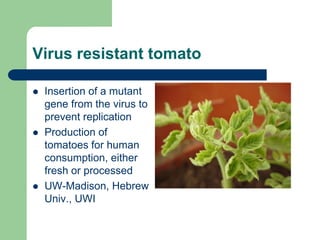
Virus resistant tomato
 Insertion of a mutant
gene from the virus to
prevent replication
 Production of
tomatoes for human
consumption, either
fresh or processed
 UW-Madison, Hebrew
Univ., UWI
Agricultural Biotechnology
 Benefits of transgenic plants
– To improve agricultural, horticultural and
ornamental value of a crop plant
– Can act as a living bioreactor
– Means of studying the action of genes
Benefits of the New Technology
 Higher yields & lower pesticide usage
– Provide indirect benefits for consumers and the
environment through lower usage of pesticides
and there are higher yields due to reduced pest
losses
– A transition to less toxic chemicals
– Facilitation of zero-till agriculture
Benefits of the New Technology
 More Nutritious Foods
– increasing the levels of essential amino acids,
vitamins, bio-available iron and to reduce toxicity
– more nutritious harvested products that keep
much longer in storage and transport.
Benefits of the New Technology
 Utilization of marginal lands
– produce plants that are more tolerant to drought,
salt and heat stresses, toxic heavy metals
Problems with rDNA technology
 Instability in transgene expression
 Interruption or silencing of existing genes
 Activation of silent genes
 Expression of anti-nutrients
Unanticipated effects in transgenic
crops
 Canola – over expression of phytoene
synthase resulted in X500 increase in levels
of and -carotene
 Maize – the stems of Bt maize contain more
lignin
 Potato – expressing kanamycin showed
changes in phynotypic and yield performance
Agricultural Biotechnology
 Arguments against transgenic plants
– Possible negative effects of transgenes on non-
target organism
– Potential for transgene escape
– Impact of gene flow on biodiversity
Negative Impact
 Food safety
 Allergic reaction
 Use of antibiotic marker genes
Food safety
 Unsafe for human consumption ?
– Allergic reaction to new proteins
– 60% of processes foods in supermarkets in the
USA contain a GM ingredient
– Soy, corn, canola and some fresh vegetables
Allergic reaction
 Cry9C a protein in Starlink corn
 Insecticidal protein shares properties with
proteins that are known food allergen
 Not licensed for human consumption
 “Taco Bell Home originals”
Antibiotic marker genes
 Antibiotics – kanamycin, hygromycin,
tetracycline, ampicillin
 Used to identify plants carrying the transgene
 Presence of the gene in the gut could enter
gut organism, increase resistance
 WHO report that antibiotic genes are safe
Impact on non-target species
 Pollen from GM corn contains the insecticidal
Bt toxin thought to be a danger to the
monarch butterfly
 Milkweed with pollen from Bt corn plants
could kill monarch caterpillars that fed on
them
 Six recent studies finds that pollen from
varieties of Bt corn most commonly grown in
the USA do not contain enough toxin to harm
monarchs.
Gene Flow
 Gene flow - natural process and can occur
between same or different species
 Gene flow between trangenics and traditional
maize in Mexico
 12 of the world’s 13 most important food crop
hybridize with at least one wild relative
Gene flow on Biodiversity
 Transgene flow might have impact on the
within-species genetic diversity of
domesticated populations
 Introduction of invasive alien species could
have far greater impact on biodiversity
 Pest or pathogen resistance and tolerance to
various abiotic stresses – may be highly
advantageous in the wild
Risk Assessment
 Assessing ecological risk prior GMO release
 May take years for the true environmental
effects of transgene escape to be known
 Predictions can be made about particular
crops or traits that are likely to pose the
greatest environmental risk
 Transgenes that are advantageous in the
wild or are weedy forms of a plant are most
likely to pose a significant risk
Ecological risk assessment
 Lack of key information on the ecology of
native plant species
 Need to generate information to enable risk
assessment to be carried out using local
information
Risk management
 Important with regard to new or emerging
technologies or programs that have
associated risks
Biosafety Assessment
 Biosafety assessment includes hazard and
risk
 Hazard can be defined as a potentially
adverse outcome of an event or activity
 Risk - The probability and severity of an
adverse event
Risk assessment
 Process of characterizing and quantifying
risk
 Proper risk assessment also involves
characterizing and quantifying uncertainties
Objective of risk management
 Anticipate detrimental effects that might
follow the release of a GMO during
experimentation or commercialization
 Design monitoring systems for the early
detection of adverse outcomes
 Plan intervention strategies to avert and, if
necessary, remediate adverse environmental
or health effects
 Define regulatory authority to prevent the
development and/or importation of potentially
dangerous GMOs
 Encouraging continued development of
increasingly effective biosafety procedures
 Providing public information about biosafety
Laboratory investigations
 Basic molecular genetic analyses and
analyses of physiological performance, done
to characterize the GMO and indicate
whether it expresses the intended phenotypic
properties, and whether the properties are
altered
 Experiments (growth chamber &
greenhouse) to study potential ecological
impacts and genetic stability of the GMO
Small field trials
 Done after laboratory investigations suggest
that GMO maybe efficacious, genetically
stable, and ecologically benign
 Suitable protocols are required – design,
sample size, controls and statistical analysis
 Assay for genetic exchange and genetic
stability
Larger field trials
 If small field trials indicate both efficacy and
safety, larger field trials can be done
 The same requirement of good experimental
design apply as with smaller field trials
Commercial release
 Initially, commercialization or widespread
application should take place in the areas
where larger field trials have been completed
and found to indicate a high probability of
GMO safety and efficacy
 Periodic monitoring after a GMO is released
into a new environment is essential
 DNA markers for the GMO is essential
Impact on society
 Many countries are actively reviewing the
safety and ethics of biotechnology research
and its applications
 Some countries have established research
guidelines and biosafety framework

Examples of gmo

  • 1.
  • 2.
    BIOTECHNOLOGY  Science basedtechnology and includes recombinant DNA techniques, biochemistry, molecular and cellular biology, microbiology, and genetics
  • 4.
    Impact of biotechnology Potential impact of transgenic crops on the environment – most hotly debated
  • 5.
    Transgenic crops andtraits GM Crops Traits ____________________________________________________ Canola Herbicide tolerance; modified seed fatty acid content Maize Herbicide tolerance; resistance to corn root worm; resistance to European corn borer Melon Delayed ripening Papaya Resistance to viral infection Potato Resistance to Colorado potato beetle; resistance to potato leafroll luteovirus Rice Herbicide tolerance; Beta-carotene Soya bean Herbicide tolerance; modified seed fatty acid content Squash Resistance to viral infection Tomato Delayed ripening; delayed softening
  • 6.
    GM Crops underproduction  Corn 140 million hectares  Soybeans 72 million hectares  Cotton 34 million hectares  Canola 25 million hectares
  • 7.
    Global Area ofGM Crops  The United States (68%)  Canada (7%)  Argentina (23%)  China (1%)  Other (1%)
  • 8.
    Delayed ripening inTomato  Introduction of a gene that results in degradation of a precursor of the plant hormone, ethylene  Production of tomatoes for human consumption, either fresh or processed  Agritope Inc. USA
  • 9.
    Genetic Trait  S-adenosylmethioninehydrolase (SAMase) encoding gene  E. coli bacteriophage T3
  • 10.
    Modification  Transformed tomatoplants that exhibit significantly reduced levels of SAM, the substrate in ethylene biosynthesis  Ethylene plays an important role in fruit ripening of climacteric fruits  Lack of a sufficient pool of SAM results in a tomato fruit with significantly reduced ethylene biosynthetic capabilities and a modified ripening phenotype
  • 11.
    Resistance to Coloradopotato beetle  Introduction of a toxin gene from a bacteria that results in insect resistance in potato  Production of potatoes for human consumption and livestock feed including potato process residue  Monsanto Company, USA
  • 12.
    Trait  Colorado potatobeetle resistant potatoes produced by inserting the cry3A gene from Bacillus thuringiensis (subsp. tenebrionis)  encodes an insecticidal crystalline Cry3A delta-endotoxin protein
  • 13.
    Modification  Transformed potatoplants expresses the insecticidal crystalline Cry3A delta-endotoxin protein  Cry3A protein binds selectively to specific sites localized on the brush border mid-gut epithelium of susceptible insect species  Causes loss of ions
  • 14.
    Herbicide tolerance Corn Glyphosate herbicide tolerance  Production of Z. mays for human consumption (wet mill or dry mill or seed oil), and meal and silage for livestock feed  Monsanto Company, USA
  • 15.
    Trait  Glyphosate tolerantversion of the enzyme 5- enolpyruvylshikimate-3-phosphate synthase (EPSPS) encoding gene  Isolated from Agrobacterium tumefaciens strain CP4 (CP4 EPSPS)
  • 16.
    Modifcation  Biolistic transformationof embryogenic maize cells with genes encoding the CP4 EPSPS enzyme  The modified enzyme (CP4 EPSPS) has a reduced binding affinity for glyphosate and allows the plant to function normally in the presence of the herbicide
  • 17.
    Papaya Resistant toviral infection  Resistance to papaya ringspot virus (PRSV)  Production of papaya for human consumption, either fresh or processed  Cornell University, USA & UWI, Jamaica
  • 18.
    Trait  Papaya ringspotvirus (PRSV) resistant papaya produced by inserting the coat protein (CP) encoding sequences from this plant potyvirus
  • 19.
    Modification  Microparticle bombardmentof plant cells or tissue  Transgenic papayas exhibit “pathogen- derived resistance” to infection and subsequent disease caused by PRSV through a process that is related to viral cross-protection
  • 20.
    Virus resistant tomato Insertion of a mutant gene from the virus to prevent replication  Production of tomatoes for human consumption, either fresh or processed  UW-Madison, Hebrew Univ., UWI
  • 21.
    Agricultural Biotechnology  Benefitsof transgenic plants – To improve agricultural, horticultural and ornamental value of a crop plant – Can act as a living bioreactor – Means of studying the action of genes
  • 22.
    Benefits of theNew Technology  Higher yields & lower pesticide usage – Provide indirect benefits for consumers and the environment through lower usage of pesticides and there are higher yields due to reduced pest losses – A transition to less toxic chemicals – Facilitation of zero-till agriculture
  • 23.
    Benefits of theNew Technology  More Nutritious Foods – increasing the levels of essential amino acids, vitamins, bio-available iron and to reduce toxicity – more nutritious harvested products that keep much longer in storage and transport.
  • 24.
    Benefits of theNew Technology  Utilization of marginal lands – produce plants that are more tolerant to drought, salt and heat stresses, toxic heavy metals
  • 25.
    Problems with rDNAtechnology  Instability in transgene expression  Interruption or silencing of existing genes  Activation of silent genes  Expression of anti-nutrients
  • 26.
    Unanticipated effects intransgenic crops  Canola – over expression of phytoene synthase resulted in X500 increase in levels of and -carotene  Maize – the stems of Bt maize contain more lignin  Potato – expressing kanamycin showed changes in phynotypic and yield performance
  • 27.
    Agricultural Biotechnology  Argumentsagainst transgenic plants – Possible negative effects of transgenes on non- target organism – Potential for transgene escape – Impact of gene flow on biodiversity
  • 28.
    Negative Impact  Foodsafety  Allergic reaction  Use of antibiotic marker genes
  • 29.
    Food safety  Unsafefor human consumption ? – Allergic reaction to new proteins – 60% of processes foods in supermarkets in the USA contain a GM ingredient – Soy, corn, canola and some fresh vegetables
  • 30.
    Allergic reaction  Cry9Ca protein in Starlink corn  Insecticidal protein shares properties with proteins that are known food allergen  Not licensed for human consumption  “Taco Bell Home originals”
  • 31.
    Antibiotic marker genes Antibiotics – kanamycin, hygromycin, tetracycline, ampicillin  Used to identify plants carrying the transgene  Presence of the gene in the gut could enter gut organism, increase resistance  WHO report that antibiotic genes are safe
  • 32.
    Impact on non-targetspecies  Pollen from GM corn contains the insecticidal Bt toxin thought to be a danger to the monarch butterfly  Milkweed with pollen from Bt corn plants could kill monarch caterpillars that fed on them  Six recent studies finds that pollen from varieties of Bt corn most commonly grown in the USA do not contain enough toxin to harm monarchs.
  • 33.
    Gene Flow  Geneflow - natural process and can occur between same or different species  Gene flow between trangenics and traditional maize in Mexico  12 of the world’s 13 most important food crop hybridize with at least one wild relative
  • 34.
    Gene flow onBiodiversity  Transgene flow might have impact on the within-species genetic diversity of domesticated populations  Introduction of invasive alien species could have far greater impact on biodiversity  Pest or pathogen resistance and tolerance to various abiotic stresses – may be highly advantageous in the wild
  • 35.
    Risk Assessment  Assessingecological risk prior GMO release  May take years for the true environmental effects of transgene escape to be known  Predictions can be made about particular crops or traits that are likely to pose the greatest environmental risk  Transgenes that are advantageous in the wild or are weedy forms of a plant are most likely to pose a significant risk
  • 36.
    Ecological risk assessment Lack of key information on the ecology of native plant species  Need to generate information to enable risk assessment to be carried out using local information
  • 37.
    Risk management  Importantwith regard to new or emerging technologies or programs that have associated risks
  • 38.
    Biosafety Assessment  Biosafetyassessment includes hazard and risk  Hazard can be defined as a potentially adverse outcome of an event or activity  Risk - The probability and severity of an adverse event
  • 39.
    Risk assessment  Processof characterizing and quantifying risk  Proper risk assessment also involves characterizing and quantifying uncertainties
  • 40.
    Objective of riskmanagement  Anticipate detrimental effects that might follow the release of a GMO during experimentation or commercialization  Design monitoring systems for the early detection of adverse outcomes  Plan intervention strategies to avert and, if necessary, remediate adverse environmental or health effects
  • 41.
     Define regulatoryauthority to prevent the development and/or importation of potentially dangerous GMOs  Encouraging continued development of increasingly effective biosafety procedures  Providing public information about biosafety
  • 42.
    Laboratory investigations  Basicmolecular genetic analyses and analyses of physiological performance, done to characterize the GMO and indicate whether it expresses the intended phenotypic properties, and whether the properties are altered  Experiments (growth chamber & greenhouse) to study potential ecological impacts and genetic stability of the GMO
  • 43.
    Small field trials Done after laboratory investigations suggest that GMO maybe efficacious, genetically stable, and ecologically benign  Suitable protocols are required – design, sample size, controls and statistical analysis  Assay for genetic exchange and genetic stability
  • 44.
    Larger field trials If small field trials indicate both efficacy and safety, larger field trials can be done  The same requirement of good experimental design apply as with smaller field trials
  • 45.
    Commercial release  Initially,commercialization or widespread application should take place in the areas where larger field trials have been completed and found to indicate a high probability of GMO safety and efficacy  Periodic monitoring after a GMO is released into a new environment is essential  DNA markers for the GMO is essential
  • 46.
    Impact on society Many countries are actively reviewing the safety and ethics of biotechnology research and its applications  Some countries have established research guidelines and biosafety framework