Introduction
What is GMO’s?
• Genetically modified organism (GMO)
“GMO is any organism whose genetic material has
been altered using genetic engineering techniques”
Genetic engineering
• Also called genetic modification
“Genetic engineering is the manipulation of an
organism's genome using biotechnology”
Specifically,
“ Any living organism that possesses a novel
combination of genetic material obtained
through the use of modern biotechnology.”
Production procedure of GMO
1. Identification of the gene interest.
2. Isolation of the gene of interest.
3. Amplifying gene to produce many copies.
4. Associating the gene with an appropriate
promoter and poly A sequence
5. Insertion into plasmids.
6. Multiplying the plasmid in bacteria
Bacteria
6. Transference of the construct into the recipient
tissue, usually fertilized eggs
7. Integration of gene into recipient genome;
8. Expression of gene in recipient genome
9.Inheritance of gene through further
generations.
Examples Of GMO’s
•Genetically Modified Animals
•Genetically Modified Plants
•Genetically Modified Bacteria
Glofish Web-spinnnig goat
Genetically
modified
PLANTS
Genetically modified crops
• Also called GMCs, GM crops, or biotech
crops)
• Plants with modified DNA by using genetic
engineering techniques
• The aim is to introduce a new trait to the
plant which does not occur naturally in the
species
Examples in food crops
• Crops resistant to certain
 pests
 diseases
 environmental conditions
 fast spoilage
 chemical treatments
• Crops with improved nutrient profile
Examples in non-food crops
• Include crops for production of
-pharmaceutical agents
-biofuels
-other industrially useful goods
-for bioremediation.
Examples
Insect resistant cotton – Bt toxin
kills the cotton boll worm
• transgene = Bt gene from
Bacillus thuringiensis
Insect resistant corn – Bt toxin
kills the European corn borer.
• transgene = Bt protein
Herbicide resistant crops -
soybean, corn, canola
• transgene = EPSP synthase
Virus resistance papaya- resistant to
papaya ring spot virus
• transgene = virus coat protein
Golden rice
Sweet corn
Yield
• In 2014 the largest review yet concluded
that GM crops’ effects on farming were
positive
• Yields increased
-9% for herbicide tolerance
-25% for insect resistance
-GM crops made 69% higher profits
• GM crops help farmers in developing
countries by increasing yields by 14%
Genetically Modified Bacteria
Genetically modified bacteria
• 1st organisms to be modified
- due to their simple genetics.
• Used for several purposes
• important in producing large amounts of
human proteins
-for use in medicine
Bacterial synthesized transgenic products
• Insulin
• Hepatitis B vaccine
• Tissue plasminogen activator
• Human growth hormone
• Interferon
• bt corn
Example:
In 1978, a version of the
human insulin gene was
inserted into the bacterium
Escherichia coli
to produce
synthetic "human" insulin.
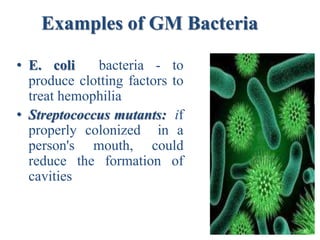
Examples of GM Bacteria
• E. coli bacteria - to
produce clotting factors to
treat hemophilia
• Streptococcus mutants: if
properly colonized in a
person's mouth, could
reduce the formation of
cavities
Genetically modified Animals
“A transgenic animal is one that carries a foreign
gene that has been deliberately inserted into its
genome”
•The foreign gene is constructed using
recombinant DNA methedology.
•Process of GMO animals is slow
-tedious
-expensive
Examples of genetic modified Animals
•Transgenic sheep
•Transgenic cow
•Genetically modified fish
•Genetically modified mice
•Genetically modified Chicken
•Genetically modified Goat
•Genetically modified pig
Dolly sheep
•Born 5 July 1996
•Roslin institute
•Died 14 febrary 2003
•National museum of
scotland
•First mammal to be
cloned from somatic cell
•Offspring six lambs
Transgenic sheep
•Tracy is the first transgenic animal
•Produce a recombinant protein in her milk
Uses of transgenic sheep
It is used as a model for studying
•Immunology
•Human blood clotting factor 8
•Transplantation
•Haematology
•Drug production in milk
•Recombinant DNA
Genetic modified cow
•Transgenic cows carrying
two types of cassiene genes
•Results in 13% more milk
proteine
•A bovine growth hormone
used in cows to increase
milk production
Transgenic fish
• Tilapia
• Trout
• Catfish ,Zebra fish
• Grow 6 times faster than wild fish
• Extra copies of growth hormone gene.
• To detect pollution in waterways.
Genetically modified chicken
•Featherless chicken are
produced to increase the
quantity of meat.
•Used to increase
quantity of meat and
eggs
•GM goats
•GM pigs
Advantages
• Higher yields
• Increased muscle bulk (animals)
• Prolonged shelf-life
• Higher nutritional value
• Inbuilt resistance to pests, weeds and
disease
• More environment friendly
• Decrease in food prices (due to lower costs
and higher yield)
• Less environmental hazards
• Decrease costs of growing and farming
• Source of more income for farmers
• Production of medicines and vaccines
(biotechnology)
Disadvantages
• Upsetting the ecosystem
• Development of super pests
• Ethical issues (religious, health)
• Interfering the normal DNA system
• Disappointing crop yields (may be)
• Doubt over the environmental benefits
• No good or natural taste
• Unpredictable results
• Increasing financial gaps between developed
& developing countries
• False claim of ending world hunger with
GMOs
Reported problems
Farmers reported:
• Pigs and cows became sterile from GM corn
• Workers exposed to BT-cotton developed
allergies
• Sheep died after grazing in BT-cotton fields
Scientists reported:
• GM peas generated an allergic-type inflammatory
response in mice
• Rats fed BT- corn had multiple health problems
• Mice fed GM BT- potatoes had intestinal damage
Are GM foods safe?
• Many people are not sure either the GMO’s are
safe to use or not.
• A very small proportion of population prefers
the use of modified foods.
Issues
• Religious issues
–Banned human cloning
• Social issues
–No to human cloning only for organs
–Difference between developed & under-
developed countries
Genetically modified organisms and limitations

Genetically modified organisms and limitations

  • 2.
  • 3.
    What is GMO’s? •Genetically modified organism (GMO) “GMO is any organism whose genetic material has been altered using genetic engineering techniques” Genetic engineering • Also called genetic modification “Genetic engineering is the manipulation of an organism's genome using biotechnology”
  • 4.
    Specifically, “ Any livingorganism that possesses a novel combination of genetic material obtained through the use of modern biotechnology.”
  • 6.
  • 7.
    1. Identification ofthe gene interest. 2. Isolation of the gene of interest. 3. Amplifying gene to produce many copies.
  • 8.
    4. Associating thegene with an appropriate promoter and poly A sequence 5. Insertion into plasmids. 6. Multiplying the plasmid in bacteria Bacteria
  • 9.
    6. Transference ofthe construct into the recipient tissue, usually fertilized eggs 7. Integration of gene into recipient genome; 8. Expression of gene in recipient genome 9.Inheritance of gene through further generations.
  • 11.
    Examples Of GMO’s •GeneticallyModified Animals •Genetically Modified Plants •Genetically Modified Bacteria
  • 12.
  • 14.
  • 15.
    Genetically modified crops •Also called GMCs, GM crops, or biotech crops) • Plants with modified DNA by using genetic engineering techniques • The aim is to introduce a new trait to the plant which does not occur naturally in the species
  • 16.
    Examples in foodcrops • Crops resistant to certain  pests  diseases  environmental conditions  fast spoilage  chemical treatments • Crops with improved nutrient profile
  • 17.
    Examples in non-foodcrops • Include crops for production of -pharmaceutical agents -biofuels -other industrially useful goods -for bioremediation.
  • 18.
    Examples Insect resistant cotton– Bt toxin kills the cotton boll worm • transgene = Bt gene from Bacillus thuringiensis Insect resistant corn – Bt toxin kills the European corn borer. • transgene = Bt protein
  • 19.
    Herbicide resistant crops- soybean, corn, canola • transgene = EPSP synthase Virus resistance papaya- resistant to papaya ring spot virus • transgene = virus coat protein
  • 20.
  • 21.
    Yield • In 2014the largest review yet concluded that GM crops’ effects on farming were positive • Yields increased -9% for herbicide tolerance -25% for insect resistance -GM crops made 69% higher profits • GM crops help farmers in developing countries by increasing yields by 14%
  • 22.
  • 23.
    Genetically modified bacteria •1st organisms to be modified - due to their simple genetics. • Used for several purposes • important in producing large amounts of human proteins -for use in medicine
  • 24.
    Bacterial synthesized transgenicproducts • Insulin • Hepatitis B vaccine • Tissue plasminogen activator • Human growth hormone • Interferon • bt corn
  • 25.
    Example: In 1978, aversion of the human insulin gene was inserted into the bacterium Escherichia coli to produce synthetic "human" insulin.
  • 26.
    Examples of GMBacteria • E. coli bacteria - to produce clotting factors to treat hemophilia • Streptococcus mutants: if properly colonized in a person's mouth, could reduce the formation of cavities
  • 27.
  • 28.
    Genetically modified Animals “Atransgenic animal is one that carries a foreign gene that has been deliberately inserted into its genome” •The foreign gene is constructed using recombinant DNA methedology. •Process of GMO animals is slow -tedious -expensive
  • 29.
    Examples of geneticmodified Animals •Transgenic sheep •Transgenic cow •Genetically modified fish •Genetically modified mice •Genetically modified Chicken •Genetically modified Goat •Genetically modified pig
  • 30.
    Dolly sheep •Born 5July 1996 •Roslin institute •Died 14 febrary 2003 •National museum of scotland •First mammal to be cloned from somatic cell •Offspring six lambs
  • 31.
    Transgenic sheep •Tracy isthe first transgenic animal •Produce a recombinant protein in her milk
  • 32.
    Uses of transgenicsheep It is used as a model for studying •Immunology •Human blood clotting factor 8 •Transplantation •Haematology •Drug production in milk •Recombinant DNA
  • 33.
    Genetic modified cow •Transgeniccows carrying two types of cassiene genes •Results in 13% more milk proteine •A bovine growth hormone used in cows to increase milk production
  • 34.
    Transgenic fish • Tilapia •Trout • Catfish ,Zebra fish • Grow 6 times faster than wild fish • Extra copies of growth hormone gene. • To detect pollution in waterways.
  • 35.
    Genetically modified chicken •Featherlesschicken are produced to increase the quantity of meat. •Used to increase quantity of meat and eggs
  • 36.
  • 37.
    Advantages • Higher yields •Increased muscle bulk (animals) • Prolonged shelf-life • Higher nutritional value
  • 39.
    • Inbuilt resistanceto pests, weeds and disease • More environment friendly • Decrease in food prices (due to lower costs and higher yield)
  • 40.
    • Less environmentalhazards • Decrease costs of growing and farming • Source of more income for farmers • Production of medicines and vaccines (biotechnology)
  • 41.
    Disadvantages • Upsetting theecosystem • Development of super pests • Ethical issues (religious, health) • Interfering the normal DNA system
  • 42.
    • Disappointing cropyields (may be) • Doubt over the environmental benefits • No good or natural taste • Unpredictable results
  • 43.
    • Increasing financialgaps between developed & developing countries • False claim of ending world hunger with GMOs
  • 44.
  • 45.
    Farmers reported: • Pigsand cows became sterile from GM corn • Workers exposed to BT-cotton developed allergies • Sheep died after grazing in BT-cotton fields
  • 46.
    Scientists reported: • GMpeas generated an allergic-type inflammatory response in mice • Rats fed BT- corn had multiple health problems • Mice fed GM BT- potatoes had intestinal damage
  • 47.
    Are GM foodssafe? • Many people are not sure either the GMO’s are safe to use or not. • A very small proportion of population prefers the use of modified foods.
  • 49.
    Issues • Religious issues –Bannedhuman cloning • Social issues –No to human cloning only for organs –Difference between developed & under- developed countries