- Aashi Gupta
B.Tech (BT)- VI sem
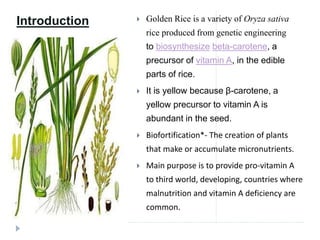
Introduction  Golden Rice is a variety of Oryza sativa
rice produced from genetic engineering
to biosynthesize beta-carotene, a
precursor of vitamin A, in the edible
parts of rice.
 It is yellow because β-carotene, a
yellow precursor to vitamin A is
abundant in the seed.
 Biofortification*- The creation of plants
that make or accumulate micronutrients.
 Main purpose is to provide pro-vitamin A
to third world, developing, countries where
malnutrition and vitamin A deficiency are
common.
Brief History
 Started in 1982 by Ingo Potrykus-Professor emeritus of the Institute for
Plant Sciences and Peter Beyer-Professor of Centre for Applied Biosciences,
Uni. Of Freiburg, Germany.
 Funded by the Rockefeller Foundation, the Swiss Federal Institute of
Technology, and Syngenta, a crop protection company.
 Golden Rice Humanitarian Board-responsible for the global development,
introduction and free distribution of Golden Rice to target countries.
 The first field trials* of golden rice cultivars were conducted by Louisiana
State University, Agricultural Center in 2004.
 Additional trials have been conducted in the Phillipines, Taiwan and in
Bangladesh (2015).
Effects of Malnutrition
 Symptoms of vitamin A deficiency (VAD) include; night
blindness, increased susceptibility to infection and cancer,
anemia (lack of red blood cells or hemoglobin), deterioration of
the eye tissue, and cardiovascular disease.
 Nearly 9 million children die from malnutrition each year.
A large proportion of those children die from common illnesses
that could have been avoided through adequate nutrition.
 The reduced immune competence increases the morbidity and
mortality rates of children.
Challenges ???
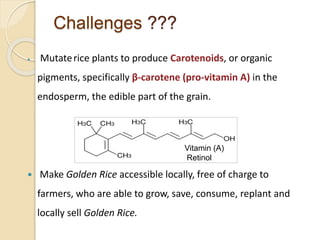
 Mutaterice plants to produce Carotenoids, or organic
pigments, specifically β-carotene (pro-vitamin A) in the
endosperm, the edible part of the grain.
 Make Golden Rice accessible locally, free of charge to
farmers, who are able to grow, save, consume, replant and
locally sell Golden Rice.
Vitamin (A)
Retinol
The Hybridisation Process
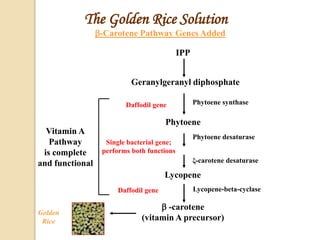
Addition of 2 genes in the rice genome completes the biosynthetic path.
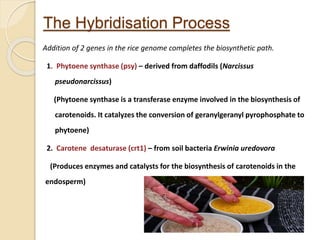
1. Phytoene synthase (psy) – derived from daffodils (Narcissus
pseudonarcissus)
(Phytoene synthase is a transferase enzyme involved in the biosynthesis of
carotenoids. It catalyzes the conversion of geranylgeranyl pyrophosphate to
phytoene)
2. Carotene desaturase (crt1) – from soil bacteria Erwinia uredovora
(Produces enzymes and catalysts for the biosynthesis of carotenoids in the
endosperm)
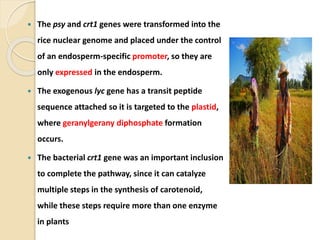
 The psy and crt1 genes were transformed into the
rice nuclear genome and placed under the control
of an endosperm-specific promoter, so they are
only expressed in the endosperm.
 The exogenous lyc gene has a transit peptide
sequence attached so it is targeted to the plastid,
where geranylgerany diphosphate formation
occurs.
 The bacterial crt1 gene was an important inclusion
to complete the pathway, since it can catalyze
multiple steps in the synthesis of carotenoid,
while these steps require more than one enzyme
in plants
 The end product of the engineered
pathway is lycopene, but if the plant
accumulated lycopene, the rice would be
red.
 Recent analysis have shown the plant's
endogenous enzymes process the lycopene
to beta-carotene in the endosperm, giving
the rice the distinctive yellow color for
which it is named.
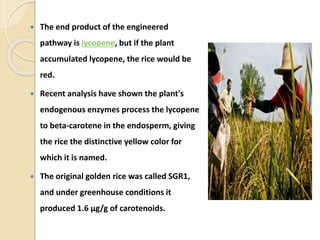
 The original golden rice was called SGR1,
and under greenhouse conditions it
produced 1.6 µg/g of carotenoids.
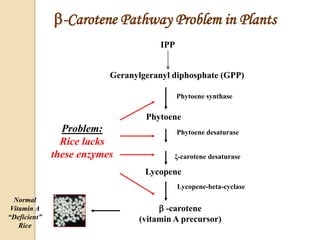
-Carotene Pathway Problem in Plants
IPP
Geranylgeranyl diphosphate (GPP)
Phytoene
Lycopene
 -carotene
(vitamin A precursor)
Phytoene synthase
Phytoene desaturase
Lycopene-beta-cyclase
ξ-carotene desaturase
Problem:
Rice lacks
these enzymes
Normal
Vitamin A
“Deficient”
Rice
The Golden Rice Solution
IPP
Geranylgeranyl diphosphate
Phytoene
Lycopene
 -carotene
(vitamin A precursor)
Phytoene synthase
Phytoene desaturase
Lycopene-beta-cyclase
ξ-carotene desaturase
Daffodil gene
Single bacterial gene;
performs both functions
Daffodil gene
-Carotene Pathway Genes Added
Vitamin A
Pathway
is complete
and functional
Golden
Rice
Advantages
 Golden rice give more quantity vitamin-A
 Easy distribution when released to needy
 Cheaper option to supply vitamin A requirement
compared to other supplementary measures
 Sustainable option as once released for common
cultivation can be cultivated every growing season by
farmer saved seeds, therefore no need of yearly
budgetary investment for distribution
Disadvantages
 Health
◦ May cause allergies or fail to perform desired effect
◦ Supply does not provide a substantial quantity as the
recommended daily intake
 Environment
◦ Loss of Biodiversity. May become a gregarious weed and
endanger the existence of natural rice plants
◦ Genetic contamination of natural, global staple foods
 Culture
◦ Some people prefer to cultivate and eat only white rice
based on traditional values and spiritual beliefs
“Read, Think
and
Love Science”
Thank You

Golden rice by aashi

  • 1.
  • 2.
    Introduction  GoldenRice is a variety of Oryza sativa rice produced from genetic engineering to biosynthesize beta-carotene, a precursor of vitamin A, in the edible parts of rice.  It is yellow because β-carotene, a yellow precursor to vitamin A is abundant in the seed.  Biofortification*- The creation of plants that make or accumulate micronutrients.  Main purpose is to provide pro-vitamin A to third world, developing, countries where malnutrition and vitamin A deficiency are common.
  • 3.
    Brief History  Startedin 1982 by Ingo Potrykus-Professor emeritus of the Institute for Plant Sciences and Peter Beyer-Professor of Centre for Applied Biosciences, Uni. Of Freiburg, Germany.  Funded by the Rockefeller Foundation, the Swiss Federal Institute of Technology, and Syngenta, a crop protection company.  Golden Rice Humanitarian Board-responsible for the global development, introduction and free distribution of Golden Rice to target countries.  The first field trials* of golden rice cultivars were conducted by Louisiana State University, Agricultural Center in 2004.  Additional trials have been conducted in the Phillipines, Taiwan and in Bangladesh (2015).
  • 4.
    Effects of Malnutrition Symptoms of vitamin A deficiency (VAD) include; night blindness, increased susceptibility to infection and cancer, anemia (lack of red blood cells or hemoglobin), deterioration of the eye tissue, and cardiovascular disease.  Nearly 9 million children die from malnutrition each year. A large proportion of those children die from common illnesses that could have been avoided through adequate nutrition.  The reduced immune competence increases the morbidity and mortality rates of children.
  • 5.
    Challenges ???  Mutatericeplants to produce Carotenoids, or organic pigments, specifically β-carotene (pro-vitamin A) in the endosperm, the edible part of the grain.  Make Golden Rice accessible locally, free of charge to farmers, who are able to grow, save, consume, replant and locally sell Golden Rice. Vitamin (A) Retinol
  • 6.
    The Hybridisation Process Additionof 2 genes in the rice genome completes the biosynthetic path. 1. Phytoene synthase (psy) – derived from daffodils (Narcissus pseudonarcissus) (Phytoene synthase is a transferase enzyme involved in the biosynthesis of carotenoids. It catalyzes the conversion of geranylgeranyl pyrophosphate to phytoene) 2. Carotene desaturase (crt1) – from soil bacteria Erwinia uredovora (Produces enzymes and catalysts for the biosynthesis of carotenoids in the endosperm)
  • 7.
     The psyand crt1 genes were transformed into the rice nuclear genome and placed under the control of an endosperm-specific promoter, so they are only expressed in the endosperm.  The exogenous lyc gene has a transit peptide sequence attached so it is targeted to the plastid, where geranylgerany diphosphate formation occurs.  The bacterial crt1 gene was an important inclusion to complete the pathway, since it can catalyze multiple steps in the synthesis of carotenoid, while these steps require more than one enzyme in plants
  • 8.
     The endproduct of the engineered pathway is lycopene, but if the plant accumulated lycopene, the rice would be red.  Recent analysis have shown the plant's endogenous enzymes process the lycopene to beta-carotene in the endosperm, giving the rice the distinctive yellow color for which it is named.  The original golden rice was called SGR1, and under greenhouse conditions it produced 1.6 µg/g of carotenoids.
  • 9.
    -Carotene Pathway Problemin Plants IPP Geranylgeranyl diphosphate (GPP) Phytoene Lycopene  -carotene (vitamin A precursor) Phytoene synthase Phytoene desaturase Lycopene-beta-cyclase ξ-carotene desaturase Problem: Rice lacks these enzymes Normal Vitamin A “Deficient” Rice
  • 10.
    The Golden RiceSolution IPP Geranylgeranyl diphosphate Phytoene Lycopene  -carotene (vitamin A precursor) Phytoene synthase Phytoene desaturase Lycopene-beta-cyclase ξ-carotene desaturase Daffodil gene Single bacterial gene; performs both functions Daffodil gene -Carotene Pathway Genes Added Vitamin A Pathway is complete and functional Golden Rice
  • 11.
    Advantages  Golden ricegive more quantity vitamin-A  Easy distribution when released to needy  Cheaper option to supply vitamin A requirement compared to other supplementary measures  Sustainable option as once released for common cultivation can be cultivated every growing season by farmer saved seeds, therefore no need of yearly budgetary investment for distribution
  • 12.
    Disadvantages  Health ◦ Maycause allergies or fail to perform desired effect ◦ Supply does not provide a substantial quantity as the recommended daily intake  Environment ◦ Loss of Biodiversity. May become a gregarious weed and endanger the existence of natural rice plants ◦ Genetic contamination of natural, global staple foods  Culture ◦ Some people prefer to cultivate and eat only white rice based on traditional values and spiritual beliefs
  • 13.