SUBMITTED TO
Dr. G. Uma Devi
Professor & University
Head
Dept. Of Plant Pathology
SUBMITTED BY
MD. Abdul Malik
RAM/2016-36
M.Sc 1 st year
CONTENTS..
• INTRODUCTION
• HISTORICAL BACKGROUND
• INDUCED RESISTANCE
• TYPES OF INDUCED RESISTANCE
• RESISTANCE INDUCED BY BIOLOGICAL AGENTS
• SIGNAL TRANSDUCTION
• DIFFERENCE BETWEEN ISR AND SAR
• CONCLUSIONS
• Induced plant resistance against pathogen
infection has been described for more than 100
years .
• Research on induced systemic resistance
against microbial pathogens has concentrated
on the :-
 specificity of interactions
 underlying signaling pathways
 how these findings might be used in
crop protection.
HISTORICAL BACKGROUND
• Resistance development in response to pathogen
infection was initially recognized by Ray (1901)&
Beauvene working with Botrytis cinerea
• Beauvene had previously discovered that the virulence
of a strain of Botrytis cinerea (grey mold) could be
varied by pre- exposing the pathogen to heat or cold.
• The first controlled laboratory study of SAR was
performed by Ross (1961),who demonstrated that
inoculation of a single leaf of tobacco with tobacco
mosaic virus (TMV) reduced the severity of subsequent
infections on other leaves
Induced resistance
• It is plant mediated mechanism of biocontrol
in which Biocontrol Agent and the pathogen
do not come in contact with one another or
with each other.
• The main strategies behind Induced resistance
is the exploitation of host plant resistance.
• Disease suppression through induction of
resistance.
TYPES OF INDUCED RESISTANCE
1. Local Acquired Resistance (LAR)
2. Systemic Acquired Resistance (SAR)
3. Systemic Gene Silencing (SGS)
4. Induced Systemic Resistance (ISR)
5. Systemic wounding Response (SWR)
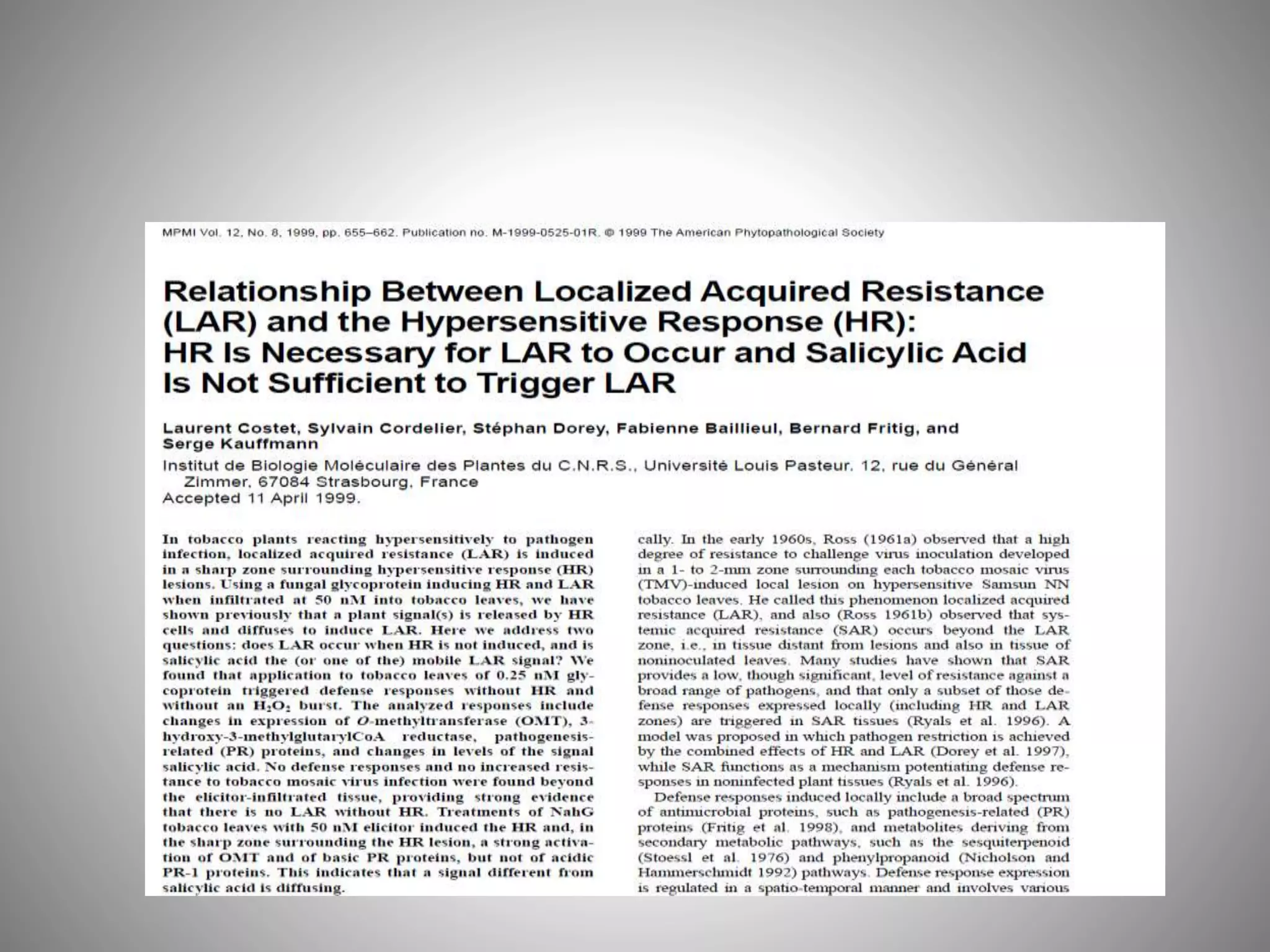
1.Local Acquired Resistance (LAR)
• Induced resistance is at first localized around
the point of plant necrosis caused by infection
by the pathogen or by the chemical and then
it is called Local acquired resistance .
• For eg. It is induced in a 1-2 mm zone around
local lesions caused by tobbacco mosaic virus.
• LAR may play a role in natural infections by
limiting the number and size of lesions per
leaf unit area.
• Plants infected with one pathogen become more
resistant to subsequent infection by another
pathogen.
• and also of plants becoming resistant to pathogen if
they have been inoculated with the same.
• For eg. Bean and sugar beet inoculated with a virus
exhibit greater resistance to fungal pathogens
causing rust and powdery mildew.
• In tobacco mosaic virus it induces a systemic
resistance to it self but also to unrelated viruses.
Systemic Acquired Resistance (SAR)
Mechanism of SAR
• Van Loon and Van Kammen(1970) and
Gianinazzi et al.(1970) showed that viral
infection of tobacco induced the accumulation
of a distinct set of proteins, called
pathogenesis related proteins(PR proteins).
• Ward et al demonstrated that at least 9 gene
families were induced in uninfected leaves of
inoculated plants , these gene families are
known as SAR genes
• Several of these SAR genes product have
direct antimicrobial activity closely related to
classes of anti microbial proteins.
• These includes chitinases , beta 1,3-
glucanases , cysteine rich proteins.
• Further, for the involvement of SAR genes in
resistance comes from a range of transgenic
plant experiment.
• The set of SAR genes that are induced differs
among the plant species.
• In cucumber , a class 3 chitinase is most highly
induced SAR gene but in tobacco , Arabidopsis
and PR-1 are predominant .
• Such differences may reflect evolutionary or
breeding constraints.
Systemic Gene Silencing (SGS)
Induced Systemic Resistance (ISR)
Concepts:-
Interactions between plants and pathogen
can lead to either to a compatible response or
incompatible response.
• In incompatible interactions, infection by
virus, bacteria or fungi will elicit a set of
localized responses in and around the
infected host cells.
• These responses include an oxidative burst
can lead to cell death.
• Thus the pathogen may be trapped in death
cells and appear to be prevented from
spreading from the site of initial infection.
• Local responses in surrounding cell include
changes in cell wall composition that can
inhibit pathogen penetration.
• De novo synthesis of anti microbial
compounds such as phytoalexins and PR
proteins.
• Phytoalexins are mainly characteristics of
local response while PR proteins occur both
locally and systematically.
• PR proteins are found in more than 40 species
belonging to at least 13 families.
• Two groups of PR proteins –
- acidic located in intercellular.
- basic located in intracellar.
• PR proteins are generally used as ISR markers.
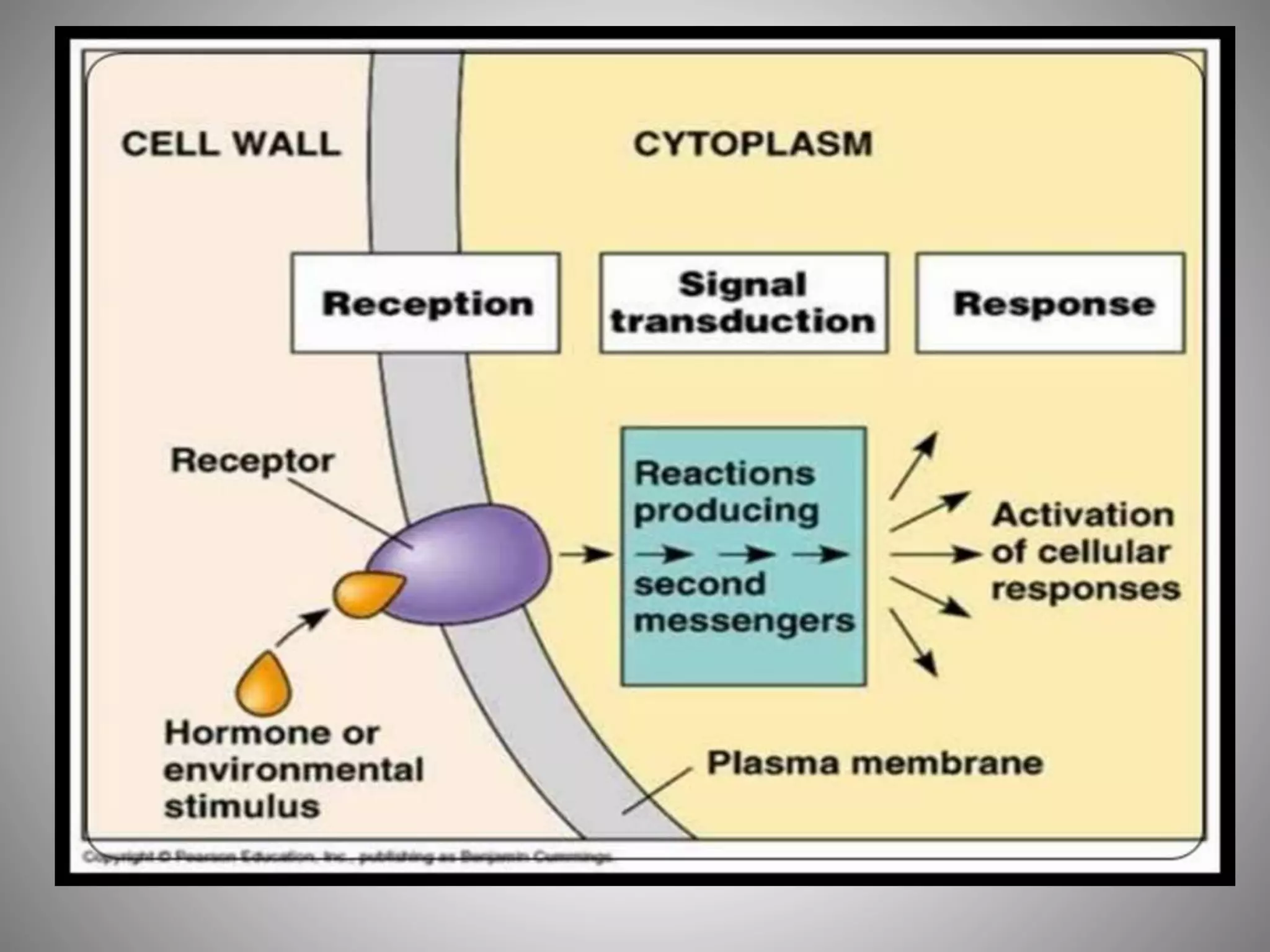
SIGNAL TRANSDUCTION
• The first step in the development of SAR is the
recognition of pathogen infection by a plant.
• Once the plant reacts to the pathogen, signals are
released that trigger resistance in adjacent as well as
distant tissues. Importantly, not a11 plant pathogen
interactions lead to SAR induction.
• Compatible interactions can lead to SAR induction; thus,
the pathogen need not induce a gene-for-gene
resistance reaction (Ku:, 1982).
• The most compelling evidence that implicates SA as a
signal in SAR comes from experiments using transgenic
tobacco to express the enzyme salicylate hydroxylase,
encoded by the nahG gene from Pseudomonas putida
(Gaffney et al., 1993).
RESISTANCE INDUCED BY BIOLOGICAL
AGENTS
• Although a range of organisms is commercially
available for use as biocontrol agents nearly all
are based on antibiotic principle.
• Eg. Extract of Rheynoutria sachaalinensis Has
good control on powdery mildews
• Extracts from Bacillus subtilis reported to
induce resistance in barley against powdery
mildews .
• Another interesting class of agents is PGPR,
which are able to protect plants against foliar
diseases.
• This strategy offers an exciting potential since
disease control and increased plant health
can be combined.
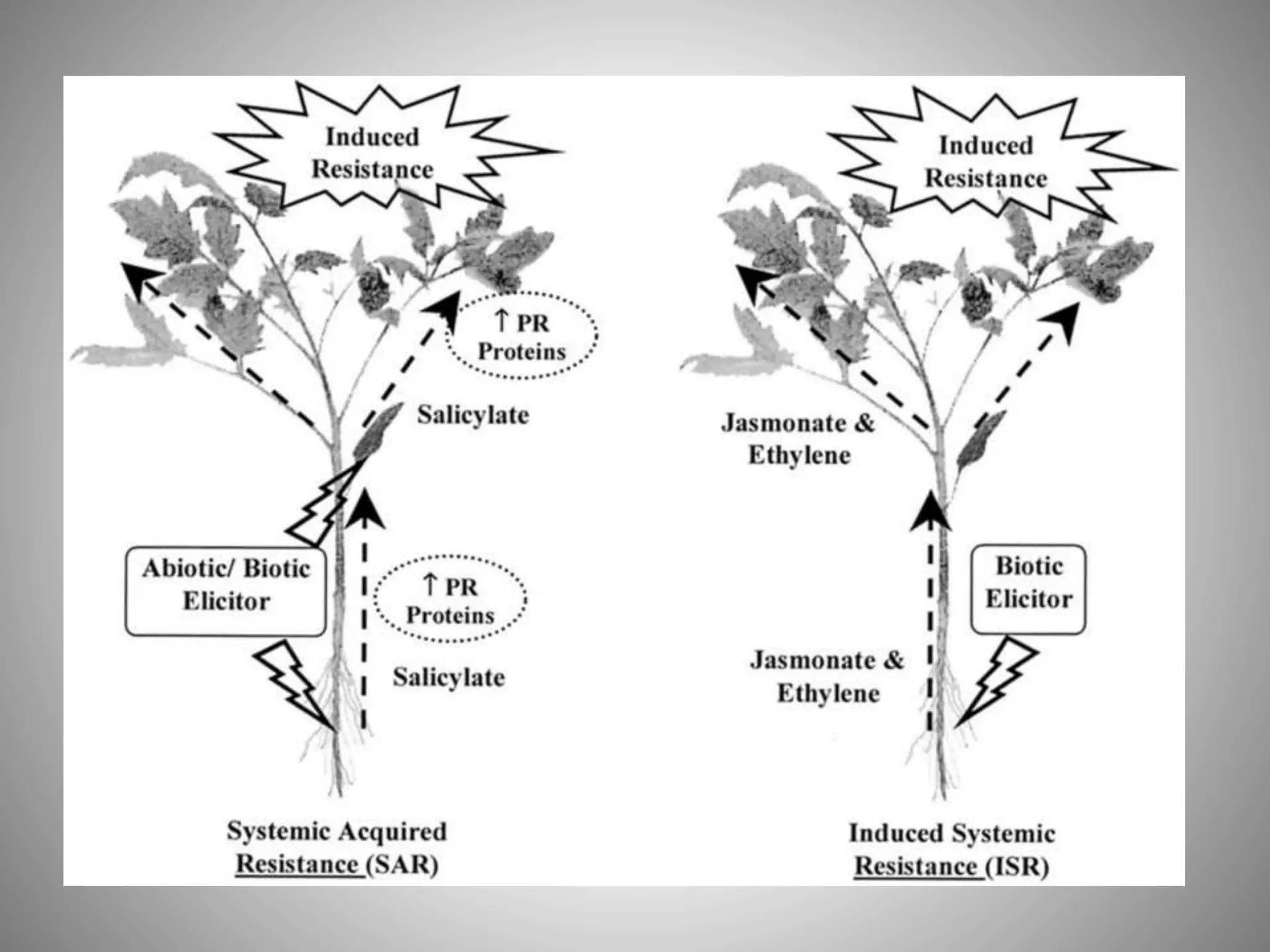
Differences between SAR and ISR
SAR
• SA mediated
• Major change is gene
expression
• Phytotoxicity occurs
ISR
• JA and ethylene
mediated
• Enhanced sensitivity to
ethylene
• Phytotoxicity absent
Conclusions:
• Our understanding of induced resistance has
increased considerably over recent years.
• We have seen many of processes contributing
to SAR are clearly required in both local and
systemic tissues.
• Although practical use of microorganisms to
induce resistance is restricted to some plants.
REFERENCES
• 1.PLANT PATHOLOGY - G.N.AGRIOS
• 2.INTRODUCTION TO PRINCIPLE OF PLANT
PATHOLOGY- R.S SINGH
• Systemic Acquired Resistance and Induced
Systemic Resistance in Conventional Agriculture-
Gary E. Vallad and Robert M. Goodman.(2004).
• W.E. Durrant and X. Dong (Annual Review of
Phytopathology Vol. 42: 185-209 (Volume
publication date September 2004).
Contd..
• John Ryals, Scott Uknes, and Eric Ward, Plant
Physiol. (1994) 104: 1109-11 12.
• Systemic Acquired Resistance-John A. Ryals,'
Urs H. Neuen schwander, Michael G. Willits,
Antonio Molina, Henry-York Steiner, and
Michelle D. Hunt
Induced resistance

Induced resistance

  • 1.
    SUBMITTED TO Dr. G.Uma Devi Professor & University Head Dept. Of Plant Pathology SUBMITTED BY MD. Abdul Malik RAM/2016-36 M.Sc 1 st year
  • 2.
    CONTENTS.. • INTRODUCTION • HISTORICALBACKGROUND • INDUCED RESISTANCE • TYPES OF INDUCED RESISTANCE • RESISTANCE INDUCED BY BIOLOGICAL AGENTS • SIGNAL TRANSDUCTION • DIFFERENCE BETWEEN ISR AND SAR • CONCLUSIONS
  • 3.
    • Induced plantresistance against pathogen infection has been described for more than 100 years . • Research on induced systemic resistance against microbial pathogens has concentrated on the :-  specificity of interactions  underlying signaling pathways  how these findings might be used in crop protection.
  • 4.
    HISTORICAL BACKGROUND • Resistancedevelopment in response to pathogen infection was initially recognized by Ray (1901)& Beauvene working with Botrytis cinerea • Beauvene had previously discovered that the virulence of a strain of Botrytis cinerea (grey mold) could be varied by pre- exposing the pathogen to heat or cold. • The first controlled laboratory study of SAR was performed by Ross (1961),who demonstrated that inoculation of a single leaf of tobacco with tobacco mosaic virus (TMV) reduced the severity of subsequent infections on other leaves
  • 5.
    Induced resistance • Itis plant mediated mechanism of biocontrol in which Biocontrol Agent and the pathogen do not come in contact with one another or with each other. • The main strategies behind Induced resistance is the exploitation of host plant resistance. • Disease suppression through induction of resistance.
  • 6.
    TYPES OF INDUCEDRESISTANCE 1. Local Acquired Resistance (LAR) 2. Systemic Acquired Resistance (SAR) 3. Systemic Gene Silencing (SGS) 4. Induced Systemic Resistance (ISR) 5. Systemic wounding Response (SWR)
  • 7.
    1.Local Acquired Resistance(LAR) • Induced resistance is at first localized around the point of plant necrosis caused by infection by the pathogen or by the chemical and then it is called Local acquired resistance . • For eg. It is induced in a 1-2 mm zone around local lesions caused by tobbacco mosaic virus. • LAR may play a role in natural infections by limiting the number and size of lesions per leaf unit area.
  • 8.
    • Plants infectedwith one pathogen become more resistant to subsequent infection by another pathogen. • and also of plants becoming resistant to pathogen if they have been inoculated with the same. • For eg. Bean and sugar beet inoculated with a virus exhibit greater resistance to fungal pathogens causing rust and powdery mildew. • In tobacco mosaic virus it induces a systemic resistance to it self but also to unrelated viruses. Systemic Acquired Resistance (SAR)
  • 10.
    Mechanism of SAR •Van Loon and Van Kammen(1970) and Gianinazzi et al.(1970) showed that viral infection of tobacco induced the accumulation of a distinct set of proteins, called pathogenesis related proteins(PR proteins). • Ward et al demonstrated that at least 9 gene families were induced in uninfected leaves of inoculated plants , these gene families are known as SAR genes
  • 11.
    • Several ofthese SAR genes product have direct antimicrobial activity closely related to classes of anti microbial proteins. • These includes chitinases , beta 1,3- glucanases , cysteine rich proteins. • Further, for the involvement of SAR genes in resistance comes from a range of transgenic plant experiment.
  • 13.
    • The setof SAR genes that are induced differs among the plant species. • In cucumber , a class 3 chitinase is most highly induced SAR gene but in tobacco , Arabidopsis and PR-1 are predominant . • Such differences may reflect evolutionary or breeding constraints.
  • 14.
  • 16.
    Induced Systemic Resistance(ISR) Concepts:- Interactions between plants and pathogen can lead to either to a compatible response or incompatible response.
  • 19.
    • In incompatibleinteractions, infection by virus, bacteria or fungi will elicit a set of localized responses in and around the infected host cells. • These responses include an oxidative burst can lead to cell death. • Thus the pathogen may be trapped in death cells and appear to be prevented from spreading from the site of initial infection.
  • 20.
    • Local responsesin surrounding cell include changes in cell wall composition that can inhibit pathogen penetration. • De novo synthesis of anti microbial compounds such as phytoalexins and PR proteins. • Phytoalexins are mainly characteristics of local response while PR proteins occur both locally and systematically.
  • 21.
    • PR proteinsare found in more than 40 species belonging to at least 13 families. • Two groups of PR proteins – - acidic located in intercellular. - basic located in intracellar. • PR proteins are generally used as ISR markers.
  • 24.
  • 26.
    • The firststep in the development of SAR is the recognition of pathogen infection by a plant. • Once the plant reacts to the pathogen, signals are released that trigger resistance in adjacent as well as distant tissues. Importantly, not a11 plant pathogen interactions lead to SAR induction. • Compatible interactions can lead to SAR induction; thus, the pathogen need not induce a gene-for-gene resistance reaction (Ku:, 1982). • The most compelling evidence that implicates SA as a signal in SAR comes from experiments using transgenic tobacco to express the enzyme salicylate hydroxylase, encoded by the nahG gene from Pseudomonas putida (Gaffney et al., 1993).
  • 27.
    RESISTANCE INDUCED BYBIOLOGICAL AGENTS • Although a range of organisms is commercially available for use as biocontrol agents nearly all are based on antibiotic principle. • Eg. Extract of Rheynoutria sachaalinensis Has good control on powdery mildews • Extracts from Bacillus subtilis reported to induce resistance in barley against powdery mildews .
  • 28.
    • Another interestingclass of agents is PGPR, which are able to protect plants against foliar diseases. • This strategy offers an exciting potential since disease control and increased plant health can be combined.
  • 29.
    Differences between SARand ISR SAR • SA mediated • Major change is gene expression • Phytotoxicity occurs ISR • JA and ethylene mediated • Enhanced sensitivity to ethylene • Phytotoxicity absent
  • 34.
    Conclusions: • Our understandingof induced resistance has increased considerably over recent years. • We have seen many of processes contributing to SAR are clearly required in both local and systemic tissues. • Although practical use of microorganisms to induce resistance is restricted to some plants.
  • 35.
    REFERENCES • 1.PLANT PATHOLOGY- G.N.AGRIOS • 2.INTRODUCTION TO PRINCIPLE OF PLANT PATHOLOGY- R.S SINGH • Systemic Acquired Resistance and Induced Systemic Resistance in Conventional Agriculture- Gary E. Vallad and Robert M. Goodman.(2004). • W.E. Durrant and X. Dong (Annual Review of Phytopathology Vol. 42: 185-209 (Volume publication date September 2004).
  • 36.
    Contd.. • John Ryals,Scott Uknes, and Eric Ward, Plant Physiol. (1994) 104: 1109-11 12. • Systemic Acquired Resistance-John A. Ryals,' Urs H. Neuen schwander, Michael G. Willits, Antonio Molina, Henry-York Steiner, and Michelle D. Hunt