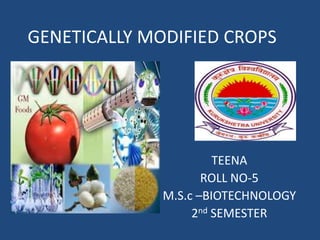
GENETICALLY MODIFIED CROPS
TEENA
ROLL NO-5
M.S.c –BIOTECHNOLOGY
2nd SEMESTER
WHAT ARE GENETICALLY MODIFIED
CROPS
A genetically modified organism (GMO) is any
organism whose genetic material has been
altered using genetic engineering techniques
Has been a very controversial topic
This presentation will go over the process,
examples, positive and negative and future
prospectives of GM crop production
HISTORY OF GMO’s
• In 1980, the first transgenic animal was created,a
mouse.
• In 1980s, transgenic plants were started to be created in
china
• 1988, first transgenic plant producing a pharmaceutical
product manafactured.
• 1995,GMO corn hits the market in USA.
• 1996, Roundup Ready Soyabeans hit market in USA.
• 1998, First GM labelling rules introduced to provide
consumers with information regarding the use of GM
ingredients in food
• Over the years,we have developed new and better ways
to manage and produce GMO crops.
•First crop introduced was Flavr Savr in
USA in 1995.
So far 20 crops approved for commercial
cultivation in different countries
Only four crops being marketed commercially
ie.corn, cotton,soyabean and canula.
Commercial production initiated for
papaya,squash,rice,alfalfa,in USA and other
countries .Others are approved but not yet
marketed
Major countries include
USA,China,Japan,India,Brazil,Argentina.
WHY TO MAKE TRANSGENIC CROPS
• Due to limitations of conventional breeding
for attaining the desirable traits use of
recombinant DNA Technology has been taken
advantage of and development of transgenic
started
TYPES OF MODIFICATIONS
• TRANSGENIC
• CISGENIC
Cisgenic plants are made using gene foung within the same species or
closely related one,where conventional plant breeding can occur.
• SUBGENIC
Genetically modified plants can also be developed using gene knockdown
or gene knockout technology to alter genetic makeup ,without
incorporating genes from other plants .In 2014 Chinese reseacher Gao
Caixia filed patents on creation of strain of wheat that is resistant to
powdery mildew
The strain lacks gene that encode protein that repress defenses against the
mildew.The reseachers deleted all three copies of genesfrom wheats
Hexapoid genome.
• MULTIPLE TRAIT INTEGERATION
Several new traits can be integerated.
Transgenic crops:Development
Objectives
Integerated pest management
Herbicide tolerance
Nutritional enhancement
Product quality improvement
Increase in yield
Stress tolerance
Plant based pharmaceuticals.
DEVELOPMENT OF GM CROP/
TRANSGENIC
• Identifying gene(s)
• Giving a desired trait
• Make copies of gene
• Transfer to plant tissue
• Regenerate plant
• Lab analysis and safety
• Development of a variety
• Field tests
• Approval by government agencies
• Monitoring of safety
PRODUCTION OF TRANSGENIC PLANT
Govt. of India approved Mahyco’s Bt-
cotton
for control of bollworms
26 MARCH 2002
India’s first transgenic crop.
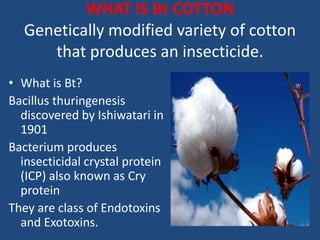
WHAT IS Bt COTTON
Genetically modified variety of cotton
that produces an insecticide.
• What is Bt?
Bacillus thuringenesis
discovered by Ishiwatari in
1901
Bacterium produces
insecticidal crystal protein
(ICP) also known as Cry
protein
They are class of Endotoxins
and Exotoxins.
HOW Bt WORKS?
1. Ingestion
2. Solubilization and proteolytic cleavage
3. Binding to target site
4. Formation of toxic lesions
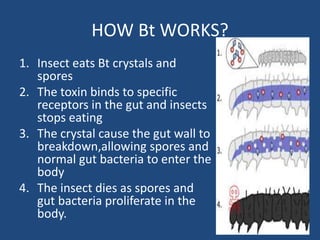
HOW Bt WORKS?
1. Insect eats Bt crystals and
spores
2. The toxin binds to specific
receptors in the gut and insects
stops eating
3. The crystal cause the gut wall to
breakdown,allowing spores and
normal gut bacteria to enter the
body
4. The insect dies as spores and
gut bacteria proliferate in the
body.
MODE OF ACTION OF Cry toxin
GM CROPS- Pros
• Improved resistance to pests and diseases.
• Improved resistance to herbicide.
• Production of more nutritious staple crops.
• Contribute to food security,sustainability.
• Contributing to the alleviation of poverty and
hunger .
• Increased food productivity.
• Stability of production.
• Economic and social benefits.
GM CROPS- Cons
• Human health hazards-
1. antibiotic resistance,
2. allergen and toxin formations,
3. Unknown effects on human health.
• Environmental hazards
1. Growing GM crop may lead to monoculture
2. The creation of pest or herbicide resistant GM
crops could result in superbugs or superweeds.
• Effects on non target organisms.
EFFECTS ON NON TARGET ORGANISMS
Do GM crops increase yield?
-To feed a growing global population that may touch
by 9 billion by 2050.The world already produces
enough food for 13 billion people,so the problem is
not of food production but of access to it by poor.
Have GM crops increased global food
security?
-In Paraguay, where nearly 65% of the land is
under GM, hunger has increased from 12.6% in
2004-06 to 25.5% in 2010-12
HERBICIDE RESISTANT
• Alfalfa
used as animal feed in USA.
first approved in 2005.Approval withdrawn in 2007 and
reapproved in2011
• Canola
used as cooking oil,and emulsifiers in packaged
food.Approved in Australia(2003), USA(1995),
Canada(1995).
• Cotton
Used as fiber,cottonseed oil,animal feed.Approved in
Argentina(2001),Australia(2002),Brazil(2008)….
• Maize
• Sotabean
• Sugar beet
INSECTICIDE RESISTANT
• Cotton(fiber)
• Eggplant(food)
• Maize(animal feed,high fructose corn syrup,corn starch)
• Poplar(tree) in China
OTHER MODIFIED TRAITS
• Canola(high laurate canola,phytase production in USA)
• Carnation (used as ornamental plant ,with trait of delayed
senescence and modified flower colour)
• Maize(increased lysine and drought resistant)
• Papaya (virus resistant)
• Petunia (modified flower colour)
• Potato(virus resistance and modified starch content)
• Soyabean(increased oleic acid production,stearidonic acid
production,virus tolerance)
RECENT RESEARCH REGARDING
GENETIC MODIFIED CROPS
• Researchers at the University of Washington
have genetically modified a common house
plant- pathos ivy- to remove chloroform and
benzene from air around it.
REFRENCES
• www.ncbi.nlm.nih.gov.im
• Researchgate.com
• Plant biotechnology book by Bhojwani and
razdan
• Science daily magazine
• Genetic engineering book by TA Brown 7th
edition
Genetically modified crops

Genetically modified crops

  • 1.
    GENETICALLY MODIFIED CROPS TEENA ROLLNO-5 M.S.c –BIOTECHNOLOGY 2nd SEMESTER
  • 2.
    WHAT ARE GENETICALLYMODIFIED CROPS A genetically modified organism (GMO) is any organism whose genetic material has been altered using genetic engineering techniques Has been a very controversial topic This presentation will go over the process, examples, positive and negative and future prospectives of GM crop production
  • 4.
    HISTORY OF GMO’s •In 1980, the first transgenic animal was created,a mouse. • In 1980s, transgenic plants were started to be created in china • 1988, first transgenic plant producing a pharmaceutical product manafactured. • 1995,GMO corn hits the market in USA. • 1996, Roundup Ready Soyabeans hit market in USA. • 1998, First GM labelling rules introduced to provide consumers with information regarding the use of GM ingredients in food • Over the years,we have developed new and better ways to manage and produce GMO crops.
  • 5.
    •First crop introducedwas Flavr Savr in USA in 1995. So far 20 crops approved for commercial cultivation in different countries Only four crops being marketed commercially ie.corn, cotton,soyabean and canula. Commercial production initiated for papaya,squash,rice,alfalfa,in USA and other countries .Others are approved but not yet marketed Major countries include USA,China,Japan,India,Brazil,Argentina.
  • 6.
    WHY TO MAKETRANSGENIC CROPS • Due to limitations of conventional breeding for attaining the desirable traits use of recombinant DNA Technology has been taken advantage of and development of transgenic started
  • 8.
    TYPES OF MODIFICATIONS •TRANSGENIC • CISGENIC Cisgenic plants are made using gene foung within the same species or closely related one,where conventional plant breeding can occur. • SUBGENIC Genetically modified plants can also be developed using gene knockdown or gene knockout technology to alter genetic makeup ,without incorporating genes from other plants .In 2014 Chinese reseacher Gao Caixia filed patents on creation of strain of wheat that is resistant to powdery mildew The strain lacks gene that encode protein that repress defenses against the mildew.The reseachers deleted all three copies of genesfrom wheats Hexapoid genome. • MULTIPLE TRAIT INTEGERATION Several new traits can be integerated.
  • 9.
    Transgenic crops:Development Objectives Integerated pestmanagement Herbicide tolerance Nutritional enhancement Product quality improvement Increase in yield Stress tolerance Plant based pharmaceuticals.
  • 10.
    DEVELOPMENT OF GMCROP/ TRANSGENIC • Identifying gene(s) • Giving a desired trait • Make copies of gene • Transfer to plant tissue • Regenerate plant • Lab analysis and safety • Development of a variety • Field tests • Approval by government agencies • Monitoring of safety
  • 11.
  • 14.
    Govt. of Indiaapproved Mahyco’s Bt- cotton for control of bollworms 26 MARCH 2002 India’s first transgenic crop.
  • 19.
    WHAT IS BtCOTTON Genetically modified variety of cotton that produces an insecticide. • What is Bt? Bacillus thuringenesis discovered by Ishiwatari in 1901 Bacterium produces insecticidal crystal protein (ICP) also known as Cry protein They are class of Endotoxins and Exotoxins.
  • 20.
    HOW Bt WORKS? 1.Ingestion 2. Solubilization and proteolytic cleavage 3. Binding to target site 4. Formation of toxic lesions
  • 21.
    HOW Bt WORKS? 1.Insect eats Bt crystals and spores 2. The toxin binds to specific receptors in the gut and insects stops eating 3. The crystal cause the gut wall to breakdown,allowing spores and normal gut bacteria to enter the body 4. The insect dies as spores and gut bacteria proliferate in the body.
  • 22.
    MODE OF ACTIONOF Cry toxin
  • 24.
    GM CROPS- Pros •Improved resistance to pests and diseases. • Improved resistance to herbicide. • Production of more nutritious staple crops. • Contribute to food security,sustainability. • Contributing to the alleviation of poverty and hunger . • Increased food productivity. • Stability of production. • Economic and social benefits.
  • 25.
    GM CROPS- Cons •Human health hazards- 1. antibiotic resistance, 2. allergen and toxin formations, 3. Unknown effects on human health. • Environmental hazards 1. Growing GM crop may lead to monoculture 2. The creation of pest or herbicide resistant GM crops could result in superbugs or superweeds. • Effects on non target organisms.
  • 26.
    EFFECTS ON NONTARGET ORGANISMS
  • 27.
    Do GM cropsincrease yield? -To feed a growing global population that may touch by 9 billion by 2050.The world already produces enough food for 13 billion people,so the problem is not of food production but of access to it by poor. Have GM crops increased global food security? -In Paraguay, where nearly 65% of the land is under GM, hunger has increased from 12.6% in 2004-06 to 25.5% in 2010-12
  • 28.
    HERBICIDE RESISTANT • Alfalfa usedas animal feed in USA. first approved in 2005.Approval withdrawn in 2007 and reapproved in2011 • Canola used as cooking oil,and emulsifiers in packaged food.Approved in Australia(2003), USA(1995), Canada(1995). • Cotton Used as fiber,cottonseed oil,animal feed.Approved in Argentina(2001),Australia(2002),Brazil(2008)…. • Maize • Sotabean • Sugar beet
  • 29.
    INSECTICIDE RESISTANT • Cotton(fiber) •Eggplant(food) • Maize(animal feed,high fructose corn syrup,corn starch) • Poplar(tree) in China OTHER MODIFIED TRAITS • Canola(high laurate canola,phytase production in USA) • Carnation (used as ornamental plant ,with trait of delayed senescence and modified flower colour) • Maize(increased lysine and drought resistant) • Papaya (virus resistant) • Petunia (modified flower colour) • Potato(virus resistance and modified starch content) • Soyabean(increased oleic acid production,stearidonic acid production,virus tolerance)
  • 31.
    RECENT RESEARCH REGARDING GENETICMODIFIED CROPS • Researchers at the University of Washington have genetically modified a common house plant- pathos ivy- to remove chloroform and benzene from air around it.
  • 32.
    REFRENCES • www.ncbi.nlm.nih.gov.im • Researchgate.com •Plant biotechnology book by Bhojwani and razdan • Science daily magazine • Genetic engineering book by TA Brown 7th edition