Issues Related to
Biosafety and registration
of transgenic agricultural
organisms
PP 603: Molecular Approaches for
Improving Physiological Traits
Presented By
Ekatpure Sachin
Dept. of Plant Biotechnology
Biosafety Guidelines
Biosafety
Protecting human & animal health and environment from the
possible adverse effects of the products of modern
biotechnology
BIOSAFETY CONCERNS
• ENVIRONMENTAL SAFETY
• FOOD SAFETY TO HUMAN AND ANIMAL HEALTH
• RISK MANAGEMENT
STUDIES ON ENVIRONMENTAL SAFETY
Direct effects on non-target organisms
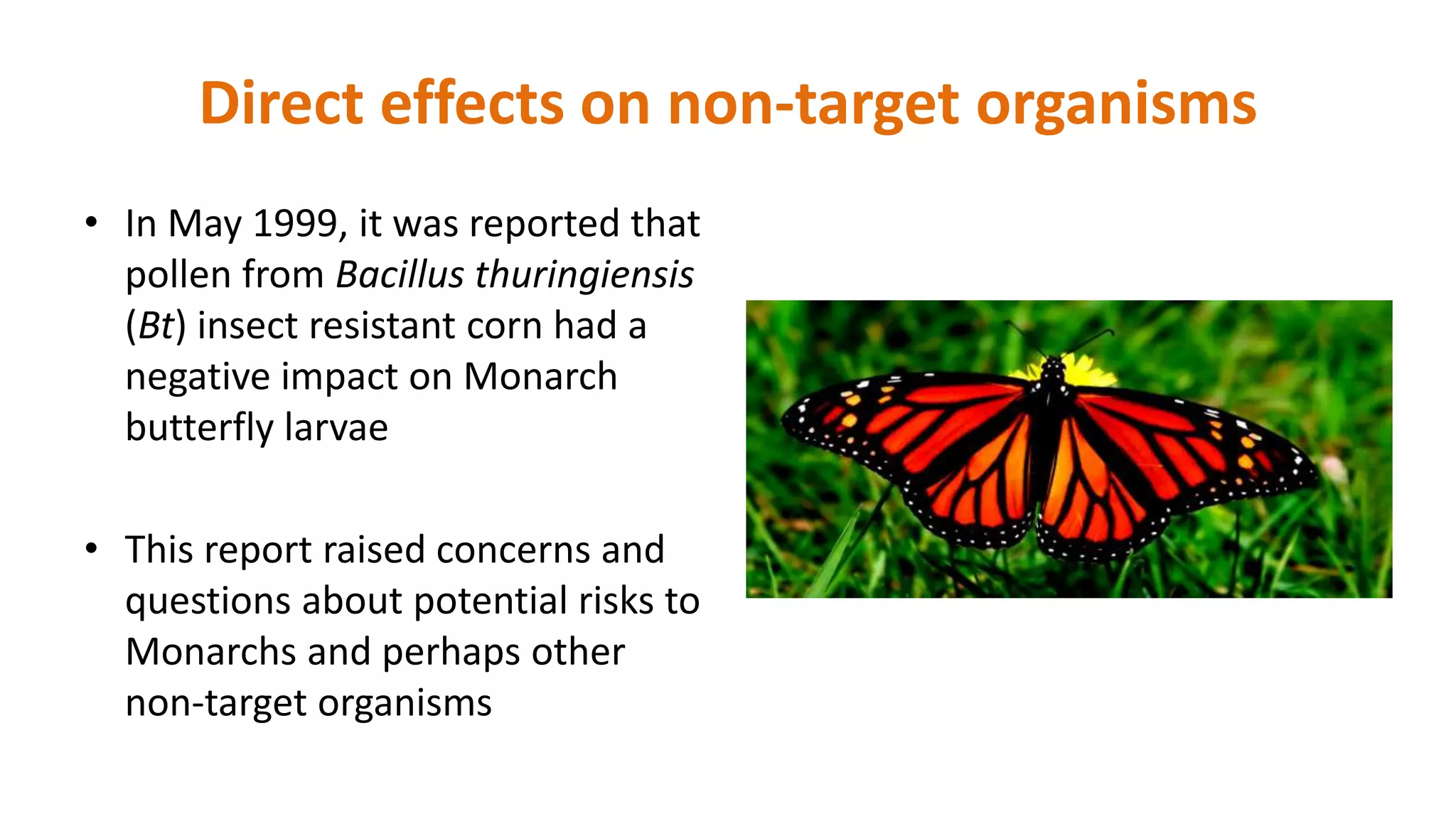
• In May 1999, it was reported that
pollen from Bacillus thuringiensis
(Bt) insect resistant corn had a
negative impact on Monarch
butterfly larvae
• This report raised concerns and
questions about potential risks to
Monarchs and perhaps other
non-target organisms
Development of insect resistance
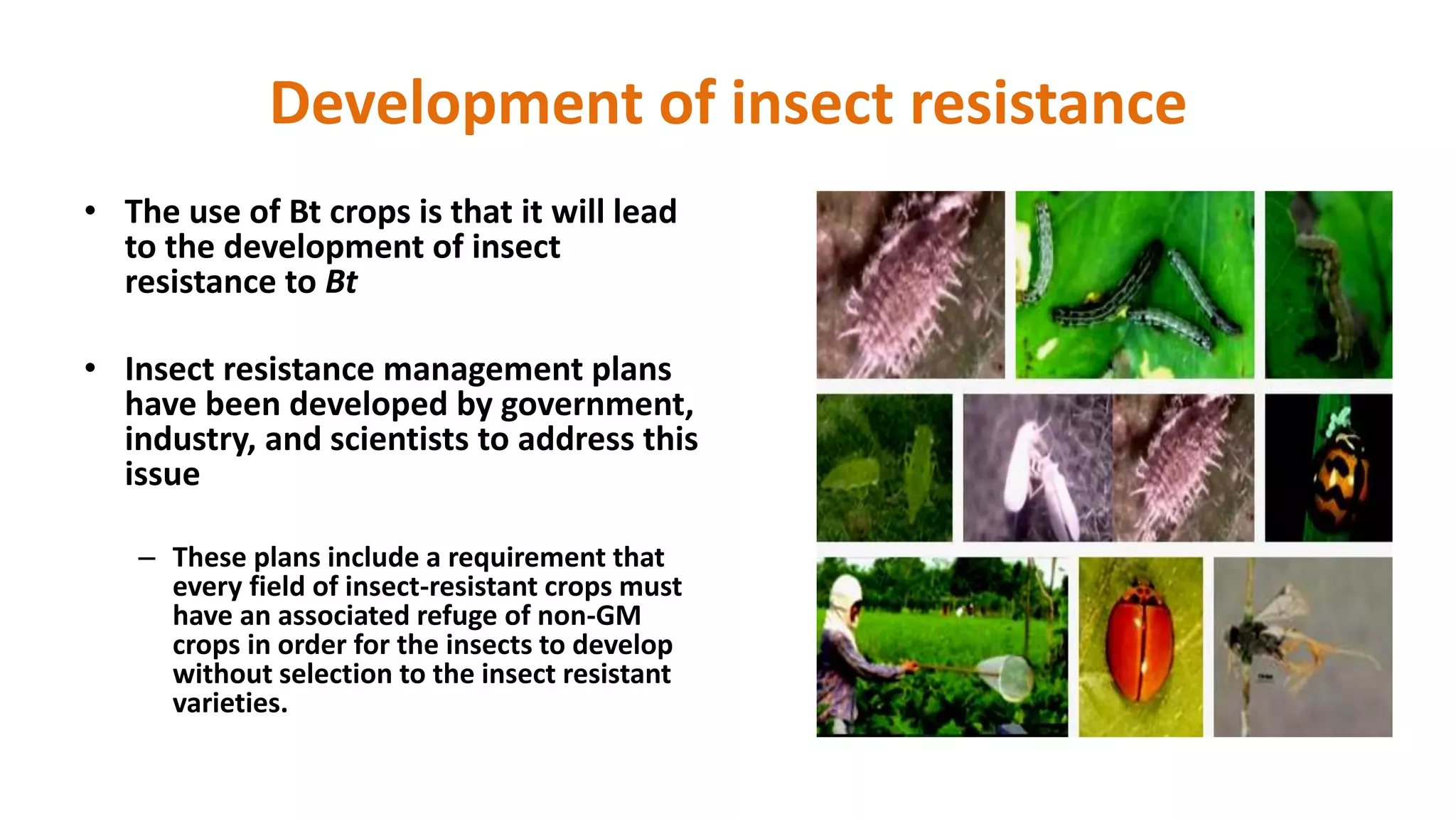
• The use of Bt crops is that it will lead
to the development of insect
resistance to Bt
• Insect resistance management plans
have been developed by government,
industry, and scientists to address this
issue
– These plans include a requirement that
every field of insect-resistant crops must
have an associated refuge of non-GM
crops in order for the insects to develop
without selection to the insect resistant
varieties.
Gene flow
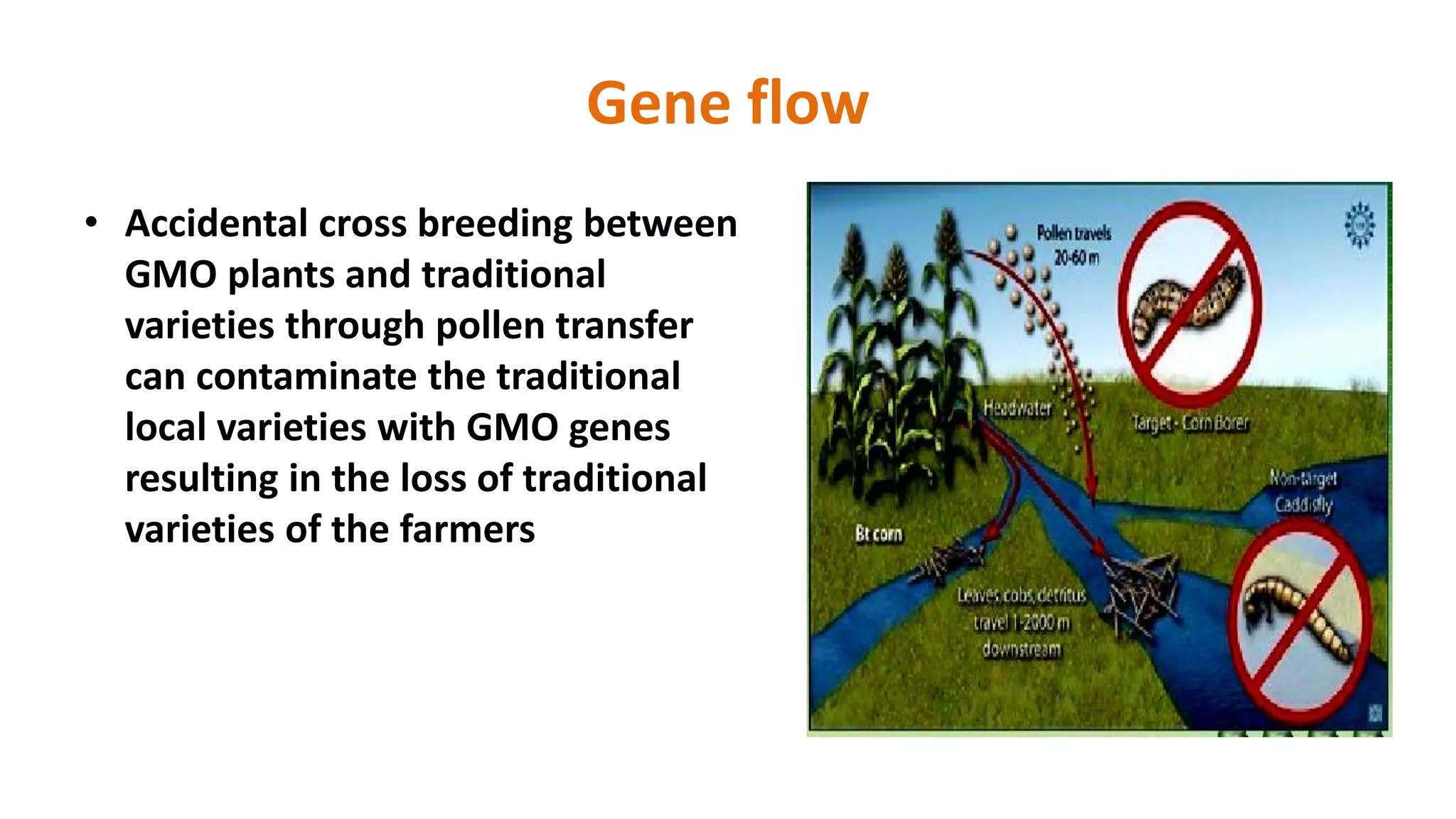
• Accidental cross breeding between
GMO plants and traditional
varieties through pollen transfer
can contaminate the traditional
local varieties with GMO genes
resulting in the loss of traditional
varieties of the farmers
Increased weediness
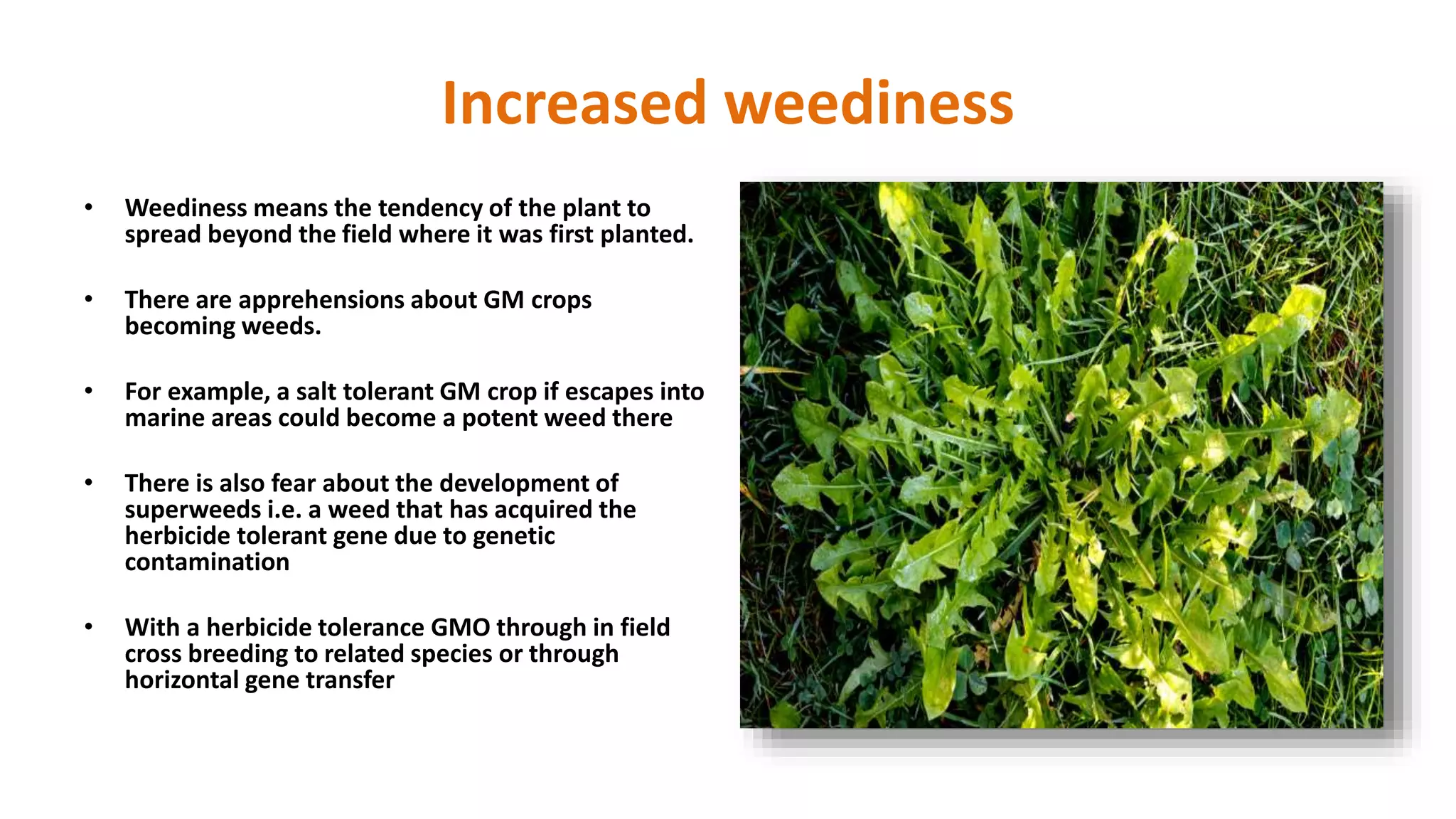
• Weediness means the tendency of the plant to
spread beyond the field where it was first planted.
• There are apprehensions about GM crops
becoming weeds.
• For example, a salt tolerant GM crop if escapes into
marine areas could become a potent weed there
• There is also fear about the development of
superweeds i.e. a weed that has acquired the
herbicide tolerant gene due to genetic
contamination
• With a herbicide tolerance GMO through in field
cross breeding to related species or through
horizontal gene transfer
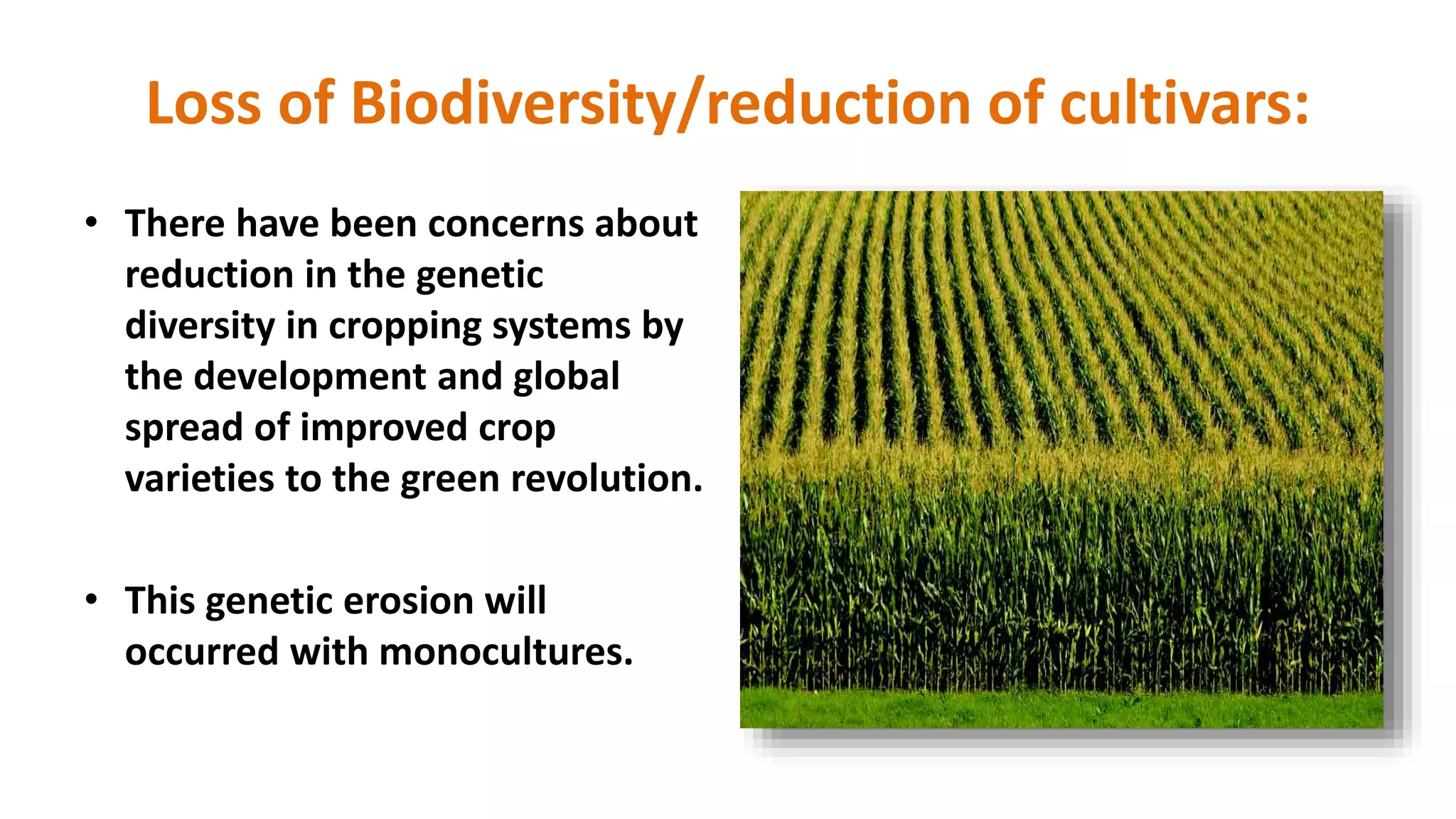
Loss of Biodiversity/reduction of cultivars:
• There have been concerns about
reduction in the genetic
diversity in cropping systems by
the development and global
spread of improved crop
varieties to the green revolution.
• This genetic erosion will
occurred with monocultures.
Changes in the soil ecology
• Many plants leak chemical compounds
into the soil through their roots
• There are concerns that transgenic plants
may leak different compounds than
conventional plants, As and unintended
sequence of their changed DNA
• The interaction between plants and solid
microorganisms is very complex, with the
microorganisms living around plant roots
also secreting chemical compounds into
the soil
Impossibility of Follow-up
• Once the GMOs have been introduced
into the environment and some
problems arise, it is impossible to
eliminate them.
• Many of these risks are identical to
those incurred with regards to the
introduction of naturally or
conventionally bred species.
• But still this does not suggest that
GMOs are safe or benefitial nor that
they should be less scrutinized
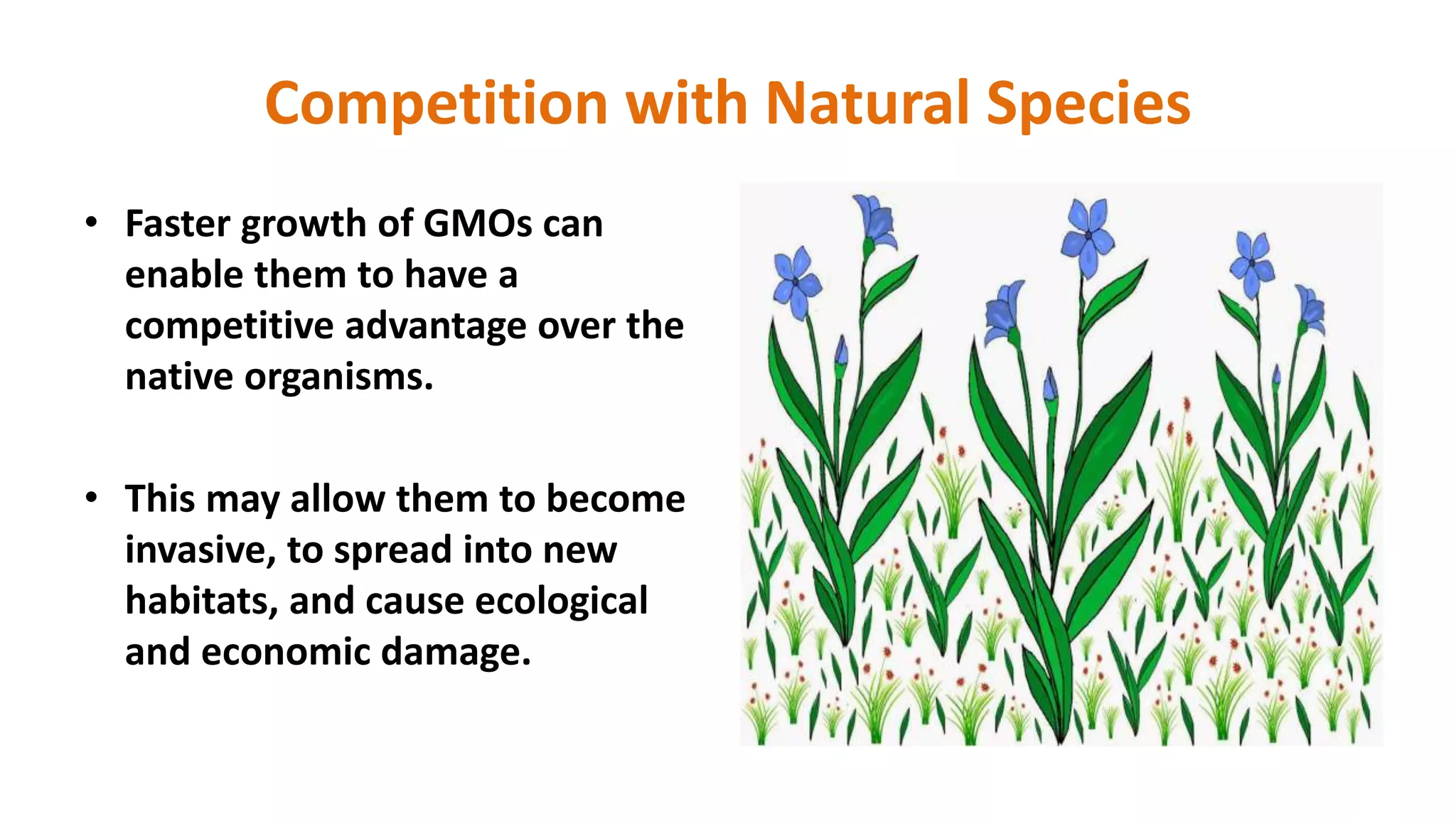
Competition with Natural Species
• Faster growth of GMOs can
enable them to have a
competitive advantage over the
native organisms.
• This may allow them to become
invasive, to spread into new
habitats, and cause ecological
and economic damage.
Increased Selection Pressure on Target and Non target
Organisms
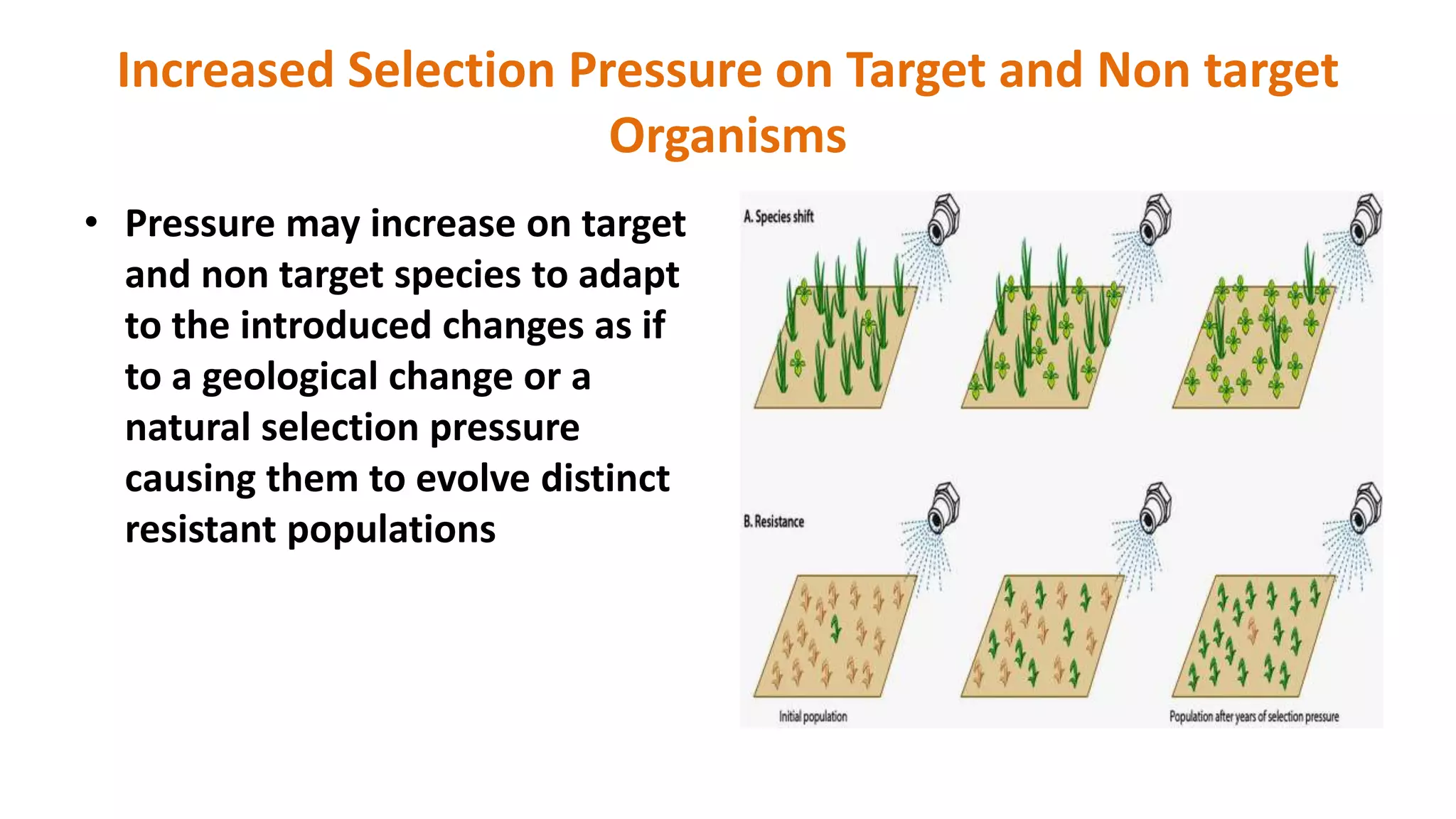
• Pressure may increase on target
and non target species to adapt
to the introduced changes as if
to a geological change or a
natural selection pressure
causing them to evolve distinct
resistant populations
Genetic Contamination/Interbreeding
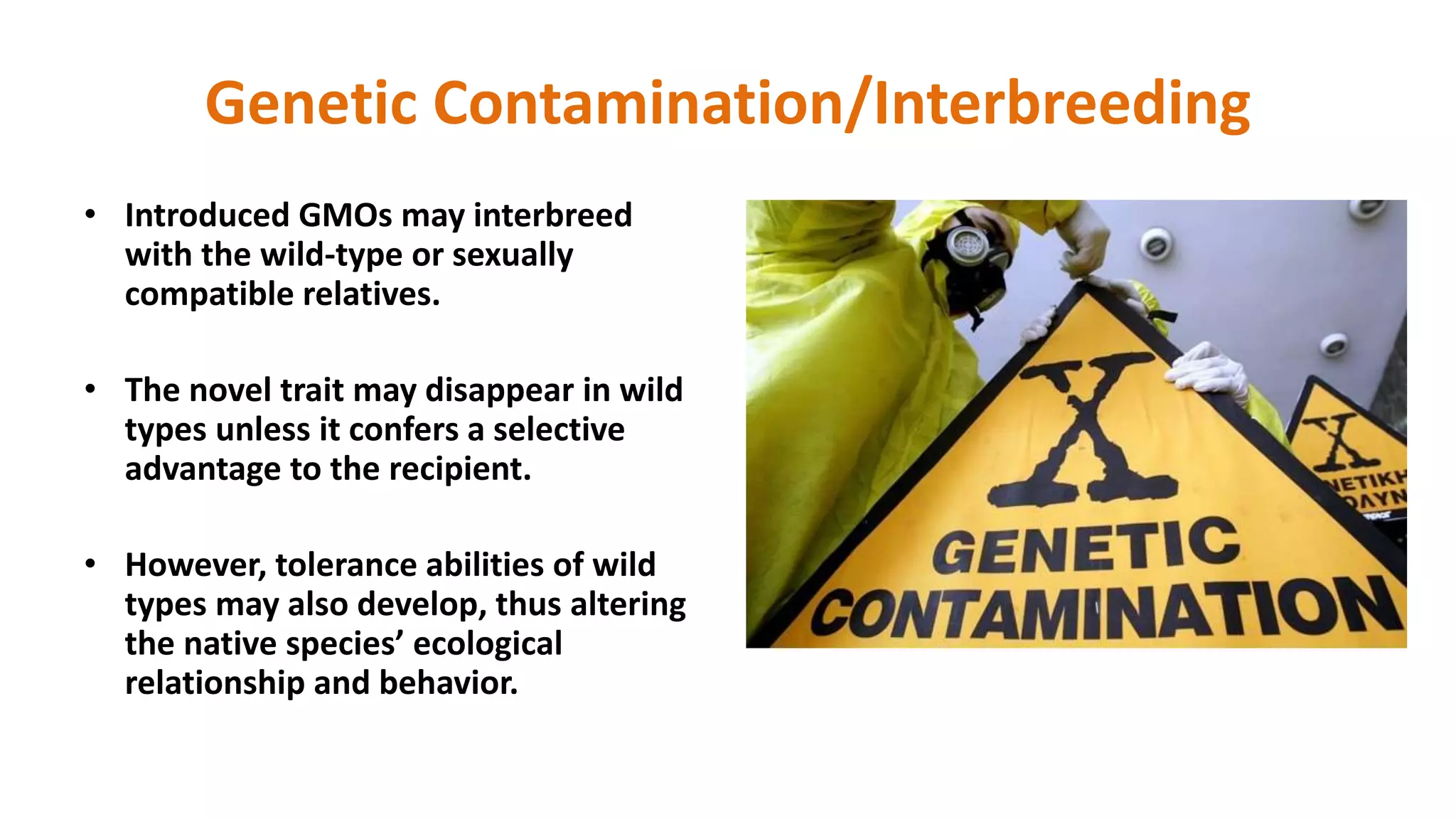
• Introduced GMOs may interbreed
with the wild-type or sexually
compatible relatives.
• The novel trait may disappear in wild
types unless it confers a selective
advantage to the recipient.
• However, tolerance abilities of wild
types may also develop, thus altering
the native species’ ecological
relationship and behavior.
FOOD BIOSAFETY TO ANIMAL HEALTH
Toxicity
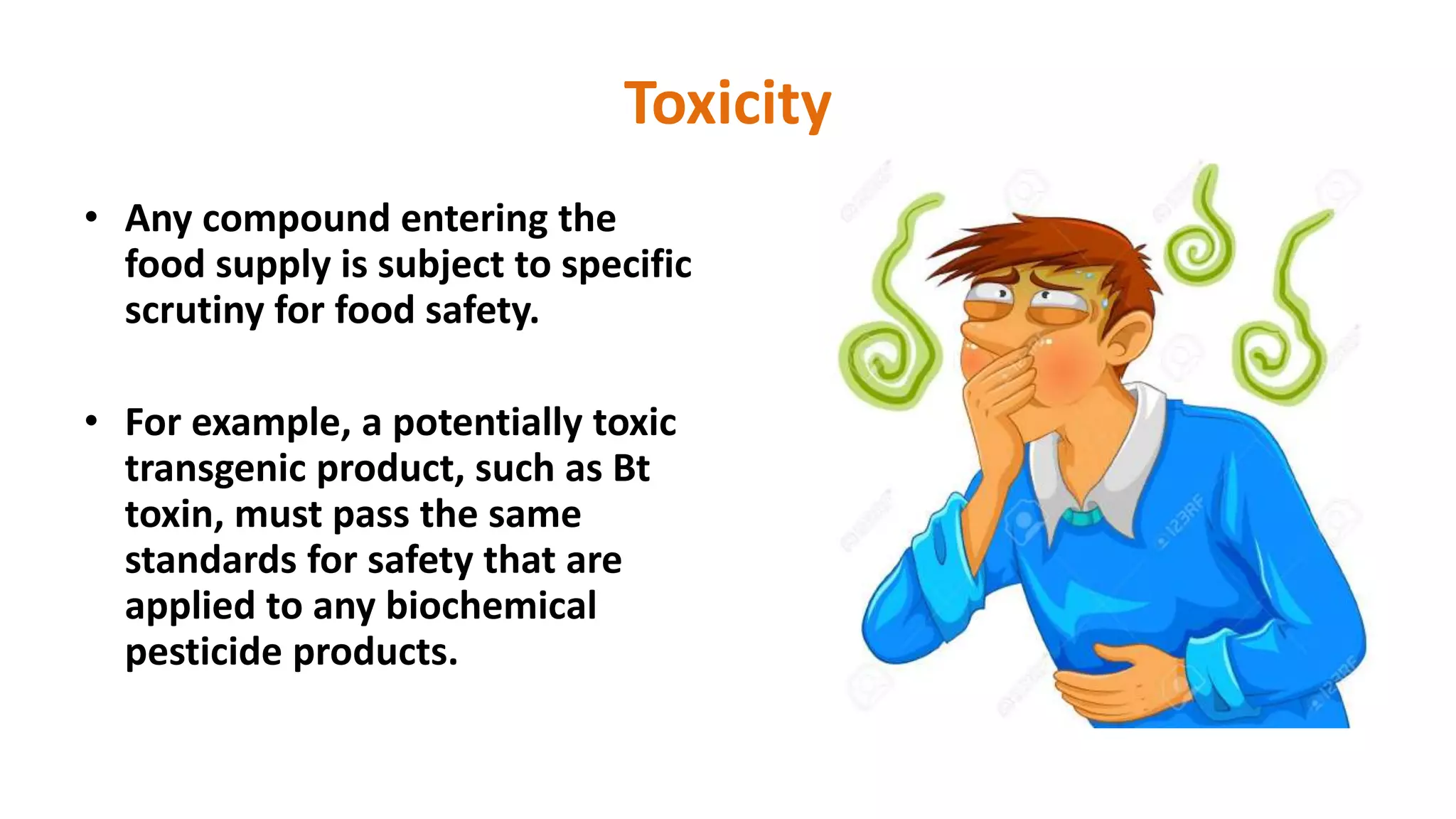
• Any compound entering the
food supply is subject to specific
scrutiny for food safety.
• For example, a potentially toxic
transgenic product, such as Bt
toxin, must pass the same
standards for safety that are
applied to any biochemical
pesticide products.
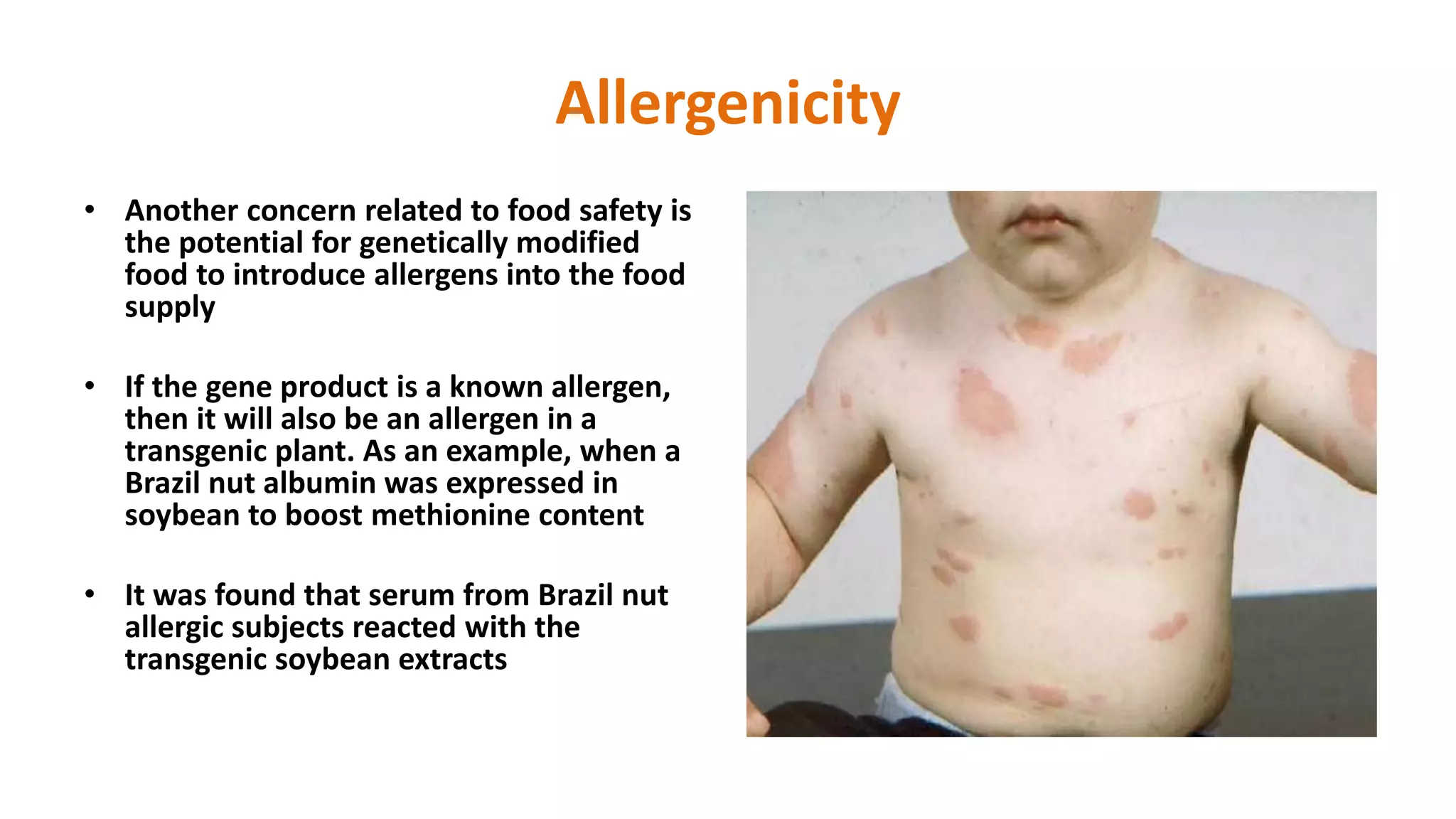
Allergenicity
• Another concern related to food safety is
the potential for genetically modified
food to introduce allergens into the food
supply
• If the gene product is a known allergen,
then it will also be an allergen in a
transgenic plant. As an example, when a
Brazil nut albumin was expressed in
soybean to boost methionine content
• It was found that serum from Brazil nut
allergic subjects reacted with the
transgenic soybean extracts
RISK MANAGEMENT
Pest population exposed to Bt crops continuously for several years may develop
resistance to the Bt toxins through natural selection mutation, and selection
– To prevent resistance build up it is recommended to plant sufficient non Bt cotton
(20%) to serve as a refuge for Bt susceptibility in seeds
– The refuge strategy is designed to ensure that Bt susceptible insects will be available
to mate with Bt resistant insects, should they arise.
– Available genetic data indicates that susceptibility is dominant over resistance.
– Therefore, the offspring of these mating would most likely be Bt susceptible, thus
mitigating the spread of resistance in the populations
Registration of transgenic agricultural organisms
Biosafety Framework Government Commitment
• The Genetically Modified Organisms (GMOs) and products thereof are regulated
articles in India in view of potential risks to human health and environment by
indiscriminate use under “Rules for Manufacture, Use, Import, Export and
Storage of Hazardous Microorganisms/Genetically engineered organisms or cells,
1989 under the EPA (1986)”.
• India has ratified the Biosafety Protocol in January 2003
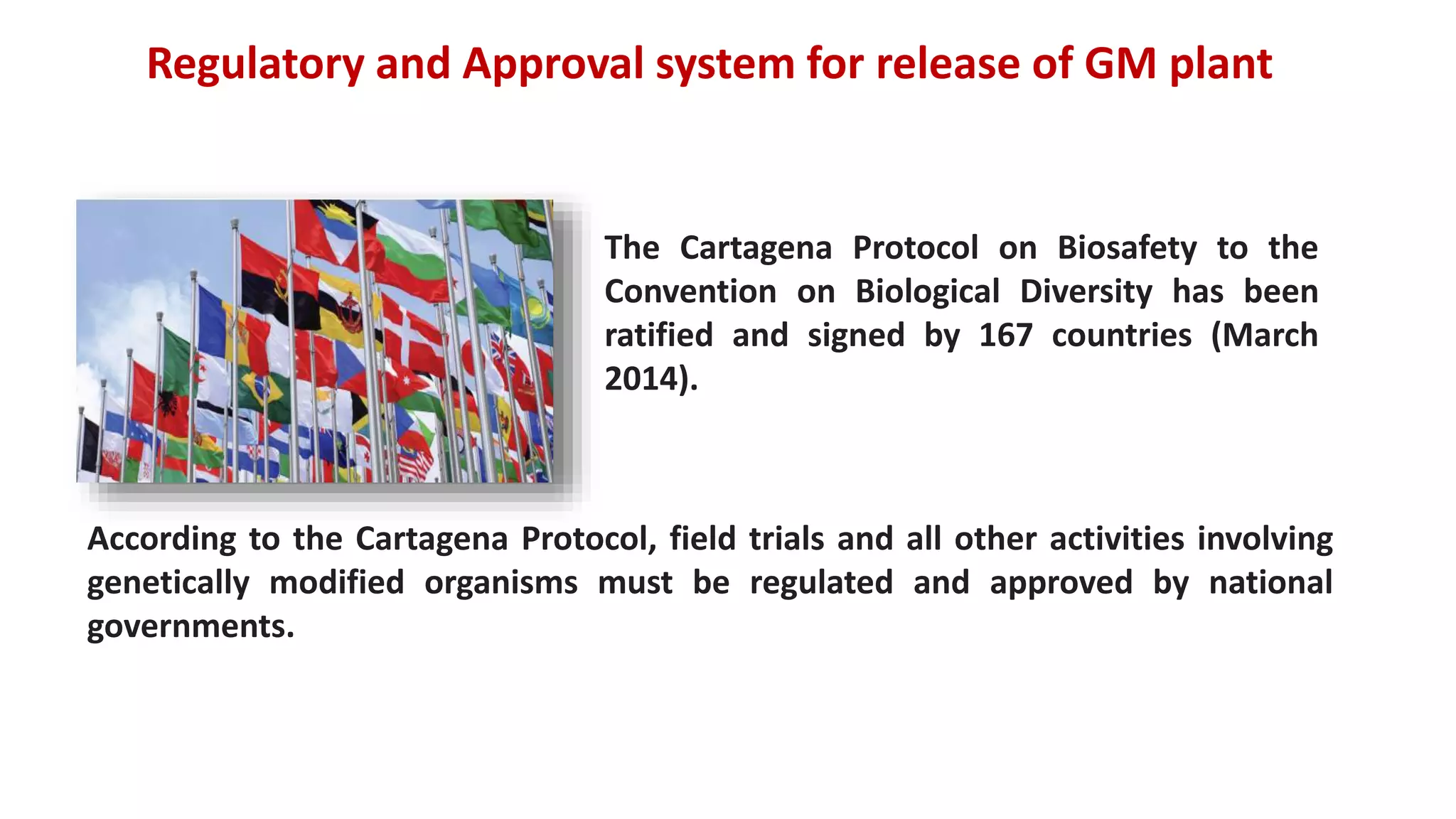
The Cartagena Protocol on Biosafety to the
Convention on Biological Diversity has been
ratified and signed by 167 countries (March
2014).
Regulatory and Approval system for release of GM plant
According to the Cartagena Protocol, field trials and all other activities involving
genetically modified organisms must be regulated and approved by national
governments.
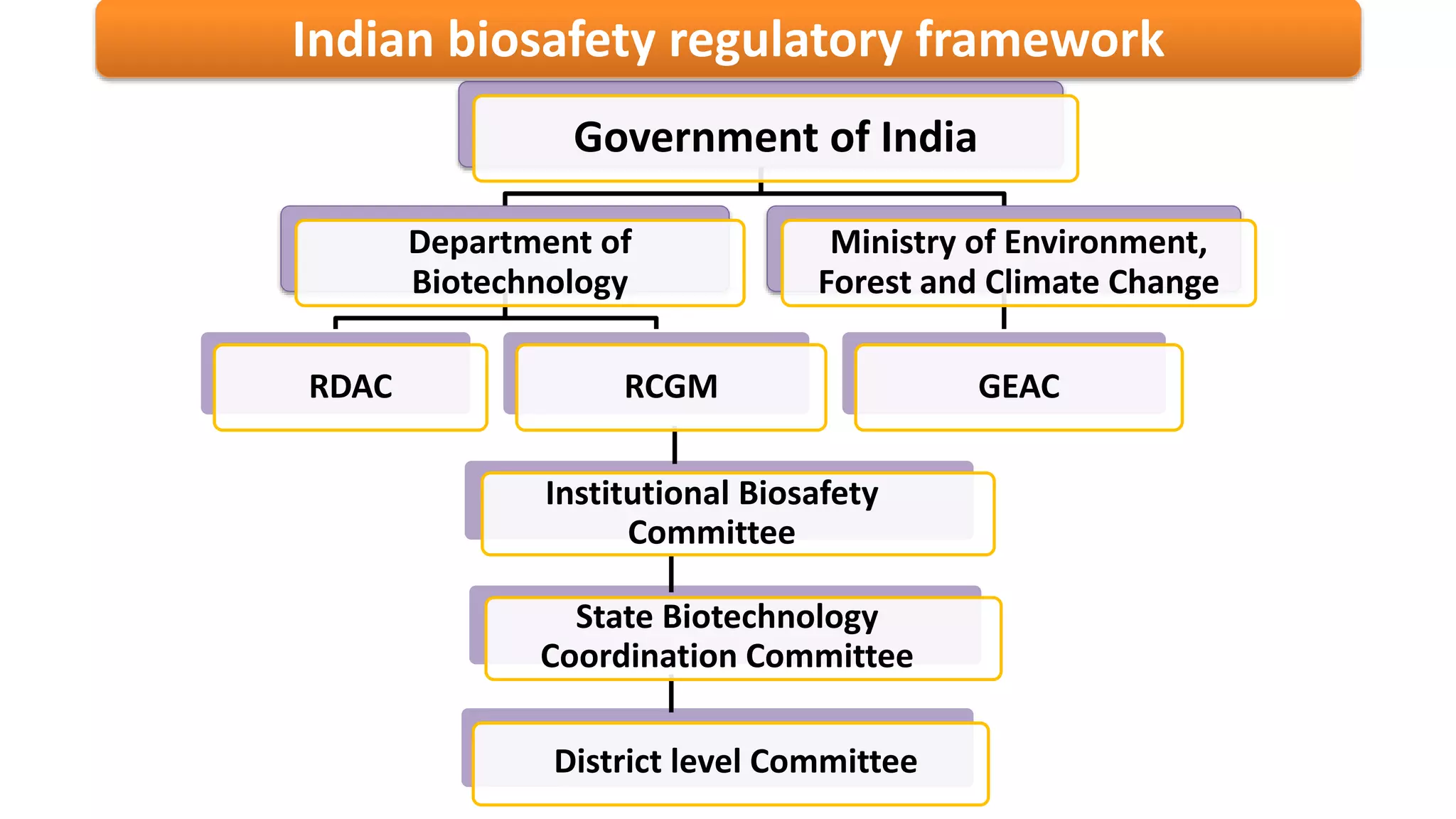
Government of India
Department of
Biotechnology
RDAC RCGM
Ministry of Environment,
Forest and Climate Change
GEAC
Institutional Biosafety
Committee
State Biotechnology
Coordination Committee
District level Committee
Indian biosafety regulatory framework
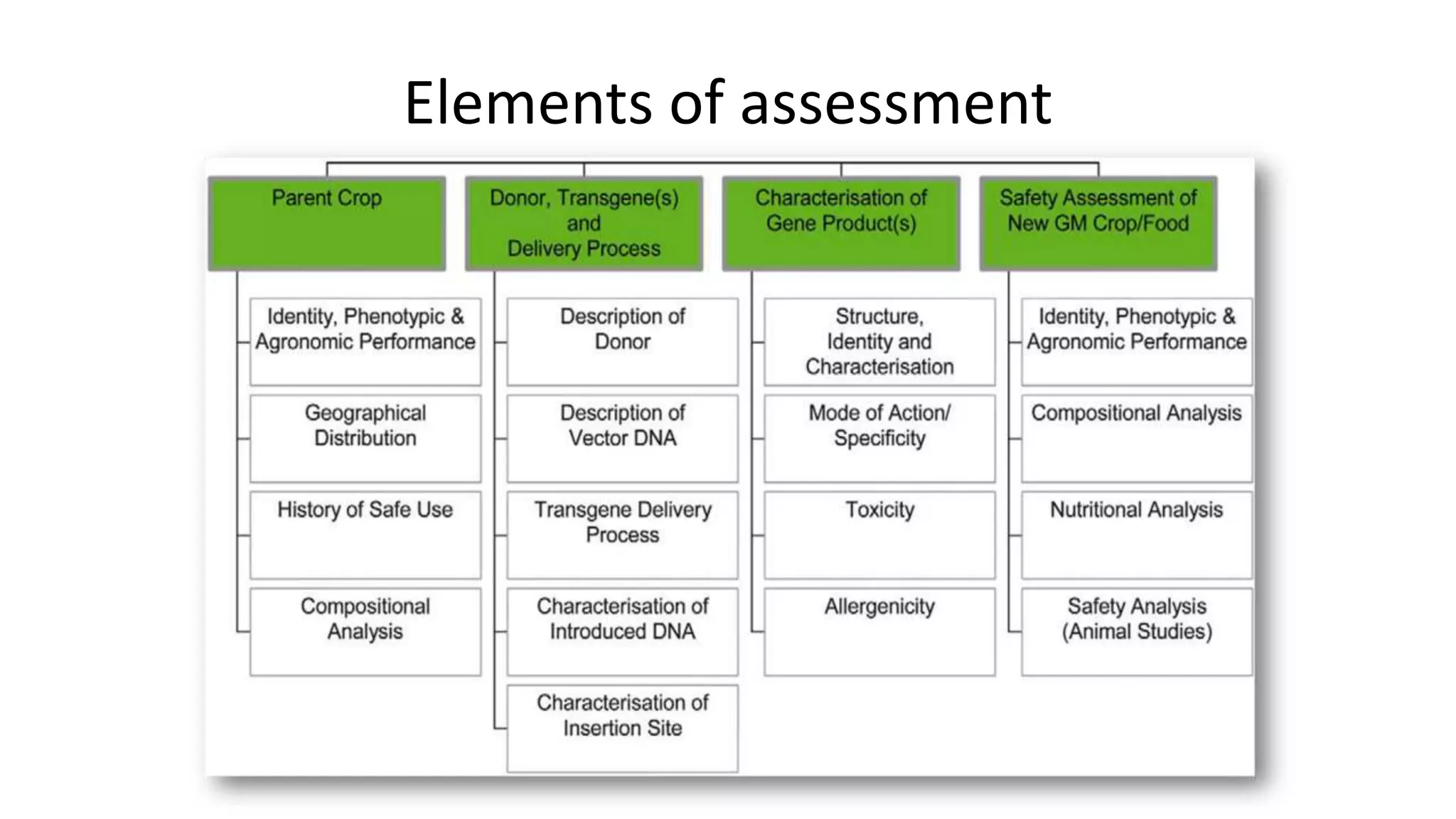
Elements of assessment
24
23
4
5
6
789
10
11
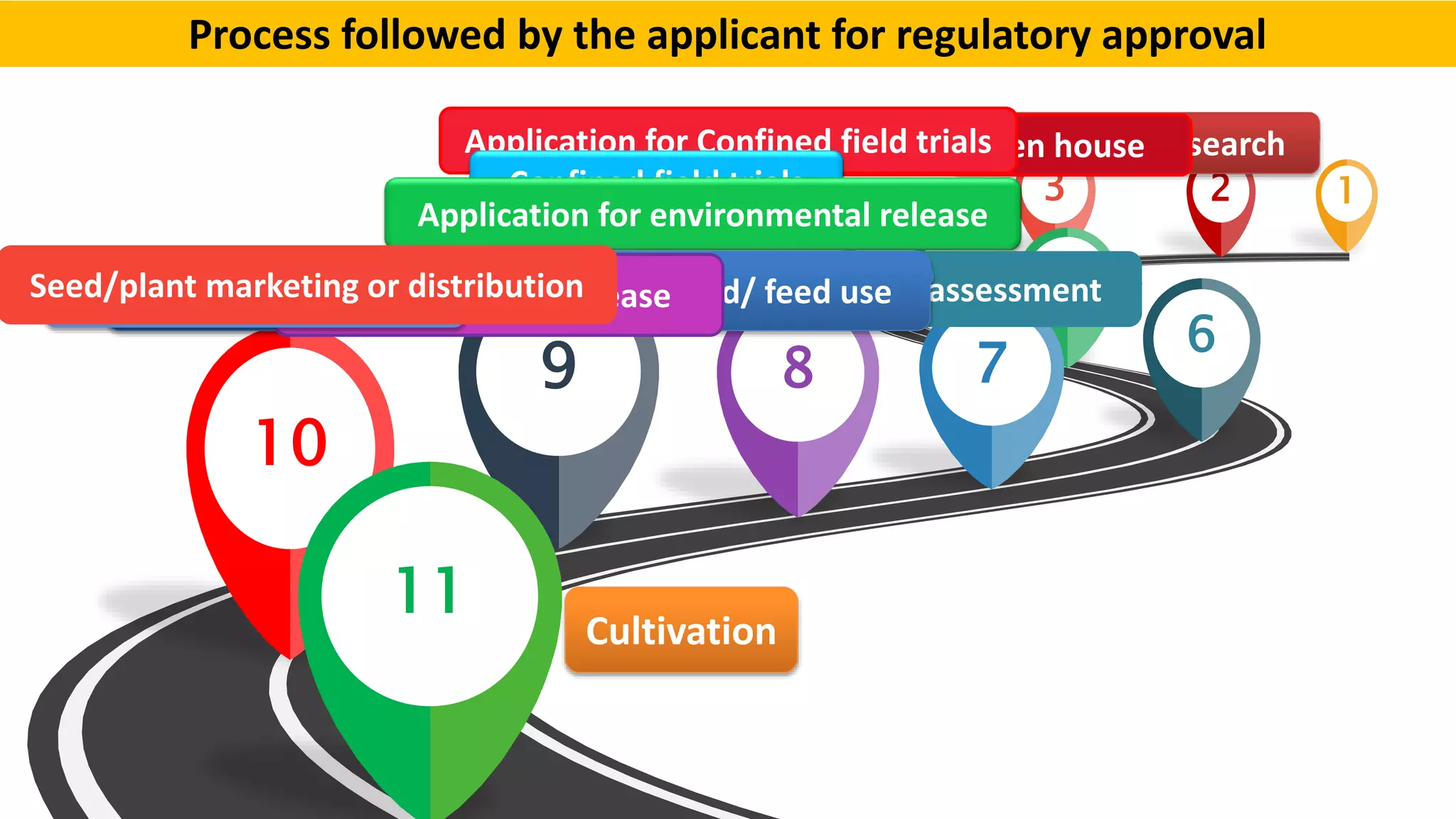
1
Laboratory researchGrowth chamber and green houseApplication for Confined field trials
Confined field trials
Application for environmental release
Application for food safety assessmentEvent approval for cultivation and food/ feed useVariety/ hybrid releaseSeed/plant multiplicationSeed/plant marketing or distribution
Cultivation
Process followed by the applicant for regulatory approval
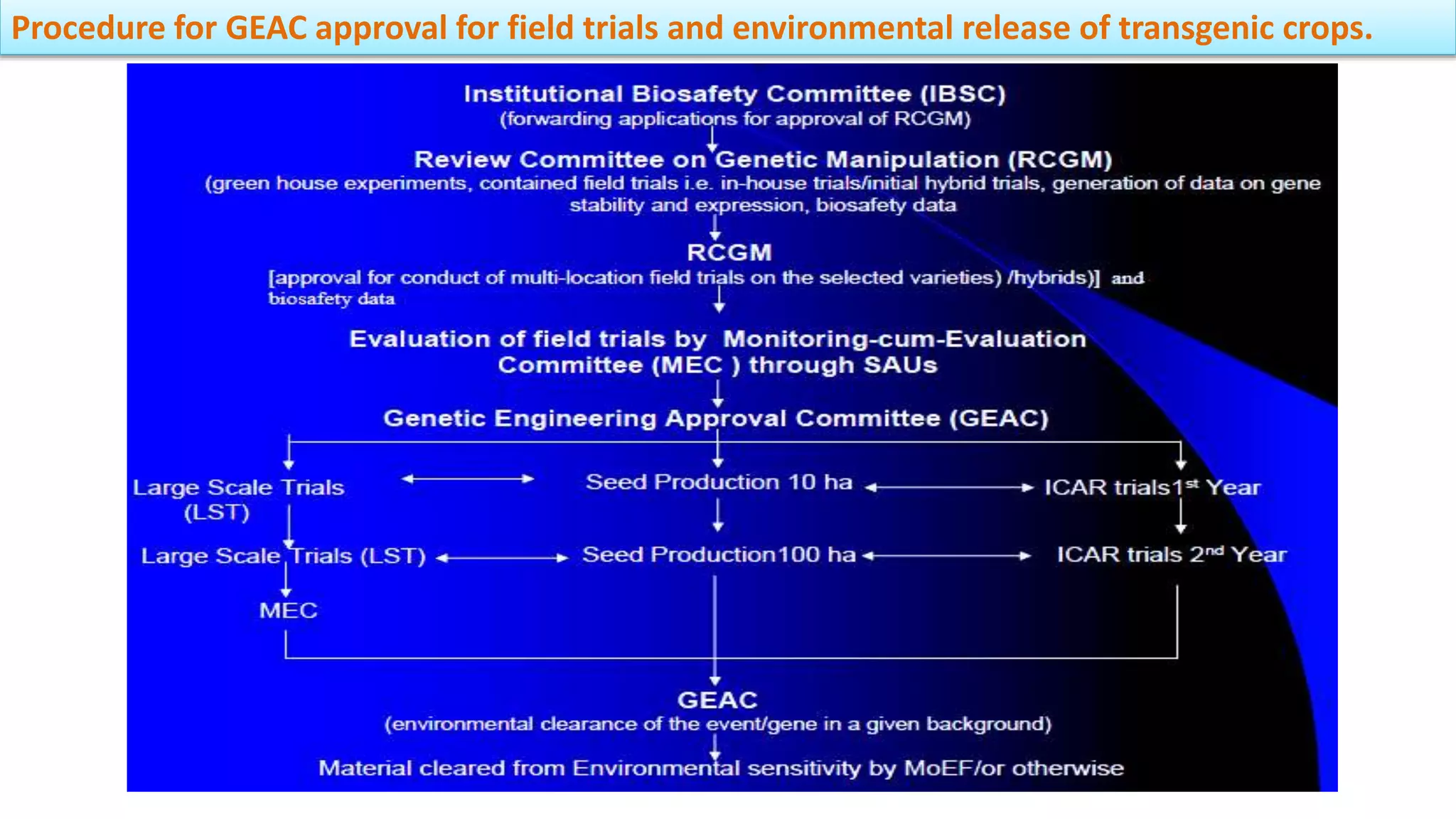
Procedure for GEAC approval for field trials and environmental release of transgenic crops.
Thank you

Biosaftey issues related to gm crops and transgenic variety release

  • 1.
    Issues Related to Biosafetyand registration of transgenic agricultural organisms PP 603: Molecular Approaches for Improving Physiological Traits Presented By Ekatpure Sachin Dept. of Plant Biotechnology Biosafety Guidelines
  • 2.
    Biosafety Protecting human &animal health and environment from the possible adverse effects of the products of modern biotechnology
  • 3.
    BIOSAFETY CONCERNS • ENVIRONMENTALSAFETY • FOOD SAFETY TO HUMAN AND ANIMAL HEALTH • RISK MANAGEMENT
  • 4.
  • 5.
    Direct effects onnon-target organisms • In May 1999, it was reported that pollen from Bacillus thuringiensis (Bt) insect resistant corn had a negative impact on Monarch butterfly larvae • This report raised concerns and questions about potential risks to Monarchs and perhaps other non-target organisms
  • 6.
    Development of insectresistance • The use of Bt crops is that it will lead to the development of insect resistance to Bt • Insect resistance management plans have been developed by government, industry, and scientists to address this issue – These plans include a requirement that every field of insect-resistant crops must have an associated refuge of non-GM crops in order for the insects to develop without selection to the insect resistant varieties.
  • 7.
    Gene flow • Accidentalcross breeding between GMO plants and traditional varieties through pollen transfer can contaminate the traditional local varieties with GMO genes resulting in the loss of traditional varieties of the farmers
  • 8.
    Increased weediness • Weedinessmeans the tendency of the plant to spread beyond the field where it was first planted. • There are apprehensions about GM crops becoming weeds. • For example, a salt tolerant GM crop if escapes into marine areas could become a potent weed there • There is also fear about the development of superweeds i.e. a weed that has acquired the herbicide tolerant gene due to genetic contamination • With a herbicide tolerance GMO through in field cross breeding to related species or through horizontal gene transfer
  • 9.
    Loss of Biodiversity/reductionof cultivars: • There have been concerns about reduction in the genetic diversity in cropping systems by the development and global spread of improved crop varieties to the green revolution. • This genetic erosion will occurred with monocultures.
  • 10.
    Changes in thesoil ecology • Many plants leak chemical compounds into the soil through their roots • There are concerns that transgenic plants may leak different compounds than conventional plants, As and unintended sequence of their changed DNA • The interaction between plants and solid microorganisms is very complex, with the microorganisms living around plant roots also secreting chemical compounds into the soil
  • 11.
    Impossibility of Follow-up •Once the GMOs have been introduced into the environment and some problems arise, it is impossible to eliminate them. • Many of these risks are identical to those incurred with regards to the introduction of naturally or conventionally bred species. • But still this does not suggest that GMOs are safe or benefitial nor that they should be less scrutinized
  • 12.
    Competition with NaturalSpecies • Faster growth of GMOs can enable them to have a competitive advantage over the native organisms. • This may allow them to become invasive, to spread into new habitats, and cause ecological and economic damage.
  • 13.
    Increased Selection Pressureon Target and Non target Organisms • Pressure may increase on target and non target species to adapt to the introduced changes as if to a geological change or a natural selection pressure causing them to evolve distinct resistant populations
  • 14.
    Genetic Contamination/Interbreeding • IntroducedGMOs may interbreed with the wild-type or sexually compatible relatives. • The novel trait may disappear in wild types unless it confers a selective advantage to the recipient. • However, tolerance abilities of wild types may also develop, thus altering the native species’ ecological relationship and behavior.
  • 15.
    FOOD BIOSAFETY TOANIMAL HEALTH
  • 16.
    Toxicity • Any compoundentering the food supply is subject to specific scrutiny for food safety. • For example, a potentially toxic transgenic product, such as Bt toxin, must pass the same standards for safety that are applied to any biochemical pesticide products.
  • 17.
    Allergenicity • Another concernrelated to food safety is the potential for genetically modified food to introduce allergens into the food supply • If the gene product is a known allergen, then it will also be an allergen in a transgenic plant. As an example, when a Brazil nut albumin was expressed in soybean to boost methionine content • It was found that serum from Brazil nut allergic subjects reacted with the transgenic soybean extracts
  • 18.
    RISK MANAGEMENT Pest populationexposed to Bt crops continuously for several years may develop resistance to the Bt toxins through natural selection mutation, and selection – To prevent resistance build up it is recommended to plant sufficient non Bt cotton (20%) to serve as a refuge for Bt susceptibility in seeds – The refuge strategy is designed to ensure that Bt susceptible insects will be available to mate with Bt resistant insects, should they arise. – Available genetic data indicates that susceptibility is dominant over resistance. – Therefore, the offspring of these mating would most likely be Bt susceptible, thus mitigating the spread of resistance in the populations
  • 19.
    Registration of transgenicagricultural organisms
  • 20.
    Biosafety Framework GovernmentCommitment • The Genetically Modified Organisms (GMOs) and products thereof are regulated articles in India in view of potential risks to human health and environment by indiscriminate use under “Rules for Manufacture, Use, Import, Export and Storage of Hazardous Microorganisms/Genetically engineered organisms or cells, 1989 under the EPA (1986)”. • India has ratified the Biosafety Protocol in January 2003
  • 21.
    The Cartagena Protocolon Biosafety to the Convention on Biological Diversity has been ratified and signed by 167 countries (March 2014). Regulatory and Approval system for release of GM plant According to the Cartagena Protocol, field trials and all other activities involving genetically modified organisms must be regulated and approved by national governments.
  • 22.
    Government of India Departmentof Biotechnology RDAC RCGM Ministry of Environment, Forest and Climate Change GEAC Institutional Biosafety Committee State Biotechnology Coordination Committee District level Committee Indian biosafety regulatory framework
  • 23.
  • 24.
    24 23 4 5 6 789 10 11 1 Laboratory researchGrowth chamberand green houseApplication for Confined field trials Confined field trials Application for environmental release Application for food safety assessmentEvent approval for cultivation and food/ feed useVariety/ hybrid releaseSeed/plant multiplicationSeed/plant marketing or distribution Cultivation Process followed by the applicant for regulatory approval
  • 25.
    Procedure for GEACapproval for field trials and environmental release of transgenic crops.
  • 26.