GENOME GENETICS 
Seminar on 
13th Nov 2014 
SYNTHETIC GENOMES 
Presented by: 
Nethravathi R 
GN113011
• The world is facing increasingly difficult challenges today. 
• Population growth resulting in the growing demand for critical 
resources such as energy, clean water, food and medicine are 
taxing our fragile planet. 
• To fulfill these needs we need to exploit technologies. 
Can we use the genomic advances to offer 
the world viable, sustainable alternatives?
SYNTHETIC BIOLOGY 
Hot field in life science area that involves the study of 
designing and construction of new biological 
entities such as enzymes, genetic circuits, and cells or whole 
biological systems, and the re-design of existing, natural 
biological systems for useful purposes 
SYNTHETIC GENOMICS 
Study of Invitro chemical synthesis of genetic material i.e., 
DNA in the form of oligonucleotides, genes, or genomes with 
Computational techniques for its design. 
SYNTHETIC GENOME 
Artificially synthesised genome (invitro)
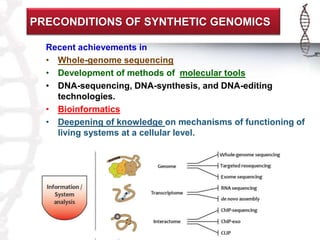
PRECONDITIONS OF SYNTHETIC GENOMICS 
Recent achievements in 
• Whole-genome sequencing 
• Development of methods of molecular tools 
• DNA-sequencing, DNA-synthesis, and DNA-editing 
technologies. 
• Bioinformatics 
• Deepening of knowledge on mechanisms of functioning of 
living systems at a cellular level.
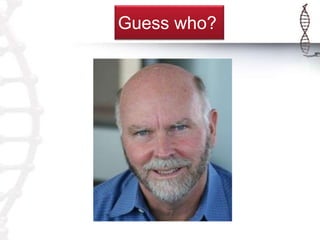
Guess who?
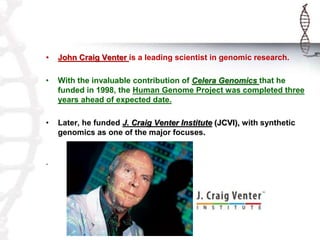
• John Craig Venter is a leading scientist in genomic research. 
• With the invaluable contribution of Celera Genomics that he 
funded in 1998, the Human Genome Project was completed three 
years ahead of expected date. 
• Later, he funded J. Craig Venter Institute (JCVI), with synthetic 
genomics as one of the major focuses. 
`
• After 15 years of investigation and ~$40 million of investment, 
JCVI walked out this significant step for synthetic biology. 
• The synthetic genome started with design of DNA sequence, 
which highly depends on the accurate sequence of 
Mycoplasma mycoides genome. 
• Venter group spent numerous efforts on comparing different 
sequencing results, making necessary corrections, and setting 
watermark sequences to differentiate synthetic and natural 
genomes.
In recent decades....(1) 
• The rapid development of molecular biology, genetics and 
the related biotechnology and bioengineering kept bringing 
surprises to scientists worldwide... 
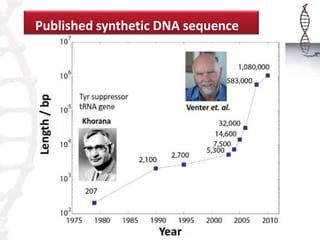
• In 1990, Mandecki et al. assembled a plasmid of 2.1 kbp using 
30 chemically synthesized oligonucleotides and the method of 
serial cloning 
• In 1995, Stemmer et al. synthesized a DNA fragment of 1100 
bp containing the TEM-1 gene of ß-lactamase using 56 
oligonucleotides and the plasmid of 2700 nucleotidesusing 
136 oligonucleotides 
• Including the cloning of Dolly (Wilmut et al., 1997) (followed 
by cloning of a variety of animals)
In recent decades....(2) 
• The completion of Human Genome Project (Cheung et al., 2001; 
Lander et al., 2001; Venter et al., 2001) (followed by the reports of 
complete genome from other species and by the spread of 
personalized genome sequencing service) 
• In 2002, Cello et al reported about the first synthesis of full-sized 
cDNA of the poliovirus genome (about 7500 bp). 
• The induction of pluripotent stem cells (Takahashi and 
Yamanaka, 2006) (followed by the production of viable iPS mice 
(Zhao et al., 2009). 
• In 2007, Kodumal et al. obtained the largest synthetic DNA of 
32,000 nucleotides containing a cluster of genes encoding the E. 
Coli megaenzyme polyketide synthase.
In recent decades....(3) 
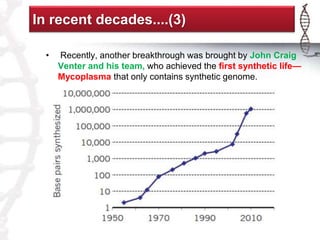
• Recently, another breakthrough was brought by John Craig 
Venter and his team, who achieved the first synthetic life— 
Mycoplasma that only contains synthetic genome.
Published synthetic DNA sequence
In 2002 Cello et al. 
First synthesis of full-sized cDNA of the 
poliovirus genome (about 7500 bp) 
steps:...(1) 
1. Chemical synthesis and purification of oligonucleotides of 
“positive” and “negative” polarity (in accordance with 
direction from 5'- to 3'-ends and vice versa) 
2. Assembly of DNA segments of 400 – 600 bp due to 
overlapping complementary oligonucleotide sites follow by 
subsequent ligation or use of PCA assembly of three 
genome fragments of 2000 – 3000 bp from these segments 
using the cloning methods and subsequent assembly of the 
whole genome from these fragments. 
Appearance of polymerase cycling assembly (PCA) was the next 
step of improvement of gene assembly; PCA was initially used for 
synthesis of HIV-2 Rev gene of 303 bp in length. The development 
of methodological base resulted in overcoming of a psychological 
barrier of 1 kbp.
In 2002 Cello et al. 
First synthesis of full-sized cDNA of 
the poliovirus genome (about 7500 bp) 
3. The synthetic cDNA Was transcribed into viral RNA by 
means of phage T7 RNA polymerase. 
4. In cell free extracts this RNA induced synthesis of viral 
particles. 
5. The resultant de novo viruses exhibited Infectivity and 
biochemical and pathogenic characteristics typical for 
poliovirus 
steps:..(2)
second full-sized genome of X174 
phage (5386 bp) synthesized 
• For the synthesis of the full-sized genomic DNA, they used only 
ligation and PCA. 
• The whole synthesis took about 2 weeks. 
1. All 259 chemically synthesized oligonucleotides (42 nucleoitide 
each) purified by means of gel-electrophoresis 
2. Covered sequences of both DNA strands were mixed in 
equimolar quantities and ligated. 
3. The resultant fragments of various length (ligation did not yield full-sized 
DNA due to the presence of some quantities of defect oligonucleotides and lack of 100% 
effectiveness of oligomer assembly into DNA duplexes) were added up to the 
“genome-sized” by means of PCA and amplified. 
Smith et al. 
steps:..(1)
second full-sized genome of X174 
phage (5386 bp) synthesized 
Smith et al. 
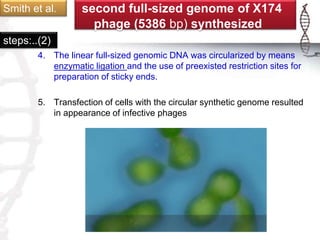
4. The linear full-sized genomic DNA was circularized by means 
enzymatic ligation and the use of preexisted restriction sites for 
preparation of sticky ends. 
5. Transfection of cells with the circular synthetic genome resulted 
in appearance of infective phages 
steps:..(2)
POTENTIAL POSITIVE APPLICATIONS 
Scientists foresee many including 
•new pharmaceuticals 
•biologically produced ("green") fuels 
•the possibility of rapidly generating vaccines 
against emerging microbial diseases 
•biofactory 
There is the potential for misuse and accidents!
CONCLUSION 
The ultimate goal of synthetic biology is to build novel 
biological systems that have new functions or to engineer 
existing biological systems to have better efficiency. 
With the many challenges to the understanding of natural 
biological systems, the rapid progress of emerging tools for 
synthetic biology has begun to provide genomes for 
applications in the areas of energy, health care, biochemicals, 
and the environment.
REFERENCES 
• http://syntheticbiology.org/ 
• http://www.synberc.org/ 
• www.syntheticgenomics.com 
• www.livescience.com/6486-live-organism-synthetic-genome-created. 
html 
• www.intecopen.com 
• Cheng et al, Syntheticbiology. Reviews in advance 
biomed.eng.2012,,14:155-178 
• Radko et al, The synthesis of artificial genome as the basis of 
synthetic biology , Biochemistry Masco supplement series DOI 
10.1134/s1990750807040014 
• Konig et al, Synthetic biology and Synthetic genomics 
applications between hopes and concerns , 
Currentgenomics,2013,14,11-24 
• Daniel et al, Synthesising a minimal genome , Journal Science, 
vol286,issue5447,2087-2090 (10 December 1999) 
• Monya Baker(2011), The next step for synthetic genome, Journal 
Nature | vol 473 | 403-408
QUESTIONNAIRE
Synthetic Genome

Synthetic Genome

  • 1.
    GENOME GENETICS Seminaron 13th Nov 2014 SYNTHETIC GENOMES Presented by: Nethravathi R GN113011
  • 2.
    • The worldis facing increasingly difficult challenges today. • Population growth resulting in the growing demand for critical resources such as energy, clean water, food and medicine are taxing our fragile planet. • To fulfill these needs we need to exploit technologies. Can we use the genomic advances to offer the world viable, sustainable alternatives?
  • 3.
    SYNTHETIC BIOLOGY Hotfield in life science area that involves the study of designing and construction of new biological entities such as enzymes, genetic circuits, and cells or whole biological systems, and the re-design of existing, natural biological systems for useful purposes SYNTHETIC GENOMICS Study of Invitro chemical synthesis of genetic material i.e., DNA in the form of oligonucleotides, genes, or genomes with Computational techniques for its design. SYNTHETIC GENOME Artificially synthesised genome (invitro)
  • 4.
    PRECONDITIONS OF SYNTHETICGENOMICS Recent achievements in • Whole-genome sequencing • Development of methods of molecular tools • DNA-sequencing, DNA-synthesis, and DNA-editing technologies. • Bioinformatics • Deepening of knowledge on mechanisms of functioning of living systems at a cellular level.
  • 5.
  • 6.
    • John CraigVenter is a leading scientist in genomic research. • With the invaluable contribution of Celera Genomics that he funded in 1998, the Human Genome Project was completed three years ahead of expected date. • Later, he funded J. Craig Venter Institute (JCVI), with synthetic genomics as one of the major focuses. `
  • 7.
    • After 15years of investigation and ~$40 million of investment, JCVI walked out this significant step for synthetic biology. • The synthetic genome started with design of DNA sequence, which highly depends on the accurate sequence of Mycoplasma mycoides genome. • Venter group spent numerous efforts on comparing different sequencing results, making necessary corrections, and setting watermark sequences to differentiate synthetic and natural genomes.
  • 8.
    In recent decades....(1) • The rapid development of molecular biology, genetics and the related biotechnology and bioengineering kept bringing surprises to scientists worldwide... • In 1990, Mandecki et al. assembled a plasmid of 2.1 kbp using 30 chemically synthesized oligonucleotides and the method of serial cloning • In 1995, Stemmer et al. synthesized a DNA fragment of 1100 bp containing the TEM-1 gene of ß-lactamase using 56 oligonucleotides and the plasmid of 2700 nucleotidesusing 136 oligonucleotides • Including the cloning of Dolly (Wilmut et al., 1997) (followed by cloning of a variety of animals)
  • 9.
    In recent decades....(2) • The completion of Human Genome Project (Cheung et al., 2001; Lander et al., 2001; Venter et al., 2001) (followed by the reports of complete genome from other species and by the spread of personalized genome sequencing service) • In 2002, Cello et al reported about the first synthesis of full-sized cDNA of the poliovirus genome (about 7500 bp). • The induction of pluripotent stem cells (Takahashi and Yamanaka, 2006) (followed by the production of viable iPS mice (Zhao et al., 2009). • In 2007, Kodumal et al. obtained the largest synthetic DNA of 32,000 nucleotides containing a cluster of genes encoding the E. Coli megaenzyme polyketide synthase.
  • 10.
    In recent decades....(3) • Recently, another breakthrough was brought by John Craig Venter and his team, who achieved the first synthetic life— Mycoplasma that only contains synthetic genome.
  • 11.
  • 12.
    In 2002 Celloet al. First synthesis of full-sized cDNA of the poliovirus genome (about 7500 bp) steps:...(1) 1. Chemical synthesis and purification of oligonucleotides of “positive” and “negative” polarity (in accordance with direction from 5'- to 3'-ends and vice versa) 2. Assembly of DNA segments of 400 – 600 bp due to overlapping complementary oligonucleotide sites follow by subsequent ligation or use of PCA assembly of three genome fragments of 2000 – 3000 bp from these segments using the cloning methods and subsequent assembly of the whole genome from these fragments. Appearance of polymerase cycling assembly (PCA) was the next step of improvement of gene assembly; PCA was initially used for synthesis of HIV-2 Rev gene of 303 bp in length. The development of methodological base resulted in overcoming of a psychological barrier of 1 kbp.
  • 13.
    In 2002 Celloet al. First synthesis of full-sized cDNA of the poliovirus genome (about 7500 bp) 3. The synthetic cDNA Was transcribed into viral RNA by means of phage T7 RNA polymerase. 4. In cell free extracts this RNA induced synthesis of viral particles. 5. The resultant de novo viruses exhibited Infectivity and biochemical and pathogenic characteristics typical for poliovirus steps:..(2)
  • 14.
    second full-sized genomeof X174 phage (5386 bp) synthesized • For the synthesis of the full-sized genomic DNA, they used only ligation and PCA. • The whole synthesis took about 2 weeks. 1. All 259 chemically synthesized oligonucleotides (42 nucleoitide each) purified by means of gel-electrophoresis 2. Covered sequences of both DNA strands were mixed in equimolar quantities and ligated. 3. The resultant fragments of various length (ligation did not yield full-sized DNA due to the presence of some quantities of defect oligonucleotides and lack of 100% effectiveness of oligomer assembly into DNA duplexes) were added up to the “genome-sized” by means of PCA and amplified. Smith et al. steps:..(1)
  • 15.
    second full-sized genomeof X174 phage (5386 bp) synthesized Smith et al. 4. The linear full-sized genomic DNA was circularized by means enzymatic ligation and the use of preexisted restriction sites for preparation of sticky ends. 5. Transfection of cells with the circular synthetic genome resulted in appearance of infective phages steps:..(2)
  • 16.
    POTENTIAL POSITIVE APPLICATIONS Scientists foresee many including •new pharmaceuticals •biologically produced ("green") fuels •the possibility of rapidly generating vaccines against emerging microbial diseases •biofactory There is the potential for misuse and accidents!
  • 17.
    CONCLUSION The ultimategoal of synthetic biology is to build novel biological systems that have new functions or to engineer existing biological systems to have better efficiency. With the many challenges to the understanding of natural biological systems, the rapid progress of emerging tools for synthetic biology has begun to provide genomes for applications in the areas of energy, health care, biochemicals, and the environment.
  • 18.
    REFERENCES • http://syntheticbiology.org/ • http://www.synberc.org/ • www.syntheticgenomics.com • www.livescience.com/6486-live-organism-synthetic-genome-created. html • www.intecopen.com • Cheng et al, Syntheticbiology. Reviews in advance biomed.eng.2012,,14:155-178 • Radko et al, The synthesis of artificial genome as the basis of synthetic biology , Biochemistry Masco supplement series DOI 10.1134/s1990750807040014 • Konig et al, Synthetic biology and Synthetic genomics applications between hopes and concerns , Currentgenomics,2013,14,11-24 • Daniel et al, Synthesising a minimal genome , Journal Science, vol286,issue5447,2087-2090 (10 December 1999) • Monya Baker(2011), The next step for synthetic genome, Journal Nature | vol 473 | 403-408
  • 19.