Terminator Gene Technology
Dr. Pavan J Kundur,
M.Sc., Ph.D.,
Assistant Professor
Department of Biotechnology
P C Jabin Science College, Hubballi,
Karnataka, India
 Terminator gene technology refers to plants that have been
genetically modified to render sterile seeds at harvest, it is also
called Genetic Use Restriction Technology or GURT.
 Terminator technology was developed by the multinational seed /
agrochemical industry and the united-states govt. to prevent
farmers from saving and re-planting harvested seed.
 The terminator gene technology, or genetic use restriction
technology (GURT), is the genetic modification of plants to make
them produce sterile seeds in second generation which is also
famous as a “suicide seeds”.
 Terminator alters the expression of certain genes in plants so that
plants terminate their reproductive switch, about the embryo and
make themselves sterile. Such plants then produce seed that
cannot germinate.
• This technology was patented by U.S. Department of agriculture
and the seed company, Delta and Pine Land Company – a subsidiary of
the seeds and agrochemical multinational Monsanto/American Home
products.
• During 2002 Monsanto acquired Delta and Pine land (DPL).
• The technology has been appropriately named “Terminator” by the
Canadian governmental organization, Rural Advancement Foundation
International (RAFI), which has spearheaded an international campaign
against it.
• Monsanto described this technology as a “gene protection
technology”.
• Both the nicknames ‘terminator’ and ‘traitor’ for these technologies
were coined by the Canadian-based nongovernment organization Rural
Advancement Foundation International (RAFI; today Action Group on
Erosion, Technology and Concentration, ETC).
Genetic use restriction technology
(GURT), Types
1.V-GURT (Varietal GURT)
2. T-GURT (Trait GURT)
1. V-GURT (Varietal GURT)
• It is also known as suicide/sterile seed/gene technology, or terminator
technology.
• The technology is restricted at the plant variety level, hence the term V-GURT.
• It is designed to control plant fertility or seed development through a genetic
process triggered
by a chemical inducer that will allow the plant to grow and to form seeds,
but will cause the embryo of each of those seeds to produce a cell toxin
that will prevent its germination if replanted, thus causing second generation seeds
to be sterile and
.
• Allowing manufacturers to maintain their intellectual property rights
and avoid concerns related to GM seed dispersal.
• This type of GURT produces sterile seeds meaning that a farmer that
had purchased seeds containing V-GURT technology could not save
the seeds of this crop for future planting
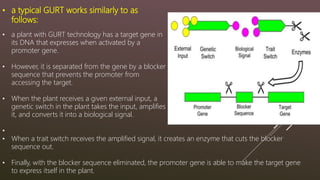
• a typical GURT works similarly to as
follows:
• a plant with GURT technology has a target gene in
its DNA that expresses when activated by a
promoter gene.
• However, it is separated from the gene by a blocker
sequence that prevents the promoter from
accessing the target.
• When the plant receives a given external input, a
genetic switch in the plant takes the input, amplifies
it, and converts it into a biological signal.
•
• When a trait switch receives the amplified signal, it creates an enzyme that cuts the blocker
sequence out.
• Finally, with the blocker sequence eliminated, the promoter gene is able to make the target gene
to express itself in the plant.
2. T-GURT (Trait GURT)
• It is considered as the second generation of V-GURT.
• T-GURT is also known as traitor technology.
• The technology is restricted to registered at the trait level, hence
the term T-GURT.
• T-GURT is designed to switch on or off a trait
(such as herbicide/cold/drought/stress tolerance, pest resistance,
germination, flowering, ripening, colour, taste and nutritional
qualities of the plant, defence mechanisms, or production of
industrial or pharmaceutical compounds) using inducible promoters
regulating the expression of the transgene through induced gene
silencing (e.g., by antisense suppression) or by excision of the
transgene using a recombinase.
• In this case, the genetic modification is activated by a chemical
treatment or by environmental factors such as heat, enabling farmers to
maintain the value-added traits of seeds.
• A second type of GURT modifies a crop in such a way that the
genetic enhancement engineered into the crop does not function until
the crop plant is treated with a chemical that is sold by the biotechnology
company.
• Farmers can save seeds for use each year. However, they do not get
to use the enhanced trait in the crop unless they purchase the activator
compound.
Advantages of Terminator technology
• Prevent escape of transgenes into wild relatives and prevent any
impact on biodiversity.
• Reduce the propagation of Volunteer plants.
• Farmers will use new seeds every year leads to maximum
production.
• Prohibit non V-GURT grain sprouting, which lowers the quality of
grain.
• This technology will induce private sector to make more
in research and development of pure line varieties and open pollinated
varieties because in these varieties the farmers do not change the seeds
each years.
• It can be used to limit the spread of genes from GMOs to other
plants in the natural environment.
Disadvantages of Terminator technology
• The production of sterile seeds by these plants would render the
seeds useless.
• Harvested seeds are used only for consumption. It may cause health
hazards for animals as well as human beings. Because it has been treated
with some chemicals before sowing.
• There is a danger of this technology affecting unintended targets. It
possible that these plants would transfer pollen to nearby wild type crops
and cause sterility in their seeds too.
• Some genotype of a particular crop grown across the country leads
genetic vulnerability to pest and diseases.
• Location specific and season bound varieties cannot be grown.
• Tetracycline is a chemical use to active the toxic gene, may alter the
soil fauna and flora.
• The country՚s rich genetic diversity will be lost.
• Maximum crop field may be covered by just one genotype, and it will
eliminate the farm conservation traditions and location specific varieties.
Controversy
As of 2006, GURT seeds have not been commercialized anywhere in the world due
to opposition from farmers, consumers, indigenous peoples, NGOs, and some
governments.
Using the technology, companies that manufacture genetic use restriction
technologies could potentially be able to make much more revenue because the
seeds sold would not be able to be resown.
Another concern is that farmers purchasing the seeds would be greatly impacted,
given they would have to buy new seeds every year. It has been argued that this
would result in higher prices in food.
GURT seeds are worried to cause a significant decrease in biodiversity and threaten
native species of plants.
• However, proponents of the technology dispute these claims, making the cases
that because non-GMO hybrid plants are used in the same way and GURT
seeds could help farmers deal with cross pollination, the benefits outweigh the
potential negatives.
• In 2000, the United Nations Convention on Biological Diversity recommended
a de facto moratorium on field-testing and commercial sale of terminator seeds;
the moratorium was re-affirmed and the language strengthened in March 2006,
at the COP8 meeting of the UNCBD.
• Specifically, the moratorium recommended that, due to a lack of research on the
technology's potential risks, no field testing of GURTs nor products using them
should be allowed until there was a sufficiently justified reason to do so.
• India and Brazil have passed national laws to prohibit the technology.

Terminator Gene Technology

  • 1.
    Terminator Gene Technology Dr.Pavan J Kundur, M.Sc., Ph.D., Assistant Professor Department of Biotechnology P C Jabin Science College, Hubballi, Karnataka, India
  • 2.
     Terminator genetechnology refers to plants that have been genetically modified to render sterile seeds at harvest, it is also called Genetic Use Restriction Technology or GURT.  Terminator technology was developed by the multinational seed / agrochemical industry and the united-states govt. to prevent farmers from saving and re-planting harvested seed.  The terminator gene technology, or genetic use restriction technology (GURT), is the genetic modification of plants to make them produce sterile seeds in second generation which is also famous as a “suicide seeds”.  Terminator alters the expression of certain genes in plants so that plants terminate their reproductive switch, about the embryo and make themselves sterile. Such plants then produce seed that cannot germinate.
  • 3.
    • This technologywas patented by U.S. Department of agriculture and the seed company, Delta and Pine Land Company – a subsidiary of the seeds and agrochemical multinational Monsanto/American Home products. • During 2002 Monsanto acquired Delta and Pine land (DPL). • The technology has been appropriately named “Terminator” by the Canadian governmental organization, Rural Advancement Foundation International (RAFI), which has spearheaded an international campaign against it. • Monsanto described this technology as a “gene protection technology”. • Both the nicknames ‘terminator’ and ‘traitor’ for these technologies were coined by the Canadian-based nongovernment organization Rural Advancement Foundation International (RAFI; today Action Group on Erosion, Technology and Concentration, ETC).
  • 4.
    Genetic use restrictiontechnology (GURT), Types 1.V-GURT (Varietal GURT) 2. T-GURT (Trait GURT)
  • 5.
    1. V-GURT (VarietalGURT) • It is also known as suicide/sterile seed/gene technology, or terminator technology. • The technology is restricted at the plant variety level, hence the term V-GURT. • It is designed to control plant fertility or seed development through a genetic process triggered by a chemical inducer that will allow the plant to grow and to form seeds, but will cause the embryo of each of those seeds to produce a cell toxin that will prevent its germination if replanted, thus causing second generation seeds to be sterile and .
  • 6.
    • Allowing manufacturersto maintain their intellectual property rights and avoid concerns related to GM seed dispersal. • This type of GURT produces sterile seeds meaning that a farmer that had purchased seeds containing V-GURT technology could not save the seeds of this crop for future planting
  • 7.
    • a typicalGURT works similarly to as follows: • a plant with GURT technology has a target gene in its DNA that expresses when activated by a promoter gene. • However, it is separated from the gene by a blocker sequence that prevents the promoter from accessing the target. • When the plant receives a given external input, a genetic switch in the plant takes the input, amplifies it, and converts it into a biological signal. • • When a trait switch receives the amplified signal, it creates an enzyme that cuts the blocker sequence out. • Finally, with the blocker sequence eliminated, the promoter gene is able to make the target gene to express itself in the plant.
  • 8.
    2. T-GURT (TraitGURT) • It is considered as the second generation of V-GURT. • T-GURT is also known as traitor technology. • The technology is restricted to registered at the trait level, hence the term T-GURT. • T-GURT is designed to switch on or off a trait (such as herbicide/cold/drought/stress tolerance, pest resistance, germination, flowering, ripening, colour, taste and nutritional qualities of the plant, defence mechanisms, or production of industrial or pharmaceutical compounds) using inducible promoters regulating the expression of the transgene through induced gene silencing (e.g., by antisense suppression) or by excision of the transgene using a recombinase.
  • 9.
    • In thiscase, the genetic modification is activated by a chemical treatment or by environmental factors such as heat, enabling farmers to maintain the value-added traits of seeds. • A second type of GURT modifies a crop in such a way that the genetic enhancement engineered into the crop does not function until the crop plant is treated with a chemical that is sold by the biotechnology company. • Farmers can save seeds for use each year. However, they do not get to use the enhanced trait in the crop unless they purchase the activator compound.
  • 10.
    Advantages of Terminatortechnology • Prevent escape of transgenes into wild relatives and prevent any impact on biodiversity. • Reduce the propagation of Volunteer plants. • Farmers will use new seeds every year leads to maximum production. • Prohibit non V-GURT grain sprouting, which lowers the quality of grain. • This technology will induce private sector to make more in research and development of pure line varieties and open pollinated varieties because in these varieties the farmers do not change the seeds each years. • It can be used to limit the spread of genes from GMOs to other plants in the natural environment.
  • 11.
    Disadvantages of Terminatortechnology • The production of sterile seeds by these plants would render the seeds useless. • Harvested seeds are used only for consumption. It may cause health hazards for animals as well as human beings. Because it has been treated with some chemicals before sowing. • There is a danger of this technology affecting unintended targets. It possible that these plants would transfer pollen to nearby wild type crops and cause sterility in their seeds too. • Some genotype of a particular crop grown across the country leads genetic vulnerability to pest and diseases. • Location specific and season bound varieties cannot be grown. • Tetracycline is a chemical use to active the toxic gene, may alter the soil fauna and flora.
  • 12.
    • The country՚srich genetic diversity will be lost. • Maximum crop field may be covered by just one genotype, and it will eliminate the farm conservation traditions and location specific varieties.
  • 13.
    Controversy As of 2006,GURT seeds have not been commercialized anywhere in the world due to opposition from farmers, consumers, indigenous peoples, NGOs, and some governments. Using the technology, companies that manufacture genetic use restriction technologies could potentially be able to make much more revenue because the seeds sold would not be able to be resown. Another concern is that farmers purchasing the seeds would be greatly impacted, given they would have to buy new seeds every year. It has been argued that this would result in higher prices in food. GURT seeds are worried to cause a significant decrease in biodiversity and threaten native species of plants.
  • 14.
    • However, proponentsof the technology dispute these claims, making the cases that because non-GMO hybrid plants are used in the same way and GURT seeds could help farmers deal with cross pollination, the benefits outweigh the potential negatives. • In 2000, the United Nations Convention on Biological Diversity recommended a de facto moratorium on field-testing and commercial sale of terminator seeds; the moratorium was re-affirmed and the language strengthened in March 2006, at the COP8 meeting of the UNCBD. • Specifically, the moratorium recommended that, due to a lack of research on the technology's potential risks, no field testing of GURTs nor products using them should be allowed until there was a sufficiently justified reason to do so. • India and Brazil have passed national laws to prohibit the technology.