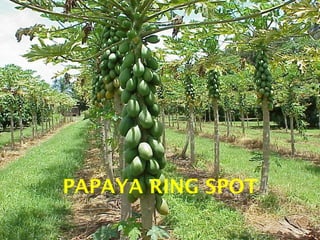
PAPAYA RING SPOT
Dr. P. KISHORE VARMA
Assistant Professor,
PJTSAU, Hyderabad
Economic impact
• PRSV occurs in most tropical and
subtropical areas where Papaya is grown
• USA, the Carribbean countries, Africa,
India and Taiwan
• In India 1st
reported from Mumbai and
Pune and occurs more in central India
• The incidence of PRSV to the tune of 75-
100% was reported from Uttar Pradesh,
Maharashtra, Gujarat, Bihar and M.P.
Etiology
• Papaya ringspot virus (PRSV)
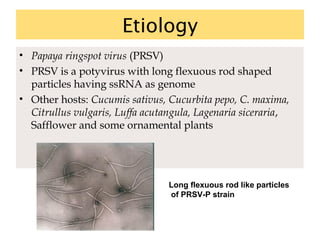
• PRSV is a potyvirus with long flexuous rod shaped
particles having ssRNA as genome
• Other hosts: Cucumis sativus, Cucurbita pepo, C. maxima,
Citrullus vulgaris, Luffa acutangula, Lagenaria siceraria,
Safflower and some ornamental plants
Long flexuous rod like particles
of PRSV-P strain
Myzus persicae
Etiology
Aphis gossypii
Aphids mainly Myzus persicae and other species like Aphis malvae and
A. gossypii transmit PRSV in a non-persistent manner
Favourable conditions
• Cool weather favours development of
severe leaf distortion symptoms
• Cultivation of susceptible hosts
• Prevalence of vector
Diagnostic symptoms
• Leaves are mottled and distorted with blisters
and have rings.
• In infected leaves, the lamina is reduced and
malformed and are often modified into tendril
like structures giving a shoestring appearance
• Water soaked chlorotic spots on tender stem
and petioles
• Under severe infection, older leaves fall down
and a small tuft of younger leaves are left at the
top in upright position
Mottling on foliage
Shoestring symptom
Foliar symptoms of Papaya ring spot
Shoestring symptom
Foliar symptoms of Papaya ring spot
Papaya orchard infected with PRSV
Diagnostic symptoms
• Plants are stunted and fruit set is reduced
• Fruits develop innumerable circular, water
soaked spots with concentric rings
• Sometimes fruit size is reduced with deformed
shape
Papya ring spot symptom on unripe fruit
Circular, water soaked concentric rings on fruit
Papaya ring spot on unripe fruit
Management
• Disease free seedlings raised in modern insect
proof nethouses or polyhouses
• Rouging and destruction of diseased plants
• Carica cauliflora is resistant
• Growing transgenic (coat protein mediated)
papaya varieties like Sun Up and Rainbow
• SunUp is a transgenic version of cultivar Sunset
and is homozygous for the CP gene. Rainbow is
an F1 hybrid created by crossing transgenic
SunUp with non- transgenic Kapoho.
Transgenic papaya varieties
Non-transgenic papaya Vs Transgenic papaya
Management
• Adjust the transplanting time to avoid the
aphid population
• Raising barrier crops like Maize or Hibiscus
sabdarifa on the boundaries of the field
• Spray white oil emulsion at 1% concentration
in water. Oil emulsion interferes with the
uptake and transmission of the virus by
aphid
• Spray with di-methoate (0.05%) and
azadirachtin (0.06%) alternately at fortnightly
interval that reduces aphid population and
PRSV incidence
Papaya ring spot virus

Papaya ring spot virus

  • 1.
    PAPAYA RING SPOT Dr.P. KISHORE VARMA Assistant Professor, PJTSAU, Hyderabad
  • 2.
    Economic impact • PRSVoccurs in most tropical and subtropical areas where Papaya is grown • USA, the Carribbean countries, Africa, India and Taiwan • In India 1st reported from Mumbai and Pune and occurs more in central India • The incidence of PRSV to the tune of 75- 100% was reported from Uttar Pradesh, Maharashtra, Gujarat, Bihar and M.P.
  • 3.
    Etiology • Papaya ringspotvirus (PRSV) • PRSV is a potyvirus with long flexuous rod shaped particles having ssRNA as genome • Other hosts: Cucumis sativus, Cucurbita pepo, C. maxima, Citrullus vulgaris, Luffa acutangula, Lagenaria siceraria, Safflower and some ornamental plants Long flexuous rod like particles of PRSV-P strain
  • 4.
    Myzus persicae Etiology Aphis gossypii Aphidsmainly Myzus persicae and other species like Aphis malvae and A. gossypii transmit PRSV in a non-persistent manner
  • 5.
    Favourable conditions • Coolweather favours development of severe leaf distortion symptoms • Cultivation of susceptible hosts • Prevalence of vector
  • 6.
    Diagnostic symptoms • Leavesare mottled and distorted with blisters and have rings. • In infected leaves, the lamina is reduced and malformed and are often modified into tendril like structures giving a shoestring appearance • Water soaked chlorotic spots on tender stem and petioles • Under severe infection, older leaves fall down and a small tuft of younger leaves are left at the top in upright position
  • 7.
    Mottling on foliage Shoestringsymptom Foliar symptoms of Papaya ring spot
  • 8.
  • 9.
    Foliar symptoms ofPapaya ring spot
  • 10.
  • 11.
    Diagnostic symptoms • Plantsare stunted and fruit set is reduced • Fruits develop innumerable circular, water soaked spots with concentric rings • Sometimes fruit size is reduced with deformed shape
  • 12.
    Papya ring spotsymptom on unripe fruit Circular, water soaked concentric rings on fruit
  • 13.
    Papaya ring spoton unripe fruit
  • 14.
    Management • Disease freeseedlings raised in modern insect proof nethouses or polyhouses • Rouging and destruction of diseased plants • Carica cauliflora is resistant • Growing transgenic (coat protein mediated) papaya varieties like Sun Up and Rainbow • SunUp is a transgenic version of cultivar Sunset and is homozygous for the CP gene. Rainbow is an F1 hybrid created by crossing transgenic SunUp with non- transgenic Kapoho.
  • 15.
  • 16.
    Non-transgenic papaya VsTransgenic papaya
  • 17.
    Management • Adjust thetransplanting time to avoid the aphid population • Raising barrier crops like Maize or Hibiscus sabdarifa on the boundaries of the field • Spray white oil emulsion at 1% concentration in water. Oil emulsion interferes with the uptake and transmission of the virus by aphid • Spray with di-methoate (0.05%) and azadirachtin (0.06%) alternately at fortnightly interval that reduces aphid population and PRSV incidence