1/7/2017 1Dept. of Plant Biotechnology
Upasana Mohapatra
PALB 6290
Jr Msc. Plant Biotechnology
UAS,GKVK,Bengaluru
1/7/2017 2Dept. of Plant Biotechnology
CONTENTS
• Definition
• History
• Molecular farming strategy
• Molecular farming host
• Plant molecular pharming
• Antibiotics, enzymes and vaccines produced from
microbes and plant
• Transgene pollution
• Case study
1/7/2017 3Dept. of Plant Biotechnology
DEFINITION
• The use of whole organisms, organs, tissues
or cells, or cell cultures, as bio-reactors for
the production of commercially valuable
products like recombinant proteins,
antibodies, vaccines via recombinant DNA
techniques.
• It is also known as Molecular farming or
Bio pharming.
1/7/2017 4Dept. of Plant Biotechnology
HISTORY
• 1986 - First plant -derived recombinant therapeutic protein-
human GH in tobacco & sunflower. (A. Barta, D. Thompson etal.)
• 1989 - First plant -derived recombinant antibody – full-sized IgG in
tobacco. (A. Hiatt, K. Bowdish)
• 1990 - First native human protein produced in plants –
human serum albumin in tobacco & potato. (P. C. Sijmons et al.)
• 1995 - First plant derived industrial enzyme – α-amylase in tobacco. (J.Pen,
L. Molendijk et al.)
1/7/2017 5Dept. of Plant Biotechnology
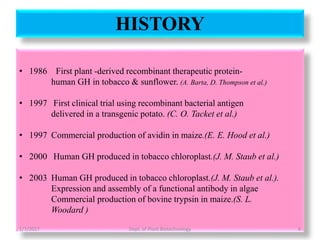
HISTORY
• 1986 First plant -derived recombinant therapeutic protein-
human GH in tobacco & sunflower. (A. Barta, D. Thompson et al.)
• 1997 First clinical trial using recombinant bacterial antigen
delivered in a transgenic potato. (C. O. Tacket et al.)
• 1997 Commercial production of avidin in maize.(E. E. Hood et al.)
• 2000 Human GH produced in tobacco chloroplast.(J. M. Staub et al.)
• 2003 Human GH produced in tobacco chloroplast.(J. M. Staub et al.).
Expression and assembly of a functional antibody in algae
Commercial production of bovine trypsin in maize.(S. L.
Woodard )
1/7/2017 6Dept. of Plant Biotechnology
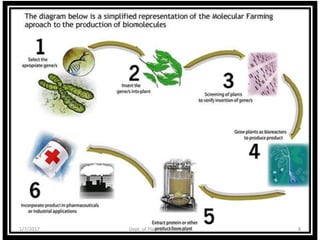
1. Clone a gene of interest
2. Transform the host platform species
3. Grow the host species, recover biomass
4. Process biomass
5. Purify product of interest
6. Deliver product of interest
Molecular Farming Strategy
1/7/2017 7Dept. of Plant Biotechnology
1/7/2017 8Dept. of Plant Biotechnology
Downstream processing & analysis of
recombinant proteins from plants
1/7/2017 9Dept. of Plant Biotechnology
1. Bacteria
2. Yeasts, (single celled fungi)
3. Unicellular algae
4. Mammalian, insect, plant, and filamentous
fungal cell cultures
5. Whole plants, ( corn, barley, rice, duckweed,
moss protonema)
6. Whole animals, (insects, birds, fish, mammals)
Molecular Farming Hosts
1/7/2017 10Dept. of Plant Biotechnology
BACTERIA:
1. Do not produce glycosylated full –sized
antibodies.
2. Contaminating endotoxin difficult to remove.
3. Recombinant proteins often form inclusion
bodies.
4. Labour-and cost –intensive refolding in vitro
necessary.
5. Lower scalability
6. Preferred for the production of small,
aglycosylated proteins like Insulin, interferon-
β.
1. Limited by legal and ethical restriction
2. Require expensive equipment & media
3. Delicate nature of mammalian cells
4. Human pathogens and oncogenes
5. Scaling up problems
ANIMAL BASED SYSTEMS
1/7/2017 11Dept. of Plant Biotechnology
12 Dept. of Plant Biotechnology
S. Biemelt;U. Sonnewald (2004)
Comparison Of Different Production Systems For Expression Of
Recombinant Proteins
1/7/2017 13Dept. of Plant Biotechnology
Cost of Production: Antibodies
HOST COST
Animal cell culture $ 333/g
Transgenic milk $ 100/g
Yeast cell culture $ 100/g
Milled corn endosperm $ 0.2/g
Enriched corn fraction $ 0.6/g
Extracted corn fraction $ 2.1/g
1/7/2017 14Dept. of Plant Biotechnology
Plant Molecular Farming
1. Significantly lower production cost than with
transgenic animals, fermentation or bioreactors.
2. Infrastructure & expertise already exists for the
planting, harvesting & processing of plant material.
3. Plants contain no known human pathogens (such as
prions, virions,etc.) that could contaminate the final
product.
4. Higher plants generally synthesize proteins from
eukaryotes with correct folding, glycosylation &post
translational activity.
1/7/2017 15Dept. of Plant Biotechnology
1. Plant cells can direct proteins to environments that
reduce degradation and therefore increase stability.
2. Low ethical concerns.
3. Easier purification (homologs don’t pose any
purification challenge, e.g.serum proteins or
antibodies).
4. Versatile(production of a broad diversity of proteins).
5. Take more time to develop.
6. Transgene & protein pollution.
1/7/2017 16Dept. of Plant Biotechnology
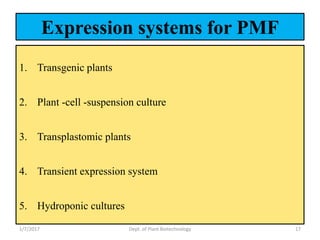
Expression systems for PMF
1. Transgenic plants
2. Plant -cell -suspension culture
3. Transplastomic plants
4. Transient expression system
5. Hydroponic cultures
1/7/2017 17Dept. of Plant Biotechnology
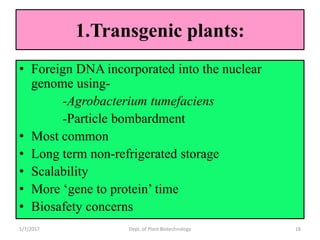
1.Transgenic plants:
• Foreign DNA incorporated into the nuclear
genome using-
-Agrobacterium tumefaciens
-Particle bombardment
• Most common
• Long term non-refrigerated storage
• Scalability
• More ‘gene to protein’ time
• Biosafety concerns
1/7/2017 18Dept. of Plant Biotechnology
2.Plant Cell Suspension Culture
1. Culture derived from
-transgenic explants
-Transformation after desegregation
2. Recombinant protein localization depends on –
-presence of targeting / leader peptides in the
-recombinant protein. Permeability of plant cell
wall for macromolecules
3. Containment & production under GMP procedure
4. Low scale up capacity
1/7/2017 19Dept. of Plant Biotechnology
1/7/2017 20Dept. of Plant Biotechnology
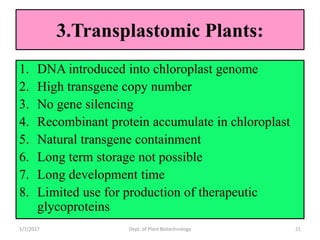
3.Transplastomic Plants:
1. DNA introduced into chloroplast genome
2. High transgene copy number
3. No gene silencing
4. Recombinant protein accumulate in chloroplast
5. Natural transgene containment
6. Long term storage not possible
7. Long development time
8. Limited use for production of therapeutic
glycoproteins
1/7/2017 21Dept. of Plant Biotechnology
4.Transient expression system
1. Biolistic delivery of ‘naked DNA
• Usually reaches only a few cells
• Can be used for a rapid test for protein expression
2. Agroinfiltraion
•Delivery of Agrobacterium in intact leaf tissue by vacuum
infiltration
•Targets many more cells in a leaf
3. Infection with modified viralvector
1/7/2017 22Dept. of Plant Biotechnology
Virus Infected Plants
• Gene of interest is cloned into the genome of a
viral plant pathogen
• Infectious recombinant viral transcripts are
used to infect plants
• Rapid & systemic infection
• High level production soon after inoculation
• Genetic modification of plant is entirely
avoided
1/7/2017 23Dept. of Plant Biotechnology
1/7/2017 24Dept. of Plant Biotechnology
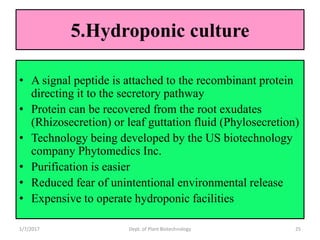
5.Hydroponic culture
• A signal peptide is attached to the recombinant protein
directing it to the secretory pathway
• Protein can be recovered from the root exudates
(Rhizosecretion) or leaf guttation fluid (Phylosecretion)
• Technology being developed by the US biotechnology
company Phytomedics Inc.
• Purification is easier
• Reduced fear of unintentional environmental release
• Expensive to operate hydroponic facilities
1/7/2017 25Dept. of Plant Biotechnology
Choice Of Host Species
Depends On:
• Protein To Be Produced & Its Desired
Application
• Transformation Efficiency
• Overall Production Cost
• Containment
1/7/2017 26Dept. of Plant Biotechnology
Comparison Of Various Plant
Expression Host Species
1/7/2017 27Dept. of Plant Biotechnology
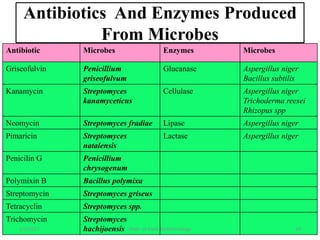
Antibiotics And Enzymes Produced
From Microbes
Antibiotic Microbes Enzymes Microbes
Griseofulvin Penicillium
griseofulvum
Glucanase Aspergillus niger
Bacillus subtilis
Kanamycin Streptomyces
kanamyceticus
Cellulase Aspergillus niger
Trichoderma reesei
Rhizopus spp
Neomycin Streptomyces fradiae Lipase Aspergillus niger
Pimaricin Streptomyces
natalensis
Lactase Aspergillus niger
Penicilin G Penicillium
chrysogenum
Polymixin B Bacillus polymixa
Streptomycin Streptomyces griseus
Tetracyclin Streptomyces spp.
Trichomycin Streptomyces
hachijoensis1/7/2017 28Dept. of Plant Biotechnology
Antibiotics And Enzymes Produced
From Microbes
Antibiotic Microbes Enzymes Microbes
Amphotericin B Streptomyces nodosus a-amylase Bacillus
licheniformis
Bacillus
amyloliquifacieens
Bacitracin Bacillus subtilis Glucoamylase Aspergillus niger
Cephalosporin C Cephalosporium
acremonium
Xylose isomerase Bacillus coagulans
Cycloheximide Streptomyces griseus Alkalineprotease Bacilus licheniformis
Bacillus subtilis
Fungimycin Streptomyces
coelicolor
Neutral protease Bacillus
amyloliquifaciens
Gentamycin Micromonospora
purpurea
Acid protease Aspergillus niger
Gramicidin Bacillus brevis Pectinase Aspergillus niger
Bacillus subtilis1/7/2017 29Dept. of Plant Biotechnology
Therapeutic Proteins Produced In
Different Plant Hosts System
1/7/2017 30Dept. of Plant Biotechnology
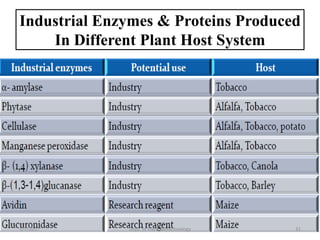
Industrial Enzymes & Proteins Produced
In Different Plant Host System
1/7/2017 31Dept. of Plant Biotechnology
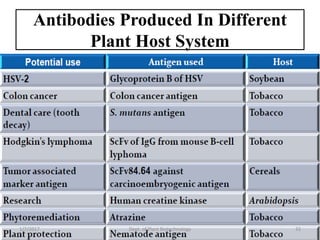
Antibodies Produced In Different
Plant Host System
1/7/2017 32Dept. of Plant Biotechnology
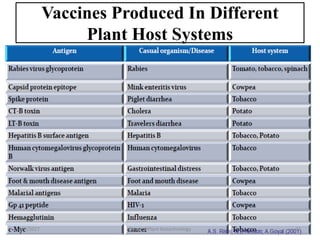
Vaccines Produced In Different
Plant Host Systems
1/7/2017 33Dept. of Plant Biotechnology
1/7/2017 34Dept. of Plant Biotechnology
Transgene Pollution –The Problems
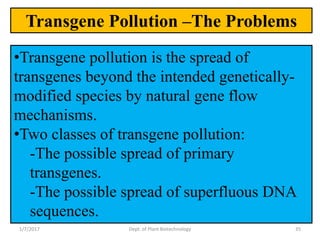
•Transgene pollution is the spread of
transgenes beyond the intended genetically-
modified species by natural gene flow
mechanisms.
•Two classes of transgene pollution:
-The possible spread of primary
transgenes.
-The possible spread of superfluous DNA
sequences.
1/7/2017 35Dept. of Plant Biotechnology
Transgene Pollution –Possible Solutions
•Minimum required genetic modification.
•Elimination of non-essential genetic
information.
•Containment of essential transgenes.
•Alternative production systems transient
expression.
•Plant suspension cultures in sealed, sterile
reactor vessels
(Fischer et al., 1999a; Doran, 2000).
1/7/2017 36Dept. of Plant Biotechnology
1. Use of lettuce, and viral vector-based transient expression systems to
develop a robust PMP production platform biological pharmaceutical agents
that is effective, safe, low-cost, and amenable to large-scale manufacturing
2. Geminiviral replicon system based on the bean yellow dwarf virus permits
high-level expression in lettuce of virus-like particles (VLP) derived from
the Norwalk virus capsid protein and therapeutic monoclonal antibodies
(mAbs) against Ebola and West Nile viruses.
1/7/2017 37Dept. of Plant Biotechnology
MATERIALS AND METHODS
1) Construction of expression vectors
• The construction of geminiviral vectors, pREP110,
pBYGFP, pBYNVCP, pBY-HL(6D8) Replicon and non-
replicon vector pP19 dual-replicon vector pBY-
HL(hE16).R
2) Lettuce agroinfiltration-
• Lettuce heads were vacuum infiltrated with GV3101
strains containing the targeted expression vectors
3) Protein extraction
• The crude leaf extract was processed by centrifugation at
to yield “lettuce extract”.
• Lettuce extract” was further clarified by filtration
through a 0.2 micron filter.1/7/2017 38Dept. of Plant Biotechnology
MATERIALS AND METHODS
4) Protein analysis-
• SDS-PAGE, Western blot, and ELISA analysis for
NVCP, 6D8 mAb and hE16 mAb,sucrose gradient
centrifugation and electron microscopy for NVCP VLP,
antigen binding assays for 6D8 and hE16 mAbs, and
GFP visualization were all performed.
5) WNV neutralization-
• The neutralizing activity of hE16 against WNV was
assessed using a focus reduction neutralization assay
6) Protein Purification-
• Anion exchange chromatography.
1/7/2017 39Dept. of Plant Biotechnology
RESULTS AND DISCUSSIONS
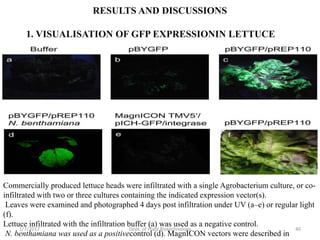
1. VISUALISATION OF GFP EXPRESSIONIN LETTUCE
Commercially produced lettuce heads were infiltrated with a single Agrobacterium culture, or co-
infiltrated with two or three cultures containing the indicated expression vector(s).
Leaves were examined and photographed 4 days post infiltration under UV (a–e) or regular light
(f).
Lettuce infiltrated with the infiltration buffer (a) was used as a negative control.
N. benthamiana was used as a positivecontrol (d). MagnICON vectors were described in
1/7/2017 40Dept. of Plant Biotechnology
2.EXPRESSION OF NVCP IN LETTUCE LEAVES
Leaf protein extracts were separated on a 10% SDS-PAGE gel andtransferred onto
PVDF membranes probed with a rabbit polyclonal antibody against NVCP.
Lane 1: insect cell-derived NVCP standard;
lane 2: protein extract from uninfiltrated lettuce leaves (negative control); lane 3: extract from
pBYNVCP/pREP110 infiltrated lettuce leaves.
(b) Time course of NVCP expression-Total proteins from lettuce leaves infiltrated with
pBYNVCP/pREP110 or pBYNVCP/pREP110 + pP19
1/7/2017 41Dept. of Plant Biotechnology
3.PURIFICATION AND CHARECTERISATION OF NVCP
Lane 1: Molecular weight marker;
Lane 2: insect cell-derived NVCP reference standard;
Lanes 3 and 4: crude protein extract and purified NVCP from N. benthamiana leaves as a
comparison;
Lane 5: crude extract from pBYNVCP/pREP110 infiltrated lettuce leaves; lane 6: purified NVCP
from lettuce leaves
b) Sucrose gradient sedimentation profile of purified NVCP. reference standard (I-NVCP)
c) Electron microscopy of lettuce-derived NVCP
1/7/2017 42Dept. of Plant Biotechnology
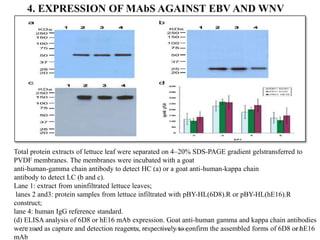
4. EXPRESSION OF MAbS AGAINST EBV AND WNV
Total protein extracts of lettuce leaf were separated on 4–20% SDS-PAGE gradient gelstransferred to
PVDF membranes. The membranes were incubated with a goat
anti-human-gamma chain antibody to detect HC (a) or a goat anti-human-kappa chain
antibody to detect LC (b and c).
Lane 1: extract from uninfiltrated lettuce leaves;
lanes 2 and3: protein samples from lettuce infiltrated with pBY-HL(6D8).R or pBY-HL(hE16).R
construct;
lane 4: human IgG reference standard.
(d) ELISA analysis of 6D8 or hE16 mAb expression. Goat anti-human gamma and kappa chain antibodies
were used as capture and detection reagents, respectively to confirm the assembled forms of 6D8 or hE16
mAb
1/7/2017 43Dept. of Plant Biotechnology
5. PURIFICATION OF MONOCLONAL ANTIBODIES
Lane 1: Molecular weight marker;
Lane 2: total leaf proteins from uninfiltrated lettuce leaves;
Lane 3: total leaf protein from lettuce leaves infiltrated with pBY HL(6D8).R;
Lane 4: purified 6D8 mAb
Lane 5: hE16 mAb purified from pBY-HL(hE16).1/7/2017 44Dept. of Plant Biotechnology
6. CHARECTERIZATION OF MONOCLONALANTIBODIES
(a) Specific binding of 6D8 mAb to EBV. Tobaccoderived 6D8 (EBV T-6D8, positive
control), or a negative control generic human IgG.
(b) Binding of lettuce-derived hE16 to domain III of WNV E displayed on the cell surface of
yeast. Lettuce-produced hE16 mAb (L-hE16), mammalian cell-derived hE16 (M-hE16,
positive control), or a generic human IgG (h-IgG, negative control)
(c) Neutralization of WNV by lettuce-produced hE16 mAb. WNV was incubated with serial
dilutions of hE16 derived from lettuce (L-hE16) or mammalian cells (M-hE16) (positive
control) and used to infect Vero cells. Cells were then fixed, permeabilized, analyzed by
focus reduction assay and quantitated by Biospot analysis.1/7/2017 45Dept. of Plant Biotechnology
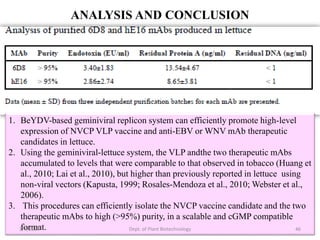
1. BeYDV-based geminiviral replicon system can efficiently promote high-level
expression of NVCP VLP vaccine and anti-EBV or WNV mAb therapeutic
candidates in lettuce.
2. Using the geminiviral-lettuce system, the VLP andthe two therapeutic mAbs
accumulated to levels that were comparable to that observed in tobacco (Huang et
al., 2010; Lai et al., 2010), but higher than previously reported in lettuce using
non-viral vectors (Kapusta, 1999; Rosales-Mendoza et al., 2010; Webster et al.,
2006).
3. This procedures can efficiently isolate the NVCP vaccine candidate and the two
therapeutic mAbs to high (>95%) purity, in a scalable and cGMP compatible
format.
ANALYSIS AND CONCLUSION
1/7/2017 46Dept. of Plant Biotechnology
Perspectives on Molecular Pharming
• Use of virus infected plants is best approach for
molecular farming
• Molecular farming provides an opportunity for
the economical and large-scale production of
pharmaceuticals, industrial enzymes and technical
proteins that are currently produced at great
expense and in small quantities.
• We must ensure that these benefits are not
outweighed by risks to human health and the
environment
1/7/2017 47Dept. of Plant Biotechnology
References
• Robust production of virus-like particles and monoclonal
antibodies with geminiviral replicon vectors in
lettuce.Huafang Lai1, Junyun He1, Michael Engle2, Michael
S. Diamond2, and Qiang Chen1Plant Biotechnol J. 2012
January ; 10(1): 95–104. doi:10.1111/j.1467-
7652.2011.00649.x.
• Wikipedia
• (Rainer Fischer; Stefan Schillberg)
• Su-May Yu; Institute of Molecular Biology Academia Sinica
Nankang, Taipei
• S. Biemelt;U. Sonnewald (2004)
1/7/2017 48Dept. of Plant Biotechnology
1/7/2017 49Dept. of Plant Biotechnology

Molecular pharming

  • 1.
    1/7/2017 1Dept. ofPlant Biotechnology
  • 2.
    Upasana Mohapatra PALB 6290 JrMsc. Plant Biotechnology UAS,GKVK,Bengaluru 1/7/2017 2Dept. of Plant Biotechnology
  • 3.
    CONTENTS • Definition • History •Molecular farming strategy • Molecular farming host • Plant molecular pharming • Antibiotics, enzymes and vaccines produced from microbes and plant • Transgene pollution • Case study 1/7/2017 3Dept. of Plant Biotechnology
  • 4.
    DEFINITION • The useof whole organisms, organs, tissues or cells, or cell cultures, as bio-reactors for the production of commercially valuable products like recombinant proteins, antibodies, vaccines via recombinant DNA techniques. • It is also known as Molecular farming or Bio pharming. 1/7/2017 4Dept. of Plant Biotechnology
  • 5.
    HISTORY • 1986 -First plant -derived recombinant therapeutic protein- human GH in tobacco & sunflower. (A. Barta, D. Thompson etal.) • 1989 - First plant -derived recombinant antibody – full-sized IgG in tobacco. (A. Hiatt, K. Bowdish) • 1990 - First native human protein produced in plants – human serum albumin in tobacco & potato. (P. C. Sijmons et al.) • 1995 - First plant derived industrial enzyme – α-amylase in tobacco. (J.Pen, L. Molendijk et al.) 1/7/2017 5Dept. of Plant Biotechnology
  • 6.
    HISTORY • 1986 Firstplant -derived recombinant therapeutic protein- human GH in tobacco & sunflower. (A. Barta, D. Thompson et al.) • 1997 First clinical trial using recombinant bacterial antigen delivered in a transgenic potato. (C. O. Tacket et al.) • 1997 Commercial production of avidin in maize.(E. E. Hood et al.) • 2000 Human GH produced in tobacco chloroplast.(J. M. Staub et al.) • 2003 Human GH produced in tobacco chloroplast.(J. M. Staub et al.). Expression and assembly of a functional antibody in algae Commercial production of bovine trypsin in maize.(S. L. Woodard ) 1/7/2017 6Dept. of Plant Biotechnology
  • 7.
    1. Clone agene of interest 2. Transform the host platform species 3. Grow the host species, recover biomass 4. Process biomass 5. Purify product of interest 6. Deliver product of interest Molecular Farming Strategy 1/7/2017 7Dept. of Plant Biotechnology
  • 8.
    1/7/2017 8Dept. ofPlant Biotechnology
  • 9.
    Downstream processing &analysis of recombinant proteins from plants 1/7/2017 9Dept. of Plant Biotechnology
  • 10.
    1. Bacteria 2. Yeasts,(single celled fungi) 3. Unicellular algae 4. Mammalian, insect, plant, and filamentous fungal cell cultures 5. Whole plants, ( corn, barley, rice, duckweed, moss protonema) 6. Whole animals, (insects, birds, fish, mammals) Molecular Farming Hosts 1/7/2017 10Dept. of Plant Biotechnology
  • 11.
    BACTERIA: 1. Do notproduce glycosylated full –sized antibodies. 2. Contaminating endotoxin difficult to remove. 3. Recombinant proteins often form inclusion bodies. 4. Labour-and cost –intensive refolding in vitro necessary. 5. Lower scalability 6. Preferred for the production of small, aglycosylated proteins like Insulin, interferon- β. 1. Limited by legal and ethical restriction 2. Require expensive equipment & media 3. Delicate nature of mammalian cells 4. Human pathogens and oncogenes 5. Scaling up problems ANIMAL BASED SYSTEMS 1/7/2017 11Dept. of Plant Biotechnology
  • 12.
    12 Dept. ofPlant Biotechnology
  • 13.
    S. Biemelt;U. Sonnewald(2004) Comparison Of Different Production Systems For Expression Of Recombinant Proteins 1/7/2017 13Dept. of Plant Biotechnology
  • 14.
    Cost of Production:Antibodies HOST COST Animal cell culture $ 333/g Transgenic milk $ 100/g Yeast cell culture $ 100/g Milled corn endosperm $ 0.2/g Enriched corn fraction $ 0.6/g Extracted corn fraction $ 2.1/g 1/7/2017 14Dept. of Plant Biotechnology
  • 15.
    Plant Molecular Farming 1.Significantly lower production cost than with transgenic animals, fermentation or bioreactors. 2. Infrastructure & expertise already exists for the planting, harvesting & processing of plant material. 3. Plants contain no known human pathogens (such as prions, virions,etc.) that could contaminate the final product. 4. Higher plants generally synthesize proteins from eukaryotes with correct folding, glycosylation &post translational activity. 1/7/2017 15Dept. of Plant Biotechnology
  • 16.
    1. Plant cellscan direct proteins to environments that reduce degradation and therefore increase stability. 2. Low ethical concerns. 3. Easier purification (homologs don’t pose any purification challenge, e.g.serum proteins or antibodies). 4. Versatile(production of a broad diversity of proteins). 5. Take more time to develop. 6. Transgene & protein pollution. 1/7/2017 16Dept. of Plant Biotechnology
  • 17.
    Expression systems forPMF 1. Transgenic plants 2. Plant -cell -suspension culture 3. Transplastomic plants 4. Transient expression system 5. Hydroponic cultures 1/7/2017 17Dept. of Plant Biotechnology
  • 18.
    1.Transgenic plants: • ForeignDNA incorporated into the nuclear genome using- -Agrobacterium tumefaciens -Particle bombardment • Most common • Long term non-refrigerated storage • Scalability • More ‘gene to protein’ time • Biosafety concerns 1/7/2017 18Dept. of Plant Biotechnology
  • 19.
    2.Plant Cell SuspensionCulture 1. Culture derived from -transgenic explants -Transformation after desegregation 2. Recombinant protein localization depends on – -presence of targeting / leader peptides in the -recombinant protein. Permeability of plant cell wall for macromolecules 3. Containment & production under GMP procedure 4. Low scale up capacity 1/7/2017 19Dept. of Plant Biotechnology
  • 20.
    1/7/2017 20Dept. ofPlant Biotechnology
  • 21.
    3.Transplastomic Plants: 1. DNAintroduced into chloroplast genome 2. High transgene copy number 3. No gene silencing 4. Recombinant protein accumulate in chloroplast 5. Natural transgene containment 6. Long term storage not possible 7. Long development time 8. Limited use for production of therapeutic glycoproteins 1/7/2017 21Dept. of Plant Biotechnology
  • 22.
    4.Transient expression system 1.Biolistic delivery of ‘naked DNA • Usually reaches only a few cells • Can be used for a rapid test for protein expression 2. Agroinfiltraion •Delivery of Agrobacterium in intact leaf tissue by vacuum infiltration •Targets many more cells in a leaf 3. Infection with modified viralvector 1/7/2017 22Dept. of Plant Biotechnology
  • 23.
    Virus Infected Plants •Gene of interest is cloned into the genome of a viral plant pathogen • Infectious recombinant viral transcripts are used to infect plants • Rapid & systemic infection • High level production soon after inoculation • Genetic modification of plant is entirely avoided 1/7/2017 23Dept. of Plant Biotechnology
  • 24.
    1/7/2017 24Dept. ofPlant Biotechnology
  • 25.
    5.Hydroponic culture • Asignal peptide is attached to the recombinant protein directing it to the secretory pathway • Protein can be recovered from the root exudates (Rhizosecretion) or leaf guttation fluid (Phylosecretion) • Technology being developed by the US biotechnology company Phytomedics Inc. • Purification is easier • Reduced fear of unintentional environmental release • Expensive to operate hydroponic facilities 1/7/2017 25Dept. of Plant Biotechnology
  • 26.
    Choice Of HostSpecies Depends On: • Protein To Be Produced & Its Desired Application • Transformation Efficiency • Overall Production Cost • Containment 1/7/2017 26Dept. of Plant Biotechnology
  • 27.
    Comparison Of VariousPlant Expression Host Species 1/7/2017 27Dept. of Plant Biotechnology
  • 28.
    Antibiotics And EnzymesProduced From Microbes Antibiotic Microbes Enzymes Microbes Griseofulvin Penicillium griseofulvum Glucanase Aspergillus niger Bacillus subtilis Kanamycin Streptomyces kanamyceticus Cellulase Aspergillus niger Trichoderma reesei Rhizopus spp Neomycin Streptomyces fradiae Lipase Aspergillus niger Pimaricin Streptomyces natalensis Lactase Aspergillus niger Penicilin G Penicillium chrysogenum Polymixin B Bacillus polymixa Streptomycin Streptomyces griseus Tetracyclin Streptomyces spp. Trichomycin Streptomyces hachijoensis1/7/2017 28Dept. of Plant Biotechnology
  • 29.
    Antibiotics And EnzymesProduced From Microbes Antibiotic Microbes Enzymes Microbes Amphotericin B Streptomyces nodosus a-amylase Bacillus licheniformis Bacillus amyloliquifacieens Bacitracin Bacillus subtilis Glucoamylase Aspergillus niger Cephalosporin C Cephalosporium acremonium Xylose isomerase Bacillus coagulans Cycloheximide Streptomyces griseus Alkalineprotease Bacilus licheniformis Bacillus subtilis Fungimycin Streptomyces coelicolor Neutral protease Bacillus amyloliquifaciens Gentamycin Micromonospora purpurea Acid protease Aspergillus niger Gramicidin Bacillus brevis Pectinase Aspergillus niger Bacillus subtilis1/7/2017 29Dept. of Plant Biotechnology
  • 30.
    Therapeutic Proteins ProducedIn Different Plant Hosts System 1/7/2017 30Dept. of Plant Biotechnology
  • 31.
    Industrial Enzymes &Proteins Produced In Different Plant Host System 1/7/2017 31Dept. of Plant Biotechnology
  • 32.
    Antibodies Produced InDifferent Plant Host System 1/7/2017 32Dept. of Plant Biotechnology
  • 33.
    Vaccines Produced InDifferent Plant Host Systems 1/7/2017 33Dept. of Plant Biotechnology
  • 34.
    1/7/2017 34Dept. ofPlant Biotechnology
  • 35.
    Transgene Pollution –TheProblems •Transgene pollution is the spread of transgenes beyond the intended genetically- modified species by natural gene flow mechanisms. •Two classes of transgene pollution: -The possible spread of primary transgenes. -The possible spread of superfluous DNA sequences. 1/7/2017 35Dept. of Plant Biotechnology
  • 36.
    Transgene Pollution –PossibleSolutions •Minimum required genetic modification. •Elimination of non-essential genetic information. •Containment of essential transgenes. •Alternative production systems transient expression. •Plant suspension cultures in sealed, sterile reactor vessels (Fischer et al., 1999a; Doran, 2000). 1/7/2017 36Dept. of Plant Biotechnology
  • 37.
    1. Use oflettuce, and viral vector-based transient expression systems to develop a robust PMP production platform biological pharmaceutical agents that is effective, safe, low-cost, and amenable to large-scale manufacturing 2. Geminiviral replicon system based on the bean yellow dwarf virus permits high-level expression in lettuce of virus-like particles (VLP) derived from the Norwalk virus capsid protein and therapeutic monoclonal antibodies (mAbs) against Ebola and West Nile viruses. 1/7/2017 37Dept. of Plant Biotechnology
  • 38.
    MATERIALS AND METHODS 1)Construction of expression vectors • The construction of geminiviral vectors, pREP110, pBYGFP, pBYNVCP, pBY-HL(6D8) Replicon and non- replicon vector pP19 dual-replicon vector pBY- HL(hE16).R 2) Lettuce agroinfiltration- • Lettuce heads were vacuum infiltrated with GV3101 strains containing the targeted expression vectors 3) Protein extraction • The crude leaf extract was processed by centrifugation at to yield “lettuce extract”. • Lettuce extract” was further clarified by filtration through a 0.2 micron filter.1/7/2017 38Dept. of Plant Biotechnology
  • 39.
    MATERIALS AND METHODS 4)Protein analysis- • SDS-PAGE, Western blot, and ELISA analysis for NVCP, 6D8 mAb and hE16 mAb,sucrose gradient centrifugation and electron microscopy for NVCP VLP, antigen binding assays for 6D8 and hE16 mAbs, and GFP visualization were all performed. 5) WNV neutralization- • The neutralizing activity of hE16 against WNV was assessed using a focus reduction neutralization assay 6) Protein Purification- • Anion exchange chromatography. 1/7/2017 39Dept. of Plant Biotechnology
  • 40.
    RESULTS AND DISCUSSIONS 1.VISUALISATION OF GFP EXPRESSIONIN LETTUCE Commercially produced lettuce heads were infiltrated with a single Agrobacterium culture, or co- infiltrated with two or three cultures containing the indicated expression vector(s). Leaves were examined and photographed 4 days post infiltration under UV (a–e) or regular light (f). Lettuce infiltrated with the infiltration buffer (a) was used as a negative control. N. benthamiana was used as a positivecontrol (d). MagnICON vectors were described in 1/7/2017 40Dept. of Plant Biotechnology
  • 41.
    2.EXPRESSION OF NVCPIN LETTUCE LEAVES Leaf protein extracts were separated on a 10% SDS-PAGE gel andtransferred onto PVDF membranes probed with a rabbit polyclonal antibody against NVCP. Lane 1: insect cell-derived NVCP standard; lane 2: protein extract from uninfiltrated lettuce leaves (negative control); lane 3: extract from pBYNVCP/pREP110 infiltrated lettuce leaves. (b) Time course of NVCP expression-Total proteins from lettuce leaves infiltrated with pBYNVCP/pREP110 or pBYNVCP/pREP110 + pP19 1/7/2017 41Dept. of Plant Biotechnology
  • 42.
    3.PURIFICATION AND CHARECTERISATIONOF NVCP Lane 1: Molecular weight marker; Lane 2: insect cell-derived NVCP reference standard; Lanes 3 and 4: crude protein extract and purified NVCP from N. benthamiana leaves as a comparison; Lane 5: crude extract from pBYNVCP/pREP110 infiltrated lettuce leaves; lane 6: purified NVCP from lettuce leaves b) Sucrose gradient sedimentation profile of purified NVCP. reference standard (I-NVCP) c) Electron microscopy of lettuce-derived NVCP 1/7/2017 42Dept. of Plant Biotechnology
  • 43.
    4. EXPRESSION OFMAbS AGAINST EBV AND WNV Total protein extracts of lettuce leaf were separated on 4–20% SDS-PAGE gradient gelstransferred to PVDF membranes. The membranes were incubated with a goat anti-human-gamma chain antibody to detect HC (a) or a goat anti-human-kappa chain antibody to detect LC (b and c). Lane 1: extract from uninfiltrated lettuce leaves; lanes 2 and3: protein samples from lettuce infiltrated with pBY-HL(6D8).R or pBY-HL(hE16).R construct; lane 4: human IgG reference standard. (d) ELISA analysis of 6D8 or hE16 mAb expression. Goat anti-human gamma and kappa chain antibodies were used as capture and detection reagents, respectively to confirm the assembled forms of 6D8 or hE16 mAb 1/7/2017 43Dept. of Plant Biotechnology
  • 44.
    5. PURIFICATION OFMONOCLONAL ANTIBODIES Lane 1: Molecular weight marker; Lane 2: total leaf proteins from uninfiltrated lettuce leaves; Lane 3: total leaf protein from lettuce leaves infiltrated with pBY HL(6D8).R; Lane 4: purified 6D8 mAb Lane 5: hE16 mAb purified from pBY-HL(hE16).1/7/2017 44Dept. of Plant Biotechnology
  • 45.
    6. CHARECTERIZATION OFMONOCLONALANTIBODIES (a) Specific binding of 6D8 mAb to EBV. Tobaccoderived 6D8 (EBV T-6D8, positive control), or a negative control generic human IgG. (b) Binding of lettuce-derived hE16 to domain III of WNV E displayed on the cell surface of yeast. Lettuce-produced hE16 mAb (L-hE16), mammalian cell-derived hE16 (M-hE16, positive control), or a generic human IgG (h-IgG, negative control) (c) Neutralization of WNV by lettuce-produced hE16 mAb. WNV was incubated with serial dilutions of hE16 derived from lettuce (L-hE16) or mammalian cells (M-hE16) (positive control) and used to infect Vero cells. Cells were then fixed, permeabilized, analyzed by focus reduction assay and quantitated by Biospot analysis.1/7/2017 45Dept. of Plant Biotechnology
  • 46.
    1. BeYDV-based geminiviralreplicon system can efficiently promote high-level expression of NVCP VLP vaccine and anti-EBV or WNV mAb therapeutic candidates in lettuce. 2. Using the geminiviral-lettuce system, the VLP andthe two therapeutic mAbs accumulated to levels that were comparable to that observed in tobacco (Huang et al., 2010; Lai et al., 2010), but higher than previously reported in lettuce using non-viral vectors (Kapusta, 1999; Rosales-Mendoza et al., 2010; Webster et al., 2006). 3. This procedures can efficiently isolate the NVCP vaccine candidate and the two therapeutic mAbs to high (>95%) purity, in a scalable and cGMP compatible format. ANALYSIS AND CONCLUSION 1/7/2017 46Dept. of Plant Biotechnology
  • 47.
    Perspectives on MolecularPharming • Use of virus infected plants is best approach for molecular farming • Molecular farming provides an opportunity for the economical and large-scale production of pharmaceuticals, industrial enzymes and technical proteins that are currently produced at great expense and in small quantities. • We must ensure that these benefits are not outweighed by risks to human health and the environment 1/7/2017 47Dept. of Plant Biotechnology
  • 48.
    References • Robust productionof virus-like particles and monoclonal antibodies with geminiviral replicon vectors in lettuce.Huafang Lai1, Junyun He1, Michael Engle2, Michael S. Diamond2, and Qiang Chen1Plant Biotechnol J. 2012 January ; 10(1): 95–104. doi:10.1111/j.1467- 7652.2011.00649.x. • Wikipedia • (Rainer Fischer; Stefan Schillberg) • Su-May Yu; Institute of Molecular Biology Academia Sinica Nankang, Taipei • S. Biemelt;U. Sonnewald (2004) 1/7/2017 48Dept. of Plant Biotechnology
  • 49.
    1/7/2017 49Dept. ofPlant Biotechnology