History of Seed 
Production and Breeding 
in Hawaii 
Héctor Valenzuela 
UH-Manoa 
hector@hawaii.edu 
http://www2.hawaii.edu/~hector/ 
http://www.ctahr.hawaii.edu/organic/
History of Breeding and Seed Program at UH 
• 1918, sweetpotato, head lettuce, Cheung! 
• WWII Victory Gardens! 
• 1940s- formal breeding work WA Frazier 
ʻPearl Harborʼ tomato 1945! 
• 1940s- tomato, Hawaiian Wonder pole bean, 
ʻLine-5ʼ Solo papaya, Tomatoes, ʻNiihauʼ, 
ʻKauaiʼ, ʻOahuʼ, ʻMauiʼ, ʻLanaiʼ, ʻMolokaiʼ, 
ʻHawaiiʼ! 
•
History of Breeding and Seed Program at UH 
• 1950s, Anuenue lettuce, Onolena sweetpotato 
Anahu tomato, Puakea cauliflower, 
Manoa sugar pea (powdery mildew), 
N-tomato hybrids, 
Kulanui head lettuce,! 
• 1960s- Awahia onion (pungent), 
Healani tomato, sweet corn, soybean, 
Hawaii Long eggplant, Manoa Wonder 
pole beans, !
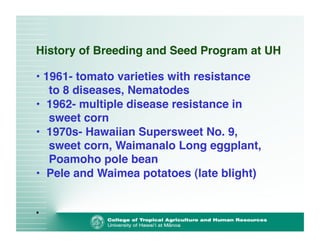
History of Breeding and Seed Program at UH 
• 1961- tomato varieties with resistance 
to 8 diseases, Nematodes! 
• 1962- multiple disease resistance in 
sweet corn! 
• 1970s- Hawaiian Supersweet No. 9, 
sweet corn, Waimanalo Long eggplant,! 
Poamoho pole bean! 
• Pele and Waimea potatoes (late blight)! 
•
UH Tomato: some Disease resistance traits 
• Root-knot nematode! 
• Tomato Spotted Wilt Virus! 
• Fusarium Wilt! 
• Stemphylium leaf spot! 
• Cladosporium, leaf mold! 
• Spider Mites! 
• Short internodes
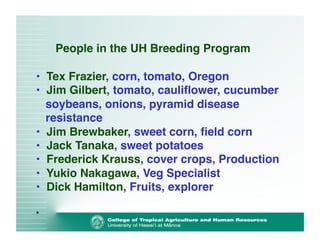
People in the UH Breeding Program 
• Tex Frazier, corn, tomato, Oregon! 
• Jim Gilbert, tomato, cauliflower, cucumber 
soybeans, onions, pyramid disease 
resistance! 
• Jim Brewbaker, sweet corn, field corn! 
• Jack Tanaka, sweet potatoes! 
• Frederick Krauss, cover crops, Production! 
• Yukio Nakagawa, Veg Specialist! 
• Dick Hamilton, Fruits, explorer! 
•
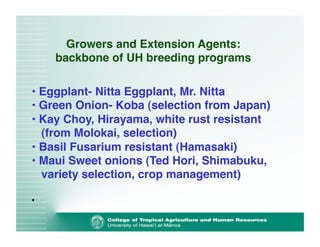
Growers and Extension Agents: 
backbone of UH breeding programs 
• Eggplant- Nitta Eggplant, Mr. Nitta! 
• Green Onion- Koba (selection from Japan)! 
• Kay Choy, Hirayama, white rust resistant 
(from Molokai, selection)! 
• Basil Fusarium resistant (Hamasaki)! 
• Maui Sweet onions (Ted Hori, Shimabuku, 
variety selection, crop management)! 
•
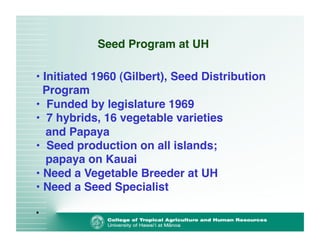
Seed Program at UH 
• Initiated 1960 (Gilbert), Seed Distribution 
Program! 
• Funded by legislature 1969! 
• 7 hybrids, 16 vegetable varieties 
and Papaya! 
• Seed production on all islands; 
papaya on Kauai! 
• Need a Vegetable Breeder at UH! 
• Need a Seed Specialist! 
•
Seed Programs 
• Public, Government 
• Private (narrow germplasm) 
• Artisanal or Informal 
(diverse germplasm) 
Home-gardening 
Indigenous 
Community
Decline of Public Breeding 
Programs 
• decline over past 40-50 years 
• Nationally and in Hawaii 
• Land-grant universities shifted 
to produce ‘products’ that were 
more profitable, royalties, patents 
• less classical breeders, more 
molecular biologists
Alternative Breeding 
Programs 
• Public breeding initiatives, 
participatory models 
eg Organic Seed Alliance & Cornell 
• Plant breeding clubs 
• Seed Saving Networks
Hawaii Statewide Seed Assessment 
SurveyMonkey.com 
N= 128 responses
Farm Size in Survey 
• Range= 0-250 Acres 
• Most farms= 1 Acre 
• Average size= 10 Acres 
• Larger farms= 250, 
195, 75, 10-20
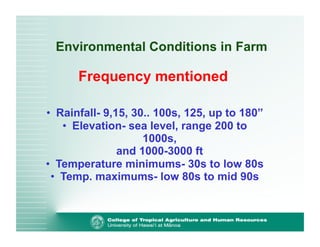
Environmental Conditions in Farm 
Frequency mentioned 
• Rainfall- 9,15, 30.. 100s, 125, up to 180” 
• Elevation- sea level, range 200 to 
1000s, 
and 1000-3000 ft 
• Temperature minimums- 30s to low 80s 
• Temp. maximums- low 80s to mid 90s
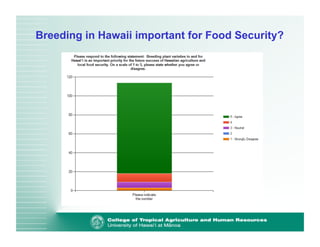
Breeding in Hawaii important for Food Security?
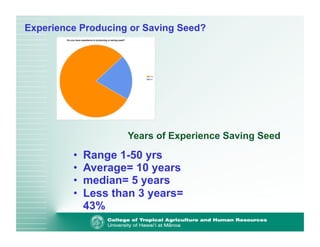
Experience Producing or Saving Seed? 
Years of Experience Saving Seed 
• Range 1-50 yrs 
• Average= 10 years 
• median= 5 years 
• Less than 3 years= 
43%
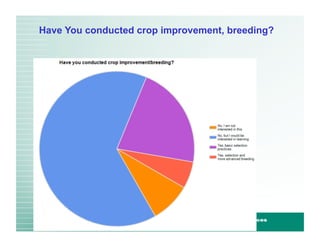
Have You conducted crop improvement, breeding?
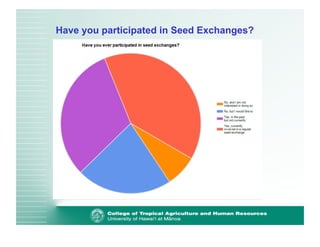
Have you participated in Seed Exchanges?
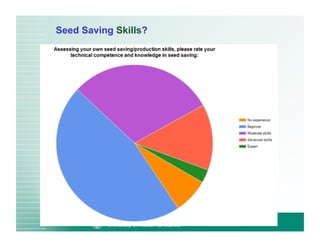
Seed Saving Skills?
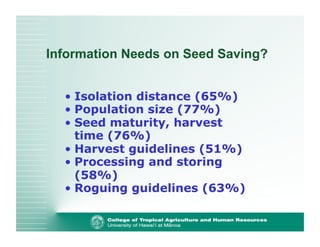
Information Needs on Seed Saving? 
• Isolation distance (65%) 
• Population size (77%) 
• Seed maturity, harvest 
time (76%) 
• Harvest guidelines (51%) 
• Processing and storing 
(58%) 
• Roguing guidelines (63%)
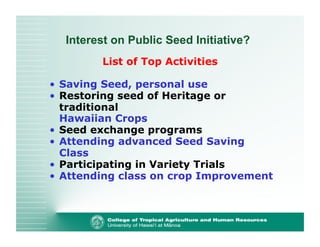
Interest on Public Seed Initiative? 
List of Top Activities 
• Saving Seed, personal use 
• Restoring seed of Heritage or 
traditional 
Hawaiian Crops 
• Seed exchange programs 
• Attending advanced Seed Saving 
Class 
• Participating in Variety Trials 
• Attending class on crop Improvement
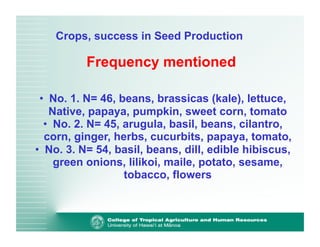
Crops, success in Seed Production 
Frequency mentioned 
• No. 1. N= 46, beans, brassicas (kale), lettuce, 
Native, papaya, pumpkin, sweet corn, tomato 
• No. 2. N= 45, arugula, basil, beans, cilantro, 
corn, ginger, herbs, cucurbits, papaya, tomato, 
• No. 3. N= 54, basil, beans, dill, edible hibiscus, 
green onions, lilikoi, maile, potato, sesame, 
tobacco, flowers
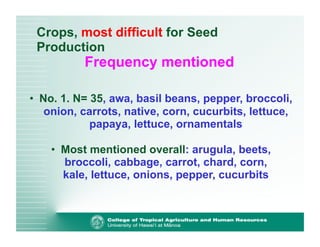
Crops, most difficult for Seed 
Production 
Frequency mentioned 
• No. 1. N= 35, awa, basil beans, pepper, broccoli, 
onion, carrots, native, corn, cucurbits, lettuce, 
papaya, lettuce, ornamentals 
• Most mentioned overall: arugula, beets, 
broccoli, cabbage, carrot, chard, corn, 
kale, lettuce, onions, pepper, cucurbits
Goal of Variety Trials 
• Expression of the plant due to genetics 
or to the environment! 
• ID varieties adapted to the land 
(replace inputs with well adapted varieties)
Experimental Design 
• Observational (non-replicated) trials: 
screen varieties, ! 
evaluate sources, check trueness to type! 
vs! 
• Replicated trials ! 
(results are not due to environment alone)!
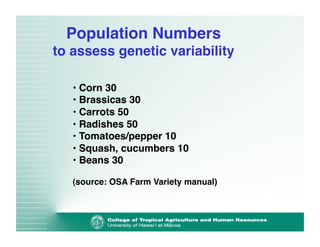
Population Numbers 
to assess genetic variability" 
• Corn 30! 
• Brassicas 30! 
• Carrots 50! 
• Radishes 50! 
• Tomatoes/pepper 10! 
• Squash, cucumbers 10! 
• Beans 30! 
(source: OSA Farm Variety manual)!
Consistent Treatments" 
• Growing seedlings! 
• Transplanting/planting! 
• Irrigation! 
• Cultivation! 
• Fertilization! 
• Pest management! 
• Harvesting!
Trial Evaluation" 
• Log sheet 
• scoring (index) vs measuring! 
Scoring may be more valuable 
and quicker-! 
• All on same date, scoring system! 
Scale of 1-9 ! 
(1= least, 9= most desirable),!
Collaborative Research Trials" 
Hawaii Trial Network, on different islands 
to compare several microclimates and 
production niches; trial database with 
trial network to follow performance 
on different microclimates.! 
(Micaela Colley, HI Public Seed Conf. 2010)! 
• Lettuce! 
• Tomato!
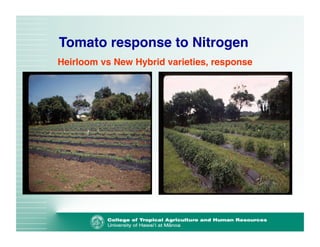
Tomato response to Nitrogen 
Heirloom vs New Hybrid varieties, response
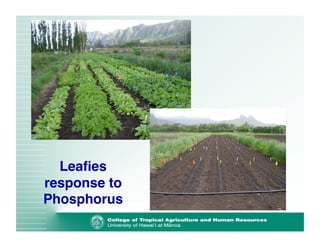
Leafies 
response to 
Phosphorus
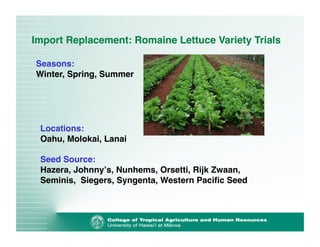
Import Replacement: Romaine Lettuce Variety Trials 
Seasons:! 
Winter, Spring, Summer! 
Locations:! 
Oahu, Molokai, Lanai! 
Seed Source:! 
Hazera, Johnnyʼs, Nunhems, Orsetti, Rijk Zwaan, 
Seminis, Siegers, Syngenta, Western Pacific Seed !
cv Lital (Hazera)! 
(Spring, cooler months, light green foliage)! 
cv Brave Heart (Seminis)! 
(Molokai, Spring, cooler months)! 
cv Concept (Johnnyʼs)! 
(Summer Poamoho)! 
Bamby (Johnnyʼs)! 
(baby, specialty, cooler?, Waimea)!
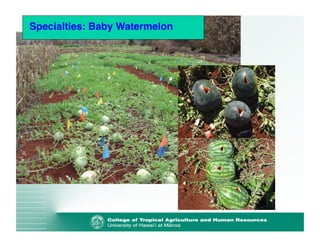
Specialties: Baby Watermelon
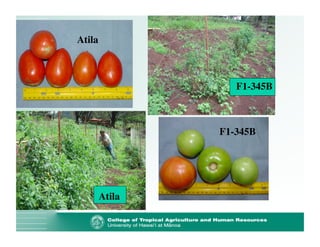
Atila 
Atila 
F1-345B 
F1-345B

History of Seed Production and Breeding in Hawaii

  • 1.
    History of Seed Production and Breeding in Hawaii Héctor Valenzuela UH-Manoa hector@hawaii.edu http://www2.hawaii.edu/~hector/ http://www.ctahr.hawaii.edu/organic/
  • 2.
    History of Breedingand Seed Program at UH • 1918, sweetpotato, head lettuce, Cheung! • WWII Victory Gardens! • 1940s- formal breeding work WA Frazier ʻPearl Harborʼ tomato 1945! • 1940s- tomato, Hawaiian Wonder pole bean, ʻLine-5ʼ Solo papaya, Tomatoes, ʻNiihauʼ, ʻKauaiʼ, ʻOahuʼ, ʻMauiʼ, ʻLanaiʼ, ʻMolokaiʼ, ʻHawaiiʼ! •
  • 3.
    History of Breedingand Seed Program at UH • 1950s, Anuenue lettuce, Onolena sweetpotato Anahu tomato, Puakea cauliflower, Manoa sugar pea (powdery mildew), N-tomato hybrids, Kulanui head lettuce,! • 1960s- Awahia onion (pungent), Healani tomato, sweet corn, soybean, Hawaii Long eggplant, Manoa Wonder pole beans, !
  • 4.
    History of Breedingand Seed Program at UH • 1961- tomato varieties with resistance to 8 diseases, Nematodes! • 1962- multiple disease resistance in sweet corn! • 1970s- Hawaiian Supersweet No. 9, sweet corn, Waimanalo Long eggplant,! Poamoho pole bean! • Pele and Waimea potatoes (late blight)! •
  • 5.
    UH Tomato: someDisease resistance traits • Root-knot nematode! • Tomato Spotted Wilt Virus! • Fusarium Wilt! • Stemphylium leaf spot! • Cladosporium, leaf mold! • Spider Mites! • Short internodes
  • 6.
    People in theUH Breeding Program • Tex Frazier, corn, tomato, Oregon! • Jim Gilbert, tomato, cauliflower, cucumber soybeans, onions, pyramid disease resistance! • Jim Brewbaker, sweet corn, field corn! • Jack Tanaka, sweet potatoes! • Frederick Krauss, cover crops, Production! • Yukio Nakagawa, Veg Specialist! • Dick Hamilton, Fruits, explorer! •
  • 7.
    Growers and ExtensionAgents: backbone of UH breeding programs • Eggplant- Nitta Eggplant, Mr. Nitta! • Green Onion- Koba (selection from Japan)! • Kay Choy, Hirayama, white rust resistant (from Molokai, selection)! • Basil Fusarium resistant (Hamasaki)! • Maui Sweet onions (Ted Hori, Shimabuku, variety selection, crop management)! •
  • 8.
    Seed Program atUH • Initiated 1960 (Gilbert), Seed Distribution Program! • Funded by legislature 1969! • 7 hybrids, 16 vegetable varieties and Papaya! • Seed production on all islands; papaya on Kauai! • Need a Vegetable Breeder at UH! • Need a Seed Specialist! •
  • 9.
    Seed Programs •Public, Government • Private (narrow germplasm) • Artisanal or Informal (diverse germplasm) Home-gardening Indigenous Community
  • 10.
    Decline of PublicBreeding Programs • decline over past 40-50 years • Nationally and in Hawaii • Land-grant universities shifted to produce ‘products’ that were more profitable, royalties, patents • less classical breeders, more molecular biologists
  • 11.
    Alternative Breeding Programs • Public breeding initiatives, participatory models eg Organic Seed Alliance & Cornell • Plant breeding clubs • Seed Saving Networks
  • 12.
    Hawaii Statewide SeedAssessment SurveyMonkey.com N= 128 responses
  • 13.
    Farm Size inSurvey • Range= 0-250 Acres • Most farms= 1 Acre • Average size= 10 Acres • Larger farms= 250, 195, 75, 10-20
  • 14.
    Environmental Conditions inFarm Frequency mentioned • Rainfall- 9,15, 30.. 100s, 125, up to 180” • Elevation- sea level, range 200 to 1000s, and 1000-3000 ft • Temperature minimums- 30s to low 80s • Temp. maximums- low 80s to mid 90s
  • 15.
    Breeding in Hawaiiimportant for Food Security?
  • 16.
    Experience Producing orSaving Seed? Years of Experience Saving Seed • Range 1-50 yrs • Average= 10 years • median= 5 years • Less than 3 years= 43%
  • 17.
    Have You conductedcrop improvement, breeding?
  • 18.
    Have you participatedin Seed Exchanges?
  • 19.
  • 20.
    Information Needs onSeed Saving? • Isolation distance (65%) • Population size (77%) • Seed maturity, harvest time (76%) • Harvest guidelines (51%) • Processing and storing (58%) • Roguing guidelines (63%)
  • 21.
    Interest on PublicSeed Initiative? List of Top Activities • Saving Seed, personal use • Restoring seed of Heritage or traditional Hawaiian Crops • Seed exchange programs • Attending advanced Seed Saving Class • Participating in Variety Trials • Attending class on crop Improvement
  • 22.
    Crops, success inSeed Production Frequency mentioned • No. 1. N= 46, beans, brassicas (kale), lettuce, Native, papaya, pumpkin, sweet corn, tomato • No. 2. N= 45, arugula, basil, beans, cilantro, corn, ginger, herbs, cucurbits, papaya, tomato, • No. 3. N= 54, basil, beans, dill, edible hibiscus, green onions, lilikoi, maile, potato, sesame, tobacco, flowers
  • 23.
    Crops, most difficultfor Seed Production Frequency mentioned • No. 1. N= 35, awa, basil beans, pepper, broccoli, onion, carrots, native, corn, cucurbits, lettuce, papaya, lettuce, ornamentals • Most mentioned overall: arugula, beets, broccoli, cabbage, carrot, chard, corn, kale, lettuce, onions, pepper, cucurbits
  • 25.
    Goal of VarietyTrials • Expression of the plant due to genetics or to the environment! • ID varieties adapted to the land (replace inputs with well adapted varieties)
  • 26.
    Experimental Design •Observational (non-replicated) trials: screen varieties, ! evaluate sources, check trueness to type! vs! • Replicated trials ! (results are not due to environment alone)!
  • 27.
    Population Numbers toassess genetic variability" • Corn 30! • Brassicas 30! • Carrots 50! • Radishes 50! • Tomatoes/pepper 10! • Squash, cucumbers 10! • Beans 30! (source: OSA Farm Variety manual)!
  • 28.
    Consistent Treatments" •Growing seedlings! • Transplanting/planting! • Irrigation! • Cultivation! • Fertilization! • Pest management! • Harvesting!
  • 29.
    Trial Evaluation" •Log sheet • scoring (index) vs measuring! Scoring may be more valuable and quicker-! • All on same date, scoring system! Scale of 1-9 ! (1= least, 9= most desirable),!
  • 30.
    Collaborative Research Trials" Hawaii Trial Network, on different islands to compare several microclimates and production niches; trial database with trial network to follow performance on different microclimates.! (Micaela Colley, HI Public Seed Conf. 2010)! • Lettuce! • Tomato!
  • 31.
    Tomato response toNitrogen Heirloom vs New Hybrid varieties, response
  • 32.
  • 33.
    Import Replacement: RomaineLettuce Variety Trials Seasons:! Winter, Spring, Summer! Locations:! Oahu, Molokai, Lanai! Seed Source:! Hazera, Johnnyʼs, Nunhems, Orsetti, Rijk Zwaan, Seminis, Siegers, Syngenta, Western Pacific Seed !
  • 34.
    cv Lital (Hazera)! (Spring, cooler months, light green foliage)! cv Brave Heart (Seminis)! (Molokai, Spring, cooler months)! cv Concept (Johnnyʼs)! (Summer Poamoho)! Bamby (Johnnyʼs)! (baby, specialty, cooler?, Waimea)!
  • 35.
  • 36.