GMO Technology-
Understanding Evidence of
Risks and Benefits
Kevin M. Folta
Professor and Chairman
Horticultural Sciences Department
kfolta.blogspot.com
@kevinfolta
kevinfolta@gmail.com
My main job:
Chairman of the Horticultural Sciences Department (Fruit and Veg crops)
56 Faculty over six locations throughout the state
-Breeding / new varieties
-Crop physiology and production
-Molecular genetics
-Genomics
-Organic and sustainable production
-Weed science
-Plant nutrition, water use
-Space biology
-Cell and developmental biology
-Postharvest physiology
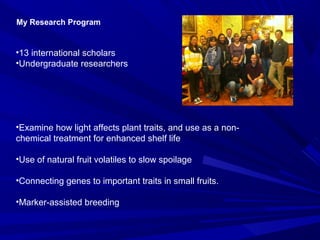
•13 international scholars
•Undergraduate researchers
•Examine how light affects plant traits, and use as a non-
chemical treatment for enhanced shelf life
•Use of natural fruit volatiles to slow spoilage
•Connecting genes to important traits in small fruits.
•Marker-assisted breeding
My Research Program
Biotechnology Communication
•What this technology is.
•Why there is there so much
misinformation about good technology?
•How to communicate the facts
effectively.
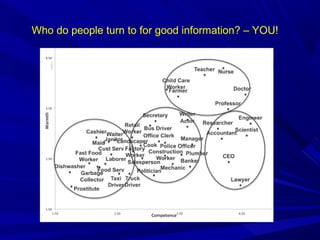
Who do people turn to for good information? – YOU!
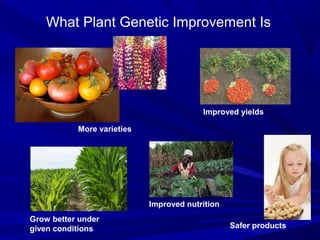
What Plant Genetic Improvement Is
More varieties
Grow better under
given conditions
Improved yields
Safer products
Improved nutrition
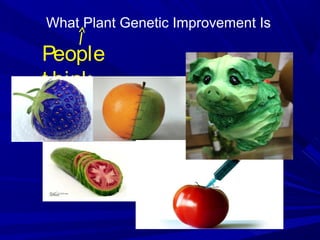
What Plant Genetic Improvement Is
People
t hink
Improved yields
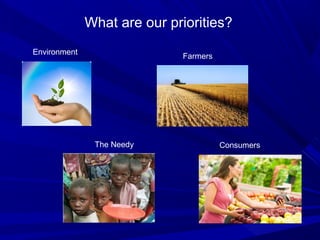
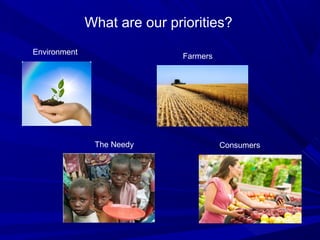
What are our priorities?
Farmers
The Needy
Environment
Consumers
What transgenic technology is.What transgenic technology is.
Elevator Points
Transgenic crop technology (familiar “GMO”) is a precise extension
of conventional plant breeding.
“The techniques used pose no more risk (actually less risk) than
conventional breeding.” (NAS, AAAS, AMA, EFSA many others)
In over 18 years of use there has not been one case of illness or
death related to these products
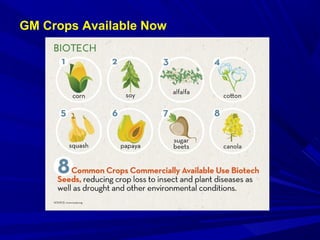
There are several traits used in only eight commercial crops
These are the most well studied and extensively tested plant
products in history.
GM Crops Available Now
Transgenic crop technology (familiar
“GMO”) is a precise extension of
conventional plant breeding.
What is “Natural”?
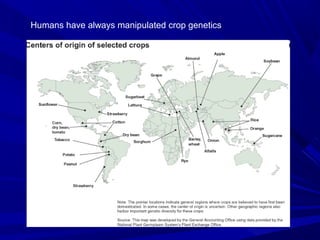
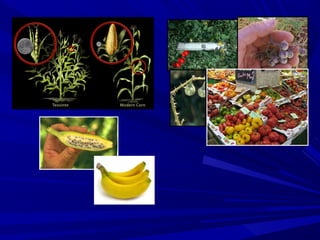
Humans have always manipulated crop genetics
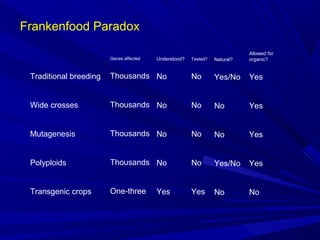
Frankenfood Paradox
Traditional breeding
Wide crosses
Mutagenesis
Polyploids
Transgenic crops
Genes affected
Thousands
Thousands
Thousands
Thousands
One-three
Understood?
No
No
No
No
Yes
Tested?
No
No
No
No
Yes
Natural?
Yes/No
No
No
Yes/No
No
Allowed for
organic?
Yes
Yes
Yes
Yes
No
How do you get a gene into a plant?
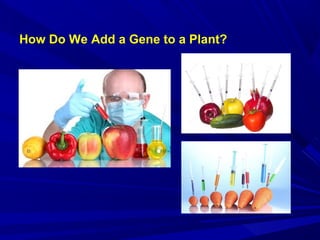
How Do We Add a Gene to a Plant?
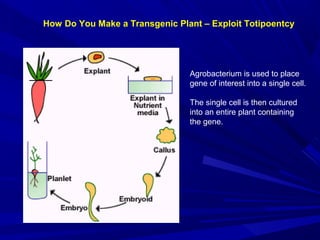
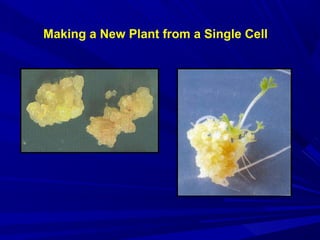
How Do You Make a Transgenic Plant – Exploit Totipoentcy
Agrobacterium is used to place
gene of interest into a single cell.
The single cell is then cultured
into an entire plant containing
the gene.
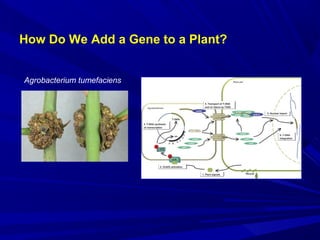
How Do We Add a Gene to a Plant?
Agrobacterium tumefaciens
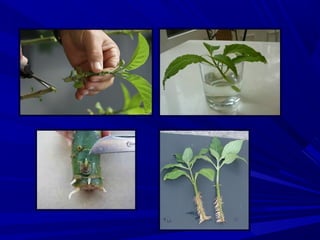
Making a New Plant from a Single Cell
CriticismsCriticisms
The T-DNA insertion is unpredictable, you don’t knowThe T-DNA insertion is unpredictable, you don’t know
about unintended consequences.about unintended consequences.
The T-DNA insertion is unpredictable, you don’t knowThe T-DNA insertion is unpredictable, you don’t know
about unintended consequences.about unintended consequences.
Today every plant is sequenced and we know exactly were T-DNAs areToday every plant is sequenced and we know exactly were T-DNAs are
located in the genomelocated in the genome
Genetic improvement companies select insertions in apparently benignGenetic improvement companies select insertions in apparently benign
areas of the genomeareas of the genome
T-DNA insertion is a natural process and is found in crops like sweetT-DNA insertion is a natural process and is found in crops like sweet
potatopotato
There are few insertions and they don’t move. Little chance of inducingThere are few insertions and they don’t move. Little chance of inducing
change relative to viruses, etc– genomes are dynamic.change relative to viruses, etc– genomes are dynamic.
CriticismsCriticisms
The T-DNA insertion is unpredictable, you don’t knowThe T-DNA insertion is unpredictable, you don’t know
about unintended consequences.about unintended consequences.
The traits are dangerous. Who wants to eat a pesticide?The traits are dangerous. Who wants to eat a pesticide?
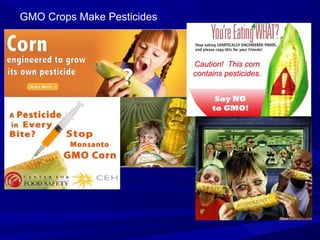
GMO Crops Make Pesticides
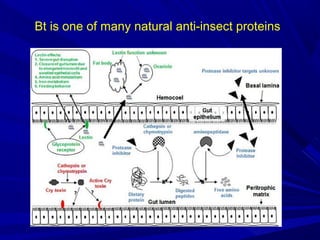
Bt is one of many natural anti-insect proteins
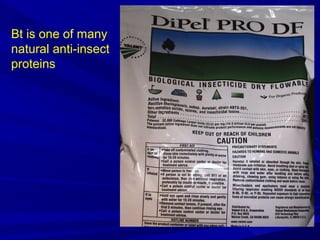
Bt is one of many
natural anti-insect
proteins
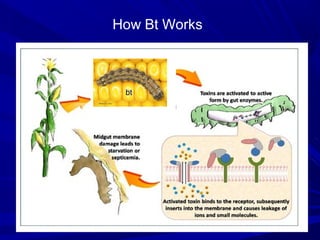
How Bt Works
bt
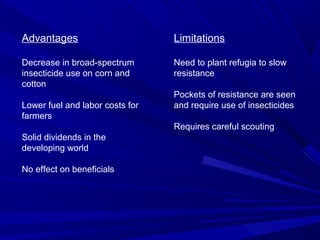
Advantages
Decrease in broad-spectrum
insecticide use on corn and
cotton
Lower fuel and labor costs for
farmers
Solid dividends in the
developing world
No effect on beneficials
Limitations
Need to plant refugia to slow
resistance
Pockets of resistance are seen
and require use of insecticides
Requires careful scouting
CriticismsCriticisms
The T-DNA insertion is unpredictable, you don’t knowThe T-DNA insertion is unpredictable, you don’t know
about unintended consequences.about unintended consequences.
The traits are dangerous. Who wants to eat a pesticide?The traits are dangerous. Who wants to eat a pesticide?
The Rounup-resistance trait is dangerous and roundupThe Rounup-resistance trait is dangerous and roundup
causes cancercauses cancer
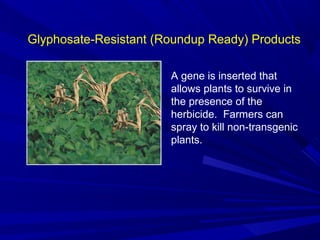
Glyphosate-Resistant (Roundup Ready) Products
A gene is inserted that
allows plants to survive in
the presence of the
herbicide. Farmers can
spray to kill non-transgenic
plants.
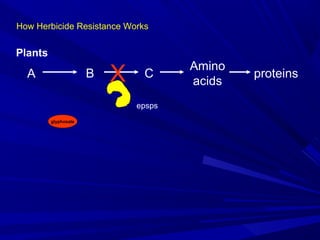
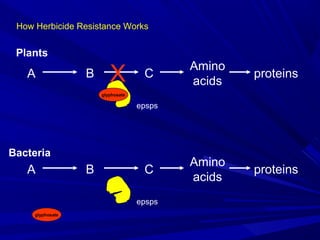
How Herbicide Resistance Works
A B C
Amino
acids
proteins
epsps
glyphosate
X
Plants
How Herbicide Resistance Works
A B C
Amino
acids
proteins
epsps
glyphosate
X
A B C
Amino
acids
proteins
epsps
Plants
Bacteria
glyphosate
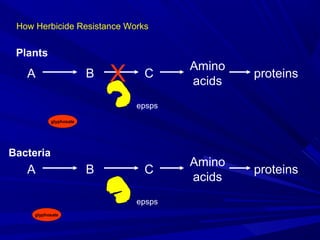
How Herbicide Resistance Works
A B C
Amino
acids
proteins
epsps
epsps
Plants
X
glyphosate
A B C
Amino
acids
proteins
Bacteria
glyphosate
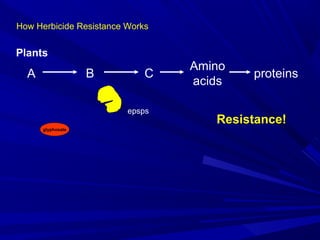
How Herbicide Resistance Works
A B C
Amino
acids
proteins
epsps
Plants
glyphosate
Resistance!
Advantages
Switch to a low-toxicity
herbicide, cheap and effective
Lower fuel and labor costs for
farmers
Decreased tilling, saved
topsoil
Limitations
Weeds can evolve resistance,
requiring increased labor, lower
yields, and new control
strategies. New chemistries.
What is Glyphosate?
Non-selective herbicide. Kills all plants.
Pathway not present in animals
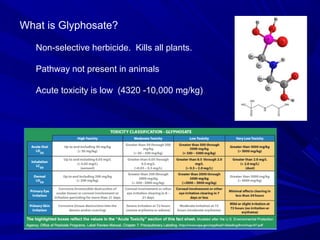
Acute toxicity is low (4320 -10,000 mg/kg)
What is Glyphosate?
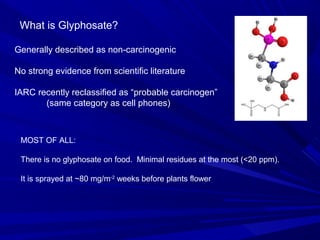
Generally described as non-carcinogenic
No strong evidence from scientific literature
IARC recently reclassified as “probable carcinogen”
(same category as cell phones)
MOST OF ALL:
There is no glyphosate on food. Minimal residues at the most (<20 ppm).
It is sprayed at ~80 mg/m-2
weeks before plants flower
CriticismsCriticisms
The T-DNA insertion is unpredictable, you don’t knowThe T-DNA insertion is unpredictable, you don’t know
about unintended consequences.about unintended consequences.
The traits are dangerous. Who wants to eat a pesticide?The traits are dangerous. Who wants to eat a pesticide?
The Rounup-resistance trait is dangerous and roundupThe Rounup-resistance trait is dangerous and roundup
causes cancercauses cancer
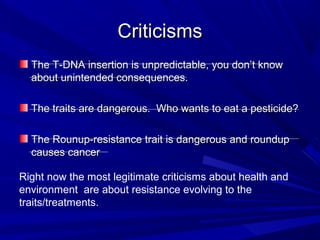
Right now the most legitimate criticisms about health and
environment are about resistance evolving to the
traits/treatments.
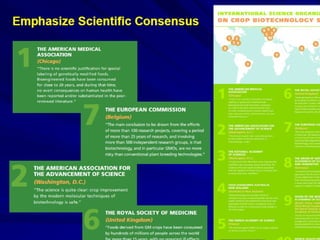
What does the scientific consensus say?
This not a scientific debate.
- benefits far outweigh limitations and new solutions are
coming.
This is not a farming debate.
-farmers freely choose the technology because it works.
This is a SOCIAL debate
- kind people concerned about their food and health are
subject to manipulation by those with financial or political
motivations.
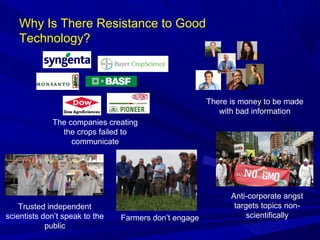
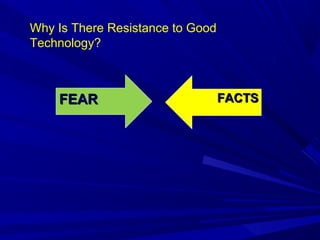
Why Is There Resistance to Good
Technology?
The companies creating
the crops failed to
communicate
Trusted independent
scientists don’t speak to the
public
There is money to be made
with bad information
Farmers don’t engage
Anti-corporate angst
targets topics non-
scientifically
FEARFEAR FACTSFACTS
Why Is There Resistance to Good
Technology?
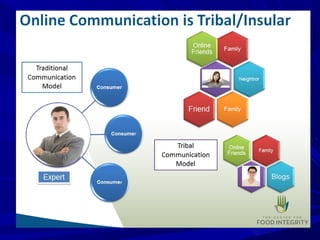
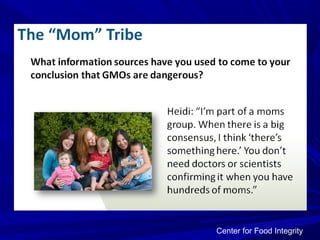
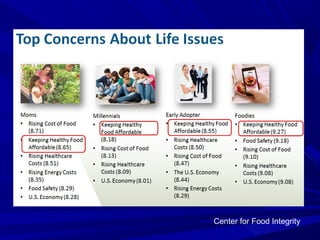
Why is there even a problem?
How do we fix the
problem?
Center for Food Integrity
Effects
Does it really matter? Why not just let people
assume it is dangerous?
--- mistrust of good food
--- higher costs
--- bad, expensive public policy changes
--- slowing the development of helpful technologies
Misinformation harms development and
deployment of helpful technology
We have, completed, tested plants that can:
Help farmers save labor, fuel, water, fertilizer, other
inputs.
Biofortify foods with vitamins, minerals, phytonutrients
Grow plants in marginal areas
Grow plants with fewer inputs
Efficient use of fertilizers
Insect resistance
Disease resistance
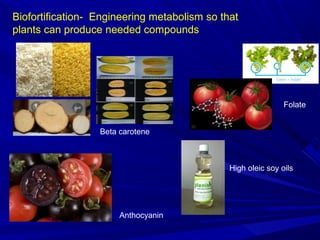
Biofortification- Engineering metabolism so that
plants can produce needed compounds
Beta carotene
Folate
Anthocyanin
High oleic soy oils
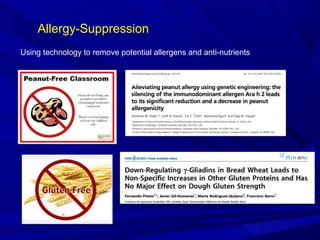
Allergy-Suppression
Using technology to remove potential allergens and anti-nutrients
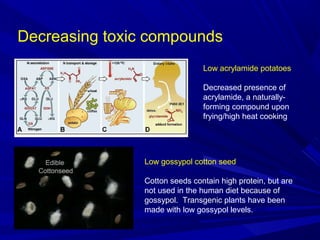
Decreasing toxic compounds
Low acrylamide potatoes
Decreased presence of
acrylamide, a naturally-
forming compound upon
frying/high heat cooking
Low gossypol cotton seed
Cotton seeds contain high protein, but are
not used in the human diet because of
gossypol. Transgenic plants have been
made with low gossypol levels.
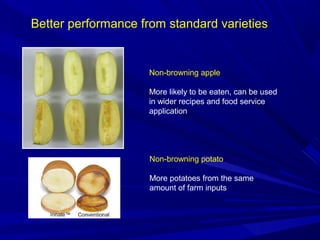
Better performance from standard varieties
Non-browning apple
More likely to be eaten, can be used
in wider recipes and food service
application
Non-browning potato
More potatoes from the same
amount of farm inputs
There are many more solutions
to pressing ag problems, yet
few are being developed.
How do we help solve the problem?
Physicians and dietitians are key in this discussion (trust +
contact)
Always discuss from a point of shared values
The effects of non-action
Emphasize the basics
No problems in 18 years of use
A precise extension of plant breeding
Strong scientific consensus
Workshops! May 11, 2015 at UF, will live stream
What are our priorities?
Farmers
The Needy
Environment
Consumers
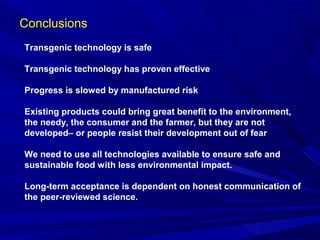
Conclusions
Transgenic technology is safe
Transgenic technology has proven effective
Progress is slowed by manufactured risk
Existing products could bring great benefit to the environment,
the needy, the consumer and the farmer, but they are not
developed– or people resist their development out of fear
We need to use all technologies available to ensure safe and
sustainable food with less environmental impact.
Long-term acceptance is dependent on honest communication of
the peer-reviewed science.
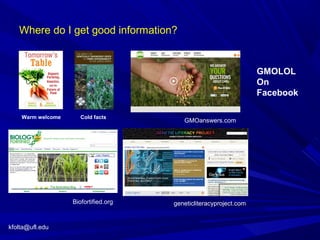
Where do I get good information?
Warm welcome Cold facts
kfolta@ufl.edu
GMOanswers.com
Biofortified.org geneticliteracyproject.com
GMOLOL
On
Facebook
Thank you
kfolta.blogspot.com
@kevinfolta
kevinfolta@gmail.com
"There is a path to truth and sincerity
that you must guard and defend“
-- Teruyuki Okazaki It is our mission to stand up for the truth
that science gives us.
Dr. Jack Payne
SVP UF/IFAS

GMO Technology - Understanding the Evidence of Risks and Benefits

  • 1.
    GMO Technology- Understanding Evidenceof Risks and Benefits Kevin M. Folta Professor and Chairman Horticultural Sciences Department kfolta.blogspot.com @kevinfolta kevinfolta@gmail.com
  • 2.
    My main job: Chairmanof the Horticultural Sciences Department (Fruit and Veg crops) 56 Faculty over six locations throughout the state -Breeding / new varieties -Crop physiology and production -Molecular genetics -Genomics -Organic and sustainable production -Weed science -Plant nutrition, water use -Space biology -Cell and developmental biology -Postharvest physiology
  • 3.
    •13 international scholars •Undergraduateresearchers •Examine how light affects plant traits, and use as a non- chemical treatment for enhanced shelf life •Use of natural fruit volatiles to slow spoilage •Connecting genes to important traits in small fruits. •Marker-assisted breeding My Research Program
  • 4.
    Biotechnology Communication •What thistechnology is. •Why there is there so much misinformation about good technology? •How to communicate the facts effectively.
  • 5.
    Who do peopleturn to for good information? – YOU!
  • 6.
    What Plant GeneticImprovement Is More varieties Grow better under given conditions Improved yields Safer products Improved nutrition
  • 7.
    What Plant GeneticImprovement Is People t hink Improved yields
  • 8.
    What are ourpriorities? Farmers The Needy Environment Consumers
  • 9.
    What transgenic technologyis.What transgenic technology is.
  • 10.
    Elevator Points Transgenic croptechnology (familiar “GMO”) is a precise extension of conventional plant breeding. “The techniques used pose no more risk (actually less risk) than conventional breeding.” (NAS, AAAS, AMA, EFSA many others) In over 18 years of use there has not been one case of illness or death related to these products There are several traits used in only eight commercial crops These are the most well studied and extensively tested plant products in history.
  • 11.
  • 12.
    Transgenic crop technology(familiar “GMO”) is a precise extension of conventional plant breeding. What is “Natural”?
  • 13.
    Humans have alwaysmanipulated crop genetics
  • 15.
    Frankenfood Paradox Traditional breeding Widecrosses Mutagenesis Polyploids Transgenic crops Genes affected Thousands Thousands Thousands Thousands One-three Understood? No No No No Yes Tested? No No No No Yes Natural? Yes/No No No Yes/No No Allowed for organic? Yes Yes Yes Yes No
  • 16.
    How do youget a gene into a plant?
  • 17.
    How Do WeAdd a Gene to a Plant?
  • 19.
    How Do YouMake a Transgenic Plant – Exploit Totipoentcy Agrobacterium is used to place gene of interest into a single cell. The single cell is then cultured into an entire plant containing the gene.
  • 20.
    How Do WeAdd a Gene to a Plant? Agrobacterium tumefaciens
  • 21.
    Making a NewPlant from a Single Cell
  • 22.
    CriticismsCriticisms The T-DNA insertionis unpredictable, you don’t knowThe T-DNA insertion is unpredictable, you don’t know about unintended consequences.about unintended consequences.
  • 23.
    The T-DNA insertionis unpredictable, you don’t knowThe T-DNA insertion is unpredictable, you don’t know about unintended consequences.about unintended consequences. Today every plant is sequenced and we know exactly were T-DNAs areToday every plant is sequenced and we know exactly were T-DNAs are located in the genomelocated in the genome Genetic improvement companies select insertions in apparently benignGenetic improvement companies select insertions in apparently benign areas of the genomeareas of the genome T-DNA insertion is a natural process and is found in crops like sweetT-DNA insertion is a natural process and is found in crops like sweet potatopotato There are few insertions and they don’t move. Little chance of inducingThere are few insertions and they don’t move. Little chance of inducing change relative to viruses, etc– genomes are dynamic.change relative to viruses, etc– genomes are dynamic.
  • 24.
    CriticismsCriticisms The T-DNA insertionis unpredictable, you don’t knowThe T-DNA insertion is unpredictable, you don’t know about unintended consequences.about unintended consequences. The traits are dangerous. Who wants to eat a pesticide?The traits are dangerous. Who wants to eat a pesticide?
  • 25.
    GMO Crops MakePesticides
  • 26.
    Bt is oneof many natural anti-insect proteins
  • 27.
    Bt is oneof many natural anti-insect proteins
  • 28.
  • 29.
    Advantages Decrease in broad-spectrum insecticideuse on corn and cotton Lower fuel and labor costs for farmers Solid dividends in the developing world No effect on beneficials Limitations Need to plant refugia to slow resistance Pockets of resistance are seen and require use of insecticides Requires careful scouting
  • 30.
    CriticismsCriticisms The T-DNA insertionis unpredictable, you don’t knowThe T-DNA insertion is unpredictable, you don’t know about unintended consequences.about unintended consequences. The traits are dangerous. Who wants to eat a pesticide?The traits are dangerous. Who wants to eat a pesticide? The Rounup-resistance trait is dangerous and roundupThe Rounup-resistance trait is dangerous and roundup causes cancercauses cancer
  • 31.
    Glyphosate-Resistant (Roundup Ready)Products A gene is inserted that allows plants to survive in the presence of the herbicide. Farmers can spray to kill non-transgenic plants.
  • 32.
    How Herbicide ResistanceWorks A B C Amino acids proteins epsps glyphosate X Plants
  • 33.
    How Herbicide ResistanceWorks A B C Amino acids proteins epsps glyphosate X A B C Amino acids proteins epsps Plants Bacteria glyphosate
  • 34.
    How Herbicide ResistanceWorks A B C Amino acids proteins epsps epsps Plants X glyphosate A B C Amino acids proteins Bacteria glyphosate
  • 35.
    How Herbicide ResistanceWorks A B C Amino acids proteins epsps Plants glyphosate Resistance!
  • 36.
    Advantages Switch to alow-toxicity herbicide, cheap and effective Lower fuel and labor costs for farmers Decreased tilling, saved topsoil Limitations Weeds can evolve resistance, requiring increased labor, lower yields, and new control strategies. New chemistries.
  • 37.
    What is Glyphosate? Non-selectiveherbicide. Kills all plants. Pathway not present in animals Acute toxicity is low (4320 -10,000 mg/kg)
  • 38.
    What is Glyphosate? Generallydescribed as non-carcinogenic No strong evidence from scientific literature IARC recently reclassified as “probable carcinogen” (same category as cell phones) MOST OF ALL: There is no glyphosate on food. Minimal residues at the most (<20 ppm). It is sprayed at ~80 mg/m-2 weeks before plants flower
  • 39.
    CriticismsCriticisms The T-DNA insertionis unpredictable, you don’t knowThe T-DNA insertion is unpredictable, you don’t know about unintended consequences.about unintended consequences. The traits are dangerous. Who wants to eat a pesticide?The traits are dangerous. Who wants to eat a pesticide? The Rounup-resistance trait is dangerous and roundupThe Rounup-resistance trait is dangerous and roundup causes cancercauses cancer Right now the most legitimate criticisms about health and environment are about resistance evolving to the traits/treatments.
  • 40.
    What does thescientific consensus say?
  • 42.
    This not ascientific debate. - benefits far outweigh limitations and new solutions are coming. This is not a farming debate. -farmers freely choose the technology because it works. This is a SOCIAL debate - kind people concerned about their food and health are subject to manipulation by those with financial or political motivations.
  • 43.
    Why Is ThereResistance to Good Technology? The companies creating the crops failed to communicate Trusted independent scientists don’t speak to the public There is money to be made with bad information Farmers don’t engage Anti-corporate angst targets topics non- scientifically
  • 44.
    FEARFEAR FACTSFACTS Why IsThere Resistance to Good Technology?
  • 45.
    Why is thereeven a problem?
  • 46.
    How do wefix the problem? Center for Food Integrity
  • 47.
    Center for FoodIntegrity
  • 48.
    Effects Does it reallymatter? Why not just let people assume it is dangerous? --- mistrust of good food --- higher costs --- bad, expensive public policy changes --- slowing the development of helpful technologies
  • 49.
    Misinformation harms developmentand deployment of helpful technology We have, completed, tested plants that can: Help farmers save labor, fuel, water, fertilizer, other inputs. Biofortify foods with vitamins, minerals, phytonutrients Grow plants in marginal areas Grow plants with fewer inputs Efficient use of fertilizers Insect resistance Disease resistance
  • 50.
    Biofortification- Engineering metabolismso that plants can produce needed compounds Beta carotene Folate Anthocyanin High oleic soy oils
  • 51.
    Allergy-Suppression Using technology toremove potential allergens and anti-nutrients
  • 52.
    Decreasing toxic compounds Lowacrylamide potatoes Decreased presence of acrylamide, a naturally- forming compound upon frying/high heat cooking Low gossypol cotton seed Cotton seeds contain high protein, but are not used in the human diet because of gossypol. Transgenic plants have been made with low gossypol levels.
  • 53.
    Better performance fromstandard varieties Non-browning apple More likely to be eaten, can be used in wider recipes and food service application Non-browning potato More potatoes from the same amount of farm inputs
  • 54.
    There are manymore solutions to pressing ag problems, yet few are being developed.
  • 55.
    How do wehelp solve the problem? Physicians and dietitians are key in this discussion (trust + contact) Always discuss from a point of shared values The effects of non-action Emphasize the basics No problems in 18 years of use A precise extension of plant breeding Strong scientific consensus Workshops! May 11, 2015 at UF, will live stream
  • 56.
    What are ourpriorities? Farmers The Needy Environment Consumers
  • 57.
    Conclusions Transgenic technology issafe Transgenic technology has proven effective Progress is slowed by manufactured risk Existing products could bring great benefit to the environment, the needy, the consumer and the farmer, but they are not developed– or people resist their development out of fear We need to use all technologies available to ensure safe and sustainable food with less environmental impact. Long-term acceptance is dependent on honest communication of the peer-reviewed science.
  • 58.
    Where do Iget good information? Warm welcome Cold facts kfolta@ufl.edu GMOanswers.com Biofortified.org geneticliteracyproject.com GMOLOL On Facebook
  • 59.
    Thank you kfolta.blogspot.com @kevinfolta kevinfolta@gmail.com "There isa path to truth and sincerity that you must guard and defend“ -- Teruyuki Okazaki It is our mission to stand up for the truth that science gives us. Dr. Jack Payne SVP UF/IFAS