Species Concepts and Speciation Mark McGinley Associate Professor Honors College and Department of Biological Sciences Texas Tech University
Species Concepts Defining “a species”  is not as simple as you might hope There are many different “species concepts”.
Historical Species Concepts Typological Species Concept species are a 'type' of organism  Lineaeus " Species are as many as were created in the beginning by the Infinite. “ Systema Naturae , 10th ed. (1758) establishes a catalog of 4,162 "types"
Historical Species Concepts Nominalistic Species Concept :  a name given for convenience  Darwin " I look at the term species, as one arbitrarily given for the sake of convenience   to a set of individuals closely resembling each other.... “ philosophical  Essentialism Only individuals exist, not universal classes.
Historial/Modern Species Concepts Morphospecies Concept Species traditionally have been described and identified on the basis of morphological criteria  According to this concept, species are “groups of individuals that are morphologically similar and clearly distinguishable from individuals of other groups”
Modern Species Concepts Biological Species Concept   a reproductively isolated population  Mayr " Species are groups of interbreeding natural populations that are reproductively   isolated from other such groups. "        Historically, the most widely used concept among  ecologists        
Biological Species Concept- Key Concepts " Interbreeding : => a  genetic  unit species are  gene pools : a  coadapted gene complex   Members of the same species   resemble each other because they have common ancestors
Biological Species Concept- Key Concepts " Natural Populations " => an  ecological  unit            
Biological Species Concept- Key Concepts " Reproductively isolated " => a  reproductive  unit  Reproductive Isolating Mechanisms  features that prevent mating outside the species Species Recognition Mechanisms features that allow recognition of potential mates
Premating or prezygotic mechanisms Ecological or habitat isolation Seasonal or temporal isolation Sexual or ethological isolation Mechanical isolation Isolation by different pollinators Gametic isolation
Habitat Isolation- Geese
Seasonal Isolation- Frogs
Behavioral Isolation- Crabs
Mechanical Isolation- Insects
Postmating or post-zygotic mechanisms Hybrid inviability Hybrid sterility F1 fails to produce viable gametes Hybrid breakdown F2s or backcrosses have reduced viability
Hybrid sterility- Mule
Reproductive Isolation Summary
Identifying Species Using the Biological Species Concept Biological Species Concept suggests a  research program  that will allow scientists to identify species using this concept the mark of a good theory    
Identifying Species Using the Biological Species Concept (1)  Experiment: test cross A  and  B  interbreed, but neither with  C  =>  A  &  B  are conspecific C  is a separate species
Identifying Species Using the Biological Species Concept (2)  Field observations : a " species gap"  exists  Populations maintain identity when  sympatric  (occuring in the same place)  &   synchronic  (occuring at the same time)           
Odocoileus   hemionus Mule Deer
Odocoileus   virginianus White-tailed Deer
Odocoileus  Distribution
Variation in Morphology
Variation in Behavior O. hemionus   O. virginianus
Lacewings Chrysoperla plorabunda
Lightening Bugs Lampyridae: Hemiptera: Insecta
Firefly Flashing Patterns
Identifying Species Using the Biological Species Concept (3)  Inference : forms  'look different'         Many new species are described from single 'skin & skull' or small series.        Most commonly used criterion: inference is often weak.
Morphological Differences
Geographic Variation in Weasels  Mustela erminea
Feloid ( Panthera ) and Canoid ( Canis)
Identifying Species Using the Biological Species Concept 4) Genetic studies  indicate  no gene flow  between forms         - fixation for  alternative alleles                       - distinct  DNA sequences                 - distinct  karyotypes                      
Evolutionary Species Concept an evolving lineage " An evolutionary species is a single lineage of ancestor-descendant populations   which maintains its identity from other such lineages and which has its own   evolutionary tendencies and historical fate. "    Historically, the most popular concept among  paleontologists .  Used extensively in  comparative biology  &  phylogenetic systematics
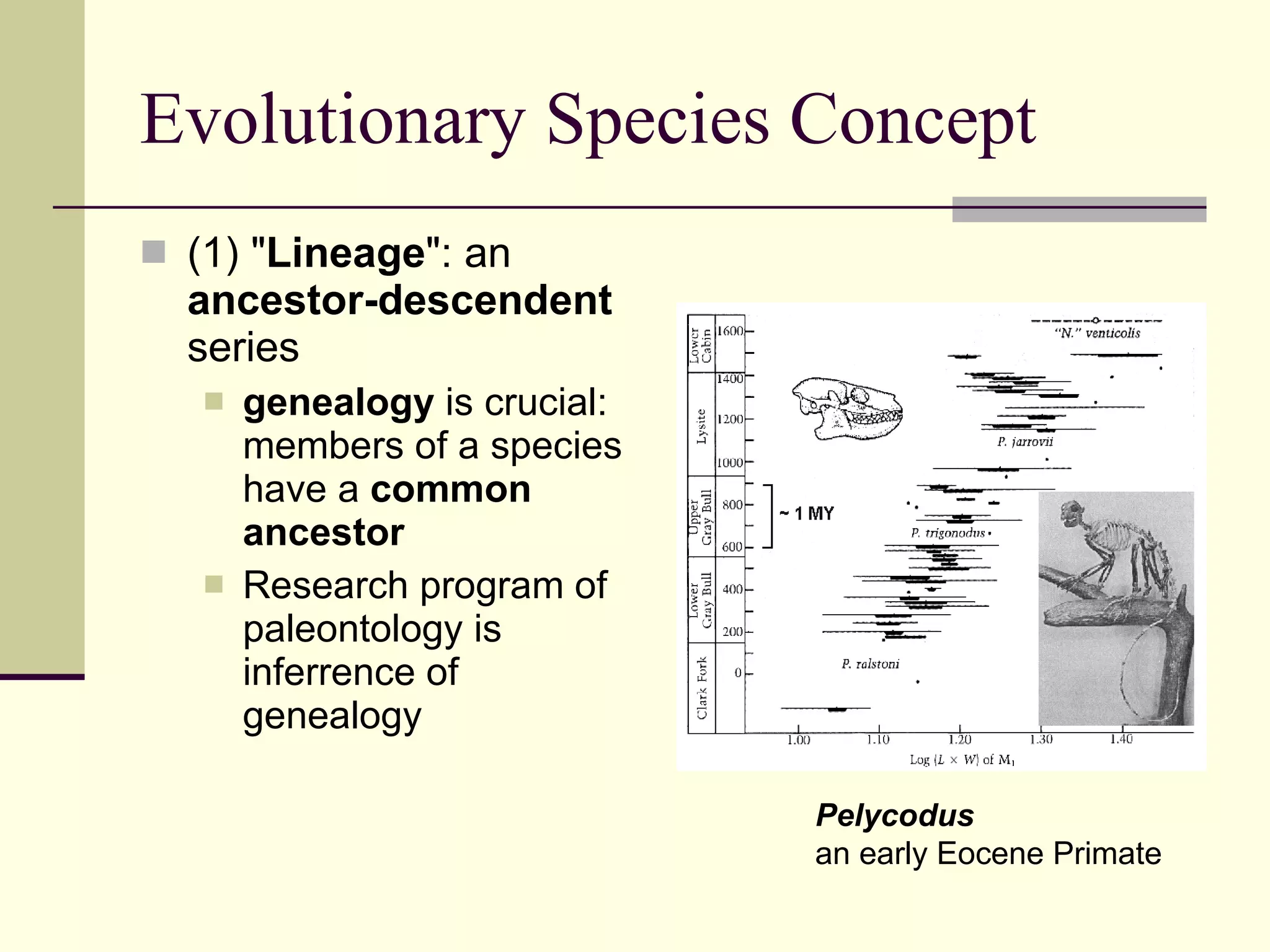
Evolutionary Species Concept (1) " Lineage ": an  ancestor-descendent  series  genealogy  is crucial: members of a species have a  common ancestor Research program of paleontology is inferrence of genealogy          Pelycodus an early Eocene Primate
Evolutionary Species Concept (2) " Identity ": a biologically distinct entity  Includes concepts associated with Biological Species, the Biological Species Concept is the broadest general case of the Evolutionary Species Concept   [ i.e. , a  biological  species is an  evolutionary  species at a partcular point in time]        
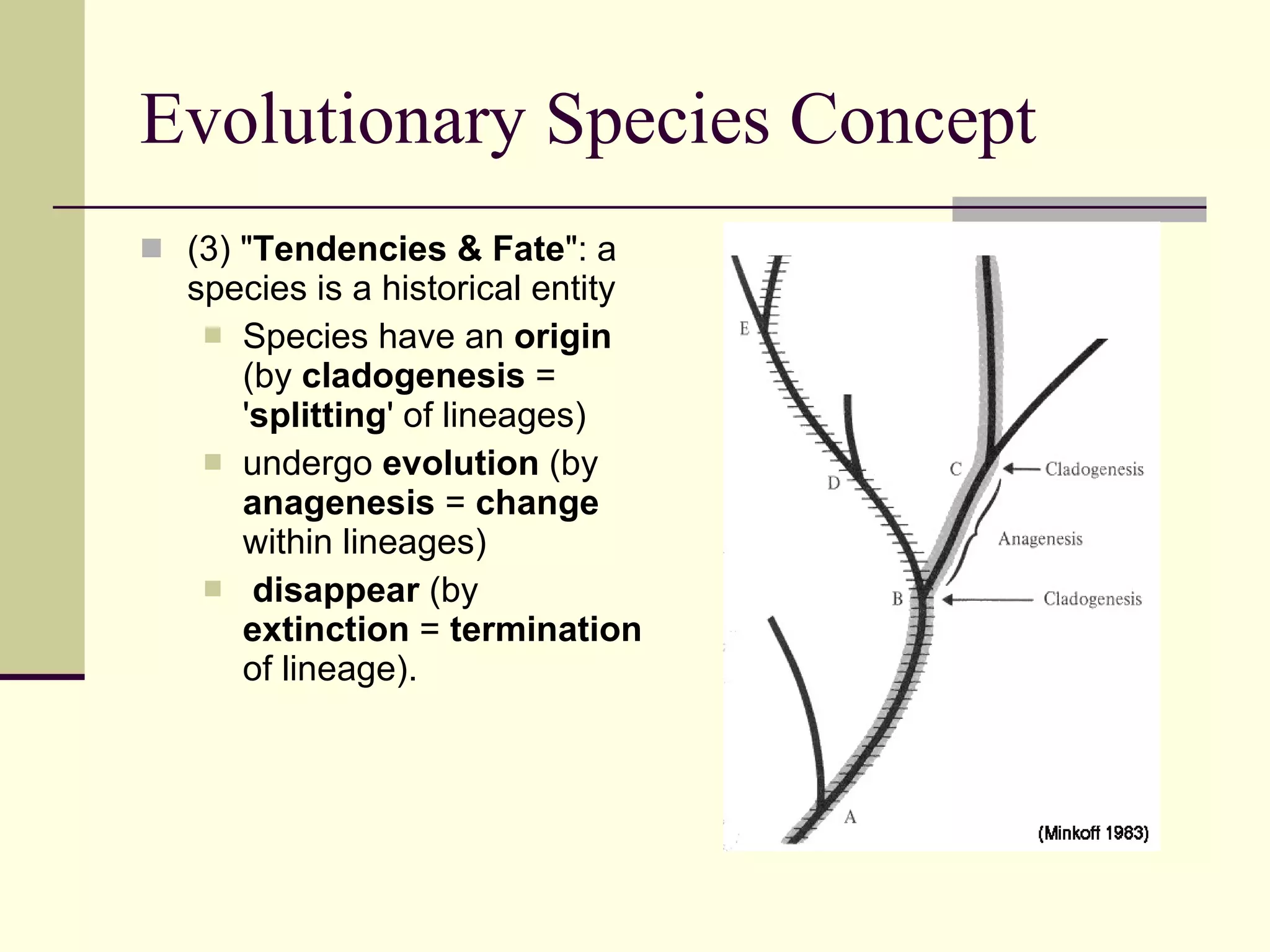
Evolutionary Species Concept (3) " Tendencies & Fate ": a species is a historical entity Species have an  origin  (by  cladogenesis  = ' splitting ' of lineages) undergo  evolution  (by  anagenesis  =  change  within lineages) disappear  (by  extinction  =  termination  of lineage).
Other Species Concepts Phylogenetic Species Concept Recognition Species Concept Cohesion Species Concept Ecological Species Concept Internodal Species Concept Why so many species concepts???
Problems with the Biological Species Concept (1)  Reproductive isolation is a &quot;typological criterion&quot;  (an  either / or  rule).        Does one successful hybridization invalidate species distinction?        Extent & consequences of hybridization may vary:               <  4% of Alberta deer show hybrid ancestry, including  F1 s (Hughes & Carr 1993)               > 50% in West Texas (Ballinger  et al . 1996): no  F1 s
Problems with the Biological Species Concept (2)  Reproductive isolation evolves gradually:  species distinctions somewhat arbitrary         Rassenkreis   (''race circle'): a geographically convergent series of species  adjacent forms are reproductively compatible & morphologically similar ends of circle are  reproductively isolated  & morphologically distinct
Ensatina - salamanders
Ring species in Gulls ( Larus )
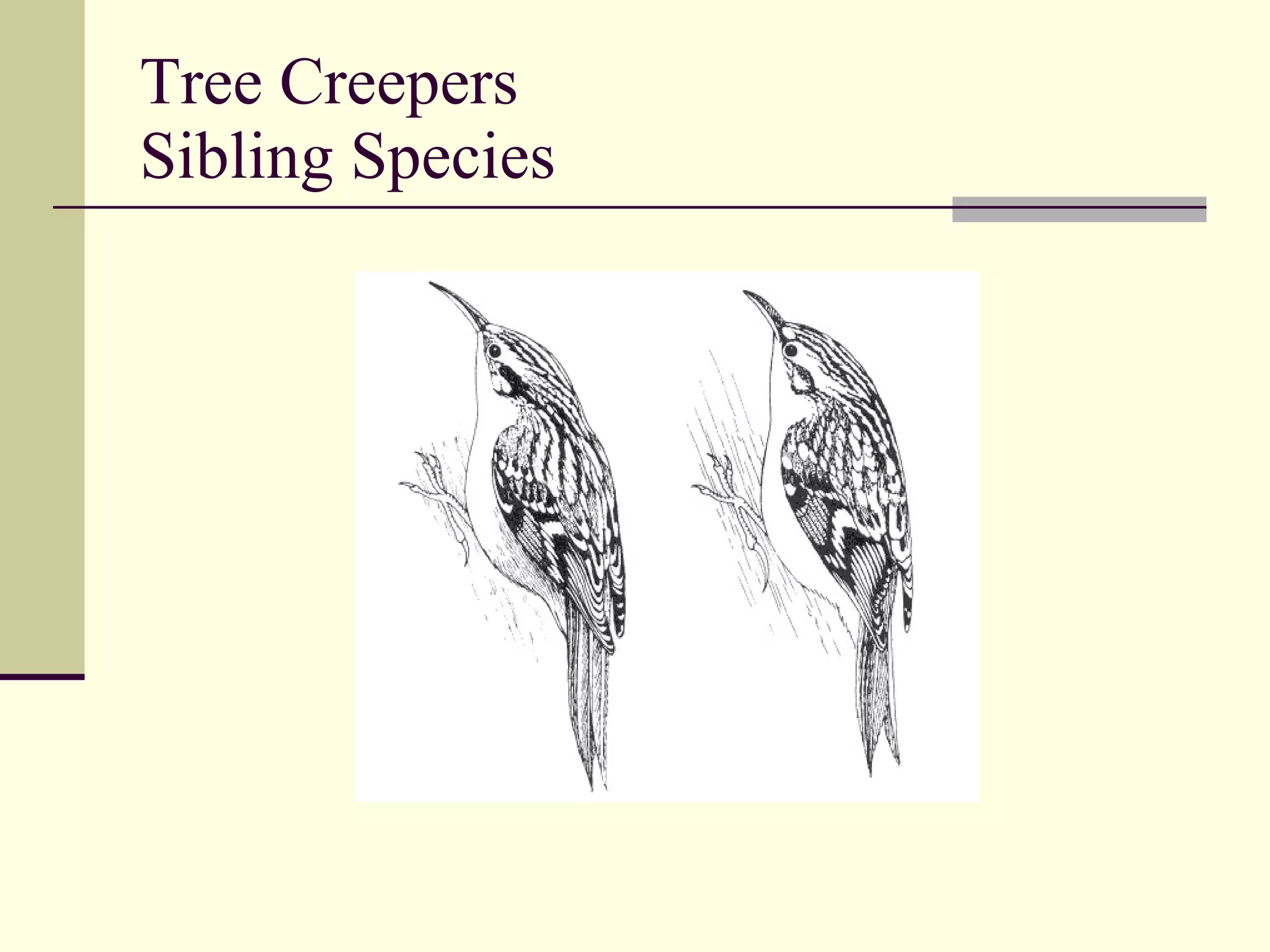
Problems with the Biological Species Concept Reproductive isolation arises without morphological differentiation:          Sibling species  are morphologically identical species pairs        
Tree Creepers Sibling Species
Sibling Species Empidonax  flycatchers
Problems with the Biological Species Concept (3)  Reproductive criterion does not work well with asexual species.          parthenogenesis   is common in plants                    Plant species hybridize widely  outside 'species' boundary:         
Hybridization Raphanus  radish X  Brassica  cabbage => “ Raphanobrassica &quot; (radish  leaves  & cabbage  root )
Problems with the Biological Species Concept (4)  Genetic differences may not indicate reproductive isolation or morphological divergence .        Fixed allelic differences  may  indicate local adaptation or genetic drift.        
Problems with the Biological Species Concept (5) What to do with  paleospecies  (extinct or fossil species)?  fragmentary ecological evidence : only by inference                    
Problems with the Biological Species Concept Are dinosaurs ? 'hot-blooded', 'maternal',  ‘ colorful'       fragmentary physical evidence

Species Concepts And Speciation

  • 1.
    Species Concepts andSpeciation Mark McGinley Associate Professor Honors College and Department of Biological Sciences Texas Tech University
  • 2.
    Species Concepts Defining“a species” is not as simple as you might hope There are many different “species concepts”.
  • 3.
    Historical Species ConceptsTypological Species Concept species are a 'type' of organism Lineaeus &quot; Species are as many as were created in the beginning by the Infinite. “ Systema Naturae , 10th ed. (1758) establishes a catalog of 4,162 &quot;types&quot;
  • 4.
    Historical Species ConceptsNominalistic Species Concept : a name given for convenience Darwin &quot; I look at the term species, as one arbitrarily given for the sake of convenience to a set of individuals closely resembling each other.... “ philosophical Essentialism Only individuals exist, not universal classes.
  • 5.
    Historial/Modern Species ConceptsMorphospecies Concept Species traditionally have been described and identified on the basis of morphological criteria According to this concept, species are “groups of individuals that are morphologically similar and clearly distinguishable from individuals of other groups”
  • 6.
    Modern Species ConceptsBiological Species Concept a reproductively isolated population Mayr &quot; Species are groups of interbreeding natural populations that are reproductively isolated from other such groups. &quot;       Historically, the most widely used concept among ecologists      
  • 7.
    Biological Species Concept-Key Concepts &quot; Interbreeding : => a genetic unit species are gene pools : a coadapted gene complex Members of the same species resemble each other because they have common ancestors
  • 8.
    Biological Species Concept-Key Concepts &quot; Natural Populations &quot; => an ecological unit           
  • 9.
    Biological Species Concept-Key Concepts &quot; Reproductively isolated &quot; => a reproductive unit Reproductive Isolating Mechanisms features that prevent mating outside the species Species Recognition Mechanisms features that allow recognition of potential mates
  • 10.
    Premating or prezygoticmechanisms Ecological or habitat isolation Seasonal or temporal isolation Sexual or ethological isolation Mechanical isolation Isolation by different pollinators Gametic isolation
  • 11.
  • 12.
  • 13.
  • 14.
  • 15.
    Postmating or post-zygoticmechanisms Hybrid inviability Hybrid sterility F1 fails to produce viable gametes Hybrid breakdown F2s or backcrosses have reduced viability
  • 16.
  • 17.
  • 18.
    Identifying Species Usingthe Biological Species Concept Biological Species Concept suggests a research program that will allow scientists to identify species using this concept the mark of a good theory    
  • 19.
    Identifying Species Usingthe Biological Species Concept (1) Experiment: test cross A and B interbreed, but neither with C => A & B are conspecific C is a separate species
  • 20.
    Identifying Species Usingthe Biological Species Concept (2) Field observations : a &quot; species gap&quot; exists Populations maintain identity when sympatric (occuring in the same place) &   synchronic (occuring at the same time)          
  • 21.
    Odocoileus hemionus Mule Deer
  • 22.
    Odocoileus virginianus White-tailed Deer
  • 23.
  • 24.
  • 25.
    Variation in BehaviorO. hemionus O. virginianus
  • 26.
  • 27.
    Lightening Bugs Lampyridae:Hemiptera: Insecta
  • 28.
  • 29.
    Identifying Species Usingthe Biological Species Concept (3) Inference : forms 'look different'       Many new species are described from single 'skin & skull' or small series.       Most commonly used criterion: inference is often weak.
  • 30.
  • 31.
    Geographic Variation inWeasels Mustela erminea
  • 32.
    Feloid ( Panthera) and Canoid ( Canis)
  • 33.
    Identifying Species Usingthe Biological Species Concept 4) Genetic studies indicate no gene flow between forms        - fixation for alternative alleles                    - distinct DNA sequences              - distinct karyotypes                    
  • 34.
    Evolutionary Species Conceptan evolving lineage &quot; An evolutionary species is a single lineage of ancestor-descendant populations which maintains its identity from other such lineages and which has its own evolutionary tendencies and historical fate. &quot;   Historically, the most popular concept among paleontologists . Used extensively in comparative biology & phylogenetic systematics
  • 35.
    Evolutionary Species Concept(1) &quot; Lineage &quot;: an ancestor-descendent series genealogy is crucial: members of a species have a common ancestor Research program of paleontology is inferrence of genealogy         Pelycodus an early Eocene Primate
  • 36.
    Evolutionary Species Concept(2) &quot; Identity &quot;: a biologically distinct entity Includes concepts associated with Biological Species, the Biological Species Concept is the broadest general case of the Evolutionary Species Concept   [ i.e. , a biological species is an evolutionary species at a partcular point in time]       
  • 37.
    Evolutionary Species Concept(3) &quot; Tendencies & Fate &quot;: a species is a historical entity Species have an origin (by cladogenesis = ' splitting ' of lineages) undergo evolution (by anagenesis = change within lineages) disappear (by extinction = termination of lineage).
  • 38.
    Other Species ConceptsPhylogenetic Species Concept Recognition Species Concept Cohesion Species Concept Ecological Species Concept Internodal Species Concept Why so many species concepts???
  • 39.
    Problems with theBiological Species Concept (1) Reproductive isolation is a &quot;typological criterion&quot; (an either / or rule).       Does one successful hybridization invalidate species distinction?       Extent & consequences of hybridization may vary:              <  4% of Alberta deer show hybrid ancestry, including F1 s (Hughes & Carr 1993)              > 50% in West Texas (Ballinger et al . 1996): no F1 s
  • 40.
    Problems with theBiological Species Concept (2) Reproductive isolation evolves gradually: species distinctions somewhat arbitrary       Rassenkreis   (''race circle'): a geographically convergent series of species adjacent forms are reproductively compatible & morphologically similar ends of circle are reproductively isolated & morphologically distinct
  • 41.
  • 42.
    Ring species inGulls ( Larus )
  • 43.
    Problems with theBiological Species Concept Reproductive isolation arises without morphological differentiation:        Sibling species are morphologically identical species pairs       
  • 44.
  • 45.
  • 46.
    Problems with theBiological Species Concept (3) Reproductive criterion does not work well with asexual species.       parthenogenesis  is common in plants                 Plant species hybridize widely outside 'species' boundary:        
  • 47.
    Hybridization Raphanus radish X Brassica cabbage => “ Raphanobrassica &quot; (radish leaves & cabbage root )
  • 48.
    Problems with theBiological Species Concept (4) Genetic differences may not indicate reproductive isolation or morphological divergence .       Fixed allelic differences may indicate local adaptation or genetic drift.       
  • 49.
    Problems with theBiological Species Concept (5) What to do with paleospecies (extinct or fossil species)? fragmentary ecological evidence : only by inference                   
  • 50.
    Problems with theBiological Species Concept Are dinosaurs ? 'hot-blooded', 'maternal', ‘ colorful'       fragmentary physical evidence