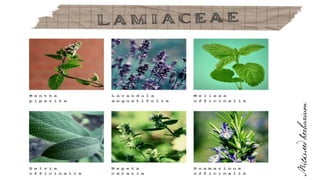
FAMILY LAMIACEAE (MINT FAMILY)
SUBMITTED BY MARYAM MUNEER
Roll no. 0206-BS-BOT-22
GCU LAHORE, PAKISTAN.
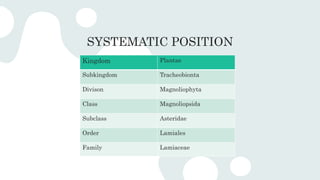
SYSTEMATIC POSITION
Kingdom Plantae
Subkingdom Tracheobionta
Divison Magnoliophyta
Class Magnoliopsida
Subclass Asteridae
Order Lamiales
Family Lamiaceae
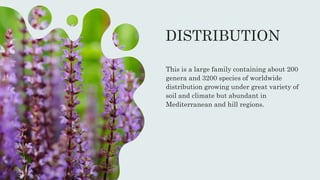
DISTRIBUTION
This is a large family containing about 200
genera and 3200 species of worldwide
distribution growing under great variety of
soil and climate but abundant in
Mediterranean and hill regions.
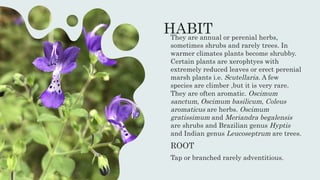
HABIT
They are annual or perenial herbs,
sometimes shrubs and rarely trees. In
warmer climates plants become shrubby.
Certain plants are xerophtyes with
extremely reduced leaves or erect perenial
marsh plants i.e. Scutellaria. A few
species are climber ,but it is very rare.
They are often aromatic. Oscimum
sanctum, Oscimum basilicum, Coleus
aromaticus are herbs. Oscimum
gratissimum and Meriandra begalensis
are shrubs and Brazilian genus Hyptis
and Indian genus Leucoseptrum are trees.
ROOT
Tap or branched rarely adventitious.
STEM
Herbaceous or woody as in tree members,
glandular pubescent, erect sometimes
prostate and with sucker as in Mentha
viridis. The young shoots are quadrangular.
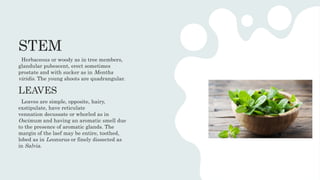
LEAVES
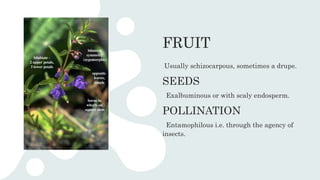
Leaves are simple, opposite, hairy,
exstipulate, have reticulate
vennation decussate or whorled as in
Oscimum and having an aromatic smell due
to the presence of aromatic glands. The
margin of the laef may be entire, toothed,
lobed as in Leonurus or finely dissected as
in Salvia.
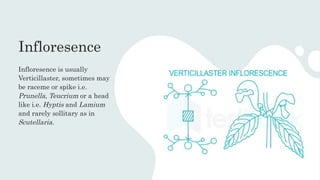
Infloresence
Infloresence is usually
Verticillaster, sometimes may
be raceme or spike i.e.
Prunella, Teucrium or a head
like i.e. Hyptis and Lamium
and rarely sollitary as in
Scutellaria.
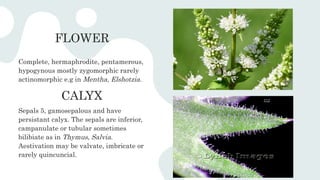
FLOWER
Complete, hermaphrodite, pentamerous,
hypogynous mostly zygomorphic rarely
actinomorphic e.g in Mentha, Elshotzia.
CALYX
Sepals 5, gamosepalous and have
persistant calyx. The sepals are inferior,
campanulate or tubular sometimes
bilibiate as in Thymus, Salvia.
Aestivation may be valvate, imbricate or
rarely quincuncial.
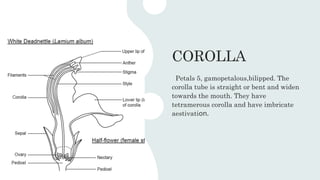
COROLLA
Petals 5, gamopetalous,bilipped. The
corolla tube is straight or bent and widen
towards the mouth. They have
tetramerous corolla and have imbricate
aestivation.
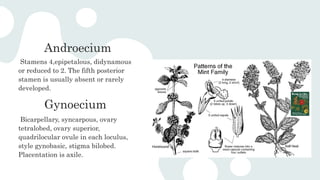
Androecium
Stamens 4,epipetalous, didynamous
or reduced to 2. The fifth posterior
stamen is usually absent or rarely
developed.
Gynoecium
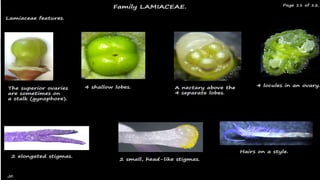
Bicarpellary, syncarpous, ovary
tetralobed, ovary superior,
quadrilocular ovule in each loculus,
style gynobasic, stigma bilobed.
Placentation is axile.
FRUIT
Usually schizocarpous, sometimes a drupe.
SEEDS
Exalbuminous or with scaly endosperm.
POLLINATION
Entamophilous i.e. through the agency of
insects.
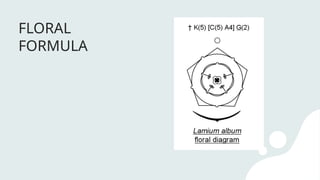
FLORAL
FORMULA
ECONOMIC IMPORTANCE
Economically, the members of the Labiatae are of importance as the source of volatile
aromatic oils and several are cultivated as ornamentals.
Lavandula vera yields "lavender oil', Mentha piperita 'peppermint oil', Rosmarinus
officinalis yields 'rosemary oil and Thymus serpyllum 'thyme oil'.
The fruits of Lycopus europaeus produce a green dye. Ocimum kilmandscharicum is raised
for camphore
Some herbs are in great demand for the flavour or aroma imparted to foods. These include
Majorana hortensis (Mediterranean), Marruhbium vulgare (Canaries to Central Asia),
Melissa officinalis, Mentha arvensis, M. spicata, Origanum vulgare, Thymas vulgaris etc.
Stachys sieboldii is grown for edible tubers and so is Coleus parviflours.
The tubers of C. rotundifolius are consumed as a potato substitute.
A few plants are used in medicines such as Hyssopus officinalis (zufah), Leonurus
cardiaca (lions ear/ lions tail), Oscimum basilicum (Niazboo), Stachys officinalis etc.
Some plants are grown as ornamental e.g. Coleus, Dracocephalum, Lamium, Melissa,
Molucella, Monarda, Nepta, Phlomis, Salivia and others.
LAMIACEAE THE MINT  FAMILY  PRESENTATION

LAMIACEAE THE MINT FAMILY PRESENTATION

  • 1.
    FAMILY LAMIACEAE (MINTFAMILY) SUBMITTED BY MARYAM MUNEER Roll no. 0206-BS-BOT-22 GCU LAHORE, PAKISTAN.
  • 2.
    SYSTEMATIC POSITION Kingdom Plantae SubkingdomTracheobionta Divison Magnoliophyta Class Magnoliopsida Subclass Asteridae Order Lamiales Family Lamiaceae
  • 3.
    DISTRIBUTION This is alarge family containing about 200 genera and 3200 species of worldwide distribution growing under great variety of soil and climate but abundant in Mediterranean and hill regions.
  • 4.
    HABIT They are annualor perenial herbs, sometimes shrubs and rarely trees. In warmer climates plants become shrubby. Certain plants are xerophtyes with extremely reduced leaves or erect perenial marsh plants i.e. Scutellaria. A few species are climber ,but it is very rare. They are often aromatic. Oscimum sanctum, Oscimum basilicum, Coleus aromaticus are herbs. Oscimum gratissimum and Meriandra begalensis are shrubs and Brazilian genus Hyptis and Indian genus Leucoseptrum are trees. ROOT Tap or branched rarely adventitious.
  • 5.
    STEM Herbaceous or woodyas in tree members, glandular pubescent, erect sometimes prostate and with sucker as in Mentha viridis. The young shoots are quadrangular. LEAVES Leaves are simple, opposite, hairy, exstipulate, have reticulate vennation decussate or whorled as in Oscimum and having an aromatic smell due to the presence of aromatic glands. The margin of the laef may be entire, toothed, lobed as in Leonurus or finely dissected as in Salvia.
  • 6.
    Infloresence Infloresence is usually Verticillaster,sometimes may be raceme or spike i.e. Prunella, Teucrium or a head like i.e. Hyptis and Lamium and rarely sollitary as in Scutellaria.
  • 7.
    FLOWER Complete, hermaphrodite, pentamerous, hypogynousmostly zygomorphic rarely actinomorphic e.g in Mentha, Elshotzia. CALYX Sepals 5, gamosepalous and have persistant calyx. The sepals are inferior, campanulate or tubular sometimes bilibiate as in Thymus, Salvia. Aestivation may be valvate, imbricate or rarely quincuncial.
  • 8.
    COROLLA Petals 5, gamopetalous,bilipped.The corolla tube is straight or bent and widen towards the mouth. They have tetramerous corolla and have imbricate aestivation.
  • 9.
    Androecium Stamens 4,epipetalous, didynamous orreduced to 2. The fifth posterior stamen is usually absent or rarely developed. Gynoecium Bicarpellary, syncarpous, ovary tetralobed, ovary superior, quadrilocular ovule in each loculus, style gynobasic, stigma bilobed. Placentation is axile.
  • 10.
    FRUIT Usually schizocarpous, sometimesa drupe. SEEDS Exalbuminous or with scaly endosperm. POLLINATION Entamophilous i.e. through the agency of insects.
  • 12.
  • 13.
    ECONOMIC IMPORTANCE Economically, themembers of the Labiatae are of importance as the source of volatile aromatic oils and several are cultivated as ornamentals. Lavandula vera yields "lavender oil', Mentha piperita 'peppermint oil', Rosmarinus officinalis yields 'rosemary oil and Thymus serpyllum 'thyme oil'. The fruits of Lycopus europaeus produce a green dye. Ocimum kilmandscharicum is raised for camphore Some herbs are in great demand for the flavour or aroma imparted to foods. These include Majorana hortensis (Mediterranean), Marruhbium vulgare (Canaries to Central Asia), Melissa officinalis, Mentha arvensis, M. spicata, Origanum vulgare, Thymas vulgaris etc. Stachys sieboldii is grown for edible tubers and so is Coleus parviflours.
  • 14.
    The tubers ofC. rotundifolius are consumed as a potato substitute. A few plants are used in medicines such as Hyssopus officinalis (zufah), Leonurus cardiaca (lions ear/ lions tail), Oscimum basilicum (Niazboo), Stachys officinalis etc. Some plants are grown as ornamental e.g. Coleus, Dracocephalum, Lamium, Melissa, Molucella, Monarda, Nepta, Phlomis, Salivia and others.