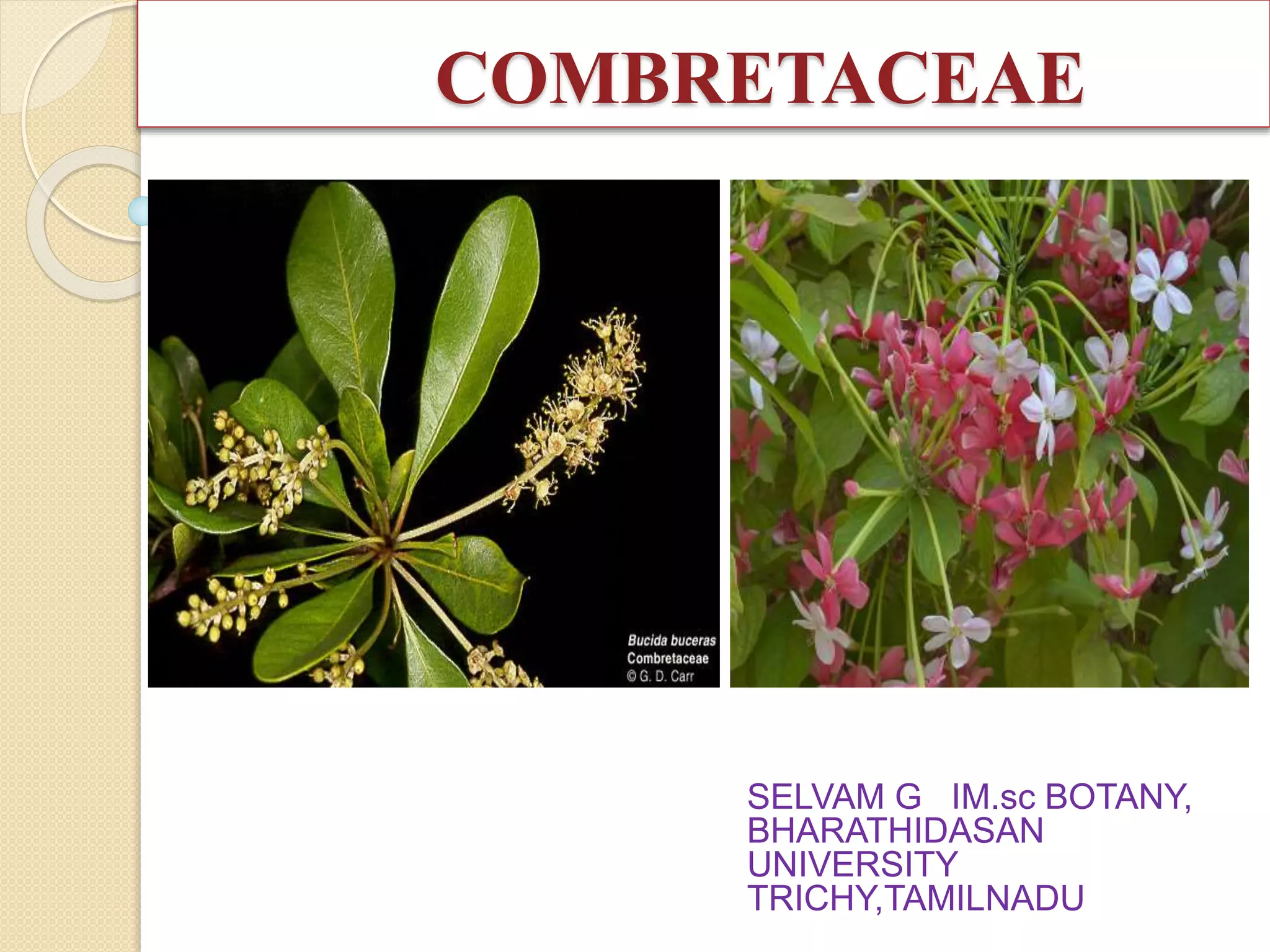
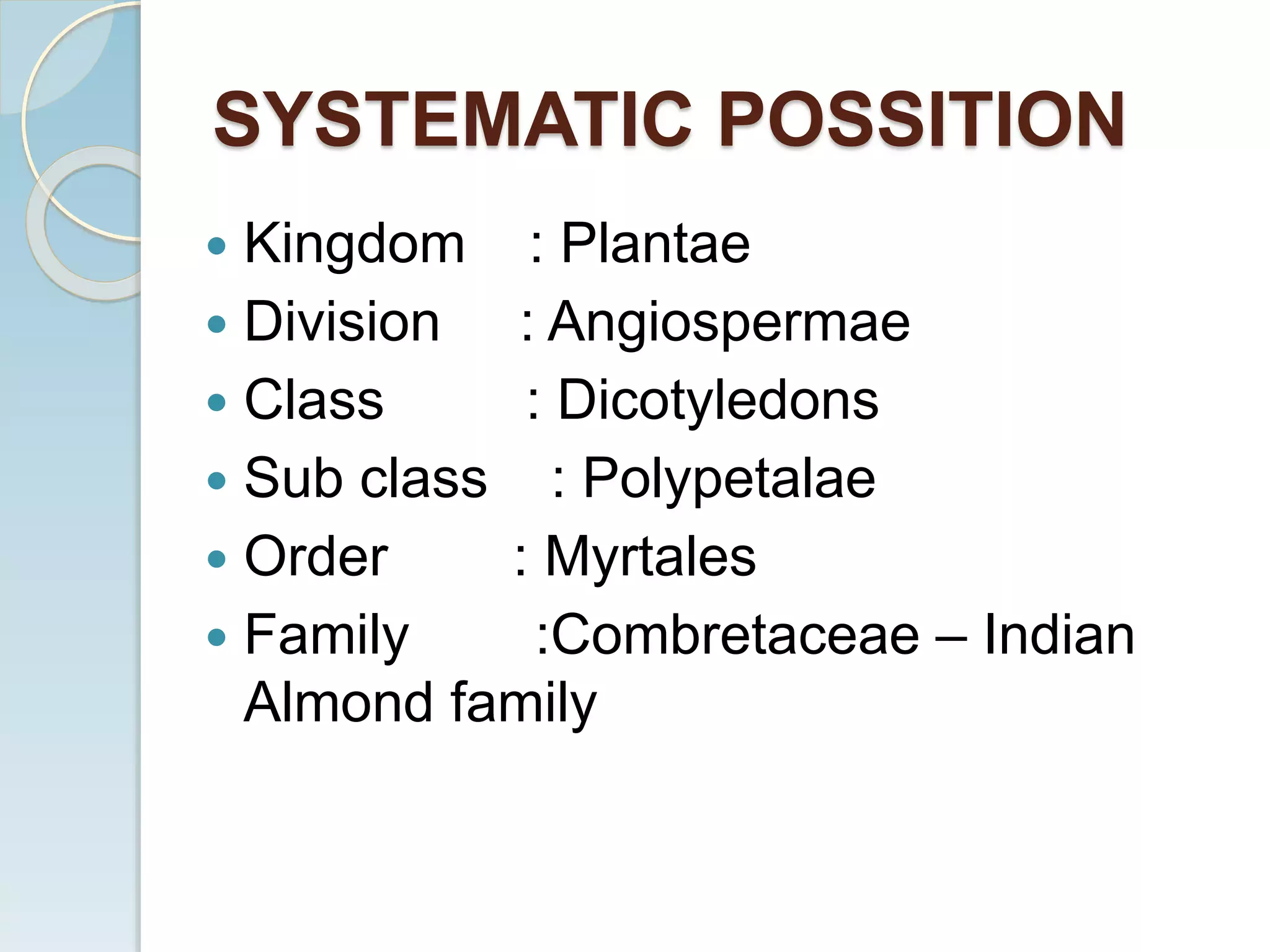
COMBRETACEAE
SELVAM G IM.sc BOTANY,
BHARATHIDASAN
UNIVERSITY
TRICHY,TAMILNADU
SYSTEMATIC POSSITION
 Kingdom : Plantae
 Division : Angiospermae
 Class : Dicotyledons
 Sub class : Polypetalae
 Order : Myrtales
 Family :Combretaceae – Indian
Almond family
Distribution of Combretaceae
 The Combretaceae are a family of flowering plants in the
order Myrtales.
 The family includes about 530 species of trees, shrubs, and
lianas in 10 genera.
 The family includes the leadwood tree, Combretum imberbe.
 The Combretaceae are widespread in the subtropics and
tropics.
 Some members of this family produce useful construction
timber, such as idigbo from Terminalia ivorensis.
 The commonly cultivated Quisqualis indica is now placed in
the genus Combretum.
Characters of Combretaceae
 Flower pentamerous
 sepals 4-5, valvate
 petals, small sometimes absent
 stamens 10 in two series
 Carpel one, inferior, unilocular
 fruit 2-5 angled.
Vegetative characters
 Habit: Mainly trees of
shrubs, sometimes sub-
scandent.
 Root: Tap, deep and
branched.
 Stem: Erect, hard and
woody or sometimes weak
and sub-scandent.
 Leaf: Simple, entire,
alternate or opposite,
Floral characters
 Inflorescence: Racemose, paniculate
or spicate.
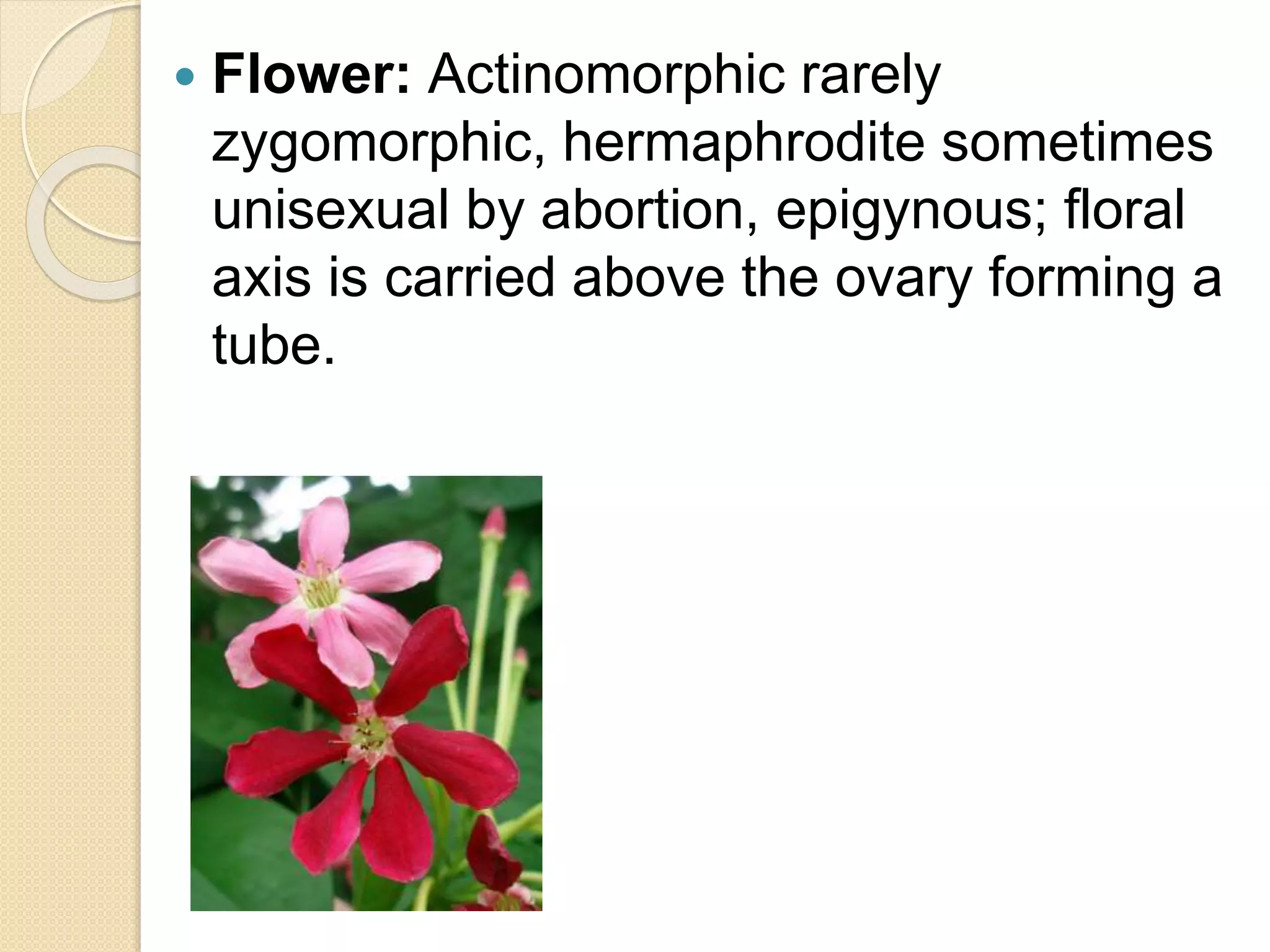
 Flower: Actinomorphic rarely
zygomorphic, hermaphrodite sometimes
unisexual by abortion, epigynous; floral
axis is carried above the ovary forming a
tube.
 Calyx: Sepals 4-5, rarely more, united
to form a calyx tube adnate to ovary ;
valvate, persistent.
 Corolla: Petals are usually small, as
many as sepals and alternating with
them, either valvate or imbricate in
aestivation, sometimes absent,
polypetalous.
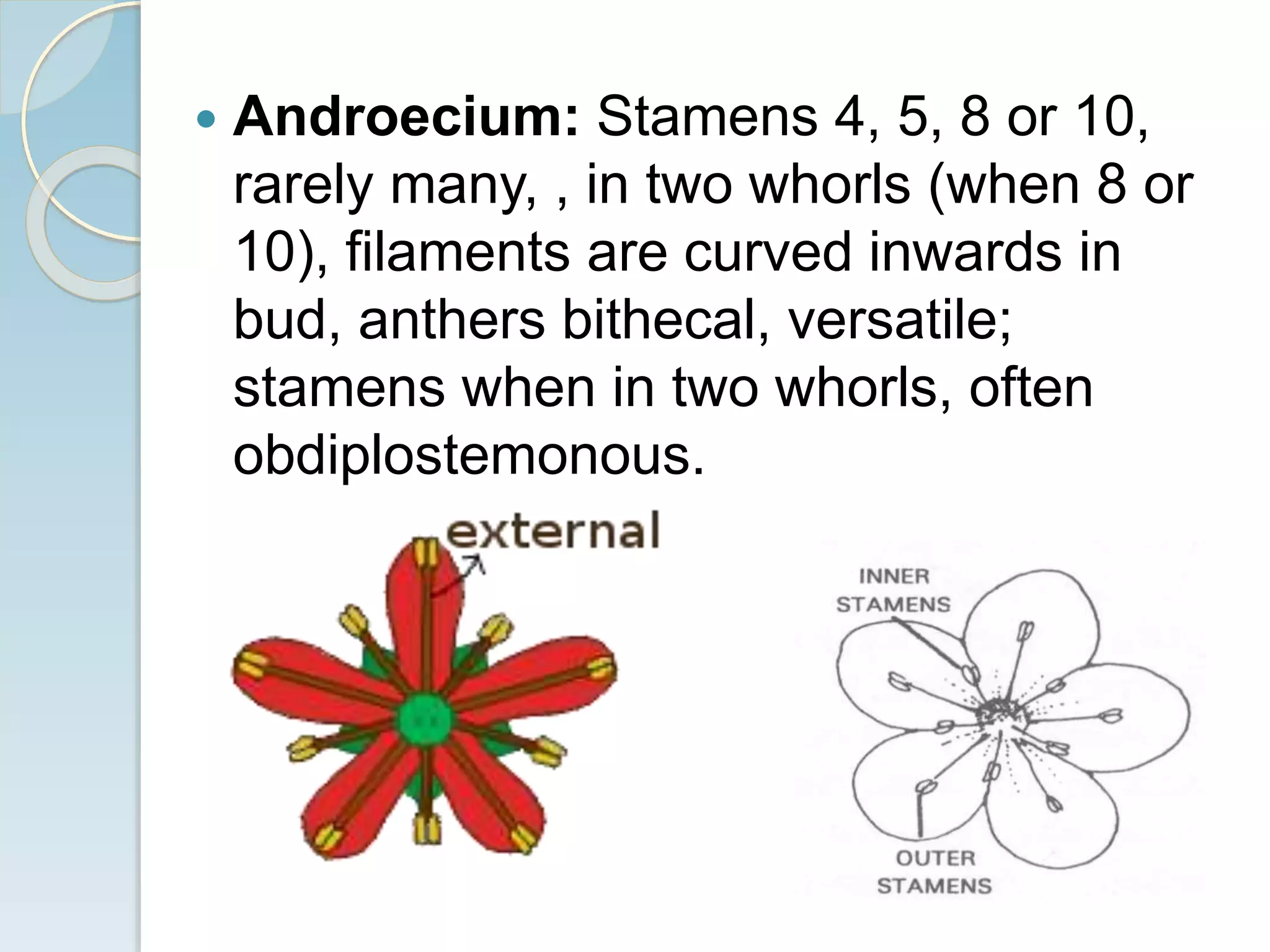
 Androecium: Stamens 4, 5, 8 or 10,
rarely many, , in two whorls (when 8 or
10), filaments are curved inwards in
bud, anthers bithecal, versatile;
stamens when in two whorls, often
obdiplostemonous.
Gynoecium
 Monocarpellary; ovary inferior, 1-celled,
generally angled, the angles equal in
number and alternating with calyx-
segments.
 ovules 2-5, rarely more, anatropous,
pendulous from the top of the ovary on
long, often united funicles.
 style one, long, filiform bearing a pointed,
rarely a capitate stigma.
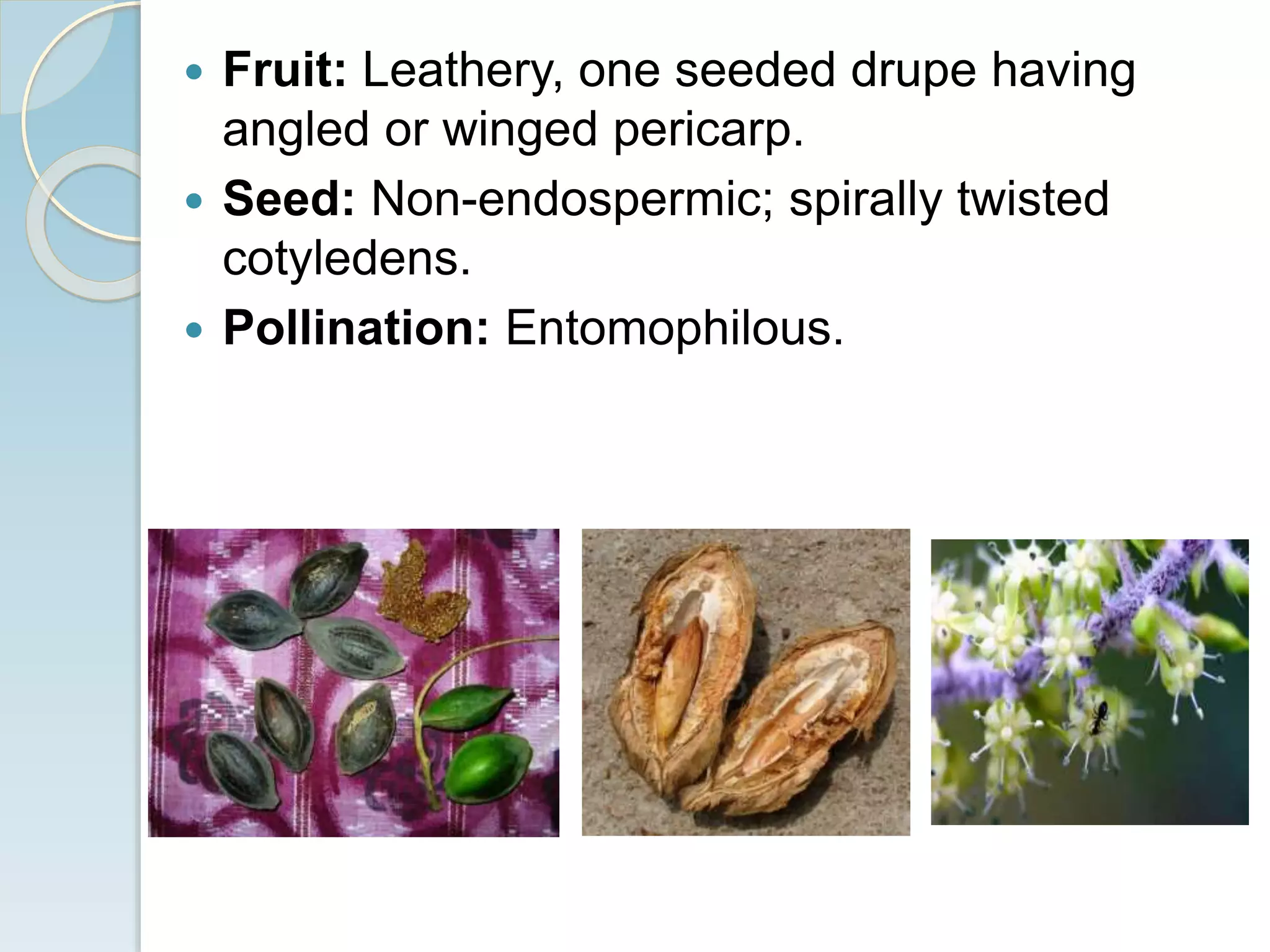
 Fruit: Leathery, one seeded drupe having
angled or winged pericarp.
 Seed: Non-endospermic; spirally twisted
cotyledens.
 Pollination: Entomophilous.
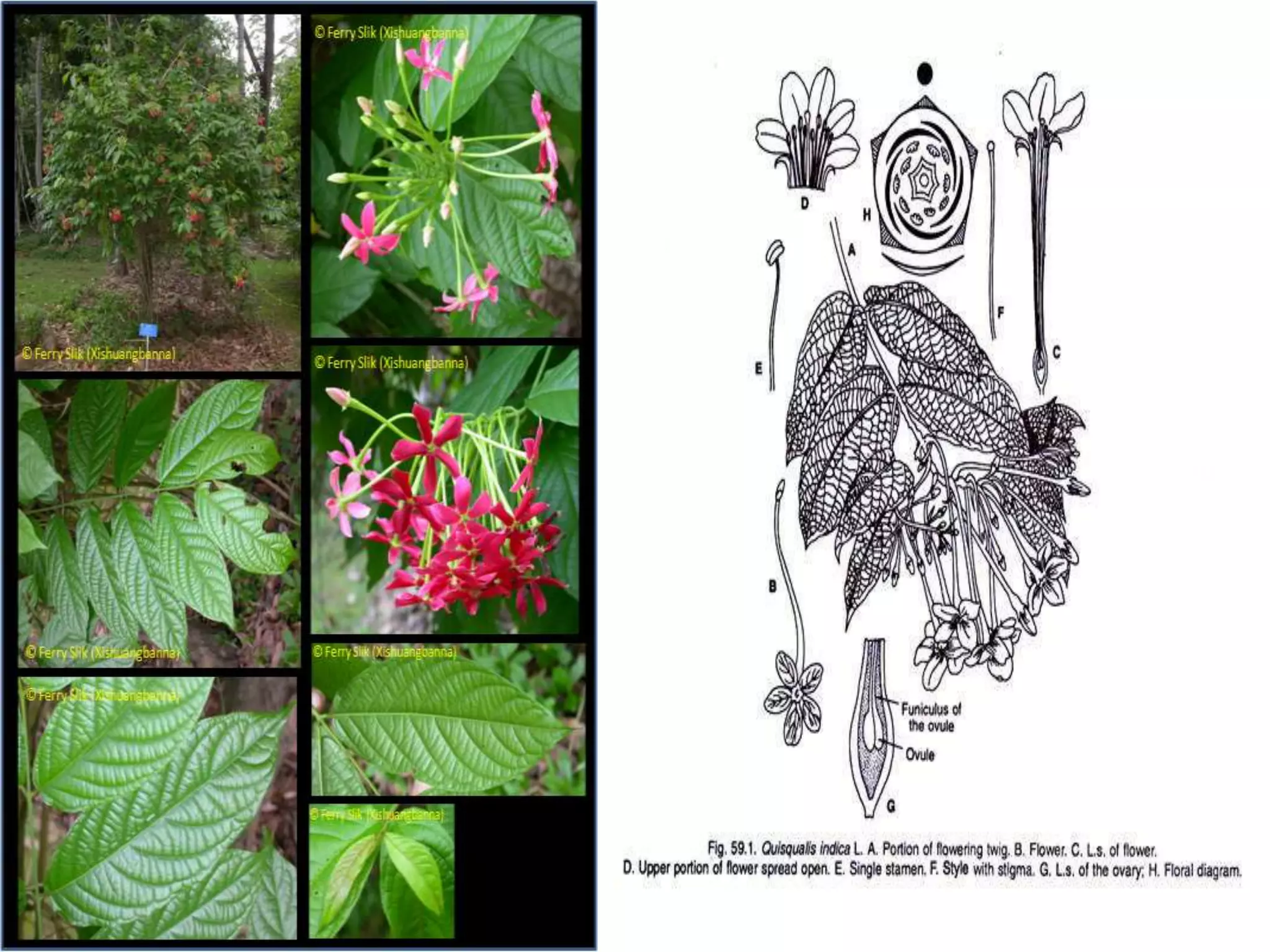
Combretum indicum (Rangoon-Creeper)
SYSTEMATIC POSSITION
 Kingdom : Plantae
 Division : Angiospermae
 Class : Dicotyledons
 Sub class : Polypetalae
 Order : Myrtales
 Family :Combretaceae – Indian
Almond family
 Genus :Combritum
 Species :indicum
Vegetative characters
 Habit: A creeping sub-scadent shrub,
commonly planted in the gardens.
 Root: Tap-root.
 Stem: Weak, sub-scadent.
 Leaf: Opposite, superposed, simple, ovate,
entire, exstipulate, unicostate reticulate.
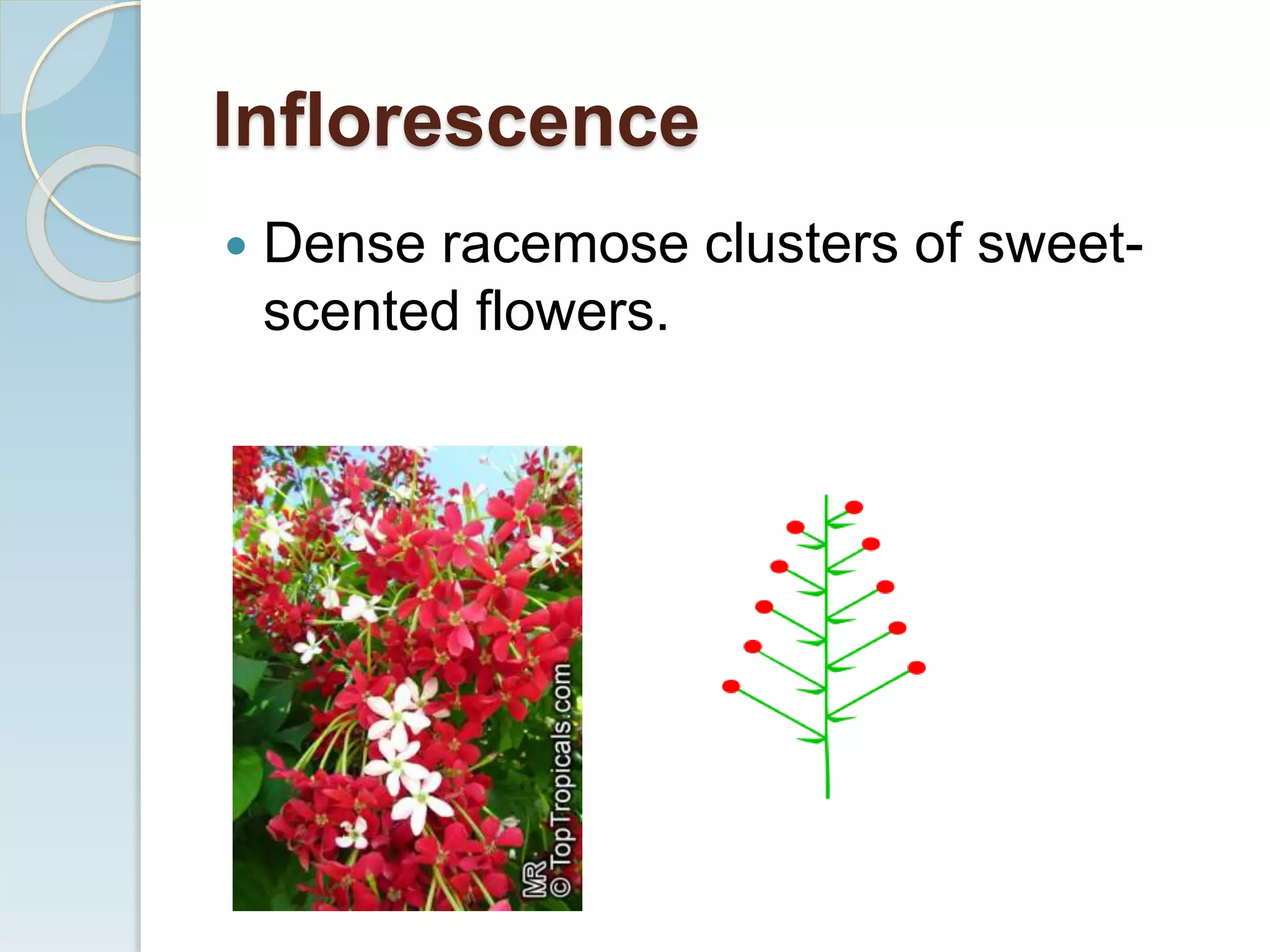
Inflorescence
 Dense racemose clusters of sweet-
scented flowers.
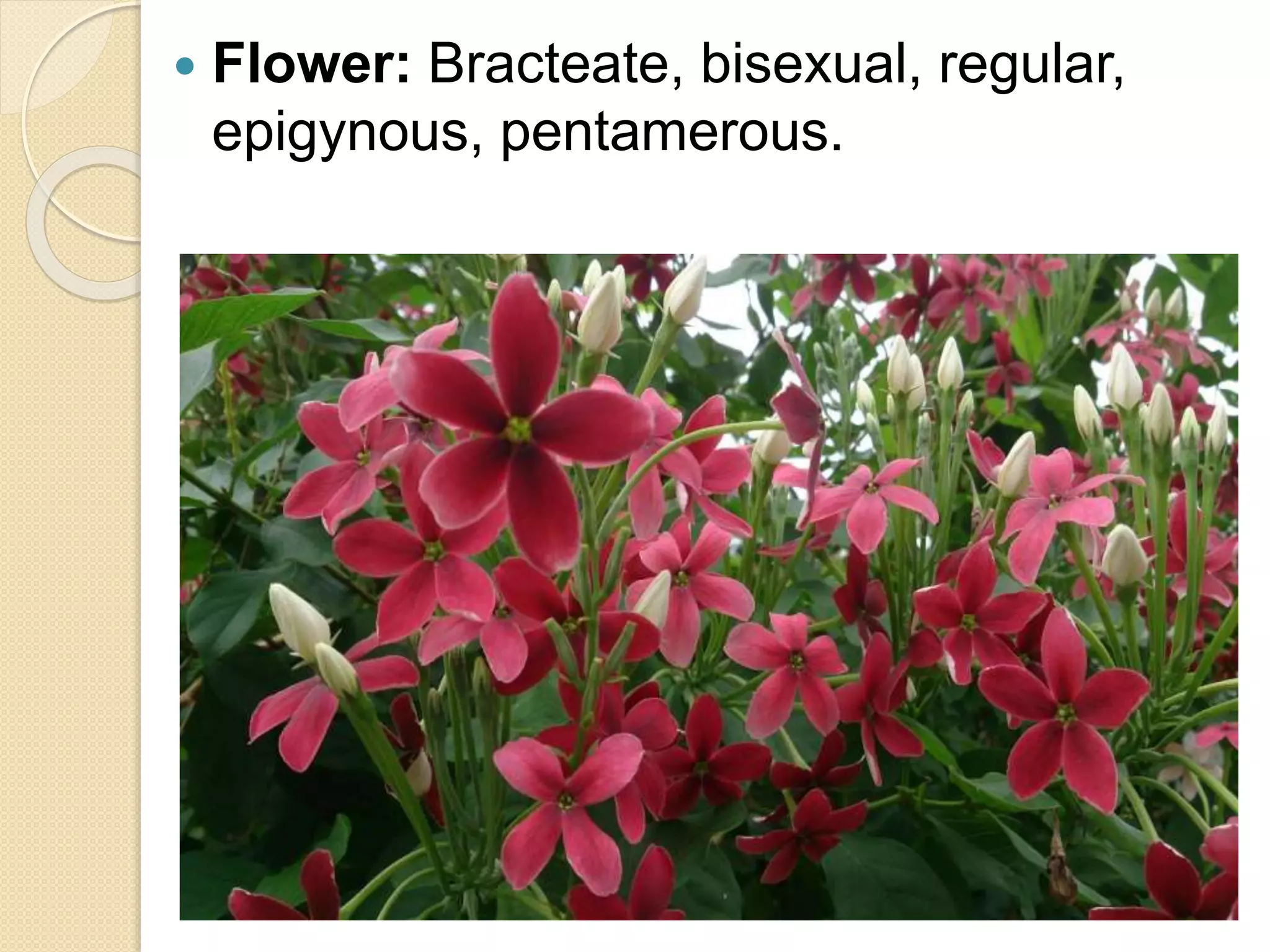
 Flower: Bracteate, bisexual, regular,
epigynous, pentamerous.
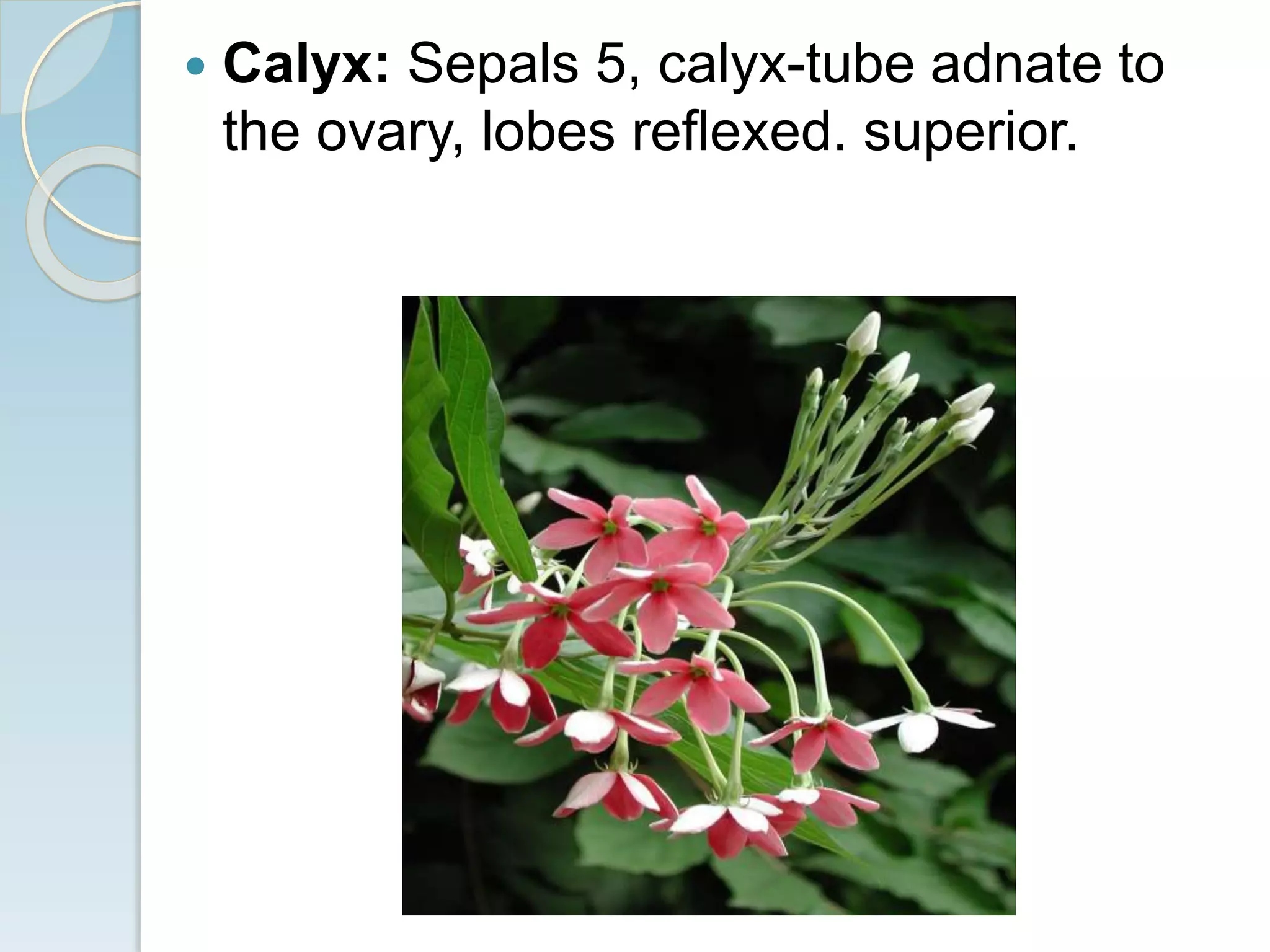
 Calyx: Sepals 5, calyx-tube adnate to
the ovary, lobes reflexed. superior.
 Corolla: Petals 5, white at first,
turning pink, alternating with the
sepals, superior, imbricate in bud.
 Androecium: Stamens ten, free in
two whorls, the upper opposite the
petals and the lower opposite the
sepals, filaments long, anthers
dorsifixed, superior.
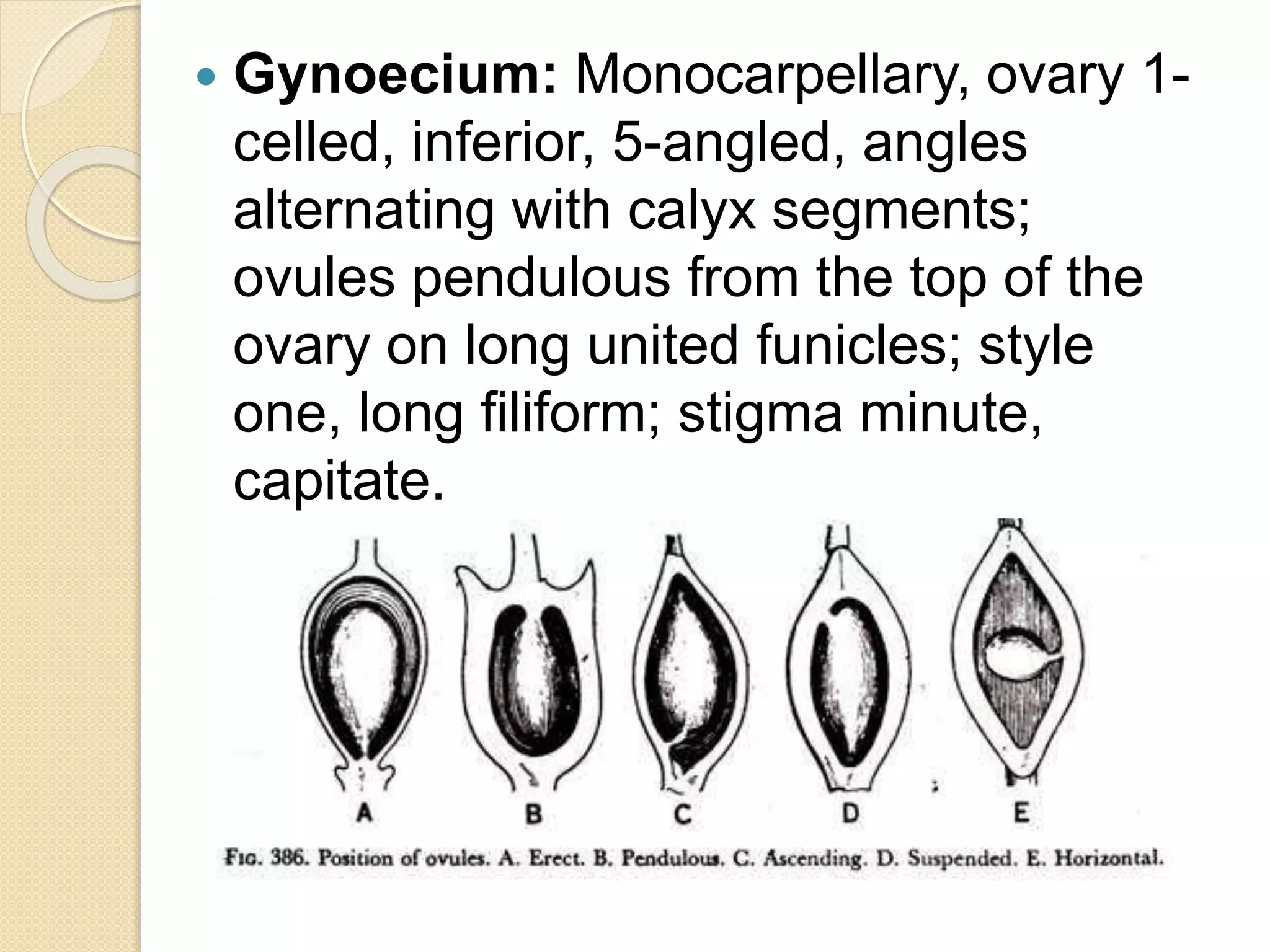
 Gynoecium: Monocarpellary, ovary 1-
celled, inferior, 5-angled, angles
alternating with calyx segments;
ovules pendulous from the top of the
ovary on long united funicles; style
one, long filiform; stigma minute,
capitate.
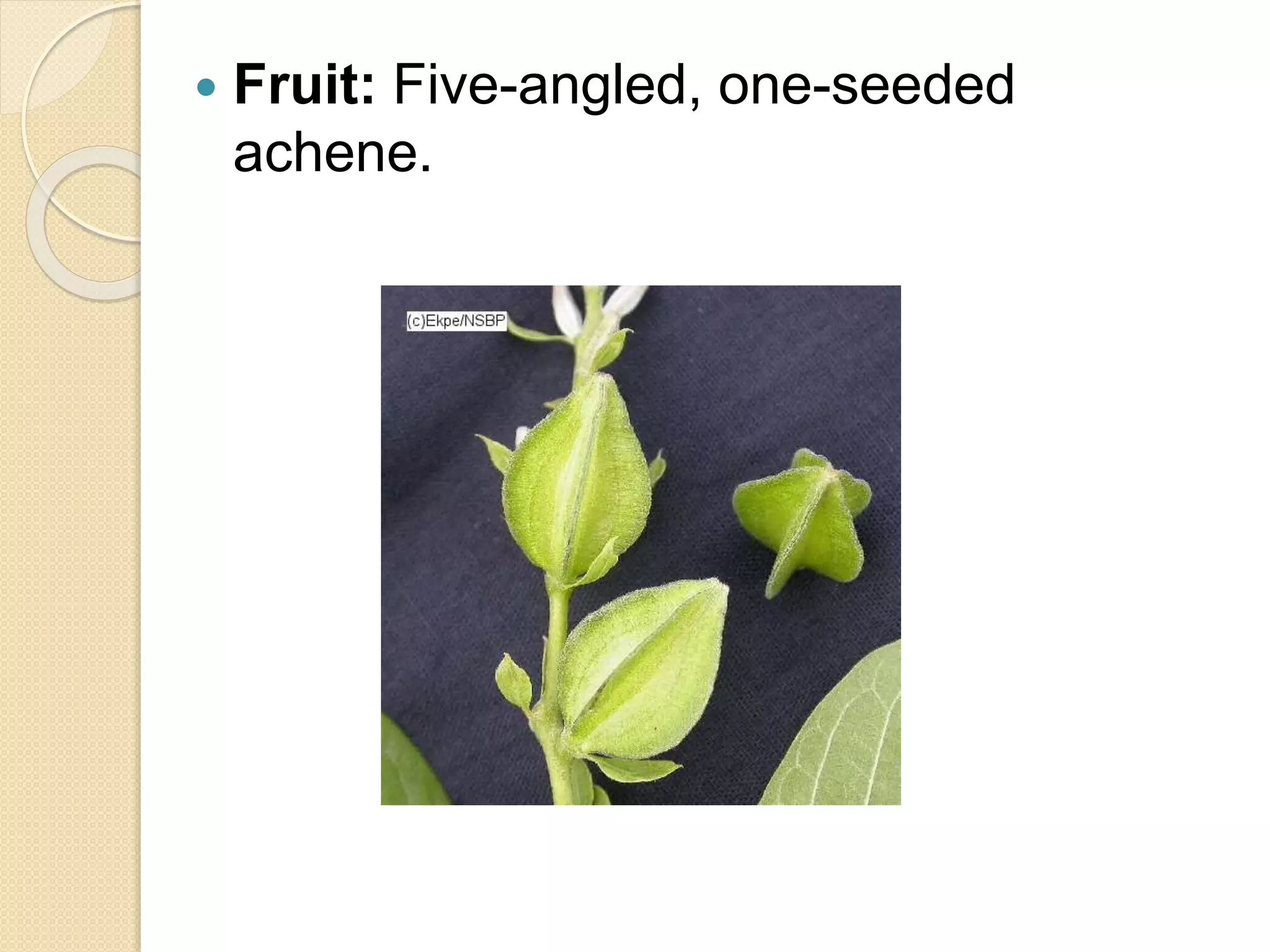
 Fruit: Five-angled, one-seeded
achene.
 Seed: Small, non-endospermic.
Economic Importance of
Combretaceae
 1. Food:
The fruits of Terminalia catappa –
Indian almond H. Jungali badam are
edible.
 2. Medicinal:
Terminalia is the most important
medicinal plant. The bark of Terminalia
arjuna is used as cardiac tonic.
 3. Gum:
The fruits of T. bellirica constitute one of
the myrobalans (an adhesive) of
commerce.
The gum exuding from the trunk of
Anogeissus latifolia is used in cali
coprinting, paper-sizing and
confectionery.
 4. Timber:
The wood obtained from T. bialata and T.
belerica is used for cabinet work furniture
and interior fittings.
 5. Tannin:
The young fruits of T. alata, T. arjuna,
T. chebule, etc. are used for tanning
and dyeing.
 6. Ornamental:
Quisqualis indica (Rangoon creeper),
Terminalia arjuna (Arjun), Bucida,
Combretum are of ornamental value.
Combretaceae

Combretaceae

  • 1.
    COMBRETACEAE SELVAM G IM.scBOTANY, BHARATHIDASAN UNIVERSITY TRICHY,TAMILNADU
  • 2.
    SYSTEMATIC POSSITION  Kingdom: Plantae  Division : Angiospermae  Class : Dicotyledons  Sub class : Polypetalae  Order : Myrtales  Family :Combretaceae – Indian Almond family
  • 3.
    Distribution of Combretaceae The Combretaceae are a family of flowering plants in the order Myrtales.  The family includes about 530 species of trees, shrubs, and lianas in 10 genera.  The family includes the leadwood tree, Combretum imberbe.  The Combretaceae are widespread in the subtropics and tropics.  Some members of this family produce useful construction timber, such as idigbo from Terminalia ivorensis.  The commonly cultivated Quisqualis indica is now placed in the genus Combretum.
  • 4.
    Characters of Combretaceae Flower pentamerous  sepals 4-5, valvate  petals, small sometimes absent  stamens 10 in two series  Carpel one, inferior, unilocular  fruit 2-5 angled.
  • 5.
    Vegetative characters  Habit:Mainly trees of shrubs, sometimes sub- scandent.  Root: Tap, deep and branched.  Stem: Erect, hard and woody or sometimes weak and sub-scandent.  Leaf: Simple, entire, alternate or opposite,
  • 6.
    Floral characters  Inflorescence:Racemose, paniculate or spicate.
  • 7.
     Flower: Actinomorphicrarely zygomorphic, hermaphrodite sometimes unisexual by abortion, epigynous; floral axis is carried above the ovary forming a tube.
  • 8.
     Calyx: Sepals4-5, rarely more, united to form a calyx tube adnate to ovary ; valvate, persistent.  Corolla: Petals are usually small, as many as sepals and alternating with them, either valvate or imbricate in aestivation, sometimes absent, polypetalous.
  • 9.
     Androecium: Stamens4, 5, 8 or 10, rarely many, , in two whorls (when 8 or 10), filaments are curved inwards in bud, anthers bithecal, versatile; stamens when in two whorls, often obdiplostemonous.
  • 10.
    Gynoecium  Monocarpellary; ovaryinferior, 1-celled, generally angled, the angles equal in number and alternating with calyx- segments.  ovules 2-5, rarely more, anatropous, pendulous from the top of the ovary on long, often united funicles.  style one, long, filiform bearing a pointed, rarely a capitate stigma.
  • 11.
     Fruit: Leathery,one seeded drupe having angled or winged pericarp.  Seed: Non-endospermic; spirally twisted cotyledens.  Pollination: Entomophilous.
  • 12.
  • 13.
    SYSTEMATIC POSSITION  Kingdom: Plantae  Division : Angiospermae  Class : Dicotyledons  Sub class : Polypetalae  Order : Myrtales  Family :Combretaceae – Indian Almond family  Genus :Combritum  Species :indicum
  • 14.
    Vegetative characters  Habit:A creeping sub-scadent shrub, commonly planted in the gardens.  Root: Tap-root.  Stem: Weak, sub-scadent.  Leaf: Opposite, superposed, simple, ovate, entire, exstipulate, unicostate reticulate.
  • 15.
    Inflorescence  Dense racemoseclusters of sweet- scented flowers.
  • 16.
     Flower: Bracteate,bisexual, regular, epigynous, pentamerous.
  • 17.
     Calyx: Sepals5, calyx-tube adnate to the ovary, lobes reflexed. superior.
  • 18.
     Corolla: Petals5, white at first, turning pink, alternating with the sepals, superior, imbricate in bud.
  • 19.
     Androecium: Stamensten, free in two whorls, the upper opposite the petals and the lower opposite the sepals, filaments long, anthers dorsifixed, superior.
  • 20.
     Gynoecium: Monocarpellary,ovary 1- celled, inferior, 5-angled, angles alternating with calyx segments; ovules pendulous from the top of the ovary on long united funicles; style one, long filiform; stigma minute, capitate.
  • 21.
     Fruit: Five-angled,one-seeded achene.
  • 22.
     Seed: Small,non-endospermic.
  • 24.
    Economic Importance of Combretaceae 1. Food: The fruits of Terminalia catappa – Indian almond H. Jungali badam are edible.  2. Medicinal: Terminalia is the most important medicinal plant. The bark of Terminalia arjuna is used as cardiac tonic.
  • 25.
     3. Gum: Thefruits of T. bellirica constitute one of the myrobalans (an adhesive) of commerce. The gum exuding from the trunk of Anogeissus latifolia is used in cali coprinting, paper-sizing and confectionery.  4. Timber: The wood obtained from T. bialata and T. belerica is used for cabinet work furniture and interior fittings.
  • 26.
     5. Tannin: Theyoung fruits of T. alata, T. arjuna, T. chebule, etc. are used for tanning and dyeing.  6. Ornamental: Quisqualis indica (Rangoon creeper), Terminalia arjuna (Arjun), Bucida, Combretum are of ornamental value.