Submitted by,
G SELVAM
BOTANY,BHARA
THIDSAN,UNIVE
RSITY TRICHY
SYSTEMATIC POSITION
DIVISION : Spermatophyta
SUB-DIVISION : Phanerogams
CLASS : Dicotyledons
SUB-CLASS : Gameopetalae
SERIES : Bicarpellate
ORDER : Lamiales
FAMILY : Lamiaceae
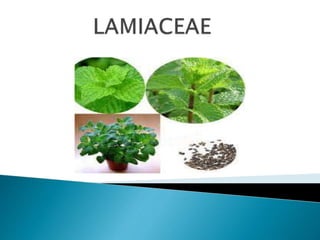
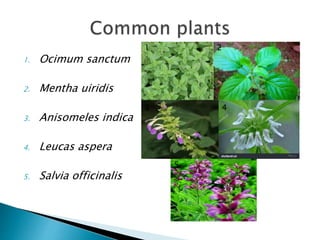
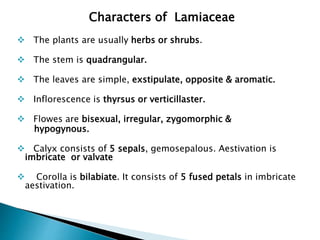
The family Lamiaceae is populary known as the mint family
1. Ocimum sanctum
2. Mentha uiridis
3. Anisomeles indica
4. Leucas aspera
5. Salvia officinalis
21
3 4
5
 The plants are usually herbs or shrubs.
 The stem is quadrangular.
 The leaves are simple, exstipulate, opposite & aromatic.
 Inflorescence is thyrsus or verticillaster.
 Flowes are bisexual, irregular, zygomorphic &
hypogynous.
 Calyx consists of 5 sepals, gemosepalous. Aestivation is
imbricate or valvate
 Corolla is bilabiate. It consists of 5 fused petals in imbricate
aestivation.
Characters of Lamiaceae
 Androecium consists 4 stamens. Stamens are epipetalous
& didynamous.
 Anther are dithecous, longitudinal slits.
 Gynoecium is bicarpellay, syncarpous & tetralocular.
 Ovary is superior. ovule is axile placentation.
 Fruit is schizocarp.
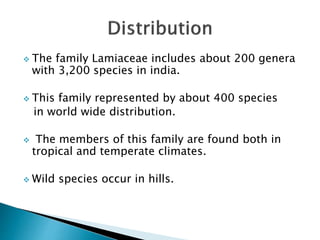
 Seed is non-endospermic .
 The family Lamiaceae includes about 200 genera
with 3,200 species in india.
 This family represented by about 400 species
in world wide distribution.
 The members of this family are found both in
tropical and temperate climates.
 Wild species occur in hills.
Systematic position
DIVISION : Spermatophyta
SUB-DIVISION : Phanerogams
CLASS : Dicotyledons
SUB-CLASS : Gameopetalae
SERIES : Bicarpellatae
ORDER : Lamiales
FAMILY : Lamiaceae
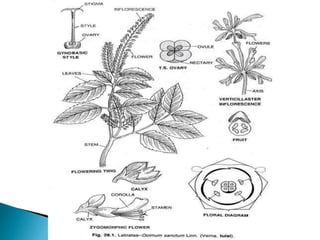
GENUS : Ocimum
SPECIES : sanctum
Habit:
 A perennial herb with typical aromatic
smell.
Stem:
 Erect, branched, quadrangular,
somewhat woody, solid, branches
covered with soft hairs.
Leaf:
 Simple, opposite, short petioled,
exstipulate, unicostate reticulate
venation.
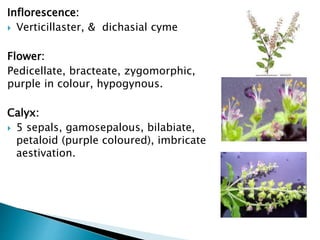
Inflorescence:
 Verticillaster, & dichasial cyme
Flower:
Pedicellate, bracteate, zygomorphic,
purple in colour, hypogynous.
Calyx:
 5 sepals, gamosepalous, bilabiate,
petaloid (purple coloured), imbricate
aestivation.
Corolla:
 5 petals, gamopetalous, bilabiate,
corolla tube short, upper lip four
lobed, lower lip large, imbricate
aestivation, inferior.
Androecium:
 4 stamens, polyandrous,
didynamous, epipetalous, fifth
posterior stamen completely
suppressed, dorsifixed.
Gynoecium:
 2 carpels (bicarpellary), syncarpous,
ovary bilocular in early stage but
becomes tetralocular in later stage,
ovary superior, four chambered, axile
placentation, single ovule in each
loculus, gynobasic style (i.e., it arises
from the base of the ovary), stigma
bifid.
Fruit:
 Schizocarpic
 Seed: seed is ex-albuminous with two
flat cotyledons
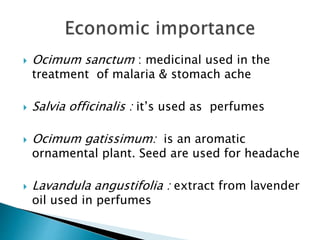
 Ocimum sanctum : medicinal used in the
treatment of malaria & stomach ache
 Salvia officinalis : it’s used as perfumes
 Ocimum gatissimum: is an aromatic
ornamental plant. Seed are used for headache
 Lavandula angustifolia : extract from lavender
oil used in perfumes
NYCTAGINACEAE
DIVISION : Magnoliophyta
SUB-DIVISION : spermatophyta
CLASS : Magnoliopsida
SUB-CLASS : Caryophyllidea
ORDER : Caryophllales
FAMILY : Nyctaginaceae
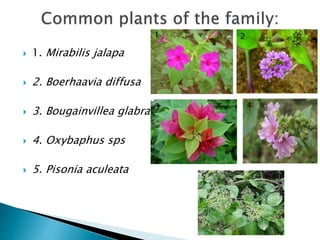
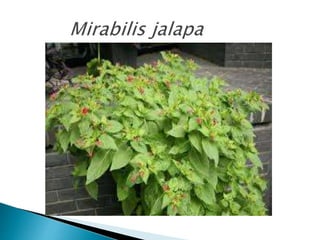
 1. Mirabilis jalapa
 2. Boerhaavia diffusa
 3. Bougainvillea glabra
 4. Oxybaphus sps
 5. Pisonia aculeata
1 2
3 4
5
 Habit: Herb, shrub or or trees.
 Root: Tap root, branched.
 Stem: Herbaceous or woody, erect or even climbing
e.g. Bougainvillea.
 Leaf: Alternate or opposite, simple, exstipulate.
 Inflorescence: Cymose or dichasial cyme
 Flower : Stamens or pistil, hypogynous,
actinomorphic, rarely zygomorphic
 Perianth: Tepals 4-5, gamophyllous, tubular with
wide spreading lobes, imbricate or twisted
aestivation.
 Androecium: Stamens variable 2 to 20, free,
usually 5 to 8 or equal to number of petals,
filaments of unequal lengths.
 Gynoecium: One carpel, superior ovary, unilocular
with a single basal ovule; style long.
 Fruit: Dry & indehiscent.
 Seed: Small, non-endospermic.
 Pollination: Entomophilous.
 Nyctaginaceae family is called as Four O’clock
family.
 It includes 30 genera and 300 species according to
Rendle.
 It is widely distributed in tropical and temperature
and warmer parts of the world.
 Reason to call this family as four o’clock- that the
flowers in certain members of the group (Mirabilis)
open in greatest numbers in late afternoon.
DIVISION : Magnoliophyta
SUB-DIVISION : spermatophyta
CLASS : Magnoliopsida
SUB-CLASS : Caryophyllidea
ORDER : Caryophllales
FAMILY : Nyctaginaceae
GENUS : Mirabilis
SPECIES : jalapa
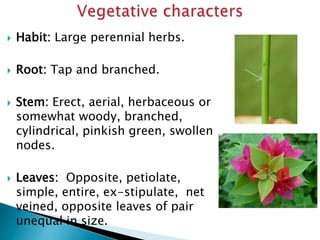
 Habit: Large perennial herbs.
 Root: Tap and branched.
 Stem: Erect, aerial, herbaceous or
somewhat woody, branched,
cylindrical, pinkish green, swollen
nodes.
 Leaves: Opposite, petiolate,
simple, entire, ex-stipulate, net
veined, opposite leaves of pair
unequal in size.
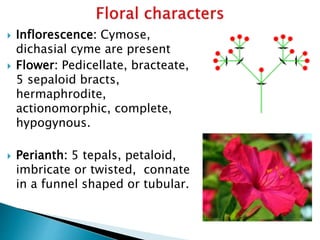
 Inflorescence: Cymose,
dichasial cyme are present
 Flower: Pedicellate, bracteate,
5 sepaloid bracts,
hermaphrodite,
actionomorphic, complete,
hypogynous.
 Perianth: 5 tepals, petaloid,
imbricate or twisted, connate
in a funnel shaped or tubular.
 Androecium: 5 stamens,
alternate to tepals,
filaments unequal, anther
dithecous, basifixed,
introrse.
 Gynoecium: Single carpel,
ovary free, superior,
unilocular, basal
placentation, single basal
erect ovule.
 Fruit: Indehiscent.
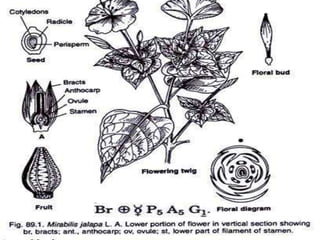
Floral formula:
 1. Medicinal: Boerhaavia diffusa’s root is also
used in asthma, anemia, jaundice.
 2. Ornamental: Mirabilis jalapa, Bougainvillea,
Abronia. Pisonia aculeata is a hedge plant.
Lamiaceae & nyctaginaceae