Poaceae (Graminae)
Grass family
Habit: Herbs, annuals or perennials or shrubs,
sometimes tree like (Bamboo).
Root: Adventitious, fibrous, branched, fascicled or stilt
(Zea mays).
Stem: Underground rhizome in all perennial grasses,
cylindrical, culm with conspicuous nodes and
internodes, internodes hollow, herbaceous or woody,
glabrous or glaucous, vegetative shoots are arising from
the base of aerial stem or from underground stems are
called tillers.
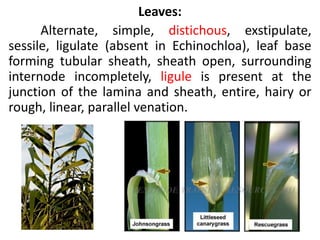
Leaves:
Alternate, simple, distichous, exstipulate,
sessile, ligulate (absent in Echinochloa), leaf base
forming tubular sheath, sheath open, surrounding
internode incompletely, ligule is present at the
junction of the lamina and sheath, entire, hairy or
rough, linear, parallel venation.
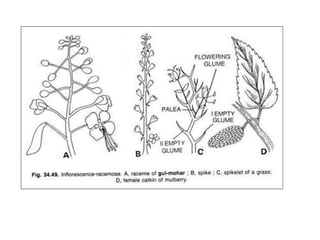
Inflorescence
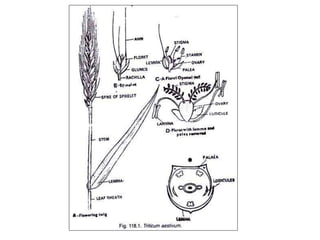
Compound spike which may be sessile or stalked.
Each unit of inflorescence is spikelet. The spikelets
are arranged in various ways on the main axis called
rachilla. A compound inflorescence may be spike of
spikelets (Triticum), panicle of spikelets (Avena).
The spikelet consists of a short axis called rachilla on
which 1 to many sessile or short stalked flowers are
borne. The florets may be arranged in alternate or
opposite manner on the central axis.
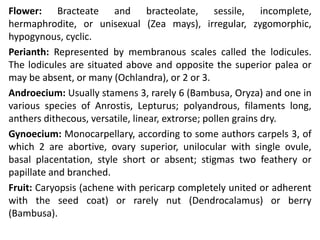
Flower: Bracteate and bracteolate, sessile, incomplete,
hermaphrodite, or unisexual (Zea mays), irregular, zygomorphic,
hypogynous, cyclic.
Perianth: Represented by membranous scales called the lodicules.
The lodicules are situated above and opposite the superior palea or
may be absent, or many (Ochlandra), or 2 or 3.
Androecium: Usually stamens 3, rarely 6 (Bambusa, Oryza) and one in
various species of Anrostis, Lepturus; polyandrous, filaments long,
anthers dithecous, versatile, linear, extrorse; pollen grains dry.
Gynoecium: Monocarpellary, according to some authors carpels 3, of
which 2 are abortive, ovary superior, unilocular with single ovule,
basal placentation, style short or absent; stigmas two feathery or
papillate and branched.
Fruit: Caryopsis (achene with pericarp completely united or adherent
with the seed coat) or rarely nut (Dendrocalamus) or berry
(Bambusa).
Distribution of Poaceae:
The family is commonly known as grass family.
It is one of the largest among the
angiospermic families. It consists of 620
genera and 6,000 species. The members are
cosmopolitan in distribution. The plants
represent all the 3 ecological types as
hydrophytes, xerophytes and mesophytes. In
India it is represented by 850 species.
Economic importance
Food: Triticum aestivum, Oryza sativa, Zea mays (Maize),
Hordeum vulgare (Jaw), Sorghum vulgare (Jowar), Avena
sativa (Oats), Pennisetum typhoides (Bajra) are cultivated
for cereals and food grains.
Fooder: Many grasses as Cynodon dactylon, Panicum,
Cymbopogon, Agrostis, Poa are grown for fodder.
Sugar: Saccharum officinarum (Sugarcane; H. Ganna) is
cultivated for gur and sugar.
Building material: Some species of Bambusa e.g. B. tulda,
B. vulgaris are used for scaffolding, thatching huts etc.
Furniture: Species of Dendrocalamus (H. Bent),
Arundinaria, Melocalamus are used in manufacture of
furniture.
Economic importance
Aromatic grasses: Many grasses yield scented oils which are used in
perfumery viz. Vetiveria zizanioides (H. Khus khus) yields vetiver oil
from the roots. The roots are also woven into curtains. Andropogon
odoratus (Ginger grass), Cymbopogon citratus (Lemon grass),
Cymbopogon martini (Geranium grass), Cymbopogon jawarancusa
etc. also yield oil.
Medicinal: Phragmites karka, Cymbopogon schoenanthus etc. are
medicinal. Secale cereale is cultivated for infection of its inflorescence
by Claviceps purpurea for production of Ergot and for extraction of
ergotine. Ergotine is an excellent remedy for uterine contraction.
Paper: It is manufactured from certain species of grasses and
bamboos.
Ornamental: Rhynchelytrum repens, Cortaderia selloana and some
species of the tribe Bambusoideae are ornamentals.
Besides these a number of grasses are grown to form fine lawns, play
grounds etc.
Poaceae

Poaceae

  • 1.
    Poaceae (Graminae) Grass family Habit:Herbs, annuals or perennials or shrubs, sometimes tree like (Bamboo). Root: Adventitious, fibrous, branched, fascicled or stilt (Zea mays). Stem: Underground rhizome in all perennial grasses, cylindrical, culm with conspicuous nodes and internodes, internodes hollow, herbaceous or woody, glabrous or glaucous, vegetative shoots are arising from the base of aerial stem or from underground stems are called tillers.
  • 2.
    Leaves: Alternate, simple, distichous,exstipulate, sessile, ligulate (absent in Echinochloa), leaf base forming tubular sheath, sheath open, surrounding internode incompletely, ligule is present at the junction of the lamina and sheath, entire, hairy or rough, linear, parallel venation.
  • 3.
    Inflorescence Compound spike whichmay be sessile or stalked. Each unit of inflorescence is spikelet. The spikelets are arranged in various ways on the main axis called rachilla. A compound inflorescence may be spike of spikelets (Triticum), panicle of spikelets (Avena). The spikelet consists of a short axis called rachilla on which 1 to many sessile or short stalked flowers are borne. The florets may be arranged in alternate or opposite manner on the central axis.
  • 5.
    Flower: Bracteate andbracteolate, sessile, incomplete, hermaphrodite, or unisexual (Zea mays), irregular, zygomorphic, hypogynous, cyclic. Perianth: Represented by membranous scales called the lodicules. The lodicules are situated above and opposite the superior palea or may be absent, or many (Ochlandra), or 2 or 3. Androecium: Usually stamens 3, rarely 6 (Bambusa, Oryza) and one in various species of Anrostis, Lepturus; polyandrous, filaments long, anthers dithecous, versatile, linear, extrorse; pollen grains dry. Gynoecium: Monocarpellary, according to some authors carpels 3, of which 2 are abortive, ovary superior, unilocular with single ovule, basal placentation, style short or absent; stigmas two feathery or papillate and branched. Fruit: Caryopsis (achene with pericarp completely united or adherent with the seed coat) or rarely nut (Dendrocalamus) or berry (Bambusa).
  • 7.
    Distribution of Poaceae: Thefamily is commonly known as grass family. It is one of the largest among the angiospermic families. It consists of 620 genera and 6,000 species. The members are cosmopolitan in distribution. The plants represent all the 3 ecological types as hydrophytes, xerophytes and mesophytes. In India it is represented by 850 species.
  • 8.
    Economic importance Food: Triticumaestivum, Oryza sativa, Zea mays (Maize), Hordeum vulgare (Jaw), Sorghum vulgare (Jowar), Avena sativa (Oats), Pennisetum typhoides (Bajra) are cultivated for cereals and food grains. Fooder: Many grasses as Cynodon dactylon, Panicum, Cymbopogon, Agrostis, Poa are grown for fodder. Sugar: Saccharum officinarum (Sugarcane; H. Ganna) is cultivated for gur and sugar. Building material: Some species of Bambusa e.g. B. tulda, B. vulgaris are used for scaffolding, thatching huts etc. Furniture: Species of Dendrocalamus (H. Bent), Arundinaria, Melocalamus are used in manufacture of furniture.
  • 9.
    Economic importance Aromatic grasses:Many grasses yield scented oils which are used in perfumery viz. Vetiveria zizanioides (H. Khus khus) yields vetiver oil from the roots. The roots are also woven into curtains. Andropogon odoratus (Ginger grass), Cymbopogon citratus (Lemon grass), Cymbopogon martini (Geranium grass), Cymbopogon jawarancusa etc. also yield oil. Medicinal: Phragmites karka, Cymbopogon schoenanthus etc. are medicinal. Secale cereale is cultivated for infection of its inflorescence by Claviceps purpurea for production of Ergot and for extraction of ergotine. Ergotine is an excellent remedy for uterine contraction. Paper: It is manufactured from certain species of grasses and bamboos. Ornamental: Rhynchelytrum repens, Cortaderia selloana and some species of the tribe Bambusoideae are ornamentals. Besides these a number of grasses are grown to form fine lawns, play grounds etc.