B.Sc. II Year
“ANGIOSPERMS SYSTEMATIC, ANATOMY AND EMBRYOLOGY”
Unit – III
‘Angiosperms Systematic’
Family- Verbenaceae
DR. SWATI V. PUNDKAR
Assistant Professor
Department of Botany
Shri Shivaji Science College, Amravati
NAAC Accredited ‘A’ Grade
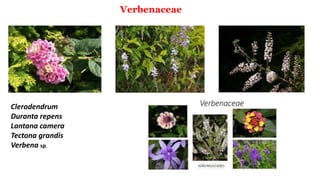
Verbenaceae
Clerodendrum
Duranta repens
Lantana camera
Tectona grandis
Verbena sp.
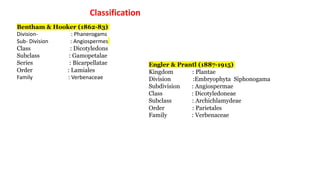
Bentham & Hooker (1862-83)
Division- : Phanerogams
Sub- Division : Angiospermes
Class : Dicotyledons
Subclass : Gamopetalae
Series : Bicarpellatae
Order : Lamiales
Family : Verbenaceae
Engler & Prantl (1887-1915)
Kingdom : Plantae
Division :Embryophyta Siphonogama
Subdivision : Angiospermae
Class : Dicotyledoneae
Subclass : Archichlamydeae
Order : Parietales
Family : Verbenaceae
Classification
Distribution of Verbenaceae:
The family is commonly called Verbena family. It
includes 77 genera and 3,020 species, out of which 21
genera and 125 species occur in India. The members of
family are inhabitants of tropical and subtropical
regions, they also extend into temperate lands.
Characters of Verbenaceae:
Plants herbs, shrubs or trees, leaves simple, exstipulate,
opposite or whorled; inflorescence cymose, racemose or
spike, flowers hermaphrodite, zygomorphic, hypogynous,
calyx gamosepalous, persistent; corolla 5 lobed,
gamopetalous sometimes 2 lipped, stamens four,
didynamous, unequally paired, epipetalous; carpels two,
syncarpous, superior, axile placentation, fruit drupe.
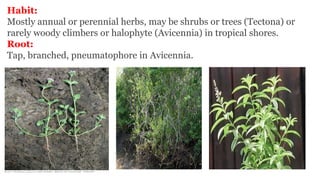
Habit:
Mostly annual or perennial herbs, may be shrubs or trees (Tectona) or
rarely woody climbers or halophyte (Avicennia) in tropical shores.
Root:
Tap, branched, pneumatophore in Avicennia.
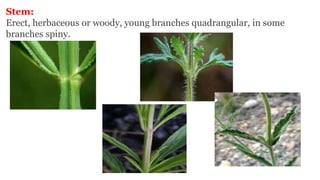
Stem:
Erect, herbaceous or woody, young branches quadrangular, in some
branches spiny.
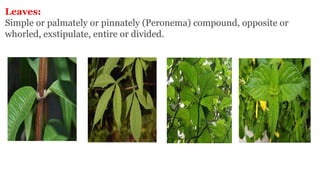
Leaves:
Simple or palmately or pinnately (Peronema) compound, opposite or
whorled, exstipulate, entire or divided.
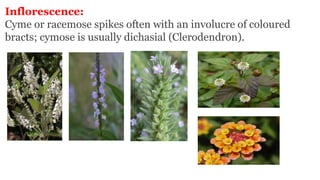
Inflorescence:
Cyme or racemose spikes often with an involucre of coloured
bracts; cymose is usually dichasial (Clerodendron).
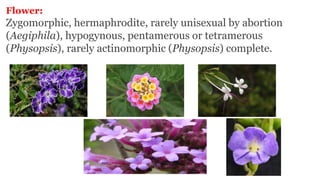
Flower:
Zygomorphic, hermaphrodite, rarely unisexual by abortion
(Aegiphila), hypogynous, pentamerous or tetramerous
(Physopsis), rarely actinomorphic (Physopsis) complete.
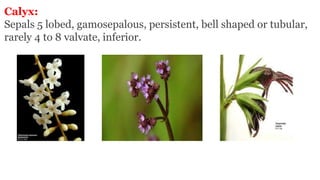
Calyx:
Sepals 5 lobed, gamosepalous, persistent, bell shaped or tubular,
rarely 4 to 8 valvate, inferior.
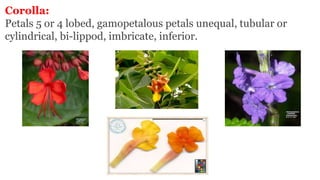
Corolla:
Petals 5 or 4 lobed, gamopetalous petals unequal, tubular or
cylindrical, bi-lippod, imbricate, inferior.
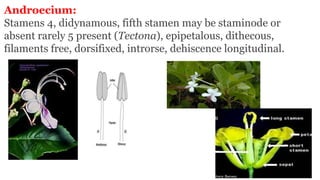
Androecium:
Stamens 4, didynamous, fifth stamen may be staminode or
absent rarely 5 present (Tectona), epipetalous, dithecous,
filaments free, dorsifixed, introrse, dehiscence longitudinal.
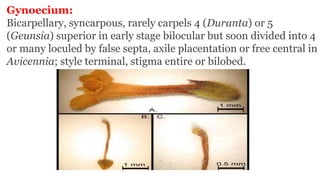
Gynoecium:
Bicarpellary, syncarpous, rarely carpels 4 (Duranta) or 5
(Geunsia) superior in early stage bilocular but soon divided into 4
or many loculed by false septa, axile placentation or free central in
Avicennia; style terminal, stigma entire or bilobed.
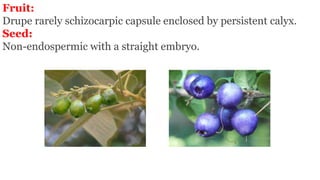
Fruit:
Drupe rarely schizocarpic capsule enclosed by persistent calyx.
Seed:
Non-endospermic with a straight embryo.
Pollination:
Entomophilous.
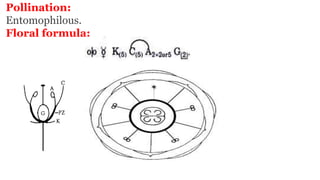
Floral formula:
Economic Importance of Verbenaceae:
1. Timber:
The wood of Tectona grandis (Teak, H. Sagwan) is extremely hard and
lasting. The wood is largely used in manufacturing of ships and good
quality furniture. Teak is grown in forests of Burma, Madhya Pradesh and
Assam. The wood of Gmelina arborea is used in making drums, sitars and
other musical instruments.
2. Medicinal:
The roots of Clerodendron are used in asthma and cough. The decoction
of leaves of Lantana camara is given in tetanus and rheumatism. The
leave’s juice of Gmelina arborea is used in gonorrhoea, cough and ulcers.
3. Oils:
Lippia alba produces a valuable oil.
4. Tanning:
The bark of Avicennia is used in tanning.
5. Febrifuge:
The leaves of Vitex negundo serve as febrifuge. The branches of
this plant are kept over stored grains to keep off insects.
6. Ornamental:
Lantana, Verbena officinalis, Duranta, Congea tomentosa,
Callicarpa, Clerodendron, Petrea are cultivated in gardens.