Magnoliaceae
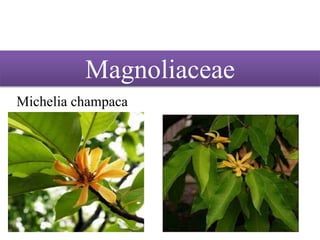
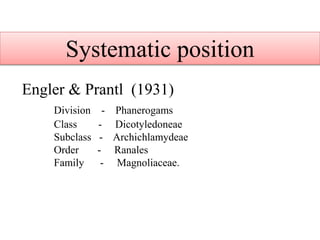
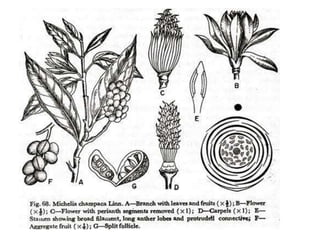
Michelia champaca
Systematic position
Bentham and Hooker [1862]
Division - Phanerogams
Class - Dicotyledones
Subclass - Polypetalae
Series - Thalamiflorae
Order - Ranales
Family - Magnoliaceae.
Engler & Prantl (1931)
Division - Phanerogams
Class - Dicotyledoneae
Subclass - Archichlamydeae
Order - Ranales
Family - Magnoliaceae.
Systematic position
Systematic position
Hutchinson[1959]
Division - Angiospermae
Class - Dicotyledones
Subclass - Lignosae
Order - Magnoliales
Family - Magnoliaceae.
Salient features
 Mostly trees or shrubs, no herbs.
 Leaves alternate, stipulate and simple.
 Flowers bisexual, actinomorphic and usually large in size.
 Perianth trimerous having three whorls
 Receptacle cone like. Stamens indefinite and spirally arranged
 Carpels many, Apocarpous and spirally arranged.
 Fruits usually an etaerio of follicles or berries or could be a samara
also
Distribution
It’s a family of about 18 Genera and 300 species.
The members of this family are distributed mainly in tropical and sub-
tropical regions of the rthern hemisphere. Some of them are found in
temperate regions also. Found in eastern Asia, Malaysia, Eastern
North America, West Indies and Brazil. Magnolia is the largest genus,
mostly Asiatic with More than 77 species. Michelia (15 Spp.) occurs
in tropical Asia from Java to China.
Description
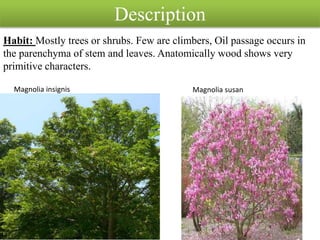
Habit: Mostly trees or shrubs. Few are climbers, Oil passage occurs in
the parenchyma of stem and leaves. Anatomically wood shows very
primitive characters.
Magnolia insignis Magnolia susan
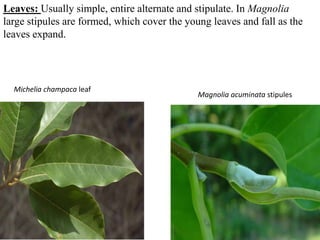
Leaves: Usually simple, entire alternate and stipulate. In Magnolia
large stipules are formed, which cover the young leaves and fall as the
leaves expand.
Michelia champaca leaf
Magnolia acuminata stipules
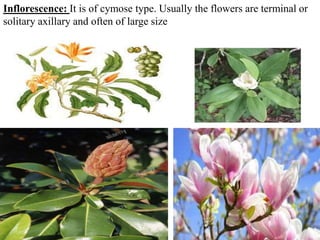
Inflorescence: It is of cymose type. Usually the flowers are terminal or
solitary axillary and often of large size
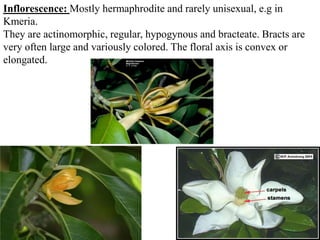
Inflorescence: Mostly hermaphrodite and rarely unisexual, e.g in
Kmeria.
They are actinomorphic, regular, hypogynous and bracteate. Bracts are
very often large and variously colored. The floral axis is convex or
elongated.
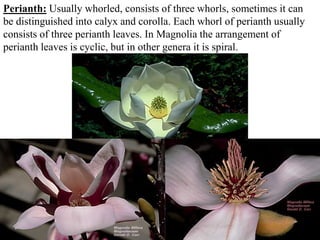
Perianth: Usually whorled, consists of three whorls, sometimes it can
be distinguished into calyx and corolla. Each whorl of perianth usually
consists of three perianth leaves. In Magnolia the arrangement of
perianth leaves is cyclic, but in other genera it is spiral.
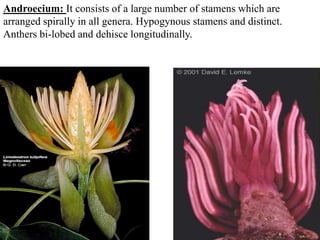
Androecium: It consists of a large number of stamens which are
arranged spirally in all genera. Hypogynous stamens and distinct.
Anthers bi-lobed and dehisce longitudinally.
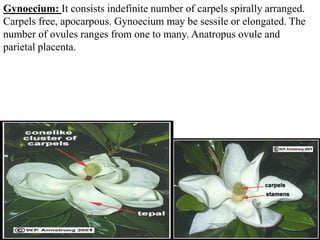
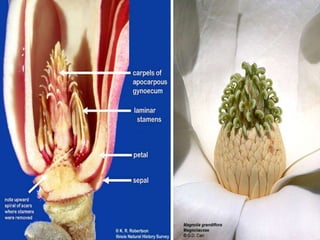
Gynoecium: It consists indefinite number of carpels spirally arranged.
Carpels free, apocarpous. Gynoecium may be sessile or elongated. The
number of ovules ranges from one to many. Anatropus ovule and
parietal placenta.
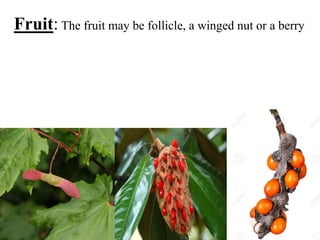
Fruit: The fruit may be follicle, a winged nut or a berry
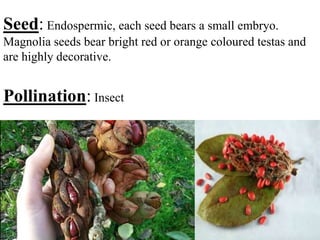
Seed: Endospermic, each seed bears a small embryo.
Magnolia seeds bear bright red or orange coloured testas and
are highly decorative.
Pollination: Insect
Common plants of the family:
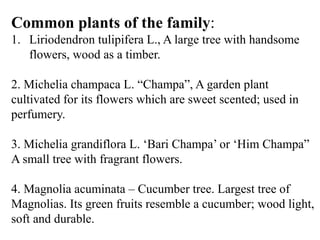
1. Liriodendron tulipifera L., A large tree with handsome
flowers, wood as a timber.
2. Michelia champaca L. “Champa”, A garden plant
cultivated for its flowers which are sweet scented; used in
perfumery.
3. Michelia grandiflora L. ‘Bari Champa’ or ‘Him Champa”
A small tree with fragrant flowers.
4. Magnolia acuminata – Cucumber tree. Largest tree of
Magnolias. Its green fruits resemble a cucumber; wood light,
soft and durable.
Economic Importance
 Many family are important economically due to their horticultural
values
1. Magnolia grandiflora: Eng- Bull bay, Ver- Bari champa, This is a
small tree with beautiful scented flowers. Cultivated as hedge
plants.
2. Michelia champaca: Large tree, cultivated mainly in South India,
the Western Ghats, Assam and Bengal. Oil obtained is used in
perfumery. Several Species yield timber. Root and bark are used as
purgative. Flowers and fruits are used in renal disease. Oil is used in
gout. Flowers yield a dye.
3. Michelia fuscata: Eng- Banana shrub- Small tree. The flowers are
used for scenting hair oil.
4 Liriodendron: Eng- Tulip tree , The tree is highly ornamental and
grown in avenues.
5 Talauma : This is also an ornamental tree

1.magnoliaceae

  • 1.
  • 2.
    Systematic position Bentham andHooker [1862] Division - Phanerogams Class - Dicotyledones Subclass - Polypetalae Series - Thalamiflorae Order - Ranales Family - Magnoliaceae.
  • 3.
    Engler & Prantl(1931) Division - Phanerogams Class - Dicotyledoneae Subclass - Archichlamydeae Order - Ranales Family - Magnoliaceae. Systematic position
  • 4.
    Systematic position Hutchinson[1959] Division -Angiospermae Class - Dicotyledones Subclass - Lignosae Order - Magnoliales Family - Magnoliaceae.
  • 5.
    Salient features  Mostlytrees or shrubs, no herbs.  Leaves alternate, stipulate and simple.  Flowers bisexual, actinomorphic and usually large in size.  Perianth trimerous having three whorls  Receptacle cone like. Stamens indefinite and spirally arranged  Carpels many, Apocarpous and spirally arranged.  Fruits usually an etaerio of follicles or berries or could be a samara also
  • 6.
    Distribution It’s a familyof about 18 Genera and 300 species. The members of this family are distributed mainly in tropical and sub- tropical regions of the rthern hemisphere. Some of them are found in temperate regions also. Found in eastern Asia, Malaysia, Eastern North America, West Indies and Brazil. Magnolia is the largest genus, mostly Asiatic with More than 77 species. Michelia (15 Spp.) occurs in tropical Asia from Java to China.
  • 7.
    Description Habit: Mostly treesor shrubs. Few are climbers, Oil passage occurs in the parenchyma of stem and leaves. Anatomically wood shows very primitive characters. Magnolia insignis Magnolia susan
  • 8.
    Leaves: Usually simple,entire alternate and stipulate. In Magnolia large stipules are formed, which cover the young leaves and fall as the leaves expand. Michelia champaca leaf Magnolia acuminata stipules
  • 9.
    Inflorescence: It isof cymose type. Usually the flowers are terminal or solitary axillary and often of large size
  • 10.
    Inflorescence: Mostly hermaphroditeand rarely unisexual, e.g in Kmeria. They are actinomorphic, regular, hypogynous and bracteate. Bracts are very often large and variously colored. The floral axis is convex or elongated.
  • 11.
    Perianth: Usually whorled,consists of three whorls, sometimes it can be distinguished into calyx and corolla. Each whorl of perianth usually consists of three perianth leaves. In Magnolia the arrangement of perianth leaves is cyclic, but in other genera it is spiral.
  • 12.
    Androecium: It consistsof a large number of stamens which are arranged spirally in all genera. Hypogynous stamens and distinct. Anthers bi-lobed and dehisce longitudinally.
  • 13.
    Gynoecium: It consistsindefinite number of carpels spirally arranged. Carpels free, apocarpous. Gynoecium may be sessile or elongated. The number of ovules ranges from one to many. Anatropus ovule and parietal placenta.
  • 15.
    Fruit: The fruitmay be follicle, a winged nut or a berry
  • 16.
    Seed: Endospermic, eachseed bears a small embryo. Magnolia seeds bear bright red or orange coloured testas and are highly decorative. Pollination: Insect
  • 17.
    Common plants ofthe family: 1. Liriodendron tulipifera L., A large tree with handsome flowers, wood as a timber. 2. Michelia champaca L. “Champa”, A garden plant cultivated for its flowers which are sweet scented; used in perfumery. 3. Michelia grandiflora L. ‘Bari Champa’ or ‘Him Champa” A small tree with fragrant flowers. 4. Magnolia acuminata – Cucumber tree. Largest tree of Magnolias. Its green fruits resemble a cucumber; wood light, soft and durable.
  • 19.
    Economic Importance  Manyfamily are important economically due to their horticultural values 1. Magnolia grandiflora: Eng- Bull bay, Ver- Bari champa, This is a small tree with beautiful scented flowers. Cultivated as hedge plants. 2. Michelia champaca: Large tree, cultivated mainly in South India, the Western Ghats, Assam and Bengal. Oil obtained is used in perfumery. Several Species yield timber. Root and bark are used as purgative. Flowers and fruits are used in renal disease. Oil is used in gout. Flowers yield a dye. 3. Michelia fuscata: Eng- Banana shrub- Small tree. The flowers are used for scenting hair oil.
  • 20.
    4 Liriodendron: Eng-Tulip tree , The tree is highly ornamental and grown in avenues. 5 Talauma : This is also an ornamental tree