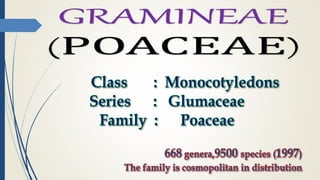
poaceae or true grass is a monocotyledon family.the family consist mainly grasses.different varieties of grasses are present under the categories.one of the most advanced reproductive mechanisms are present in the family.
the presentation is about plant family Brassicaceae. in this presentation you will study about general introduction of the family, its distributions, vegetative characters, floral characters, floral formula and diagram, important genera of this family and economic importance of this family.
Poaceae or Gramineae is a large and nearly ubiquitous family of monocotyledonous flowering plants known as grasses. It includes the cereal grasses, bamboos and the grasses of natural grassland and species cultivated in lawns and pasture. The latter are commonly referred to collectively as grass
Angiosperms are the flowering plants also known as Magnoliophyta. The botanical term "Angiosperm" meaning ‘bottle or vessel’ is derived from the ancient Greek. These are the most diverse group of land plants. Angiosperms are seed-producing plants and the distinguished features of angiosperms over gymnosperms are angiosperms bear flowers, endosperm within the seeds and the production of fruits that contain the seed. According to the botanists the flowering plants diversified and widespread 120 million years ago. The classification of the flowering plants also has a long history.
In the past, classification systems were typically produced by an individual botanist or by a small group resulting large number of systems. Different systems and their updates were generally favored in different countries. Bentham and Hooker’s system was popular in the Britain and the Engler’s system was famous in the Europe etc. These systems were introduced before the availability of genetic evidences and angiosperms were classified using their morphology and biochemistry. After the 1980’s genetic evidences were available and phylogenetic methods came into the classification procedures.
In the late 1990s, an informal group of researchers from major institutions worldwide came together and they established the Angiosperm Phylogeny Group (APG). The objective was to provide a widely accepted and more stable point of reference for angiosperm classification. APG I was published in 1998 as their first attempt in Annals of the Missouri Botanical Garden. The initial 1998 paper by the APG made angiosperms the first large group of organisms to be systematically re-classified primarily on the basis of genetic characteristics. The group emphasized the need for a classification system for angiosperms at the level of families, orders and above. The existed systems are rejected is because they are not phylogenetically classified. The outline of a phylogenetic tree of all flowering plants became established and several well supported major clades involving many families of flowering plants were identified. The new knowledge of phylogeny revealed relationships in conflict with the then widely used modern classifications.
The principles of APG system are retaining the Linnean system of orders and families, Use of monophyletic groups (Consist of all descendants of a common ancestor), taking a broad approach to defining the limits of groups such as orders and families and use of term ‘clades’ above or parallel to the level of orders and families. A major outcome of the classification is the disappearance of the traditional division of the flowering plants into two groups, which are monocots and dicots.
Even though there are several controversies about APG the botanists worldwide are influenced by the concept and are currently practice the system.
the presentation is about plant family Brassicaceae. in this presentation you will study about general introduction of the family, its distributions, vegetative characters, floral characters, floral formula and diagram, important genera of this family and economic importance of this family.
Poaceae or Gramineae is a large and nearly ubiquitous family of monocotyledonous flowering plants known as grasses. It includes the cereal grasses, bamboos and the grasses of natural grassland and species cultivated in lawns and pasture. The latter are commonly referred to collectively as grass
Angiosperms are the flowering plants also known as Magnoliophyta. The botanical term "Angiosperm" meaning ‘bottle or vessel’ is derived from the ancient Greek. These are the most diverse group of land plants. Angiosperms are seed-producing plants and the distinguished features of angiosperms over gymnosperms are angiosperms bear flowers, endosperm within the seeds and the production of fruits that contain the seed. According to the botanists the flowering plants diversified and widespread 120 million years ago. The classification of the flowering plants also has a long history.
In the past, classification systems were typically produced by an individual botanist or by a small group resulting large number of systems. Different systems and their updates were generally favored in different countries. Bentham and Hooker’s system was popular in the Britain and the Engler’s system was famous in the Europe etc. These systems were introduced before the availability of genetic evidences and angiosperms were classified using their morphology and biochemistry. After the 1980’s genetic evidences were available and phylogenetic methods came into the classification procedures.
In the late 1990s, an informal group of researchers from major institutions worldwide came together and they established the Angiosperm Phylogeny Group (APG). The objective was to provide a widely accepted and more stable point of reference for angiosperm classification. APG I was published in 1998 as their first attempt in Annals of the Missouri Botanical Garden. The initial 1998 paper by the APG made angiosperms the first large group of organisms to be systematically re-classified primarily on the basis of genetic characteristics. The group emphasized the need for a classification system for angiosperms at the level of families, orders and above. The existed systems are rejected is because they are not phylogenetically classified. The outline of a phylogenetic tree of all flowering plants became established and several well supported major clades involving many families of flowering plants were identified. The new knowledge of phylogeny revealed relationships in conflict with the then widely used modern classifications.
The principles of APG system are retaining the Linnean system of orders and families, Use of monophyletic groups (Consist of all descendants of a common ancestor), taking a broad approach to defining the limits of groups such as orders and families and use of term ‘clades’ above or parallel to the level of orders and families. A major outcome of the classification is the disappearance of the traditional division of the flowering plants into two groups, which are monocots and dicots.
Even though there are several controversies about APG the botanists worldwide are influenced by the concept and are currently practice the system.
this presentation is about family rosaceae. it is also known as Rose family. in this presentation you will study about the occurrence, distribution, vegetative characters, floral characters, important genera and economic importance this family.
This ppt contains all about the family Rosaceae under Dicotyledons. It explains about its systematic position, general characters, phylogenetic affinities, floral formula and diagram, economic importance and important genera under this family.
Characters of Apiaceae:
Stem fistular, leaves alternate, much dissected mostly decompound, sheathing leaf base; inflorescence umbel or compound umbel occasionally simple; flowers epigynous, pentamerous, regular rarely zygomorphic, hermaphrodite; calyx superior, pentafid or 0; corolla five, polypetalous, often inflexed; stamens 5; carpels 2; syncarpous, bicarpellary with 2 pendulous ovules; honey-disc surrounding the stigmas – stylopodium is present; fruit cremocarp; seeds endospermic and oily.
A. Vegetative characters:
Habit:
Plants are mostly herbs which may be annual, biennial or perennial, the herbs may be large (Bupleurum, Heracleum, Agelica) rarely shrubs with aromatic odour due to the presence of oil ducts. Pseudocarum climbs by means of its petioles which are very sensitive to contact.
Malvaceae, or the mallows, is a family of flowering plants estimated to contain 244 genera with 4225 known species. Well-known members of economic importance include okra, cotton, cacao and durian. There are also some genera containing familiar ornamentals, such as Alcea, Malva and Lavatera, as well as Tilia
Vascular Cambium & Seasonal activity & its Role in Stem & RootFatima Ramay
Vascular Cambium & Seasonal activity & its Role in Stem & Root:
The vascular cambium (pl. cambia or cambiums) is a lateral meristem in the vascular tissue of plants.
The vascular cambium is a cylindrical layer of cambium that runs through the stem of a plant that undergoes secondary growth.
In Dicots:
The vascular cambium is in dicot stems and roots, located between the xylem and the phloem in the stem and root of a vascular plant, and is the source of both the secondary xylem growth (inwards, towards the pith) and the secondary phloem growth (outwards).
In Monocots:
Monocot stems, such as corn, palms and bamboos, do not have a vascular cambium and do not exhibit secondary growth by the production of concentric annual rings. They cannot increase in girth by adding lateral layers of cells as in conifers and woody dicots.
Cambium of some plants remains active for the entire period of their life, i.e., cambial cells divide and resulting cells mature to form xylem and phloem elements.
This type of seasonal activity usually found in the plants present in the tropical regions, and not all plants show cambial activity.
Percentage of ringless trees in the rain forests of; India : 75% Amazon : 43% Malaysia : 15%
In regions with definite seasonal climate; seasonal activity of cambium ceased with onset of unfavorable conditions; In Autumn, it enters the dormant state and lasts for the end of summer; In Spring, cambium again becomes active.
Duration of cambial activity is also affected by day-length, e.g., In Robinia pseudoacacia, cambium is dormant under short-day condition.
The cambium cells formed in circular in cross section from the beginning onwards.
The cambial ring is partially primary (fascicular cambium) and partially secondary (interfascicular cambium).
Periderm originates from the cortical cells (extra stelar in origin).
In Dicot stem, for mechanical support xylem is with comparatively smaller vessels, greater fibers and less parenchyma.
More amount of cork is produces for protection.
Lenticels on periderm are very prominent.
The cambial ring formed is wavy in the beginning and later becomes circular.
The cambium ring is completely secondary in origin.
Periderm originates from the pericycle (intra stelar in origin).
In Dicot root, xylem is with big thin walled vessels with few fibers and more parenchyma.
Less amount of cork is produced as root is underground.
Lenticels on periderm are not very prominent.
Parental care in fishes, several fishes showing parental care,different types...Anand P P
parental care in fishes is very important role in survival of young ones.the important parental care methods included in this slide,and this slide also contain which are the fishes showing parental cares.
this presentation is about family rosaceae. it is also known as Rose family. in this presentation you will study about the occurrence, distribution, vegetative characters, floral characters, important genera and economic importance this family.
This ppt contains all about the family Rosaceae under Dicotyledons. It explains about its systematic position, general characters, phylogenetic affinities, floral formula and diagram, economic importance and important genera under this family.
Characters of Apiaceae:
Stem fistular, leaves alternate, much dissected mostly decompound, sheathing leaf base; inflorescence umbel or compound umbel occasionally simple; flowers epigynous, pentamerous, regular rarely zygomorphic, hermaphrodite; calyx superior, pentafid or 0; corolla five, polypetalous, often inflexed; stamens 5; carpels 2; syncarpous, bicarpellary with 2 pendulous ovules; honey-disc surrounding the stigmas – stylopodium is present; fruit cremocarp; seeds endospermic and oily.
A. Vegetative characters:
Habit:
Plants are mostly herbs which may be annual, biennial or perennial, the herbs may be large (Bupleurum, Heracleum, Agelica) rarely shrubs with aromatic odour due to the presence of oil ducts. Pseudocarum climbs by means of its petioles which are very sensitive to contact.
Malvaceae, or the mallows, is a family of flowering plants estimated to contain 244 genera with 4225 known species. Well-known members of economic importance include okra, cotton, cacao and durian. There are also some genera containing familiar ornamentals, such as Alcea, Malva and Lavatera, as well as Tilia
Vascular Cambium & Seasonal activity & its Role in Stem & RootFatima Ramay
Vascular Cambium & Seasonal activity & its Role in Stem & Root:
The vascular cambium (pl. cambia or cambiums) is a lateral meristem in the vascular tissue of plants.
The vascular cambium is a cylindrical layer of cambium that runs through the stem of a plant that undergoes secondary growth.
In Dicots:
The vascular cambium is in dicot stems and roots, located between the xylem and the phloem in the stem and root of a vascular plant, and is the source of both the secondary xylem growth (inwards, towards the pith) and the secondary phloem growth (outwards).
In Monocots:
Monocot stems, such as corn, palms and bamboos, do not have a vascular cambium and do not exhibit secondary growth by the production of concentric annual rings. They cannot increase in girth by adding lateral layers of cells as in conifers and woody dicots.
Cambium of some plants remains active for the entire period of their life, i.e., cambial cells divide and resulting cells mature to form xylem and phloem elements.
This type of seasonal activity usually found in the plants present in the tropical regions, and not all plants show cambial activity.
Percentage of ringless trees in the rain forests of; India : 75% Amazon : 43% Malaysia : 15%
In regions with definite seasonal climate; seasonal activity of cambium ceased with onset of unfavorable conditions; In Autumn, it enters the dormant state and lasts for the end of summer; In Spring, cambium again becomes active.
Duration of cambial activity is also affected by day-length, e.g., In Robinia pseudoacacia, cambium is dormant under short-day condition.
The cambium cells formed in circular in cross section from the beginning onwards.
The cambial ring is partially primary (fascicular cambium) and partially secondary (interfascicular cambium).
Periderm originates from the cortical cells (extra stelar in origin).
In Dicot stem, for mechanical support xylem is with comparatively smaller vessels, greater fibers and less parenchyma.
More amount of cork is produces for protection.
Lenticels on periderm are very prominent.
The cambial ring formed is wavy in the beginning and later becomes circular.
The cambium ring is completely secondary in origin.
Periderm originates from the pericycle (intra stelar in origin).
In Dicot root, xylem is with big thin walled vessels with few fibers and more parenchyma.
Less amount of cork is produced as root is underground.
Lenticels on periderm are not very prominent.
Parental care in fishes, several fishes showing parental care,different types...Anand P P
parental care in fishes is very important role in survival of young ones.the important parental care methods included in this slide,and this slide also contain which are the fishes showing parental cares.
The Fabaceae or Leguminosae, commonly known as the legume, pea, or bean family, are a large and economically important family of flowering plants. It includes trees, shrubs, and perennial or annual herbaceous plants, which are easily recognized by their fruit and their compound, stipulate leaves.
The Arum Family “
The diversity of Aroids”
Dr DON J SCOTT BERIN G BHMS(MD)
DEPARTMENT OF MATERIA MEDICA
WHITE MEMORIAL HOMOEOPATHIC MEDICAL
COLLEGE AND HOSPITAL VEEYANOOR, ATTOOR, K K DIST.
Dr DON J SCOTT BERIN G BHMS(MD)
DEPARTMENT OF MATERIA MEDICA
WHITE MEMORIAL HOMOEOPATHIC MEDICAL COLLEGE VEEYANOOR, ATTOOR. KANYAKUMARI DISTRICT,
TAMIL NADU.
insect pest controlled via microbes, microbial control, bacteria used for control, fungi used for control, virus used for control, some other microbes used for control, name of microbes economically used
insect population estimation, nature of sampling , stage to be counted, collection methods , models used for sampling, methods of samples, sample size, nature of samples
Survey of animal poison,different types of organisms and their poisonic prope...Anand P P
different organisms having different types of defense mechanisms.one of the major important character of defense is related to their own poison .the poison have very important of their fitness and survival value.
Human kidney,structure and functions of kidneyAnand P P
human kidney structural and functions.different types of structural components present in kidney and each structure having definite functions.structural and functional aspects of kidney.
penguins and pelicans.this different types of penguins and pelicansAnand P P
this slide contain equally important of pelicans and penguins.different types of pelicans and penguins are present.the systematic system also present in this slides.
Viper,the snake viper major poison and several types vipers are presentAnand P P
vipers is a one of the venomous snake,several varieties of snake present..pit vipers and pit less vipers .this slide containe several types of vipers and their main features.
Palaerarctic region.the zoogeographical separation and distribution of animal...Anand P P
zoogeography mean that simply state that distribution of animals on the basics of geography.several zoogeography area present.palaearctic region have a special type of organisms distribution
National parks & sanctuaries in india,several exsitu biodiversity conservatio...Anand P P
in India several biodiversity conservation methods are present.mainly the biodiversity conservation is insitu and exsitu.in insitu sonservation is natural conservation method for conserving ative organisms.in indian national parks and sanctuaries.
Environmental pollutions,several types of environmental pollutions are presen...Anand P P
the main environmental problems are listed out.the pollution causes several problems.different types of environmental pollutions are present .the environmental pollutions causes serious problems in our life
Natural and acquired immunity,several immune mechanisms are present in our bo...Anand P P
immune mechanisms and their categories.mainly two types of immune mechanisms are present natural and artificial mechanisms.several organs and specialized cells are serve for the part of immune mechanism of our body
Lampbrush chromosome,chromosomes structure.giant chromosomes lambrush chromos...Anand P P
this slide mainly deals with the special types of chromosomes .normally the large sized chromosomes is called as the giant chromosomes,it occur in some insects larval stage .it has several functions and structural modifications.
Aquatic mammals & their adaptation.fully aquatic mammal and amphibian aquatic...Anand P P
this slide animation and videos work mainly in power point 2013 version.the slide contain aquatic mammals and their evolutions.mainly evolutions and their adaptive mechanisms are also listed
ART ( ASSISTED REPRODUCTIVE TECHNOLOGIES).THIS THE ARTIFICIAL REPRODUCTION TE...Anand P P
Artificial reproductive technology helps to produce the offspring without direct biological mating.several methods are used to artificial reproduction like zift , gift ,INTRA CYTOPLASMIC SPERM INGECTION
2024.06.01 Introducing a competency framework for languag learning materials ...Sandy Millin
http://sandymillin.wordpress.com/iateflwebinar2024
Published classroom materials form the basis of syllabuses, drive teacher professional development, and have a potentially huge influence on learners, teachers and education systems. All teachers also create their own materials, whether a few sentences on a blackboard, a highly-structured fully-realised online course, or anything in between. Despite this, the knowledge and skills needed to create effective language learning materials are rarely part of teacher training, and are mostly learnt by trial and error.
Knowledge and skills frameworks, generally called competency frameworks, for ELT teachers, trainers and managers have existed for a few years now. However, until I created one for my MA dissertation, there wasn’t one drawing together what we need to know and do to be able to effectively produce language learning materials.
This webinar will introduce you to my framework, highlighting the key competencies I identified from my research. It will also show how anybody involved in language teaching (any language, not just English!), teacher training, managing schools or developing language learning materials can benefit from using the framework.
June 3, 2024 Anti-Semitism Letter Sent to MIT President Kornbluth and MIT Cor...Levi Shapiro
Letter from the Congress of the United States regarding Anti-Semitism sent June 3rd to MIT President Sally Kornbluth, MIT Corp Chair, Mark Gorenberg
Dear Dr. Kornbluth and Mr. Gorenberg,
The US House of Representatives is deeply concerned by ongoing and pervasive acts of antisemitic
harassment and intimidation at the Massachusetts Institute of Technology (MIT). Failing to act decisively to ensure a safe learning environment for all students would be a grave dereliction of your responsibilities as President of MIT and Chair of the MIT Corporation.
This Congress will not stand idly by and allow an environment hostile to Jewish students to persist. The House believes that your institution is in violation of Title VI of the Civil Rights Act, and the inability or
unwillingness to rectify this violation through action requires accountability.
Postsecondary education is a unique opportunity for students to learn and have their ideas and beliefs challenged. However, universities receiving hundreds of millions of federal funds annually have denied
students that opportunity and have been hijacked to become venues for the promotion of terrorism, antisemitic harassment and intimidation, unlawful encampments, and in some cases, assaults and riots.
The House of Representatives will not countenance the use of federal funds to indoctrinate students into hateful, antisemitic, anti-American supporters of terrorism. Investigations into campus antisemitism by the Committee on Education and the Workforce and the Committee on Ways and Means have been expanded into a Congress-wide probe across all relevant jurisdictions to address this national crisis. The undersigned Committees will conduct oversight into the use of federal funds at MIT and its learning environment under authorities granted to each Committee.
• The Committee on Education and the Workforce has been investigating your institution since December 7, 2023. The Committee has broad jurisdiction over postsecondary education, including its compliance with Title VI of the Civil Rights Act, campus safety concerns over disruptions to the learning environment, and the awarding of federal student aid under the Higher Education Act.
• The Committee on Oversight and Accountability is investigating the sources of funding and other support flowing to groups espousing pro-Hamas propaganda and engaged in antisemitic harassment and intimidation of students. The Committee on Oversight and Accountability is the principal oversight committee of the US House of Representatives and has broad authority to investigate “any matter” at “any time” under House Rule X.
• The Committee on Ways and Means has been investigating several universities since November 15, 2023, when the Committee held a hearing entitled From Ivory Towers to Dark Corners: Investigating the Nexus Between Antisemitism, Tax-Exempt Universities, and Terror Financing. The Committee followed the hearing with letters to those institutions on January 10, 202
How to Make a Field invisible in Odoo 17Celine George
It is possible to hide or invisible some fields in odoo. Commonly using “invisible” attribute in the field definition to invisible the fields. This slide will show how to make a field invisible in odoo 17.
The French Revolution, which began in 1789, was a period of radical social and political upheaval in France. It marked the decline of absolute monarchies, the rise of secular and democratic republics, and the eventual rise of Napoleon Bonaparte. This revolutionary period is crucial in understanding the transition from feudalism to modernity in Europe.
For more information, visit-www.vavaclasses.com
Instructions for Submissions thorugh G- Classroom.pptxJheel Barad
This presentation provides a briefing on how to upload submissions and documents in Google Classroom. It was prepared as part of an orientation for new Sainik School in-service teacher trainees. As a training officer, my goal is to ensure that you are comfortable and proficient with this essential tool for managing assignments and fostering student engagement.
Embracing GenAI - A Strategic ImperativePeter Windle
Artificial Intelligence (AI) technologies such as Generative AI, Image Generators and Large Language Models have had a dramatic impact on teaching, learning and assessment over the past 18 months. The most immediate threat AI posed was to Academic Integrity with Higher Education Institutes (HEIs) focusing their efforts on combating the use of GenAI in assessment. Guidelines were developed for staff and students, policies put in place too. Innovative educators have forged paths in the use of Generative AI for teaching, learning and assessments leading to pockets of transformation springing up across HEIs, often with little or no top-down guidance, support or direction.
This Gasta posits a strategic approach to integrating AI into HEIs to prepare staff, students and the curriculum for an evolving world and workplace. We will highlight the advantages of working with these technologies beyond the realm of teaching, learning and assessment by considering prompt engineering skills, industry impact, curriculum changes, and the need for staff upskilling. In contrast, not engaging strategically with Generative AI poses risks, including falling behind peers, missed opportunities and failing to ensure our graduates remain employable. The rapid evolution of AI technologies necessitates a proactive and strategic approach if we are to remain relevant.
Introduction to AI for Nonprofits with Tapp NetworkTechSoup
Dive into the world of AI! Experts Jon Hill and Tareq Monaur will guide you through AI's role in enhancing nonprofit websites and basic marketing strategies, making it easy to understand and apply.
Introduction to AI for Nonprofits with Tapp Network
Gramineae (poaceae).it is the one of the largest plant family
1.
2. Etymology
The Poaceae name was given by John Hendley Barnhart in
1895, based on the tribe Poeae (described in 1814 by
Robert Brown), and the type genus Poa (described in 1753
by Linnaeus). The term is derived from the Ancient Greek
term for grass.
3. Diagnostic Characters
1. Mostly annual herbs with fistular stem
2. Leaves distichous with sheathing bases and ligule
3. Inflorescence unit is a spikelet
4. Perianth is reduced to lodicules or even absent
5. Anthers are versatile
6. Stigma are feathery
7. Fruit is caryopsis
14. Inflorescence
Flowers of poaceae are characteristically arranged in
spikelets .
Each spikelet has a very short or minute axis called
Rachilla
Spikelet having one or more florets
A spikelets consist 2 bracts at the base Glumes and
followed by one or more florets
A floret consist of the flower surrounded by 2 bracts one
external lemma & one internal palea
Perianth is absent or reduced to scales -----lodicules
21. Androecium : stamens are usually 3 and
belong to outer whorl. The inner
whorl of stamens is generally
completely absent .
Anthers are dithecous , versatile and introse &which
open by a longitudinal slit .
The stamens are 6 , arranged in 2 whorls of 3 each in
Bambusa and Oryza
The stamens are numerous in Pariana.
22.
23. Gynoecium : Bi or tricarpellary and syncarpous or
monocarpellary & superior .
It is always unilocular with a single ovule
on basal placentation
Styles usually 2 (rarely 1 or 3 0r absent)
and 3 in Bambusa .
Stigmas are 2 and feathery
24.
25. Fruit : A caryopsis ( fruit wall is completely
fused with the seed coat)
26. Advanced characters
Herbaceous , annual or perennial habit
Exstipulate leaves with sheathing bases and ligules
Flowers arranged in distinct inflorescence called spikelet
Highly reduced , inconspicuous and zygomorphic flowers
Perianth is represented by lodicules
Reduction in the number of stamens to three
Monocarpellary and unilocular ovary with a single ovule on
basal placenta
Fruit is a caryopsis
27. Plants of economic importants
Food: this family consists of the most important
food plants called cereals
Wheat (Triticum aestivum)
Rice (Oryza sativa )
Maize (zea mays)
Barley (Hordeum vulgare)
Oats (Avena sativa)
Ragi (Eleusine coracana)
28. Paper : Bambusa and dendrocalamus yield bamboos
.Paper pulp is made out of bamboos
Medicinal : Roots of Vetiveria zizanioides are
medicinal and give a pleasant scent
Valuable perfumery oils are obtained from
Cymbopogon citratus (lemon grass) and
Andropogon odonatus (ginger grass)
Ornamental : Cynodon (Bermuda grass) , Agrostis
(florin grass) , Poa (meadow grass) and Festuca
(festuca grass) are grown in lawns.