Enterobius vermicularis
Made By : Niteesh Kumar
Introduction
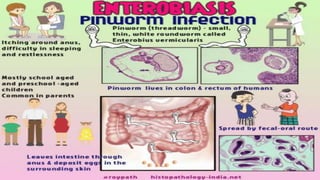
Enterobius vermicularis is a nematode which widespread
prevalence in children and occasionally in adults.
It is also known as threadworm , seatworm and pinworm .
As usual in nematodes , the female is longer than male
Enterobius vermicularis.
Morphology
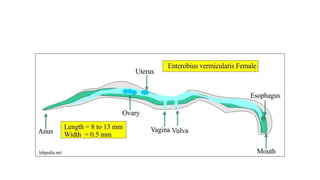
Enterobius vermicularis –
Female : 9-12 mm long
Male :- 3-5 mm long ; both are about 0.5mm in diameter.
Colour : Striking whitish beige colour
Round in shape , covered with thick cuticle and sow crawling movement.
Head : Rounded with muscular oesophagus and bulb.
In female , tail is narrow and sharply tapered.
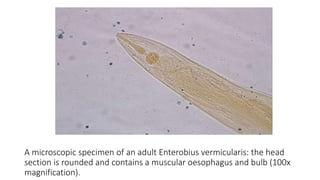
A microscopic specimen of an adult Enterobius vermicularis: the head
section is rounded and contains a muscular oesophagus and bulb (100x
magnification).
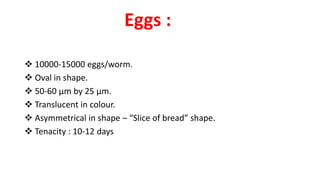
Eggs :
 10000-15000 eggs/worm.
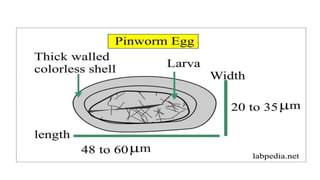
 Oval in shape.
 50-60 μm by 25 μm.
 Translucent in colour.
 Asymmetrical in shape – “Slice of bread” shape.
 Tenacity : 10-12 days
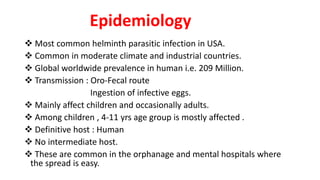
Epidemiology
 Most common helminth parasitic infection in USA.
 Common in moderate climate and industrial countries.
 Global worldwide prevalence in human i.e. 209 Million.
 Transmission : Oro-Fecal route
Ingestion of infective eggs.
 Mainly affect children and occasionally adults.
 Among children , 4-11 yrs age group is mostly affected .
 Definitive host : Human
 No intermediate host.
 These are common in the orphanage and mental hospitals where
the spread is easy.
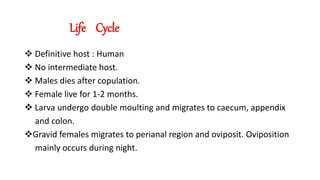
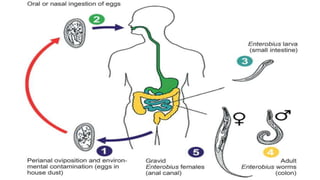
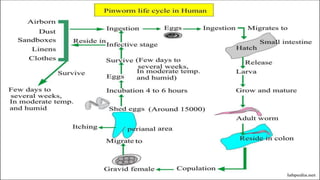
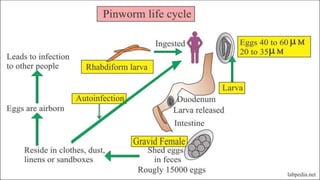
Life Cycle
 Definitive host : Human
 No intermediate host.
 Males dies after copulation.
 Female live for 1-2 months.
 Larva undergo double moulting and migrates to caecum, appendix
and colon.
Gravid females migrates to perianal region and oviposit. Oviposition
mainly occurs during night.
Clinical Features :
1) 40% cases are asymptomatic.
2) Mostly disease is self limiting.
3) Intermittent anal and perianal pruritis – Mostly night time.
4) Restlessness , disturbed sleep
5) Irritation , poor appetite
6) Abdominal pain
7) Childhood enuresis
8) Impaired concentration during day.
Complications of Enterobiasis
Scratching of perianal region may leads ulceration which may result
in secondary bacterial infection.
Anal dermatitis
Perianal folliculitis
Ischiorectal abscess
Rarely vulvovaginitis
Diagnosis
 Cardinal sign : Perianal pruritis
 Parasites can be seen with naked eye on underwear , bedsheet and
in stool & also around perianal region.
 Stool microscopy
 Scotch Tape Test
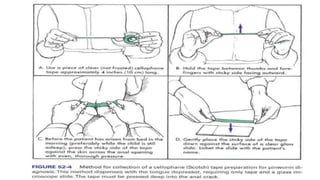
Scotch Tape Test
1) Put the cellophane tape around the anal area in cases of children.
The eggs attach to the tape. Then this tape can be seen under the
microscope. Perform this test for three days.
2) Or touch the slide with the tape.
3) 50% of the time tap will show ova and if you repeat this procedure
three times then positivity is 90%.
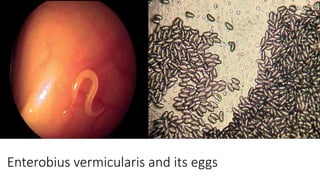
Enterobius vermicularis and its eggs
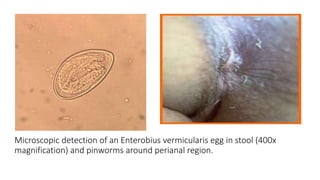
Microscopic detection of an Enterobius vermicularis egg in stool (400x
magnification) and pinworms around perianal region.
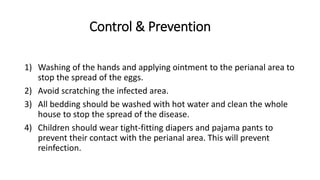
Control & Prevention
1) Washing of the hands and applying ointment to the perianal area to
stop the spread of the eggs.
2) Avoid scratching the infected area.
3) All bedding should be washed with hot water and clean the whole
house to stop the spread of the disease.
4) Children should wear tight-fitting diapers and pajama pants to
prevent their contact with the perianal area. This will prevent
reinfection.
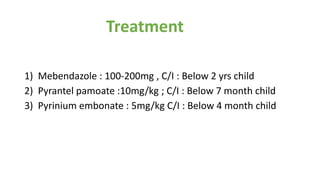
Treatment
1) Mebendazole : 100-200mg , C/I : Below 2 yrs child
2) Pyrantel pamoate :10mg/kg ; C/I : Below 7 month child
3) Pyrinium embonate : 5mg/kg C/I : Below 4 month child
Thank You

Enterobius vermicularis

  • 1.
  • 2.
    Introduction Enterobius vermicularis isa nematode which widespread prevalence in children and occasionally in adults. It is also known as threadworm , seatworm and pinworm . As usual in nematodes , the female is longer than male Enterobius vermicularis.
  • 3.
    Morphology Enterobius vermicularis – Female: 9-12 mm long Male :- 3-5 mm long ; both are about 0.5mm in diameter. Colour : Striking whitish beige colour Round in shape , covered with thick cuticle and sow crawling movement. Head : Rounded with muscular oesophagus and bulb. In female , tail is narrow and sharply tapered.
  • 4.
    A microscopic specimenof an adult Enterobius vermicularis: the head section is rounded and contains a muscular oesophagus and bulb (100x magnification).
  • 6.
    Eggs :  10000-15000eggs/worm.  Oval in shape.  50-60 μm by 25 μm.  Translucent in colour.  Asymmetrical in shape – “Slice of bread” shape.  Tenacity : 10-12 days
  • 8.
    Epidemiology  Most commonhelminth parasitic infection in USA.  Common in moderate climate and industrial countries.  Global worldwide prevalence in human i.e. 209 Million.  Transmission : Oro-Fecal route Ingestion of infective eggs.  Mainly affect children and occasionally adults.  Among children , 4-11 yrs age group is mostly affected .  Definitive host : Human  No intermediate host.  These are common in the orphanage and mental hospitals where the spread is easy.
  • 9.
    Life Cycle  Definitivehost : Human  No intermediate host.  Males dies after copulation.  Female live for 1-2 months.  Larva undergo double moulting and migrates to caecum, appendix and colon. Gravid females migrates to perianal region and oviposit. Oviposition mainly occurs during night.
  • 13.
    Clinical Features : 1)40% cases are asymptomatic. 2) Mostly disease is self limiting. 3) Intermittent anal and perianal pruritis – Mostly night time. 4) Restlessness , disturbed sleep 5) Irritation , poor appetite 6) Abdominal pain 7) Childhood enuresis 8) Impaired concentration during day.
  • 15.
    Complications of Enterobiasis Scratchingof perianal region may leads ulceration which may result in secondary bacterial infection. Anal dermatitis Perianal folliculitis Ischiorectal abscess Rarely vulvovaginitis
  • 16.
    Diagnosis  Cardinal sign: Perianal pruritis  Parasites can be seen with naked eye on underwear , bedsheet and in stool & also around perianal region.  Stool microscopy  Scotch Tape Test
  • 17.
    Scotch Tape Test 1)Put the cellophane tape around the anal area in cases of children. The eggs attach to the tape. Then this tape can be seen under the microscope. Perform this test for three days. 2) Or touch the slide with the tape. 3) 50% of the time tap will show ova and if you repeat this procedure three times then positivity is 90%.
  • 19.
  • 20.
    Microscopic detection ofan Enterobius vermicularis egg in stool (400x magnification) and pinworms around perianal region.
  • 21.
    Control & Prevention 1)Washing of the hands and applying ointment to the perianal area to stop the spread of the eggs. 2) Avoid scratching the infected area. 3) All bedding should be washed with hot water and clean the whole house to stop the spread of the disease. 4) Children should wear tight-fitting diapers and pajama pants to prevent their contact with the perianal area. This will prevent reinfection.
  • 22.
    Treatment 1) Mebendazole :100-200mg , C/I : Below 2 yrs child 2) Pyrantel pamoate :10mg/kg ; C/I : Below 7 month child 3) Pyrinium embonate : 5mg/kg C/I : Below 4 month child
  • 23.