ASCARIS
CLASSIFICATION.
• Family: Ascarididae
• Genus: Ascaris
• Species: Ascaris Lumbricoides and Ascaris
Suum.
• Binomial name:Ascaris Lumbricoides
ASCARIS LUMBRICOIDES
Ascaris lumbricoides is the giant roundworm of
humans, belonging to the phylum Nematoda. An
ascarid nematode is responsible for the disease
ascariasis in humans, and it is the largest and
most common parasitic worm in humans.
MORPHOLOGY
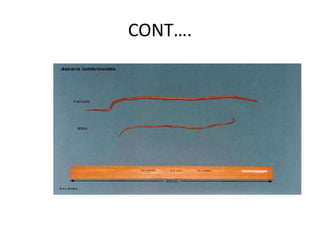
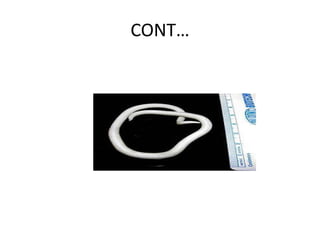
Ascaris is a large intestinal roundworm. It superficially
resembles the common earthworms found in the soil. Female
worms can be as long as 20-35cms, and males tend to be smaller,
no larger than 30cms.
They can be anywhere from 2-6 mm wide. Mature worms are
cylindrical, creamy white or light brown. They tend to have
tapered ends.
The worms have a thick cuticle, 3 lips at its head, small teeth,
and its own digestive tract. The fertilized eggs are oval shaped,
and they are about 65 to 40um in size. The eggs are brown or
yellow brown, and they have a thick shell.
CONT…..
An adult male has a coiled posterior end and a
female A. lumbricoides anterior ends are more
slender than the posterior ends.
CONT….
CONT…
EPIDEMIOLOGY
It is estimated that more than 1.4 billion people
are infected with A. lumbricoides, representing
25 percent of the world population. A number
of features account for its high prevalence
including the durability of eggs under a variety
of environmental conditions, the high number of
eggs produced per parasite, and poor
socioeconomic conditions that facilitate its
spread.
CONT….
More than 2 billion people are affected by this
infection. In the United States there is a
reported prevalence of 0.8% of the total
population as of 1987. Ascaris lumbricoides eggs
are extremely resistant to strong chemicals and
low temperatures. The eggs can remain viable in
the soil for several months or even years.
CONT….
Although ascariasis occurs at all ages, it is most
common in children 2 to 10 years old, and
prevalence decreases over the age of 15 years.
Infections tend to cluster in families, and worm
burden correlates with the number of people
living in a home. Infection rates for ascariasis
have not been reported to be higher in patients
infected with the human immunodeficiency
virus (HIV) .
TRANSMISSION
• Lumbricoides is transmitted primarily through fecal-oral
contamination. The transmission can occur by ingesting
contaminated soil, water, or food(raw vegetables or fruits)
• Usually, ascariasis is caused by directly or indirectly eating soil
contaminated with feces carrying these eggs.
• These eggs mature in the body, and adult female worms can
then lay eggs that come out in the feces. Note, however, that
in order for the eggs to be infective , the feces must have
been infected 2-4 weeks before it is ingested. Infection with
Ascaris eggs is so common because the eggs are frequently
found in the environment due to poor sanitation practices.
CONT…
• Ascariasis can occur by way of trasnplacental
transmission, since many neonatal cases have
been documented.
• Occasionally inhalation of contaminated dust.
Reservoir; No reservoir for this type of Ascaris exists
outside of humans
Vector; No vector exists for Ascaris.
Incubation period; between 4-16 days after
ingestion of the eggs
LIFE CYCLE
LIFECYLE CONT…D
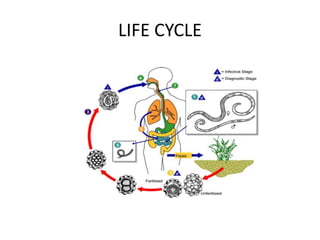
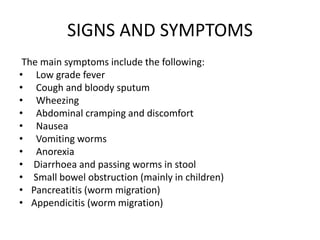
Life Cycle from the Figure above ;–
 Adult worms (1) live in the lumen of the small intestine. A female
may produce approximately 200,000 eggs per day, which are
passed with the feces.
 (2). Unfertilized eggs may be ingested but are not infective. Fertile
eggs embryonate and become infective after 18 days to several
weeks (3), depending on the environmental conditions (optimum:
moist, warm, shaded soil).
 After infective eggs are swallowed (4), the larvae hatch (5), invade
the intestinal mucosa, and are carried via the portal, then systemic
circulation to the lungs
CONT…D
(6) The larvae mature further in the
lungs (10 to 14 days), penetrate the
alveolar walls, ascend the bronchial
tree to the throat, and are swallowed
(7) Upon reaching the small intestine.
They develop into adult worms;
Between 2 and 3 months. Adult worms
can live 1 to 2 years.
CONT…
SIGNS AND SYMPTOMS
The main symptoms include the following:
• Low grade fever
• Cough and bloody sputum
• Wheezing
• Abdominal cramping and discomfort
• Nausea
• Vomiting worms
• Anorexia
• Diarrhoea and passing worms in stool
• Small bowel obstruction (mainly in children)
• Pancreatitis (worm migration)
• Appendicitis (worm migration)
INVESTIGATIONS
• Abdominal x-ray or other imaging tests
• Complete blood count
• Eosinophil count
• Stool ova and parasites exam
• Liver Function Test may reveal liver damage
or low protein state.
• Sputum for larva and eosinophil count.
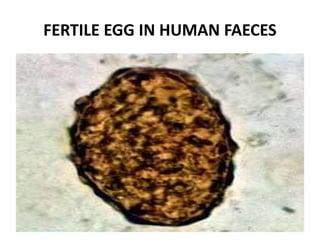
FERTILE EGG IN HUMAN FAECES
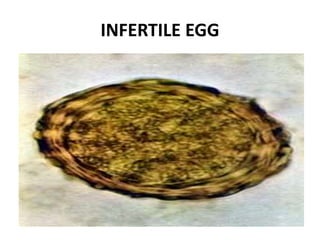
INFERTILE EGG
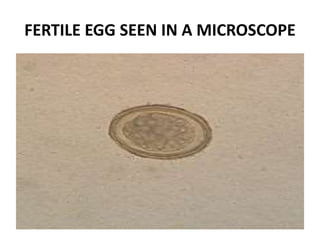
FERTILE EGG SEEN IN A MICROSCOPE
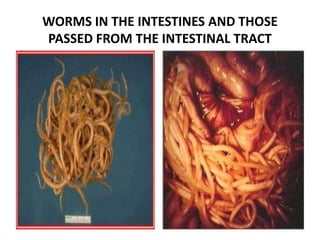
WORMS IN THE INTESTINES AND THOSE
PASSED FROM THE INTESTINAL TRACT
MANAGEMENT
• Pyrantel pamoate — Pyrantel pamoate (11 mg/kg up to a
maximum of 1 g) is administered as a single dose.
• Mebendazole — Mebendazole (100 mg BD for 3 days or 500
mg as a single dose)
• Albendazole — A single dose of albendazole:400 mg for
2years and above, 200mg for 12-24months
• Piperazine citrate — Piperazine citrate (50 to 75 mg/kg QD up
to a maximum of 3.5 g for 2 days
• Levamisole — Levamisole (150 mg for adults and 5 mg/kg for
children)
• Manage other signs and symptoms as they present
PREVENTION
• Good sanitation to prevent fecal
contamination of soil.
• Health education program advising against the
use of human feces as a fertilizer.
• Improved sanitation and hygiene.
• routine or preventive (prophylactic) treatment
with deworming medications.
COMPLICATIONS
• Liver secretion (biliary tract) obstruction
• Blockage in the intestine
• Hole (perforation) in the gut
REFERENCES
• Et al cedric; 2004; medical microbiology; 3rd
edition; mosby-elsevier limited; philadelphia
• www.cdc.gov/ncidod/dpd/parasites/ascaris

ascaris lumbricoids

  • 1.
  • 2.
    CLASSIFICATION. • Family: Ascarididae •Genus: Ascaris • Species: Ascaris Lumbricoides and Ascaris Suum. • Binomial name:Ascaris Lumbricoides
  • 3.
    ASCARIS LUMBRICOIDES Ascaris lumbricoidesis the giant roundworm of humans, belonging to the phylum Nematoda. An ascarid nematode is responsible for the disease ascariasis in humans, and it is the largest and most common parasitic worm in humans.
  • 4.
    MORPHOLOGY Ascaris is alarge intestinal roundworm. It superficially resembles the common earthworms found in the soil. Female worms can be as long as 20-35cms, and males tend to be smaller, no larger than 30cms. They can be anywhere from 2-6 mm wide. Mature worms are cylindrical, creamy white or light brown. They tend to have tapered ends. The worms have a thick cuticle, 3 lips at its head, small teeth, and its own digestive tract. The fertilized eggs are oval shaped, and they are about 65 to 40um in size. The eggs are brown or yellow brown, and they have a thick shell.
  • 5.
    CONT….. An adult malehas a coiled posterior end and a female A. lumbricoides anterior ends are more slender than the posterior ends.
  • 6.
  • 7.
  • 8.
    EPIDEMIOLOGY It is estimatedthat more than 1.4 billion people are infected with A. lumbricoides, representing 25 percent of the world population. A number of features account for its high prevalence including the durability of eggs under a variety of environmental conditions, the high number of eggs produced per parasite, and poor socioeconomic conditions that facilitate its spread.
  • 9.
    CONT…. More than 2billion people are affected by this infection. In the United States there is a reported prevalence of 0.8% of the total population as of 1987. Ascaris lumbricoides eggs are extremely resistant to strong chemicals and low temperatures. The eggs can remain viable in the soil for several months or even years.
  • 10.
    CONT…. Although ascariasis occursat all ages, it is most common in children 2 to 10 years old, and prevalence decreases over the age of 15 years. Infections tend to cluster in families, and worm burden correlates with the number of people living in a home. Infection rates for ascariasis have not been reported to be higher in patients infected with the human immunodeficiency virus (HIV) .
  • 11.
    TRANSMISSION • Lumbricoides istransmitted primarily through fecal-oral contamination. The transmission can occur by ingesting contaminated soil, water, or food(raw vegetables or fruits) • Usually, ascariasis is caused by directly or indirectly eating soil contaminated with feces carrying these eggs. • These eggs mature in the body, and adult female worms can then lay eggs that come out in the feces. Note, however, that in order for the eggs to be infective , the feces must have been infected 2-4 weeks before it is ingested. Infection with Ascaris eggs is so common because the eggs are frequently found in the environment due to poor sanitation practices.
  • 12.
    CONT… • Ascariasis canoccur by way of trasnplacental transmission, since many neonatal cases have been documented. • Occasionally inhalation of contaminated dust. Reservoir; No reservoir for this type of Ascaris exists outside of humans Vector; No vector exists for Ascaris. Incubation period; between 4-16 days after ingestion of the eggs
  • 13.
  • 14.
    LIFECYLE CONT…D Life Cyclefrom the Figure above ;–  Adult worms (1) live in the lumen of the small intestine. A female may produce approximately 200,000 eggs per day, which are passed with the feces.  (2). Unfertilized eggs may be ingested but are not infective. Fertile eggs embryonate and become infective after 18 days to several weeks (3), depending on the environmental conditions (optimum: moist, warm, shaded soil).  After infective eggs are swallowed (4), the larvae hatch (5), invade the intestinal mucosa, and are carried via the portal, then systemic circulation to the lungs
  • 15.
    CONT…D (6) The larvaemature further in the lungs (10 to 14 days), penetrate the alveolar walls, ascend the bronchial tree to the throat, and are swallowed (7) Upon reaching the small intestine. They develop into adult worms; Between 2 and 3 months. Adult worms can live 1 to 2 years.
  • 16.
  • 17.
    SIGNS AND SYMPTOMS Themain symptoms include the following: • Low grade fever • Cough and bloody sputum • Wheezing • Abdominal cramping and discomfort • Nausea • Vomiting worms • Anorexia • Diarrhoea and passing worms in stool • Small bowel obstruction (mainly in children) • Pancreatitis (worm migration) • Appendicitis (worm migration)
  • 18.
    INVESTIGATIONS • Abdominal x-rayor other imaging tests • Complete blood count • Eosinophil count • Stool ova and parasites exam • Liver Function Test may reveal liver damage or low protein state. • Sputum for larva and eosinophil count.
  • 19.
    FERTILE EGG INHUMAN FAECES
  • 20.
  • 21.
    FERTILE EGG SEENIN A MICROSCOPE
  • 22.
    WORMS IN THEINTESTINES AND THOSE PASSED FROM THE INTESTINAL TRACT
  • 23.
    MANAGEMENT • Pyrantel pamoate— Pyrantel pamoate (11 mg/kg up to a maximum of 1 g) is administered as a single dose. • Mebendazole — Mebendazole (100 mg BD for 3 days or 500 mg as a single dose) • Albendazole — A single dose of albendazole:400 mg for 2years and above, 200mg for 12-24months • Piperazine citrate — Piperazine citrate (50 to 75 mg/kg QD up to a maximum of 3.5 g for 2 days • Levamisole — Levamisole (150 mg for adults and 5 mg/kg for children) • Manage other signs and symptoms as they present
  • 24.
    PREVENTION • Good sanitationto prevent fecal contamination of soil. • Health education program advising against the use of human feces as a fertilizer. • Improved sanitation and hygiene. • routine or preventive (prophylactic) treatment with deworming medications.
  • 25.
    COMPLICATIONS • Liver secretion(biliary tract) obstruction • Blockage in the intestine • Hole (perforation) in the gut
  • 26.
    REFERENCES • Et alcedric; 2004; medical microbiology; 3rd edition; mosby-elsevier limited; philadelphia • www.cdc.gov/ncidod/dpd/parasites/ascaris