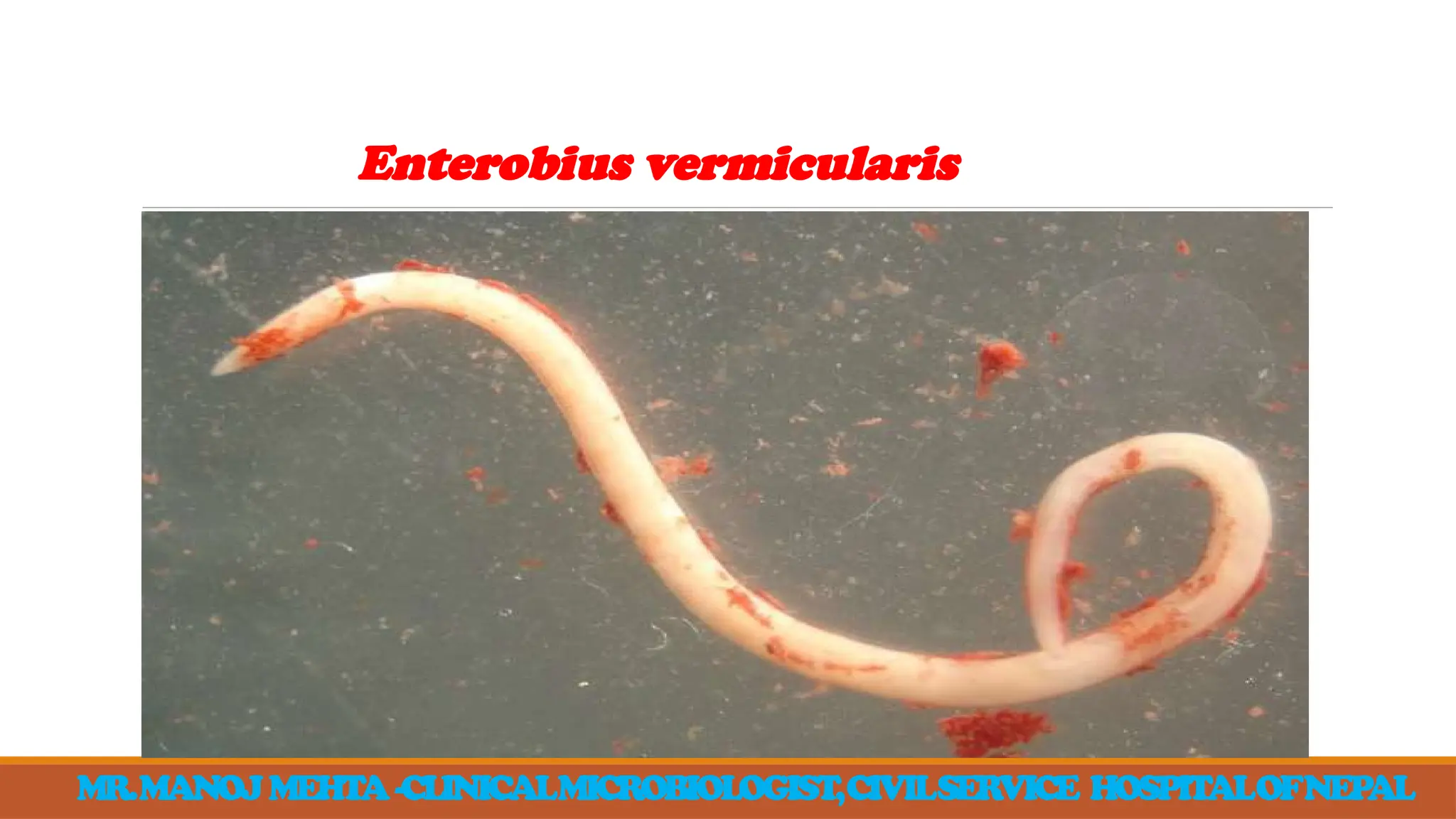
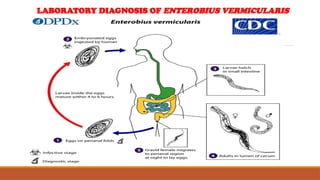
Enterobius vermicularis
MR.MANOJMEHTA-CLINICALMICROBIOLOGIST,CIVILSERVICE HOSPITALOFNEP
AL
It is worldwide in distribution. Unlike the usual situation where helminthic
infections are more prevalent in the poor people of the tropics
E.vermicularis is one worm infestation which is far more common in the affluent nations in
the cold and temperate regions
It is considered to be world’s most common parasite, which affects the children
Adult worms are found in the caecum, appendix and adjacent portion of ascending colon
GEOGRAPHICAL DISTRIBUTION
Both temperate and tropical
Both developed and under developed countries
Although adult can be infected, but the infection is more common
in children.
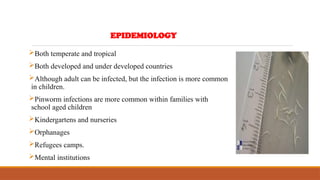
Pinworm infections are more common within families with
school aged children
Kindergartens and nurseries
Orphanages
Refugees camps.
Mental institutions
EPIDEMIOLOGY
Enterobius vermicularis, the human pinworm, threadworm or seat worm, formerly called Oxyuris
vermicularis has been known from ancient times.
The name Enterobius vermicularis means a tiny worm living in the intestine(Greek enteron—intestine,
bios-life and vermiculus—small worm).
The term Oxyuris means ‘sharp tail’, a feature of the female worm, from which the name ‘pinworm’ is also
derived.
Enterobius vermicularis is a nematode worm commonly known as pinworm.
This because it has sharp & pointed posterior end(like pin), or may be also due to pinpricks sensation
experienced by infected people.
INTRODUCTION
E. vermicularis is parasitic only to humans.
Adults inhabit the ileocecus, that is, cecum and adjacent ascending colon and distal ileum.
The infection of E. vermicularis may cause Enterobiasis..
It has a round body with cylindrical ends and a complete digestive system including mouth and
anus.
It has separate sexes, the female is usually larger than a male.
Right after mating, the male dies. Therefore, the male worms are rarely seen.
The female worms migrate out the anus depositing eggs on the perianal skin.
Humans get this infection by mouth and by autoinfection
INTRODUCTION
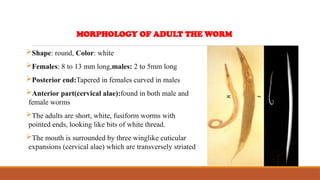
Shape: round, Color: white
Females: 8 to 13 mm long,males: 2 to 5mm long
Posterior end:Tapered in females curved in males
Anterior part(cervical alae):found in both male and
female worms
The adults are short, white, fusiform worms with
pointed ends, looking like bits of white thread.
The mouth is surrounded by three winglike cuticular
expansions (cervical alae) which are transversely striated
MORPHOLOGY OF ADULT THE WORM
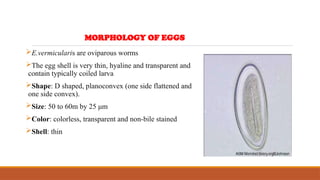
E.vermicularis are oviparous worms
The egg shell is very thin, hyaline and transparent and
contain typically coiled larva
Shape: D shaped, planoconvex (one side flattened and
one side convex).
Size: 50 to 60m by 25 μm
Color: colorless, transparent and non-bile stained
Shell: thin
MORPHOLOGY OF EGGS
Through contaminated hand, food ,water, clothing and dust
Autoinfection: Due to scatching of perianal area with fingers: occurs most commonly in
children
Retroinfection: The egg laid on the perianal skin immediately hatch into the infective
stage larva and migrate through the anus to develop into the adult worm in the colon.
MODE OF TRAMSMISSION
LABORATORY DIAGNOSIS OF ENTEROBIUS VERMICULARIS
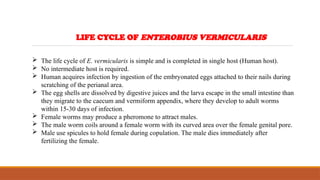
LIFE CYCLE OF ENTEROBIUS VERMICULARIS
 The life cycle of E. vermicularis is simple and is completed in single host (Human host).
 No intermediate host is required.
 Human acquires infection by ingestion of the embryonated eggs attached to their nails during
scratching of the perianal area.
 The egg shells are dissolved by digestive juices and the larva escape in the small intestine than
they migrate to the caecum and vermiform appendix, where they develop to adult worms
within 15-30 days of infection.
 Female worms may produce a pheromone to attract males.
 The male worm coils around a female worm with its curved area over the female genital pore.
 Male use spicules to hold female during copulation. The male dies immediately after
fertilizing the female.
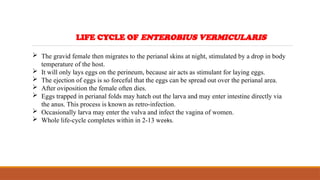
LIFE CYCLE OF ENTEROBIUS VERMICULARIS
 The gravid female then migrates to the perianal skins at night, stimulated by a drop in body
temperature of the host.
 It will only lays eggs on the perineum, because air acts as stimulant for laying eggs.
 The ejection of eggs is so forceful that the eggs can be spread out over the perianal area.
 After oviposition the female often dies.
 Eggs trapped in perianal folds may hatch out the larva and may enter intestine directly via
the anus. This process is known as retro-infection.
 Occasionally larva may enter the vulva and infect the vagina of women.
 Whole life-cycle completes within in 2-13 weeks.
The most common clinical manifestation of a pinworm infection is
Night itch in anal region because worms lay eggs nocturnal
 Irritation of the anal area due to scratching
Secondary bacterial infection
Teeth grinding during sleeping
Insomnia
Abdominal pain
Frequent defecation
SIGN AND SYMPTOMS ENTEROBIUS VERMICULARIS
In heavy infection following complication are seen:
Impetigo (pustules) or excoriation due to perineal scratching.
Vulvo-vaginitis, salpingitis (inflammation of the fallopian tubes) and prostatitis due to
ectopic migration of gravid female.
Urethritis and Endometritis
COMPLICATIONS

Stool samples. Eggs are only rarely seen in stool, but in patients with heavy worm burdens,
adult female worm may be seen in stool samples.

Microscopic demonstration of characteristic eggs in the perianal or perineal scraping is the methods of
choice for the diagnosis of enterobiasis.
Anal or perianal specimens can be collected by either National Institute of health (NIH) swab,
cellophane swab or Scotchtape swab method.
Detection of egg:
Examination of egg in feaces is not useful in diagnosis because of present of it in small proportion.
Under finge nails:

Egg may be demostrated from the dirt collected from the finger nails in infected children

Swab collected in early morning from perianal folds are most often positive
LABORATORY DIAGNOSIS OF ENTEROBIUS VERMICULARIS
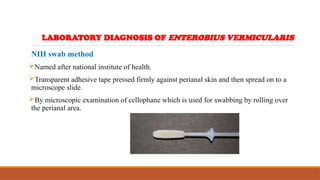
NIH swab method
Named after national institute of health.
Transparent adhesive tape pressed firmly against perianal skin and then spread on to a
microscope slide.
By microscopic examination of cellophane which is used for swabbing by rolling over
the perianal area.
LABORATORY DIAGNOSIS OF ENTEROBIUS VERMICULARIS
Cellophane Tape Test.
E. vermicularis females lay their eggs on the perineum during the night. Touching the perianal
skin with the sticky side of the tape will pick up the eggs; the tape is affixed to a microscope
slide and examined. Eggs are oval, approximately 55X25μm in size, and flattened on one side,
and they contain a larva.
Specimens should be collected prior to bathing or using the toilet.
Four to six consecutive negative pinworm tape preparations are required to rule out infection.
LABORATORY DIAGNOSIS OF ENTEROBIUS VERMICULARIS
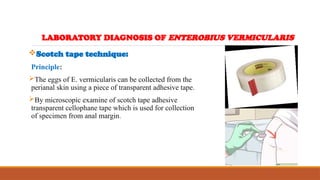
Scotch tape technique:
Principle:
The eggs of E. vermicularis can be collected from the
perianal skin using a piece of transparent adhesive tape.
By microscopic examine of scotch tape adhesive
transparent cellophane tape which is used for collection
of specimen from anal margin.
LABORATORY DIAGNOSIS OF ENTEROBIUS VERMICULARIS
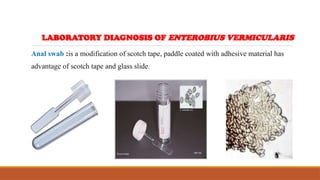
Anal swab :is a modification of scotch tape, paddle coated with adhesive material has
advantage of scotch tape and glass slide.
LABORATORY DIAGNOSIS OF ENTEROBIUS VERMICULARIS
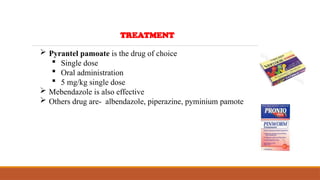
TREATMENT
 Pyrantel pamoate is the drug of choice
 Single dose
 Oral administration
 5 mg/kg single dose
 Mebendazole is also effective
 Others drug are- albendazole, piperazine, pyminium pamote
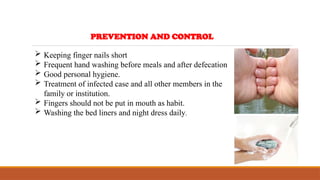
PREVENTION AND CONTROL
 Keeping finger nails short
 Frequent hand washing before meals and after defecation
 Good personal hygiene.
 Treatment of infected case and all other members in the
family or institution.
 Fingers should not be put in mouth as habit.
 Washing the bed liners and night dress daily.
Underwear, night clothes, blankets bedsheets- handled
with care, boiled, laundered.
PREVENTION AND CONTROL
Enterobious vermacularis.pptx Manoj Mahato

Enterobious vermacularis.pptx Manoj Mahato

  • 1.
  • 2.
    It is worldwidein distribution. Unlike the usual situation where helminthic infections are more prevalent in the poor people of the tropics E.vermicularis is one worm infestation which is far more common in the affluent nations in the cold and temperate regions It is considered to be world’s most common parasite, which affects the children Adult worms are found in the caecum, appendix and adjacent portion of ascending colon GEOGRAPHICAL DISTRIBUTION
  • 3.
    Both temperate andtropical Both developed and under developed countries Although adult can be infected, but the infection is more common in children. Pinworm infections are more common within families with school aged children Kindergartens and nurseries Orphanages Refugees camps. Mental institutions EPIDEMIOLOGY
  • 4.
    Enterobius vermicularis, thehuman pinworm, threadworm or seat worm, formerly called Oxyuris vermicularis has been known from ancient times. The name Enterobius vermicularis means a tiny worm living in the intestine(Greek enteron—intestine, bios-life and vermiculus—small worm). The term Oxyuris means ‘sharp tail’, a feature of the female worm, from which the name ‘pinworm’ is also derived. Enterobius vermicularis is a nematode worm commonly known as pinworm. This because it has sharp & pointed posterior end(like pin), or may be also due to pinpricks sensation experienced by infected people. INTRODUCTION
  • 5.
    E. vermicularis isparasitic only to humans. Adults inhabit the ileocecus, that is, cecum and adjacent ascending colon and distal ileum. The infection of E. vermicularis may cause Enterobiasis.. It has a round body with cylindrical ends and a complete digestive system including mouth and anus. It has separate sexes, the female is usually larger than a male. Right after mating, the male dies. Therefore, the male worms are rarely seen. The female worms migrate out the anus depositing eggs on the perianal skin. Humans get this infection by mouth and by autoinfection INTRODUCTION
  • 6.
    Shape: round, Color:white Females: 8 to 13 mm long,males: 2 to 5mm long Posterior end:Tapered in females curved in males Anterior part(cervical alae):found in both male and female worms The adults are short, white, fusiform worms with pointed ends, looking like bits of white thread. The mouth is surrounded by three winglike cuticular expansions (cervical alae) which are transversely striated MORPHOLOGY OF ADULT THE WORM
  • 7.
    E.vermicularis are oviparousworms The egg shell is very thin, hyaline and transparent and contain typically coiled larva Shape: D shaped, planoconvex (one side flattened and one side convex). Size: 50 to 60m by 25 μm Color: colorless, transparent and non-bile stained Shell: thin MORPHOLOGY OF EGGS
  • 8.
    Through contaminated hand,food ,water, clothing and dust Autoinfection: Due to scatching of perianal area with fingers: occurs most commonly in children Retroinfection: The egg laid on the perianal skin immediately hatch into the infective stage larva and migrate through the anus to develop into the adult worm in the colon. MODE OF TRAMSMISSION
  • 9.
    LABORATORY DIAGNOSIS OFENTEROBIUS VERMICULARIS
  • 10.
    LIFE CYCLE OFENTEROBIUS VERMICULARIS  The life cycle of E. vermicularis is simple and is completed in single host (Human host).  No intermediate host is required.  Human acquires infection by ingestion of the embryonated eggs attached to their nails during scratching of the perianal area.  The egg shells are dissolved by digestive juices and the larva escape in the small intestine than they migrate to the caecum and vermiform appendix, where they develop to adult worms within 15-30 days of infection.  Female worms may produce a pheromone to attract males.  The male worm coils around a female worm with its curved area over the female genital pore.  Male use spicules to hold female during copulation. The male dies immediately after fertilizing the female.
  • 11.
    LIFE CYCLE OFENTEROBIUS VERMICULARIS  The gravid female then migrates to the perianal skins at night, stimulated by a drop in body temperature of the host.  It will only lays eggs on the perineum, because air acts as stimulant for laying eggs.  The ejection of eggs is so forceful that the eggs can be spread out over the perianal area.  After oviposition the female often dies.  Eggs trapped in perianal folds may hatch out the larva and may enter intestine directly via the anus. This process is known as retro-infection.  Occasionally larva may enter the vulva and infect the vagina of women.  Whole life-cycle completes within in 2-13 weeks.
  • 12.
    The most commonclinical manifestation of a pinworm infection is Night itch in anal region because worms lay eggs nocturnal  Irritation of the anal area due to scratching Secondary bacterial infection Teeth grinding during sleeping Insomnia Abdominal pain Frequent defecation SIGN AND SYMPTOMS ENTEROBIUS VERMICULARIS
  • 13.
    In heavy infectionfollowing complication are seen: Impetigo (pustules) or excoriation due to perineal scratching. Vulvo-vaginitis, salpingitis (inflammation of the fallopian tubes) and prostatitis due to ectopic migration of gravid female. Urethritis and Endometritis COMPLICATIONS
  • 14.
     Stool samples. Eggsare only rarely seen in stool, but in patients with heavy worm burdens, adult female worm may be seen in stool samples.  Microscopic demonstration of characteristic eggs in the perianal or perineal scraping is the methods of choice for the diagnosis of enterobiasis. Anal or perianal specimens can be collected by either National Institute of health (NIH) swab, cellophane swab or Scotchtape swab method. Detection of egg: Examination of egg in feaces is not useful in diagnosis because of present of it in small proportion. Under finge nails:  Egg may be demostrated from the dirt collected from the finger nails in infected children  Swab collected in early morning from perianal folds are most often positive LABORATORY DIAGNOSIS OF ENTEROBIUS VERMICULARIS
  • 15.
    NIH swab method Namedafter national institute of health. Transparent adhesive tape pressed firmly against perianal skin and then spread on to a microscope slide. By microscopic examination of cellophane which is used for swabbing by rolling over the perianal area. LABORATORY DIAGNOSIS OF ENTEROBIUS VERMICULARIS
  • 16.
    Cellophane Tape Test. E.vermicularis females lay their eggs on the perineum during the night. Touching the perianal skin with the sticky side of the tape will pick up the eggs; the tape is affixed to a microscope slide and examined. Eggs are oval, approximately 55X25μm in size, and flattened on one side, and they contain a larva. Specimens should be collected prior to bathing or using the toilet. Four to six consecutive negative pinworm tape preparations are required to rule out infection. LABORATORY DIAGNOSIS OF ENTEROBIUS VERMICULARIS
  • 17.
    Scotch tape technique: Principle: Theeggs of E. vermicularis can be collected from the perianal skin using a piece of transparent adhesive tape. By microscopic examine of scotch tape adhesive transparent cellophane tape which is used for collection of specimen from anal margin. LABORATORY DIAGNOSIS OF ENTEROBIUS VERMICULARIS
  • 18.
    Anal swab :isa modification of scotch tape, paddle coated with adhesive material has advantage of scotch tape and glass slide. LABORATORY DIAGNOSIS OF ENTEROBIUS VERMICULARIS
  • 19.
    TREATMENT  Pyrantel pamoateis the drug of choice  Single dose  Oral administration  5 mg/kg single dose  Mebendazole is also effective  Others drug are- albendazole, piperazine, pyminium pamote
  • 20.
    PREVENTION AND CONTROL Keeping finger nails short  Frequent hand washing before meals and after defecation  Good personal hygiene.  Treatment of infected case and all other members in the family or institution.  Fingers should not be put in mouth as habit.  Washing the bed liners and night dress daily.
  • 21.
    Underwear, night clothes,blankets bedsheets- handled with care, boiled, laundered. PREVENTION AND CONTROL