THE TAPEWORM
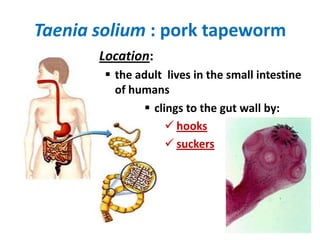
Taenia solium : pork tapeworm
Location:
 the adult lives in the small intestine
of humans
 clings to the gut wall by:
 hooks
 suckers
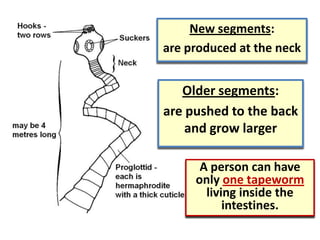
New segments:
are produced at the neck

Older segments:
are pushed to the back
and grow larger
A person can have
only one tapeworm
living inside the
intestines.
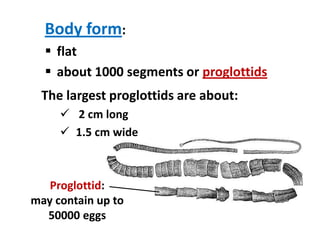
Body form:
 flat
 about 1000 segments or proglottids
The largest proglottids are about:
 2 cm long
 1.5 cm wide

Proglottid:
may contain up to
50000 eggs
Fig 2. Internal structure of proglottids.

The tapeworm is
hermaphrodite.
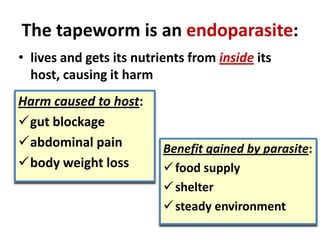
The tapeworm is an endoparasite:
• lives and gets its nutrients from inside its
host, causing it harm
Harm caused to host:
gut blockage
abdominal pain
body weight loss

Benefit gained by parasite:
 food supply
 shelter
 steady environment
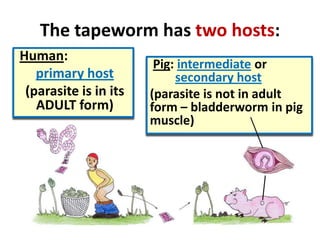
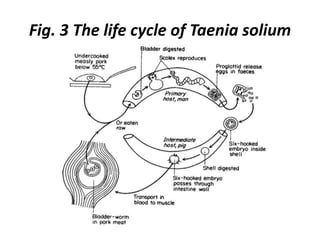
The tapeworm has two hosts:
Human:
primary host
(parasite is in its
ADULT form)

Pig: intermediate or
secondary host
(parasite is not in adult
form – bladderworm in pig
muscle)
Fig. 3 The life cycle of Taenia solium
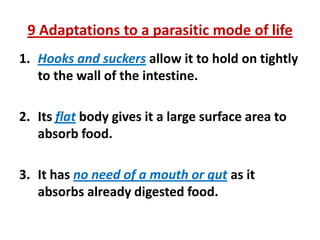
9 Adaptations to a parasitic mode of life
1. Hooks and suckers allow it to hold on tightly
to the wall of the intestine.
2. Its flat body gives it a large surface area to
absorb food.
3. It has no need of a mouth or gut as it
absorbs already digested food.
9 Adaptations to a parasitic mode of life
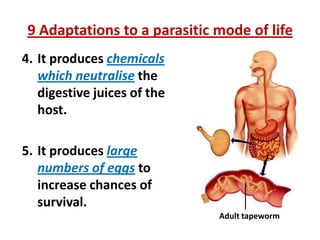
4. It produces chemicals
which neutralise the
digestive juices of the
host.
5. It produces large
numbers of eggs to
increase chances of
survival.
Adult tapeworm
9 Adaptations to a parasitic mode of life
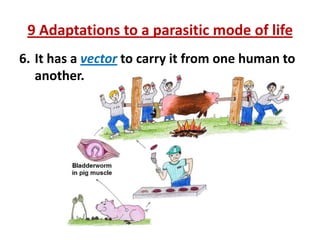
6. It has a vector to carry it from one human to
another.
9 Adaptations to a parasitic mode of life
7. It respires anaerobically as there is lack of
oxygen within the intestines.
8. The tapeworm has both male and female sex
organs (is hermaphrodite) and can fertilise itself.
This is because only one tapeworm can be
present within the intestines,
9. It lacks sensory organs such as eyes as it does
not need them.
How to get rid of tapeworms
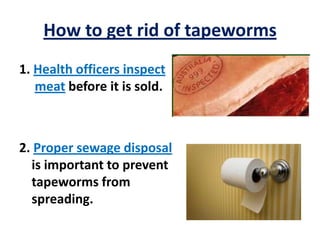
1. Health officers inspect
meat before it is sold.

2. Proper sewage disposal
is important to prevent
tapeworms from
spreading.
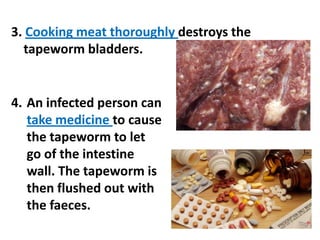
3. Cooking meat thoroughly destroys the
tapeworm bladders.

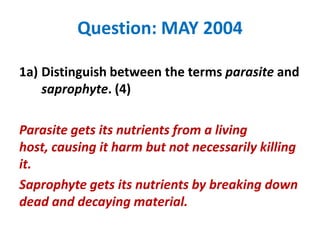
4. An infected person can
take medicine to cause
the tapeworm to let
go of the intestine
wall. The tapeworm is
then flushed out with
the faeces.
Question: MAY 2004
1a) Distinguish between the terms parasite and
saprophyte. (4)
Parasite gets its nutrients from a living
host, causing it harm but not necessarily killing
it.
Saprophyte gets its nutrients by breaking down
dead and decaying material.
Question: MAY 2004
b) Give one named example of a parasite and
one named example of a saprophyte. (2)
Parasite: tapeworm
Saprophyte: bacteria / fungus
Question: MAY 2004
c) Explain how the parasite you mention in (b)
is adapted to its mode of life. (6)
Question: No. 2
a) Why would a parasite be at an advantage if
it could produce large numbers of eggs? (2)
More chance that some survive and infect a
host so that the parasite can continue its life
cycle.
Question: No. 2
b) Explain fully the meaning of the term
‘endoparasite’. (3)
An endoparasite lives inside its host to get
its nutrients. The host is harmed.
Question: MAY 2010
3) Explain ONE benefit of each of the following
features in the parasitic mode of life of a
parasite living in the gut of its host: (3)
i) body surface covered with microvilli:
Large surface area to absorb nutrients.
ii) long and thin body:
Long body increases the surface area to
absorb nutrients and a thin body makes
diffusion pathway short.
Question: MAY 2010
iii) body wall has active transport systems:
To allow upatke of ions, glucose and amino
acids against a concentration gradient.
THE END

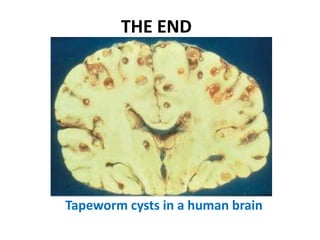
Tapeworm cysts in a human brain

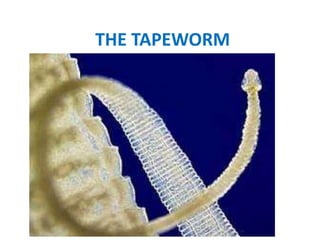
Tapeworm

  • 1.
  • 2.
    Taenia solium :pork tapeworm Location:  the adult lives in the small intestine of humans  clings to the gut wall by:  hooks  suckers
  • 3.
    New segments: are producedat the neck Older segments: are pushed to the back and grow larger A person can have only one tapeworm living inside the intestines.
  • 4.
    Body form:  flat about 1000 segments or proglottids The largest proglottids are about:  2 cm long  1.5 cm wide Proglottid: may contain up to 50000 eggs
  • 5.
    Fig 2. Internalstructure of proglottids. The tapeworm is hermaphrodite.
  • 6.
    The tapeworm isan endoparasite: • lives and gets its nutrients from inside its host, causing it harm Harm caused to host: gut blockage abdominal pain body weight loss Benefit gained by parasite:  food supply  shelter  steady environment
  • 7.
    The tapeworm hastwo hosts: Human: primary host (parasite is in its ADULT form) Pig: intermediate or secondary host (parasite is not in adult form – bladderworm in pig muscle)
  • 8.
    Fig. 3 Thelife cycle of Taenia solium
  • 9.
    9 Adaptations toa parasitic mode of life 1. Hooks and suckers allow it to hold on tightly to the wall of the intestine. 2. Its flat body gives it a large surface area to absorb food. 3. It has no need of a mouth or gut as it absorbs already digested food.
  • 10.
    9 Adaptations toa parasitic mode of life 4. It produces chemicals which neutralise the digestive juices of the host. 5. It produces large numbers of eggs to increase chances of survival. Adult tapeworm
  • 11.
    9 Adaptations toa parasitic mode of life 6. It has a vector to carry it from one human to another.
  • 12.
    9 Adaptations toa parasitic mode of life 7. It respires anaerobically as there is lack of oxygen within the intestines. 8. The tapeworm has both male and female sex organs (is hermaphrodite) and can fertilise itself. This is because only one tapeworm can be present within the intestines, 9. It lacks sensory organs such as eyes as it does not need them.
  • 13.
    How to getrid of tapeworms 1. Health officers inspect meat before it is sold. 2. Proper sewage disposal is important to prevent tapeworms from spreading.
  • 14.
    3. Cooking meatthoroughly destroys the tapeworm bladders. 4. An infected person can take medicine to cause the tapeworm to let go of the intestine wall. The tapeworm is then flushed out with the faeces.
  • 15.
    Question: MAY 2004 1a)Distinguish between the terms parasite and saprophyte. (4) Parasite gets its nutrients from a living host, causing it harm but not necessarily killing it. Saprophyte gets its nutrients by breaking down dead and decaying material.
  • 16.
    Question: MAY 2004 b)Give one named example of a parasite and one named example of a saprophyte. (2) Parasite: tapeworm Saprophyte: bacteria / fungus
  • 17.
    Question: MAY 2004 c)Explain how the parasite you mention in (b) is adapted to its mode of life. (6)
  • 18.
    Question: No. 2 a)Why would a parasite be at an advantage if it could produce large numbers of eggs? (2) More chance that some survive and infect a host so that the parasite can continue its life cycle.
  • 19.
    Question: No. 2 b)Explain fully the meaning of the term ‘endoparasite’. (3) An endoparasite lives inside its host to get its nutrients. The host is harmed.
  • 20.
    Question: MAY 2010 3)Explain ONE benefit of each of the following features in the parasitic mode of life of a parasite living in the gut of its host: (3) i) body surface covered with microvilli: Large surface area to absorb nutrients. ii) long and thin body: Long body increases the surface area to absorb nutrients and a thin body makes diffusion pathway short.
  • 21.
    Question: MAY 2010 iii)body wall has active transport systems: To allow upatke of ions, glucose and amino acids against a concentration gradient.
  • 22.
    THE END Tapeworm cystsin a human brain