Entrobius vermicularis
The pinworm
Lecture by: Maha Gamal Aldein
Introduction
• Enterobius vermicularis is a nematode worm commonly known as
pinworm.
• This because it has sharp & pointed posterior end(like pin), or may be
also due to pinpricks sensation experienced by infected people.
• Inhabits human large intestine
• Causing the disease known as Enterobiasis.
2
3
Geographical distribution:
• There is a worldwide distribution of pinworm infection
4
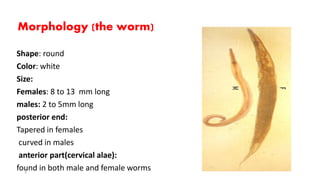
Morphology (the worm)
Shape: round
Color: white
Size:
Females: 8 to 13 mm long
males: 2 to 5mm long
posterior end:
Tapered in females
curved in males
anterior part(cervical alae):
found in both male and female worms5
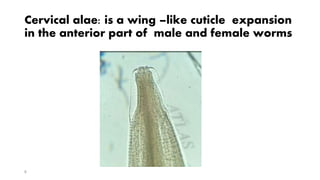
Cervical alae: is a wing –like cuticle expansion
in the anterior part of male and female worms
6
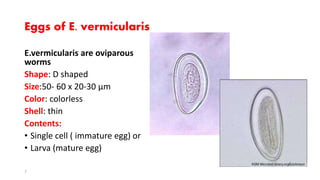
Eggs of E. vermicularis
E.vermicularis are oviparous
worms
Shape: D shaped
Size:50- 60 x 20-30 µm
Color: colorless
Shell: thin
Contents:
• Single cell ( immature egg) or
• Larva (mature egg)
7
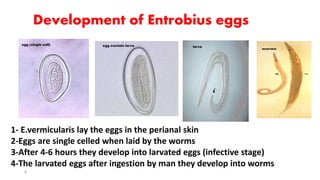
Development of Entrobius eggs
8
1- E.vermicularis lay the eggs in the perianal skin
2-Eggs are single celled when laid by the worms
3-After 4-6 hours they develop into larvated eggs (infective stage)
4-The larvated eggs after ingestion by man they develop into worms
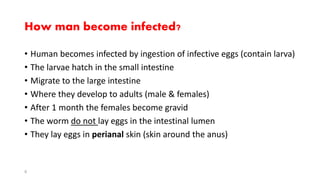
How man become infected?
• Human becomes infected by ingestion of infective eggs (contain larva)
• The larvae hatch in the small intestine
• Migrate to the large intestine
• Where they develop to adults (male & females)
• After 1 month the females become gravid
• The worm do not lay eggs in the intestinal lumen
• They lay eggs in perianal skin (skin around the anus)
9
• The worms migrates out the colon and lays
eggs around the anus at usually night.
Each worm lay about 10,000-11,000 eggs
The eggs can spread every where
and become infective in 4 to 6 hours
10
E. vermicularis worms in the anal area depositing
thousands of eggs
11
Where we find Entrobius vermicularis eggs???
12
More??
13
• Pinworm eggs can survive for up to two weeks on clothing, bedding,
food, and other surfaces.
• Ready to infect other people.
14
Life cycle
15
Types of infection occur in entrobiasis
1- Infection
Occur when healthy person ingest the infective eggs from enviroment
2-Re- infection (self infection)
A person can re-infect themselves from their own( by ingestion of infective
eggs )
3-Retro-infection:
This occur when eggs mature and larvae hatch in anal area, this larva can
migrate back to the large intestine through the anus, where they grow into
mature worms. (larvae are the infective stages)
16
Pathology & Symptomatology
The most common clinical manifestation of a pinworm infection is
• Night itch in anal region because worms lay eggs nocturnal
• Irritation of the anal area due to scratching
• Secondary bacterial infection
• Teeth grinding during sleeping
• Insomnia
• Abdominal pain
• Frequent defecation
17
Epidemiology
• Although adult can be infected, but the infection is more common in
children.
• Pinworm infections are more common within families with school-
aged children
• Kindergartens and nurseries
• Orphanages
• Refugees camps.
• Mental institutions
18
Factor helps spread of infection:
• The worms deposit large numbers of eggs.
• The worms lay the eggs of intestine (anal area), where it can
spread to environment easily.
• The eggs become infective within short time (4-6hours).
• The eggs can remain infective for up to 2 weeks
• The eggs have a surface that adheres to environmental
objects.
• Poor personal hygiene.
19
Complications:
• Appendicitis: when worms invade the appendix
• Vaginitis: found in female patient due to invasion of vagina by
hatched larva from anal area
20
Laboratory Diagnosis
1- what is /are suitable sample/s?
2- what is are suitable diagnostic test/s or technique/s?
3- what is/are the diagnostic stage/s?
21
Summary:
• E. vermicularis worm inhabit human large intestine
• The worm lay about 10,000-11,000 eggs/ day
• 95-97% of eggs are deposited in the perianal skin
• Only 3-5% can be found in stool
• The eggs usually deposited at night while the patient is sleep
• Sometimes the worm can found in stool.
22
1- Best sample to diagnose entrobiasis is
Swab from perianal area
Best time for swab: early morning before going to toilet
2- Suitable diagnostic technique:
1- scotch tape technique
2- anal swab “swube’’
3-NIH swap
3-diagnostic stages:
A- eggs & adults worm
23
1-Scotch tape technique
Principle:
the eggs of E. vermicularis can be collected from the perianal skin using
a piece of transparent adhesive tape.
24
procedure
• Firmly press the sticky side of the cellophane tape over the skin
surround the anus several times.
• The eggs will stick to the tape.
• The tape is then placed on glass slide, sticky side down.
• Put drop of glycerol, examine the slide under the microscope.
Precaution:
Put on gloves because eggs are directly infective.
25
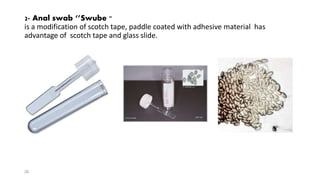
2- Anal swab ‘’Swube "
is a modification of scotch tape, paddle coated with adhesive material has
advantage of scotch tape and glass slide.
26
Can we find Entrobius eggs in other specimens?
1- Very few eggs sometimes found in stool
3- Urine of the infected females
4- Vaginal secretion in case of vaginitis caused by the worms
27
Treatment
Several medications used for the treatment of pinworm are:
Mebendazole
Pyrantel pamoate
Albendazole
All three of these drugs are to be given in single dose and then
repeated 2 weeks later.
Prognosis
The prognosis is good
28
Prevention & control
1- Washing hands with soap &
water (after using toilet, Before
eat)
2-Trimming nails regularly
& avoid biting the nails
29
3- Avoid scratching anal area.
4-Showering every morning and
washing the anal area( to remove
the eggs)
30
5- Do not co-path with infected
people
6- Cleansing bathroom & toilet
31
7-Washing cloth and bed linens
with hot water, to kill the eggs.
8- Ironing, or expose them to
sunlight for 24 hours to kill the
eggs
32
9- Treatment of infected
individuals.
In institutions, day care centers,
and schools, control of pinworm
can be difficult, but mass drug
administration during an
outbreak can be successful.
10- Avoid ready made foods &
drinks
33

Entrobius vermicularis

  • 1.
  • 2.
    Introduction • Enterobius vermicularisis a nematode worm commonly known as pinworm. • This because it has sharp & pointed posterior end(like pin), or may be also due to pinpricks sensation experienced by infected people. • Inhabits human large intestine • Causing the disease known as Enterobiasis. 2
  • 3.
  • 4.
    Geographical distribution: • Thereis a worldwide distribution of pinworm infection 4
  • 5.
    Morphology (the worm) Shape:round Color: white Size: Females: 8 to 13 mm long males: 2 to 5mm long posterior end: Tapered in females curved in males anterior part(cervical alae): found in both male and female worms5
  • 6.
    Cervical alae: isa wing –like cuticle expansion in the anterior part of male and female worms 6
  • 7.
    Eggs of E.vermicularis E.vermicularis are oviparous worms Shape: D shaped Size:50- 60 x 20-30 µm Color: colorless Shell: thin Contents: • Single cell ( immature egg) or • Larva (mature egg) 7
  • 8.
    Development of Entrobiuseggs 8 1- E.vermicularis lay the eggs in the perianal skin 2-Eggs are single celled when laid by the worms 3-After 4-6 hours they develop into larvated eggs (infective stage) 4-The larvated eggs after ingestion by man they develop into worms
  • 9.
    How man becomeinfected? • Human becomes infected by ingestion of infective eggs (contain larva) • The larvae hatch in the small intestine • Migrate to the large intestine • Where they develop to adults (male & females) • After 1 month the females become gravid • The worm do not lay eggs in the intestinal lumen • They lay eggs in perianal skin (skin around the anus) 9
  • 10.
    • The wormsmigrates out the colon and lays eggs around the anus at usually night. Each worm lay about 10,000-11,000 eggs The eggs can spread every where and become infective in 4 to 6 hours 10
  • 11.
    E. vermicularis wormsin the anal area depositing thousands of eggs 11
  • 12.
    Where we findEntrobius vermicularis eggs??? 12
  • 13.
  • 14.
    • Pinworm eggscan survive for up to two weeks on clothing, bedding, food, and other surfaces. • Ready to infect other people. 14
  • 15.
  • 16.
    Types of infectionoccur in entrobiasis 1- Infection Occur when healthy person ingest the infective eggs from enviroment 2-Re- infection (self infection) A person can re-infect themselves from their own( by ingestion of infective eggs ) 3-Retro-infection: This occur when eggs mature and larvae hatch in anal area, this larva can migrate back to the large intestine through the anus, where they grow into mature worms. (larvae are the infective stages) 16
  • 17.
    Pathology & Symptomatology Themost common clinical manifestation of a pinworm infection is • Night itch in anal region because worms lay eggs nocturnal • Irritation of the anal area due to scratching • Secondary bacterial infection • Teeth grinding during sleeping • Insomnia • Abdominal pain • Frequent defecation 17
  • 18.
    Epidemiology • Although adultcan be infected, but the infection is more common in children. • Pinworm infections are more common within families with school- aged children • Kindergartens and nurseries • Orphanages • Refugees camps. • Mental institutions 18
  • 19.
    Factor helps spreadof infection: • The worms deposit large numbers of eggs. • The worms lay the eggs of intestine (anal area), where it can spread to environment easily. • The eggs become infective within short time (4-6hours). • The eggs can remain infective for up to 2 weeks • The eggs have a surface that adheres to environmental objects. • Poor personal hygiene. 19
  • 20.
    Complications: • Appendicitis: whenworms invade the appendix • Vaginitis: found in female patient due to invasion of vagina by hatched larva from anal area 20
  • 21.
    Laboratory Diagnosis 1- whatis /are suitable sample/s? 2- what is are suitable diagnostic test/s or technique/s? 3- what is/are the diagnostic stage/s? 21
  • 22.
    Summary: • E. vermicularisworm inhabit human large intestine • The worm lay about 10,000-11,000 eggs/ day • 95-97% of eggs are deposited in the perianal skin • Only 3-5% can be found in stool • The eggs usually deposited at night while the patient is sleep • Sometimes the worm can found in stool. 22
  • 23.
    1- Best sampleto diagnose entrobiasis is Swab from perianal area Best time for swab: early morning before going to toilet 2- Suitable diagnostic technique: 1- scotch tape technique 2- anal swab “swube’’ 3-NIH swap 3-diagnostic stages: A- eggs & adults worm 23
  • 24.
    1-Scotch tape technique Principle: theeggs of E. vermicularis can be collected from the perianal skin using a piece of transparent adhesive tape. 24
  • 25.
    procedure • Firmly pressthe sticky side of the cellophane tape over the skin surround the anus several times. • The eggs will stick to the tape. • The tape is then placed on glass slide, sticky side down. • Put drop of glycerol, examine the slide under the microscope. Precaution: Put on gloves because eggs are directly infective. 25
  • 26.
    2- Anal swab‘’Swube " is a modification of scotch tape, paddle coated with adhesive material has advantage of scotch tape and glass slide. 26
  • 27.
    Can we findEntrobius eggs in other specimens? 1- Very few eggs sometimes found in stool 3- Urine of the infected females 4- Vaginal secretion in case of vaginitis caused by the worms 27
  • 28.
    Treatment Several medications usedfor the treatment of pinworm are: Mebendazole Pyrantel pamoate Albendazole All three of these drugs are to be given in single dose and then repeated 2 weeks later. Prognosis The prognosis is good 28
  • 29.
    Prevention & control 1-Washing hands with soap & water (after using toilet, Before eat) 2-Trimming nails regularly & avoid biting the nails 29
  • 30.
    3- Avoid scratchinganal area. 4-Showering every morning and washing the anal area( to remove the eggs) 30
  • 31.
    5- Do notco-path with infected people 6- Cleansing bathroom & toilet 31
  • 32.
    7-Washing cloth andbed linens with hot water, to kill the eggs. 8- Ironing, or expose them to sunlight for 24 hours to kill the eggs 32
  • 33.
    9- Treatment ofinfected individuals. In institutions, day care centers, and schools, control of pinworm can be difficult, but mass drug administration during an outbreak can be successful. 10- Avoid ready made foods & drinks 33