MAN BAHADUR RANA
BPH,ACAS,NEPAL
Common name: Bancrofts
filaria
 In 1863, Demarquay first demonstrated
the larval forms of W. bancrofti (microfilarie)
in hydrocele fluid from Cuba.
 In 1866, Wucherer from brazil discovered
these larval forms in chylous urine.
 In 1872, Lewis from India found the
microfilarae in the peripheral blood.
Geographical distribution: The
parasite is largely confined to the tropics and
subtropics occuring in India, WestIndies,
Japan, Central Africa and South America.
Habitat: Adults worm are found in the
lymphatics vessels and lymph nodes of man
only. Bancroftian filariasis is not a zoonotic
diseases.
 Long, hair like, transparent (often creamy
white color) with smooth cuticular.
 Filiform shaped.
 Both ends are tapering with slightly swollen
head.
Male: 2.5-4cm x 0.1mm, 2 spicules at tail
end.
Female: 8-10cm x0.2-0.3mm, narrow,
pointed tail.
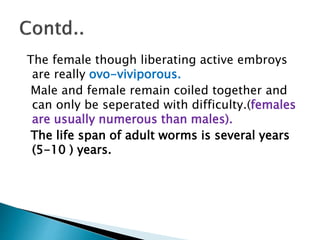
The female though liberating active embroys
are really ovo-viviporous.
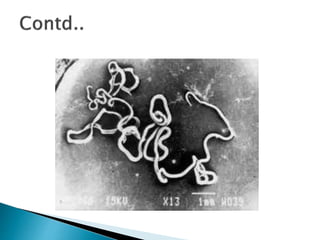
Male and female remain coiled together and
can only be seperated with difficulty.(females
are usually numerous than males).
The life span of adult worms is several years
(5-10 ) years.
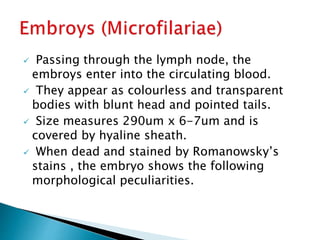
 Passing through the lymph node, the
embroys enter into the circulating blood.
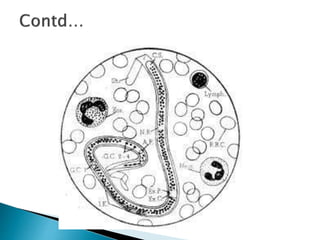
 They appear as colourless and transparent
bodies with blunt head and pointed tails.
 Size measures 290um x 6-7um and is
covered by hyaline sheath.
 When dead and stained by Romanowsky’s
stains , the embryo shows the following
morphological peculiarities.
# Hyaline sheath.
- Structureless sac.
- Sheath is longer than the larval body so
that larva can move forward and backwards
with in it.
# Somatic cells or nuclei:
- appear as granules in the central axis
of the body.
- extend from head to tail end.
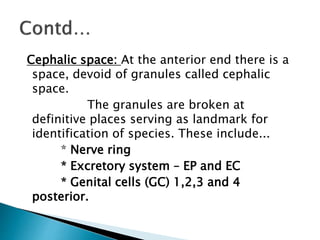
Cephalic space: At the anterior end there is a
space, devoid of granules called cephalic
space.
The granules are broken at
definitive places serving as landmark for
identification of species. These include...
* Nerve ring
* Excretory system – EP and EC
* Genital cells (GC) 1,2,3 and 4
posterior.
The larval forms do not
undergo any further
development in human
body.
If these are not sucked by
the mosquito they die in
about 70 days.
Periodicity:
 Microfilariae circulation in blood is periodic.
 Nocturnal Periodicity – microfilariae in blood
are high during 10pm-4am.
 In most regions W. bancrofti exhibits
nocturnal periodicity- Culex fatigans.
 In south pacific they exhibit diurnal
periodicity – Aedes polymensis (sub periodic)
During day time they retire
inside the capillaries of lungs,
kidneys, heart and big arteries
such as carotid.
The mechanism of nocturnal
periodicity is not yet clearly
known.
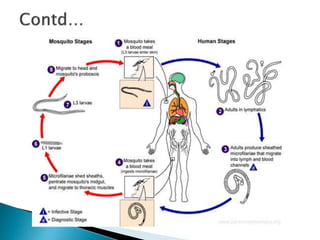
Wuchereria bancrofti passes its life cycle in
two hosts. i.e
Man (definitive host).
Mosquito ( intermediate host).
1. The definitive host:
 The adult worms are harboured in
lymphatic system of man. The male fertilises
the female.
 Live embroys (microfilariae) are discharged
which find their way into the blood stream.
 The embroys(microfilariae) capable of living
in the peripheral blood for a considerable
time without undergoing any developmental
metamorphosis.
 They are subsequently taken up by the
female mosquito during their blood meal.
2. The intermediate host:
 mosquito, in which the microfilariae undergo
further development after which they become
infective to man.
 They cast off their sheaths in 2-6 hours and
penetrate the stomach walls and within 4-17
hours, reach thoracic muscle .
 In next 2 days they metamorphose into first
stage larvae (short, sausage shaped with
short spiky tail.
 In 3-7days, they moult once or twice to
become second stage larvae.
 On 10th or 11th day, they are converted into
the third stage larvae which is infective.
 The third stage larvae then migrate from
thoracic muscle to the proboscis sheath of
the mosquito.
 A large no. of species of mosquito belong to
the genus culex, Aedes, and Anopheles acts
as a intermediate host for W. bancrofti.
- Infection with this parasite is called
Wucheriasis (commonly called filariasis).
Mode of Infection: through the bite of
mosquito
Transmitting agent: female mosquito (culex,
Aedes or Anopheles).
Infective form : third stage larvae
portal of entry: skin
Site of localisation: lymphatic system.
The disease is of two types:
1. Classical filariasis.
2. Occult filariasis.
# Classical filariasis:
 The pathogenic effects seen in Wucheriasis are
produced by the adult Wuchereria, living or dead.
 It leads to lymphangitis, lymphadenitis,
lymphodema with hypertrophy with affected part
(elephantiasis), lymphangiovarix, hydrocele and
chyluria.
Lymphangitis (causes) :
i) Mechanical irritation caused by the
movement of adult parasite inside the
lymphatic system.
ii) Secretion of some toxic fluid by fertilised
female at the time of parturition.
Causes of lymphatic Obstruction:
i) Mechanical blocking of lumen by dead
worms ( single or bunch) which acts as an
embolus.
ii) Obliterative Endolymphangitis : Endothelial
proliferation and inflammatory thickening of
the walls of lymphatic vessels.
Effects:
a) Lymph varix - Varicosity of lymphatic
vessel
b) Elephantiasis – Hypertrophy of the
affected part.
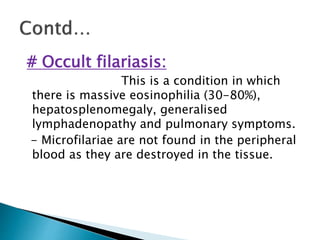
# Occult filariasis:
This is a condition in which
there is massive eosinophilia (30-80%),
hepatosplenomegaly, generalised
lymphadenopathy and pulmonary symptoms.
- Microfilariae are not found in the peripheral
blood as they are destroyed in the tissue.
Filarial fever: Rise of temperature
ranging from 103o C – 1040 C which may
continue for several days. (usually 3-5 days)
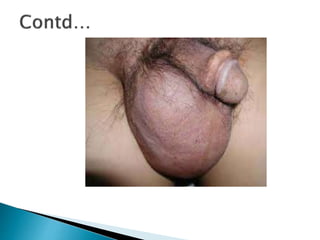
Hydrocele : Recurrent attacks of
Wuchererial Orchitis and Epididymitis
predispose to the occurrence of hydrocele
and this condition may exist with or without
elephantiasis of the scrotum.
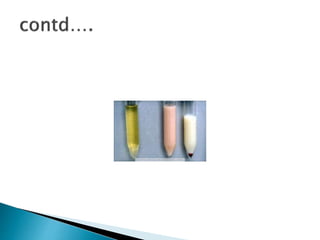
Chyluria: Escapes of chyle through urine due
to rupture of varicose chyle vessel through
the mucous membrane of urinary tract.
It is milk white in colour.
It contains fat particles, albumin and
fibrinogen.
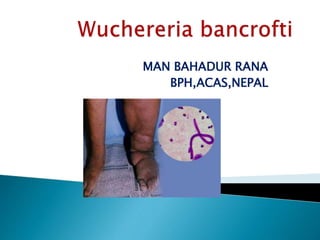
Elephantiasis: The affected part becomes
enormously enlarged producing a tumour like
solidity. This the end result of Wuchereria
infection and usually follows years of
continuous infection.
Samples:
 Blood (at night or day time,
according to the periodicity of
microfilariae)
 Urine
 Hydrocele fluid
 Biopsied tissue material.
1. Detection of Microfilariae in blood :
 It is done by thin and thick smears, stained
by Giemsa/ hematoxylin stain.
 Blood samples should be collected at mid
night where there is nocturnal periodicity of
microfilariae.
2. Detection of microfilariae in urine:
 It is done by wet preparation and fixed
stained smear preparation of centrifuged
deposit.
3. Detection of adult worms in biopsied
tissue:
 Microfilariae are not present in peripheral
blood under the following condition,
elephantitis.
4. Serological methods:
 These include ELISA, CFT, IFA.
Immunochromatographic card test (ICT) are
now available for the detection of adult worm
infection. The specificity of these test is
about 99%.
Polymerase chain reaction (PCR):
- It can detect filarial DNA in the patient blood.
- The test is positive only when microfilariae are
present in peripheral blood. Hence the test is
negative in chronic filariasis.
X-ray examination shows
calcified adult worms.
DEC (Diethylcarbamazine)
is the drug of choice.
It is given orally in a dose of
6mg/kg body weight daily for a
period of 12days.
It kills microfilariae.
 Protection against mosquito bites.
 Control of vectors by spraying insectisides
such as DDT, malathion etc on to common
resting sites.
 Treatment of cases and carriers.
 Improvement in sanitary condition.

Wuchereria bancrofti

  • 1.
  • 2.
    Common name: Bancrofts filaria In 1863, Demarquay first demonstrated the larval forms of W. bancrofti (microfilarie) in hydrocele fluid from Cuba.  In 1866, Wucherer from brazil discovered these larval forms in chylous urine.  In 1872, Lewis from India found the microfilarae in the peripheral blood.
  • 3.
    Geographical distribution: The parasiteis largely confined to the tropics and subtropics occuring in India, WestIndies, Japan, Central Africa and South America. Habitat: Adults worm are found in the lymphatics vessels and lymph nodes of man only. Bancroftian filariasis is not a zoonotic diseases.
  • 4.
     Long, hairlike, transparent (often creamy white color) with smooth cuticular.  Filiform shaped.  Both ends are tapering with slightly swollen head. Male: 2.5-4cm x 0.1mm, 2 spicules at tail end. Female: 8-10cm x0.2-0.3mm, narrow, pointed tail.
  • 5.
    The female thoughliberating active embroys are really ovo-viviporous. Male and female remain coiled together and can only be seperated with difficulty.(females are usually numerous than males). The life span of adult worms is several years (5-10 ) years.
  • 7.
     Passing throughthe lymph node, the embroys enter into the circulating blood.  They appear as colourless and transparent bodies with blunt head and pointed tails.  Size measures 290um x 6-7um and is covered by hyaline sheath.  When dead and stained by Romanowsky’s stains , the embryo shows the following morphological peculiarities.
  • 8.
    # Hyaline sheath. -Structureless sac. - Sheath is longer than the larval body so that larva can move forward and backwards with in it. # Somatic cells or nuclei: - appear as granules in the central axis of the body. - extend from head to tail end.
  • 9.
    Cephalic space: Atthe anterior end there is a space, devoid of granules called cephalic space. The granules are broken at definitive places serving as landmark for identification of species. These include... * Nerve ring * Excretory system – EP and EC * Genital cells (GC) 1,2,3 and 4 posterior.
  • 10.
    The larval formsdo not undergo any further development in human body. If these are not sucked by the mosquito they die in about 70 days.
  • 12.
    Periodicity:  Microfilariae circulationin blood is periodic.  Nocturnal Periodicity – microfilariae in blood are high during 10pm-4am.  In most regions W. bancrofti exhibits nocturnal periodicity- Culex fatigans.  In south pacific they exhibit diurnal periodicity – Aedes polymensis (sub periodic)

  • 13.
    During day timethey retire inside the capillaries of lungs, kidneys, heart and big arteries such as carotid. The mechanism of nocturnal periodicity is not yet clearly known.
  • 14.
    Wuchereria bancrofti passesits life cycle in two hosts. i.e Man (definitive host). Mosquito ( intermediate host). 1. The definitive host:  The adult worms are harboured in lymphatic system of man. The male fertilises the female.
  • 15.
     Live embroys(microfilariae) are discharged which find their way into the blood stream.  The embroys(microfilariae) capable of living in the peripheral blood for a considerable time without undergoing any developmental metamorphosis.  They are subsequently taken up by the female mosquito during their blood meal.
  • 16.
    2. The intermediatehost:  mosquito, in which the microfilariae undergo further development after which they become infective to man.  They cast off their sheaths in 2-6 hours and penetrate the stomach walls and within 4-17 hours, reach thoracic muscle .  In next 2 days they metamorphose into first stage larvae (short, sausage shaped with short spiky tail.
  • 17.
     In 3-7days,they moult once or twice to become second stage larvae.  On 10th or 11th day, they are converted into the third stage larvae which is infective.  The third stage larvae then migrate from thoracic muscle to the proboscis sheath of the mosquito.  A large no. of species of mosquito belong to the genus culex, Aedes, and Anopheles acts as a intermediate host for W. bancrofti.
  • 19.
    - Infection withthis parasite is called Wucheriasis (commonly called filariasis). Mode of Infection: through the bite of mosquito Transmitting agent: female mosquito (culex, Aedes or Anopheles). Infective form : third stage larvae portal of entry: skin Site of localisation: lymphatic system.
  • 20.
    The disease isof two types: 1. Classical filariasis. 2. Occult filariasis. # Classical filariasis:  The pathogenic effects seen in Wucheriasis are produced by the adult Wuchereria, living or dead.  It leads to lymphangitis, lymphadenitis, lymphodema with hypertrophy with affected part (elephantiasis), lymphangiovarix, hydrocele and chyluria.
  • 21.
    Lymphangitis (causes) : i)Mechanical irritation caused by the movement of adult parasite inside the lymphatic system. ii) Secretion of some toxic fluid by fertilised female at the time of parturition. Causes of lymphatic Obstruction: i) Mechanical blocking of lumen by dead worms ( single or bunch) which acts as an embolus.
  • 22.
    ii) Obliterative Endolymphangitis: Endothelial proliferation and inflammatory thickening of the walls of lymphatic vessels. Effects: a) Lymph varix - Varicosity of lymphatic vessel b) Elephantiasis – Hypertrophy of the affected part.
  • 24.
    # Occult filariasis: Thisis a condition in which there is massive eosinophilia (30-80%), hepatosplenomegaly, generalised lymphadenopathy and pulmonary symptoms. - Microfilariae are not found in the peripheral blood as they are destroyed in the tissue.
  • 25.
    Filarial fever: Riseof temperature ranging from 103o C – 1040 C which may continue for several days. (usually 3-5 days) Hydrocele : Recurrent attacks of Wuchererial Orchitis and Epididymitis predispose to the occurrence of hydrocele and this condition may exist with or without elephantiasis of the scrotum.
  • 27.
    Chyluria: Escapes ofchyle through urine due to rupture of varicose chyle vessel through the mucous membrane of urinary tract. It is milk white in colour. It contains fat particles, albumin and fibrinogen. Elephantiasis: The affected part becomes enormously enlarged producing a tumour like solidity. This the end result of Wuchereria infection and usually follows years of continuous infection.
  • 29.
    Samples:  Blood (atnight or day time, according to the periodicity of microfilariae)  Urine  Hydrocele fluid  Biopsied tissue material.
  • 30.
    1. Detection ofMicrofilariae in blood :  It is done by thin and thick smears, stained by Giemsa/ hematoxylin stain.  Blood samples should be collected at mid night where there is nocturnal periodicity of microfilariae. 2. Detection of microfilariae in urine:  It is done by wet preparation and fixed stained smear preparation of centrifuged deposit.
  • 31.
    3. Detection ofadult worms in biopsied tissue:  Microfilariae are not present in peripheral blood under the following condition, elephantitis. 4. Serological methods:  These include ELISA, CFT, IFA. Immunochromatographic card test (ICT) are now available for the detection of adult worm infection. The specificity of these test is about 99%.
  • 32.
    Polymerase chain reaction(PCR): - It can detect filarial DNA in the patient blood. - The test is positive only when microfilariae are present in peripheral blood. Hence the test is negative in chronic filariasis. X-ray examination shows calcified adult worms.
  • 33.
    DEC (Diethylcarbamazine) is thedrug of choice. It is given orally in a dose of 6mg/kg body weight daily for a period of 12days. It kills microfilariae.
  • 34.
     Protection againstmosquito bites.  Control of vectors by spraying insectisides such as DDT, malathion etc on to common resting sites.  Treatment of cases and carriers.  Improvement in sanitary condition.