
• Three species of Trypanosoma are parasitic in
humans , T. gambiense, T. rhodesiense & T. cruzi.
• First two live as parasites in human blood, lymph or
cerebrospinal fluid and cause sleeping sickness in
Africa .
• while the third T. cruzi is parasitic in the tissues of
many mammals and causes chagas disease in South
America.
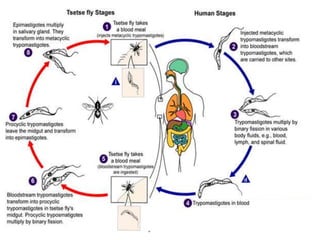
• A part of their life-cycle is passed in blood sucking
insect tse tse fly.
Morphology
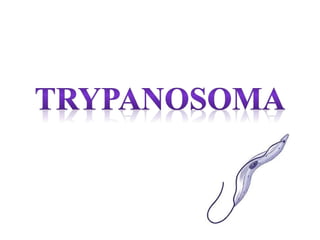
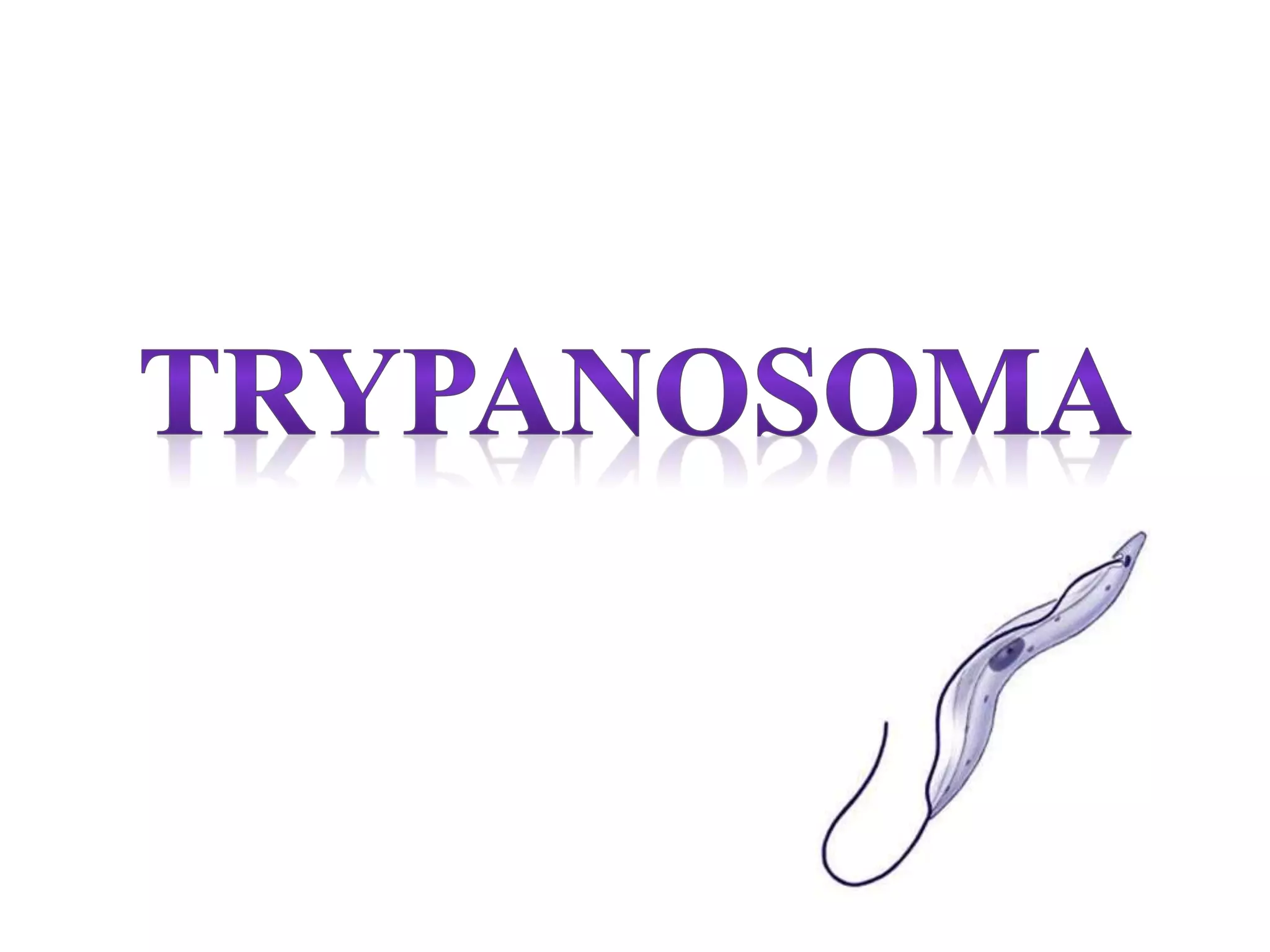
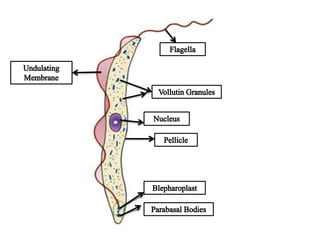
• It is spindle shaped, covered by a membranous
pellicle .
• A single flagellum arises from the posterior end
and curves in a spiral form round the body
forming undulating membrane .
• The nucleus is present in the centre of the body
and the cytoplasm contains volutin granules.
• At the base of the flagellum is located the basal
granule or blepharoplast close to which is another
granule the parabasal body.
Pathogenesis
• Trypanosomes in the blood stream liberate toxins
and cause Gambian fever.
• Finally they enter the CSF surrounding the brain and
spinal cord and cause sleeping sickness.
• In this the person is restless at night .
• Has a tendency to fall asleep during the day while
standing, sitting or eating.
• Finally the person looses consciousness leading to
coma and death.
• Some other symptoms are itching and irritation near
the wound, fever, headache, enlarged lymph glands,
anemia, physical and mental lethargy.
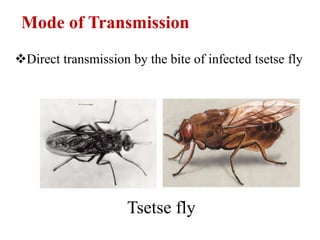
Tsetse fly
Mode of Transmission
Direct transmission by the bite of infected tsetse fly
Laboratory Diagnosis
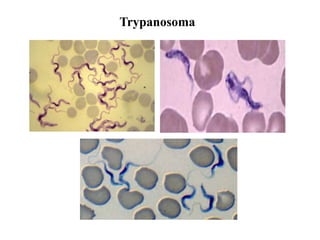
• Trypanosomes are diagnosed by microscopic
examination of stained and unstained peripheral
blood smears, cerebrospinal fluid, bone marrow,
secretions obtained from lymph nodes.
• Serology
• Indirect immunofluorescence
• Indirect haemaglutination
• ELISA
• Compliment fixation test
Trypanosoma
TREATMENT
• Pentamidine
• Suramin
• Nitrofurazone
• Arsenicals etc.
5. trypanosoma

5. trypanosoma

  • 2.
    • Three speciesof Trypanosoma are parasitic in humans , T. gambiense, T. rhodesiense & T. cruzi. • First two live as parasites in human blood, lymph or cerebrospinal fluid and cause sleeping sickness in Africa . • while the third T. cruzi is parasitic in the tissues of many mammals and causes chagas disease in South America. • A part of their life-cycle is passed in blood sucking insect tse tse fly.
  • 3.
    Morphology • It isspindle shaped, covered by a membranous pellicle . • A single flagellum arises from the posterior end and curves in a spiral form round the body forming undulating membrane . • The nucleus is present in the centre of the body and the cytoplasm contains volutin granules. • At the base of the flagellum is located the basal granule or blepharoplast close to which is another granule the parabasal body.
  • 6.
    Pathogenesis • Trypanosomes inthe blood stream liberate toxins and cause Gambian fever. • Finally they enter the CSF surrounding the brain and spinal cord and cause sleeping sickness. • In this the person is restless at night . • Has a tendency to fall asleep during the day while standing, sitting or eating. • Finally the person looses consciousness leading to coma and death. • Some other symptoms are itching and irritation near the wound, fever, headache, enlarged lymph glands, anemia, physical and mental lethargy.
  • 7.
    Tsetse fly Mode ofTransmission Direct transmission by the bite of infected tsetse fly
  • 8.
    Laboratory Diagnosis • Trypanosomesare diagnosed by microscopic examination of stained and unstained peripheral blood smears, cerebrospinal fluid, bone marrow, secretions obtained from lymph nodes. • Serology • Indirect immunofluorescence • Indirect haemaglutination • ELISA • Compliment fixation test
  • 9.
  • 10.
    TREATMENT • Pentamidine • Suramin •Nitrofurazone • Arsenicals etc.