Enterobius vermicularis
Introduction:
• Enterobius vermicularis, also called pinworm, is one of
the most common nematode infections in the world.
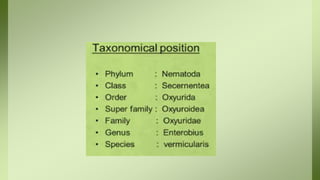
Originally, E. vermicularis was named Oxyuris
vermicularis. Humans are the only natural host for this
infection.
• Transmission occurs in people who are living in crowded
environments and usually occurs within families.
• The worms are tiny, thread-like, and whitish.
• The worm is named after the characteristic pin-like
tail present on the posterior part of female worms.
• Pinworm infestation usually occurs in children.
Transmission is via direct contact with contaminated
items or even during sexual contact. Most infections
are asymptomatic. While the cure rate is high,
recurrences are common.
• Infection most commonly occurs in children, but
any individual is susceptible to E. vermicularis
infection.
• People from tropical climates and school-aged
children are the most vulnerable. Infection is
caused by the ingestion of the pinworm eggs.
• Transmission is most commonly through the
fecal-oral route.
• Risk factors for pinworms include poor hygiene, eating
after touching contaminated items and living with an
individual who is identified as egg positive
• Female Enterobius vermicularis, measuring 8 to 13 mm
long by 0.4 mm wide.
• They are characterized by the presence of wing like
expansions (alae) of the body wall at the anterior end,
distension of the body .
• Due to the large number of eggs in the uteri, and a
pointed tail.
• Males egg’s smaller in size, are 2 to 5 mm long
and possess a curved tail.
• Enterobiasis is considered the most common roundworm
infection in the United States.
• Commonly occurs as a result of nail biting, poor
hygiene, or inadequate hand-washing
• The life span of the adults is about two months.
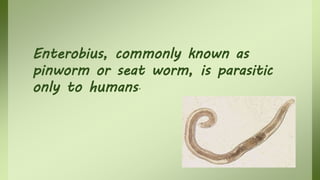
Enterobius, commonly known as
pinworm or seat worm, is parasitic
only to humans.
LIFE CYCLE OF ENTEROBIUS
LOCATION:
Sexually mature worms usually inhabit the ileocaecal
area of the human intestinal tract, but they can
spread to adjacent regions of the small and large
intestines
MIGRATION:
Adhering to the mucosa, the worms feed on bacteria
and epithelial cells. Males die following copulation, while
egg-bearing females, with up to 15,000 eggs in their
uteri, migrate to the perianal and perineal regions.
DEPOSTION OF EGGS:
There, stimulated by lower temperature and aerobic
environment, they deposit their eggs and then also die.
More eggs are released when the female’s body ruptures.
Each egg contains, upon deposition, an immature larva.
THIRD STAGE LARVA:
The infective, third-stage larva completes development
within the egg several hours after leaving the body of
the female worm.
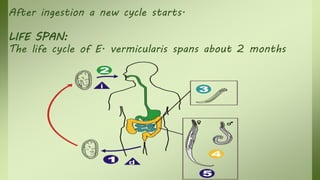
HOW INFECTION OCCURS
Infection and re-infection occur when eggs containing the
infective larvae are ingested by the host. This may happen
when eggs are picked up on the hands from bedclothes or
beneath fingernails contaminated when the host scratches
the perianal zone to relieve itching caused by nocturnal
migration of the female worms.
It may be airborne infection because these eggs are light
weight and can be spread through air.
After ingestion a new cycle starts.
LIFE SPAN:
The life cycle of E. vermicularis spans about 2 months
Enterobius vermicularis
Life Cycle
Epidemiology
Symptomatology and Diagnosis
Chemotherapy
Prevention
Symptomatology
 Pinworms are not highly pathogenic.
Clinical symptoms
Such as itching and irritation are
caused by the migration of gravid females around the
perianal, perineal, and vaginal area.
Heavy infections
In children may also produce such
symptoms as sleeplessness, weight loss, hyperactivity,
grinding of teeth, abdominal pain, and vomiting.
 Gravid females
may also migrate up the female
reproductive tract, become trapped in the tissues, and
cause granulomata in the uterus and fallopian tubes.
They may also migrate to the appendix, the
peritonealcavity, or even the urinary bladder.
Diagnosis
• Diagnosis is verified when adult worms and/or eggs are
detected.
• Female worms emerge at night and are frequently visible
in the perianal and perineal regions. Adult worms can
• often be observed on feces as well; however, eggs are
found in feces in only about 5% of cases.
• The most reliable procedure for finding eggs is to press a
strip of scotch tape on the perianal
skin, remove it, and place it on a clean microscope slide
for examination.
• Negative results from this protocol for seven consecutive
days constitute confirmation that the patient is free of
infection
Chemotherapy
 Following positive diagnosis in any individual, treatment
should be administered to all
 members of the household.
 Several relatively inexpensive and essentially nontoxic
drugs are available. Either pyrantel pamoate, albendazole,
or mebendazole, usually administered
 Mebendazole and albendazole are contraindicated for
pregnant women since they are teratogenic in
experimental animals.
prevention
Complete eradication of pinworm infection from a population
is highly unlikely.
Scrupulous personal hygiene is the most effective deterrent.
Fingernails should be cut short, and hands should be washed
thoroughly after toilet use and before food is prepared or
eaten.
Since infection is most prevalent in urban areas where
relatively large populations intermingle education of parents
has proven most effective.
prevention
Parents should be informed that it is a self-limiting,
nonfatal infection, widespread among children and that no
social stigma should be attached to it.
There is no evidence that dogs can transmit the infection.
Infected children as well as other members of the household
should be treated promptly. Bedclothes, towels, and
washcloths from infected homes should be carefully laundered
in hot water and
aired in sunlight.
Enterobius vermicularis

Enterobius vermicularis

  • 2.
  • 4.
    Introduction: • Enterobius vermicularis,also called pinworm, is one of the most common nematode infections in the world. Originally, E. vermicularis was named Oxyuris vermicularis. Humans are the only natural host for this infection. • Transmission occurs in people who are living in crowded environments and usually occurs within families. • The worms are tiny, thread-like, and whitish. • The worm is named after the characteristic pin-like tail present on the posterior part of female worms.
  • 5.
    • Pinworm infestationusually occurs in children. Transmission is via direct contact with contaminated items or even during sexual contact. Most infections are asymptomatic. While the cure rate is high, recurrences are common. • Infection most commonly occurs in children, but any individual is susceptible to E. vermicularis infection. • People from tropical climates and school-aged children are the most vulnerable. Infection is caused by the ingestion of the pinworm eggs. • Transmission is most commonly through the fecal-oral route.
  • 6.
    • Risk factorsfor pinworms include poor hygiene, eating after touching contaminated items and living with an individual who is identified as egg positive • Female Enterobius vermicularis, measuring 8 to 13 mm long by 0.4 mm wide. • They are characterized by the presence of wing like expansions (alae) of the body wall at the anterior end, distension of the body . • Due to the large number of eggs in the uteri, and a pointed tail.
  • 7.
    • Males egg’ssmaller in size, are 2 to 5 mm long and possess a curved tail. • Enterobiasis is considered the most common roundworm infection in the United States. • Commonly occurs as a result of nail biting, poor hygiene, or inadequate hand-washing • The life span of the adults is about two months.
  • 8.
    Enterobius, commonly knownas pinworm or seat worm, is parasitic only to humans.
  • 9.
    LIFE CYCLE OFENTEROBIUS
  • 10.
    LOCATION: Sexually mature wormsusually inhabit the ileocaecal area of the human intestinal tract, but they can spread to adjacent regions of the small and large intestines MIGRATION: Adhering to the mucosa, the worms feed on bacteria and epithelial cells. Males die following copulation, while egg-bearing females, with up to 15,000 eggs in their uteri, migrate to the perianal and perineal regions.
  • 11.
    DEPOSTION OF EGGS: There,stimulated by lower temperature and aerobic environment, they deposit their eggs and then also die. More eggs are released when the female’s body ruptures. Each egg contains, upon deposition, an immature larva. THIRD STAGE LARVA: The infective, third-stage larva completes development within the egg several hours after leaving the body of the female worm.
  • 12.
    HOW INFECTION OCCURS Infectionand re-infection occur when eggs containing the infective larvae are ingested by the host. This may happen when eggs are picked up on the hands from bedclothes or beneath fingernails contaminated when the host scratches the perianal zone to relieve itching caused by nocturnal migration of the female worms. It may be airborne infection because these eggs are light weight and can be spread through air.
  • 13.
    After ingestion anew cycle starts. LIFE SPAN: The life cycle of E. vermicularis spans about 2 months
  • 14.
  • 15.
    Symptomatology  Pinworms arenot highly pathogenic. Clinical symptoms Such as itching and irritation are caused by the migration of gravid females around the perianal, perineal, and vaginal area. Heavy infections In children may also produce such symptoms as sleeplessness, weight loss, hyperactivity, grinding of teeth, abdominal pain, and vomiting.
  • 16.
     Gravid females mayalso migrate up the female reproductive tract, become trapped in the tissues, and cause granulomata in the uterus and fallopian tubes. They may also migrate to the appendix, the peritonealcavity, or even the urinary bladder.
  • 17.
    Diagnosis • Diagnosis isverified when adult worms and/or eggs are detected. • Female worms emerge at night and are frequently visible in the perianal and perineal regions. Adult worms can • often be observed on feces as well; however, eggs are found in feces in only about 5% of cases.
  • 18.
    • The mostreliable procedure for finding eggs is to press a strip of scotch tape on the perianal skin, remove it, and place it on a clean microscope slide for examination. • Negative results from this protocol for seven consecutive days constitute confirmation that the patient is free of infection
  • 19.
    Chemotherapy  Following positivediagnosis in any individual, treatment should be administered to all  members of the household.  Several relatively inexpensive and essentially nontoxic drugs are available. Either pyrantel pamoate, albendazole, or mebendazole, usually administered  Mebendazole and albendazole are contraindicated for pregnant women since they are teratogenic in experimental animals.
  • 20.
    prevention Complete eradication ofpinworm infection from a population is highly unlikely. Scrupulous personal hygiene is the most effective deterrent. Fingernails should be cut short, and hands should be washed thoroughly after toilet use and before food is prepared or eaten. Since infection is most prevalent in urban areas where relatively large populations intermingle education of parents has proven most effective.
  • 21.
    prevention Parents should beinformed that it is a self-limiting, nonfatal infection, widespread among children and that no social stigma should be attached to it. There is no evidence that dogs can transmit the infection. Infected children as well as other members of the household should be treated promptly. Bedclothes, towels, and washcloths from infected homes should be carefully laundered in hot water and aired in sunlight.