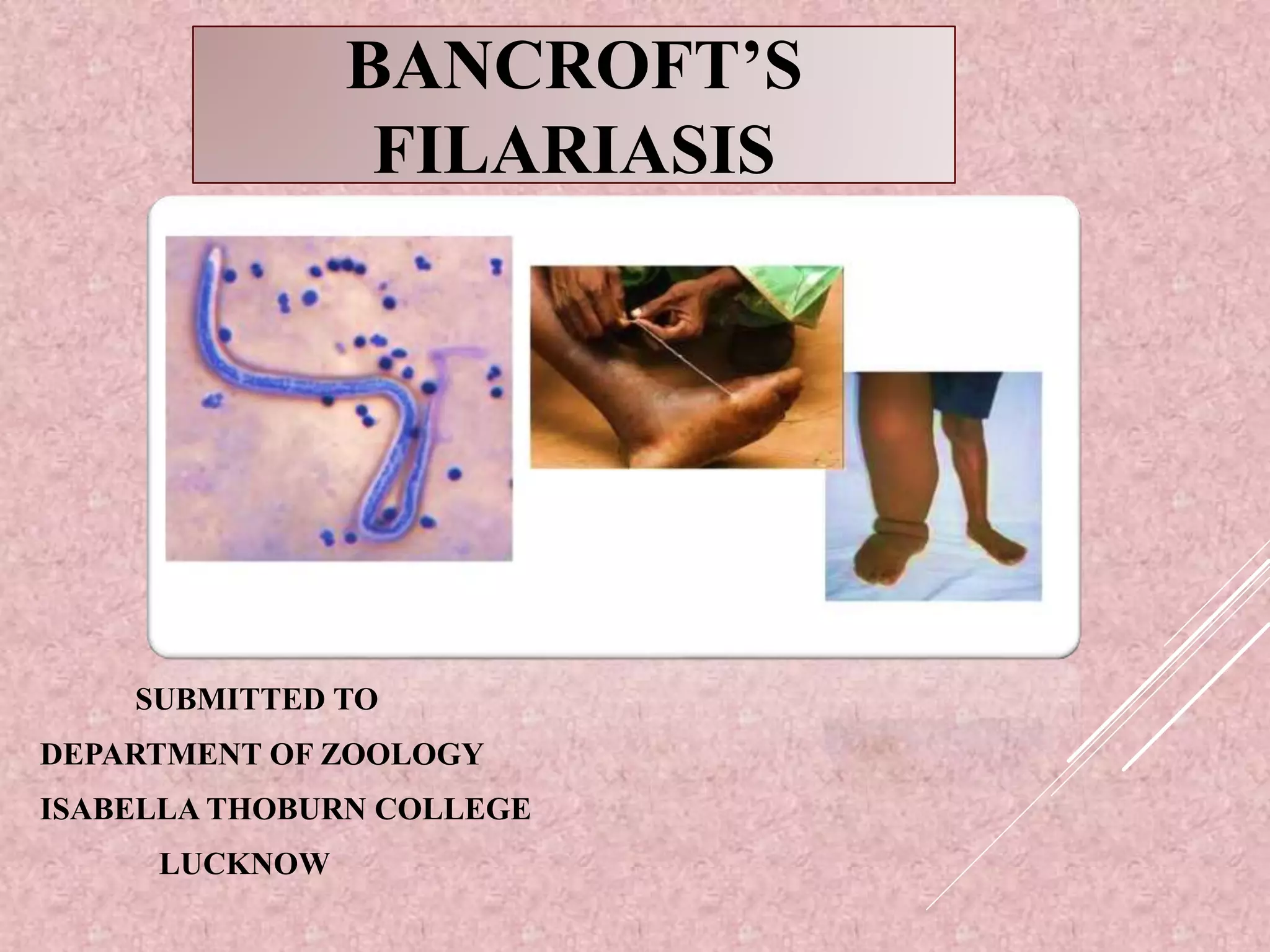
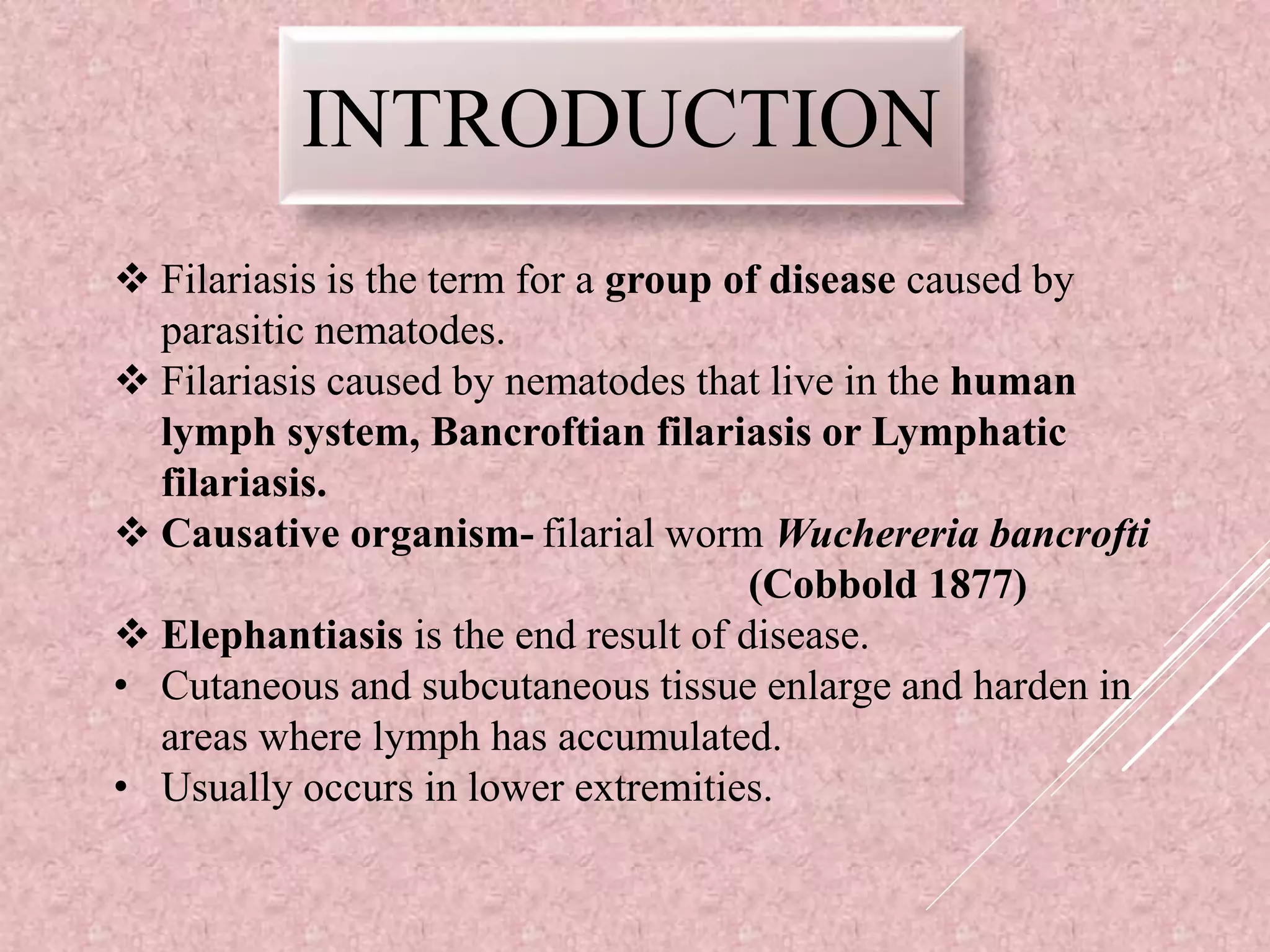
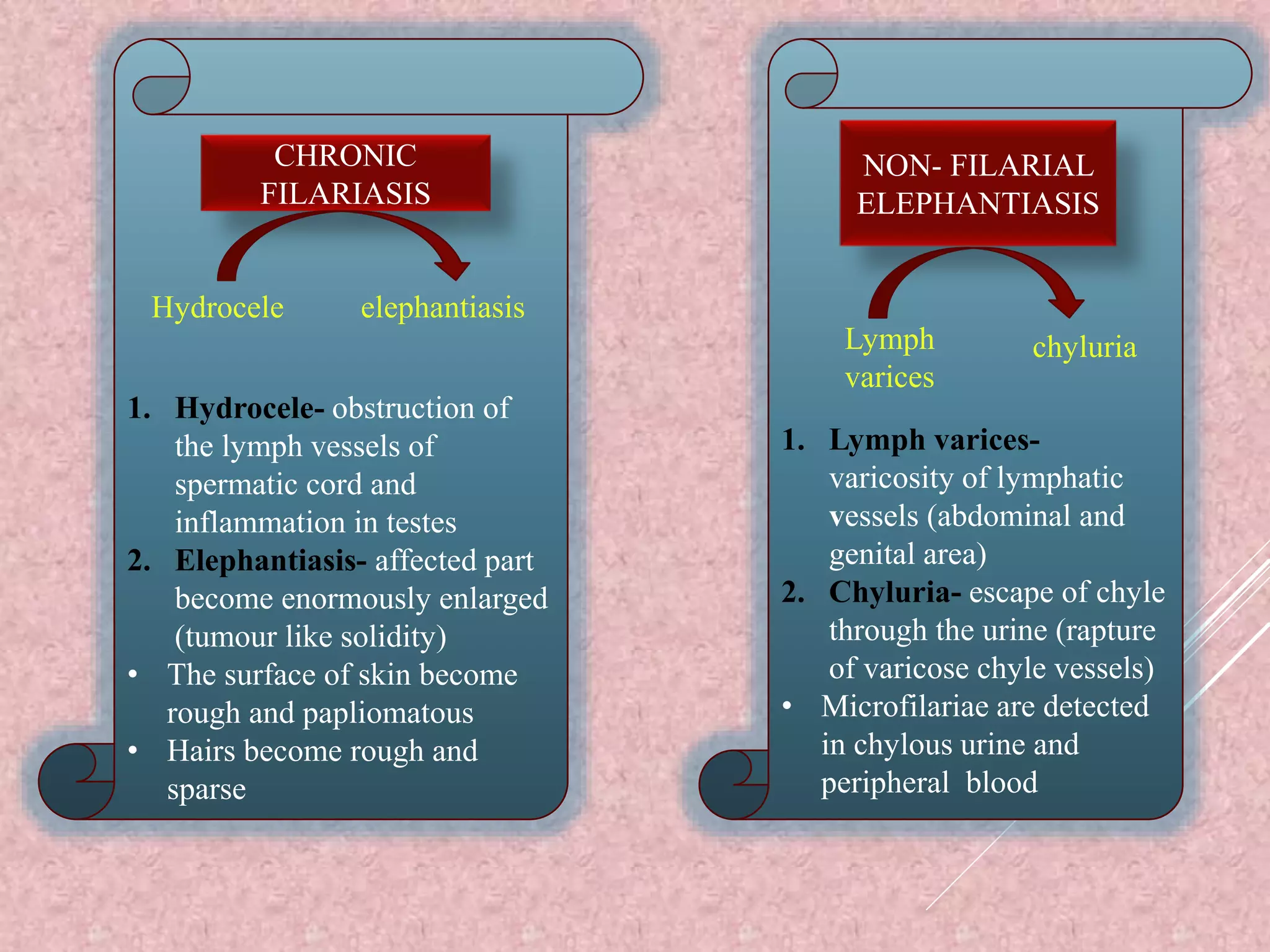
BANCROFT’S
FILARIASIS
SUBMITTED TO
DEPARTMENT OF ZOOLOGY
ISABELLA THOBURN COLLEGE
LUCKNOW
INTRODUCTION
 Filariasis is the term for a group of disease caused by
parasitic nematodes.
 Filariasis caused by nematodes that live in the human
lymph system, Bancroftian filariasis or Lymphatic
filariasis.
 Causative organism- filarial worm Wuchereria bancrofti
(Cobbold 1877)
 Elephantiasis is the end result of disease.
• Cutaneous and subcutaneous tissue enlarge and harden in
areas where lymph has accumulated.
• Usually occurs in lower extremities.
Wuchereria bancrofti
 Common name- Bancroft’s filaria
Bancroft (1876-77) demonstrated adult female and
Sibthorpe (1888) first found adult male.
Manson (1878) first demonstrated the culex mosquitoes
as the INTERMEDIATE HOST.
Geographical distribution
• Very widespread and
important human parasite in
worm countries.
• In Africa (Mediterranean and
east west coastal areas)
• In Asia (coasts of Arabia,
India, Malaya and north to
china.
Habitat
• Filarial worm inhabit the
lymphatic vessels, especially
the lymph nodes of man and
other vertebrates.
• Microfilariae are found in
peripheral blood (also found
in chylous urine or
hydrocele fluid)
Morphology
Adult worm
Third stage
larva
Microfilariae
(first stage larva)
ADULT WORM
 Long hair like transparent nematodes
 Creamy white in colour.
 Filiform in shape, both ends are tapering
 Male- 2.5-4 cm in length and 0.1mm thickness
 Tail end is curved ventrally contain 2 spicules
 Female- 8-10cm in length and 0.2-0.3mm
thickness
 Tail end is narrow and abruptly pointed
 Ovo-viviparous, though liberating active
embryos.
 Male and female coiled together, can be
separated with difficulty
 Life span is long, 5-10 years Wuchereria bancrofti
MICROFILARIAE
 First stage larva
 Location- peripheral blood and often in
hydrocele fluid and chylous urine
 Size- 244-296 micrometre in length and
7.5-10micrometre in diameter
 Body- transparent and colourless,
covered by hyaline sheath
 They can live up to 70 days in human
blood
 Microfilarial periodicity-
Nocturnal periodicity
Present in high number in
peripheral blood at
midnight
Eg- Brugia malayi
Diurnal periodicity
Present in greatest number
in peripheral blood during
day time
Eg- Loa loa
MORPHOLOGY OF MICROFILARIAE
THIRD STAGE LARVA
 Infective form of the filarial worm in human.
 Shape- elongated, Filiform
 Size- 1.4-2 micrometre in length and 18-23
micrometre in breadth
MICROFILARIAE IN
BLOOD FILM
LIFE CYCLE
• DEFINITIVE HOST- Man
(In human lymphatic system)
• INTERMEDIATE HOST-
Mosquitoes
 Culex quinquesfasciatus
 Anopheles
 Aedes
Culex
quinquesfasciatus
Aedes
Anopheles
PATHOGENICITY
 INFECTION- Wuchereriasis (commonly called
filariasis)
 MODE OF INFECTION- Inoculative method,
through the bite of mosquito
 TRANSMITTING AGENT- Female mosquito(Culex,
Aedes, Anopheles)
 INFECTIVE FORM-Third stage larva
 PORTAL OF ENTRY-Skin
 SITE OF LOCALIZATION-Lymphatic system of
superior or inferior extremities
 INCUBATION PERIOD- About 1 to 2 years(3rd stage
infective larva grows to adult form)
CLINICAL MENIFESTATION
LYMPHATIC
FILARIASIS
OCCULT
FILARIASIS
 endemic normal
 Asymptomatic stage
 Acute filariasis
 Chronic filariasis
 Non-filarial
elephantiasis
 Tropical pulmonary
eosinophilia
(TPE)
LYMPHATIC FILARIASIS
ENDEMIC NORMAL
• In the area of
endemic filariasis, a
certain proportion of
the population living
in these area do not
show any overt
clinical manifestation
of disease
• Difficult to know,
people are infected or
not
ASYMPTOMATIC
STAGE
• Have microfilariae
in their blood but
do not show any
symptoms of
disease
• Remains
asymptomatic for
years or even life
ACUTE
FILARIASIS
• Filarial fever and
lymphadenitis
(major symptoms)
• May occur several
times a year
ELEPHANTIASIS
THANK YOU…
1. Hydrocele- obstruction of
the lymph vessels of
spermatic cord and
inflammation in testes
2. Elephantiasis- affected part
become enormously enlarged
(tumour like solidity)
• The surface of skin become
rough and papliomatous
• Hairs become rough and
sparse
CHRONIC
FILARIASIS
Hydrocele elephantiasis
1. Lymph varices-
varicosity of lymphatic
vessels (abdominal and
genital area)
2. Chyluria- escape of chyle
through the urine (rapture
of varicose chyle vessels)
• Microfilariae are detected
in chylous urine and
peripheral blood
NON- FILARIAL
ELEPHANTIASIS
Lymph
varices
chyluria
OCCULT FILARIASIS
• Hypersensitivity reaction of the host to
Microfilarial antigen
• Microfilariae are not detected in peripheral blood
• Examples- tropical pulmonary eosinophilia
(TPE), Less frequently arthritis
TROPICAL PULMONARY EOSINOPHILIA (TPE)
Eosinophilic lung, Weingarten’s syndrome
• Characterised by low fever, loss of weight, paroxysmal
cough with scanty sputum, dyspnoea and splenomegaly
• Chest radiography shows increased branchiovascular
marking or military “mottling” in lung fields
• Microfilariae may b e demonstrated in tissue obtained by
lung biopsy
EPIDEMIOLOGY
 GEOGRAPHICAL DISTRIBUTION- topics and
subtropics of Asia, Africa, South America
• Periodic nocturnal W. bancrofti is the most
widespread
• Endemic in India, China and other countries of
South-East Asia
 RESERVOIR HOST AND TRANSMISSION OF
INFECTION
• Infected person with circulating microfilariae are the
chief source of reservoir and infection
• Man- to- man transmission by the bite of mosquito
DIAGNOSIS
 DIRECT EVIDENCES
1. Microfilariae (sheathed having
tail- tip free from nucleus)
• In peripheral blood
• In chylous urine
• In hydrocele fluid
2. Adult worm
• In biopsied lymph nodes
• Calcified worm by X-ray
 INDIRECT EVIDENCES
1. Allergic test
a. Blood examination(eosinophilia 5 to
15%)
b. Intradermat test- an immediate
hypersensitivity reaction
2. Immunological test
(complement fixative test)
• A sensitive test for loiasis and occult
filariasis
Other tests-
• Biopsy (for purely diagnostic purpose)
• Serological diagnosis (ELISA, RIA)
• Trop Bio Test (detection of adult worm infection not depends on
Microfilarial periodicity)
• PCR assay (detection of Microfilarial infection)
• X-ray examination ( shows calcified adult worm)
TREATMENT
Diethyl carbamazine (DEC)
• Kills mainly microfilariae
• Most effective against 3rd and 4th stage larva
• Adenolymphangitis decreases significantly
• Cheap, effective and safe with few side effects
(fever, chill, headache etc.)
DOSE
1st day - 50mg after food
2nd day - 50mg three times daily
3rd day - 100mg three times daily
4th day – 21st day - 5mg/kg/day in three
divided dose
Other drugs
• Iveemeciin (150ug/kg body wt., destroy microfilariae, no
mocrofilaricidal effect)
• Lavamisole
• Mebendazole
• Centprazine (CDRI Lucknow)
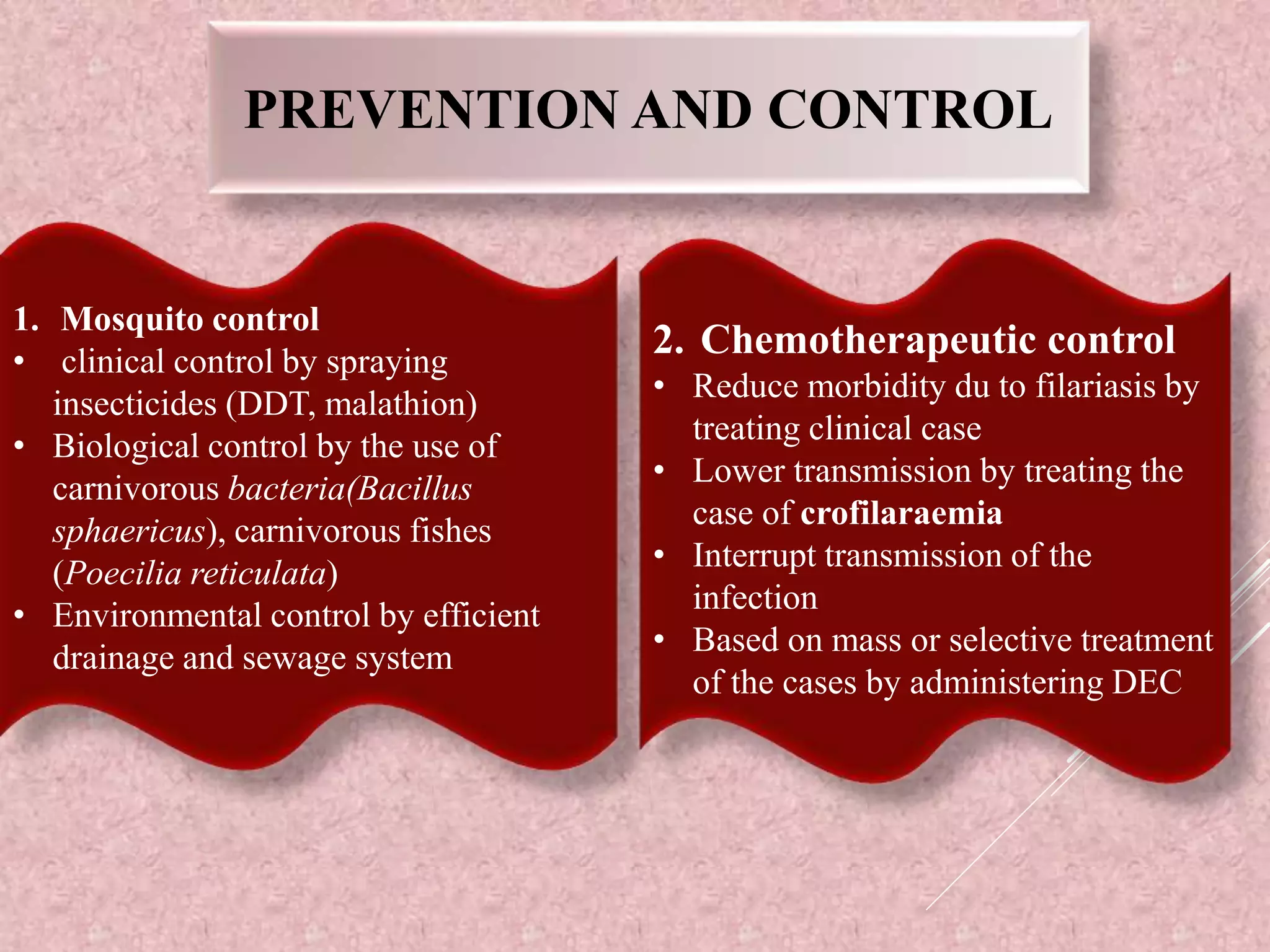
PREVENTION AND CONTROL
1. Mosquito control
• clinical control by spraying
insecticides (DDT, malathion)
• Biological control by the use of
carnivorous bacteria(Bacillus
sphaericus), carnivorous fishes
(Poecilia reticulata)
• Environmental control by efficient
drainage and sewage system
2. Chemotherapeutic control
• Reduce morbidity du to filariasis by
treating clinical case
• Lower transmission by treating the
case of crofilaraemia
• Interrupt transmission of the
infection
• Based on mass or selective treatment
of the cases by administering DEC

Filariasis ( wuchereria bancrofti)

  • 1.
    BANCROFT’S FILARIASIS SUBMITTED TO DEPARTMENT OFZOOLOGY ISABELLA THOBURN COLLEGE LUCKNOW
  • 2.
    INTRODUCTION  Filariasis isthe term for a group of disease caused by parasitic nematodes.  Filariasis caused by nematodes that live in the human lymph system, Bancroftian filariasis or Lymphatic filariasis.  Causative organism- filarial worm Wuchereria bancrofti (Cobbold 1877)  Elephantiasis is the end result of disease. • Cutaneous and subcutaneous tissue enlarge and harden in areas where lymph has accumulated. • Usually occurs in lower extremities.
  • 3.
    Wuchereria bancrofti  Commonname- Bancroft’s filaria Bancroft (1876-77) demonstrated adult female and Sibthorpe (1888) first found adult male. Manson (1878) first demonstrated the culex mosquitoes as the INTERMEDIATE HOST. Geographical distribution • Very widespread and important human parasite in worm countries. • In Africa (Mediterranean and east west coastal areas) • In Asia (coasts of Arabia, India, Malaya and north to china. Habitat • Filarial worm inhabit the lymphatic vessels, especially the lymph nodes of man and other vertebrates. • Microfilariae are found in peripheral blood (also found in chylous urine or hydrocele fluid)
  • 4.
  • 5.
    ADULT WORM  Longhair like transparent nematodes  Creamy white in colour.  Filiform in shape, both ends are tapering  Male- 2.5-4 cm in length and 0.1mm thickness  Tail end is curved ventrally contain 2 spicules  Female- 8-10cm in length and 0.2-0.3mm thickness  Tail end is narrow and abruptly pointed  Ovo-viviparous, though liberating active embryos.  Male and female coiled together, can be separated with difficulty  Life span is long, 5-10 years Wuchereria bancrofti
  • 6.
    MICROFILARIAE  First stagelarva  Location- peripheral blood and often in hydrocele fluid and chylous urine  Size- 244-296 micrometre in length and 7.5-10micrometre in diameter  Body- transparent and colourless, covered by hyaline sheath  They can live up to 70 days in human blood  Microfilarial periodicity- Nocturnal periodicity Present in high number in peripheral blood at midnight Eg- Brugia malayi Diurnal periodicity Present in greatest number in peripheral blood during day time Eg- Loa loa MORPHOLOGY OF MICROFILARIAE
  • 7.
    THIRD STAGE LARVA Infective form of the filarial worm in human.  Shape- elongated, Filiform  Size- 1.4-2 micrometre in length and 18-23 micrometre in breadth MICROFILARIAE IN BLOOD FILM
  • 8.
    LIFE CYCLE • DEFINITIVEHOST- Man (In human lymphatic system) • INTERMEDIATE HOST- Mosquitoes  Culex quinquesfasciatus  Anopheles  Aedes Culex quinquesfasciatus Aedes Anopheles
  • 10.
    PATHOGENICITY  INFECTION- Wuchereriasis(commonly called filariasis)  MODE OF INFECTION- Inoculative method, through the bite of mosquito  TRANSMITTING AGENT- Female mosquito(Culex, Aedes, Anopheles)  INFECTIVE FORM-Third stage larva  PORTAL OF ENTRY-Skin  SITE OF LOCALIZATION-Lymphatic system of superior or inferior extremities  INCUBATION PERIOD- About 1 to 2 years(3rd stage infective larva grows to adult form)
  • 11.
    CLINICAL MENIFESTATION LYMPHATIC FILARIASIS OCCULT FILARIASIS  endemicnormal  Asymptomatic stage  Acute filariasis  Chronic filariasis  Non-filarial elephantiasis  Tropical pulmonary eosinophilia (TPE)
  • 12.
    LYMPHATIC FILARIASIS ENDEMIC NORMAL •In the area of endemic filariasis, a certain proportion of the population living in these area do not show any overt clinical manifestation of disease • Difficult to know, people are infected or not ASYMPTOMATIC STAGE • Have microfilariae in their blood but do not show any symptoms of disease • Remains asymptomatic for years or even life ACUTE FILARIASIS • Filarial fever and lymphadenitis (major symptoms) • May occur several times a year
  • 13.
  • 14.
  • 15.
    1. Hydrocele- obstructionof the lymph vessels of spermatic cord and inflammation in testes 2. Elephantiasis- affected part become enormously enlarged (tumour like solidity) • The surface of skin become rough and papliomatous • Hairs become rough and sparse CHRONIC FILARIASIS Hydrocele elephantiasis 1. Lymph varices- varicosity of lymphatic vessels (abdominal and genital area) 2. Chyluria- escape of chyle through the urine (rapture of varicose chyle vessels) • Microfilariae are detected in chylous urine and peripheral blood NON- FILARIAL ELEPHANTIASIS Lymph varices chyluria
  • 16.
    OCCULT FILARIASIS • Hypersensitivityreaction of the host to Microfilarial antigen • Microfilariae are not detected in peripheral blood • Examples- tropical pulmonary eosinophilia (TPE), Less frequently arthritis TROPICAL PULMONARY EOSINOPHILIA (TPE) Eosinophilic lung, Weingarten’s syndrome • Characterised by low fever, loss of weight, paroxysmal cough with scanty sputum, dyspnoea and splenomegaly • Chest radiography shows increased branchiovascular marking or military “mottling” in lung fields • Microfilariae may b e demonstrated in tissue obtained by lung biopsy
  • 17.
    EPIDEMIOLOGY  GEOGRAPHICAL DISTRIBUTION-topics and subtropics of Asia, Africa, South America • Periodic nocturnal W. bancrofti is the most widespread • Endemic in India, China and other countries of South-East Asia  RESERVOIR HOST AND TRANSMISSION OF INFECTION • Infected person with circulating microfilariae are the chief source of reservoir and infection • Man- to- man transmission by the bite of mosquito
  • 18.
    DIAGNOSIS  DIRECT EVIDENCES 1.Microfilariae (sheathed having tail- tip free from nucleus) • In peripheral blood • In chylous urine • In hydrocele fluid 2. Adult worm • In biopsied lymph nodes • Calcified worm by X-ray  INDIRECT EVIDENCES 1. Allergic test a. Blood examination(eosinophilia 5 to 15%) b. Intradermat test- an immediate hypersensitivity reaction 2. Immunological test (complement fixative test) • A sensitive test for loiasis and occult filariasis Other tests- • Biopsy (for purely diagnostic purpose) • Serological diagnosis (ELISA, RIA) • Trop Bio Test (detection of adult worm infection not depends on Microfilarial periodicity) • PCR assay (detection of Microfilarial infection) • X-ray examination ( shows calcified adult worm)
  • 19.
    TREATMENT Diethyl carbamazine (DEC) •Kills mainly microfilariae • Most effective against 3rd and 4th stage larva • Adenolymphangitis decreases significantly • Cheap, effective and safe with few side effects (fever, chill, headache etc.) DOSE 1st day - 50mg after food 2nd day - 50mg three times daily 3rd day - 100mg three times daily 4th day – 21st day - 5mg/kg/day in three divided dose Other drugs • Iveemeciin (150ug/kg body wt., destroy microfilariae, no mocrofilaricidal effect) • Lavamisole • Mebendazole • Centprazine (CDRI Lucknow)
  • 20.
    PREVENTION AND CONTROL 1.Mosquito control • clinical control by spraying insecticides (DDT, malathion) • Biological control by the use of carnivorous bacteria(Bacillus sphaericus), carnivorous fishes (Poecilia reticulata) • Environmental control by efficient drainage and sewage system 2. Chemotherapeutic control • Reduce morbidity du to filariasis by treating clinical case • Lower transmission by treating the case of crofilaraemia • Interrupt transmission of the infection • Based on mass or selective treatment of the cases by administering DEC