MANI . R
BSC.MLT 2ND
YEAR
ENTEROBIUS VERMICULARIS
WELCOME
Enterobius
vermicularis: The
Pinworm
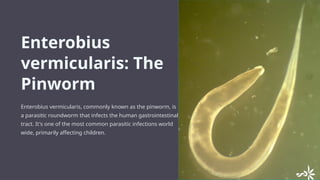
Enterobius vermicularis, commonly known as the pinworm, is
a parasitic roundworm that infects the human gastrointestinal
tract. It's one of the most common parasitic infections world
wide, primarily affecting children.
Infective Form of Enterobius
vermicularis
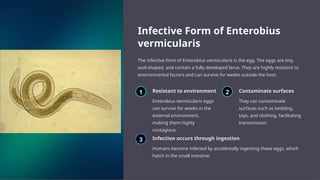
The infective form of Enterobius vermicularis is the egg. The eggs are tiny,
oval-shaped, and contain a fully developed larva. They are highly resistant to
environmental factors and can survive for weeks outside the host.
1 Resistant to environment
Enterobius vermicularis eggs
can survive for weeks in the
external environment,
making them highly
contagious.
2 Contaminate surfaces
They can contaminate
surfaces such as bedding,
toys, and clothing, facilitating
transmission.
3 Infection occurs through ingestion
Humans become infected by accidentally ingesting these eggs, which
hatch in the small intestine.
Morphology of Enterobius vermicularis
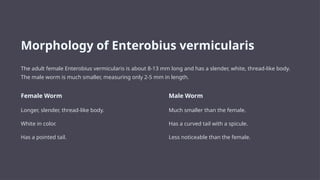
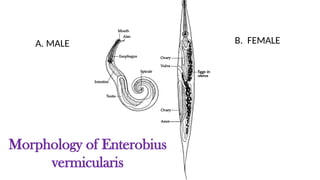
The adult female Enterobius vermicularis is about 8-13 mm long and has a slender, white, thread-like body.
The male worm is much smaller, measuring only 2-5 mm in length.
Female Worm
Longer, slender, thread-like body.
White in color.
Has a pointed tail.
Male Worm
Much smaller than the female.
Has a curved tail with a spicule.
Less noticeable than the female.
Morphology of Enterobius
vermicularis
A. MALE B. FEMALE
Incubation Period of Enterobius
vermicularis
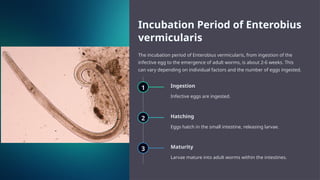
The incubation period of Enterobius vermicularis, from ingestion of the
infective egg to the emergence of adult worms, is about 2-6 weeks. This
can vary depending on individual factors and the number of eggs ingested.
1 Ingestion
Infective eggs are ingested.
2 Hatching
Eggs hatch in the small intestine, releasing larvae.
3 Maturity
Larvae mature into adult worms within the intestines.
Life Cycle of Enterobius vermicularis
The life cycle of Enterobius vermicularis involves several stages. After ingestion, the eggs hatch in the small intestine,
releasing larvae that mature into adult worms. The female worms migrate to the colon and rectum, where they lay
thousands of eggs.
Ingestion
Infective eggs are ingested.
Hatching
Eggs hatch in the small intestine, releasing larvae.
Migration
Larvae mature into adult worms and migrate to the
colon and rectum.
Egg Laying
Female worms lay thousands of eggs around the anus
at night.
Transmission
Eggs are spread through contaminated hands, bedding, or toys.
Pathogenesis of Enterobius
vermicularis
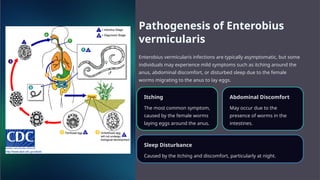
Enterobius vermicularis infections are typically asymptomatic, but some
individuals may experience mild symptoms such as itching around the
anus, abdominal discomfort, or disturbed sleep due to the female
worms migrating to the anus to lay eggs.
Itching
The most common symptom,
caused by the female worms
laying eggs around the anus.
Abdominal Discomfort
May occur due to the
presence of worms in the
intestines.
Sleep Disturbance
Caused by the itching and discomfort, particularly at night.
Clinical Features of Enterobius vermicularis
The most prominent clinical feature is intense anal itching, especially at night. This is caused by the female worms
migrating to the perianal region to lay eggs. Itching can lead to scratching, which can cause secondary bacterial infections.
Anal Itching
The most common
symptom, particularly at
night.
Sleep Disturbance
Itching can disrupt sleep.
Abdominal Discomfort
May experience mild pain
or discomfort.
Secondary Infections
Scratching can lead to
bacterial infections.
Laboratory Diagnosis of Enterobius
vermicularis
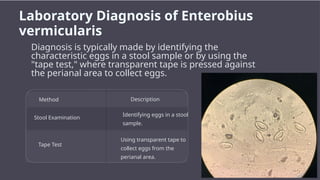
Diagnosis is typically made by identifying the
characteristic eggs in a stool sample or by using the
"tape test," where transparent tape is pressed against
the perianal area to collect eggs.
Method Description
Stool Examination
Identifying eggs in a stool
sample.
Tape Test
Using transparent tape to
collect eggs from the
perianal area.
Treatment of Enterobius
vermicularis
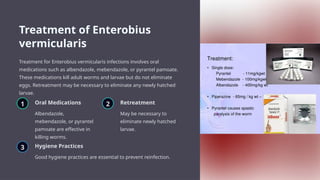
Treatment for Enterobius vermicularis infections involves oral
medications such as albendazole, mebendazole, or pyrantel pamoate.
These medications kill adult worms and larvae but do not eliminate
eggs. Retreatment may be necessary to eliminate any newly hatched
larvae.
1 Oral Medications
Albendazole,
mebendazole, or pyrantel
pamoate are effective in
killing worms.
2 Retreatment
May be necessary to
eliminate newly hatched
larvae.
3 Hygiene Practices
Good hygiene practices are essential to prevent reinfection.
Prophylaxis of Enterobius vermicularis
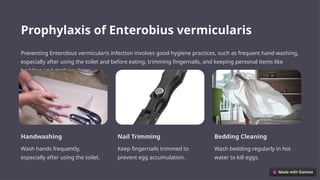
Preventing Enterobius vermicularis infection involves good hygiene practices, such as frequent hand washing,
especially after using the toilet and before eating, trimming fingernails, and keeping personal items like
bedding and clothing clean.
Handwashing
Wash hands frequently,
especially after using the toilet.
Nail Trimming
Keep fingernails trimmed to
prevent egg accumulation.
Bedding Cleaning
Wash bedding regularly in hot
water to kill eggs.
THANK YOU

Enterobius-vermicularis-The-Pinworm.pptx

  • 1.
    MANI . R BSC.MLT2ND YEAR ENTEROBIUS VERMICULARIS WELCOME
  • 2.
    Enterobius vermicularis: The Pinworm Enterobius vermicularis,commonly known as the pinworm, is a parasitic roundworm that infects the human gastrointestinal tract. It's one of the most common parasitic infections world wide, primarily affecting children.
  • 3.
    Infective Form ofEnterobius vermicularis The infective form of Enterobius vermicularis is the egg. The eggs are tiny, oval-shaped, and contain a fully developed larva. They are highly resistant to environmental factors and can survive for weeks outside the host. 1 Resistant to environment Enterobius vermicularis eggs can survive for weeks in the external environment, making them highly contagious. 2 Contaminate surfaces They can contaminate surfaces such as bedding, toys, and clothing, facilitating transmission. 3 Infection occurs through ingestion Humans become infected by accidentally ingesting these eggs, which hatch in the small intestine.
  • 4.
    Morphology of Enterobiusvermicularis The adult female Enterobius vermicularis is about 8-13 mm long and has a slender, white, thread-like body. The male worm is much smaller, measuring only 2-5 mm in length. Female Worm Longer, slender, thread-like body. White in color. Has a pointed tail. Male Worm Much smaller than the female. Has a curved tail with a spicule. Less noticeable than the female.
  • 5.
  • 6.
    Incubation Period ofEnterobius vermicularis The incubation period of Enterobius vermicularis, from ingestion of the infective egg to the emergence of adult worms, is about 2-6 weeks. This can vary depending on individual factors and the number of eggs ingested. 1 Ingestion Infective eggs are ingested. 2 Hatching Eggs hatch in the small intestine, releasing larvae. 3 Maturity Larvae mature into adult worms within the intestines.
  • 7.
    Life Cycle ofEnterobius vermicularis The life cycle of Enterobius vermicularis involves several stages. After ingestion, the eggs hatch in the small intestine, releasing larvae that mature into adult worms. The female worms migrate to the colon and rectum, where they lay thousands of eggs. Ingestion Infective eggs are ingested. Hatching Eggs hatch in the small intestine, releasing larvae. Migration Larvae mature into adult worms and migrate to the colon and rectum. Egg Laying Female worms lay thousands of eggs around the anus at night. Transmission Eggs are spread through contaminated hands, bedding, or toys.
  • 8.
    Pathogenesis of Enterobius vermicularis Enterobiusvermicularis infections are typically asymptomatic, but some individuals may experience mild symptoms such as itching around the anus, abdominal discomfort, or disturbed sleep due to the female worms migrating to the anus to lay eggs. Itching The most common symptom, caused by the female worms laying eggs around the anus. Abdominal Discomfort May occur due to the presence of worms in the intestines. Sleep Disturbance Caused by the itching and discomfort, particularly at night.
  • 9.
    Clinical Features ofEnterobius vermicularis The most prominent clinical feature is intense anal itching, especially at night. This is caused by the female worms migrating to the perianal region to lay eggs. Itching can lead to scratching, which can cause secondary bacterial infections. Anal Itching The most common symptom, particularly at night. Sleep Disturbance Itching can disrupt sleep. Abdominal Discomfort May experience mild pain or discomfort. Secondary Infections Scratching can lead to bacterial infections.
  • 10.
    Laboratory Diagnosis ofEnterobius vermicularis Diagnosis is typically made by identifying the characteristic eggs in a stool sample or by using the "tape test," where transparent tape is pressed against the perianal area to collect eggs. Method Description Stool Examination Identifying eggs in a stool sample. Tape Test Using transparent tape to collect eggs from the perianal area.
  • 11.
    Treatment of Enterobius vermicularis Treatmentfor Enterobius vermicularis infections involves oral medications such as albendazole, mebendazole, or pyrantel pamoate. These medications kill adult worms and larvae but do not eliminate eggs. Retreatment may be necessary to eliminate any newly hatched larvae. 1 Oral Medications Albendazole, mebendazole, or pyrantel pamoate are effective in killing worms. 2 Retreatment May be necessary to eliminate newly hatched larvae. 3 Hygiene Practices Good hygiene practices are essential to prevent reinfection.
  • 12.
    Prophylaxis of Enterobiusvermicularis Preventing Enterobius vermicularis infection involves good hygiene practices, such as frequent hand washing, especially after using the toilet and before eating, trimming fingernails, and keeping personal items like bedding and clothing clean. Handwashing Wash hands frequently, especially after using the toilet. Nail Trimming Keep fingernails trimmed to prevent egg accumulation. Bedding Cleaning Wash bedding regularly in hot water to kill eggs.
  • 13.