

A brief overview of what electrolysis is and how it
works
Electrolysis is the chemical separation of an ionic compound using a direct
electrical current.
WHAT IS ELECTROLYSIS?
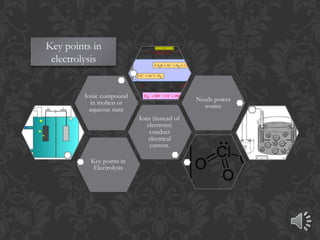
Key points in
electrolysis
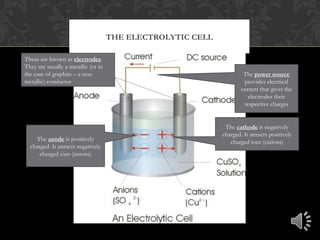
THE ELECTROLYTIC CELL
The cathode is negatively
charged. It attracts positively
charged ions (cations)The anode is positively
charged. It attracts negatively
charged ions (anions)
The power source
provides electrical
current that gives the
electrodes their
respective charges
These are known as electrodes.
They are usually a metallic (or in
the case of graphite – a non-
metallic) conductor
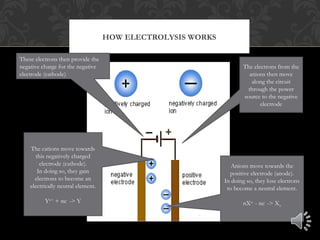
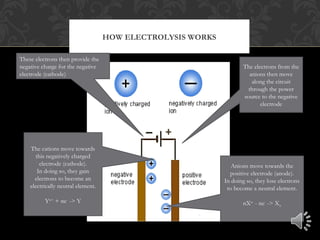
HOW ELECTROLYSIS WORKS
Anions move towards the
positive electrode (anode).
In doing so, they lose electrons
to become a neutral element.
nXn-
- ne-
-> Xn
The cations move towards
this negatively charged
electrode (cathode).
In doing so, they gain
electrons to become an
electrically neutral element.
Yn+
+ ne-
-> Y
The electrons from the
anions then move
along the circuit
through the power
source to the negative
electrode
These electrons then provide the
negative charge for the negative
electrode (cathode)
HOW ELECTROLYSIS WORKS
Anions move towards the
positive electrode (anode).
In doing so, they lose electrons
to become a neutral element.
nXn-
- ne-
-> Xn
The cations move towards
this negatively charged
electrode (cathode).
In doing so, they gain
electrons to become an
electrically neutral element.
Yn+
+ ne-
-> Y
The electrons from the
anions then move
along the circuit
through the power
source to the negative
electrode
These electrons then provide the
negative charge for the negative
electrode (cathode)

Electrolysis summarized

  • 1.
    A brief overviewof what electrolysis is and how it works
  • 2.
    Electrolysis is thechemical separation of an ionic compound using a direct electrical current. WHAT IS ELECTROLYSIS?
  • 3.
  • 4.
    THE ELECTROLYTIC CELL Thecathode is negatively charged. It attracts positively charged ions (cations)The anode is positively charged. It attracts negatively charged ions (anions) The power source provides electrical current that gives the electrodes their respective charges These are known as electrodes. They are usually a metallic (or in the case of graphite – a non- metallic) conductor
  • 5.
    HOW ELECTROLYSIS WORKS Anionsmove towards the positive electrode (anode). In doing so, they lose electrons to become a neutral element. nXn- - ne- -> Xn The cations move towards this negatively charged electrode (cathode). In doing so, they gain electrons to become an electrically neutral element. Yn+ + ne- -> Y The electrons from the anions then move along the circuit through the power source to the negative electrode These electrons then provide the negative charge for the negative electrode (cathode)
  • 6.
    HOW ELECTROLYSIS WORKS Anionsmove towards the positive electrode (anode). In doing so, they lose electrons to become a neutral element. nXn- - ne- -> Xn The cations move towards this negatively charged electrode (cathode). In doing so, they gain electrons to become an electrically neutral element. Yn+ + ne- -> Y The electrons from the anions then move along the circuit through the power source to the negative electrode These electrons then provide the negative charge for the negative electrode (cathode)