
Mrs. Uroosa Samman
Chemistry O Level
Principal:
Muhammadan
Educational Institute
R-Block Attock
03190510897
ELECTROLYSIS
Electrolytes & Non- Electrolytes
Electrolytes
• Substances that
conduct electricity and
undergoes Chemical
changes.
• For example; ionic
compounds.
Non- Electrolytes
• Substances that do not
conduct electricity.
• For example; Covalent
compounds.
Electrolysis
■ A process where compounds in
molten or aqueous state are broken
down into their constituent elements
by passing electricity through them.
Or
■ The breakdown of an ionic
compound, molten or in aqueous
solution, by the passage of electricity.
Prediction of products
When you have an ionic
solution (NOT a molten
ionic compound), your
solution
will contain: the ions that make
up the ionic compound, and the
ions in water (OH- and H + )
● at the cathode (-):
hydrogen (from H + in water) is produced
UNLESS the + ions in the ionic compound are
from a metal less reactive than hydrogen if
○
the metal is less reactive, it will be produced
instead
● at the anode (+):
oxygen (from OHin water) will be produced
UNLESS the ionic compound contains halide
ions (Cl -
, Br -
, I -
) if there are halide ions,
○
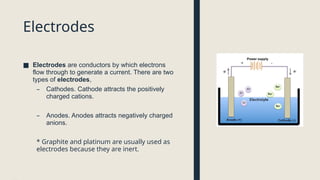
Electrodes
■ Electrodes are conductors by which electrons
flow through to generate a current. There are two
types of electrodes,
– Cathodes. Cathode attracts the positively
charged cations.
– Anodes. Anodes attracts negatively charged
anions.
* Graphite and platinum are usually used as
electrodes because they are inert.
Electrolysis Of Molten Compounds
■ PbBr2
■ LiCl
■ MgBr2
■ Pbl2
■ MgO
■ Cucl2
■ Molten Potassium Oxide
■ Molten Magnesium Oxide
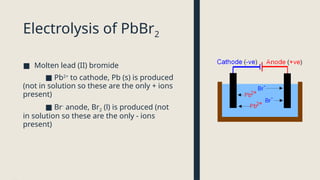
Electrolysis of PbBr2
■ Molten lead (II) bromide
■ Pb2+
to cathode, Pb (s) is produced
(not in solution so these are the only + ions
present)
■ Br-
anode, Br2 (l) is produced (not
in solution so these are the only - ions
present)
Conductio
n of
Electricity
By Ionic
Compound
s
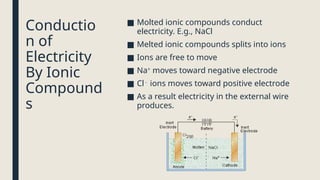
■ Molted ionic compounds conduct
electricity. E.g., NaCl
■ Melted ionic compounds splits into ions
■ Ions are free to move
■ Na+
moves toward negative electrode
■ Cl -
ions moves toward positive electrode
■ As a result electricity in the external wire
produces.
Reactions
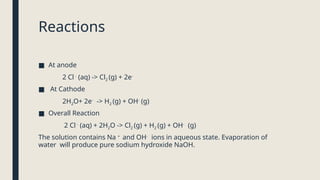
■ At anode
2 Cl -
(aq) -> Cl2 (g) + 2e-
■ At Cathode
2H2O+ 2e-
-> H2 (g) + OH-
(g)
■ Overall Reaction
2 Cl-
(aq) + 2H2O -> Cl2 (g) + H2 (g) + OH-
(g)
The solution contains Na +
and OH-
ions in aqueous state. Evaporation of
water will produce pure sodium hydroxide NaOH.
Electroplating
■ Electrolytic process of depositing one metal on the other is called
Electroplating.
Examples:
– Tin Plating,
– gold plating,
– chromium plating
– Copper plating
– Silver plating
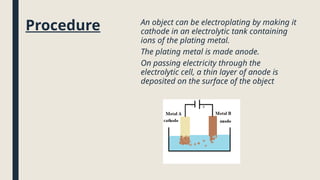
Procedure An object can be electroplating by making it
cathode in an electrolytic tank containing
ions of the plating metal.
The plating metal is made anode.
On passing electricity through the
electrolytic cell, a thin layer of anode is
deposited on the surface of the object
Electrolytic Refining Of Copper
■ The copper metal obtained from its ores is usually impure.
■ Impurities such as
Zinc,
Iron,
Silver and
gold
These impurities are removed by process of electrolytic refining. .
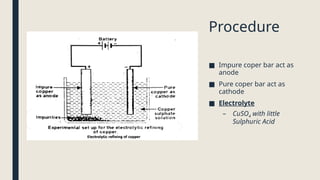
Procedure
■ Impure coper bar act as
anode
■ Pure coper bar act as
cathode
■ Electrolyte
– CuSO4 with little
Sulphuric Acid
Working
■ On passing electricity, copper anode dissolves forming Cu2+
ions.
■ Cations move towards the cathode at which Cu2+
ions are reduced.
■ Pure copper deposits at cathode.
■ Less electropositive metals Silver and Gold falls at the bottom of the cell.
■ Copper obtained is 99.5% pure.
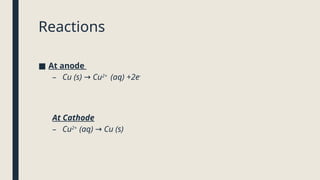
Reactions
■ At anode
– Cu (s) Cu
→ 2+
(aq) +2e-
At Cathode
– Cu2+
(aq) Cu (s)
→
Electrochemical Cells
■ Devices that converts chemical energy into electrical energy
Types Of Electrochemical Cells
1. Electrolytic Cell
2. Galvanic Cell
Examples
Electrolytic Cell & Galvanic Cell
1. Electrolytic Cell
An electrochemical cell that uses electrical energy to drive a chemical
reaction.
2. Galvanic Cell
An electrochemical cell that converts chemical energy into electrical energy.
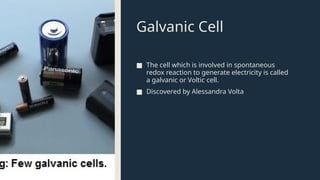
Galvanic Cell
■ The cell which is involved in spontaneous
redox reaction to generate electricity is called
a galvanic or Voltic cell.
■ Discovered by Alessandra Volta
Construction of
a Galvanic Cell
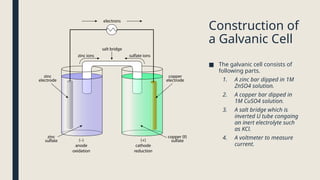
■ The galvanic cell consists of
following parts.
1. A zinc bar dipped in 1M
ZnSO4 solution.
2. A copper bar dipped in
1M CuSO4 solution.
3. A salt bridge which is
inverted U tube congaing
an inert electrolyte such
as KCl.
4. A voltmeter to measure
current.
Working of galvanic cell
■ Half cell
■ A galvanic cell contains two half cells
■ When circuit is complete, electrons begins to flow from Zn rod through the
external wires to Cu rod.
■ Thus Zn half cell acts as anode and Cu half cell as cathode.
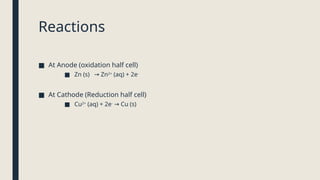
Reactions
■ At Anode (oxidation half cell)
■ Zn (s) Zn
→ 2+
(aq) + 2e-
■ At Cathode (Reduction half cell)
■ Cu2+
(aq) + 2e-
Cu (s)
→
Manufacture of aluminum from pure
aluminum oxide in molten cryolite Na3AlF6
■ Aluminium is manufactured by the electrolysis of a molten mixture of
aluminium oxide and cryolite using carbon as the positive electrode
(anode).
■ Aluminium is the most abundant metal on Earth, but it is expensive, largely
because of the amount of electricity used in the extraction process.
– Aluminium oxide has a very high melting point, so it would be too
expensive to melt it, which is why it is mixed with cryolite
– the positive electrodes need to be continually replaced because oxygen is
formed, which reacts with the carbon of the positive electrodes, forming
carbon dioxide, and they gradually burn away
Conversion of the aluminium oxide
into aluminium by electrolysis
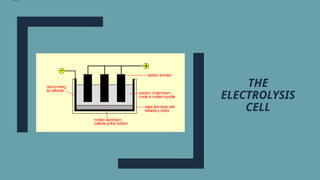
■ The aluminium oxide is electrolysed in solution in molten cryolite, Na3AlF6.
Cryolite is another aluminium ore, but is rare and expensive, and most is
now made chemically.
■ Instead, it is dissolved in molten cryolite – an aluminium compound with a
lower melting point than aluminium oxide. The use of molten cryolite as
a solvent reduces some of the energy costs involved in extracting aluminium by
allowing the ions in aluminium oxide to move freely at a lower temperature.
THE
ELECTROLYSIS
CELL
Reactions
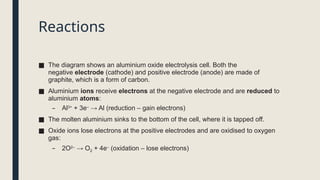
■ The diagram shows an aluminium oxide electrolysis cell. Both the
negative electrode (cathode) and positive electrode (anode) are made of
graphite, which is a form of carbon.
■ Aluminium ions receive electrons at the negative electrode and are reduced to
aluminium atoms:
– Al3+
+ 3e–
→ Al (reduction – gain electrons)
■ The molten aluminium sinks to the bottom of the cell, where it is tapped off.
■ Oxide ions lose electrons at the positive electrodes and are oxidised to oxygen
gas:
– 2O2–
→ O2 + 4e–
(oxidation – lose electrons)
Application
of
Electrolysis
■ The most industrial applications of
electrolysis are:
– Extraction
– Purification
– Electroplating of metals

Electrolysis O level Chemistry notes.pptx

  • 1.
    Mrs. Uroosa Samman ChemistryO Level Principal: Muhammadan Educational Institute R-Block Attock 03190510897 ELECTROLYSIS
  • 2.
    Electrolytes & Non-Electrolytes Electrolytes • Substances that conduct electricity and undergoes Chemical changes. • For example; ionic compounds. Non- Electrolytes • Substances that do not conduct electricity. • For example; Covalent compounds.
  • 3.
    Electrolysis ■ A processwhere compounds in molten or aqueous state are broken down into their constituent elements by passing electricity through them. Or ■ The breakdown of an ionic compound, molten or in aqueous solution, by the passage of electricity.
  • 4.
    Prediction of products Whenyou have an ionic solution (NOT a molten ionic compound), your solution will contain: the ions that make up the ionic compound, and the ions in water (OH- and H + ) ● at the cathode (-): hydrogen (from H + in water) is produced UNLESS the + ions in the ionic compound are from a metal less reactive than hydrogen if ○ the metal is less reactive, it will be produced instead ● at the anode (+): oxygen (from OHin water) will be produced UNLESS the ionic compound contains halide ions (Cl - , Br - , I - ) if there are halide ions, ○
  • 5.
    Electrodes ■ Electrodes areconductors by which electrons flow through to generate a current. There are two types of electrodes, – Cathodes. Cathode attracts the positively charged cations. – Anodes. Anodes attracts negatively charged anions. * Graphite and platinum are usually used as electrodes because they are inert.
  • 6.
    Electrolysis Of MoltenCompounds ■ PbBr2 ■ LiCl ■ MgBr2 ■ Pbl2 ■ MgO ■ Cucl2 ■ Molten Potassium Oxide ■ Molten Magnesium Oxide
  • 7.
    Electrolysis of PbBr2 ■Molten lead (II) bromide ■ Pb2+ to cathode, Pb (s) is produced (not in solution so these are the only + ions present) ■ Br- anode, Br2 (l) is produced (not in solution so these are the only - ions present)
  • 8.
    Conductio n of Electricity By Ionic Compound s ■Molted ionic compounds conduct electricity. E.g., NaCl ■ Melted ionic compounds splits into ions ■ Ions are free to move ■ Na+ moves toward negative electrode ■ Cl - ions moves toward positive electrode ■ As a result electricity in the external wire produces.
  • 9.
    Reactions ■ At anode 2Cl - (aq) -> Cl2 (g) + 2e- ■ At Cathode 2H2O+ 2e- -> H2 (g) + OH- (g) ■ Overall Reaction 2 Cl- (aq) + 2H2O -> Cl2 (g) + H2 (g) + OH- (g) The solution contains Na + and OH- ions in aqueous state. Evaporation of water will produce pure sodium hydroxide NaOH.
  • 10.
    Electroplating ■ Electrolytic processof depositing one metal on the other is called Electroplating. Examples: – Tin Plating, – gold plating, – chromium plating – Copper plating – Silver plating
  • 11.
    Procedure An objectcan be electroplating by making it cathode in an electrolytic tank containing ions of the plating metal. The plating metal is made anode. On passing electricity through the electrolytic cell, a thin layer of anode is deposited on the surface of the object
  • 12.
    Electrolytic Refining OfCopper ■ The copper metal obtained from its ores is usually impure. ■ Impurities such as Zinc, Iron, Silver and gold These impurities are removed by process of electrolytic refining. .
  • 13.
    Procedure ■ Impure coperbar act as anode ■ Pure coper bar act as cathode ■ Electrolyte – CuSO4 with little Sulphuric Acid
  • 14.
    Working ■ On passingelectricity, copper anode dissolves forming Cu2+ ions. ■ Cations move towards the cathode at which Cu2+ ions are reduced. ■ Pure copper deposits at cathode. ■ Less electropositive metals Silver and Gold falls at the bottom of the cell. ■ Copper obtained is 99.5% pure.
  • 15.
    Reactions ■ At anode –Cu (s) Cu → 2+ (aq) +2e- At Cathode – Cu2+ (aq) Cu (s) →
  • 16.
    Electrochemical Cells ■ Devicesthat converts chemical energy into electrical energy Types Of Electrochemical Cells 1. Electrolytic Cell 2. Galvanic Cell Examples
  • 17.
    Electrolytic Cell &Galvanic Cell 1. Electrolytic Cell An electrochemical cell that uses electrical energy to drive a chemical reaction. 2. Galvanic Cell An electrochemical cell that converts chemical energy into electrical energy.
  • 18.
    Galvanic Cell ■ Thecell which is involved in spontaneous redox reaction to generate electricity is called a galvanic or Voltic cell. ■ Discovered by Alessandra Volta
  • 19.
    Construction of a GalvanicCell ■ The galvanic cell consists of following parts. 1. A zinc bar dipped in 1M ZnSO4 solution. 2. A copper bar dipped in 1M CuSO4 solution. 3. A salt bridge which is inverted U tube congaing an inert electrolyte such as KCl. 4. A voltmeter to measure current.
  • 20.
    Working of galvaniccell ■ Half cell ■ A galvanic cell contains two half cells ■ When circuit is complete, electrons begins to flow from Zn rod through the external wires to Cu rod. ■ Thus Zn half cell acts as anode and Cu half cell as cathode.
  • 21.
    Reactions ■ At Anode(oxidation half cell) ■ Zn (s) Zn → 2+ (aq) + 2e- ■ At Cathode (Reduction half cell) ■ Cu2+ (aq) + 2e- Cu (s) →
  • 22.
    Manufacture of aluminumfrom pure aluminum oxide in molten cryolite Na3AlF6 ■ Aluminium is manufactured by the electrolysis of a molten mixture of aluminium oxide and cryolite using carbon as the positive electrode (anode). ■ Aluminium is the most abundant metal on Earth, but it is expensive, largely because of the amount of electricity used in the extraction process. – Aluminium oxide has a very high melting point, so it would be too expensive to melt it, which is why it is mixed with cryolite – the positive electrodes need to be continually replaced because oxygen is formed, which reacts with the carbon of the positive electrodes, forming carbon dioxide, and they gradually burn away
  • 23.
    Conversion of thealuminium oxide into aluminium by electrolysis ■ The aluminium oxide is electrolysed in solution in molten cryolite, Na3AlF6. Cryolite is another aluminium ore, but is rare and expensive, and most is now made chemically. ■ Instead, it is dissolved in molten cryolite – an aluminium compound with a lower melting point than aluminium oxide. The use of molten cryolite as a solvent reduces some of the energy costs involved in extracting aluminium by allowing the ions in aluminium oxide to move freely at a lower temperature.
  • 24.
  • 25.
    Reactions ■ The diagramshows an aluminium oxide electrolysis cell. Both the negative electrode (cathode) and positive electrode (anode) are made of graphite, which is a form of carbon. ■ Aluminium ions receive electrons at the negative electrode and are reduced to aluminium atoms: – Al3+ + 3e– → Al (reduction – gain electrons) ■ The molten aluminium sinks to the bottom of the cell, where it is tapped off. ■ Oxide ions lose electrons at the positive electrodes and are oxidised to oxygen gas: – 2O2– → O2 + 4e– (oxidation – lose electrons)
  • 26.
    Application of Electrolysis ■ The mostindustrial applications of electrolysis are: – Extraction – Purification – Electroplating of metals