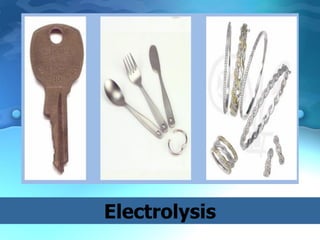
Electrolysis
Electrolysis of Molten
substances
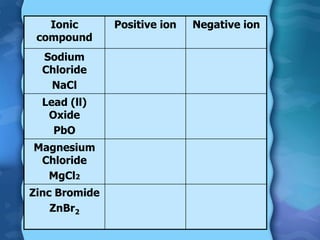
Ionic
compound
Positive ion Negative ion
Sodium
Chloride
NaCl
Lead (ll)
Oxide
PbO
Magnesium
Chloride
MgCl2
Zinc Bromide
ZnBr2
Ionic
compound
Positive ion Negative ion
Sodium
Chloride
NaCl
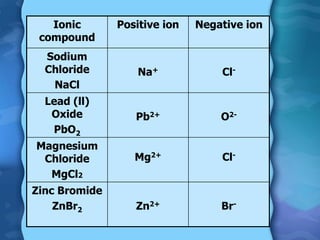
Na+ Cl-
Lead (ll)
Oxide
PbO2
Pb2+ O2-
Magnesium
Chloride
MgCl2
Mg2+ Cl-
Zinc Bromide
ZnBr2 Zn2+ Br-
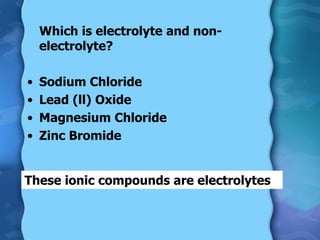
Which is electrolyte and non-
electrolyte?
• Sodium Chloride
• Lead (ll) Oxide
• Magnesium Chloride
• Zinc Bromide
These ionic compounds are electrolytes
The term electrolysis
was introduced by
Michael Faraday.
• ‘Lysis’ means loosening
in Greek.
• Thus electrolysis means
‘loosening by
electricity’.
Electrolysis
Electrolysis is a process occurs
when electricity is pass
through a solution
(electrolyte) and cause it to
decompose into its
constituent elements.
Electrolytes are substances able to conduct
electricity in [ ] state or [ ]
state and undergo [ ] change.
Electrolysis is a process where the [ ]
are broken down into its [ ]
elements by passing [ ] through it.
electrolytes molten chemical
liquid electricity constituent
Electrolytes are substances able to
conduct electricity in [molten] state or
[liquid] state and undergo [chemical]
change.
Electrolysis is a process where the
[electrolytes] are broken down into its
[constituent] elements by passing
[electricity] through it.
Electrolytic Cell
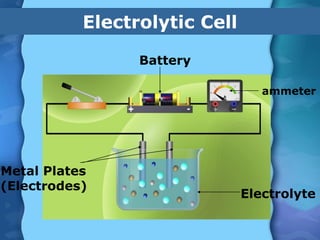
The electrolytic cell is the set of
apparatus needed to conduct
electrolysis.
Electrolytic cell consists
of
•a battery connected to
a switch in series with
•2 metal plates called
electrodes. Electrodes
will carry electricity to
the electrolyte.
Electrolytic Cell
Battery
Electrolyte
Metal Plates
(Electrodes)
ammeter
a)Electrode connected to
the positive terminal of
an electric source is
called anode.
b)Electrode connected to
the negative terminal of
an electric source is
called cathode.
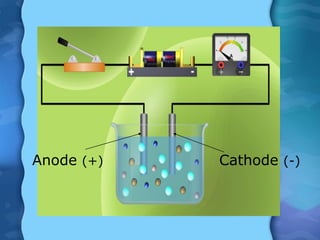
Anode (+) Cathode (-)
• When electric current is allowed
to pass through, the electrolytes
which are ionic compound will
split up into positive (+) and
negative (-)ions.
• Example:
NaCl Na+ + Cl-
Ionic compound +ve ion -ve ion
• Ions will migrate to the oppositely
charged electrodes.
• Negatively charged (-) ions will
move to the positively charged
anode (+).
Therefore called anions.
• Positively charged (+) ions will
move to the negatively charged
cathode (-) and are called cations.
• At the anode, the negative ions
will lose their electrons to the
anode.
• Anode will readily accepts
electrons because it is positively
charged.
ANODE
CATHODE
• At the cathode, the positively
charged cations will accept
electrons from the cathode.
• This discharging of ions at the
electrode results in chemical
decomposition of the
electrolyte.
• The movement of ions allows
electricity to be conducted.
When describing
electrolysis, state:
• The ions present in the
electrolyte
• The movement of ions to
the anode and cathode
• Half equation at the anode
and cathode
Electrolysis of Molten
Lead (ll) Bromide
PbBr2
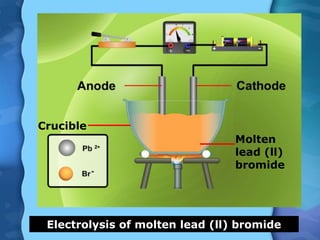
• Lead (ll) bromide is an ionic
compound electrolyte.
• PbBr2 consist of lead (ll)
cations, Pb2+ and bromide
anions, Br-.
• In solid lead (ll) bromide,
these ions do not move freely
but are held in fixed positions
in lattice.
• It can only can conduct
electricity when dissolved in
water or in molten state.
Molten
lead (ll)
bromide
Crucible
Electrolysis of molten lead (ll) bromide
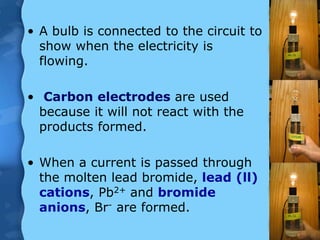
• A bulb is connected to the circuit to
show when the electricity is
flowing.
• Carbon electrodes are used
because it will not react with the
products formed.
• When a current is passed through
the molten lead bromide, lead (ll)
cations, Pb2+ and bromide
anions, Br- are formed.
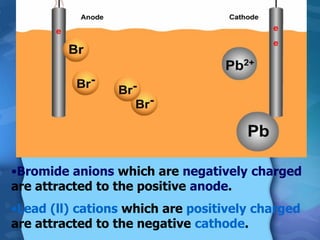
•Bromide anions which are negatively charged
are attracted to the positive anode.
•Lead (ll) cations which are positively charged
are attracted to the negative cathode.
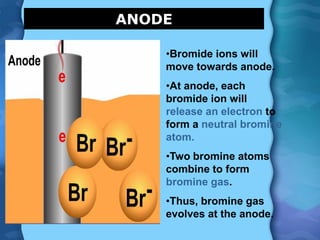
ANODE
•Bromide ions will
move towards anode.
•At anode, each
bromide ion will
release an electron to
form a neutral bromine
atom.
•Two bromine atoms
combine to form
bromine gas.
•Thus, bromine gas
evolves at the anode.
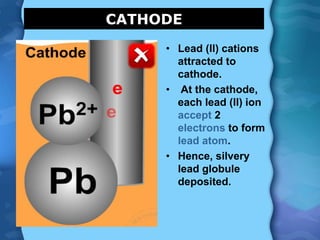
• Lead (ll) cations
attracted to
cathode.
• At the cathode,
each lead (ll) ion
accept 2
electrons to form
lead atom.
• Hence, silvery
lead globule
deposited.
CATHODE
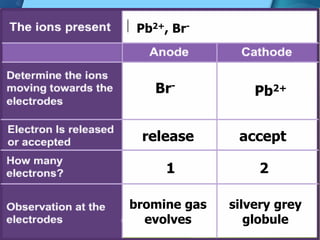
Pb2+, Br-
Br-
Pb2+
release accept
1 2
bromine gas
evolves
silvery grey
globule
Half Equation
Half equation is equation
used to show the reaction
occur at the anode or
cathode.
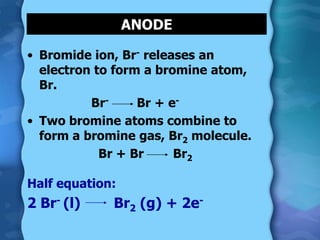
• Bromide ion, Br- releases an
electron to form a bromine atom,
Br.
Br- Br + e-
• Two bromine atoms combine to
form a bromine gas, Br2 molecule.
Br + Br Br2
Half equation:
2 Br- (l) Br2 (g) + 2e-
ANODE
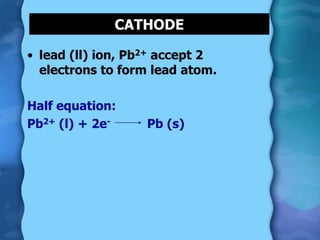
• lead (ll) ion, Pb2+ accept 2
electrons to form lead atom.
Half equation:
Pb2+ (l) + 2e- Pb (s)
CATHODE
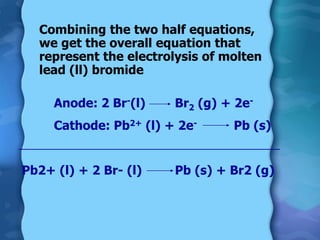
Combining the two half equations,
we get the overall equation that
represent the electrolysis of molten
lead (ll) bromide
Anode: 2 Br-(l) Br2 (g) + 2e-
Cathode: Pb2+ (l) + 2e- Pb (s)
Pb2+ (l) + 2 Br- (l) Pb (s) + Br2 (g)
Electrolysis of Molten
Lead (ll) Oxide
PbO
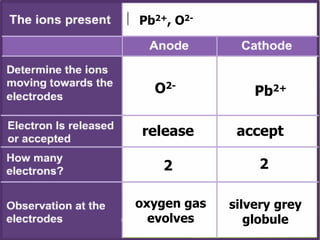
Pb2+, O2-
O2-
Pb2+
release accept
2 2
oxygen gas
evolves
silvery grey
globule
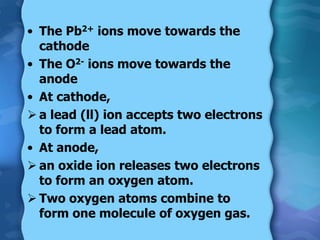
• The Pb2+ ions move towards the
cathode
• The O2- ions move towards the
anode
• At cathode,
 a lead (ll) ion accepts two electrons
to form a lead atom.
• At anode,
 an oxide ion releases two electrons
to form an oxygen atom.
 Two oxygen atoms combine to
form one molecule of oxygen gas.
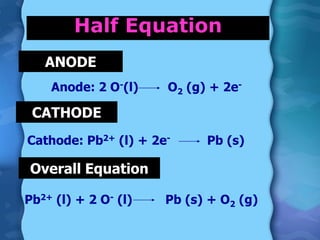
Half Equation
ANODE
Anode: 2 O-(l) O2 (g) + 2e-
CATHODE
Cathode: Pb2+ (l) + 2e- Pb (s)
Pb2+ (l) + 2 O- (l) Pb (s) + O2 (g)
Overall Equation
Web Link
• You can find out more about electrolysis
of molten compound.
TRY THESE:
• http://www.mcwdn.org/chemist/pccha
nge.html

Electrolysis molten substances

  • 1.
  • 2.
  • 3.
    Ionic compound Positive ion Negativeion Sodium Chloride NaCl Lead (ll) Oxide PbO Magnesium Chloride MgCl2 Zinc Bromide ZnBr2
  • 4.
    Ionic compound Positive ion Negativeion Sodium Chloride NaCl Na+ Cl- Lead (ll) Oxide PbO2 Pb2+ O2- Magnesium Chloride MgCl2 Mg2+ Cl- Zinc Bromide ZnBr2 Zn2+ Br-
  • 5.
    Which is electrolyteand non- electrolyte? • Sodium Chloride • Lead (ll) Oxide • Magnesium Chloride • Zinc Bromide These ionic compounds are electrolytes
  • 6.
    The term electrolysis wasintroduced by Michael Faraday. • ‘Lysis’ means loosening in Greek. • Thus electrolysis means ‘loosening by electricity’.
  • 7.
    Electrolysis Electrolysis is aprocess occurs when electricity is pass through a solution (electrolyte) and cause it to decompose into its constituent elements.
  • 8.
    Electrolytes are substancesable to conduct electricity in [ ] state or [ ] state and undergo [ ] change. Electrolysis is a process where the [ ] are broken down into its [ ] elements by passing [ ] through it. electrolytes molten chemical liquid electricity constituent
  • 9.
    Electrolytes are substancesable to conduct electricity in [molten] state or [liquid] state and undergo [chemical] change. Electrolysis is a process where the [electrolytes] are broken down into its [constituent] elements by passing [electricity] through it.
  • 10.
    Electrolytic Cell The electrolyticcell is the set of apparatus needed to conduct electrolysis.
  • 11.
    Electrolytic cell consists of •abattery connected to a switch in series with •2 metal plates called electrodes. Electrodes will carry electricity to the electrolyte.
  • 12.
  • 13.
    a)Electrode connected to thepositive terminal of an electric source is called anode. b)Electrode connected to the negative terminal of an electric source is called cathode.
  • 14.
  • 15.
    • When electriccurrent is allowed to pass through, the electrolytes which are ionic compound will split up into positive (+) and negative (-)ions. • Example: NaCl Na+ + Cl- Ionic compound +ve ion -ve ion
  • 16.
    • Ions willmigrate to the oppositely charged electrodes. • Negatively charged (-) ions will move to the positively charged anode (+). Therefore called anions. • Positively charged (+) ions will move to the negatively charged cathode (-) and are called cations.
  • 17.
    • At theanode, the negative ions will lose their electrons to the anode. • Anode will readily accepts electrons because it is positively charged. ANODE
  • 18.
    CATHODE • At thecathode, the positively charged cations will accept electrons from the cathode. • This discharging of ions at the electrode results in chemical decomposition of the electrolyte. • The movement of ions allows electricity to be conducted.
  • 19.
    When describing electrolysis, state: •The ions present in the electrolyte • The movement of ions to the anode and cathode • Half equation at the anode and cathode
  • 20.
    Electrolysis of Molten Lead(ll) Bromide PbBr2
  • 21.
    • Lead (ll)bromide is an ionic compound electrolyte. • PbBr2 consist of lead (ll) cations, Pb2+ and bromide anions, Br-. • In solid lead (ll) bromide, these ions do not move freely but are held in fixed positions in lattice.
  • 22.
    • It canonly can conduct electricity when dissolved in water or in molten state.
  • 23.
  • 24.
    • A bulbis connected to the circuit to show when the electricity is flowing. • Carbon electrodes are used because it will not react with the products formed. • When a current is passed through the molten lead bromide, lead (ll) cations, Pb2+ and bromide anions, Br- are formed.
  • 25.
    •Bromide anions whichare negatively charged are attracted to the positive anode. •Lead (ll) cations which are positively charged are attracted to the negative cathode.
  • 26.
    ANODE •Bromide ions will movetowards anode. •At anode, each bromide ion will release an electron to form a neutral bromine atom. •Two bromine atoms combine to form bromine gas. •Thus, bromine gas evolves at the anode.
  • 27.
    • Lead (ll)cations attracted to cathode. • At the cathode, each lead (ll) ion accept 2 electrons to form lead atom. • Hence, silvery lead globule deposited. CATHODE
  • 28.
    Pb2+, Br- Br- Pb2+ release accept 12 bromine gas evolves silvery grey globule
  • 29.
    Half Equation Half equationis equation used to show the reaction occur at the anode or cathode.
  • 30.
    • Bromide ion,Br- releases an electron to form a bromine atom, Br. Br- Br + e- • Two bromine atoms combine to form a bromine gas, Br2 molecule. Br + Br Br2 Half equation: 2 Br- (l) Br2 (g) + 2e- ANODE
  • 31.
    • lead (ll)ion, Pb2+ accept 2 electrons to form lead atom. Half equation: Pb2+ (l) + 2e- Pb (s) CATHODE
  • 32.
    Combining the twohalf equations, we get the overall equation that represent the electrolysis of molten lead (ll) bromide Anode: 2 Br-(l) Br2 (g) + 2e- Cathode: Pb2+ (l) + 2e- Pb (s) Pb2+ (l) + 2 Br- (l) Pb (s) + Br2 (g)
  • 33.
  • 34.
    Pb2+, O2- O2- Pb2+ release accept 22 oxygen gas evolves silvery grey globule
  • 35.
    • The Pb2+ions move towards the cathode • The O2- ions move towards the anode • At cathode,  a lead (ll) ion accepts two electrons to form a lead atom. • At anode,  an oxide ion releases two electrons to form an oxygen atom.  Two oxygen atoms combine to form one molecule of oxygen gas.
  • 36.
    Half Equation ANODE Anode: 2O-(l) O2 (g) + 2e- CATHODE Cathode: Pb2+ (l) + 2e- Pb (s) Pb2+ (l) + 2 O- (l) Pb (s) + O2 (g) Overall Equation
  • 37.
    Web Link • Youcan find out more about electrolysis of molten compound. TRY THESE: • http://www.mcwdn.org/chemist/pccha nge.html