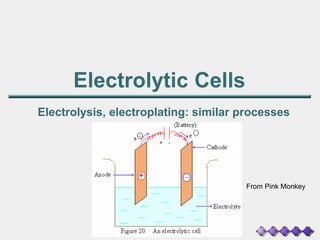
Electrolytic Cells
Electrolysis, electroplating: similar processes
From Pink Monkey
Electrochemistry
The Two Types
▪ Electrochemical Cells:
▸ Spontaneous flow of electrons from anode through
a meter or “work” to the cathode. Energy is
produced by the cell and used to do work
▪ Electrolytic Cells:
▸ Forced flow of electrons from anode to the
cathode by an external battery or generator. Energy
is used by the electrochemical cell to make high-
energy elements or compounds
Example
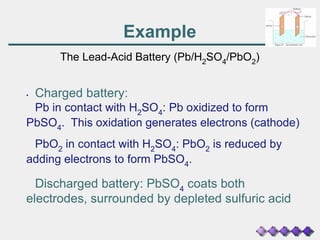
The Lead-Acid Battery (Pb/H2SO4/PbO2)
▪ Charged battery:
Pb in contact with H2SO4: Pb oxidized to form
PbSO4. This oxidation generates electrons (cathode)
PbO2 in contact with H2SO4: PbO2 is reduced by
adding electrons to form PbSO4.
Discharged battery: PbSO4 coats both
electrodes, surrounded by depleted sulfuric acid
Example
The Lead-Acid Battery (Pb/H2SO4/PbO2)
▪ Discharged battery is recharged:
PbSO4 coats both electrodes, surrounded by depleted sulfuric
acid
▸ Electrons are forced in the opposite direction by the automobile
generator
PbSO4 is oxidized to PbO2 (+2 to +4)
PbSO4 is reduced to Pb at the other electrode
Now the Pb and PbO2 are restored at their proper electrodes
so they can start your car the next time you need some “juice”
Summary
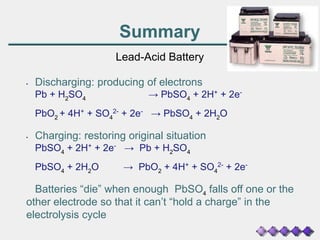
Lead-Acid Battery
▪ Discharging: producing of electrons
Pb + H2SO4 → PbSO4 + 2H+ + 2e-
PbO2 + 4H+ + SO4
2- + 2e- → PbSO4 + 2H2O
▪ Charging: restoring original situation
PbSO4 + 2H+ + 2e- → Pb + H2SO4
PbSO4 + 2H2O → PbO2 + 4H+ + SO4
2- + 2e-
Batteries “die” when enough PbSO4 falls off one or the
other electrode so that it can’t “hold a charge” in the
electrolysis cycle
What Reaction Happens?
 If a voltage is supplied to a mixture of cations,
which one will plate out?
Since this would cause reduction, look at reduction
potentials
Ag+ + e- → Ag (s) E° = 0.80 V
Cu2+ + 2e- → 2Cu (s) E° = 0.34 V
Zn2+ + 2e- → 2Zn (s) E° = -0.76 V
 The more positive voltage has a more
negative G
Thus Ag+ >Cu2+ >Zn2+
Chlorine & NaOH
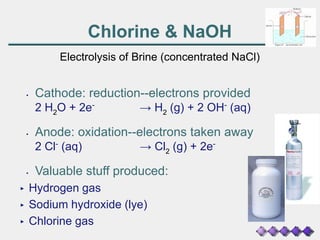
Electrolysis of Brine (concentrated NaCl)
▪ Cathode: reduction--electrons provided
2 H2O + 2e- → H2 (g) + 2 OH- (aq)
▪ Anode: oxidation--electrons taken away
2 Cl- (aq) → Cl2 (g) + 2e-
▪ Valuable stuff produced:
▸ Hydrogen gas
▸ Sodium hydroxide (lye)
▸ Chlorine gas
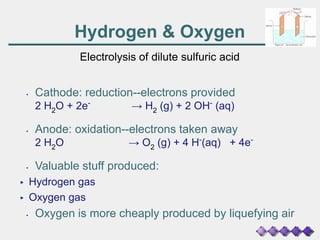
Hydrogen & Oxygen
Electrolysis of dilute sulfuric acid
▪ Cathode: reduction--electrons provided
2 H2O + 2e- → H2 (g) + 2 OH- (aq)
▪ Anode: oxidation--electrons taken away
2 H2O → O2 (g) + 4 H-(aq) + 4e-
▪ Valuable stuff produced:
▸ Hydrogen gas
▸ Oxygen gas
▪ Oxygen is more cheaply produced by liquefying air
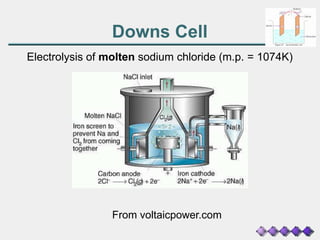
Downs Cell
Electrolysis of molten sodium chloride (m.p. = 1074K)
From voltaicpower.com
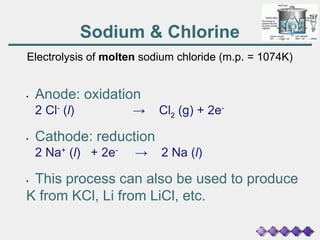
Sodium & Chlorine
Electrolysis of molten sodium chloride (m.p. = 1074K)
▪ Anode: oxidation
2 Cl-
(l) → Cl2 (g) + 2e-
▪ Cathode: reduction
2 Na+ (l) + 2e- → 2 Na (l)
▪ This process can also be used to produce
K from KCl, Li from LiCl, etc.
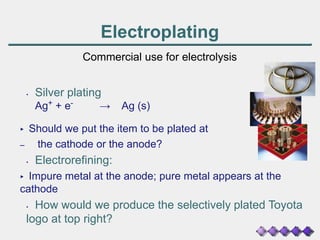
Electroplating
Commercial use for electrolysis
▪ Silver plating
Ag+ + e- → Ag (s)
▸ Should we put the item to be plated at
– the cathode or the anode?
▪ Electrorefining:
▸ Impure metal at the anode; pure metal appears at the
cathode
▪ How would we produce the selectively plated Toyota
logo at top right?
Electrolysis Stoichiometry
Commercial use for electrolysis
 We can predict amount of product at either electrode
 Current x time = coulombs of charge
 Coulombs x 1 mol e- = mol electrons
96,485 Coulombs
 Moles product = mol e- x Stoichiometric ratio
 Grams product = mol product x molar mass
1 mol electrons = 96,485 C = 1 Faraday
Electrolysis Stoichiometry
Problem to work
 Current x time = coulombs of charge
 Coulombs x 1 mol e-
= mol electrons
96,485 Coulombs
Mol product = mol e-
x Stoichiometric ratio
Grams product = mol product x molar mass
How much silver can we
plate out with a 12.0 A
current running 3.5 hours?
Coulombs = 12.0 A x 3.5 hr x 60 min/hr = 2520 C
Mol e- = 2520 C x 1 mol e- = 2.6 x 10⁻² mol e-
96,485 C
Mol Ag = 2.6 x 10⁻² mol e- x 1 mol Ag = 2.6 x 10⁻² mol Ag
1 mol e-
Mass Ag = 2.6 x 10⁻² mol Ag x 107.9 g Ag
1 mol Ag
= 2.8 g Ag

Electrolytic cells

  • 1.
    Electrolytic Cells Electrolysis, electroplating:similar processes From Pink Monkey
  • 2.
    Electrochemistry The Two Types ▪Electrochemical Cells: ▸ Spontaneous flow of electrons from anode through a meter or “work” to the cathode. Energy is produced by the cell and used to do work ▪ Electrolytic Cells: ▸ Forced flow of electrons from anode to the cathode by an external battery or generator. Energy is used by the electrochemical cell to make high- energy elements or compounds
  • 3.
    Example The Lead-Acid Battery(Pb/H2SO4/PbO2) ▪ Charged battery: Pb in contact with H2SO4: Pb oxidized to form PbSO4. This oxidation generates electrons (cathode) PbO2 in contact with H2SO4: PbO2 is reduced by adding electrons to form PbSO4. Discharged battery: PbSO4 coats both electrodes, surrounded by depleted sulfuric acid
  • 4.
    Example The Lead-Acid Battery(Pb/H2SO4/PbO2) ▪ Discharged battery is recharged: PbSO4 coats both electrodes, surrounded by depleted sulfuric acid ▸ Electrons are forced in the opposite direction by the automobile generator PbSO4 is oxidized to PbO2 (+2 to +4) PbSO4 is reduced to Pb at the other electrode Now the Pb and PbO2 are restored at their proper electrodes so they can start your car the next time you need some “juice”
  • 5.
    Summary Lead-Acid Battery ▪ Discharging:producing of electrons Pb + H2SO4 → PbSO4 + 2H+ + 2e- PbO2 + 4H+ + SO4 2- + 2e- → PbSO4 + 2H2O ▪ Charging: restoring original situation PbSO4 + 2H+ + 2e- → Pb + H2SO4 PbSO4 + 2H2O → PbO2 + 4H+ + SO4 2- + 2e- Batteries “die” when enough PbSO4 falls off one or the other electrode so that it can’t “hold a charge” in the electrolysis cycle
  • 6.
    What Reaction Happens? If a voltage is supplied to a mixture of cations, which one will plate out? Since this would cause reduction, look at reduction potentials Ag+ + e- → Ag (s) E° = 0.80 V Cu2+ + 2e- → 2Cu (s) E° = 0.34 V Zn2+ + 2e- → 2Zn (s) E° = -0.76 V  The more positive voltage has a more negative G Thus Ag+ >Cu2+ >Zn2+
  • 7.
    Chlorine & NaOH Electrolysisof Brine (concentrated NaCl) ▪ Cathode: reduction--electrons provided 2 H2O + 2e- → H2 (g) + 2 OH- (aq) ▪ Anode: oxidation--electrons taken away 2 Cl- (aq) → Cl2 (g) + 2e- ▪ Valuable stuff produced: ▸ Hydrogen gas ▸ Sodium hydroxide (lye) ▸ Chlorine gas
  • 8.
    Hydrogen & Oxygen Electrolysisof dilute sulfuric acid ▪ Cathode: reduction--electrons provided 2 H2O + 2e- → H2 (g) + 2 OH- (aq) ▪ Anode: oxidation--electrons taken away 2 H2O → O2 (g) + 4 H-(aq) + 4e- ▪ Valuable stuff produced: ▸ Hydrogen gas ▸ Oxygen gas ▪ Oxygen is more cheaply produced by liquefying air
  • 9.
    Downs Cell Electrolysis ofmolten sodium chloride (m.p. = 1074K) From voltaicpower.com
  • 10.
    Sodium & Chlorine Electrolysisof molten sodium chloride (m.p. = 1074K) ▪ Anode: oxidation 2 Cl- (l) → Cl2 (g) + 2e- ▪ Cathode: reduction 2 Na+ (l) + 2e- → 2 Na (l) ▪ This process can also be used to produce K from KCl, Li from LiCl, etc.
  • 11.
    Electroplating Commercial use forelectrolysis ▪ Silver plating Ag+ + e- → Ag (s) ▸ Should we put the item to be plated at – the cathode or the anode? ▪ Electrorefining: ▸ Impure metal at the anode; pure metal appears at the cathode ▪ How would we produce the selectively plated Toyota logo at top right?
  • 12.
    Electrolysis Stoichiometry Commercial usefor electrolysis  We can predict amount of product at either electrode  Current x time = coulombs of charge  Coulombs x 1 mol e- = mol electrons 96,485 Coulombs  Moles product = mol e- x Stoichiometric ratio  Grams product = mol product x molar mass 1 mol electrons = 96,485 C = 1 Faraday
  • 13.
    Electrolysis Stoichiometry Problem towork  Current x time = coulombs of charge  Coulombs x 1 mol e- = mol electrons 96,485 Coulombs Mol product = mol e- x Stoichiometric ratio Grams product = mol product x molar mass How much silver can we plate out with a 12.0 A current running 3.5 hours? Coulombs = 12.0 A x 3.5 hr x 60 min/hr = 2520 C Mol e- = 2520 C x 1 mol e- = 2.6 x 10⁻² mol e- 96,485 C Mol Ag = 2.6 x 10⁻² mol e- x 1 mol Ag = 2.6 x 10⁻² mol Ag 1 mol e- Mass Ag = 2.6 x 10⁻² mol Ag x 107.9 g Ag 1 mol Ag = 2.8 g Ag