PHYSICAL and  CHEMICAL CHANGES
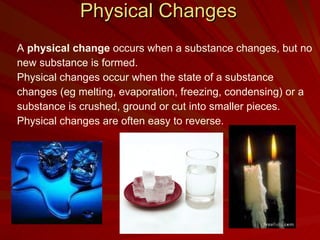
Physical Changes A  physical change  occurs when a substance changes, but no new substance is formed. Physical changes occur when the state of a substance  changes (eg melting, evaporation, freezing, condensing) or a substance is crushed, ground or cut into smaller pieces. Physical changes are often easy to reverse.
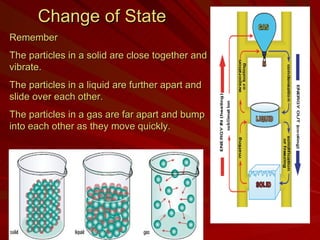
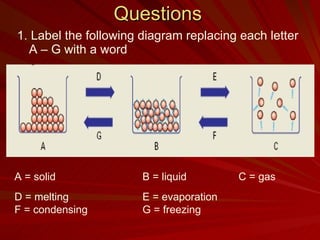
  Change of State Remember  The particles in a solid are close together and vibrate. The particles in a liquid are further apart and slide over each other. The particles in a gas are far apart and bump into each other as they move quickly.
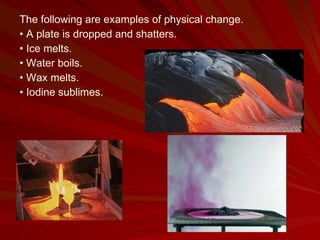
The following are examples of physical change. •  A plate is dropped and shatters. •  Ice melts. •  Water boils. •  Wax melts. •  Iodine sublimes.
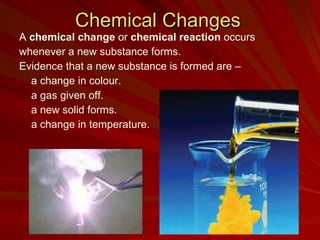
Chemical Changes A  chemical change  or  chemical reaction  occurs  whenever a new substance forms.  Evidence that a new substance is formed are –  a change in colour. a gas given off. a new solid forms. a change in temperature.
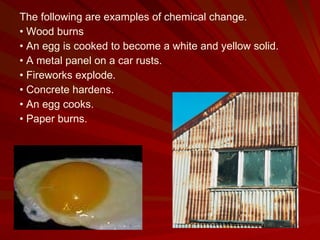
The following are examples of chemical change. •  Wood burns •  An egg is cooked to become a white and yellow solid. •  A metal panel on a car rusts. •  Fireworks explode. •  Concrete hardens. •  An egg cooks. •  Paper burns.
Questions 1. Label the following diagram replacing each letter A – G with a word A = solid B = liquid C = gas D = melting E = evaporation F = condensing G = freezing
Questions Classify  the following examples as physical or chemical changes.   a) Water freezes to make snow. b) A cake cooking. c) Food is digested. d) A puddle of water evaporates. e) Lighting the gas in a bunsen burner.   f) Lighting a match. g) Steam condensing on a mirror. h) Melting a gold nugget to make a gold bar. i) Dynamite exploding. j) Burning your toast. k)   Water freezes to make ice cubes. l) Ice cream melting. m) Iron rusting a) Physical b) Chemical c) Chemical d) Physical e) Chemical f) Chemical g) Physical h) Physical j) Chemical i) Chemical k) Physical l) Physical m) Chemical
 

Physical and chemical changes

  • 1.
    PHYSICAL and CHEMICAL CHANGES
  • 2.
    Physical Changes A physical change occurs when a substance changes, but no new substance is formed. Physical changes occur when the state of a substance changes (eg melting, evaporation, freezing, condensing) or a substance is crushed, ground or cut into smaller pieces. Physical changes are often easy to reverse.
  • 3.
    Changeof State Remember The particles in a solid are close together and vibrate. The particles in a liquid are further apart and slide over each other. The particles in a gas are far apart and bump into each other as they move quickly.
  • 4.
    The following areexamples of physical change. • A plate is dropped and shatters. • Ice melts. • Water boils. • Wax melts. • Iodine sublimes.
  • 5.
    Chemical Changes A chemical change or chemical reaction occurs whenever a new substance forms. Evidence that a new substance is formed are – a change in colour. a gas given off. a new solid forms. a change in temperature.
  • 6.
    The following areexamples of chemical change. • Wood burns • An egg is cooked to become a white and yellow solid. • A metal panel on a car rusts. • Fireworks explode. • Concrete hardens. • An egg cooks. • Paper burns.
  • 7.
    Questions 1. Labelthe following diagram replacing each letter A – G with a word A = solid B = liquid C = gas D = melting E = evaporation F = condensing G = freezing
  • 8.
    Questions Classify the following examples as physical or chemical changes. a) Water freezes to make snow. b) A cake cooking. c) Food is digested. d) A puddle of water evaporates. e) Lighting the gas in a bunsen burner. f) Lighting a match. g) Steam condensing on a mirror. h) Melting a gold nugget to make a gold bar. i) Dynamite exploding. j) Burning your toast. k) Water freezes to make ice cubes. l) Ice cream melting. m) Iron rusting a) Physical b) Chemical c) Chemical d) Physical e) Chemical f) Chemical g) Physical h) Physical j) Chemical i) Chemical k) Physical l) Physical m) Chemical
  • 9.