Electric Fields and Forces
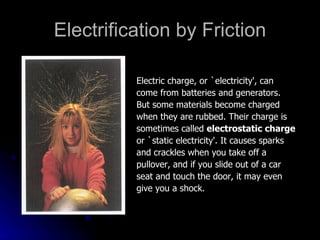
Electrification by Friction Electric charge, or `electricity', can come from batteries and generators. But some materials become charged when they are rubbed. Their charge is sometimes called  electrostatic charge  or `static electricity'. It causes sparks and crackles when you take off a pullover, and if you slide out of a car seat and touch the door, it may even give you a shock.
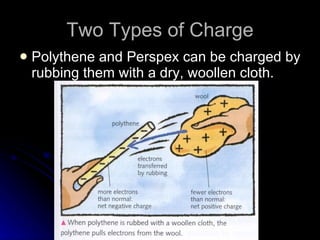
Two Types of Charge Polythene and Perspex can be charged by rubbing them with a dry, woollen cloth.
 
When two charged polythene rods are brought close together, they repel (try to push each other apart). The same thing happens with two charged Perspex rods.
However, a charged polythene rod and a charged Perspex rod attract each other. Experiments like this suggest that there are two different and opposite types of electric charge. These are called positive (+) charge and negative (‑) charge:
Conservation of Charge Where do charges come from? Everything is made of tiny particles called atoms. These have electric charge inside them. There is a central  nucleus  made up of  protons and neutrons. Orbiting the nucleus are much lighter electrons
Electrons have a negative (‑) charge.  Protons have an equal positive (+) charge. Neutrons have no charge.
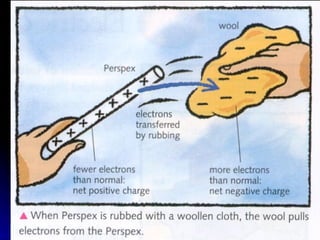
Normally, atoms have equal numbers of electrons and protons, so the  net  (overall) charge on a material is zero. However, when two materials are rubbed together, electrons may be transferred from one to the other. One material ends up with more electrons than normal and the other with less. So one has a net negative charge, while the other is left with a net positive charge.
Rubbing materials together does not  make  electric charge. It just  separates  charges that are already there. Charge is always conserved in any action, the distribution of charge is changed.
Question If a million electrons are transferred in one rub by a cloth, what are the resulting charges in Coulombs of (i) 3 rubs of polythene (ii) 5 rubs of Perspex (iii) the rods from (i) and (ii) are made to touch
Solution If a million electrons are transferred in one rub by a cloth, what are the resulting charges in Coulombs of (i) 3 million*-1.6e-19 = -4.8e-13C (ii) 5 million*1.6e-19 = 8e-13C (iii) -4.8e-13C+8e-13C=  3.2e-13C
Conductors and Insulators When some materials gain charge, they lose it almost immediately. This is because electrons flow through them or the surrounding material until the balance of negative and positive charge is restored.
Conductors Conductors  are materials that let electrons pass through them. Metals are the best electrical conductors. Some of their electrons are so loosely held to their atoms that they can pass freely between them. These free electrons also make metals good thermal conductors. Most non‑metals conduct charge poorly or not at all, although carbon  (in the form of graphite)  is an exception.
Insulators Insulators are materials that hardly conduct at all. Their electrons are tightly held to atoms and are not free to move ‑ although they can be transferred by rubbing. Insulators are easy to charge by rubbing because any electrons that get transferred tend to stay where they are.
Semiconductors Semiconductors  are `in‑between' materials. They are poor conductors when cold, but much better conductors when warm.
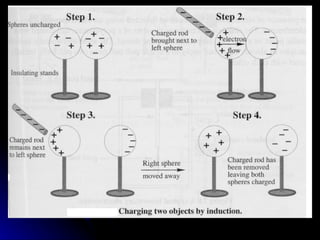
Electrostatic Induction Attraction of uncharged objects A charged object will attract any uncharged object close to it. For example, the charged screen of a TV will attract dust.
 
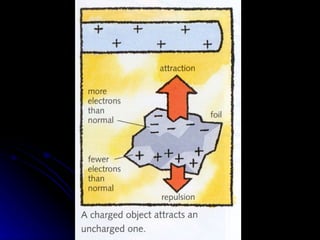
The previous diagram shows what happens if a positively charged rod is brought near a small piece of aluminium foil. Electrons in the foil are pulled towards the rod, which leaves the bottom of the foil with a net positive charge. As a result, the top of the foil is attracted to the rod, while the bottom is repelled. However, the attraction is stronger because the attracting charges are closer than the repelling ones.
 
 
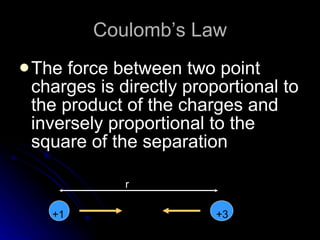
Coulomb’s Law The force between two point charges is directly proportional to the product of the charges and inversely proportional to the square of the separation +1 +3 r
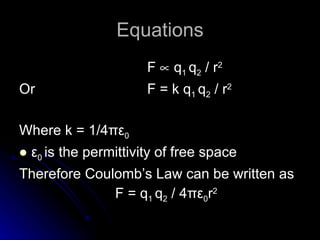
Equations F    q 1  q 2  / r 2 Or  F = k q 1  q 2  / r 2 Where k = 1/4 πε 0 ε 0   is the permittivity of free space Therefore Coulomb’s Law can be written as F = q 1  q 2  / 4 πε 0 r 2
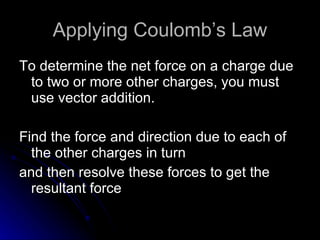
Applying Coulomb’s Law To determine the net force on a charge due to two or more other charges, you must use vector addition. Find the force and direction due to each of the other charges in turn  and then resolve these forces to get the resultant force
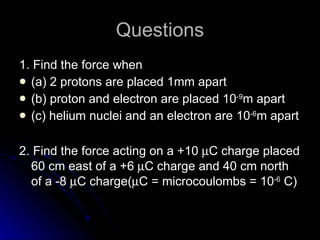
Questions 1. Find the force when (a) 2 protons are placed 1mm apart (b) proton and electron are placed 10 -9 m apart (c) helium nuclei and an electron are 10 -6 m apart 2. Find the force acting on a +10   C charge placed 60 cm east of a +6   C charge and 40 cm north of a -8   C charge(  C = microcoulombs = 10 -6  C)
Electric Field A resultant force changes motion. Many everyday forces are pushes or pulls between bodies in contact. In other cases forces arise between bodies that are separated from one another. Electric, magnetic and gravitational effects involve such action‑at‑a‑distance forces and to deal with them physicists find the idea of a  field of force,  or simply a field, useful.
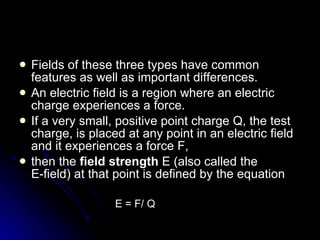
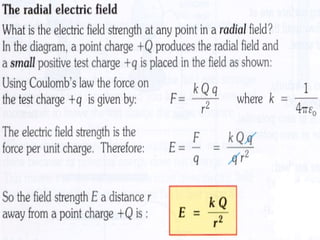
Fields of these three types have common features as well as important differences. An electric field is a region where an electric charge experiences a force. If a very small, positive point charge Q, the test charge, is placed at any point in an electric field and it experiences a force F, then the  field strength  E (also called the E‑field) at that point is defined by the equation E = F/ Q
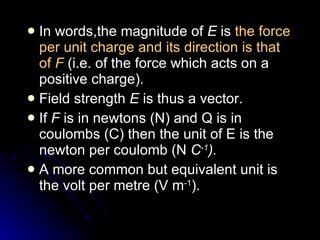
In words,the magnitude of  E  is  the force per unit charge and its direction is that of  F   (i.e. of the force which acts on a positive charge). Field strength  E  is thus a vector. If  F  is in newtons (N) and Q is in coulombs (C) then the unit of E is the newton per coulomb (N  C ‑1 ).  A more common but equivalent unit is the volt per metre (V m ‑1 ).
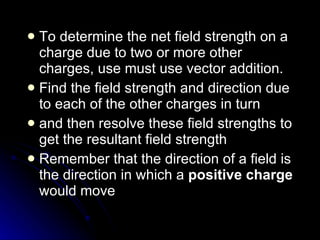
To determine the net field strength on a charge due to two or more other charges, use must use vector addition. Find the field strength and direction due to each of the other charges in turn  and then resolve these field strengths to get the resultant field strength Remember that the direction of a field is the direction in which a  positive charge  would move
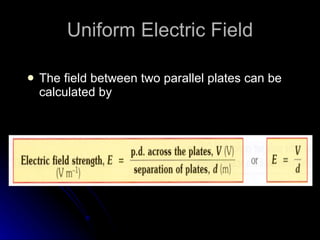
Uniform Electric Field The field between two parallel plates can be calculated by
 
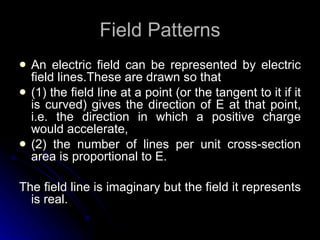
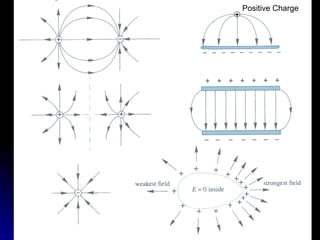
Field Patterns An electric field can be represented by electric field lines.These are drawn so that  (1) the field line at a point (or the tangent to it if it is curved) gives the direction of E at that point, i.e. the direction in which a positive charge would accelerate,  (2) the number of lines per unit cross‑section area is proportional to E. The field line is imaginary but the field it represents is real.
Positive   Charge +
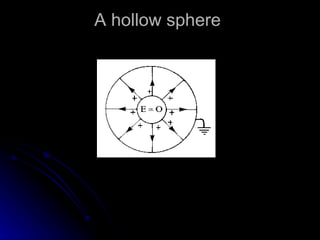
A hollow sphere

Electric Fields

  • 1.
  • 2.
    Electrification by FrictionElectric charge, or `electricity', can come from batteries and generators. But some materials become charged when they are rubbed. Their charge is sometimes called electrostatic charge or `static electricity'. It causes sparks and crackles when you take off a pullover, and if you slide out of a car seat and touch the door, it may even give you a shock.
  • 3.
    Two Types ofCharge Polythene and Perspex can be charged by rubbing them with a dry, woollen cloth.
  • 4.
  • 5.
    When two chargedpolythene rods are brought close together, they repel (try to push each other apart). The same thing happens with two charged Perspex rods.
  • 6.
    However, a chargedpolythene rod and a charged Perspex rod attract each other. Experiments like this suggest that there are two different and opposite types of electric charge. These are called positive (+) charge and negative (‑) charge:
  • 7.
    Conservation of ChargeWhere do charges come from? Everything is made of tiny particles called atoms. These have electric charge inside them. There is a central nucleus made up of protons and neutrons. Orbiting the nucleus are much lighter electrons
  • 8.
    Electrons have anegative (‑) charge. Protons have an equal positive (+) charge. Neutrons have no charge.
  • 9.
    Normally, atoms haveequal numbers of electrons and protons, so the net (overall) charge on a material is zero. However, when two materials are rubbed together, electrons may be transferred from one to the other. One material ends up with more electrons than normal and the other with less. So one has a net negative charge, while the other is left with a net positive charge.
  • 10.
    Rubbing materials togetherdoes not make electric charge. It just separates charges that are already there. Charge is always conserved in any action, the distribution of charge is changed.
  • 11.
    Question If amillion electrons are transferred in one rub by a cloth, what are the resulting charges in Coulombs of (i) 3 rubs of polythene (ii) 5 rubs of Perspex (iii) the rods from (i) and (ii) are made to touch
  • 12.
    Solution If amillion electrons are transferred in one rub by a cloth, what are the resulting charges in Coulombs of (i) 3 million*-1.6e-19 = -4.8e-13C (ii) 5 million*1.6e-19 = 8e-13C (iii) -4.8e-13C+8e-13C= 3.2e-13C
  • 13.
    Conductors and InsulatorsWhen some materials gain charge, they lose it almost immediately. This is because electrons flow through them or the surrounding material until the balance of negative and positive charge is restored.
  • 14.
    Conductors Conductors are materials that let electrons pass through them. Metals are the best electrical conductors. Some of their electrons are so loosely held to their atoms that they can pass freely between them. These free electrons also make metals good thermal conductors. Most non‑metals conduct charge poorly or not at all, although carbon (in the form of graphite) is an exception.
  • 15.
    Insulators Insulators arematerials that hardly conduct at all. Their electrons are tightly held to atoms and are not free to move ‑ although they can be transferred by rubbing. Insulators are easy to charge by rubbing because any electrons that get transferred tend to stay where they are.
  • 16.
    Semiconductors Semiconductors are `in‑between' materials. They are poor conductors when cold, but much better conductors when warm.
  • 17.
    Electrostatic Induction Attractionof uncharged objects A charged object will attract any uncharged object close to it. For example, the charged screen of a TV will attract dust.
  • 18.
  • 19.
    The previous diagramshows what happens if a positively charged rod is brought near a small piece of aluminium foil. Electrons in the foil are pulled towards the rod, which leaves the bottom of the foil with a net positive charge. As a result, the top of the foil is attracted to the rod, while the bottom is repelled. However, the attraction is stronger because the attracting charges are closer than the repelling ones.
  • 20.
  • 21.
  • 22.
    Coulomb’s Law Theforce between two point charges is directly proportional to the product of the charges and inversely proportional to the square of the separation +1 +3 r
  • 23.
    Equations F  q 1 q 2 / r 2 Or F = k q 1 q 2 / r 2 Where k = 1/4 πε 0 ε 0 is the permittivity of free space Therefore Coulomb’s Law can be written as F = q 1 q 2 / 4 πε 0 r 2
  • 24.
    Applying Coulomb’s LawTo determine the net force on a charge due to two or more other charges, you must use vector addition. Find the force and direction due to each of the other charges in turn and then resolve these forces to get the resultant force
  • 25.
    Questions 1. Findthe force when (a) 2 protons are placed 1mm apart (b) proton and electron are placed 10 -9 m apart (c) helium nuclei and an electron are 10 -6 m apart 2. Find the force acting on a +10  C charge placed 60 cm east of a +6  C charge and 40 cm north of a -8  C charge(  C = microcoulombs = 10 -6 C)
  • 26.
    Electric Field Aresultant force changes motion. Many everyday forces are pushes or pulls between bodies in contact. In other cases forces arise between bodies that are separated from one another. Electric, magnetic and gravitational effects involve such action‑at‑a‑distance forces and to deal with them physicists find the idea of a field of force, or simply a field, useful.
  • 27.
    Fields of thesethree types have common features as well as important differences. An electric field is a region where an electric charge experiences a force. If a very small, positive point charge Q, the test charge, is placed at any point in an electric field and it experiences a force F, then the field strength E (also called the E‑field) at that point is defined by the equation E = F/ Q
  • 28.
    In words,the magnitudeof E is the force per unit charge and its direction is that of F (i.e. of the force which acts on a positive charge). Field strength E is thus a vector. If F is in newtons (N) and Q is in coulombs (C) then the unit of E is the newton per coulomb (N C ‑1 ). A more common but equivalent unit is the volt per metre (V m ‑1 ).
  • 29.
    To determine thenet field strength on a charge due to two or more other charges, use must use vector addition. Find the field strength and direction due to each of the other charges in turn and then resolve these field strengths to get the resultant field strength Remember that the direction of a field is the direction in which a positive charge would move
  • 30.
    Uniform Electric FieldThe field between two parallel plates can be calculated by
  • 31.
  • 32.
    Field Patterns Anelectric field can be represented by electric field lines.These are drawn so that (1) the field line at a point (or the tangent to it if it is curved) gives the direction of E at that point, i.e. the direction in which a positive charge would accelerate, (2) the number of lines per unit cross‑section area is proportional to E. The field line is imaginary but the field it represents is real.
  • 33.
    Positive Charge +
  • 34.