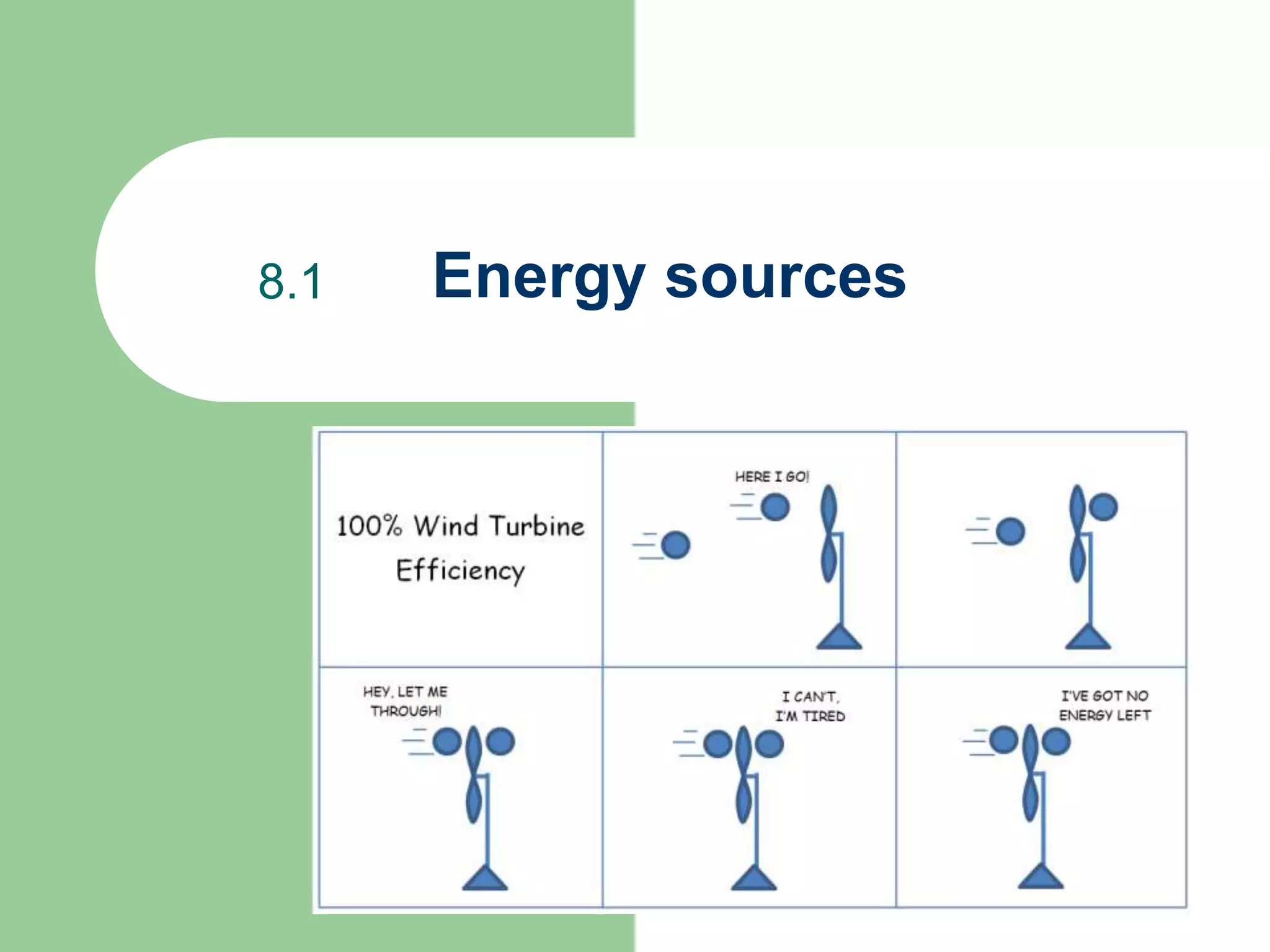
Energy sources8.1
World energy Sources
In 2006, about 18% of
global final energy
consumption came
from renewables.
How much progress
have we made?
Image from wikipedia
World energy Sources
Who uses the most?
What questions do you need to ask to explore this in detail?
World energy Sources
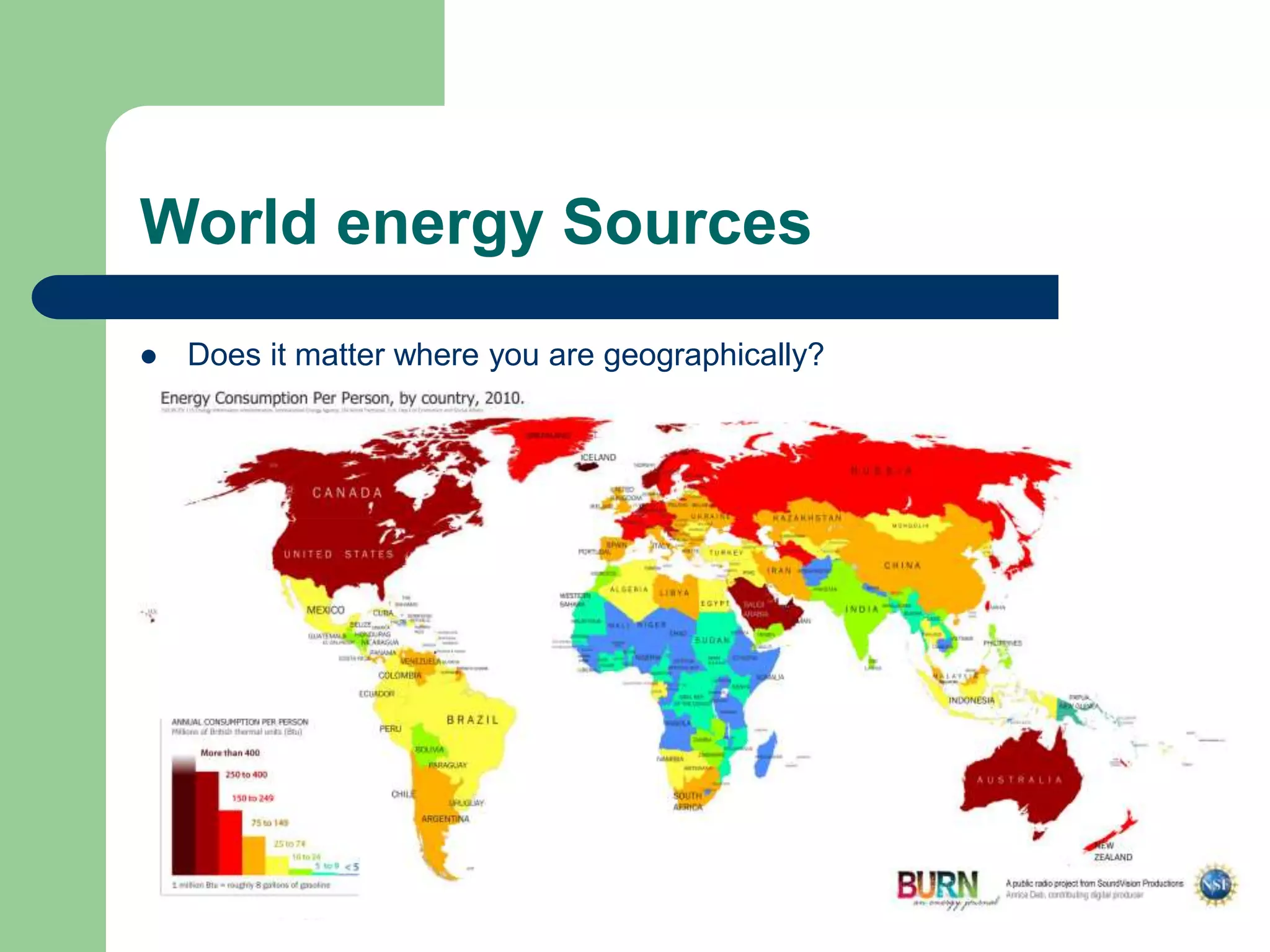
 Does it matter where you are geographically?
Energy types
 Kinetic
 Potential
 Thermal
 Sound
 Light (Electromagnetic)
 Electrical
 Magnetic
 Nuclear
 Chemical
Energy degradation
 Every time energy is converted from
one form to another thermal energy
will be lost
 Conversion of energy into work is a
cyclical process
 Energy transferred to surroundings is
no longer able to do useful work
Energy density of fuel
 Energy density is the amount of energy stored
in a given system or region of space per unit
volume or per unit mass
 J/kg
 Need to be able to do calculations
Energy conversion of typical fuels
Firewood 16 MJ/kg
Brown coal 9 MJ/kg
Black coal (low quality) 13-20 MJ/kg
Black coal 24-30 MJ/kg
Natural Gas 39 MJ/m3
Crude Oil 45-46 MJ/kg
Uranium* - in light water reactor 500,000 MJ/kg
Advantage Disadvantage
Oil widely accepted in manufacturing ,
relatively cheap and high efficiency
CO2 emission, greenhouse effect.
Gas high efficiency expensive to transport and store, CH4
contributes to greenhouse effect.
Coal widely accepted in manufacturing,
cheapest among the three non-
renewable energy source
low efficiency, air pollution, CO2 and CO
emission, greenhouse effect.
Solar easy to get sun light, renewable energy
source
expensive to use solar panel and grid, unstable
in modern due to the changeable weather
Wind easy to get wind, renewable energy
source
noise, spoil scenery, expensive maintaining fees
Biofuel clean, renewable energy source expensive in refining process
Geothermal stable, renewable energy source expensive to build, the technology has not been
very mature yet
Hydropower functional. very useful to avoid flooding
in some countries, renewable
energy source
very expensive to build, expensive to maintain,
drought, harm the river eco-system
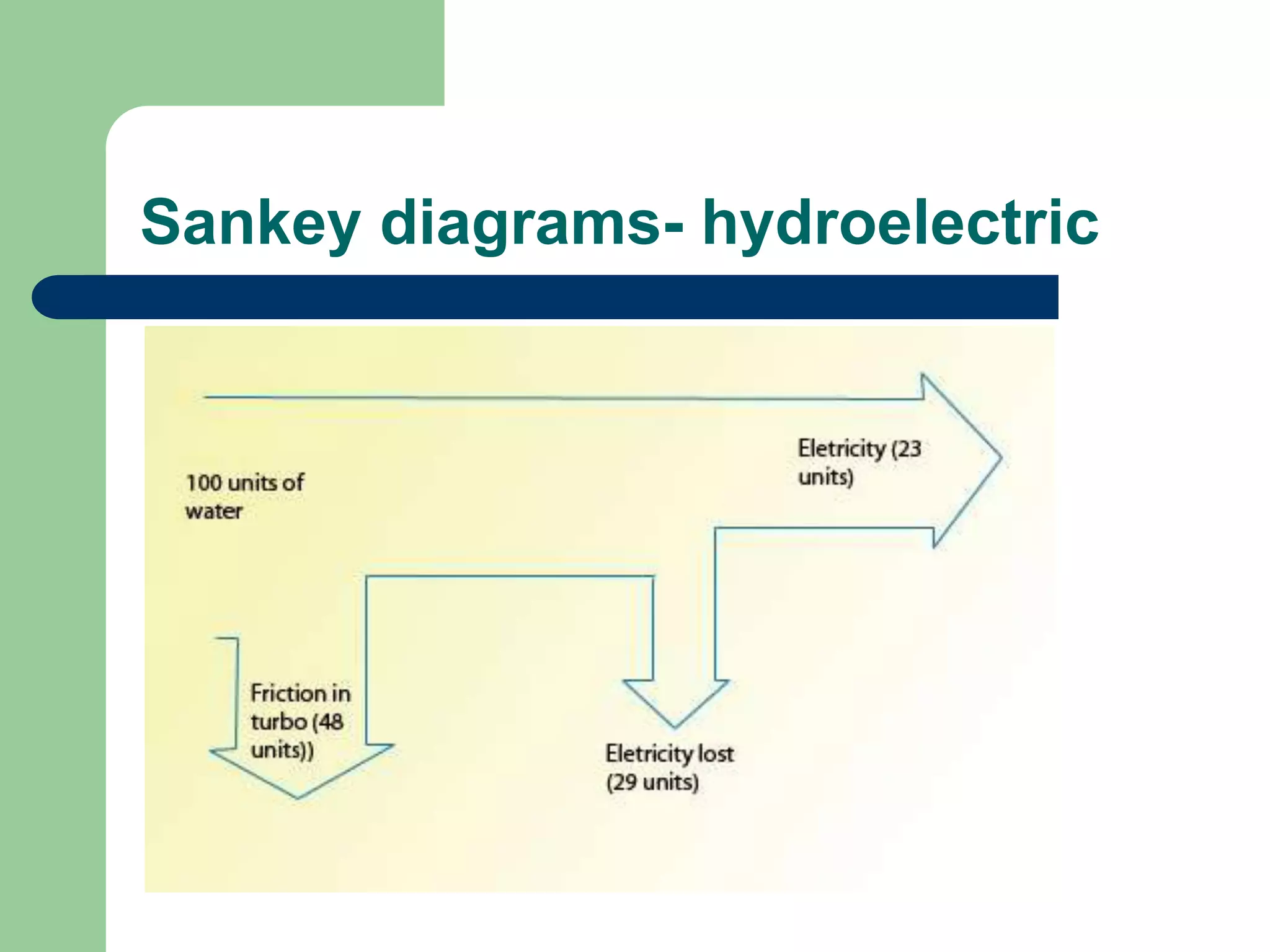
Sankey diagrams
 A Sankey diagram show energy transfers in a
scale diagram
 Arrowheads are in proportion to value
 You need to be able to draw these from data
Sankey diagrams
 For fossil fuel power stations
Sankey diagrams-nuclear
Sankey diagrams- solar
Sankey diagrams- hydroelectric
Sankey diagrams- wind
What is renewable?
 Reusable
 Bountiful
 Short time to regenerate
 Cheap
 Life time to regenerate
 Something else?
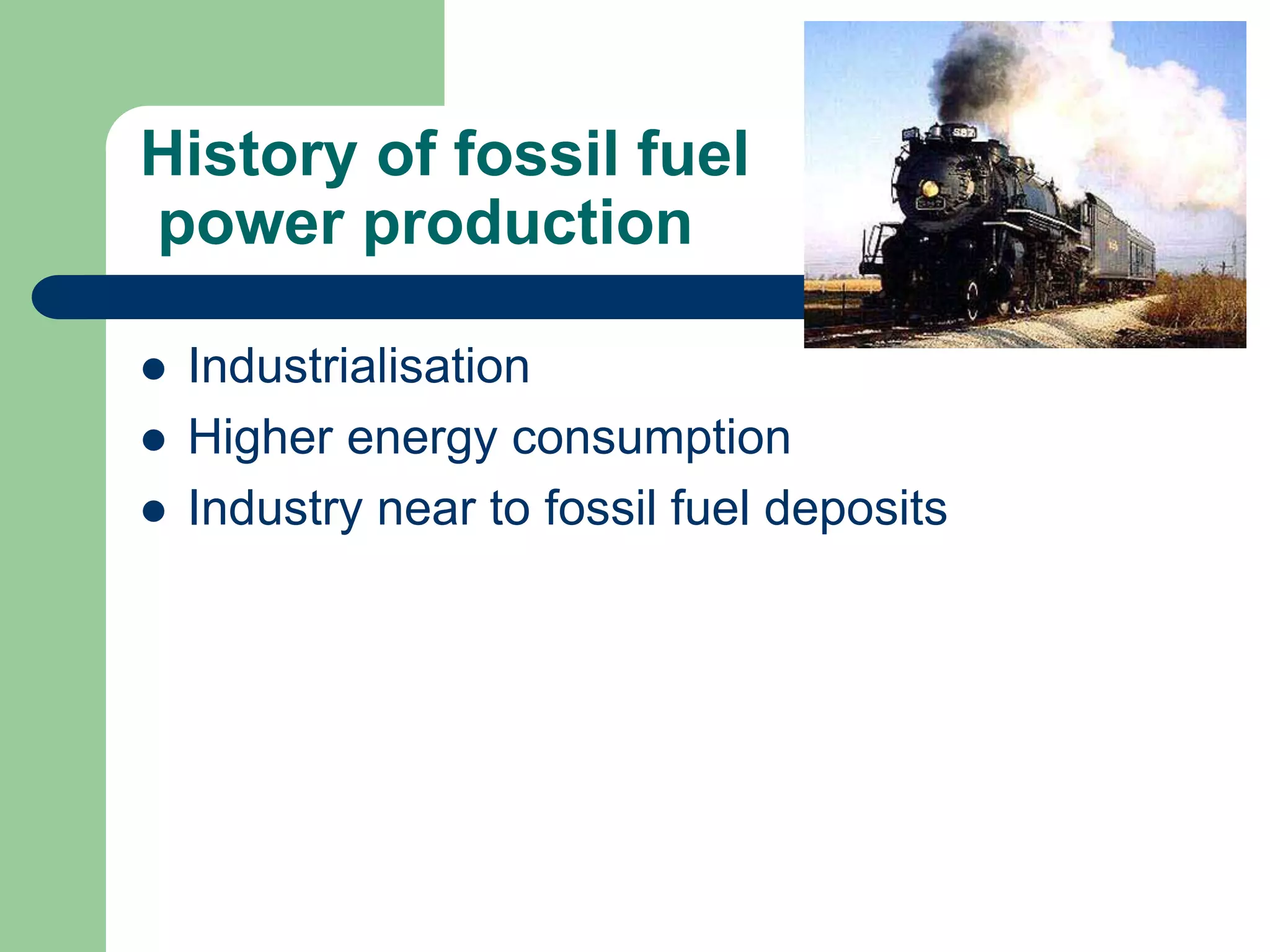
History of fossil fuel
power production
 Industrialisation
 Higher energy consumption
 Industry near to fossil fuel deposits
Coal
Coal
Power is generated via a power plant in the following way:
 Coal and lmestone is injected into a bed furnace.
 The ash from the coal is removed from the plant and then
disposed of.
 This furnace is used to heat a large container of water.
 this water then is turned into steam and then pushed at high
speed through a turbine.
 The turbine turns a Generator.
 This generates a huge amount of electricity and is then
carried off by the substandard power grid that is often shut
off so that victoria still has its power
 The steam is then filtered in a number particulate controllers
and any remaining ash is then removed.
 A fan then blows the steam out into the atmosphere.
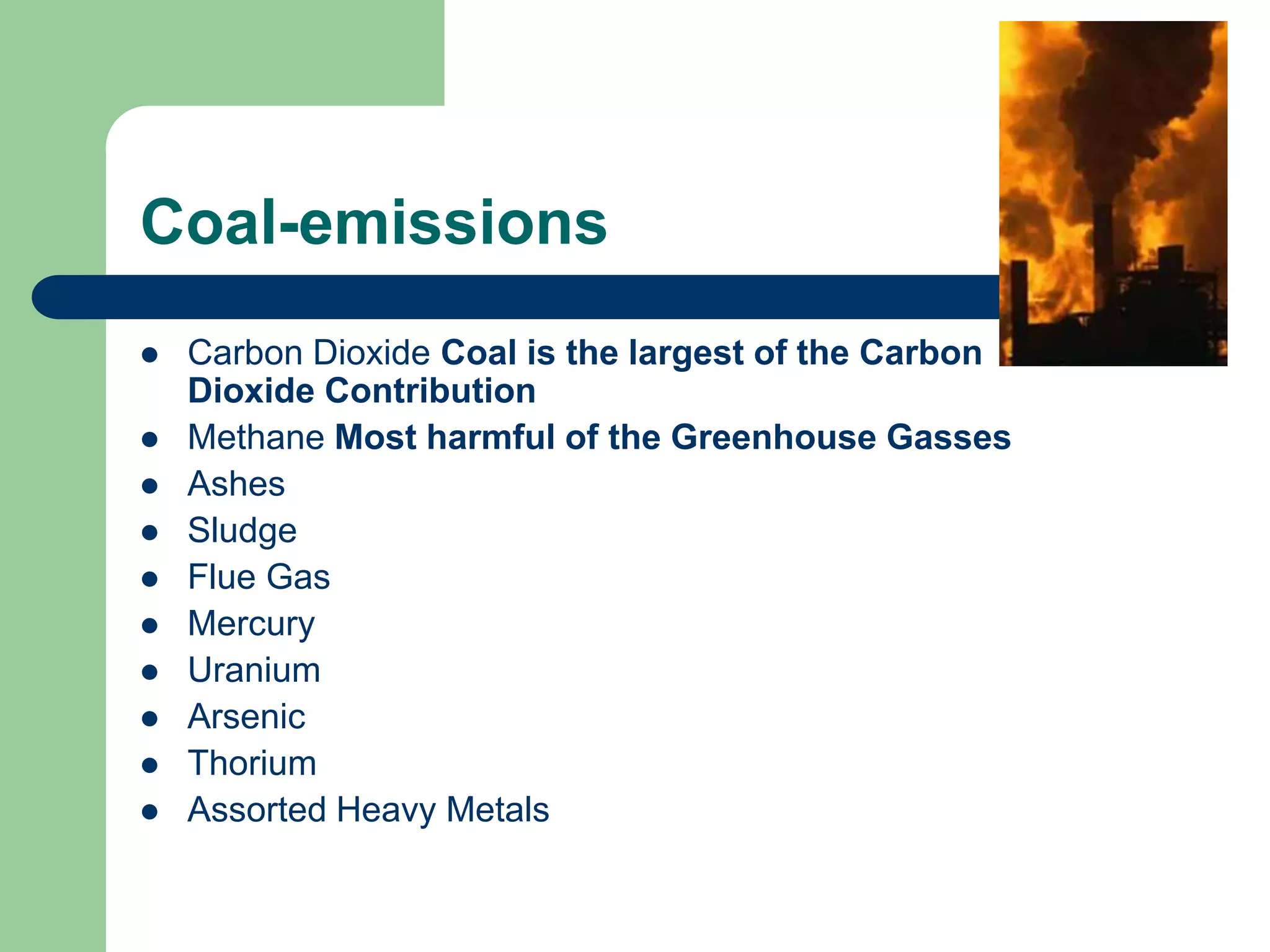
Coal-emissions
 Carbon Dioxide Coal is the largest of the Carbon
Dioxide Contribution
 Methane Most harmful of the Greenhouse Gasses
 Ashes
 Sludge
 Flue Gas
 Mercury
 Uranium
 Arsenic
 Thorium
 Assorted Heavy Metals
Coal-costs
 Economic
– Coal
– Plants
– Labor
– Transport
 Social
– Health
 Cancers caused
– Environmental
 Smog
 Waste Products
 Mining
Oil
Oil
How Oil Fuelled Power Station Works:
 The combustion of heavy oil turns the water in the boiler into steam
 This is then collected in the boiler drum.
 The steam is then returned to the boiler where it is superheated, dried,
and directed towards the turbines.
 As it expands, the steam spins the turbine which drives the generator.
 After leaving the turbines, the steam passes through condensers which
return it to a liquid state
 The water is pumped back into the boiler.
 This cycle is repeated.
Oil-emissions
 Carbon Dioxide
 Methane Most harmful of the Greenhouse Gasses
 Ashes
 Sludge
 Flue Gas
 Mercury
 Uranium
 Arsenic
 Thorium
 Assorted Heavy Metals
Oil-costs
Economic
 Oil
 Plants
 Labour
 Transport
Social
 Health
– Cancers caused
 Environmental
– Smog
– Waste Products
– Mining
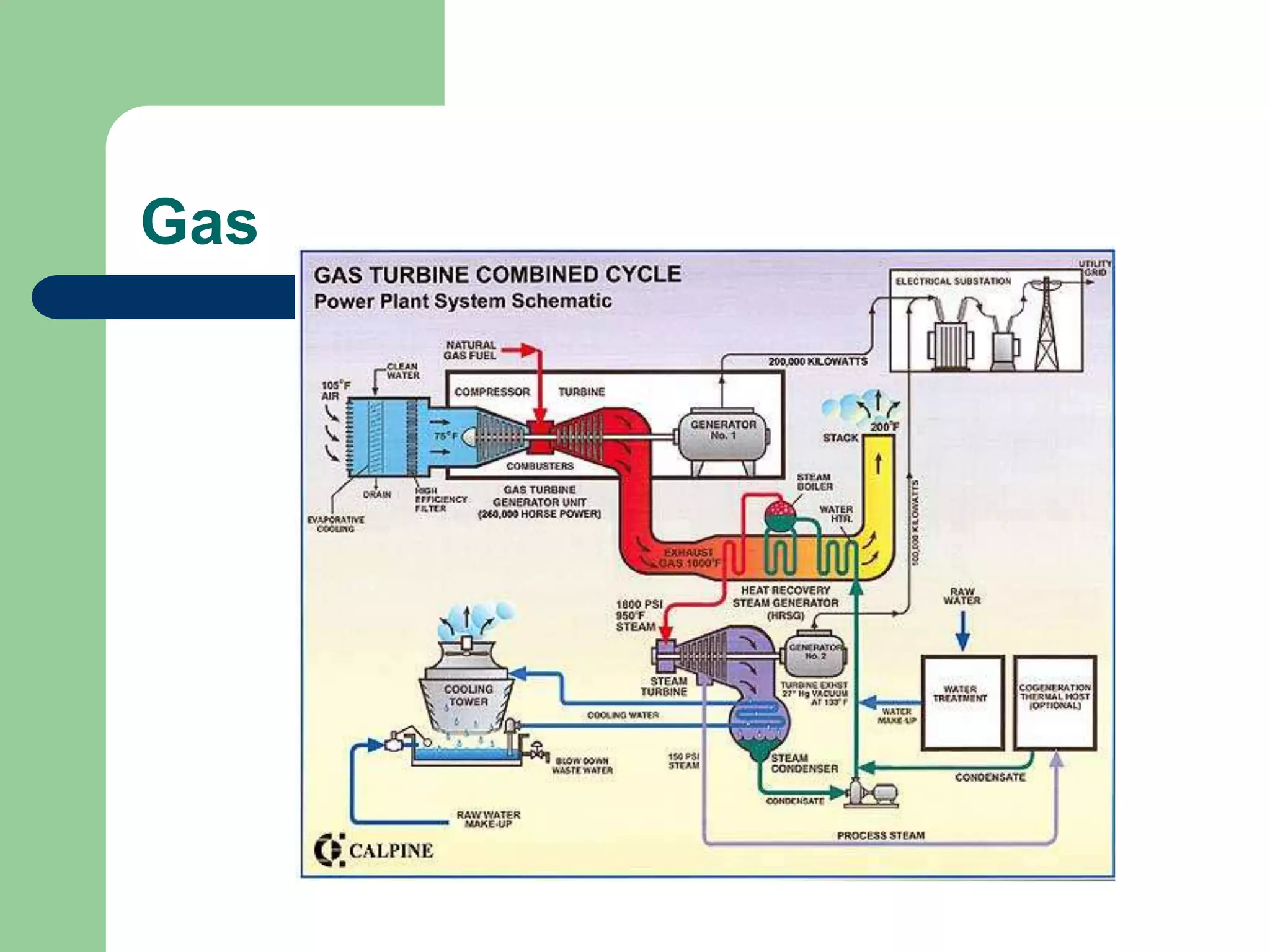
Gas
Gas
 The combustion of natural gas turns the
water in the boiler into steam
 This is then collected in the boiler drum.
 The steam is then returned to the boiler
where it is superheated, dried, and
directed towards the turbines.
Gas
 As it expands, the steam spins the
turbine which drives the generator.
 After leaving the turbines, the steam
passes through condensers which return
it to a liquid state
 The water is pumped back into the boiler.
 This cycle is repeated.
Gas-emissions
 Carbon Dioxide
 Methane Most harmful of the Greenhouse Gasses
 Ashes
 Sludge
 Flue Gas
 Mercury
 Uranium
 Arsenic
 Thorium
 Assorted Heavy Metals
Gas-costs
 Economic
– Oil
– Plants
– Labour
– Transport
 Social
– Health
 Cancers caused
– Environmental
 Smog
 Waste Products
 Mining
Fossil fuel usage
 Why is fossil fuel use widespread?
 What is the energy density of each fossil fuel?
 What are the advantages of fossil fuel use?
 What are the disadvantages of fossil fuel use?
 What is the efficiency of fossil fuel power
stations?
 What are the environmental concerns?
Nuclear
 Nuclear power is term used to describe the process
that harness the energy produced in nuclear reactions.
In nuclear reactions, the atomic energy within atomic
nuclei is transformed into other forms of energy, mainly
thermal energy. This is commonly done through the
process of nuclear fission however nuclear reactions
can also be done through the process of nuclear fusion
and radioactive decay.
Nuclear
 Nuclear power has many applications for
current and future uses. This is because of the
large amounts of energy if transformed in these
reactions in comparison to other sources of
energy per unit mass. This makes it ideal for
nuclear marine propulsion, to generate
electricity for humanity's energy needs or even
to fuel nuclear weapons.
Nuclear Fission
 Nuclear Fission is a nuclear reaction where the
nucleus of an atom is split into smaller particles
producing lighter elements. The reaction is only
energetically possible (i.e. the reaction is exothermic) if
the binding energy per nucleon for the reactants is
greater than the binding energy per nucleon for the
products
Nuclear Fission
 The reaction is initiated by bombarding the nuclei with
neutrons. This type of nuclear reaction is used in
nuclear power plants which harness the energy to
produce electricity.
Nuclear
Key components
 Moderator
 Energy transfer
 Control rods
 Heat exchangers
Nuclear
Retractable Control Rods
 These are used to absorb free neutrons and
prevent further fission events. Control rods,
placed between the fissile uranium are
retractable to expose more uranium and speed
up the reaction or they can be injected to cover
the uranium fuel rods and slow down the
reaction.
Nuclear
Moderator
 A moderator is a liquid medium, usually light or heavy
water, that surrounds the uranium fuel rods in order to
slow down the free neutrons so that they can be
absorbed into uranium atoms more easily inducing
fission, speeding up the reaction. If the moderator is at
a higher temperature then usual, then the liquid
becomes less dense, thus slowing down less neutrons.
Nuclear
Energy transfer
Approximately 70% of the energy released from
the reaction is wasted leaving only 30%
transformed into electricity, however the energy
content is far superior to conventional sources
such as coal for an equivalent mass on the
order of 10^7 times greater. Each fission event
releases about two hundred million eV of
energy
Nuclear
Enrichment of uranium occurs so that the
percentage of uranium-235 is increased to 2 or
3%.
 This allows the reaction to keep its ‘critical
mass’ (the mass required to keep the chain
reaction going).
 The method used to enrich the uranium relies
on the different masses of the isotopes. This
takes many stages and is very costly.
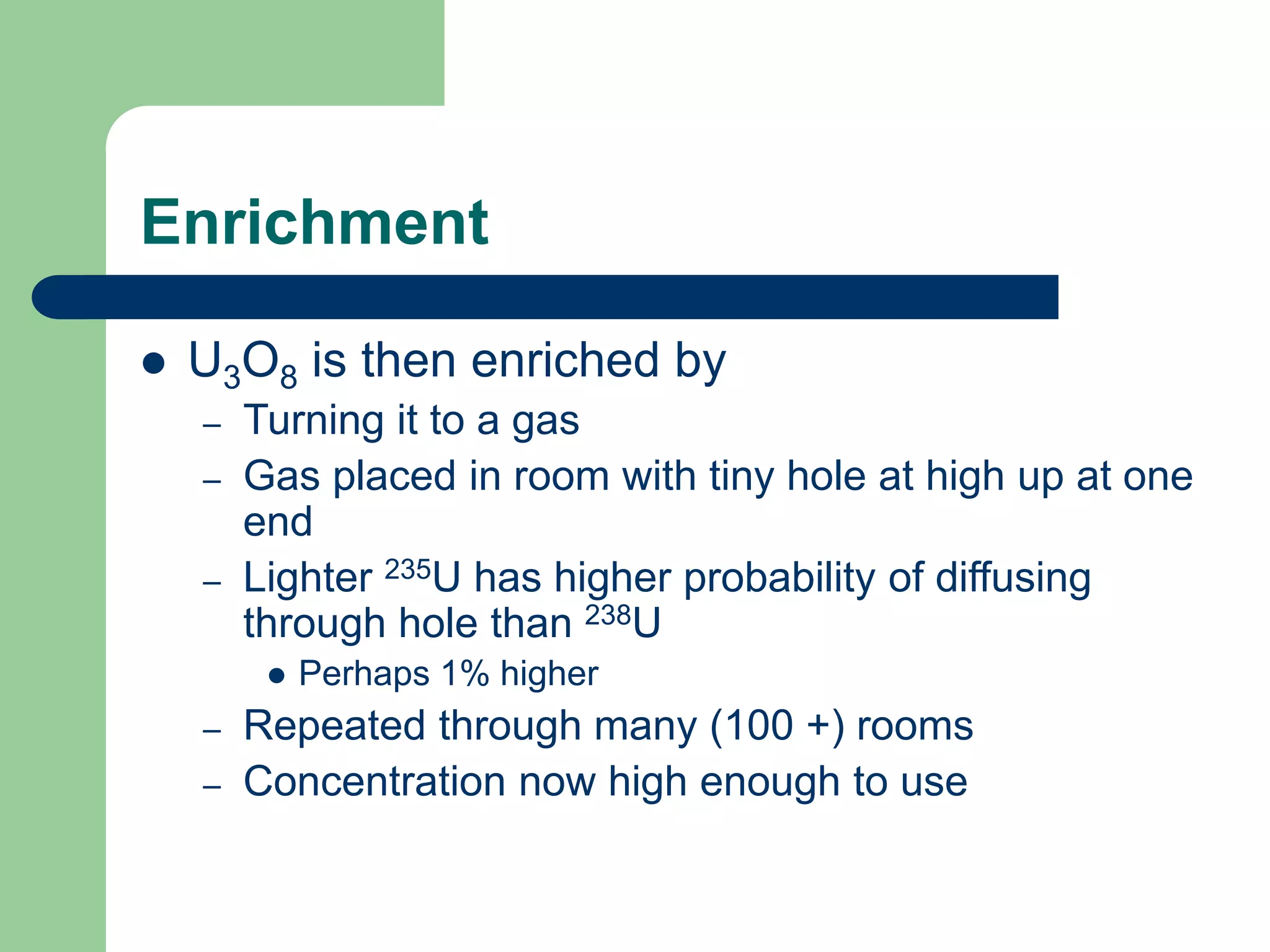
Enrichment
 U3O8 is then enriched by
– Turning it to a gas
– Gas placed in room with tiny hole at high up at one
end
– Lighter 235U has higher probability of diffusing
through hole than 238U
 Perhaps 1% higher
– Repeated through many (100 +) rooms
– Concentration now high enough to use
Nuclear
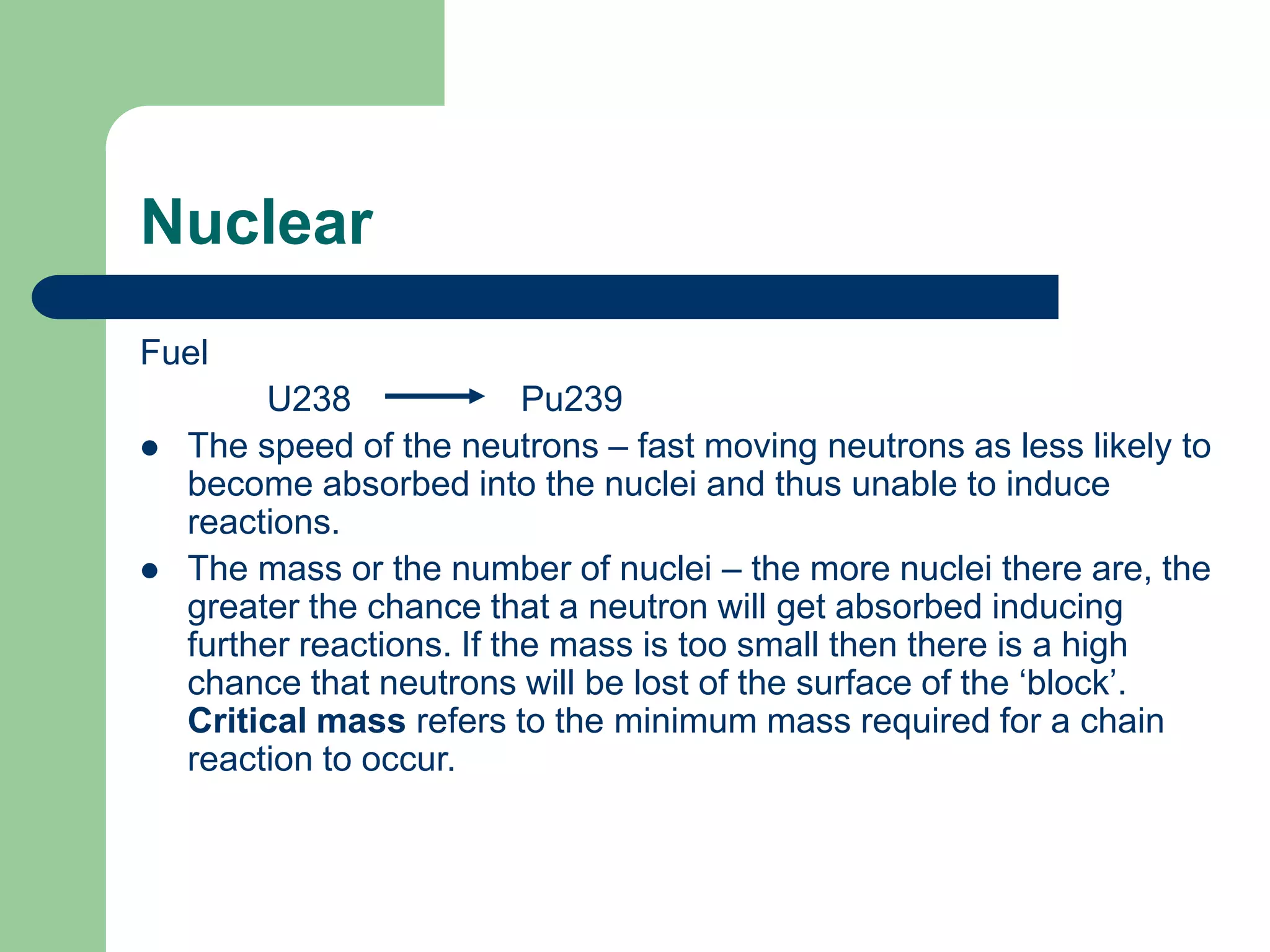
Fuel
U238 Pu239
 The speed of the neutrons – fast moving neutrons as less likely to
become absorbed into the nuclei and thus unable to induce
reactions.
 The mass or the number of nuclei – the more nuclei there are, the
greater the chance that a neutron will get absorbed inducing
further reactions. If the mass is too small then there is a high
chance that neutrons will be lost of the surface of the ‘block’.
Critical mass refers to the minimum mass required for a chain
reaction to occur.
Nuclear
Safety rods are also placed into the reactor so
that the reactor can be shut down if necessary
in a matter of seconds.
 They are triggered automatically if the coolant
pressure falls because of a pipe failure for
example.
Nuclear Fusion
 Nuclear Fusion is a nuclear reaction where nuclei are
join together or fuse producing heavier elements. The
reaction is only energetically possible (i.e. the reaction
is exothermic) if the binding energy per nucleon for the
reactants is less than the binding energy per nucleon
for the products
Wind
 Rotor blades - The
blades are what captures
the energy of the wind
and act like sails do on
boats. When the wind
forces the blades to
move, it has transferred
some of its energy to the
rotor.
Wind
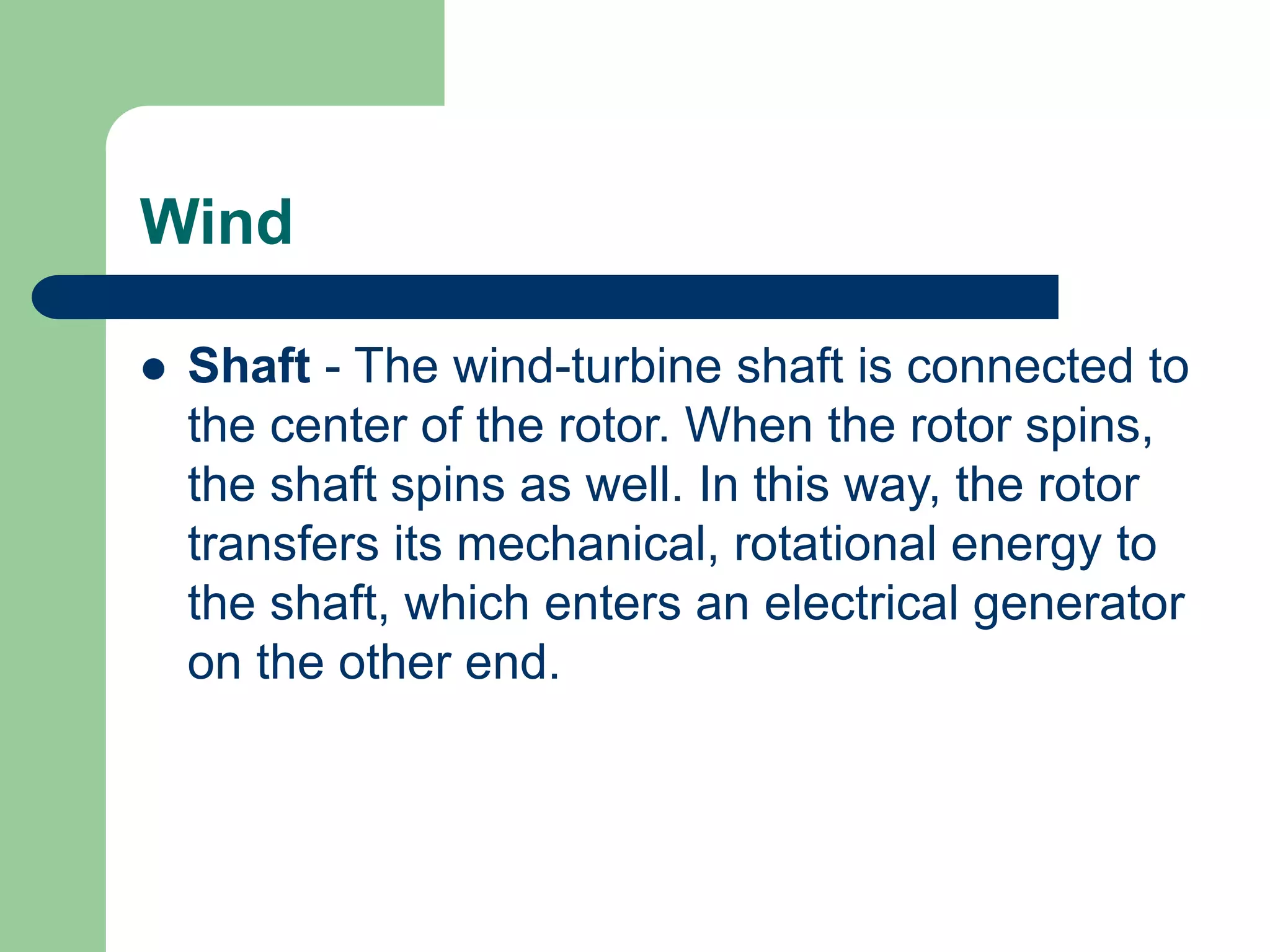
 Shaft - The wind-turbine shaft is connected to
the center of the rotor. When the rotor spins,
the shaft spins as well. In this way, the rotor
transfers its mechanical, rotational energy to
the shaft, which enters an electrical generator
on the other end.
Wind
 Generator -The generator uses the properties
of electromagnetic induction to produce
electrical voltage. A simple generator consists
of magnets and a conductor. The conductor is
typically a coiled wire. Inside the generator, the
shaft connects to an assembly of permanent
magnets that surrounds the coil of wire.
Wind
 In electromagnetic induction, if you have a
conductor surrounded by magnets, and one of
those parts is rotating relative to the other, it
induces voltage in the conductor. When the
rotor spins the shaft, the shaft spins the
assembly of magnets, generating voltage in the
coil of wire. That voltage drives electrical
current (typically alternating current, or AC
power) out through power lines for distribution.
Wind
 Wind power equation
P = ½ Aρv3
 At 33 mph, most large turbines generate their rated
power capacity, and at 45 mph (20 meters per second),
most large turbines shut down.
Wind
 There are a number of safety systems that can turn off
a turbine if wind speeds threaten the structure,
including a remarkably simple vibration sensor used in
some turbines that basically consists of a metal ball
attached to a chain, poised on a tiny pedestal.
 Probably the most commonly activated safety system
in a turbine is the "braking" system, which is triggered
by above-threshold wind speeds.
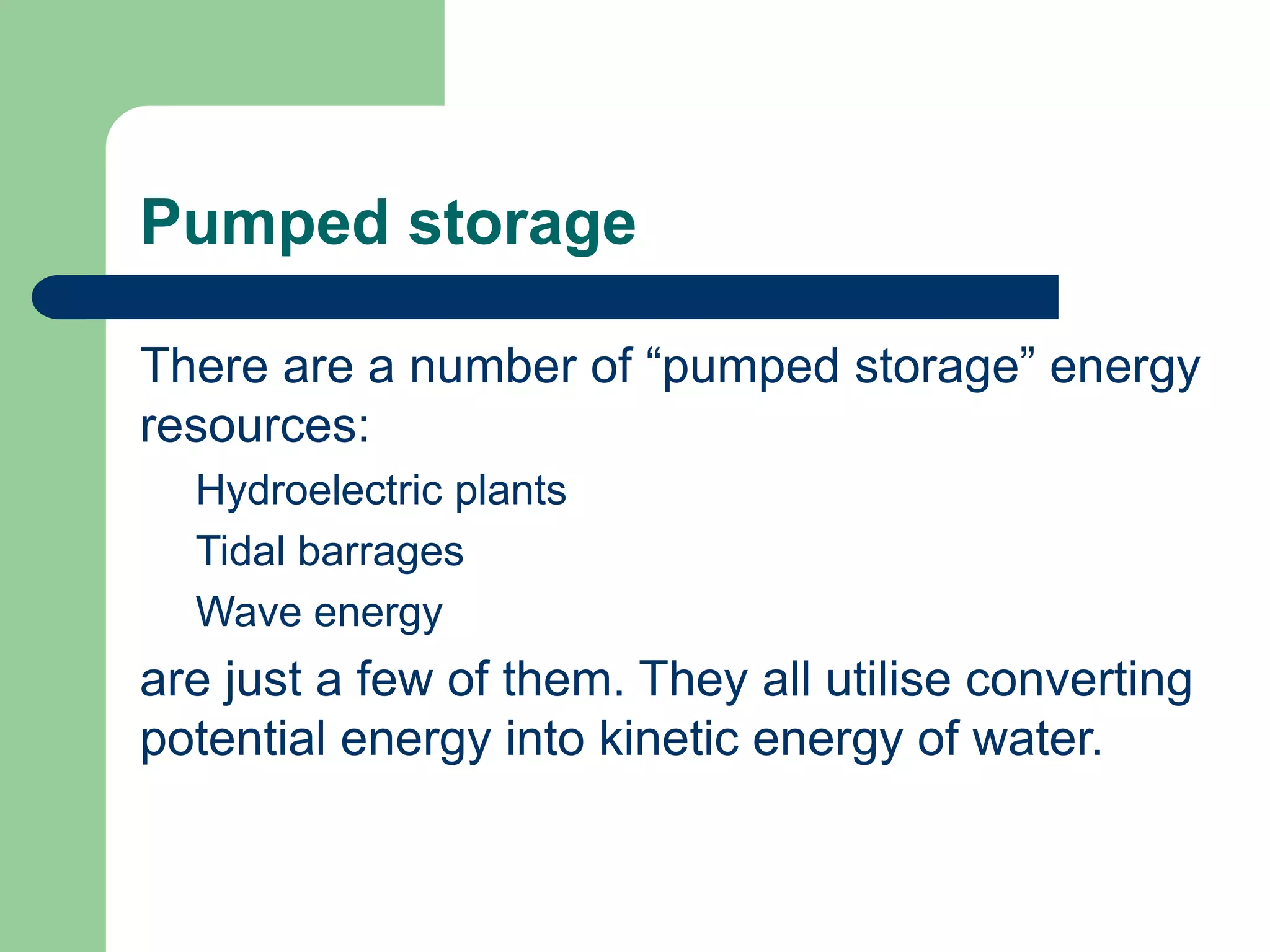
Pumped storage
There are a number of “pumped storage” energy
resources:
Hydroelectric plants
Tidal barrages
Wave energy
are just a few of them. They all utilise converting
potential energy into kinetic energy of water.
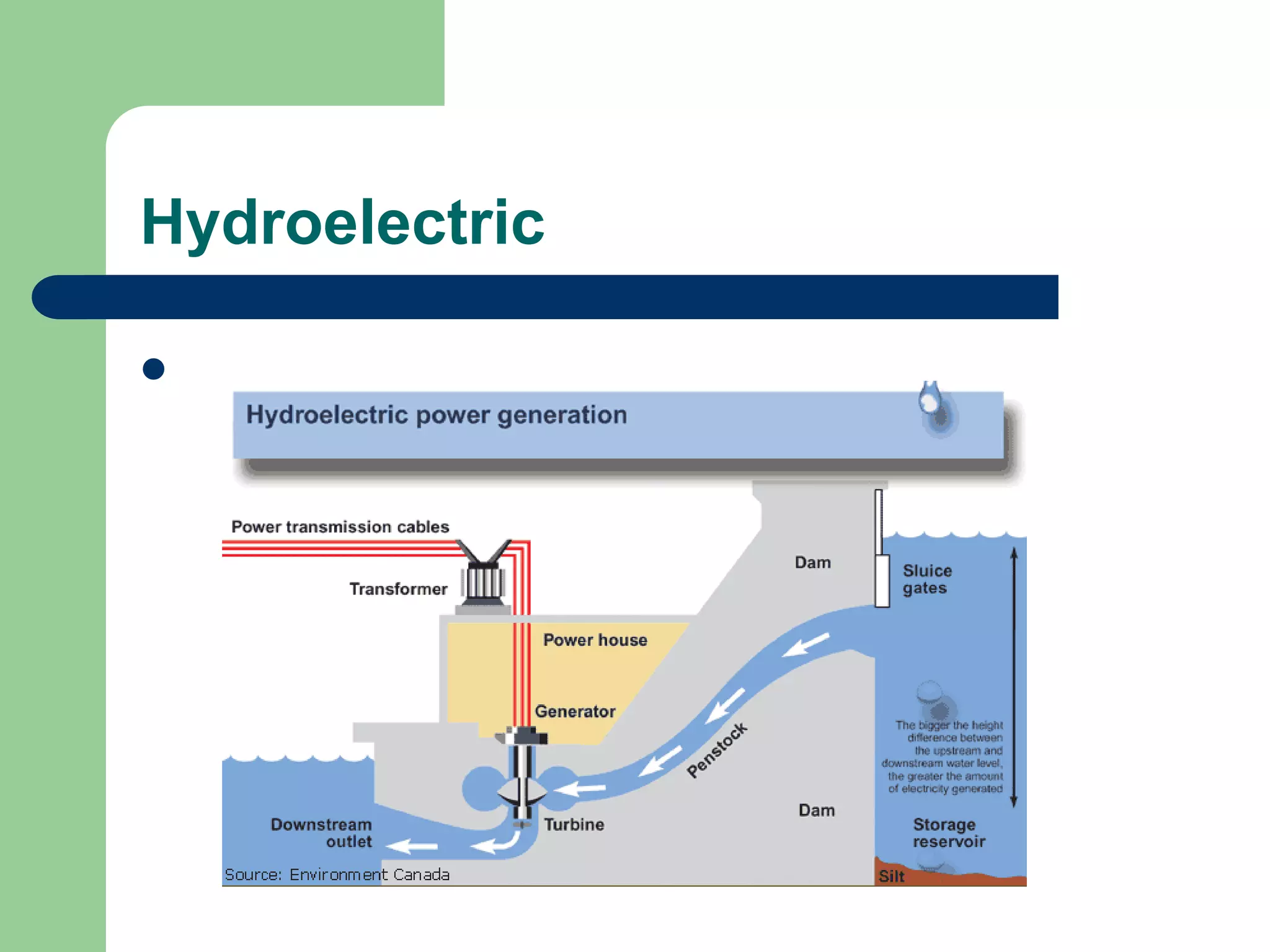
Hydroelectric

Hydroelectric
Water Storage in Lakes:
 The first, and probably most common method
of storing water is to damn an existing river in
order to increase it's height and thus the
potential for energy to be created.
Hydroelectric
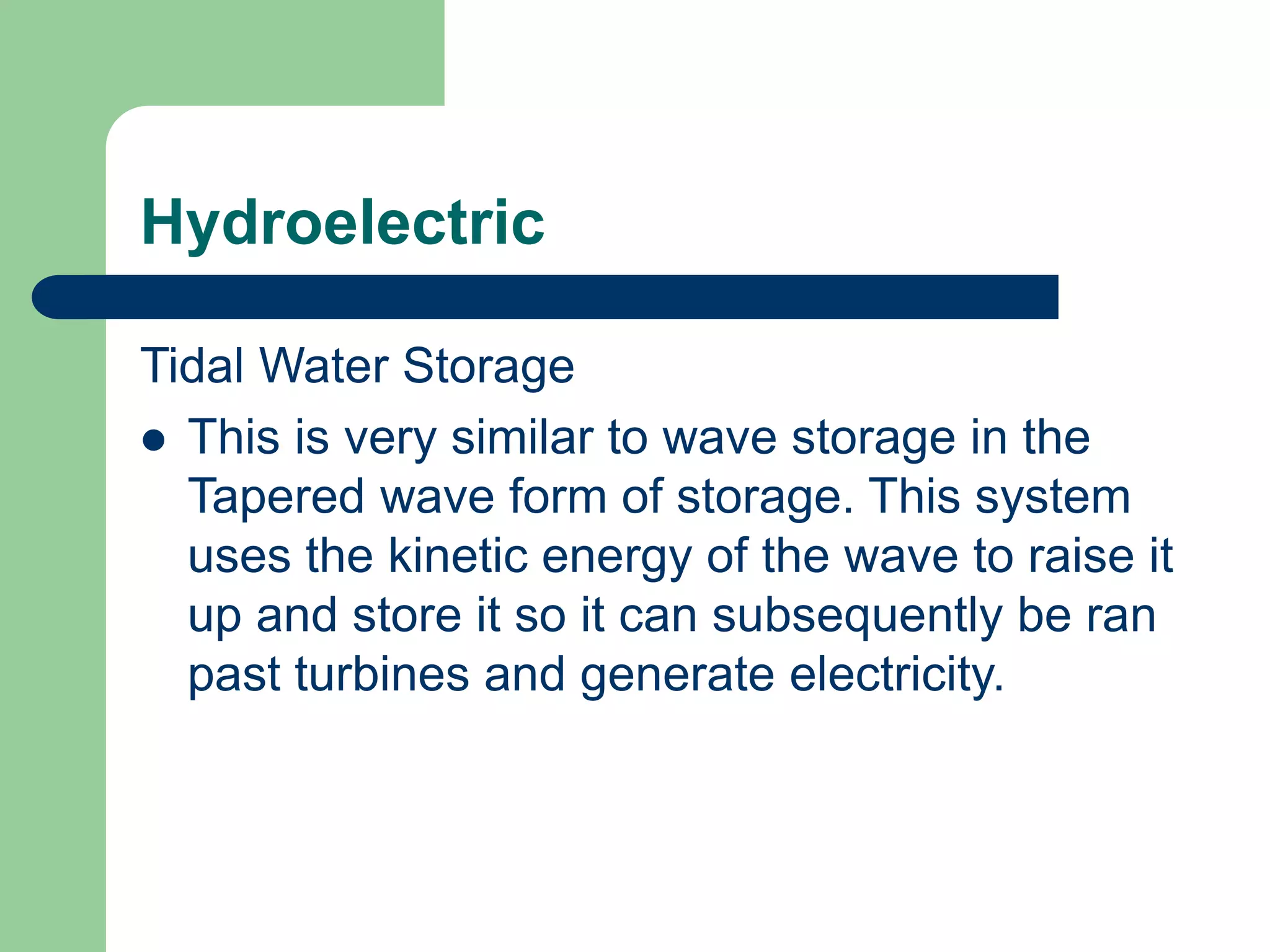
Tidal Water Storage
 This is very similar to wave storage in the
Tapered wave form of storage. This system
uses the kinetic energy of the wave to raise it
up and store it so it can subsequently be ran
past turbines and generate electricity.
Hydroelectric
Pump Storage
 Electric energy is used to pump water up to
reservoirs so it can then be run past turbines.
pump storage is only effective as long as the
energy output of the power plant is less than is
consumed to pump the water up to the
reservoir.
Solar
 Solar heaters use solar collectors to harness
solar radiation and convert to heat energy.
 Water is pumped through thin copper piping
embedded in a blackened copper plate with
rear insulation. On top of this is a glass plate.
 Water is piped through and heated by the
infrared radiation.
 Examples – parabolic dish, solar furnace
Solar Panels
 Solar panels (arrays of photovoltaic cells) make use of
renewable energy from the sun, and are a clean and
environmentally sound means of collecting solar
energy.
 Solar panels are made by semiconductor such as
silicon. Normally, electricity can't get through
semiconductors, but when the semiconductor is heated
i.e by the sun, electricity can go through.
 When the sun shines on solar panels, the electrons are
excited and start to move along a conducting wire, this
flow of electrons generates electricity.
Solar
 Photovoltaic cells
PV Cell
 A photovoltaic cell (PV cell) is a semiconductor diode
that converts visible light into direct current (DC)
(electricity). Some PV cells can also convert infrared
(IR) or ultraviolet (UV) radiation into DC electricity.
 These cells are what convert the energy from the sun
into electricity creating this solar power energy source.
PV cells are what make up solar panels as solar
panels are many PV cells connected together.
Semiconductor
 Photovoltaic (PV) cells are made of special materials
called semiconductors such as silicon, which is
currently the most commonly used.
 A semiconductor is a solid material that has electrical
conductivity between that of an insulator and a
conductor. When light shines on the cell, a certain
portion of it is absorbed within the semiconductor
material. This means that the energy of the absorbed
light is transferred to the semiconductor. The energy
knocks electrons loose, allowing them to flow freely.
This free flow of electrons is what creates electricity.
Semiconductor
Two types of semiconductor
 p-type
 n-type
Doping silicon with a group 3 element results in
an electron deficient layer (p-type), with a
group 5 element results in an electron rich
layer (n-type).
Semiconductor
n-type
Electron rich therefore electron can move around
p-type
Electron moves from hole to hole
This produces a potential difference
Why Use Solar?
Advantages:
 Solar power is a clean energy source and so it
doesn't create any greenhouse gases and pollute
the planet.
 Solar power is a renewable energy source and so
we won't run out of it unlike for example, coal for
which there is a finite amount.
 Enables self sustainability - once the panels are
installed the system will generate its own
electricity so there will be no need to buy any fuel
etc. however there will be maintenance costs.
Why Use Solar?
Disadvantages
 Solar power is not as efficient as other power
sources so not as much energy can be produced
with the current technology.
 Solar power is expensive compared to other power
sources and this can discourage people from
wanting to use it as the initial installation expenses
of buying and setting up the solar panels is too
much.
Solar
Seasonal/regional variation is due to:
Solar constant
Earth’s distance from Sun
Altitude of Sun in sky
Length of night/day

8.1 energy sources

  • 1.
  • 2.
    World energy Sources In2006, about 18% of global final energy consumption came from renewables. How much progress have we made? Image from wikipedia
  • 3.
    World energy Sources Whouses the most? What questions do you need to ask to explore this in detail?
  • 4.
    World energy Sources Does it matter where you are geographically?
  • 5.
    Energy types  Kinetic Potential  Thermal  Sound  Light (Electromagnetic)  Electrical  Magnetic  Nuclear  Chemical
  • 6.
    Energy degradation  Everytime energy is converted from one form to another thermal energy will be lost  Conversion of energy into work is a cyclical process  Energy transferred to surroundings is no longer able to do useful work
  • 7.
    Energy density offuel  Energy density is the amount of energy stored in a given system or region of space per unit volume or per unit mass  J/kg  Need to be able to do calculations
  • 8.
    Energy conversion oftypical fuels Firewood 16 MJ/kg Brown coal 9 MJ/kg Black coal (low quality) 13-20 MJ/kg Black coal 24-30 MJ/kg Natural Gas 39 MJ/m3 Crude Oil 45-46 MJ/kg Uranium* - in light water reactor 500,000 MJ/kg
  • 9.
    Advantage Disadvantage Oil widelyaccepted in manufacturing , relatively cheap and high efficiency CO2 emission, greenhouse effect. Gas high efficiency expensive to transport and store, CH4 contributes to greenhouse effect. Coal widely accepted in manufacturing, cheapest among the three non- renewable energy source low efficiency, air pollution, CO2 and CO emission, greenhouse effect. Solar easy to get sun light, renewable energy source expensive to use solar panel and grid, unstable in modern due to the changeable weather Wind easy to get wind, renewable energy source noise, spoil scenery, expensive maintaining fees Biofuel clean, renewable energy source expensive in refining process Geothermal stable, renewable energy source expensive to build, the technology has not been very mature yet Hydropower functional. very useful to avoid flooding in some countries, renewable energy source very expensive to build, expensive to maintain, drought, harm the river eco-system
  • 10.
    Sankey diagrams  ASankey diagram show energy transfers in a scale diagram  Arrowheads are in proportion to value  You need to be able to draw these from data
  • 11.
    Sankey diagrams  Forfossil fuel power stations
  • 12.
  • 13.
  • 14.
  • 15.
  • 16.
    What is renewable? Reusable  Bountiful  Short time to regenerate  Cheap  Life time to regenerate  Something else?
  • 17.
    History of fossilfuel power production  Industrialisation  Higher energy consumption  Industry near to fossil fuel deposits
  • 18.
  • 19.
    Coal Power is generatedvia a power plant in the following way:  Coal and lmestone is injected into a bed furnace.  The ash from the coal is removed from the plant and then disposed of.  This furnace is used to heat a large container of water.  this water then is turned into steam and then pushed at high speed through a turbine.  The turbine turns a Generator.  This generates a huge amount of electricity and is then carried off by the substandard power grid that is often shut off so that victoria still has its power  The steam is then filtered in a number particulate controllers and any remaining ash is then removed.  A fan then blows the steam out into the atmosphere.
  • 20.
    Coal-emissions  Carbon DioxideCoal is the largest of the Carbon Dioxide Contribution  Methane Most harmful of the Greenhouse Gasses  Ashes  Sludge  Flue Gas  Mercury  Uranium  Arsenic  Thorium  Assorted Heavy Metals
  • 21.
    Coal-costs  Economic – Coal –Plants – Labor – Transport  Social – Health  Cancers caused – Environmental  Smog  Waste Products  Mining
  • 22.
  • 23.
    Oil How Oil FuelledPower Station Works:  The combustion of heavy oil turns the water in the boiler into steam  This is then collected in the boiler drum.  The steam is then returned to the boiler where it is superheated, dried, and directed towards the turbines.  As it expands, the steam spins the turbine which drives the generator.  After leaving the turbines, the steam passes through condensers which return it to a liquid state  The water is pumped back into the boiler.  This cycle is repeated.
  • 24.
    Oil-emissions  Carbon Dioxide Methane Most harmful of the Greenhouse Gasses  Ashes  Sludge  Flue Gas  Mercury  Uranium  Arsenic  Thorium  Assorted Heavy Metals
  • 25.
    Oil-costs Economic  Oil  Plants Labour  Transport Social  Health – Cancers caused  Environmental – Smog – Waste Products – Mining
  • 26.
  • 27.
    Gas  The combustionof natural gas turns the water in the boiler into steam  This is then collected in the boiler drum.  The steam is then returned to the boiler where it is superheated, dried, and directed towards the turbines.
  • 28.
    Gas  As itexpands, the steam spins the turbine which drives the generator.  After leaving the turbines, the steam passes through condensers which return it to a liquid state  The water is pumped back into the boiler.  This cycle is repeated.
  • 29.
    Gas-emissions  Carbon Dioxide Methane Most harmful of the Greenhouse Gasses  Ashes  Sludge  Flue Gas  Mercury  Uranium  Arsenic  Thorium  Assorted Heavy Metals
  • 30.
    Gas-costs  Economic – Oil –Plants – Labour – Transport  Social – Health  Cancers caused – Environmental  Smog  Waste Products  Mining
  • 31.
    Fossil fuel usage Why is fossil fuel use widespread?  What is the energy density of each fossil fuel?  What are the advantages of fossil fuel use?  What are the disadvantages of fossil fuel use?  What is the efficiency of fossil fuel power stations?  What are the environmental concerns?
  • 32.
    Nuclear  Nuclear poweris term used to describe the process that harness the energy produced in nuclear reactions. In nuclear reactions, the atomic energy within atomic nuclei is transformed into other forms of energy, mainly thermal energy. This is commonly done through the process of nuclear fission however nuclear reactions can also be done through the process of nuclear fusion and radioactive decay.
  • 33.
    Nuclear  Nuclear powerhas many applications for current and future uses. This is because of the large amounts of energy if transformed in these reactions in comparison to other sources of energy per unit mass. This makes it ideal for nuclear marine propulsion, to generate electricity for humanity's energy needs or even to fuel nuclear weapons.
  • 34.
    Nuclear Fission  NuclearFission is a nuclear reaction where the nucleus of an atom is split into smaller particles producing lighter elements. The reaction is only energetically possible (i.e. the reaction is exothermic) if the binding energy per nucleon for the reactants is greater than the binding energy per nucleon for the products
  • 35.
    Nuclear Fission  Thereaction is initiated by bombarding the nuclei with neutrons. This type of nuclear reaction is used in nuclear power plants which harness the energy to produce electricity.
  • 36.
    Nuclear Key components  Moderator Energy transfer  Control rods  Heat exchangers
  • 37.
    Nuclear Retractable Control Rods These are used to absorb free neutrons and prevent further fission events. Control rods, placed between the fissile uranium are retractable to expose more uranium and speed up the reaction or they can be injected to cover the uranium fuel rods and slow down the reaction.
  • 38.
    Nuclear Moderator  A moderatoris a liquid medium, usually light or heavy water, that surrounds the uranium fuel rods in order to slow down the free neutrons so that they can be absorbed into uranium atoms more easily inducing fission, speeding up the reaction. If the moderator is at a higher temperature then usual, then the liquid becomes less dense, thus slowing down less neutrons.
  • 39.
    Nuclear Energy transfer Approximately 70%of the energy released from the reaction is wasted leaving only 30% transformed into electricity, however the energy content is far superior to conventional sources such as coal for an equivalent mass on the order of 10^7 times greater. Each fission event releases about two hundred million eV of energy
  • 40.
    Nuclear Enrichment of uraniumoccurs so that the percentage of uranium-235 is increased to 2 or 3%.  This allows the reaction to keep its ‘critical mass’ (the mass required to keep the chain reaction going).  The method used to enrich the uranium relies on the different masses of the isotopes. This takes many stages and is very costly.
  • 41.
    Enrichment  U3O8 isthen enriched by – Turning it to a gas – Gas placed in room with tiny hole at high up at one end – Lighter 235U has higher probability of diffusing through hole than 238U  Perhaps 1% higher – Repeated through many (100 +) rooms – Concentration now high enough to use
  • 42.
    Nuclear Fuel U238 Pu239  Thespeed of the neutrons – fast moving neutrons as less likely to become absorbed into the nuclei and thus unable to induce reactions.  The mass or the number of nuclei – the more nuclei there are, the greater the chance that a neutron will get absorbed inducing further reactions. If the mass is too small then there is a high chance that neutrons will be lost of the surface of the ‘block’. Critical mass refers to the minimum mass required for a chain reaction to occur.
  • 43.
    Nuclear Safety rods arealso placed into the reactor so that the reactor can be shut down if necessary in a matter of seconds.  They are triggered automatically if the coolant pressure falls because of a pipe failure for example.
  • 45.
    Nuclear Fusion  NuclearFusion is a nuclear reaction where nuclei are join together or fuse producing heavier elements. The reaction is only energetically possible (i.e. the reaction is exothermic) if the binding energy per nucleon for the reactants is less than the binding energy per nucleon for the products
  • 46.
    Wind  Rotor blades- The blades are what captures the energy of the wind and act like sails do on boats. When the wind forces the blades to move, it has transferred some of its energy to the rotor.
  • 47.
    Wind  Shaft -The wind-turbine shaft is connected to the center of the rotor. When the rotor spins, the shaft spins as well. In this way, the rotor transfers its mechanical, rotational energy to the shaft, which enters an electrical generator on the other end.
  • 48.
    Wind  Generator -Thegenerator uses the properties of electromagnetic induction to produce electrical voltage. A simple generator consists of magnets and a conductor. The conductor is typically a coiled wire. Inside the generator, the shaft connects to an assembly of permanent magnets that surrounds the coil of wire.
  • 49.
    Wind  In electromagneticinduction, if you have a conductor surrounded by magnets, and one of those parts is rotating relative to the other, it induces voltage in the conductor. When the rotor spins the shaft, the shaft spins the assembly of magnets, generating voltage in the coil of wire. That voltage drives electrical current (typically alternating current, or AC power) out through power lines for distribution.
  • 50.
    Wind  Wind powerequation P = ½ Aρv3  At 33 mph, most large turbines generate their rated power capacity, and at 45 mph (20 meters per second), most large turbines shut down.
  • 51.
    Wind  There area number of safety systems that can turn off a turbine if wind speeds threaten the structure, including a remarkably simple vibration sensor used in some turbines that basically consists of a metal ball attached to a chain, poised on a tiny pedestal.  Probably the most commonly activated safety system in a turbine is the "braking" system, which is triggered by above-threshold wind speeds.
  • 52.
    Pumped storage There area number of “pumped storage” energy resources: Hydroelectric plants Tidal barrages Wave energy are just a few of them. They all utilise converting potential energy into kinetic energy of water.
  • 53.
  • 54.
    Hydroelectric Water Storage inLakes:  The first, and probably most common method of storing water is to damn an existing river in order to increase it's height and thus the potential for energy to be created.
  • 55.
    Hydroelectric Tidal Water Storage This is very similar to wave storage in the Tapered wave form of storage. This system uses the kinetic energy of the wave to raise it up and store it so it can subsequently be ran past turbines and generate electricity.
  • 56.
    Hydroelectric Pump Storage  Electricenergy is used to pump water up to reservoirs so it can then be run past turbines. pump storage is only effective as long as the energy output of the power plant is less than is consumed to pump the water up to the reservoir.
  • 57.
    Solar  Solar heatersuse solar collectors to harness solar radiation and convert to heat energy.  Water is pumped through thin copper piping embedded in a blackened copper plate with rear insulation. On top of this is a glass plate.  Water is piped through and heated by the infrared radiation.  Examples – parabolic dish, solar furnace
  • 58.
    Solar Panels  Solarpanels (arrays of photovoltaic cells) make use of renewable energy from the sun, and are a clean and environmentally sound means of collecting solar energy.  Solar panels are made by semiconductor such as silicon. Normally, electricity can't get through semiconductors, but when the semiconductor is heated i.e by the sun, electricity can go through.  When the sun shines on solar panels, the electrons are excited and start to move along a conducting wire, this flow of electrons generates electricity.
  • 59.
  • 60.
    PV Cell  Aphotovoltaic cell (PV cell) is a semiconductor diode that converts visible light into direct current (DC) (electricity). Some PV cells can also convert infrared (IR) or ultraviolet (UV) radiation into DC electricity.  These cells are what convert the energy from the sun into electricity creating this solar power energy source. PV cells are what make up solar panels as solar panels are many PV cells connected together.
  • 61.
    Semiconductor  Photovoltaic (PV)cells are made of special materials called semiconductors such as silicon, which is currently the most commonly used.  A semiconductor is a solid material that has electrical conductivity between that of an insulator and a conductor. When light shines on the cell, a certain portion of it is absorbed within the semiconductor material. This means that the energy of the absorbed light is transferred to the semiconductor. The energy knocks electrons loose, allowing them to flow freely. This free flow of electrons is what creates electricity.
  • 62.
    Semiconductor Two types ofsemiconductor  p-type  n-type Doping silicon with a group 3 element results in an electron deficient layer (p-type), with a group 5 element results in an electron rich layer (n-type).
  • 63.
    Semiconductor n-type Electron rich thereforeelectron can move around p-type Electron moves from hole to hole This produces a potential difference
  • 64.
    Why Use Solar? Advantages: Solar power is a clean energy source and so it doesn't create any greenhouse gases and pollute the planet.  Solar power is a renewable energy source and so we won't run out of it unlike for example, coal for which there is a finite amount.  Enables self sustainability - once the panels are installed the system will generate its own electricity so there will be no need to buy any fuel etc. however there will be maintenance costs.
  • 65.
    Why Use Solar? Disadvantages Solar power is not as efficient as other power sources so not as much energy can be produced with the current technology.  Solar power is expensive compared to other power sources and this can discourage people from wanting to use it as the initial installation expenses of buying and setting up the solar panels is too much.
  • 66.
    Solar Seasonal/regional variation isdue to: Solar constant Earth’s distance from Sun Altitude of Sun in sky Length of night/day