This document discusses the photoelectric effect and how it relates to classical and quantum theories of light. It begins by describing early observations of the photoelectric effect and how it works. It then outlines several predictions of classical theory that did not match experimental observations, such as intensity of light not affecting electron kinetic energy. Einstein's explanation using a quantum theory approach is then presented, introducing the concept of photons. Several actual observations from experiments are then matched to explanations using quantum theory. The document concludes by discussing de Broglie's hypothesis of matter waves and how particles can behave as waves.
Overview of the interaction of matter with radiation in Quantum and Nuclear Physics.
The photoelectric effect explains how light ejects electrons from metal surfaces, with historical examples.
Explains classical theory predictions about light's interaction with electrons, showing discrepancies with observations.
Detailed explanation of the photoelectric effect through quantum theory, introducing photons and energy relationships.
Discusses key observations in the photoelectric effect aligned with quantum theory versus classical predictions.
Describes apparatus and experiments confirming Einstein's model, focusing on photoelectric emission characteristics.
Summarizes key points of the photoelectric effect, emphasizing relationships between light intensity, frequency, and electron emission.
Introduces the dual behavior of light and particles, prompting examination of de Broglie’s hypothesis on matter waves.
Calculations for determining de Broglie wavelengths for various particles, illustrating quantum principles.Details of the Davisson-Germer experiment observing electron diffraction, supporting the wave nature of matter.
Describes Bohr's model, quantum energy levels, and corresponding atomic phenomena, emphasizing quantization.Explains the concepts of pair production and annihilation in particle physics and characteristics of antimatter.
Discusses quantization principles in atomic models and Schrödinger's contributions to wave function theory.
Introduces Schrödinger's wave function, explaining electron behavior within atoms and probabilistic nature of particles.
Discusses Heisenberg's uncertainty principle, illustrating limits of measurement in quantum mechanics.
Explains quantum tunneling, its implications in classical physics, and examples like fusion in the sun.
THE PHOTOELECTRIC EFFECT
Early last century, several people had noticed that
light was capable of ejecting electrons from various
metal surfaces.
This effect, known as the photoelectric effect, is
used in photographer’s light meters, sound tracks of
motion pictures and electric eyes used to
automatically open doors.
Photoelectric Effect
3.
THE PHOTOELECTRIC EFFECT
Remember that metals have “free”
electrons that are not tightly
bound. It is these electrons that
allow current and heat to flow in a
metal, as the electron’s move.
4.
THE PHOTOELECTRIC EFFECT
Examplesof the freeing of electrons from
light energy…
Hertz, in 1887, noticed that a spark would
jump between electrodes if exposed to UV
light (electrons being released from the
electrode).
Other scientists noticed that the leaves of a
negatively charged electroscope diverged less
over time while a positively charged
electroscope did not.
5.
THE PHOTOELECTRIC EFFECT
Thiswas due to the electrons
“leaking” away from the
electroscope as the light
energy struck the top plate,
allowing the electrons to
escape.
6.
CLASSICAL THEORY
We willnow look at the predictions
made for light using classical (light
behaving as a wave) physics and the
actual observations that were made
in experiments.
7.
CLASSICAL THEORY
CLASSICAL PREDICTION:
Themore intense
(brighter) the light, the
greater the kinetic
energy of ejection of
the electron. Bright
light would eject
electrons at high speed
ACTUAL OBSERVATION:
Intensity (brightness) did
not lead to high
velocity electrons.
Instead it led to a
greater numbers of
electrons being
ejected from the
metal.
8.
CLASSICAL THEORY
CLASSICAL PREDICTION:
Morephotoelectrons should be ejected by
low frequency radiation (i.e. red) than by
high frequency radiation.
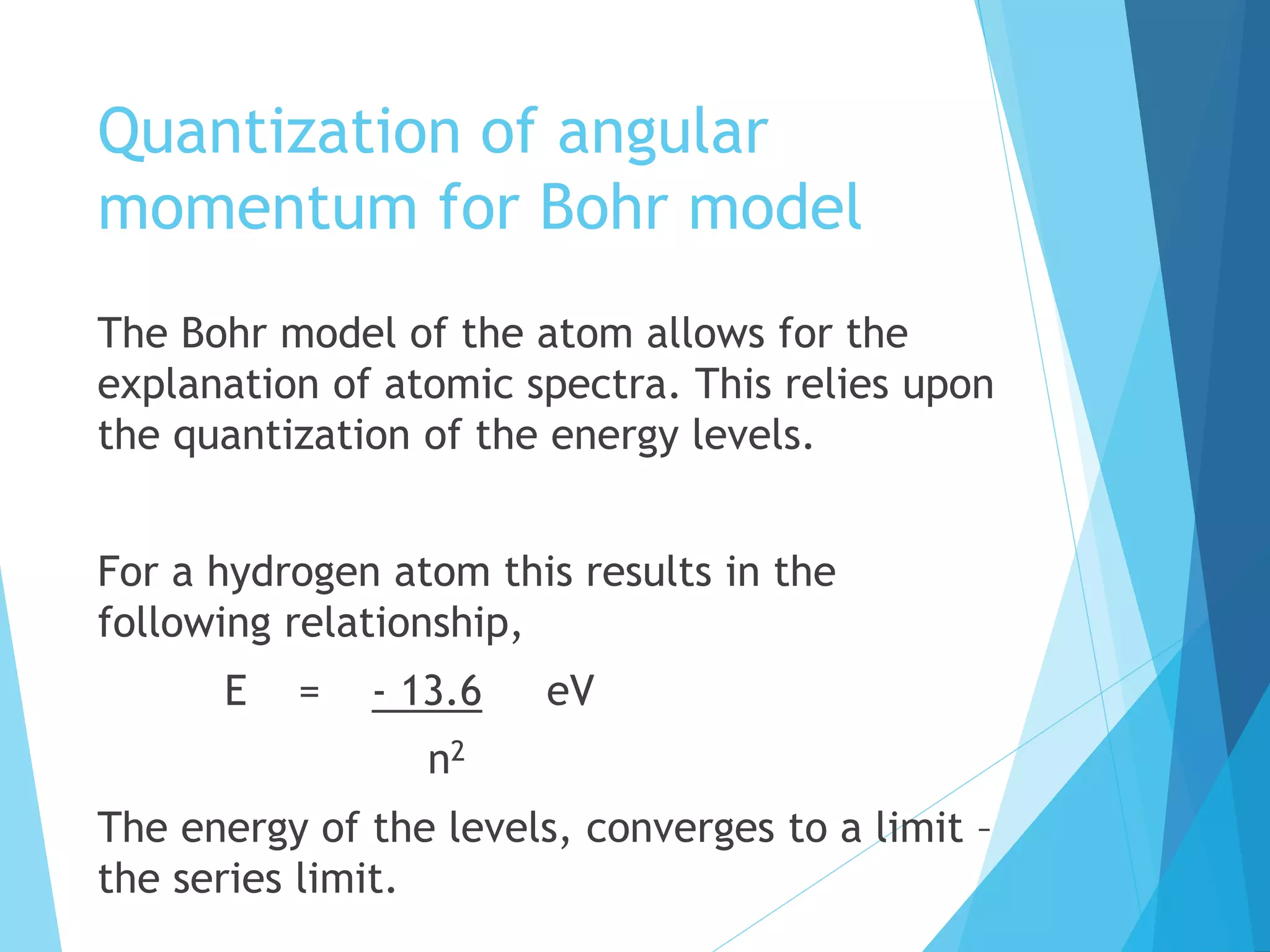
e-m waves are oscillating electric and
magnetic fields.
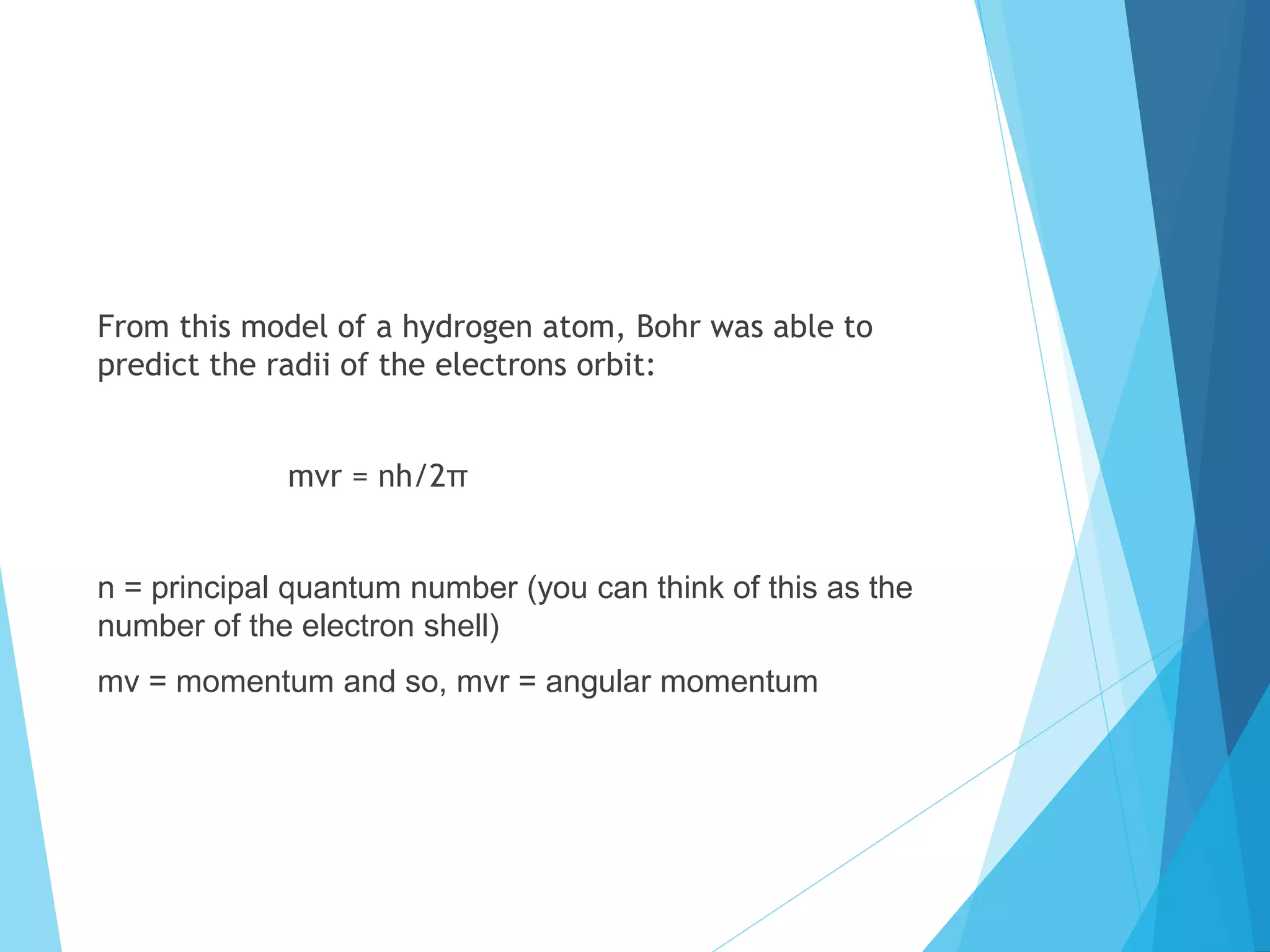
Low frequency waves allow more time for the
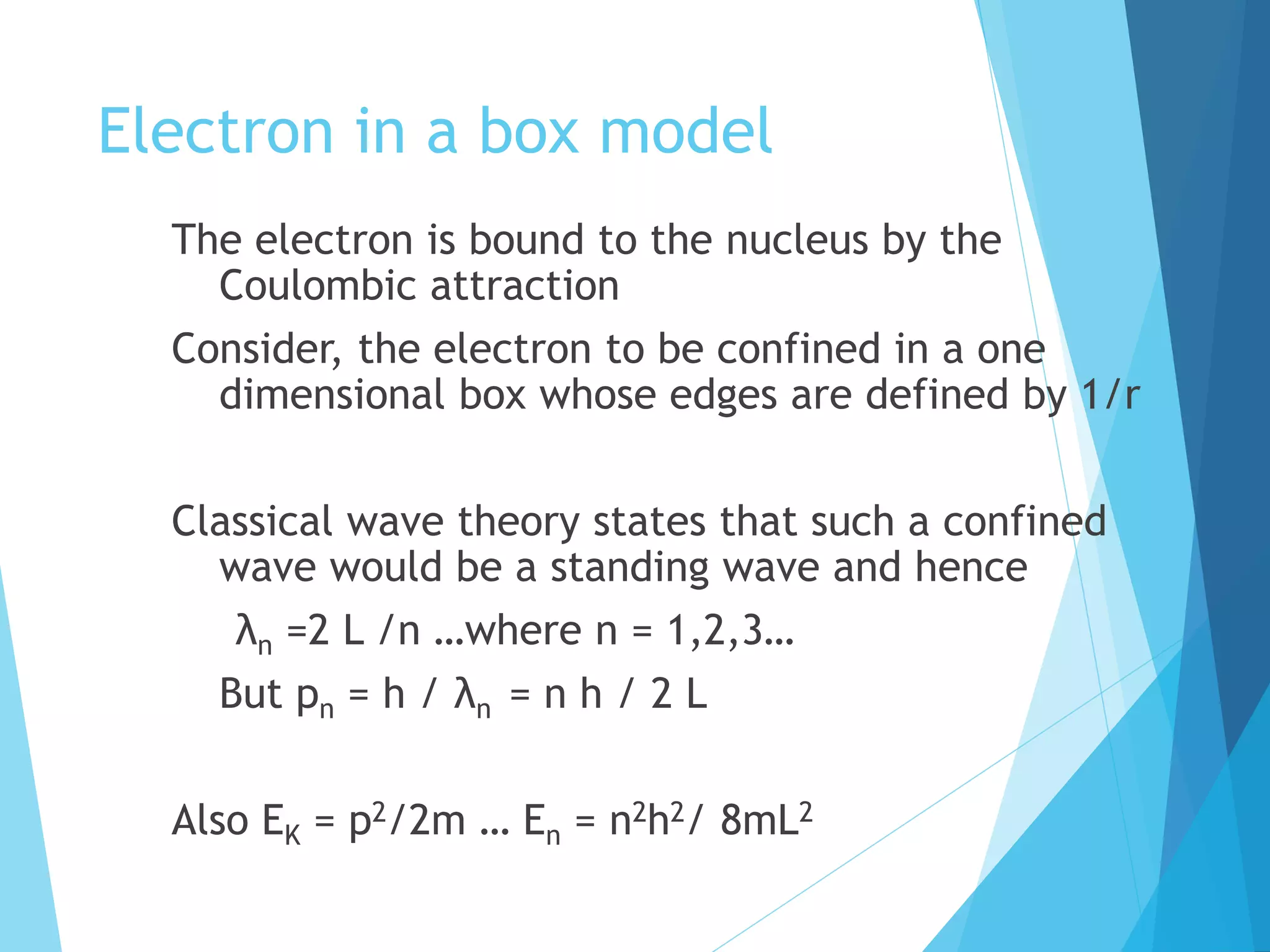
electron to move in one direction before
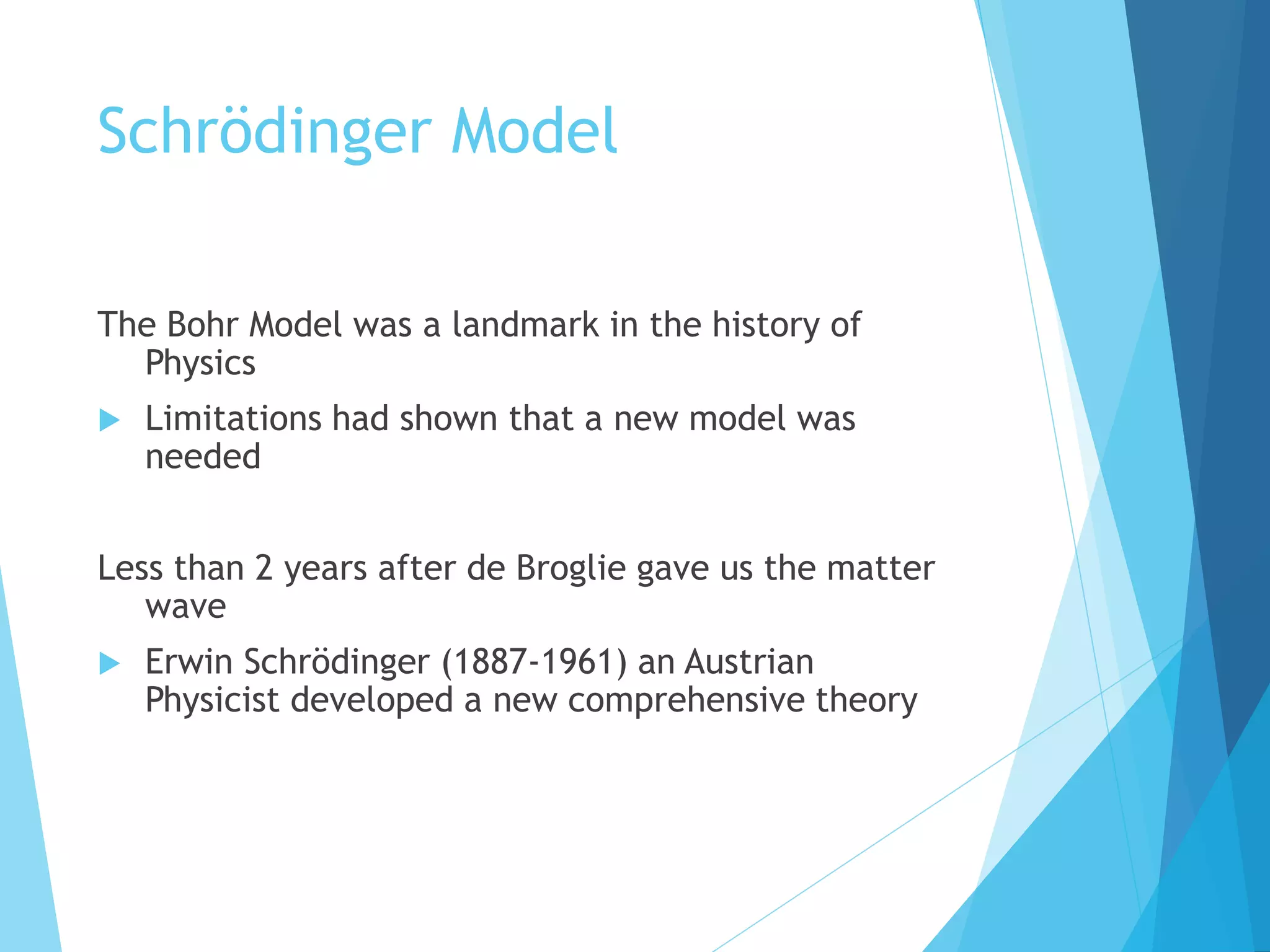
the field reverses and the electron moves
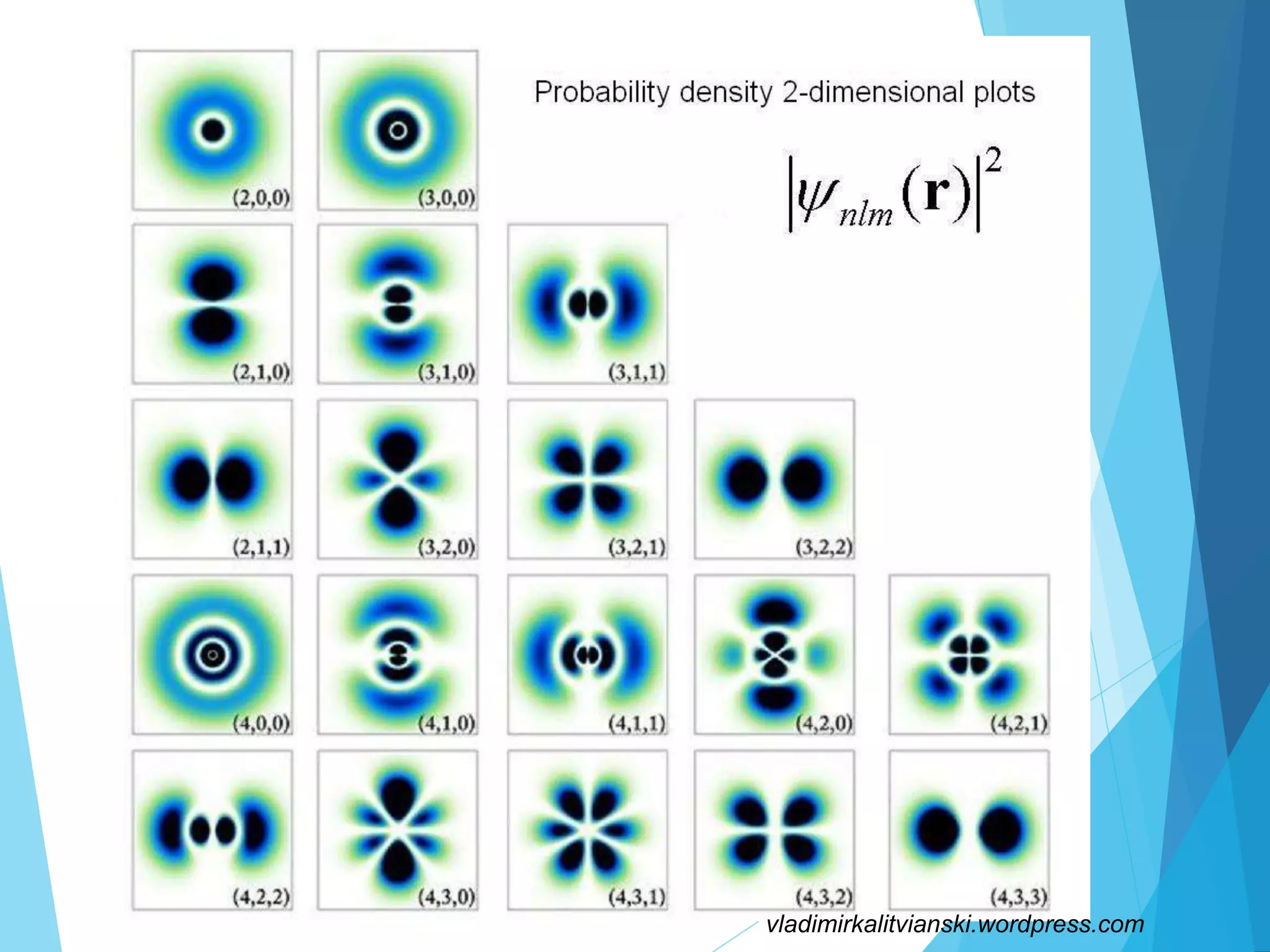
in the opposite direction.
High frequency waves would move so fast the
electron would hardly begin to move in
one direction before it was forced to
reverse direction - not ideal for ejection.
ACTUAL OBSERVATION:
Experiments showed that high
frequency (UV) radiation
ejected photoelectrons more
readily than low frequency.
There was a minimum frequency
below which no
photoelectrons were ejected.
This was called the threshold
frequency which is different
for different materials.
9.
CLASSICAL THEORY
CLASSICAL PREDICTION:
Thereshould be a time
delay between when a
radiation is incident on
a surface and when the
photoelectrons are
ejected (See point 2)
ACTUAL OBSERVATION:
Photoelectrons were
ejected
instantaneously.
10.
CLASSICAL THEORY
CLASSICAL PREDICTION:
Theradiation’s wavefront
falls over the whole
surface, billions of
photoelectrons should
be simultaneously
ejected.
ACTUAL OBSERVATION:
By limiting the amount
of light on a surface,
a single electron
could be ejected.
11.
CLASSICAL THEORY
CLASSICAL PREDICTION:
Onevelocity of ejection
should be possible for
radiation of one
frequency.
ACTUAL OBSERVATION:
Emitted photoelectrons
have a range of
ejection velocities
and energies.
12.
CLASSICAL THEORY
The observationsmade on the previous
slides do NOT AGREE with the predictions
made by the Classical Theory.
Photoelectric Effect - Changing Variables
Photoelectric Effect - Changing Variables
2
How can we resolve this?
13.
EINSTEIN’S EXPLANATION -
PHOTOELECTRICEFFECT
In 1905 Einstein adopted quantum theory to
explain the photoelectric effect and was
awarded a Nobel Prize for Physics in 1921.
Planck also used quantum theory to explain the
photoelectric effect. He said that the
quantum effect occurred at the point where
the radiation struck the electrons. The
electron would only accept a discrete amount
of energy from the incident radiation.
14.
EINSTEIN’S EXPLANATION -
PHOTOELECTRICEFFECT
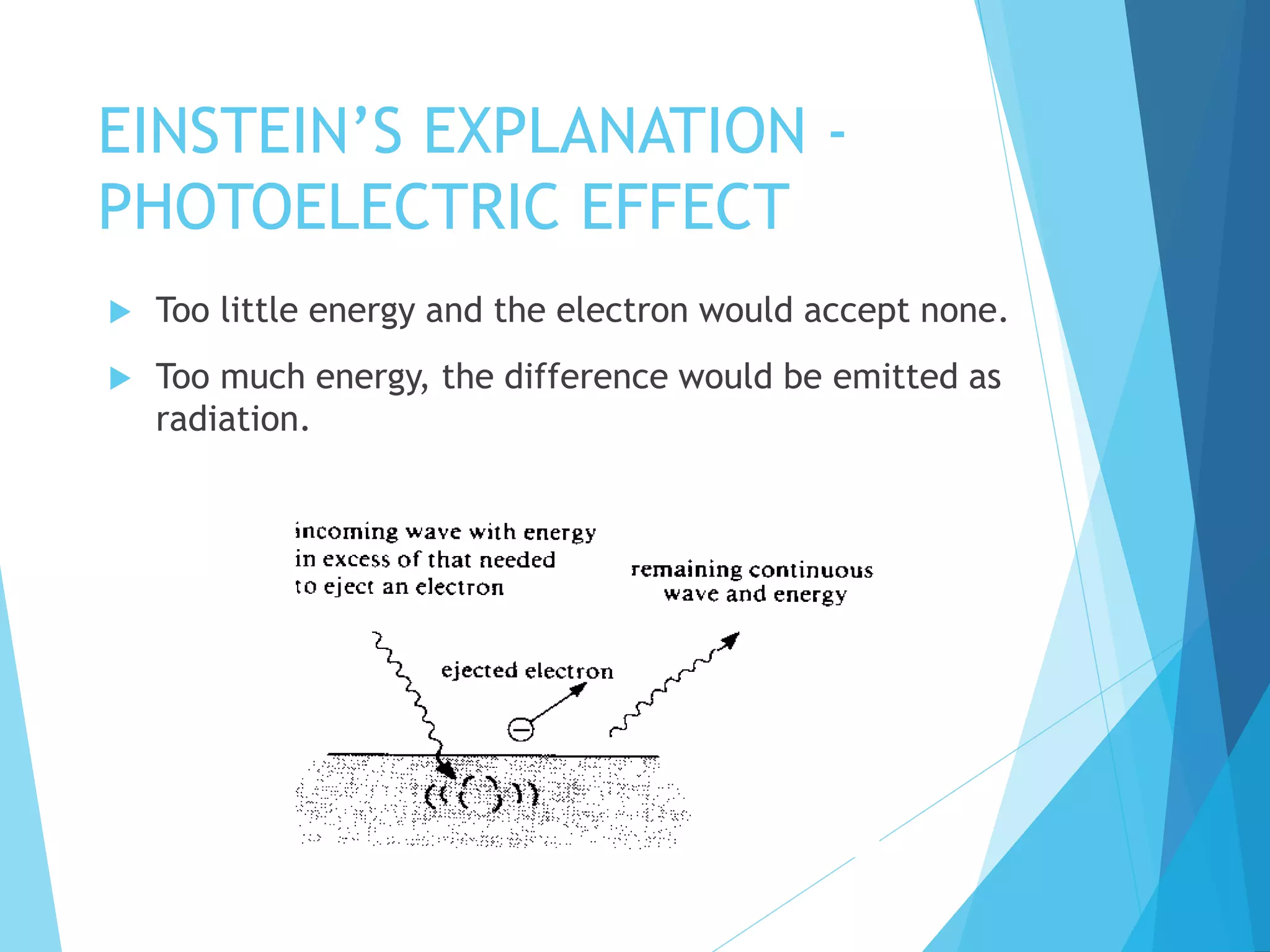
Too little energy and the electron would accept none.
Too much energy, the difference would be emitted as
radiation.
15.
EINSTEIN’S EXPLANATION -
PHOTOELECTRICEFFECT
Einstein also said that not only was the energy
absorbed and emitted by atoms in bursts but
the incoming radiation was in the form of
discrete entities and not a continuous wave.
He named these discrete entities light quanta.
This was renamed photons (a quantum of
radiant energy) later as they do behave like
particles and in keeping with other particles,
electrons, protons and neutrons.
16.
EINSTEIN’S EXPLANATION -
PHOTOECLECTRICEFFECT
Einstein’s explanation depends on the
relationship E = hf
A UV photon would have more energy than a
blue light photon as it has a higher frequency.
The key to his explanation is that each photon
on striking an atom and being absorbed may
release only one electron. It never shares its
energy amongst electrons.
Any excess energy will be given as kinetic energy
to the electron.
17.
EINSTEIN’S EXPLANATION -
PHOTOECLECTRICEFFECT
According to Einstein, only high frequency
light would have enough energy
( E = hf ) to eject an electron from a metal
surface.
Low frequency light (like red light) might
not have enough energy to pull the
electron away from the atom’s nucleus.
18.
EINSTEIN’S EXPLANATION -
PHOTOECLECTRICEFFECT
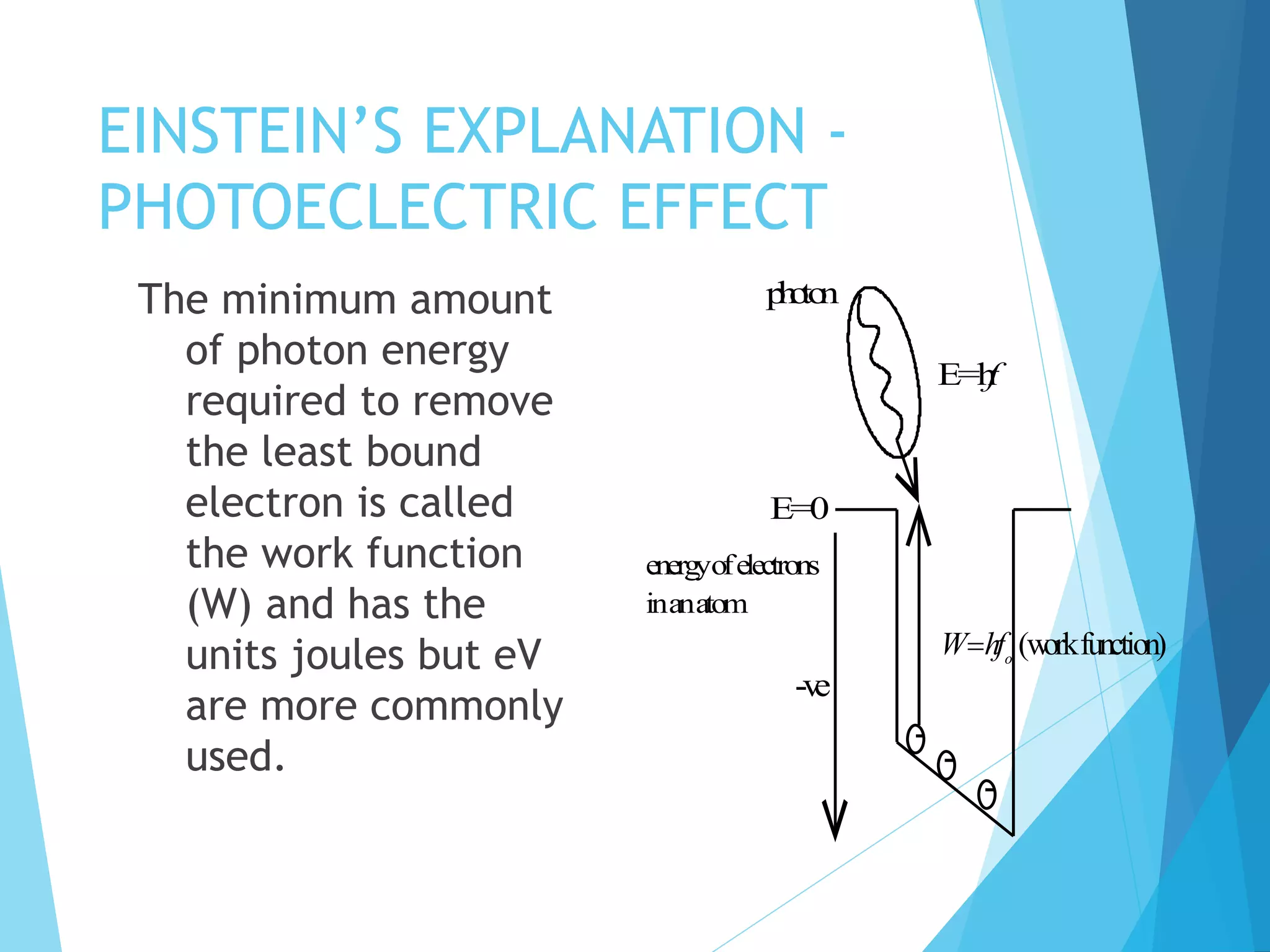
Imagine that electrons
in an atom are at
the bottom of a
potential energy
well that has a
sloping base as
shown:
-
-
-
W hfo
(workfunction)
energyofelectrons
inanatom
-ve
E=0
photon
E=hf
19.
EINSTEIN’S EXPLANATION -
PHOTOECLECTRICEFFECT
As each electron is at a
different depth, they
are bound to the atom
by a different amount.
Each electron will then
be emitted with
different energies. If
an electron absorbs a
photon with sufficient
energy, the electron
can be freed.
-
-
-
W hfo
(workfunction)
energyofelectrons
inanatom
-ve
E=0
photon
E=hf
20.
EINSTEIN’S EXPLANATION -
PHOTOECLECTRICEFFECT
The minimum amount
of photon energy
required to remove
the least bound
electron is called
the work function
(W) and has the
units joules but eV
are more commonly
used.
-
-
-
W hfo
(workfunction)
energyofelectrons
inanatom
-ve
E=0
photon
E=hf
21.
EINSTEIN’S EXPLANATION -
PHOTOECLECTRICEFFECT
The “least bound electron” is the electron
in the outermost electron shell of the
atom. This will be the easiest electron to
pull away from the atom.
It is also called the “most energetic
electron” because all of the remaining
energy given to it will be in the form of
kinetic energy which will give it the
highest speed of any of the released
electrons.
22.
EINSTEIN’S EXPLANATION -
PHOTOECLECTRICEFFECT
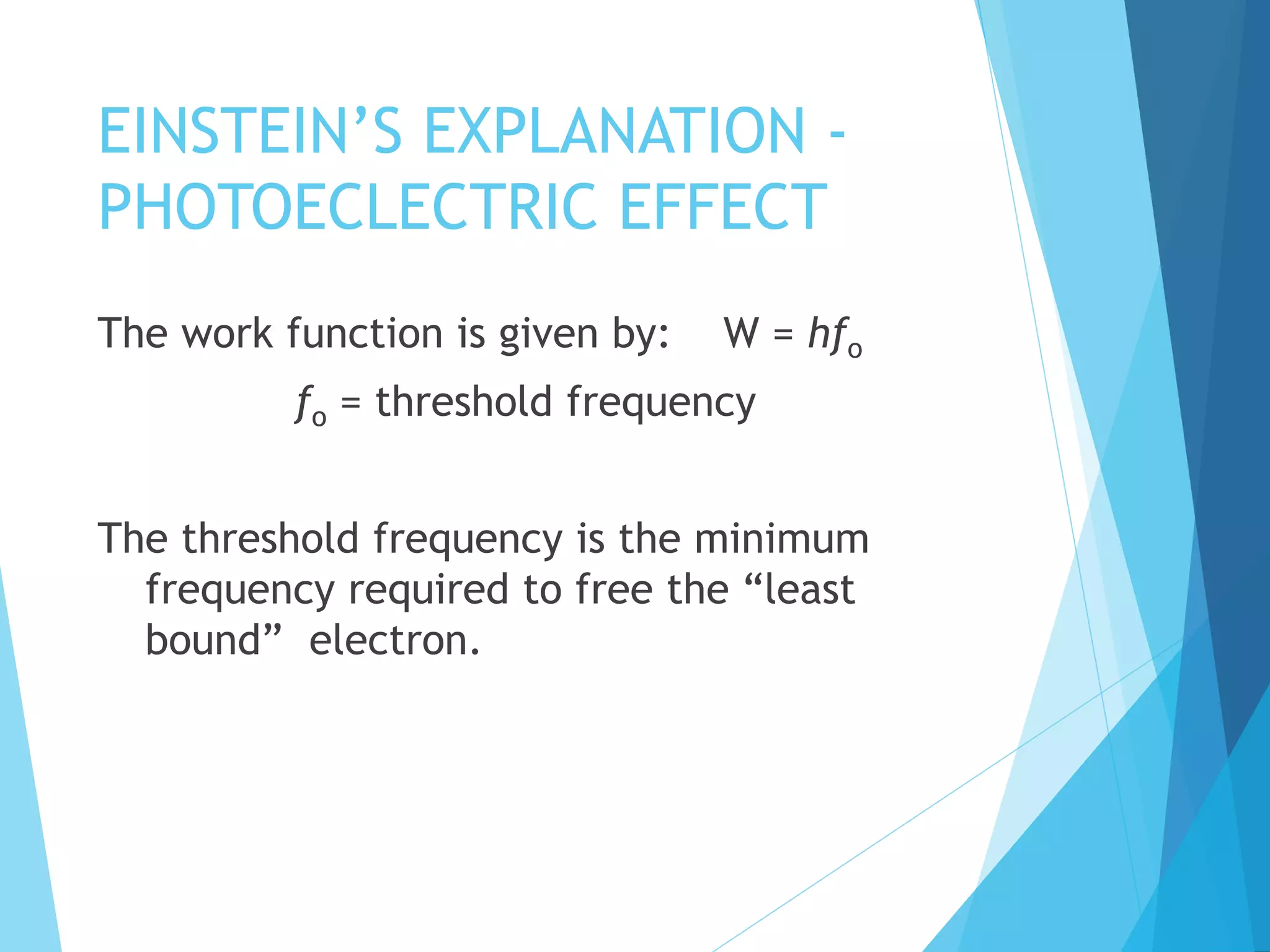
The work function is given by: W = hfo
fo = threshold frequency
The threshold frequency is the minimum
frequency required to free the “least
bound” electron.
23.
EINSTEIN’S EXPLANATION -
PHOTOECLECTRICEFFECT
When the photon falls on
an electron with more
energy than is needed
to remove the bound
electron, the difference
in energy is transformed
into kinetic energy of
the electron.
The least bound electron is
also known as the most
energetic electron. -
-
-
-ve
E = 0
E = hf
W hfo
( 1
2
mv 2
)m a x
24.
EINSTEIN’S EXPLANATION -
PHOTOECLECTRICEFFECT
Eincoming photon = K + Energy
required for electron to
escape
For the least bound
electron,
Eincoming photon = K(max)+ W
As E = hf
EKmax = hf – hf0
-
-
-
-ve
E = 0
E = hf
W hf o
( 1
2
mv 2
)m a x
25.
EXAMPLE 1
A certainmetal has a work function of
2.0eV. Will light of wavelength 4.0 x
10-7 m cause the ejection of
photoelectrons and if so what will
be their maximum velocity of
ejection?
QUANTUM (MODERN) PHYSICS
Thephoton concept was used by Einstein to
explain the experimental observations of the
photoelectric effect.
We will now go back to the observations made in
the photoelectric effect experiment and look
at Einstein’s explanation using quantum
physics.
28.
QUANTUM (MODERN) PHYSICS
ACTUALOBSERVATION:
The (kinetic) energy of
ejected
photoelectrons is
independent of the
intensity of
radiation.
QUANTUM EXPLANATION:
A greater intensity means
that more photons will
fall on the surface.
This will simply eject more
electrons but NOT at a
faster speed.
29.
QUANTUM (MODERN) PHYSICS
ACTUALOBSERVATION:
Photoelectrons are
more likely to be
ejected by high
frequency than low
frequency radiation.
QUANTUM EXPLANATION:
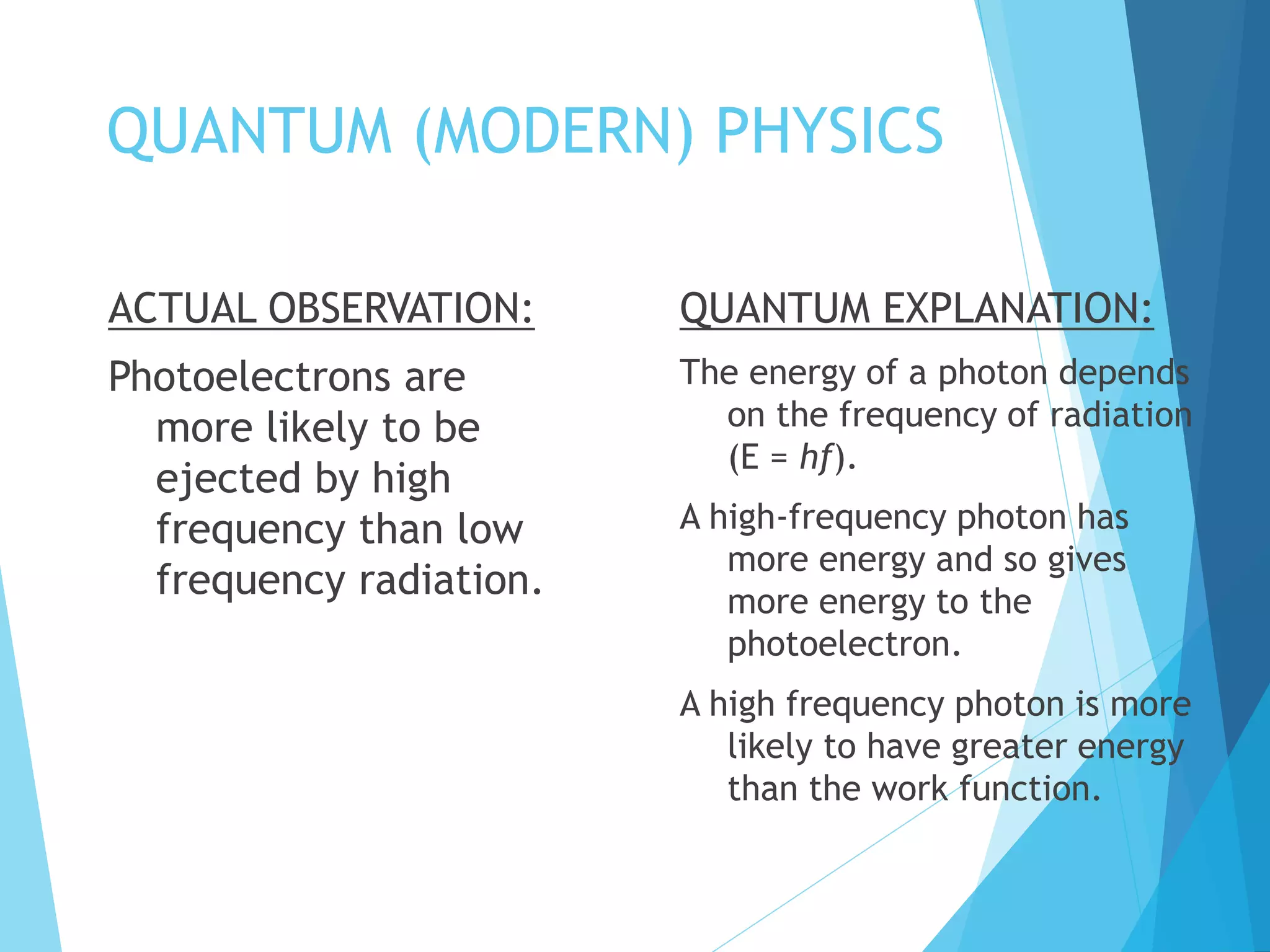
The energy of a photon depends
on the frequency of radiation
(E = hf).
A high-frequency photon has
more energy and so gives
more energy to the
photoelectron.
A high frequency photon is more
likely to have greater energy
than the work function.
30.
QUANTUM (MODERN) PHYSICS
ACTUALOBSERVATION:
Photoelectrons are
ejected instantly.
QUANTUM EXPLANATION:
All of the energy of the
photon is given up to the
electron instantly.
Experimental results
show that the maximum
time delay for the
photoelectric effect is
about 10-8s.
31.
QUANTUM (MODERN) PHYSICS
ACTUALOBSERVATION:
A range of electron
velocities of ejection
are possible.
QUANTUM EXPLANATION:
Once the work function is
subtracted, the
remaining energy exists
as kinetic energy.
Depending on which
electron absorbs the
photon, varying amounts
of kinetic energy may be
left over.
32.
QUANTUM (MODERN) PHYSICS
SUMMARY– the photoelectric effect can be
best explained using the Quantum Theory
(light behaving as a particle) as opposed
to the Classical Theory (light behaving as
a wave).
You would use the photoelectric effect in
any question that asks you to prove that
light behaves as particles (photons).
33.
Experiment to testEinstein’s
model
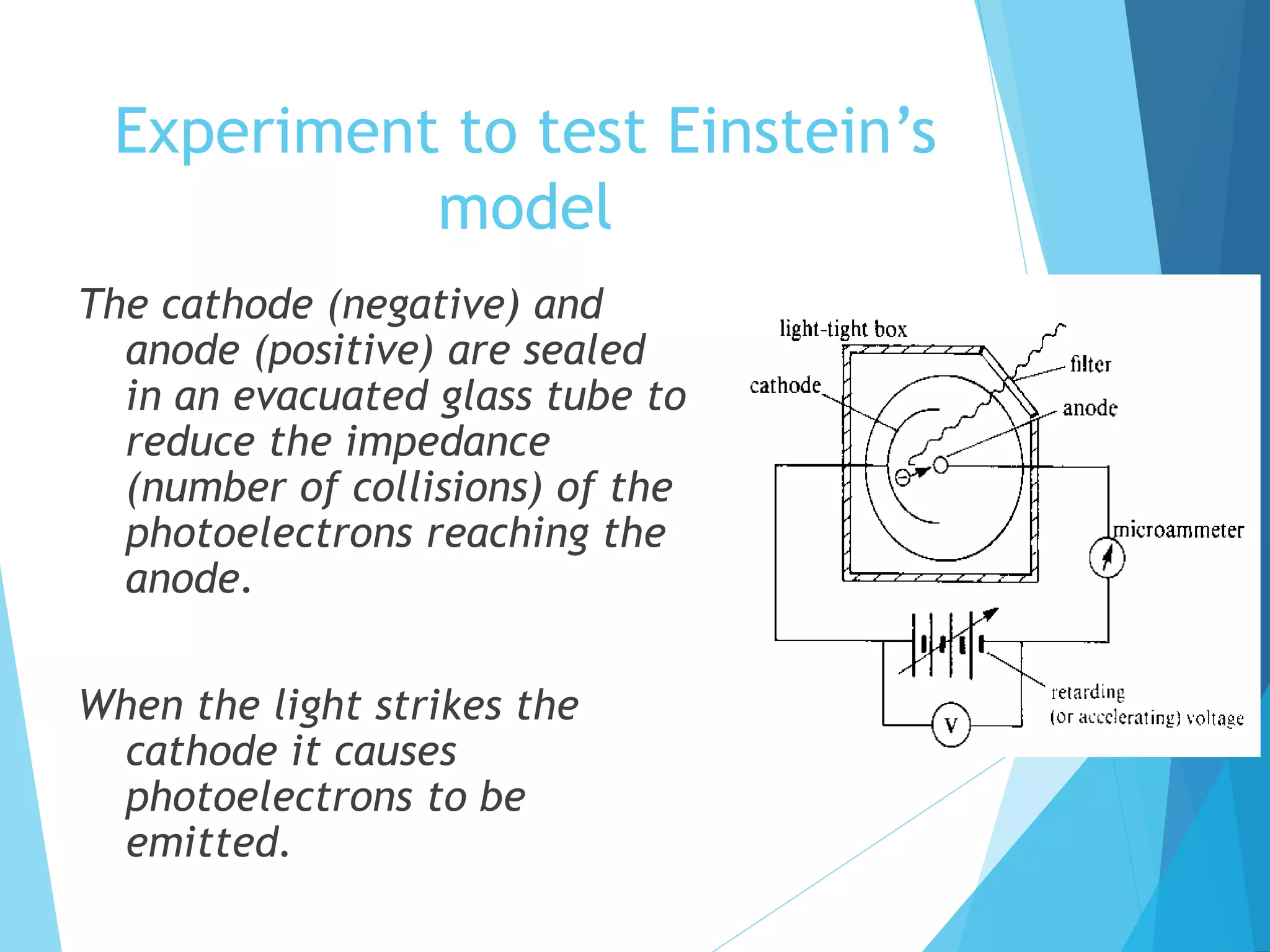
This is a diagram of an
apparatus used to
investigate the
characteristics of
photoelectric emission.
It is used to try to determine
Plank’s Constant (h) from E
=hf
Milikan used it to verify
Einstein’s model in 1916
34.
Experiment to testEinstein’s
model
The cathode (negative) and
anode (positive) are sealed
in an evacuated glass tube to
reduce the impedance
(number of collisions) of the
photoelectrons reaching the
anode.
When the light strikes the
cathode it causes
photoelectrons to be
emitted.
35.
Experiment to testEinstein’s
model
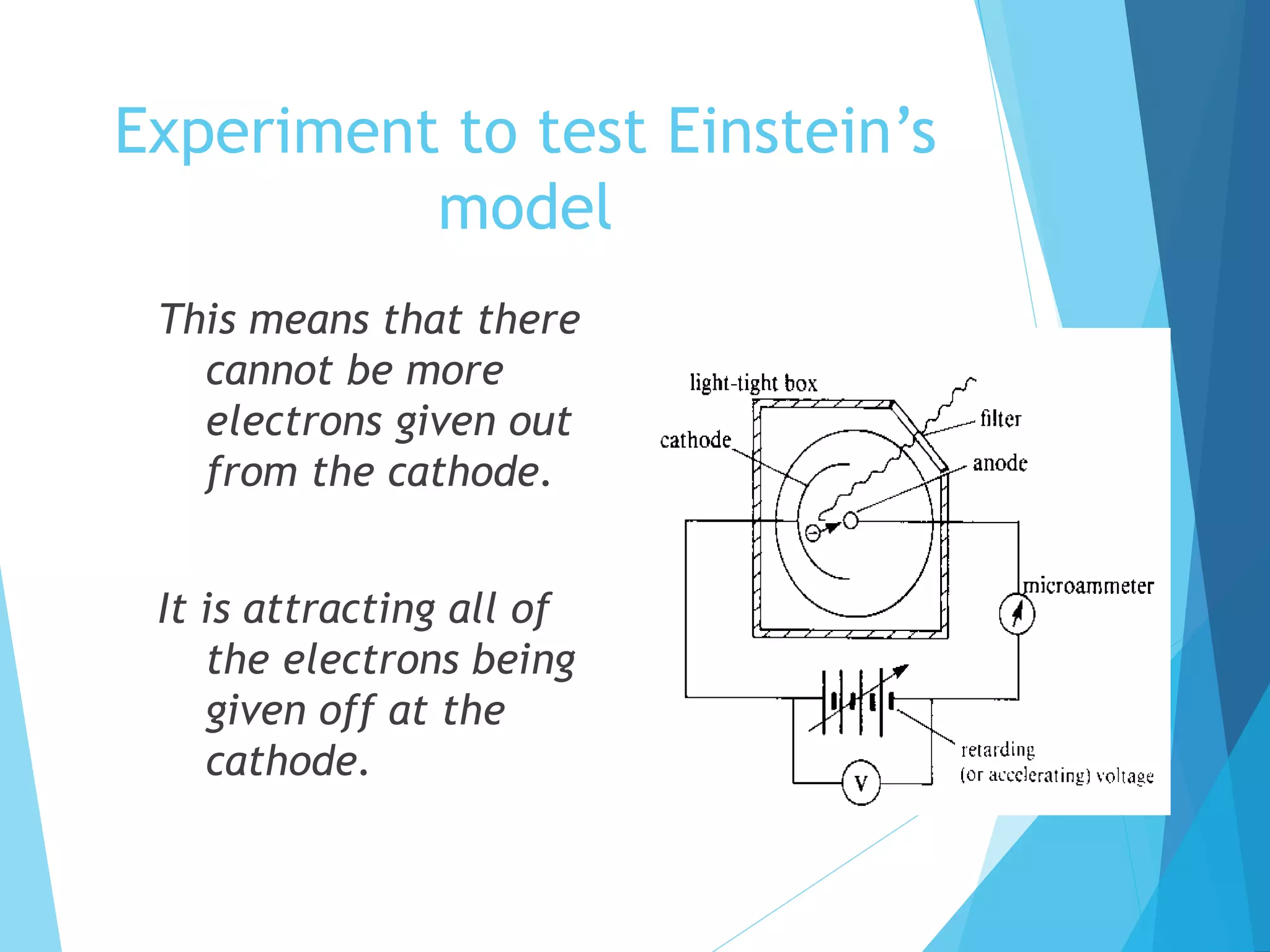
If they cross the gap then
they will create a current
that will be read by a
microammeter.
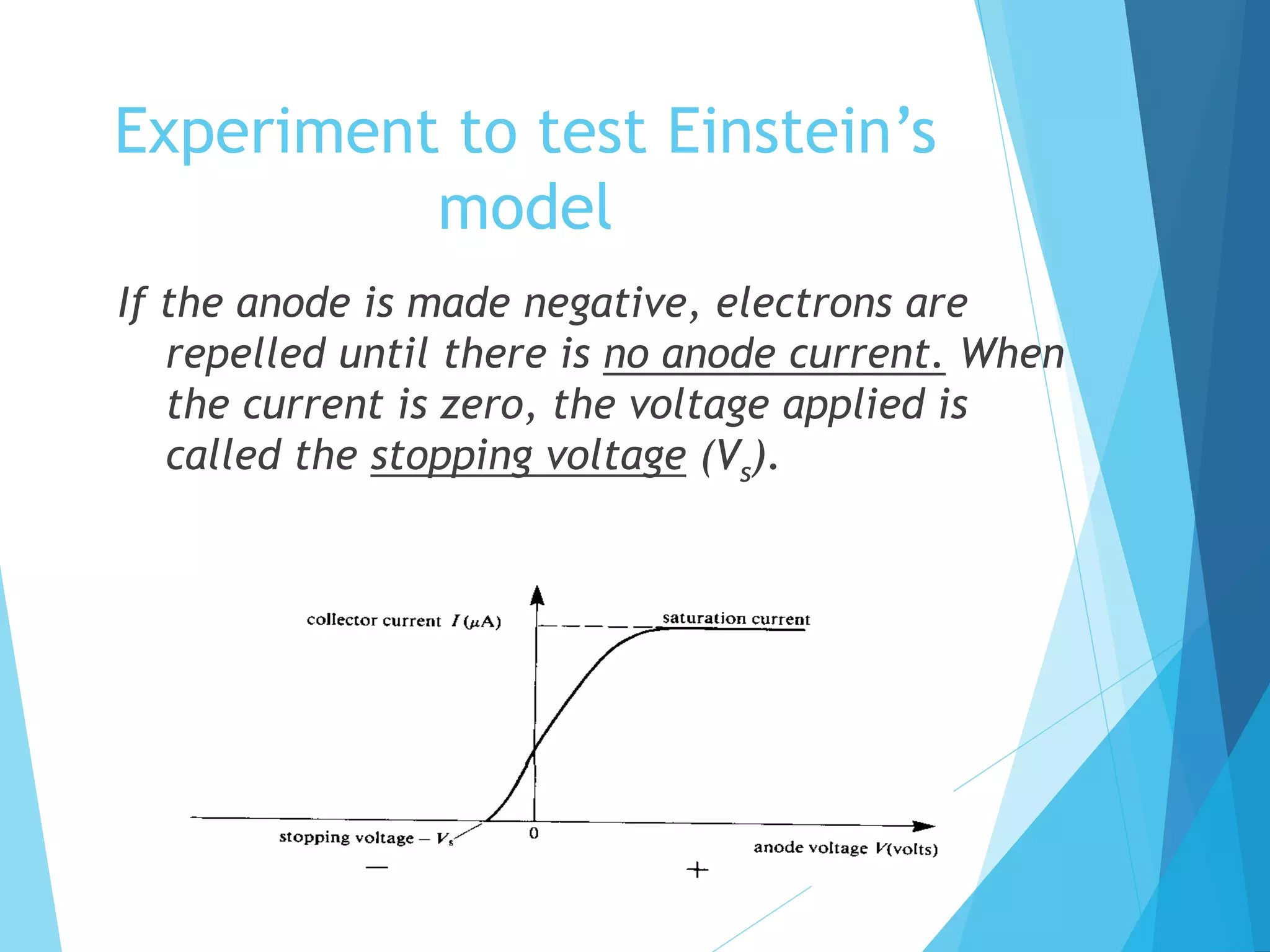
The anode is made
progressively more positive
attracting more
photoelectrons until the
saturation current is
reached.
36.
Experiment to testEinstein’s
model
This means that there
cannot be more
electrons given out
from the cathode.
It is attracting all of
the electrons being
given off at the
cathode.
37.
Experiment to testEinstein’s
model
Note that we DO NOT vary
the frequency or the
intensity during the time
that we are making the
anode more positive.
During this time the current
will get stronger, proof
that the electrons are
being emitted with
different kinetic
energies.
38.
Experiment to testEinstein’s
model
Only when you make the
anode very positive do
you finally attract the
electrons that have very
little kinetic energy (they
are drifting around) due
to the fact that they
required a large amount
of energy just to free
them (their Work
Function).
39.
Experiment to testEinstein’s
model
If the anode is made negative, electrons are
repelled until there is no anode current. When
the current is zero, the voltage applied is
called the stopping voltage (Vs).
40.
Experiment to testEinstein’s
model
At this point even the most energetic
electron (with the smallest work function
and hence the most kinetic energy) will
not be able to make it to the anode (due
to repulsion).
41.
Experiment to testEinstein’s
model
This graph shows what happens as we change the
frequency (colour) of the light and the voltage
required to stop the most energetic electron
for that particular frequency.
Vs e = hf – hf0
42.
The Photoelectric Effect
1.Themore intense the incident light, the
greater the energy of ejection of the
electron.
The voltage required to repel the
photoelectron from a current measuring
device,should also be greater.
43.
The Photoelectric Effect
Intensity increased the number of ejected
photoelectrons but, the energy is
independent of the intensity of the
radiation.
The number of electrons emitted per
second is,proportional to the intensity of
the emitted light.
44.
The Photoelectric Effect
2.Morephotoelectrons should be ejected by
low frequency radiation (i.e. red),than by
high frequency radiation.
Classical theory considers e-m waves to
be,oscillating electric and magnetic
fields.
45.
The Photoelectric Effect
Lowfrequency waves allow more time
for the electron to move in one
direction,before the field reverses
and,
the electron moves in the opposite
direction.
46.
The Photoelectric Effect
Highfrequency waves would move so
fast the electron would hardly begin
to move in one direction, before it
was forced to reverse direction, not
ideal for ejection.
Experiments showed that high
frequency (UV) radiation ejected
photoelectrons more readily, than low
frequency.
47.
The Photoelectric Effect
Therewas a minimum frequency
below which,no photoelectrons were
ejected.
This was called the threshold
frequency,
different for different materials.
48.
The Photoelectric Effect
3.Thereshould be a time delay
between when a radiation is incident
on a surface and,when the
photoelectrons are ejected.
Photoelectrons were ejected
instantaneously.
49.
The Photoelectric Effect
4.Theradiation’s wavefront falls over
the whole surface,billions of
photoelectrons should be
simultaneously ejected.
By limiting the amount of light on a
surface, a single electron could be
ejected.
50.
The Photoelectric Effect
5.Onevelocity of ejection should be
possible for radiation of one frequency.
The electric current in the detector
should immediately drop to zero once a
critical voltage for repulsion of the single
energy photoelectron is reached.
Emitted photoelectrons have a range of
ejection velocities and energies.
51.
WAVE NATURE OFMATTER
It has been shown that in some
circumstances, light exhibits certain
behaviours characteristic of waves.
In other circumstances, light behaves as
particles.
Could the reverse be true, namely that
particles can behave as waves? This topic
investigates this question.
52.
WAVE NATURE OFMATTER
DE BROGLIE’S HYPOTHESIS
Count Louis de Broglie (1892 - 1970) believed in the
symmetry of nature. In 1923 he reasoned that if a
photon could behave like a particle, then a particle
could behave as a wave.
53.
WAVE NATURE OFMATTER
Special Relativity has given us the relationship
E = mc2
But, we also know E = hf
This gives
hf = hc/λ = mc2
mc = h/ λ
p = h/ λ
54.
WAVE NATURE OFMATTER
He turned Compton’s relationship to make
wavelength the subject of the equation.
Compton- “a photon has momentum”
De Broglie- “An electron has a wavelength”
h
p
p
h
55.
WAVE NATURE OFMATTER
This is called the de Broglie wavelength of a
particle.
All particles (electrons, protons, bullets,
even humans) have a wavelength.
They must be moving.
They are called “matter waves”.
56.
WAVE NATURE OFMATTER
We cannot see light. We can only
make inferences about the nature
of light by looking at its properties.
Its properties indicate that it is both
wave like and particle like in
nature.
57.
WAVE NATURE OFMATTER
We also cannot see atoms. We often think of
them as exhibiting the properties of particles.
But, because we have never seen them, could
they be waves pretending to be particles?
De Broglie suggested that particles, in some
instances could be wave like.
58.
EXAMPLE 1
Calculate thede Broglie wavelength
associated with a 1.0 kg mass fired
through the air at 100 km/hr.
EXAMPLE 1 SOLUTION
Notethe wavelength is so small that it
cannot be detected and measured.
We cannot create slits capable of diffracting
such small wavelengths.
Can a microscopic object give a more
realistic wavelength?
61.
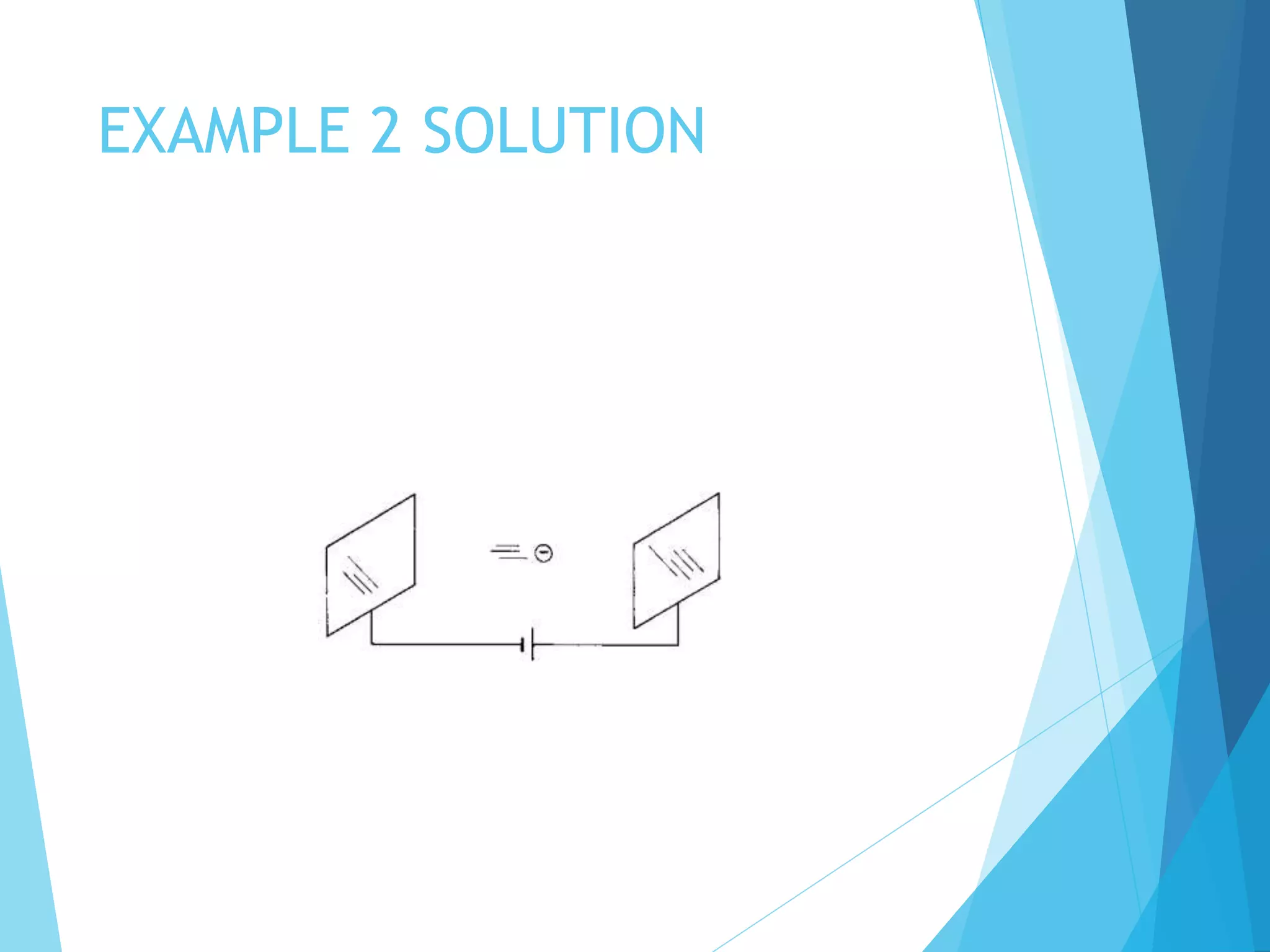
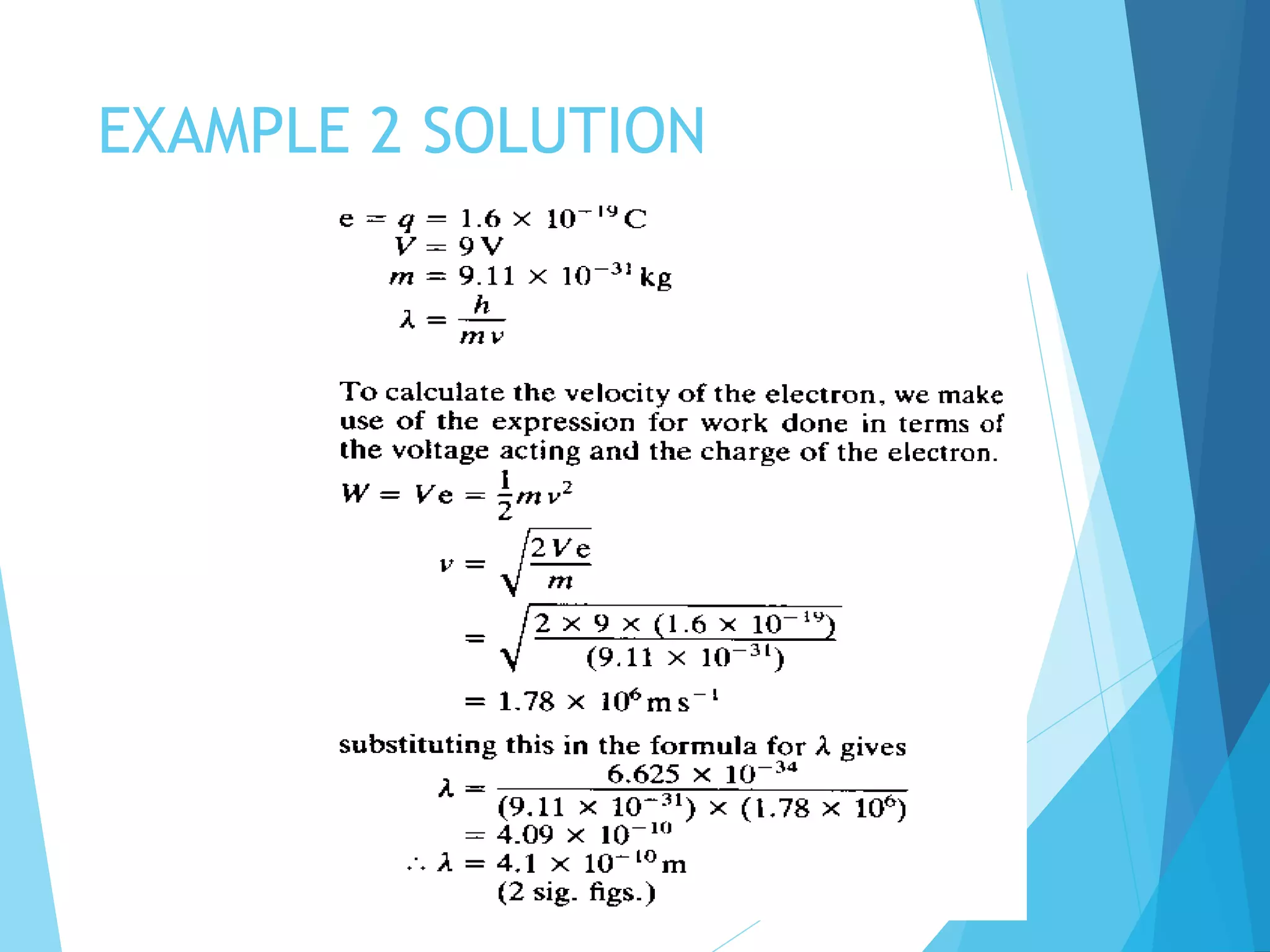
EXAMPLE 2
Calculate thede Broglie wavelength that
would be associated with an electron
accelerated from rest by a P.D. of 9.0V
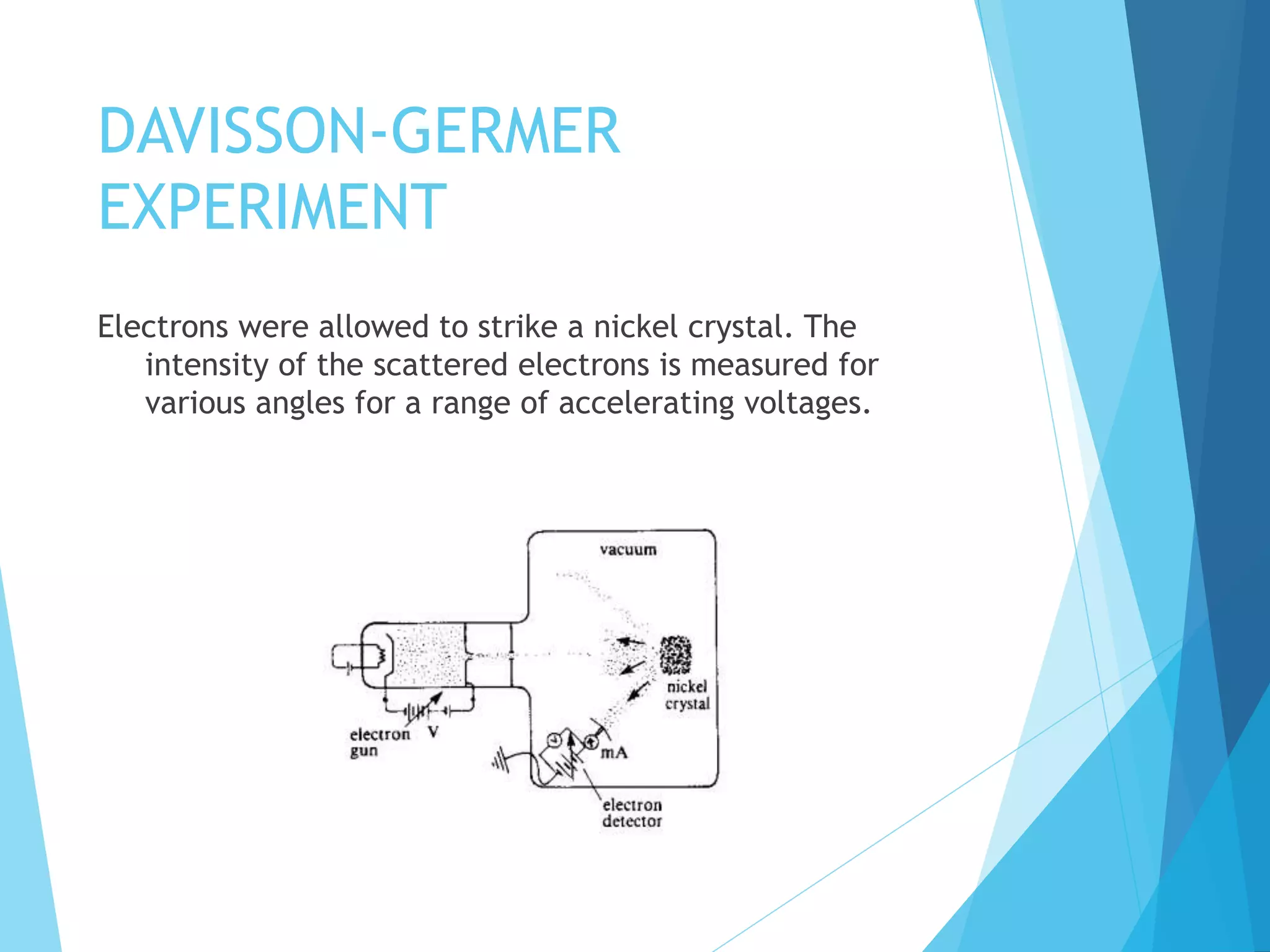
DAVIDSON-GERMER
EXPERIMENT
It was foundthat a strong ‘reflection’ was found at θ = 50°
when V = 54V.
This appeared to be a place of constructive interference,
suggesting that the “matter waves” from the electrons
were striking the crystal lattice and diffracting into an
interference pattern.
69.
DAVIDSON-GERMER
EXPERIMENT
The interatomic spacingof Nickel is close to the ‘wavelength’ of
an electron. Therefore it would seem possible that electron
matter waves could be diffracted.
Davidson and Germer set out to verify that the electrons were
behaving like a wave using the following calculations.
Theoretical Result (according to de Broglie’s calculation)
The kinetic energy of the electrons is
1/2 mv2 = Ve
70.
DAVIDSON-GERMER
EXPERIMENT
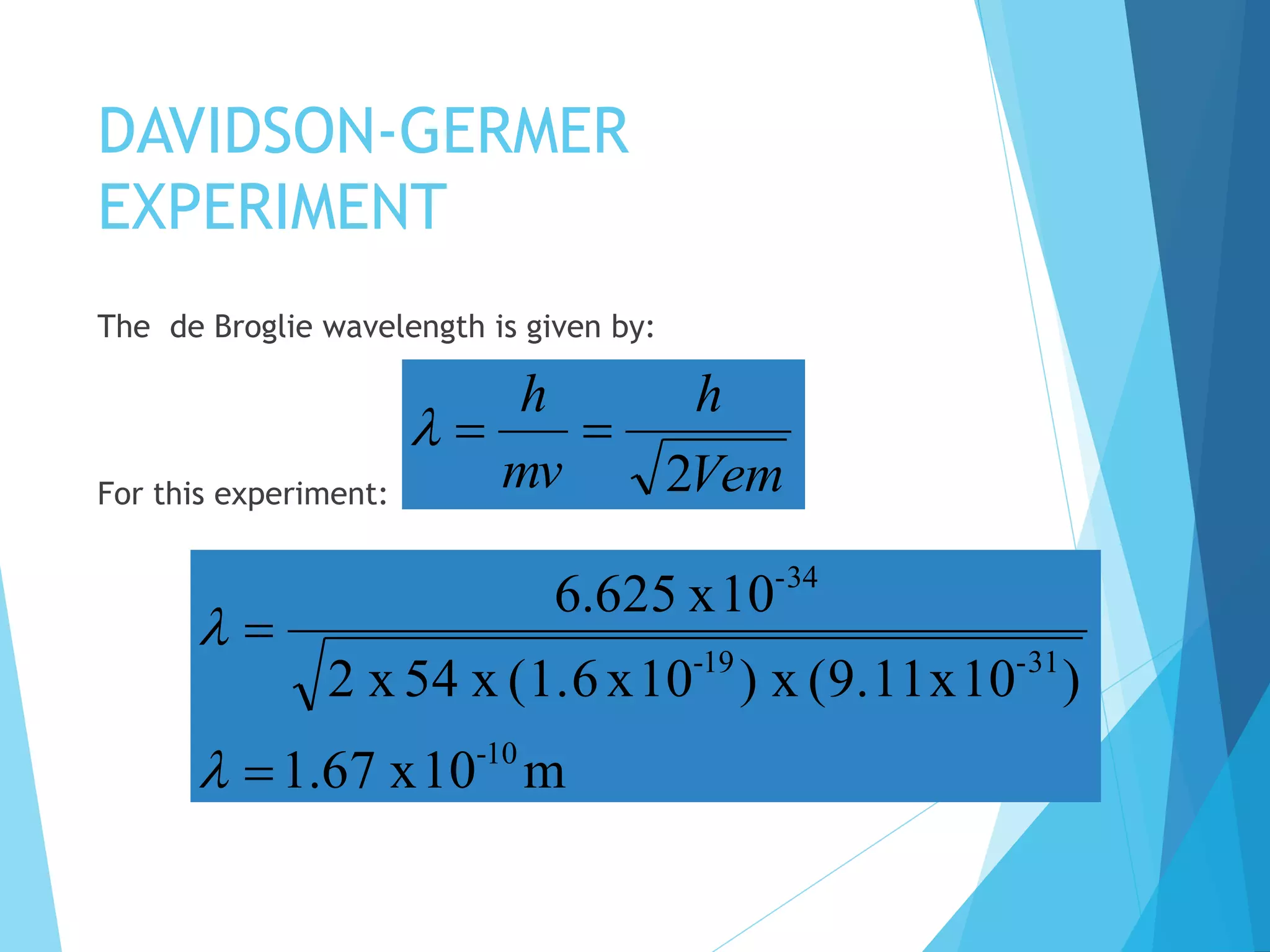
The de Brogliewavelength is given by:
For this experiment: Vem
h
mv
h
2
m10x67.1
)10x(9.11x)10x(1.6x54x2
10x625.6
10-
31-19-
-34
71.
DAVIDSON-GERMER
EXPERIMENT
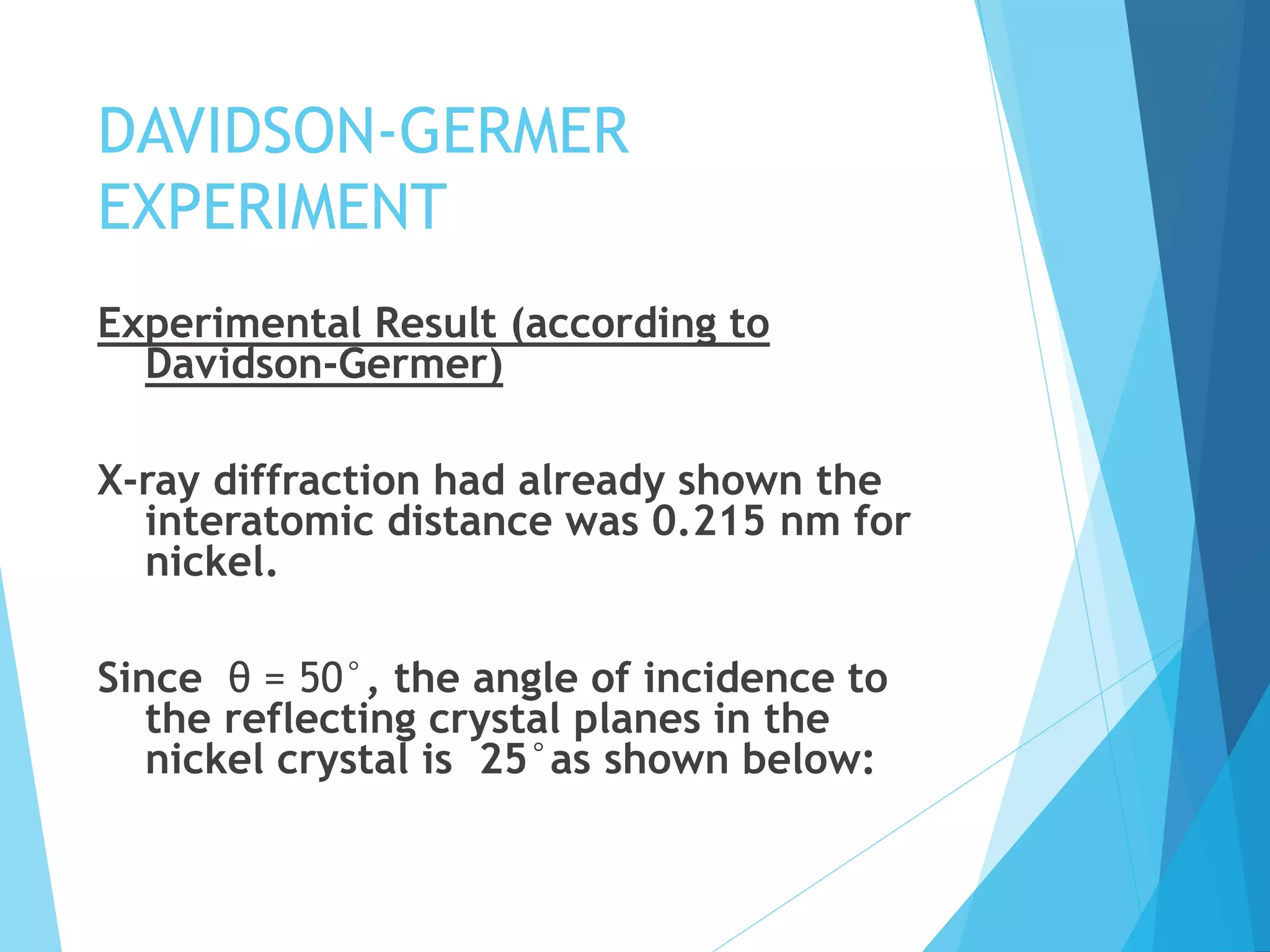
Experimental Result (accordingto
Davidson-Germer)
X-ray diffraction had already shown the
interatomic distance was 0.215 nm for
nickel.
Since θ = 50°, the angle of incidence to
the reflecting crystal planes in the
nickel crystal is 25°as shown below:
DAVIDSON-GERMER
EXPERIMENT
The close correspondencebetween the theoretical
prediction for the wavelength by de Broglie (1.67 x 10⁻¹⁰
m) and the experimental results of Davidson-Germer
(1.65 x 10⁻¹⁰ m) provided a strong argument for the de
Broglie hypothesis.
74.
THE BOHR MODELOF THE
ATOM
In 1911 Bohr ignored all the previous
descriptions of the electronic structure as
they were based on classical physics.
This allowed the electron to have any
amount of energy.
Planck and Einstein used the idea of quanta
for the energy carried by light.
75.
THE BOHR MODELOF THE
ATOM
Bohr assumed that the energy carried by an
electron was also quantized.
From this assumption, he formed three
postulates (good intelligent guesses) from
which he developed a mathematical
description.
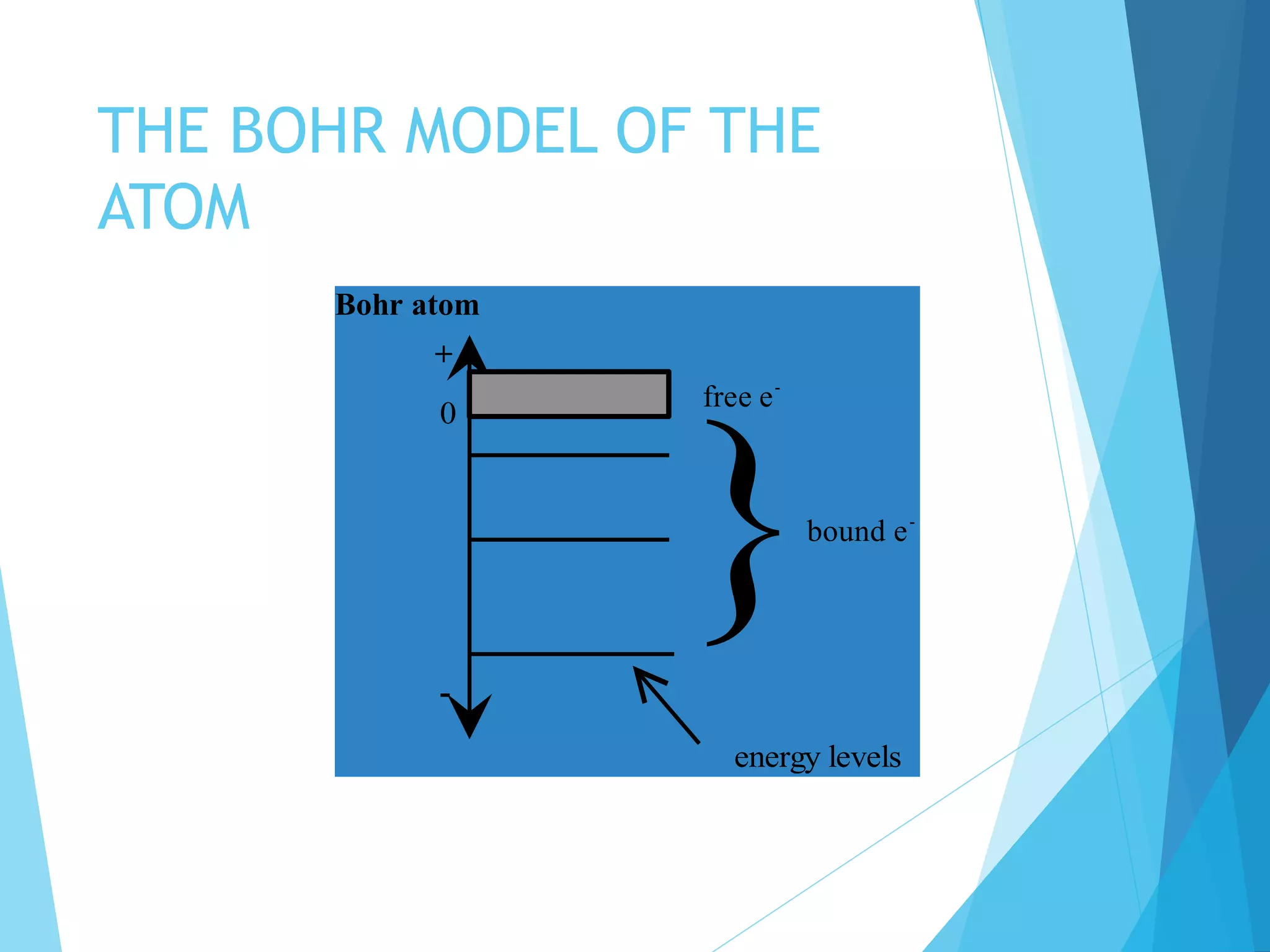
76.
THE BOHR MODELOF THE
ATOM
0
+
-
free e-
}bound e-
energy levels
Bohr atom
77.
THE BOHR MODELOF THE
ATOM
In summary, if the atom had electrons that
varied in their energy levels, you would
expect to get random frequencies
emitted.
This is not the case.
Electrons give off photons of SPECIFIC
frequencies.
More evidence for the Quantum Theory!
78.
THE BOHR MODELOF THE
ATOM
An electron can be moved to a higher
energy level by…
1. INCOMING PHOTON- Must be of exactly
the same energy as E2 – E1
2. INCOMING ELECTRON- remaining
energy stays with the incoming electron.
3. HEAT- gives the electron vibrational
energy.
79.
THE BOHR MODELOF THE
ATOM
IONIZATION- energy required to remove
an electron from the atom.
Example: the ionization energy required
to remove an electron from its ground
state (K=1) for Hydrogen is 13.6 eV.
80.
Wave particle duality
Pair production & annihilation
Every elementary particle has an equivalent anti-
particle (antimatter!). They have the same mass,
but opposite charge and quantum numbers.
An anti-electron has the same mass and magnitude
of charge but opposite sign. It is called a positron.
81.
Pair production
A gammaray can convert into a particle and anti-
particle pair. The energy is converted into mass.
Can you determine the energy the gamma ray needs
to produce a positron and an electron?
82.
Pair annihilation
The oppositeof pair production is pair
annihilation. A matter-antimatter pair interact to
produce a pair of gamma rays.
83.
Quantization of angular
momentumfor Bohr model
The Bohr model of the atom allows for the
explanation of atomic spectra. This relies upon
the quantization of the energy levels.
For a hydrogen atom this results in the
following relationship,
E = - 13.6 eV
n2
The energy of the levels, converges to a limit –
the series limit.
85.
From this modelof a hydrogen atom, Bohr was able to
predict the radii of the electrons orbit:
mvr = nh/2π
n = principal quantum number (you can think of this as the
number of the electron shell)
mv = momentum and so, mvr = angular momentum
86.
Electron in abox model
The electron is bound to the nucleus by the
Coulombic attraction
Consider, the electron to be confined in a one
dimensional box whose edges are defined by 1/r
Classical wave theory states that such a confined
wave would be a standing wave and hence
λn =2 L /n …where n = 1,2,3…
But pn = h / λn = n h / 2 L
Also EK = p2/2m … En = n2h2/ 8mL2
87.
Schrödinger Model
The BohrModel was a landmark in the history of
Physics
Limitations had shown that a new model was
needed
Less than 2 years after de Broglie gave us the matter
wave
Erwin Schrödinger (1887-1961) an Austrian
Physicist developed a new comprehensive theory
88.
Schrödinger Model
De Brogliedetermined the wavelength and
momentum of a matter wave
What about amplitude?
The amplitude of a matter wave is given the
symbol Greek letter psi
89.
Schrödinger Model
Schrödinger developedan equation to
determine the wavefunction,.
The wavefunction represents the
amplitude of a matter wave as a function
of time and position
It is a differential equation – the solution
of which exactly predicts the line spectra
of a hydrogen atom
may vary in magnitude from point to
point in space and time
90.
Schrödinger Model
Consider Young’sDouble Slit Experiment
If slits are in the order of the wavelength
of light
An interference pattern would be seen
Reduce the flow of photons (or electrons)
to one at a time
Schrödinger Model
To getan interference pattern;
Electrons must pass through both slits at the
same time
This is possible as an electron is as much a
wave as a particle
What would happen if we covered up one
slit?
97.
Schrödinger Model
Electron wouldpass through one slit only;
A diffraction pattern would be seen
If we then covered up the other slit?
A different diffraction pattern would be seen
There would be no interference pattern
98.
Schrödinger Model
If bothslits were open
Electron passes through both slits
As if it were a wave
Forming an interference pattern
Yet each electron would make a tiny spot on
the screen as if it were a particle
99.
Schrödinger Model
The mainpoint:
Treat electrons as waves;
represents the wave amplitude
Treat electrons as particles
Must treat them on probabilistic basis
2 gives the probability of finding a given
electron at a point
We cannot predict or follow the path of an
electron precisely through space and time
100.
Schrödinger Model
Can useSchrödinger’s equation to determine the
probability of finding an electron at any given
place or time around a nucleus
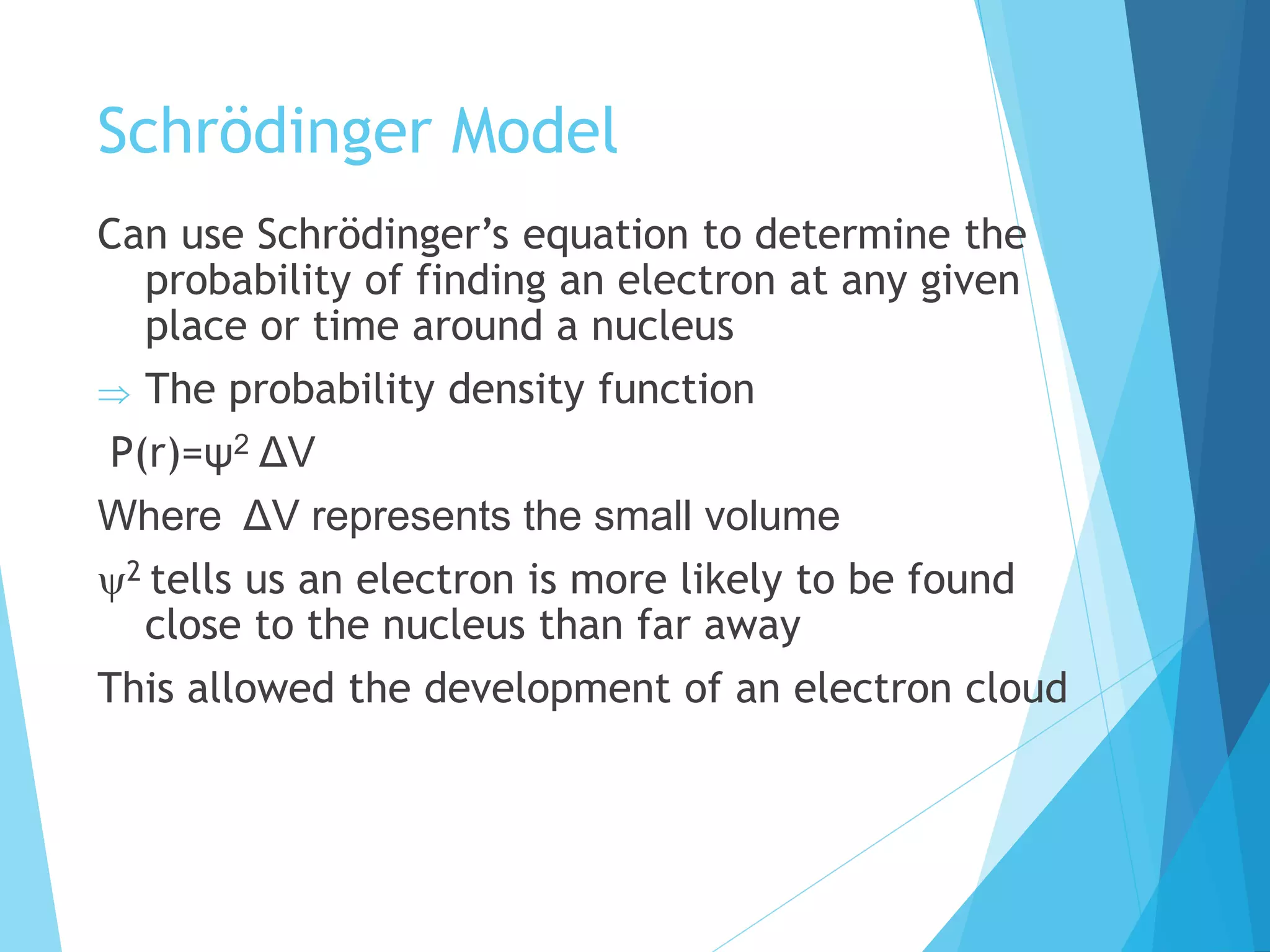
The probability density function
P(r)=ψ2 ΔV
Where ΔV represents the small volume
2 tells us an electron is more likely to be found
close to the nucleus than far away
This allowed the development of an electron cloud
Heisenberg Uncertainty
Principle
In 1927Werner Heisenberg proposed a
principle that helped understand the
interpretation of the wavefunction.
Let the uncertainty in position be Δx
& the uncertainty in momentum be Δp
The uncertainty principle states
Δx Δp h
(More accurately h/4)
103.
If p isknown precisely then = h/p is also known
But a completely defined means that a wave
must be infinite in space and time
Therefore if p is known then we cant know the
position and vice versa
Uncertainty principle also applies to energy
ΔE Δt h
This explains why spectral lines are of finite
width
105.
Quantum tunnelling
Quantum mechanicsimplies that particles can
exhibit behaviours that classical physics cannot
explain. Think back to wave particle duality and the
photoelectric effect.
One such phenomena is tunnelling, consider a
particle trapped in a well (or between two barriers).
Classically when an electron interacts with the
barrier it will reflect; quantum mechanics allows for
the possibility of the electron passing through.
106.
(Source: U. ofOregon Lectures:http://abyss.uoregon.edu/%7Ejs/ast123/lectures/lec06.html)
107.
The wave modelallows us to consider the
electron as a wave and that it has a probability of
being within/on the other side of the barrier.
Tunnelling probability will depend on:
1. Mass of particle
2. Thickness of barrier
3. “height” of the potential barrier
4. Energy carried by particle.