Cartesian Coordinates
Cartesian coordinates can be used to pinpoint where you are on a map or graph.
Cartesian Coordinates
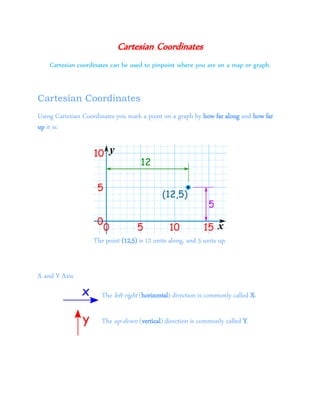
Using Cartesian Coordinates you mark a point on a graph by how far along and how far
up it is:
The point (12,5) is 12 units along, and 5 units up.
X and Y Axis
The left-right (horizontal) direction is commonly called X.
The up-down (vertical) direction is commonly called Y.
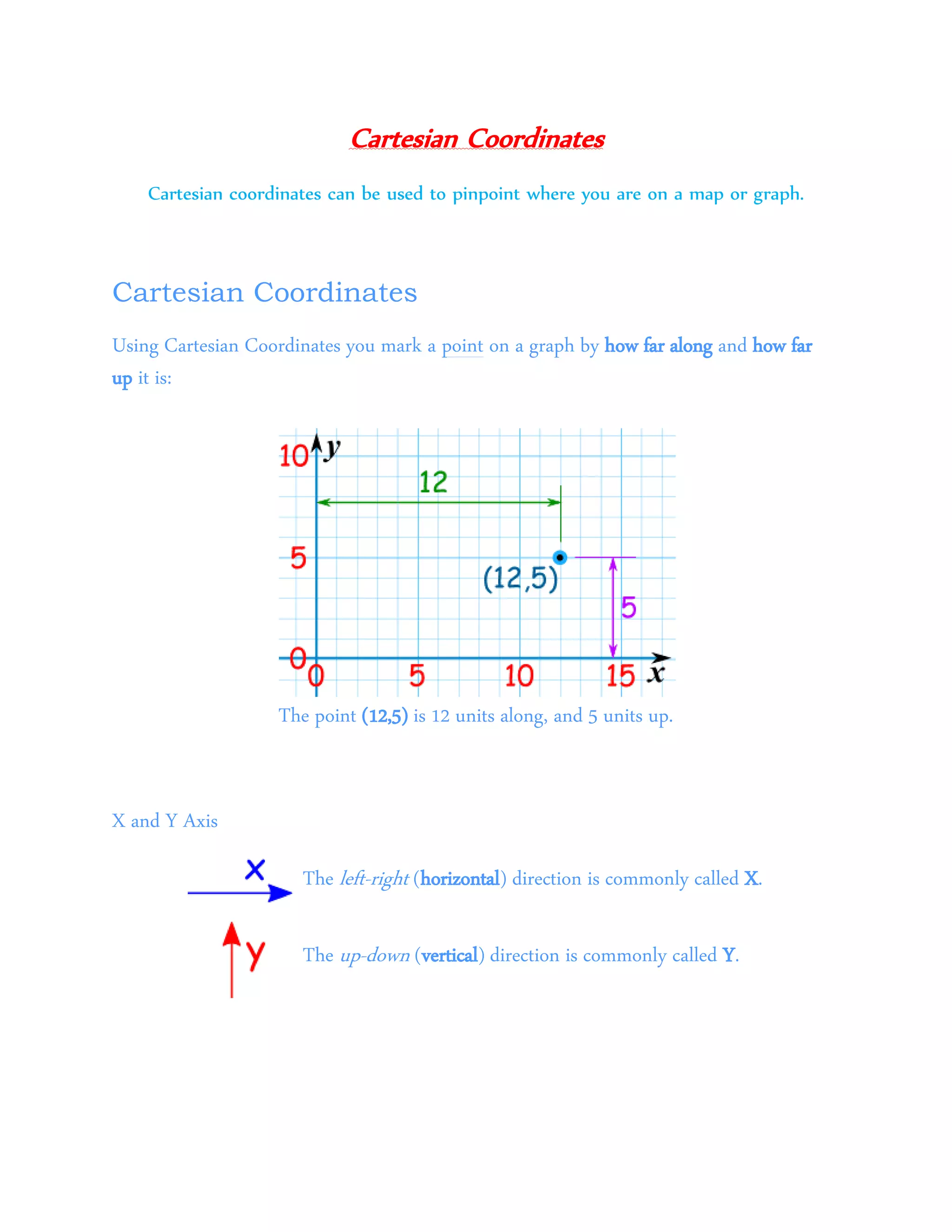
Put them together on a graph ...
... and you are ready to go
Where they cross over is the "0" point,
you measure everything from there.
 The X Axis runs horizontally through zero
 The Y Axis runs vertically through zero
Axis: The reference line from which distances are measured.
The plural of Axis is Axes, and is pronounced ax-eez
Example:
Point (6,4) is
6 units across (in the x direction), and
4 units up (in the y direction)
So (6,4) means:
Go along 6 and then go up 4 then "plot the dot".
And you can remember which axis is which by:x is A CROSS, so x is ACROSS the page.
Play With It !
Now would be a good time to play with
Interactive Cartesian Coordinates
to see for yourself how it all works.
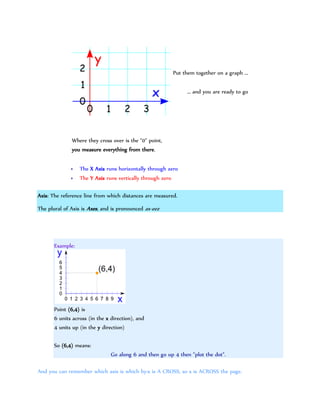
Like 2 Number Lines Put Together
It is like we put two Number Lines together, one going left-right, and the other going up-down.
Direction
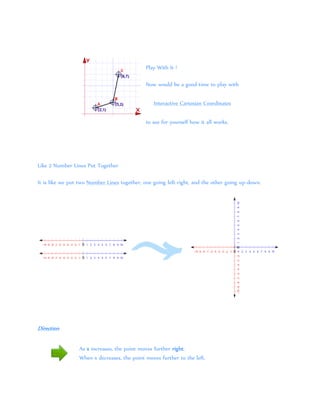
As x increases, the point moves further right.
When x decreases, the point moves further to the left.
As y increases, the point moves further up.
When y decreases, the point moves further down.
Writing Coordinates
The coordinates are always written in a certain order:
 the horizontal distance first,
 then the vertical distance.
This is called an "ordered pair" (a pair of numbers in a special order)
And usually the numbers are separated by a comma, and parentheses are put
around the whole thing like this:
(3,2)
Example: (3,2) means 3 units to the right, and 2 units up
Example: (0,5) means 0 units to the right, and 5 units up.
In other words, only 5 units up.
The Origin
The point (0,0) is given the special name "The Origin", and is sometimes
given the letter "O".
Abscissa and Ordinate
You may hear the words "Abscissa" and "Ordinate" ... they are just
the x and y values:
 Abscissa: the horizontal ("x") value in a pair of coordinates: how
far along the point is
 Ordinate: the vertical ("y") value in a pair of coordinates: how far up or
down the point is
What About Negative Values of X and Y?
Just like with the Number Line, you can also have
negative values.
Negative: start at zero and head in the opposite
direction:
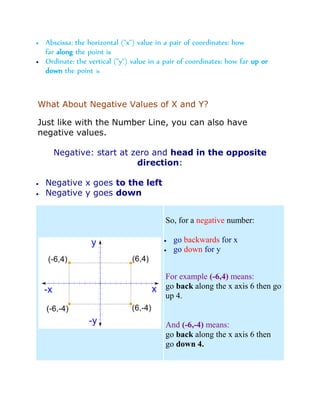
 Negative x goes to the left
 Negative y goes down
So, for a negative number:
 go backwards for x
 go down for y
For example (-6,4) means:
go back along the x axis 6 then go
up 4.
And (-6,-4) means:
go back along the x axis 6 then
go down 4.
Four Quadrants
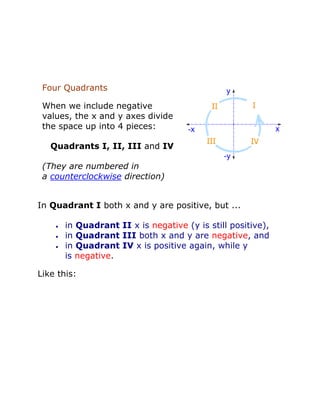
When we include negative
values, the x and y axes divide
the space up into 4 pieces:
Quadrants I, II, III and IV
(They are numbered in
a counterclockwise direction)
In Quadrant I both x and y are positive, but ...
 in Quadrant II x is negative (y is still positive),
 in Quadrant III both x and y are negative, and
 in Quadrant IV x is positive again, while y
is negative.
Like this:
Quadra
nt
X
(horizonta
l)
Y
(vertica
l)
Exampl
e
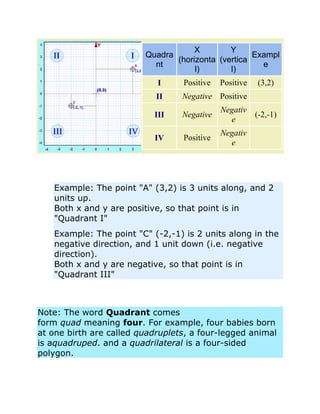
I Positive Positive (3,2)
II Negative Positive
III Negative
Negativ
e
(-2,-1)
IV Positive
Negativ
e
Example: The point "A" (3,2) is 3 units along, and 2
units up.
Both x and y are positive, so that point is in
"Quadrant I"
Example: The point "C" (-2,-1) is 2 units along in the
negative direction, and 1 unit down (i.e. negative
direction).
Both x and y are negative, so that point is in
"Quadrant III"
Note: The word Quadrant comes
form quad meaning four. For example, four babies born
at one birth are called quadruplets, a four-legged animal
is aquadruped. and a quadrilateral is a four-sided
polygon.
Dimensions: 1, 2, 3 and more ...
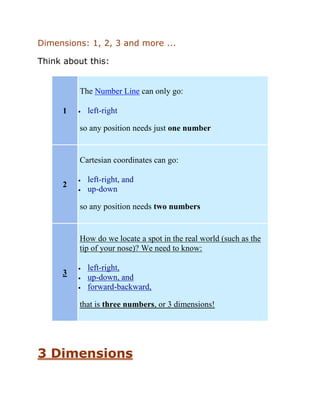
Think about this:
1
The Number Line can only go:
 left-right
so any position needs just one number
2
Cartesian coordinates can go:
 left-right, and
 up-down
so any position needs two numbers
3
How do we locate a spot in the real world (such as the
tip of your nose)? We need to know:
 left-right,
 up-down, and
 forward-backward,
that is three numbers, or 3 dimensions!
3 Dimensions
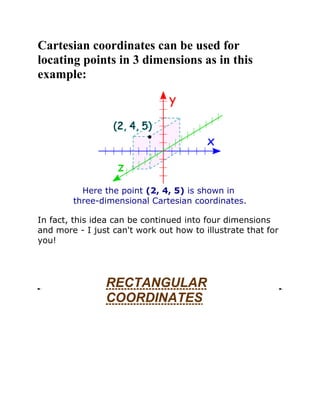
Cartesian coordinates can be used for
locating points in 3 dimensions as in this
example:
Here the point (2, 4, 5) is shown in
three-dimensional Cartesian coordinates.
In fact, this idea can be continued into four dimensions
and more - I just can't work out how to illustrate that for
you!
RECTANGULAR
COORDINATES
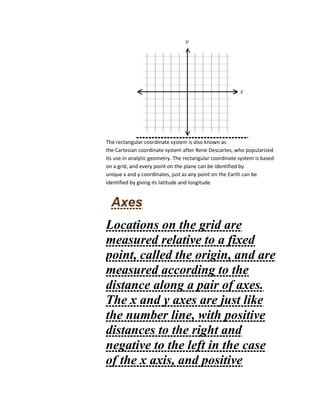
The rectangular coordinate system is also known as
the Cartesian coordinate system after Rene Descartes, who popularized
its use in analytic geometry. The rectangular coordinate system is based
on a grid, and every point on the plane can be identified by
unique x and y coordinates, just as any point on the Earth can be
identified by giving its latitude and longitude.
Axes
Locations on the grid are
measured relative to a fixed
point, called the origin, and are
measured according to the
distance along a pair of axes.
The x and y axes are just like
the number line, with positive
distances to the right and
negative to the left in the case
of the x axis, and positive
distances measured upwards
and negative down for
the y axis. Any displacement
away from the origin can be
constructed by moving a
specified distance in
the x direction and then
another distance in
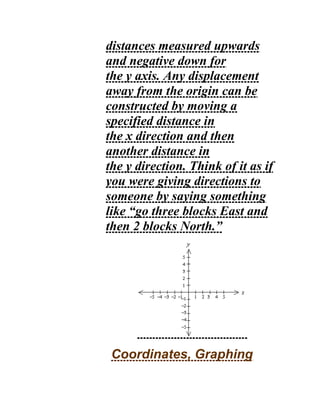
the y direction. Think of it as if
you were giving directions to
someone by saying something
like “go three blocks East and
then 2 blocks North.”
Coordinates, Graphing
Points
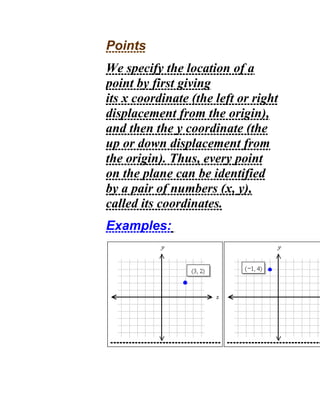
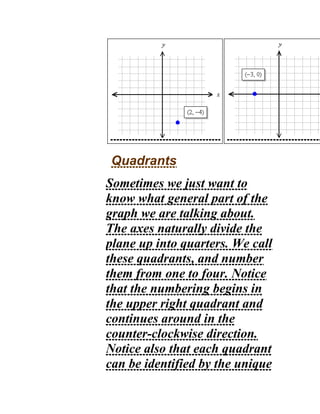
We specify the location of a
point by first giving
its x coordinate (the left or right
displacement from the origin),
and then the y coordinate (the
up or down displacement from
the origin). Thus, every point
on the plane can be identified
by a pair of numbers (x, y),
called its coordinates.
Examples:
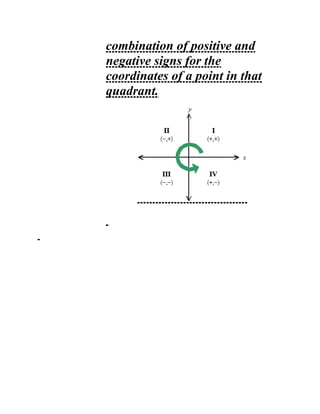
Quadrants
Sometimes we just want to
know what general part of the
graph we are talking about.
The axes naturally divide the
plane up into quarters. We call
these quadrants, and number
them from one to four. Notice
that the numbering begins in
the upper right quadrant and
continues around in the
counter-clockwise direction.
Notice also that each quadrant
can be identified by the unique
combination of positive and
negative signs for the
coordinates of a point in that
quadrant.

Cartesian coordinates

  • 1.
    Cartesian Coordinates Cartesian coordinatescan be used to pinpoint where you are on a map or graph. Cartesian Coordinates Using Cartesian Coordinates you mark a point on a graph by how far along and how far up it is: The point (12,5) is 12 units along, and 5 units up. X and Y Axis The left-right (horizontal) direction is commonly called X. The up-down (vertical) direction is commonly called Y.
  • 2.
    Put them togetheron a graph ... ... and you are ready to go Where they cross over is the "0" point, you measure everything from there.  The X Axis runs horizontally through zero  The Y Axis runs vertically through zero Axis: The reference line from which distances are measured. The plural of Axis is Axes, and is pronounced ax-eez Example: Point (6,4) is 6 units across (in the x direction), and 4 units up (in the y direction) So (6,4) means: Go along 6 and then go up 4 then "plot the dot". And you can remember which axis is which by:x is A CROSS, so x is ACROSS the page.
  • 3.
    Play With It! Now would be a good time to play with Interactive Cartesian Coordinates to see for yourself how it all works. Like 2 Number Lines Put Together It is like we put two Number Lines together, one going left-right, and the other going up-down. Direction As x increases, the point moves further right. When x decreases, the point moves further to the left.
  • 4.
    As y increases,the point moves further up. When y decreases, the point moves further down. Writing Coordinates The coordinates are always written in a certain order:  the horizontal distance first,  then the vertical distance. This is called an "ordered pair" (a pair of numbers in a special order) And usually the numbers are separated by a comma, and parentheses are put around the whole thing like this: (3,2) Example: (3,2) means 3 units to the right, and 2 units up Example: (0,5) means 0 units to the right, and 5 units up. In other words, only 5 units up. The Origin The point (0,0) is given the special name "The Origin", and is sometimes given the letter "O". Abscissa and Ordinate You may hear the words "Abscissa" and "Ordinate" ... they are just the x and y values:
  • 5.
     Abscissa: thehorizontal ("x") value in a pair of coordinates: how far along the point is  Ordinate: the vertical ("y") value in a pair of coordinates: how far up or down the point is What About Negative Values of X and Y? Just like with the Number Line, you can also have negative values. Negative: start at zero and head in the opposite direction:  Negative x goes to the left  Negative y goes down So, for a negative number:  go backwards for x  go down for y For example (-6,4) means: go back along the x axis 6 then go up 4. And (-6,-4) means: go back along the x axis 6 then go down 4.
  • 6.
    Four Quadrants When weinclude negative values, the x and y axes divide the space up into 4 pieces: Quadrants I, II, III and IV (They are numbered in a counterclockwise direction) In Quadrant I both x and y are positive, but ...  in Quadrant II x is negative (y is still positive),  in Quadrant III both x and y are negative, and  in Quadrant IV x is positive again, while y is negative. Like this:
  • 7.
    Quadra nt X (horizonta l) Y (vertica l) Exampl e I Positive Positive(3,2) II Negative Positive III Negative Negativ e (-2,-1) IV Positive Negativ e Example: The point "A" (3,2) is 3 units along, and 2 units up. Both x and y are positive, so that point is in "Quadrant I" Example: The point "C" (-2,-1) is 2 units along in the negative direction, and 1 unit down (i.e. negative direction). Both x and y are negative, so that point is in "Quadrant III" Note: The word Quadrant comes form quad meaning four. For example, four babies born at one birth are called quadruplets, a four-legged animal is aquadruped. and a quadrilateral is a four-sided polygon.
  • 8.
    Dimensions: 1, 2,3 and more ... Think about this: 1 The Number Line can only go:  left-right so any position needs just one number 2 Cartesian coordinates can go:  left-right, and  up-down so any position needs two numbers 3 How do we locate a spot in the real world (such as the tip of your nose)? We need to know:  left-right,  up-down, and  forward-backward, that is three numbers, or 3 dimensions! 3 Dimensions
  • 9.
    Cartesian coordinates canbe used for locating points in 3 dimensions as in this example: Here the point (2, 4, 5) is shown in three-dimensional Cartesian coordinates. In fact, this idea can be continued into four dimensions and more - I just can't work out how to illustrate that for you! RECTANGULAR COORDINATES
  • 10.
    The rectangular coordinatesystem is also known as the Cartesian coordinate system after Rene Descartes, who popularized its use in analytic geometry. The rectangular coordinate system is based on a grid, and every point on the plane can be identified by unique x and y coordinates, just as any point on the Earth can be identified by giving its latitude and longitude. Axes Locations on the grid are measured relative to a fixed point, called the origin, and are measured according to the distance along a pair of axes. The x and y axes are just like the number line, with positive distances to the right and negative to the left in the case of the x axis, and positive
  • 11.
    distances measured upwards andnegative down for the y axis. Any displacement away from the origin can be constructed by moving a specified distance in the x direction and then another distance in the y direction. Think of it as if you were giving directions to someone by saying something like “go three blocks East and then 2 blocks North.” Coordinates, Graphing
  • 12.
    Points We specify thelocation of a point by first giving its x coordinate (the left or right displacement from the origin), and then the y coordinate (the up or down displacement from the origin). Thus, every point on the plane can be identified by a pair of numbers (x, y), called its coordinates. Examples:
  • 13.
    Quadrants Sometimes we justwant to know what general part of the graph we are talking about. The axes naturally divide the plane up into quarters. We call these quadrants, and number them from one to four. Notice that the numbering begins in the upper right quadrant and continues around in the counter-clockwise direction. Notice also that each quadrant can be identified by the unique
  • 14.
    combination of positiveand negative signs for the coordinates of a point in that quadrant.